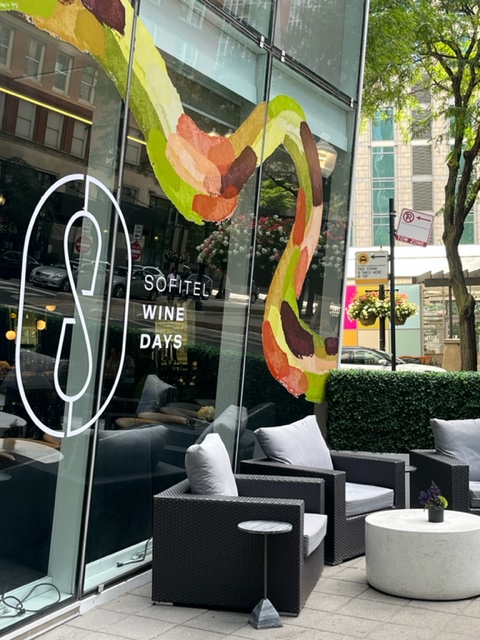
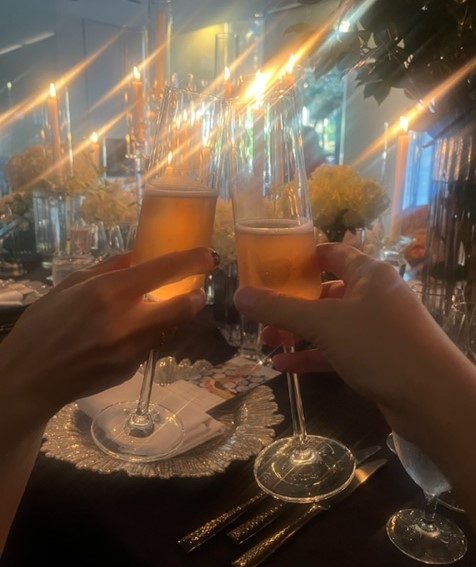
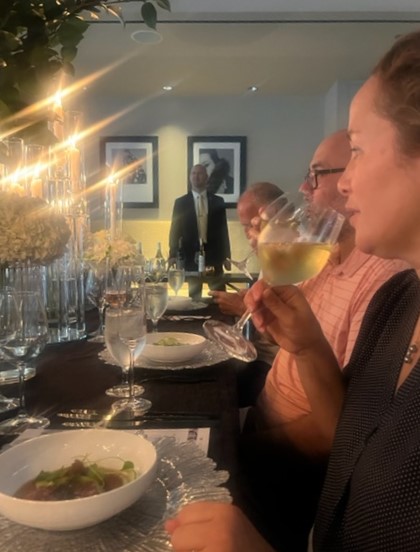
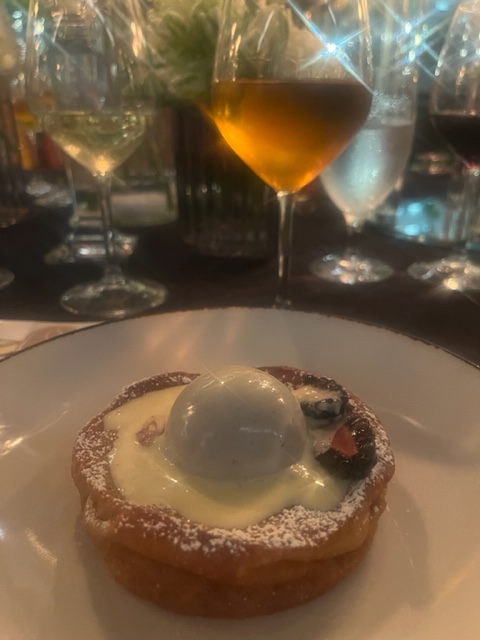
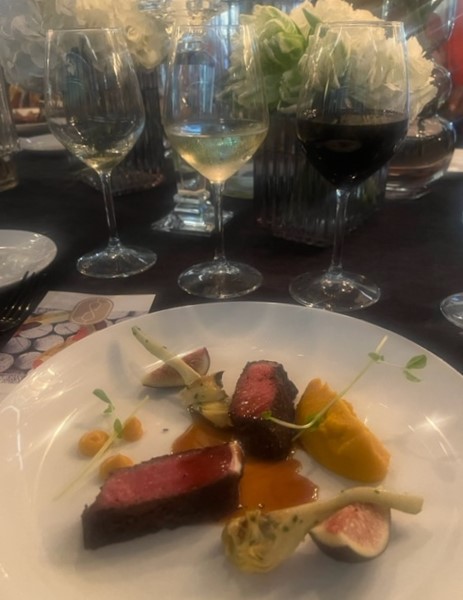
Dozens of blooming white flowers and shimmering candles in glass holders grace the center of a long dining table. Greeted with a glass of sparkling wine upon entry to the Cigale Room, Sofitel Chicago Wine Dinner guests seat themselves around the table and sip their bubbling beverages while reviewing the printed menu of culinary delights and drinks to come. The varied-height centerpieces create intimacy between clusters of conversing guests, allowing privacy within a group setting. Per French ideals, one simple joy of life is savoring food and wine that bring out the best in each other, and Sofitel Chicago is an expert in this pairing of dishes and drinks, offering fine dining experiences through its creatively curated Sofitel Wine Dinners. This series of seasonal dinners introduces guests to exquisitely prepared courses matched with wines and cocktails whose notes enhance flavors in the meal.
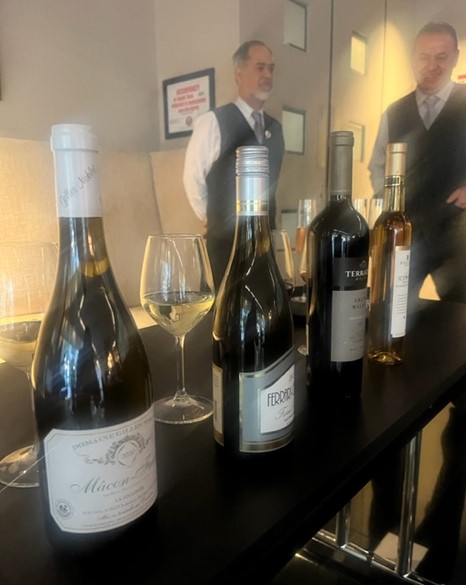
The September 2022 Sofitel Wine Days Dinner at Sofitel Chicago was prepared by Executive Chef Cliff Crawford, who crafts meals that embody Sofitel’s “Live the French Way” motto. He said, “I always strive to have a noticeable French influence in the menus. It can be ingredients used, such as cheeses or pâtes, or could be a modern take on French classics.” Per this ideal, the September dinner’s first course was a beautifully plated French-style tuna tartare alongside cucumber mousse and delicate cucumber curls, ponzu onion, and topped with a marquise-shaped scoop of paddlefish caviar. This flavorful delicacy was accompanied by a generous pour of golden Domaine Gilles Noblet Mâcon-Fuissé from vineyards in Mâconnais, Burgundy, France.
Sofitel Chicago began hosting these wine dinners in late 2021, and a gourmet dinner is scheduled for each of the remaining three months of 2022. The dining room’s exquisite décor changes based on the time of year, as does Chef Crawford’s menu planning. “It is really just about the season and the ingredients that are best at that time of year. It mostly revolves around produce. Wild mushrooms, for example, are one of my favorites. I love to have morels in the spring and black trumpets in the winter,” Crawford said.
The Fall Harvest Wine Dinner on October 7will feature wines from France, Italy, and the USA, alongside seasonal spreads. The November 11 Winter Whiskey Dinnerwill serve an exclusive Maker’s Mark bourbon mixed into cocktails, in lieu of wine. The December 9 Art de Noel Dinner will feature holiday décor and include festive cocktails to compliment the meal.
Regarding guests at these luxurious dinner experiences, Chef Crawford said, “I would like to see them leave with plans to return. I feel we are a bit of a ‘hidden gem’ here in downtown Chicago; we are a great location, but not everyone has heard of us. I want them to feel like they have found something special.” To purchase tickets for upcoming dinners at Sofitel Chicago, please visit https://www.sofitel-chicago.com/dining/wine-dinner-series/. To round out the evening, a convenient and comfortable overnight stay in the posh rooms above can be booked at https://www.sofitel-chicago.com/.
The 5-star Sofitel Chicago is part of a French luxury hotel chain that embodies “living the French way” by celebrating life through a sophisticated and unique approach to luxury accommodations and hospitality. Its stylish avant-garde exterior is a preview of the interior’s chic design and atmosphere. Le Bar, the glass-walled bar and lounge on the lobby level of the hotel, is a trendy place to unwind and socialize while indulging in savory appetizers, flatbreads, main dishes, and desserts, and sipping unique libations like the Banana Old Fashioned. A combination of Bacardi 8-year, Giffard Banane Liqueur, Angostura bitters, Angostura cocoa bitters, and Demerara syrup, with a dark cherry and an orange peel garnish, one patron described this drink as “a really interesting take on an old fashioned. Not too sweet, and very banana, which was fun!”
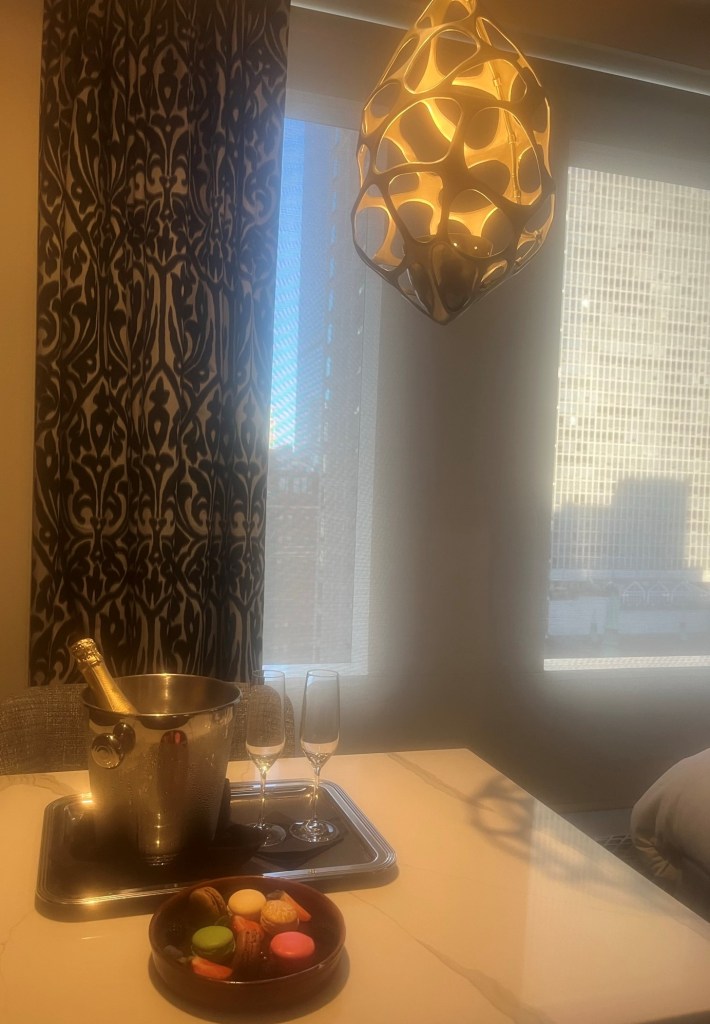
The higher floors of Sofitel Chicago offer a wide-windowed, stunning view of the bustling city below, while an easy flick of a switch lowers the blinds for privacy and comfort. In the European way, the fluffy bedding provides a warm nest in which to rest beneath a soft duvet with no need for a top sheet. Room bathrooms are supplied with bath and skin products by LANVIN Paris, a soft white robe, soaker tub, and rainfall shower. Luxurious and cozy, Sofitel Chicago provides home-away-from-home accommodations that pamper and allow for chic indulgence.
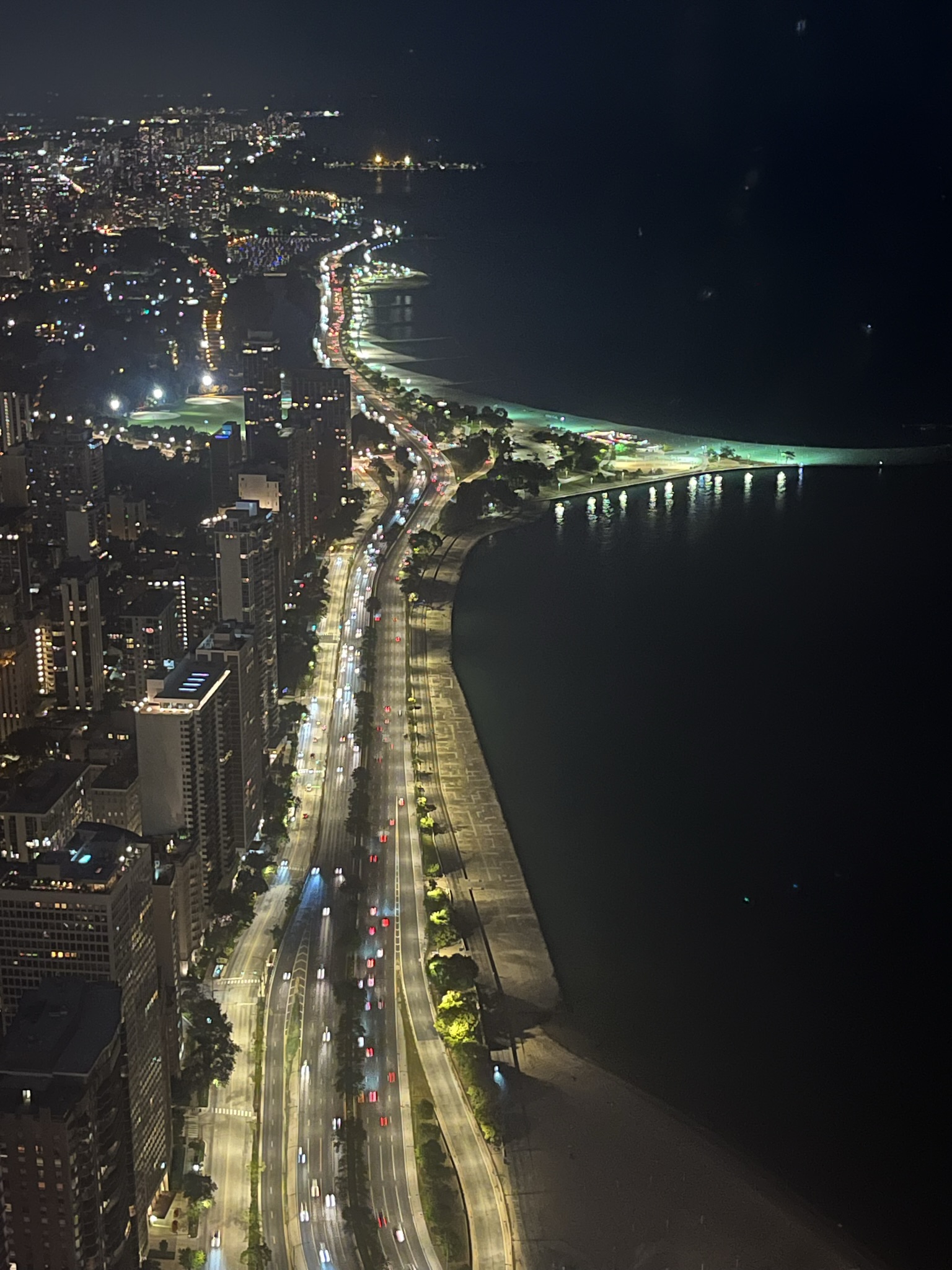
Further celebrate the art of living—l’art de vivre—and say oui to a nearby adventure that will bring the soirée to new heights. A mere five-minute walk from Sofitel Chicago, you can experience elevation to an even higher viewpoint of the city, at 360 CHICAGO, the top of the former John Hancock Center. The observation deck sits 94 floors high (1,030 feet above the Magnificent Mile) and is the home of Chicago’s highest thrill ride, TILT. To get to this height, you first stroll through an exhibition celebrating the history of Chicago and nine of its culture-rich neighborhoods. A quick 20-miles-per-hour elevator ride then lifts you to the glass-walled, 17,000-square-foot level that allows breathtaking 360-degree vistas of the city and lakefront. On a clear day, you can even see four states from this lookout deck!
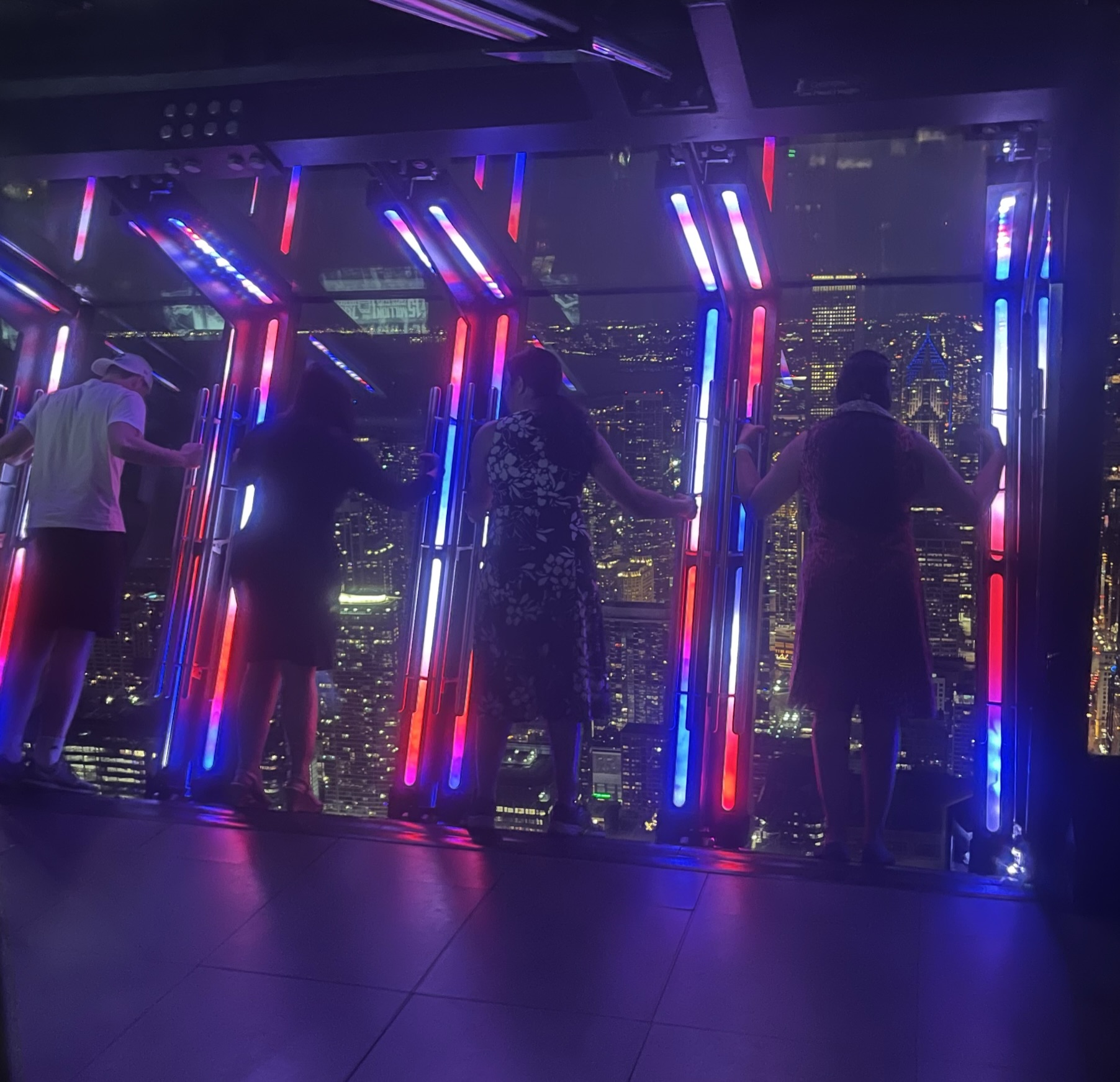
An add-on to the observation deck entry is a ticket to experience TILT, where guests 42 inches and taller can spend 2-3 minutes safely angling forward over the cityscape and peering downward through the glass window. While excited participants tightly grasp handles to their right and left sides, the glass wall is set into action in a series of motion profiles, allowing people to feel the sensation of leaning out into the sky and over the skyscrapers. Energizing music builds as the windows tilt farther and farther out at each interval, causing some people to close their eyes, some to giggle nervously, and others to shriek in terror. At night, colorful lights outline each panel separating participants. In “Extreme” mode (an experience that requires a prerequisite signing of a safety waiver), a window can even slide open for guests to enjoy further thrills and feel the city breeze. Trying out the basic mode, with its increasing angles and exhilarating music, Megan Pletzer from Madison, Wis., said, “You think it’s done, and then it just keeps going!”
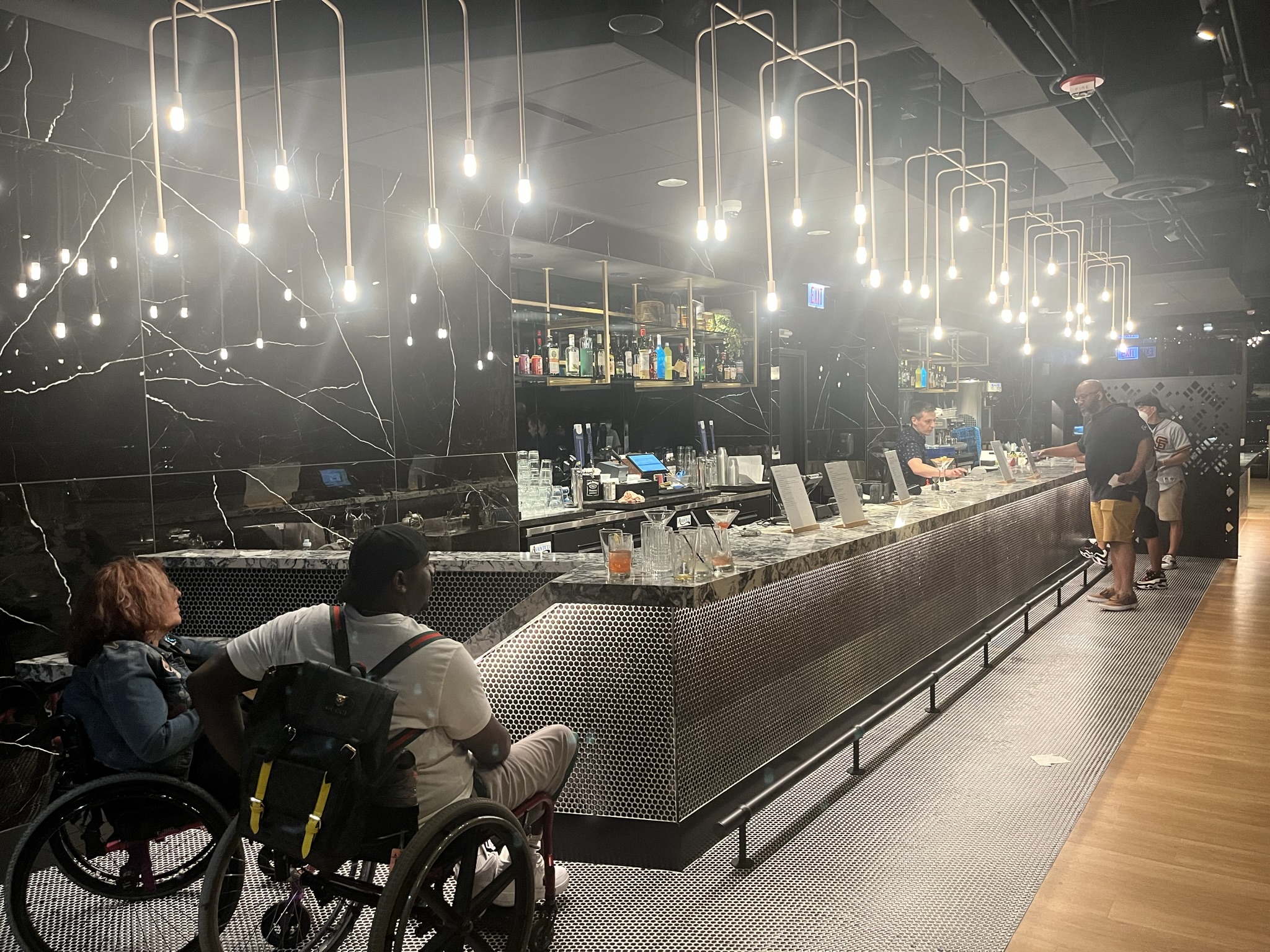
A general admission ticket to the observation deck includes entry to the brand new CloudBar, which officially opened on September 14, 2022. Owned and operated by Magnicity, a Paris-based company, 360 CHICAGO’s CloudBar is a novel, sky-high bar and lounge that magnifies the best of Chicago by featuring local food and beverage partnerships and décor by area artisans. Magnicity CEO, Alexia Vettier, said, “We want each Magnicity location to act as a true city ambassador for our guests—encouraging exploration of the vibrant neighborhoods within our cities and forging new adventures and experiences. We are thrilled to introduce our brand-new bar concept with CloudBar.”
Photos above courtesy of 360 CHICAGO.
The Gettys Group Chicago design team fashioned the area to give people the feeling of “floating in the air.” Numerous reflective surfaces (including the ceiling, drink rails, and back wall) echo the spectacular sights visible through the floor-to-ceiling windows. Modern European lounge furniture and stylish lighting coupled with customized, original graphics by Chicago-based muralist Lauren Asta emphasize the blended cultures found in the city.
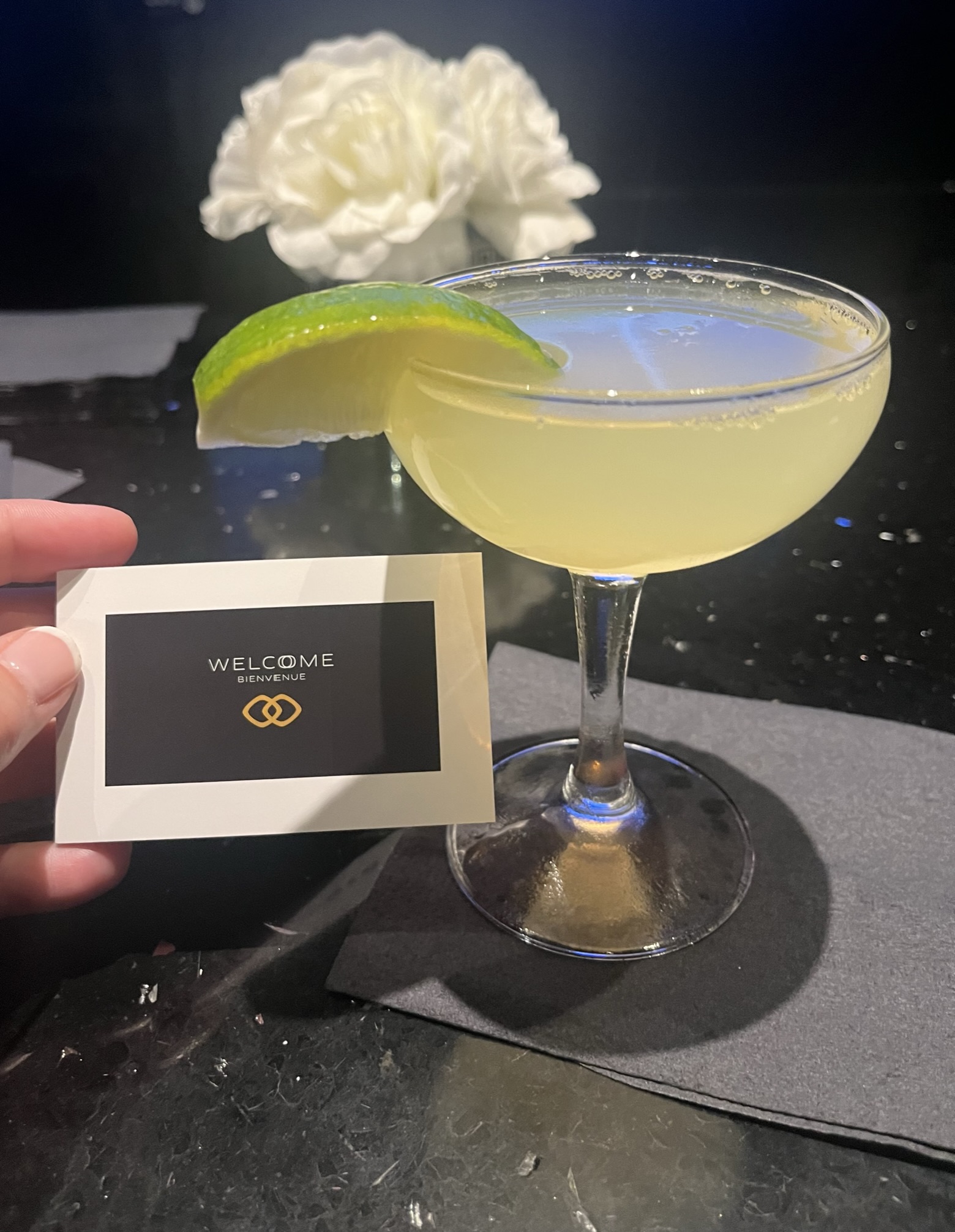
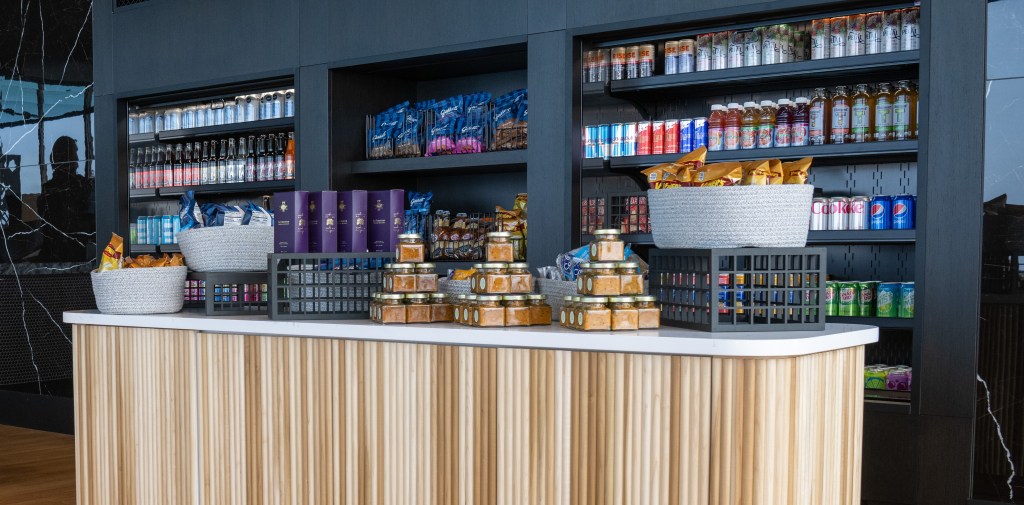
At this great height and surrounded by inspiring art and lights, you can also stimulate your sense of taste with snacks and sips from CloudBar’s offerings. The “Feeling Tilt-sy” cocktail carries on the “TILT” theme, served in a unique glass that leans to one side. Another colorful drink emits a haze of white mist from its lime-accessorized martini glass. Exclusively available at CloudBar is the Magnicity Pilsner, created by Moody Tongue brewery in partnership with 360 CHICAGO. Other true Chicago brands and products can be found at this exciting altitude, including wares from Garrett Popcorn, Vosges Haut-Chocolate, Carol’s Cookies, Kit Kat Lounge & Supper Club, and Kikwetu Coffee Company.
Photos above courtesy of 360 CHICAGO. Pictured at center above is artist Lauren Asta.
This space in the clouds is also available to be rented for private events, weddings, and parties. For information on event reservations, please visit 360chicagoevents.com. Relax at cloud level with besties and beverages, elevate your mood, and let the spectacular city views fill you with joie de vivre, the joy of living.
Straying off the beaten path in Castile-León, a region ripe for discovery
Story and Photos by Randy Mink
Does your town have a distinct look or personality? Something that really sets it apart from others?
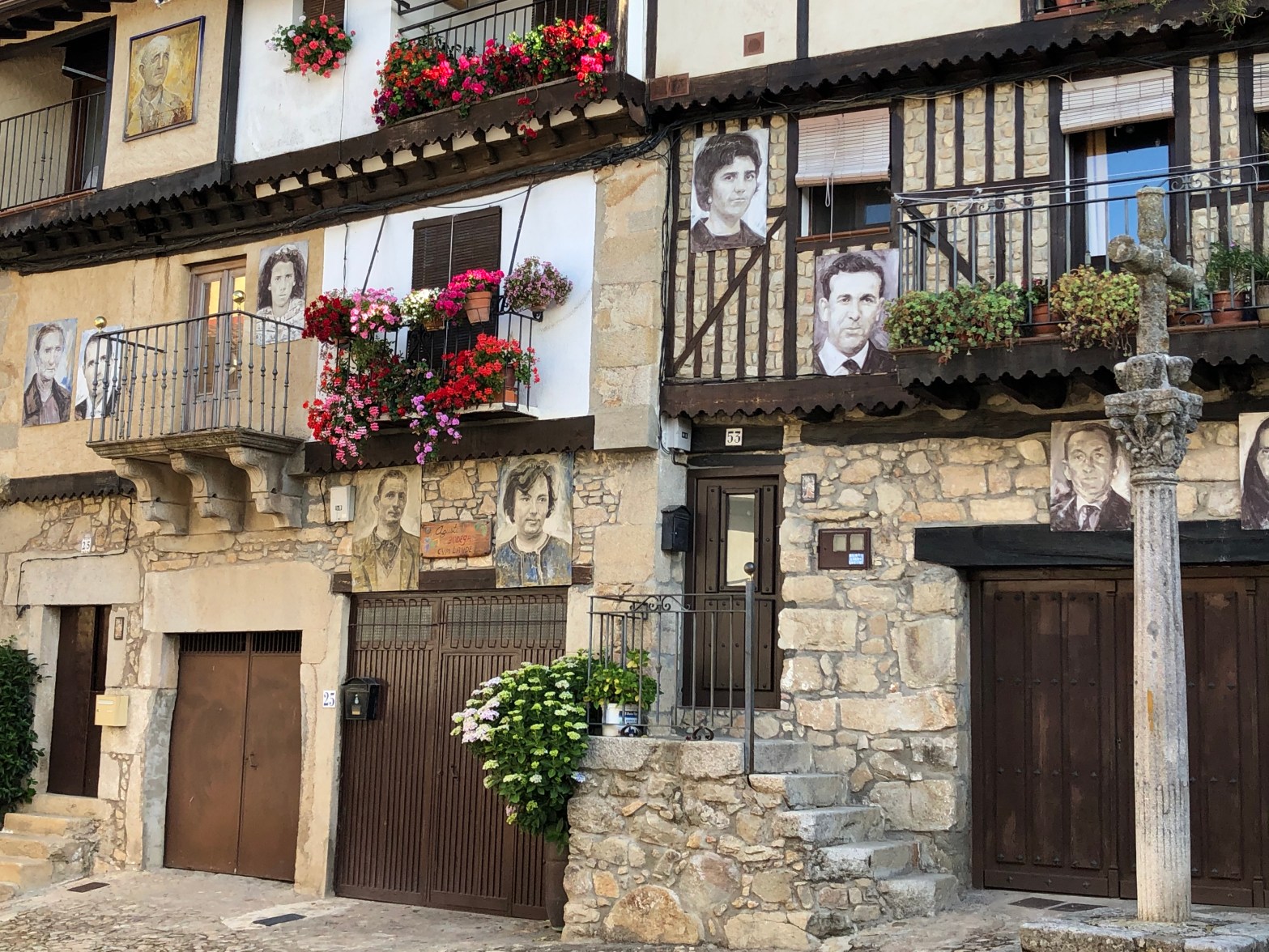
In western Spain, tiny Mogarraz (pop. 250) plasters its personality all over town, festooning houses with pictures of residents past and present. These portraits are large artworks that visitors can’t help noticing as they prowl the little plazas and narrow streets of this obscure town in the Sierra de Francia Mountains of southern Salamanca province.
Overlooked by most travel guidebooks, quirky Mogarraz was one of my favorite discoveries on a recent trip that included some under-the-radar places in Castile-León, one of Spain’s 17 autonomous regions. Our group concentrated on the region’s less-traveled western frontier, dropping in on remote rural areas, sampling three of its designated wine routes and venturing as far as the Portugal border.
This was my first trip overseas in three years, so I was more than revved up. Like a lot of Americans whose international travel plans were stifled by the pandemic, I had been itching to travel abroad. What a joy it was to be in Europe again! Each day was a revelation, a real adventure delving into art history, gastronomy, wine and everything that gets me psyched about Spain. Talk about pent-up wanderlust. The week-long trip provided a much-needed boost indeed.
Castile-León, situated west and north of Madrid, makes up about 20 percent of Spain’s total area but is only its sixth largest region in population (2½ million). Consisting of nine provinces, the vast chunk of real estate is slightly bigger than Portugal. Castile-León claims nine of Spain’s 34 wine routes and counts more than 400 wineries. It boasts three UNESCO World Heritage Sites—Salamanca (which our group visited), Segovia and Ávila.
The quaint medieval village of Mogarraz, on the Sierra de Francia Wine Route, would be a delightful destination if just for the enchanting cobblestone lanes that snake past its stone and half-timbered houses, many with flower-filled balconies. But portraits of the people who live in these ancient buildings add a strange twist.
The novel art project began in the 1960s, when poverty in the area drove many residents to seek jobs in South America, for which they needed a photo ID card. These IDs inspired the idea of decorating houses with photographs of the adults who lived in them. In 2012, local artist Florencio Maíllo took over the project and today he paints each of the 300-some portraits, from wizened grandmothers to young men in military caps.
Mogarraz, a tiny village in the Sierra de Francia Mountains of Salamanca province, is known for the portraits of residents that adorn its houses. These sketches of townspeople give the streets a personality all their own.
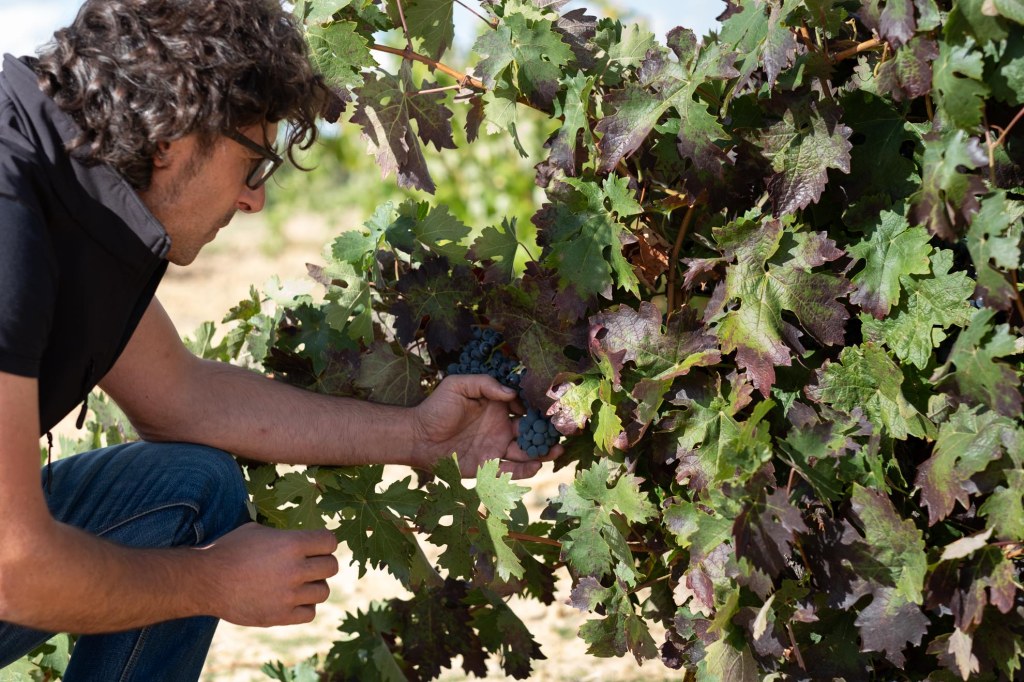
Mogarraz and other towns in this mountainous region base their economies on tourism and winemaking. The delicate, dark-skinned rufete grape is special to the Sierra de Francia area in southern Salamanca province, where vines have been tended in terraces for centuries.
Our nest for the night, Hotel Spa Villa de Mogarraz, was right in the heart of the fairy-tale town and just steps from Bodega Vinos La Zorra. Under a tent canopy on La Zorra’s streetside patio, bistro patrons savor wines and tapas at tables fashioned from colorfully painted oil drums. We noshed on croquetas (croquettes), those addictive deep-fried balls of mushy goodness, and patatas meneás, mashed sweet potatoes flavored with garlic and paprika and topped with a pork rind.
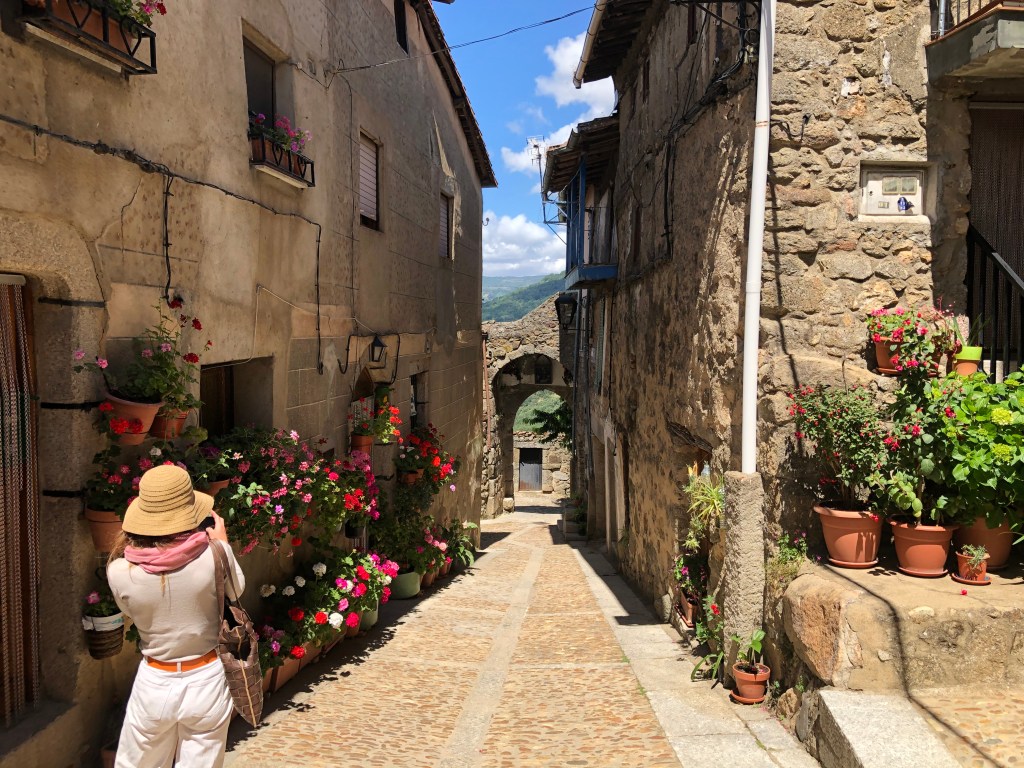
Our group also went back in time in Miranda del Castañar, another gem on the Sierra de Francia Wine Route. With a guide we wandered the cobbled streets and took in forested panoramas from the 12th century walls of the pretty hilltop village. The medieval castle is now a brewery.
The medieval streets of Miranda del Castañar invite tourists to explore.
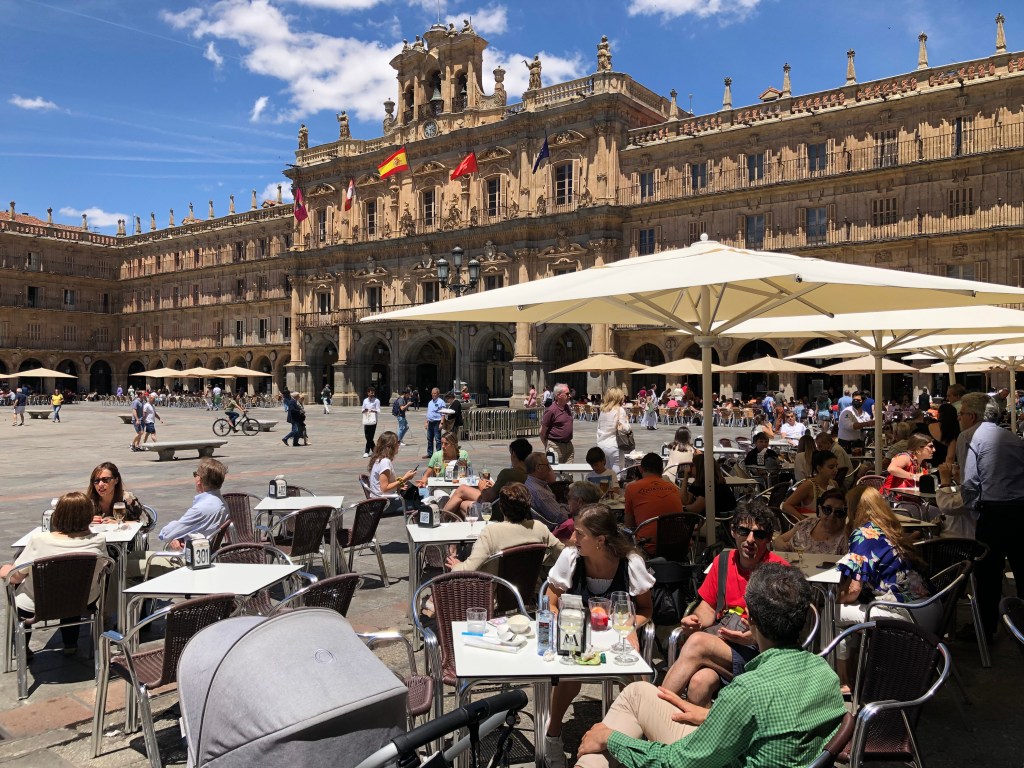
The city of Salamanca, unlike sleepy Mogarraz and Miranda del Castañar, is rather well known as a visitor destination, its historical core centering on the venerable buildings of Spain’s oldest university, founded in 1218. With a magnificent central plaza, lively pedestrian streets and youthful vibe, the manageable, medium-sized city of 150,000 residents offers just the right ingredients for a pleasant day or two of seeing the sights and soaking in the ambience. To me, it’s Spain in a nutshell.
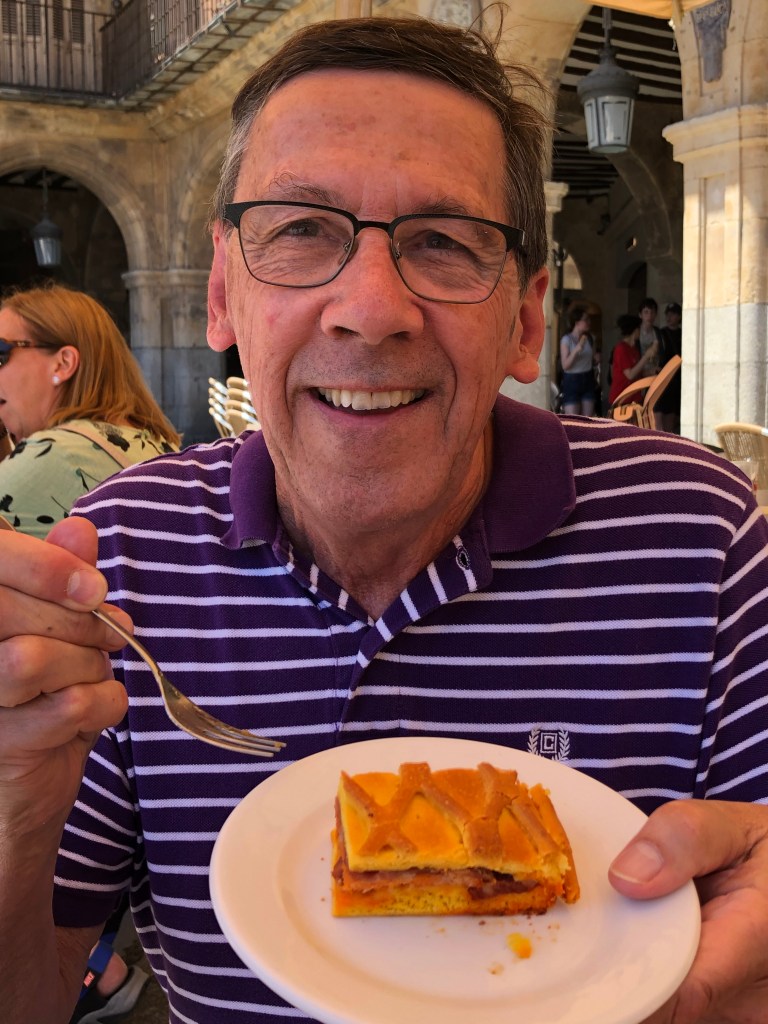
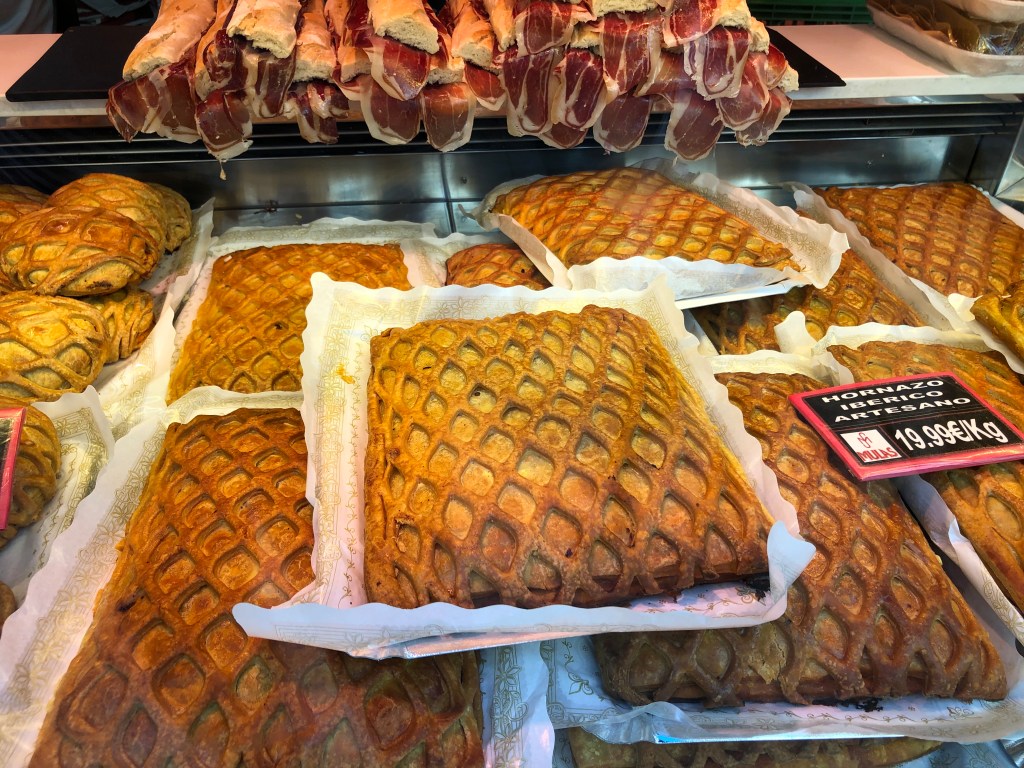
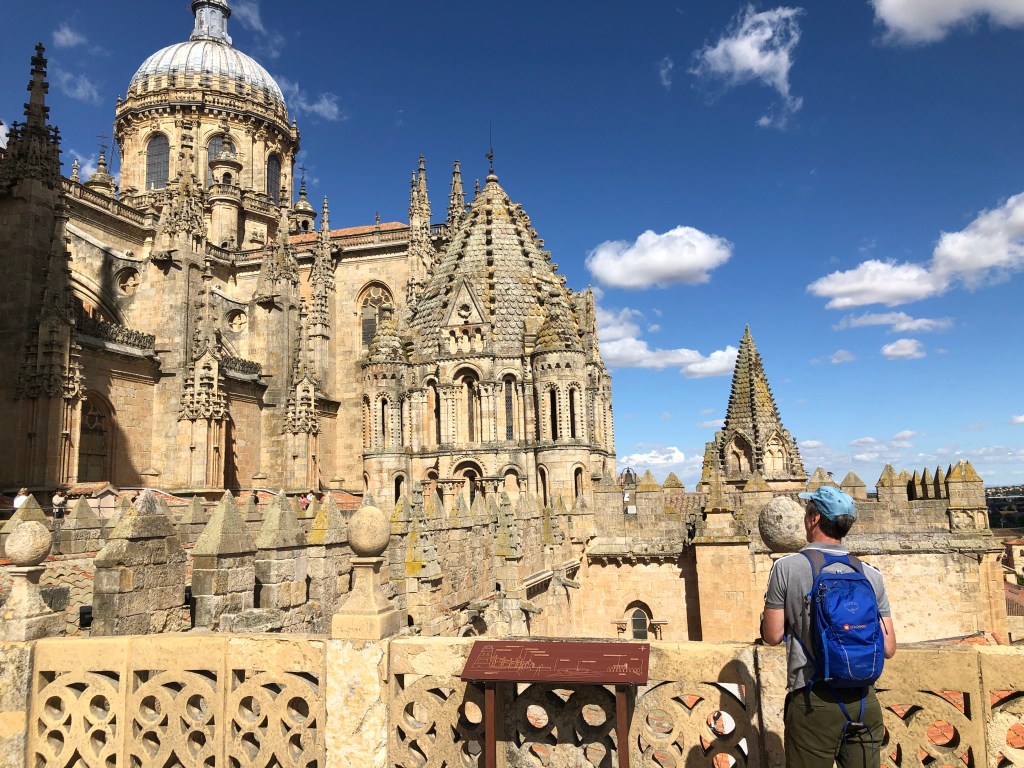
Clockwise from upper left: Relaxing and people-watching on Salamanca’s Plaza Major, one of Spain’s largest and most beautiful squares; The best views of Salamanca’s Old World skyline are from the banks of the River Tormes and its Roman bridge; The author enjoys a hornazo meat pie at a café on Salamanca’s Plaza Major; Hornazo, a meat pie with layers of pork chorizo, pork loin and ham wrapped in lattice-crusted yellow dough, is a specialty of Salamanca province; Exploring Salamanca’s Old and New Cathedrals.
In Salamanca’s Old Town, an open-air museum of radiant sandstone buildings, prime attractions lie within walking distance of each other. I recommend these five experiences:
Touring the Old and New Cathedrals. Built centuries apart, they are attached; you can’t visit the 13th century Romanesque church (Cathedral of Santa Maria) without going through the Cathedral of La Asunción de la Virgen, or New Cathedral, which isn’t new at all. It was built hundreds of years ago in the Gothic, Renaissance and Baroque styles.
Ascending the “Stairway to Heaven” on a 200-step climb up La Clerecía Church’s bell towers for bird’s-eye views of Old Town. The colossal Baroque building, now Pontificia University, began life in 1617 as a training school for Jesuit missionaries.
Walking across the River Tormes’ Roman-era bridge while admiring the classic Old World skyline
Touring the University of Salamanca, a popular place for American and other foreign students to study Spanish. Standing before the main building’s intricately sculpted sandstone façade, tourists try to find the “hidden” frog, said to be a symbol of good luck.
Relaxing over tapas at a café on postcard-perfect Plaza Mayor, one of the largest and most beautiful squares in Spain. Try hornazo, a meat pie with layers of pork chorizo, pork loin and ham wrapped in lattice-crusted yellow dough.
Zamora, a town of 60,000 north of Salamanca, is called the “Romanesque City.” Its 23 Romanesque churches, 10th century walls and Duero River bridge ruins provide a magical setting for communing with the past. The Cathedral of Zamora impresses with its Byzantine-style dome, richly carved choir and 15th century Flemish tapestries.
The Zamora Wine Route in Zamora and Salamanca provinces takes travelers through traditional rural landscapes of sheep pastures, hay fields, vineyards and unspoiled villages with stone houses and Romanesque churches. In Villanueva de Campeán, we did wine tastings in the barrel room and vineyards of Bodegas Viñas del Cenit, which makes Cenit Tradición, an unusual blend of red and white grapes (mostly tempranillo)—a light, refreshing wine with less alcohol. The vines have been mixed since the times of the Franciscan friars who tended them from their 15th century monastery, the ruins of which we saw in the distance. (Older locals remember when monks still inhabited the monastery.)
“They just wanted to make wine, with no worries whether it was red or white. It was just wine for them,” said Ana Belen Hernández, Cenit’s director of marketing. “Cenit Tradición is our commitment to carrying on the tradition and personality of the historic wines of this territory. It’s a wine with no recipe, a wine we think our ancestors would have made.”
Growing grapes for wine is an age-old tradition in the Castile-León region of western Spain.
Cenit’s 90-year-old vineyards are threaded by the Via de la Plata, or Silver Route, one of the 11 pilgrimage routes to the tomb of St. James in the Cathedral of Santiago de Compostela in Galicia; visitors may encounter pilgrims making the trek.
In the nearby village of Casaseca de Campeán, our group enjoyed an atmospheric wine country lunch at Café de Quintano. Deep underground, we feasted amid the rustic trappings of a vaulted, 200-year-old cellar. The hard-working servers must have made 20 trips each from the upstairs kitchen to our cozy “cave.” Besides wines, the group menu featured platters of cheeses and paper-thin slices of cured ham, chickpea soup, tuna steak in garlic sauce and Iberian pork steak with deep-fried vegetables. At dinner the previous night we had two regional specialties—roast suckling leg of lamb and Zamoran-style rice, a zesty dish with pork and paprika.
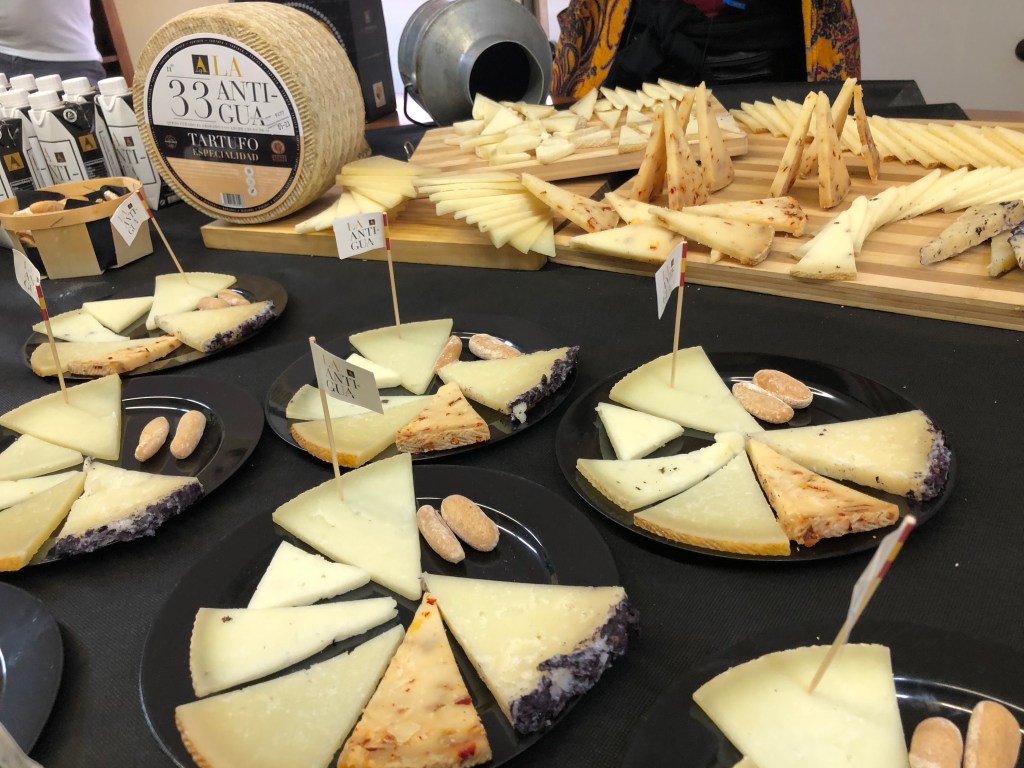
My best memory of the Zamora Wine Route was touring Quesería La Antigua, a high-tech dairy in Fuentesaúco. Donning a white plastic coat, hairnet and shoe covers, we followed guides who explained how sheep’s milk is turned into prize-winning cheeses. Afterward, we watched a video and sampled six varieties, including one with tempranillo grape skins in the rind, another flecked with paprika flakes. Under construction is a museum that will showcase La Antigua’s passion for making cheese.
Sampling the product is a highlight on tours of Quesaría La Antigua in Fuentesaúco, a dairy that makes sheep’s milk cheeses.
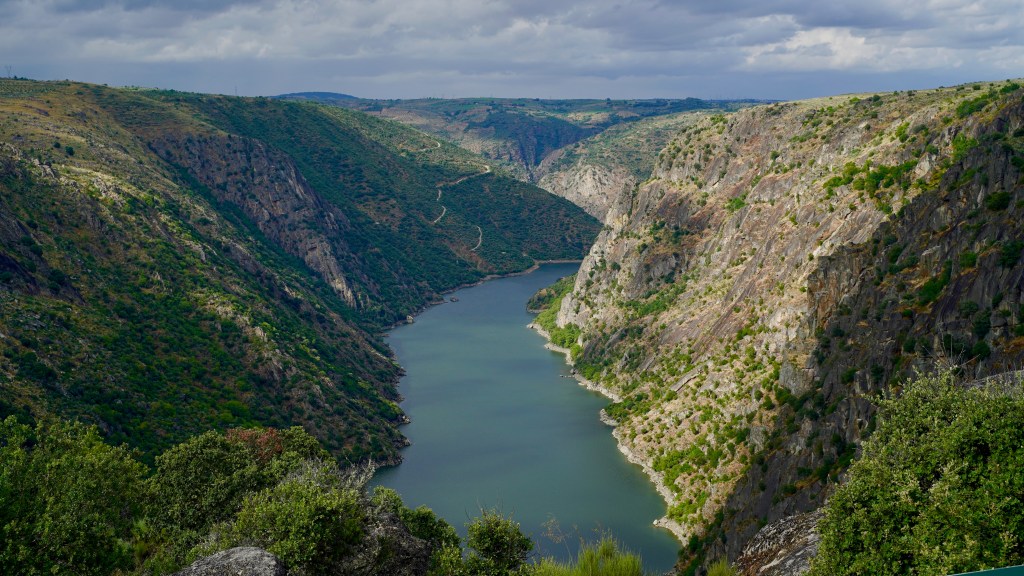
When our bus passed a shepherd tending his flock later that day, we got giddy and were granted a photo stop. We were en route to the far western stretches of Zamora and Salamanca provinces where the Douro River’s scenic canyonlands straddle the Spain-Portugal border. (“Douro” is the Portuguese spelling; it’s “Duero” in Spanish.) For Spaniards, this remote valley of granite cliffs and outcroppings is considered the “Wild West.”
Our introduction to the Arribes del Duero Wine Route, set against the backdrop of the valley’s Arribes del Duero nature park, involved vineyard and winery visits hosted by Bodega el Hato y el Garabato in tiny Formariz. Dinner and overnight were in the comfortable Posada Doña Urraca in Fermoselle, a quiet Spanish border town famous for its centuries-old network of wine caves (more than 1,000, so they say), a few of which have been opened for tourism. After our subterranean tour and wine tasting, we did more sampling at Bodega Frontio, a winery started by a young Danish entrepreneur who goes by the nicknames “Chus” and the “Crazy Dane.”
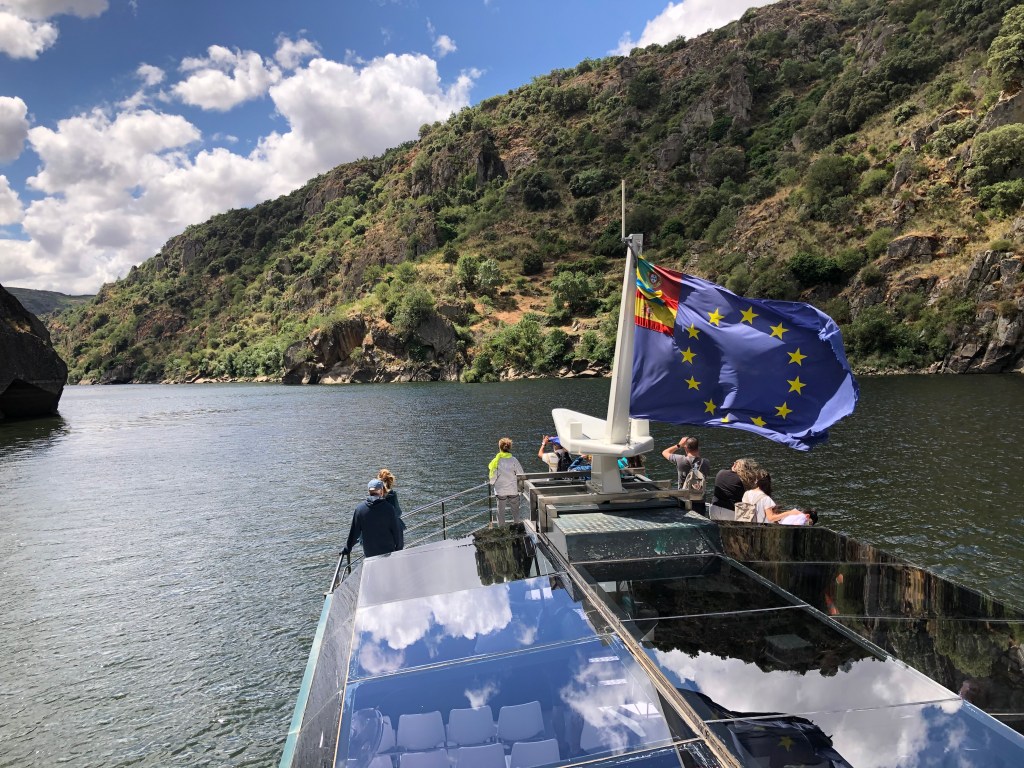
A brief foray into Portugal the next day took us to Miranda do Douro, where we boarded an excursion boat for an ecology cruise focusing on the geology, flora and fauna of the UNESCO Meseta Ibérica Biosphere Reserve. Our one-hour journey provided a chance to witness up-close the spectacular gorge topography we had viewed from a lookout point earlier that day.
Flying the flag of the European Union, this excursion boat offers a narrated environmental cruise spotlighting the geology, flora and fauna of the Douro River Valley, a land of scenic splendor on the Spain-Portugal border.
Exploring Fermoselle and other villages tucked away from the crowds, we often felt as if we had Castile-León to ourselves. On early morning strolls up and down the twisting, shadowy alleyways, sometimes the only sounds were chirping birds, crowing roosters and our own footsteps. It was good to be back in the Old Country, making new discoveries in corners of Spain off the beaten track.
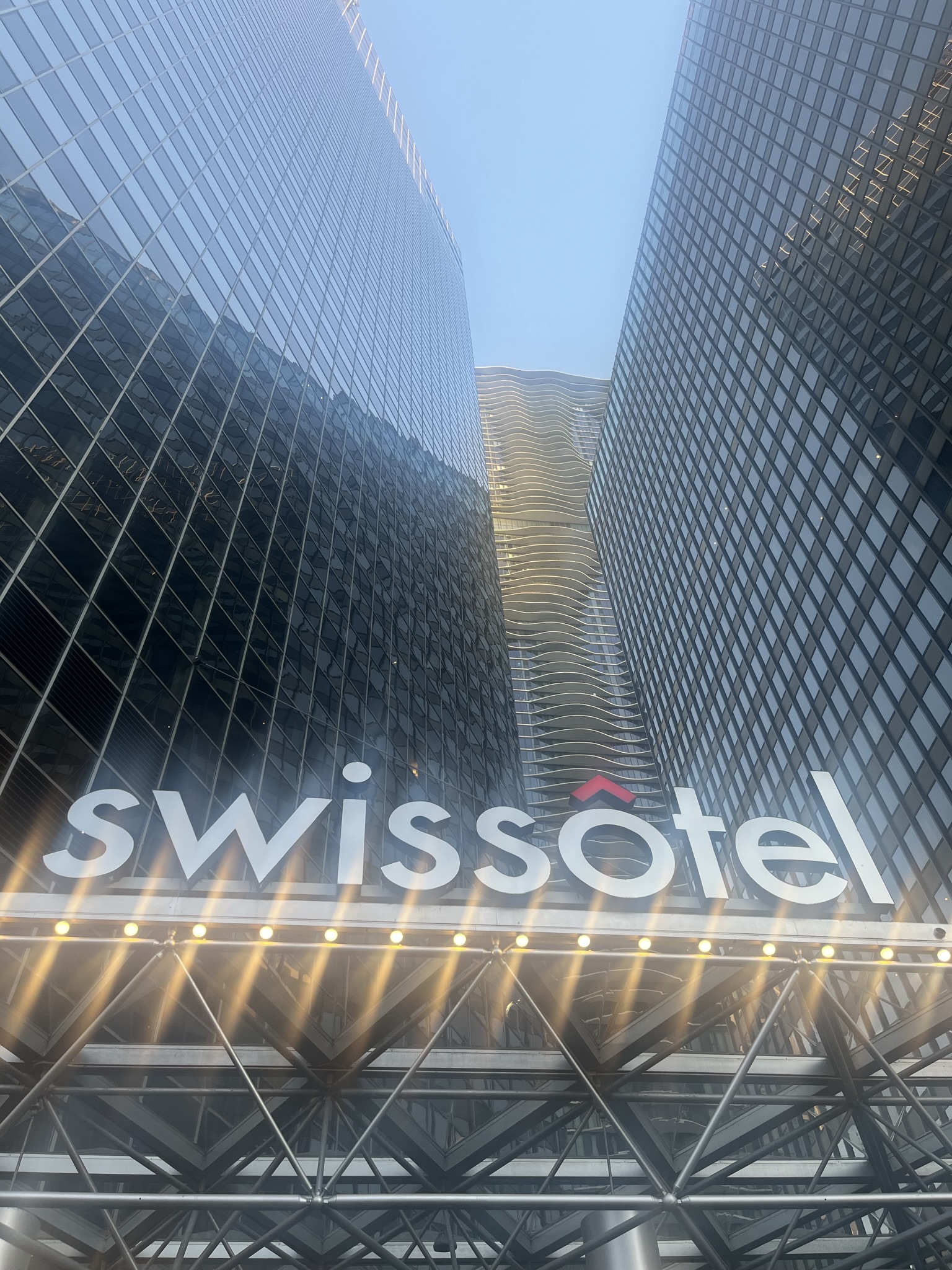
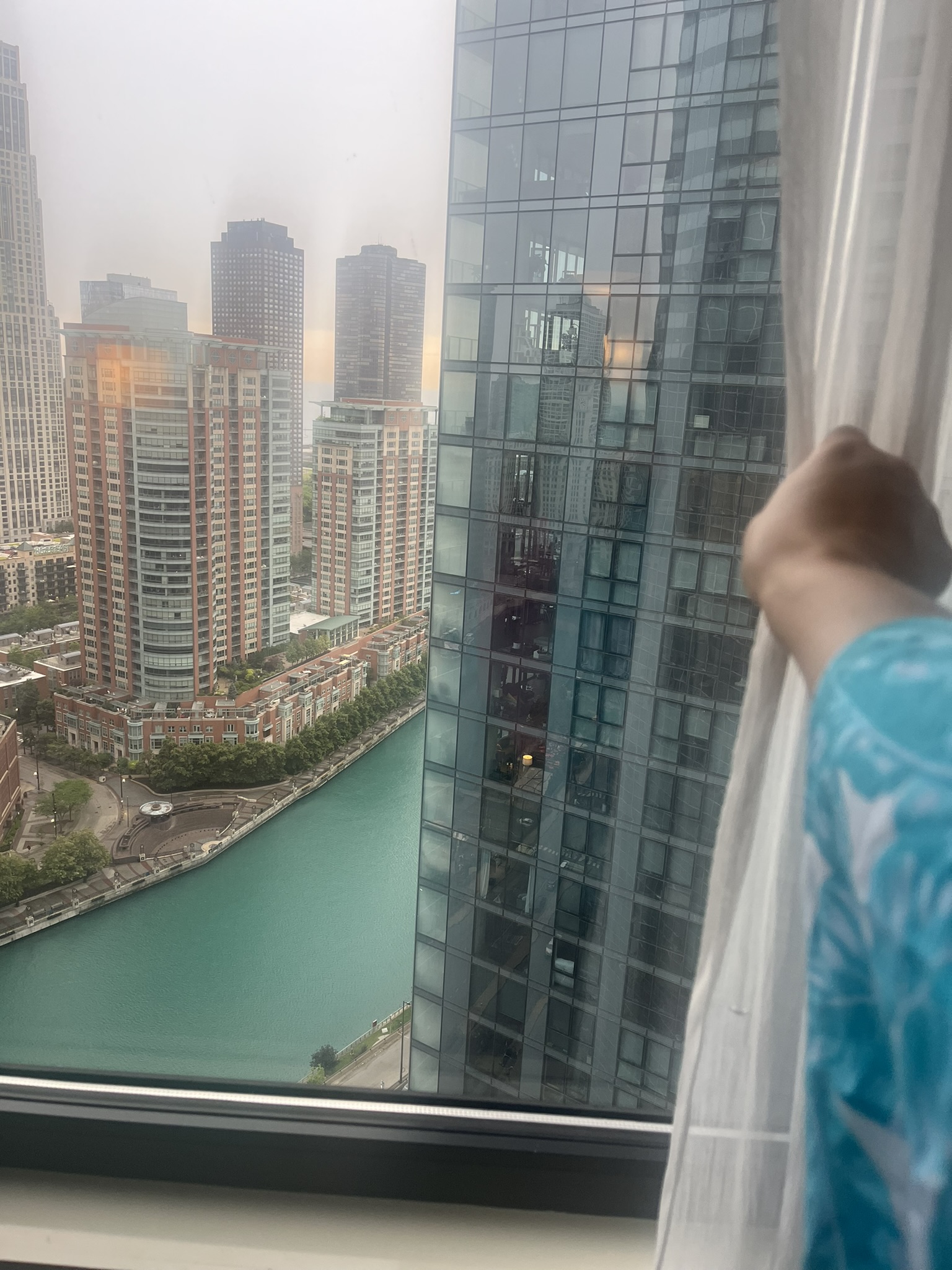
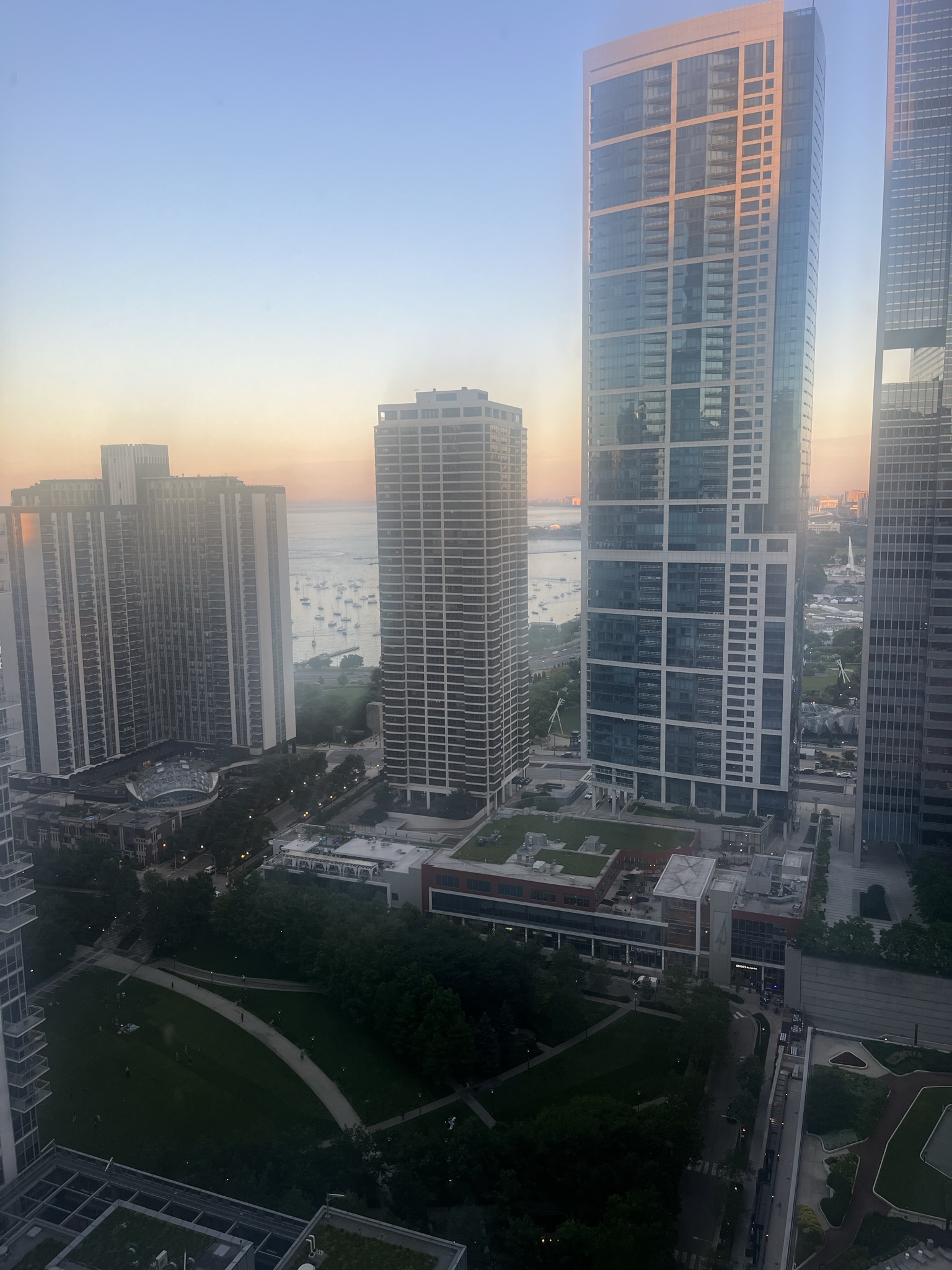
The kids’ favorite part of a weekend in Chicago? “The hotel! The hotel’s fitness center!” Weekending in downtown Chicago with small children sounds overwhelming, but a kids’ suite hotel stay and a family-friendly itinerary ensure a safe, fun, and memorable vacation. Swissôtel Chicago’s kids’ suites are like a sky-high family apartment, with a cozy master bedroom and bathroom, spacious common area and bathroom, and a separate but adjoining bedroom and bathroom for the littles. Plenty of full-wall windows provide a panorama of the Windy City, with views of Buckingham Fountain, the Chicago River, Pritzker Pavilion, Maggie Daley Park, and Navy Pier.
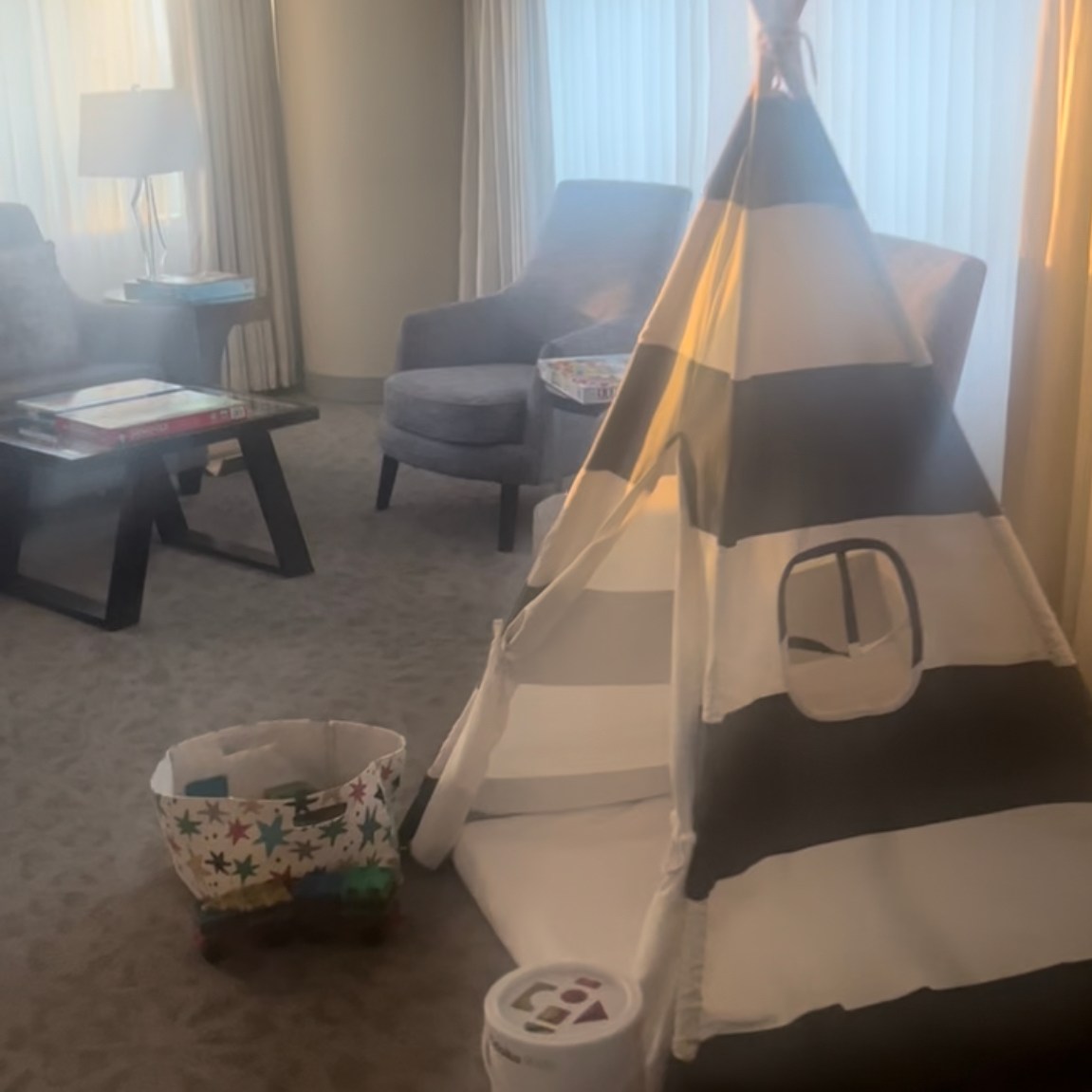
The suite’s shared rooms and kids’ wing are equipped with age-appropriate toys, games, and art supplies to engage and entertain without even needing to turn on the TV. The teepee tent provides a snug hideaway and place to house stuffed animals along for the trip. A giggle-filled game of Twister, marker doodling on fresh paper, birds’-eye boat-watching, and exercising in the huge, clean, and upscale Penthouse Fitness Center—you can enjoy the city without ever leaving Swissôtel!
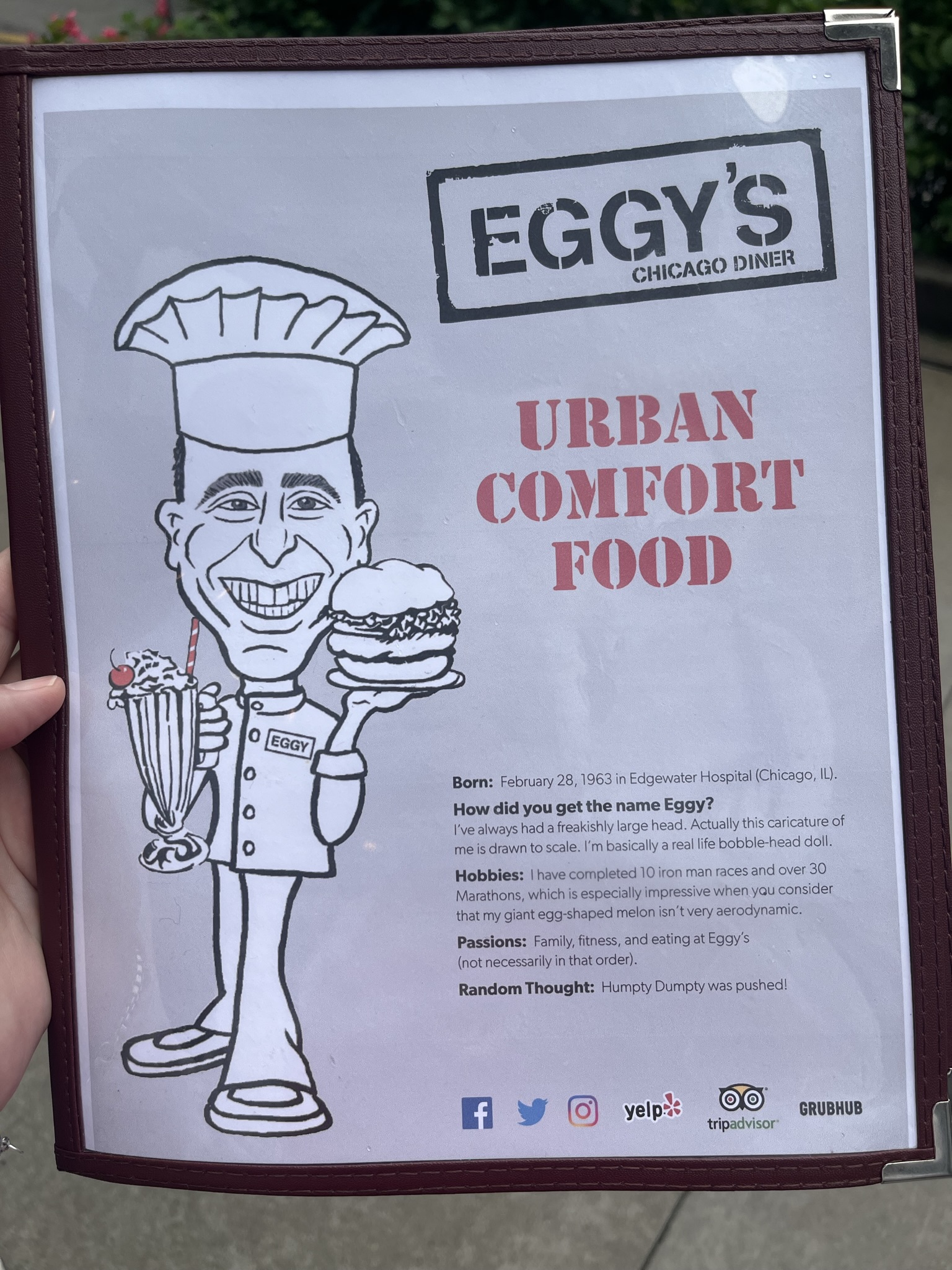
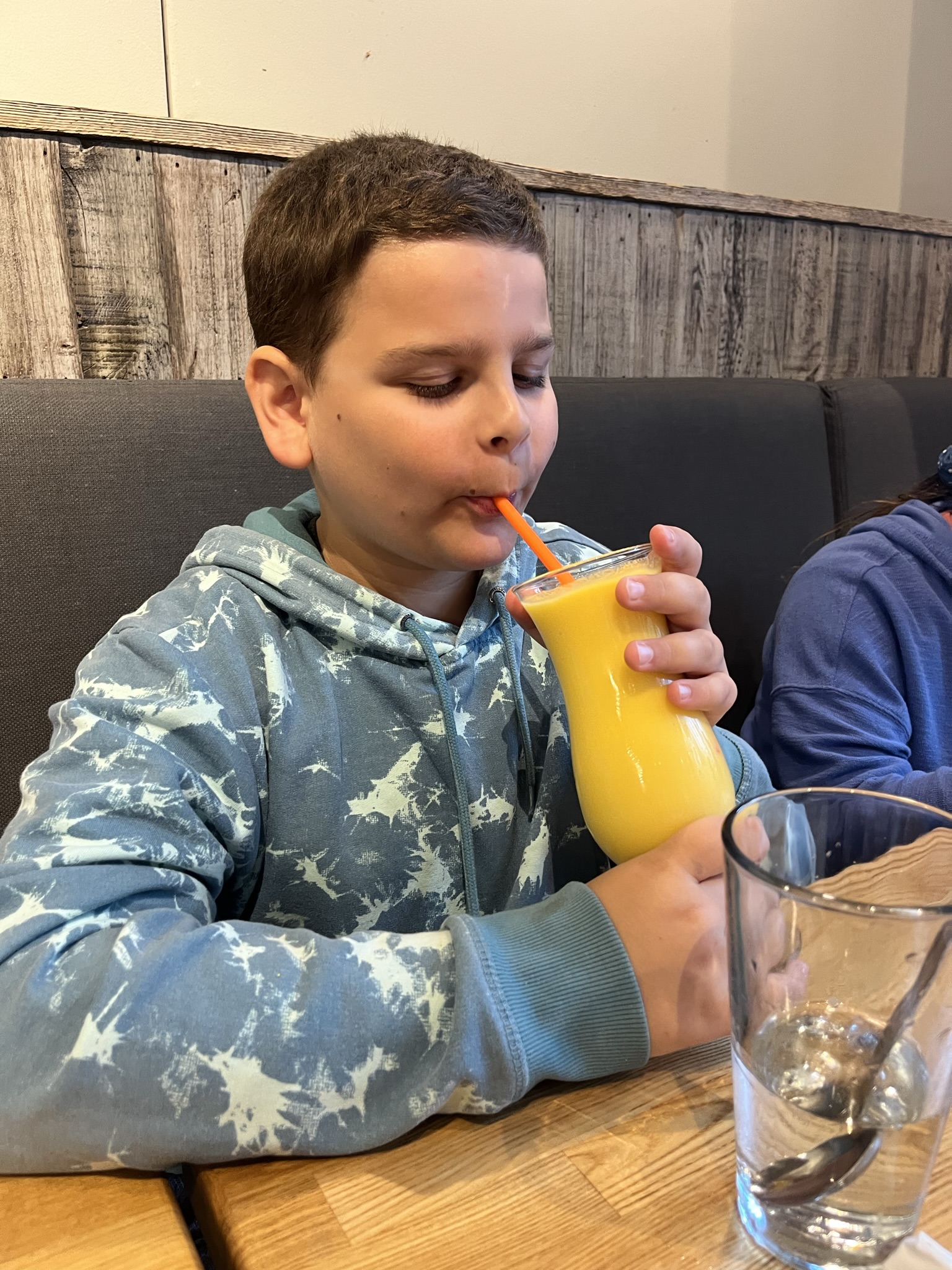
Eventually you’ll need to eat, though, and if room service isn’t your preference, you have plenty of dining options near the hotel. Eggy’s diner at the Chicago-Benton Place location is a 5-minute walk from Swissôtel across a beautifully landscaped park and serves home-cooked breakfast and lunch, coffee and tea, and bar drinks. Milkshakes, fresh-squeezed juices, smoothies, chocolate-chip pancakes, waffles, biscuits and gravy, crepes, skillets, sandwiches, and soups are among the delicious options for feeding a range of tastes. Crayons and a coloring sheet of cute food characters make waiting time seem fast.
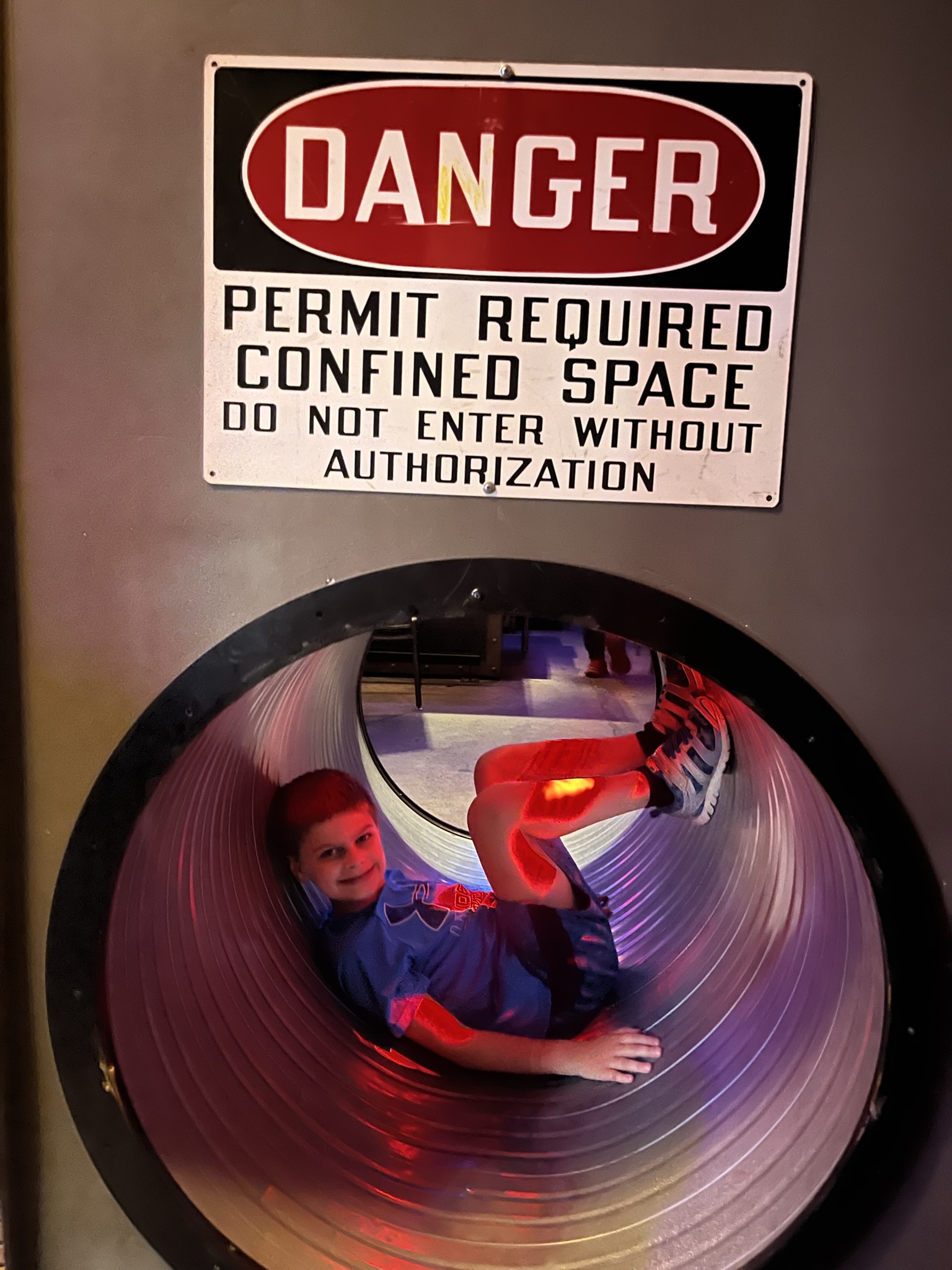
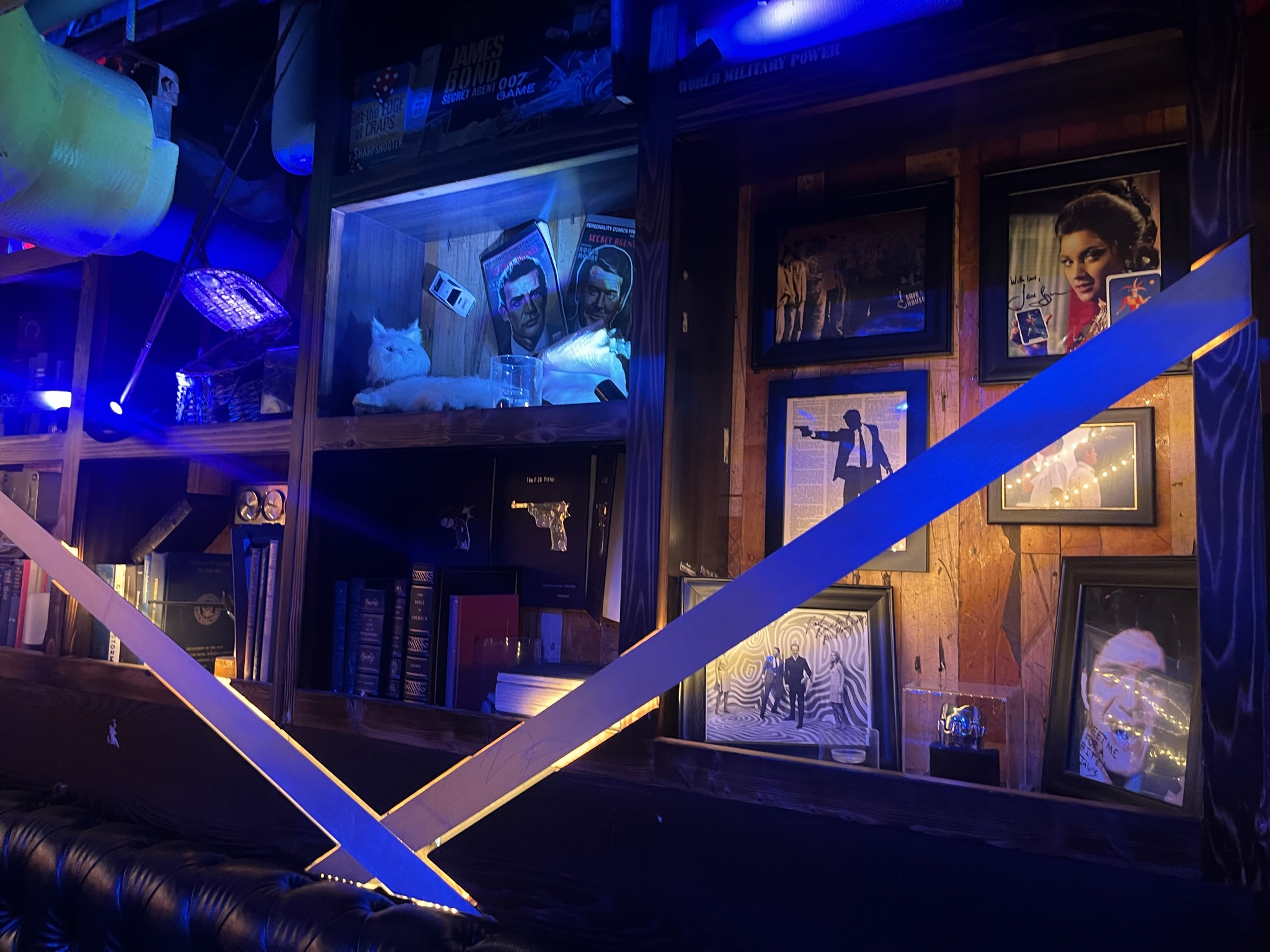
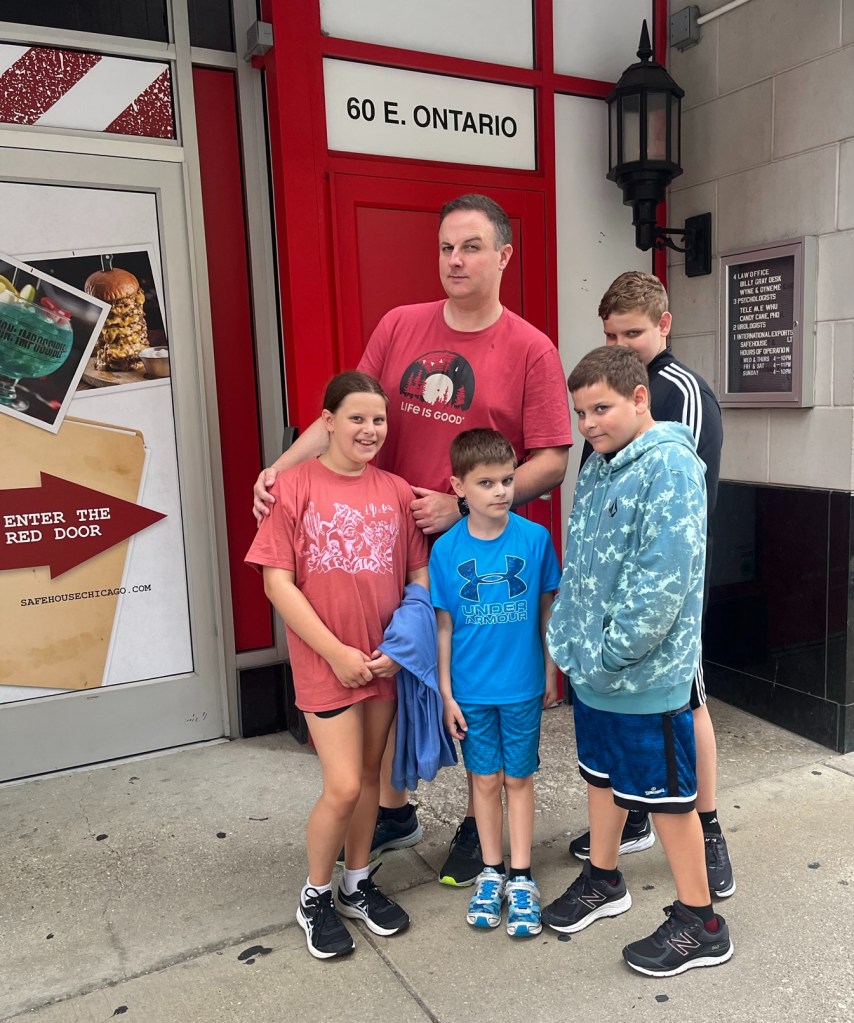
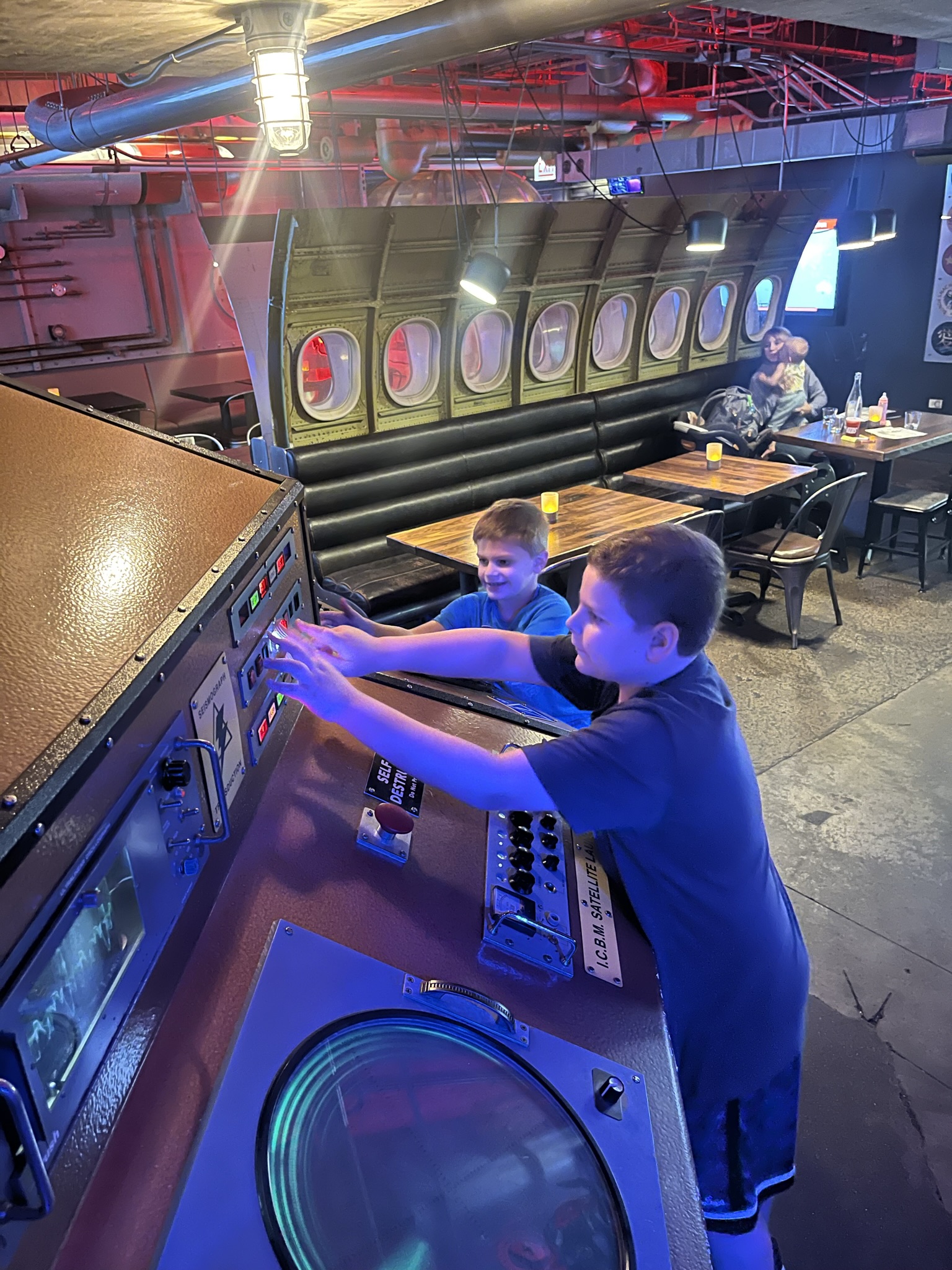
Chicago’s one-of-a-kind spy-themed dining experience at the SafeHouse is a 15-minute walk from Swissôtel down the Magnificent Mile to River North. The Red Door at 60 E. Ontario is the entry point to spy headquarters, where you start in a non-descript office and either whisper the correct password to Moneypenny, the front office “secretary,” or engage in an amusing test to gain clearance. Upon entering the underground restaurant and Interpol Bar, you can make your way through dimly lit rooms to explore spy memorabilia, discover secret rooms, complete a checklist of secret agent duties, climb through a sewer pipe labeled “DANGER,” and email goofy selfies from the photo booth.
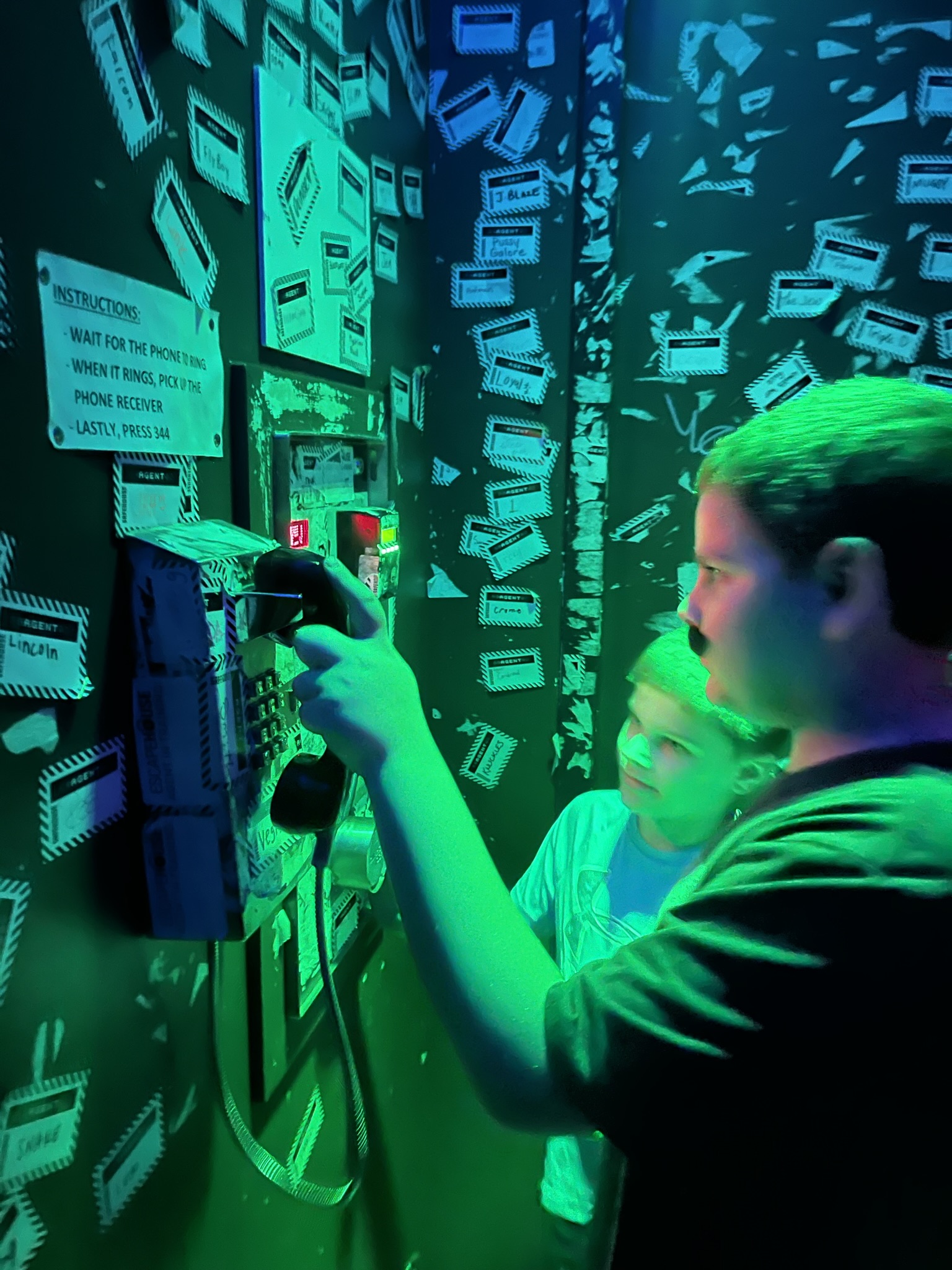
Silly surprises like one-way mirrors and alarms await in the bathrooms, and kids and adults alike can play with futuristic tech gadgets and create their own agent names. In-character waitstaff check with “Command” regarding food allergy inquiries and provide junior agents with top-secret disguises (sticky-backed fuzzy mustaches) upon request. Reasonably priced fare includes A License to Kill Mac & Cheese, “007” Layer Salad, Mission Impossible burgers, Camp Stanley Nachos, and Russian Finger Potatoes. Junior Spies can request meals like Goldfingers chicken nuggets, Carmen Cortez mac & cheese, or an Uncle Machete chopped taco salad. Make your escape by dialing a secret code in the hidden phone booth, dodge the maze of red lasers in the dark hallway, slap your agent nametag on the wall, and make your discreet exit back onto the city street.
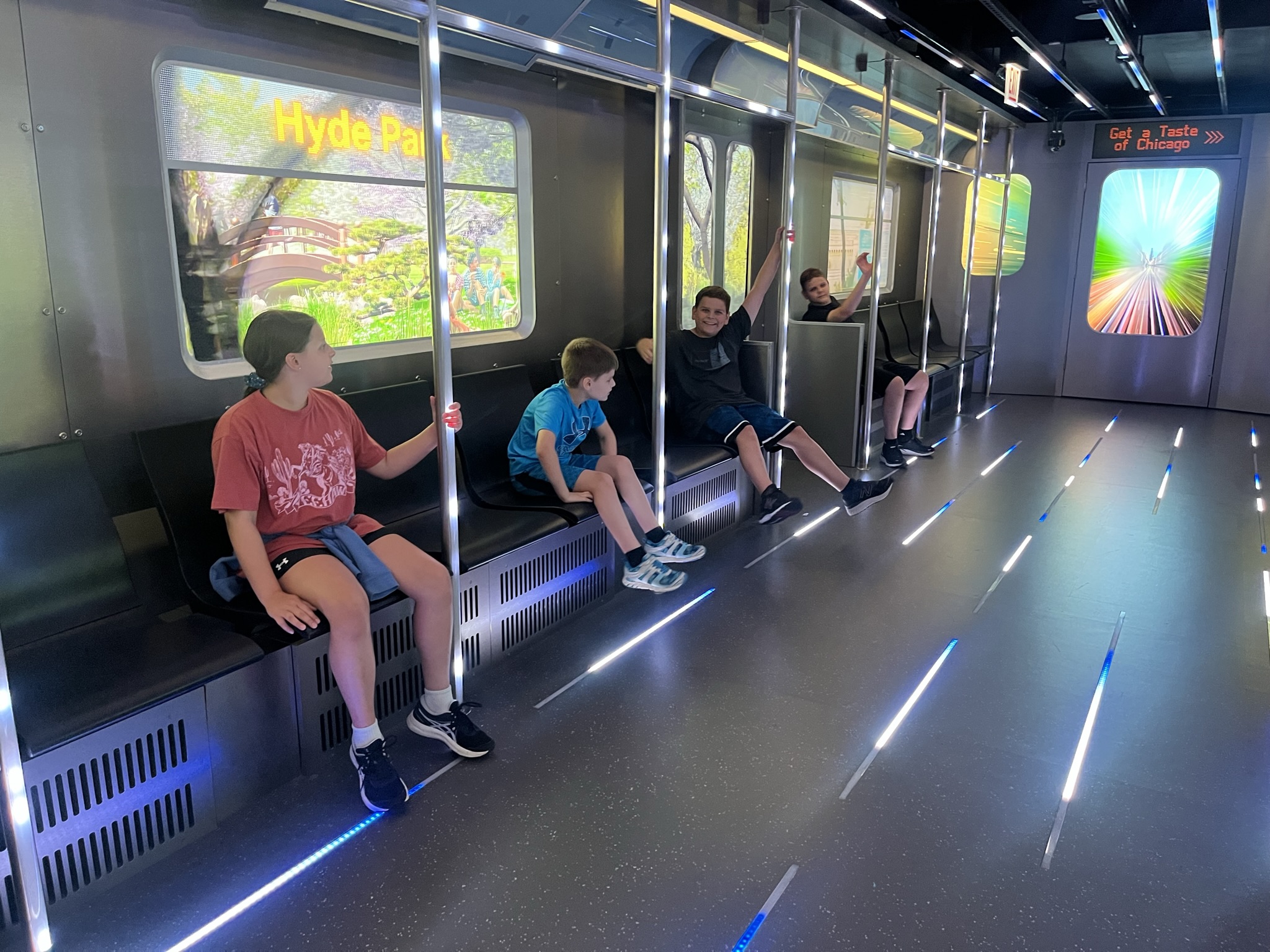
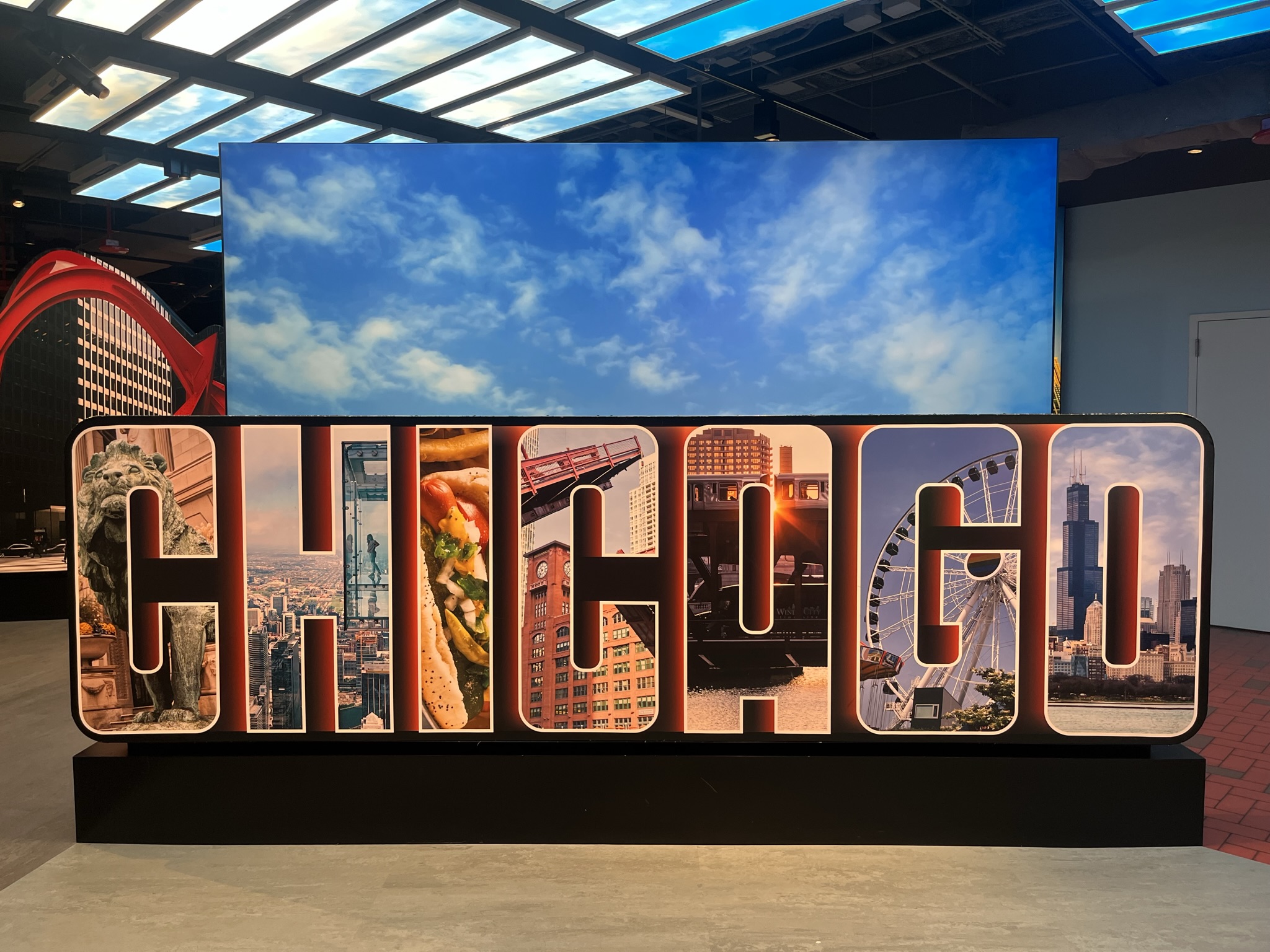
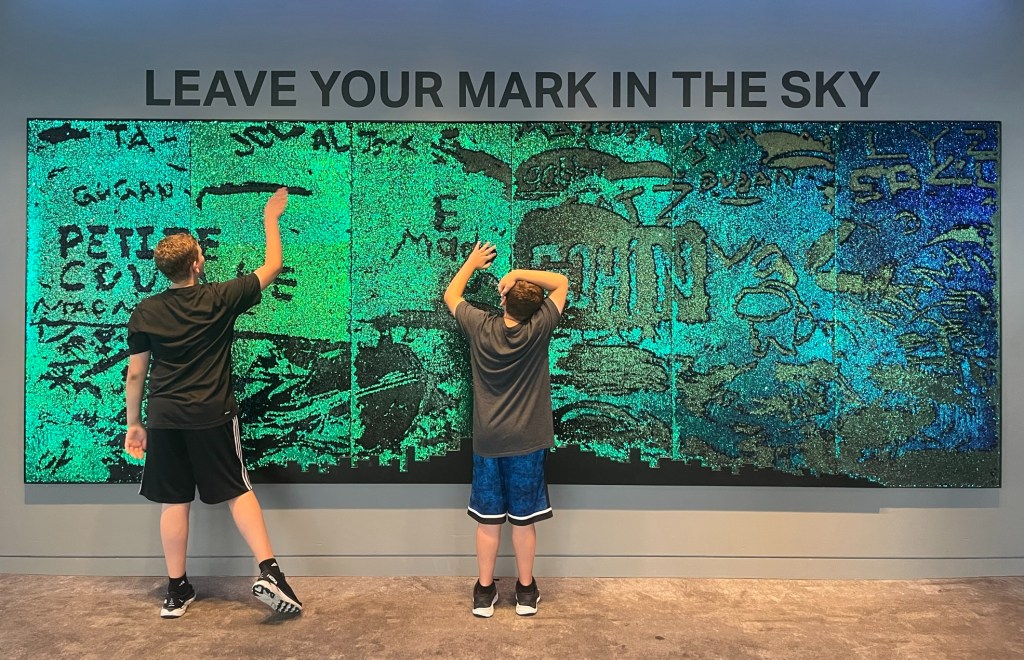
To head from dinner toward an evening at Skydeck Chicago in the Willis Tower, ride the scenic water taxi from the north side of the river at Michigan Avenue to the Ogilvie/Union Station stop, followed by a short walk, or call for a 13-minute Lyft drive. The winding, museum-tour walk to get to the elevator bank displays an artful collection of exhibitions, facts and figures about Chicago, and fantastic photo opportunities—an El simulation with vibrating seats and city scenes sliding by the window; a giant, plastic Chicago-style hot dog and deep-dish pizza to rest on; jazz, Oprah, The Second City, Wrigley Field, Cadillac Palace Theatre, and iconic city scene backdrops to pose in front of. A speedy ride in the elevator (1,600 feet per minute) shoots you up to the skyscraper’s viewing level.
The highest observation deck in the U.S., the Skydeck Ledge juts out over four feet from the 103rd floor—a breathtaking 1,353 feet above the Chicago River and Wacker Drive. View the city below with confidence, knowing that the Ledge can withstand four tons of pressure, hold 10,000 lbs, and is seamlessly constructed using three layers of half-inch thick laminated glass. Groups of guests are given a timed five minutes to step into one of the Ledge booths and take in the view, jump, do handstands, yoga poses—however they want to spend their time in the sky. Some feedback from kids who were initially wary of traveling up so high included, “We’re in the air, we’re super-secure, and we’re looking down 100 stories. It was a cool experience!” and “Well, that was awesome, and I totally don’t regret going on it!” A 1.5-mile Lyft ride or walk brings you back to Swissôtel.
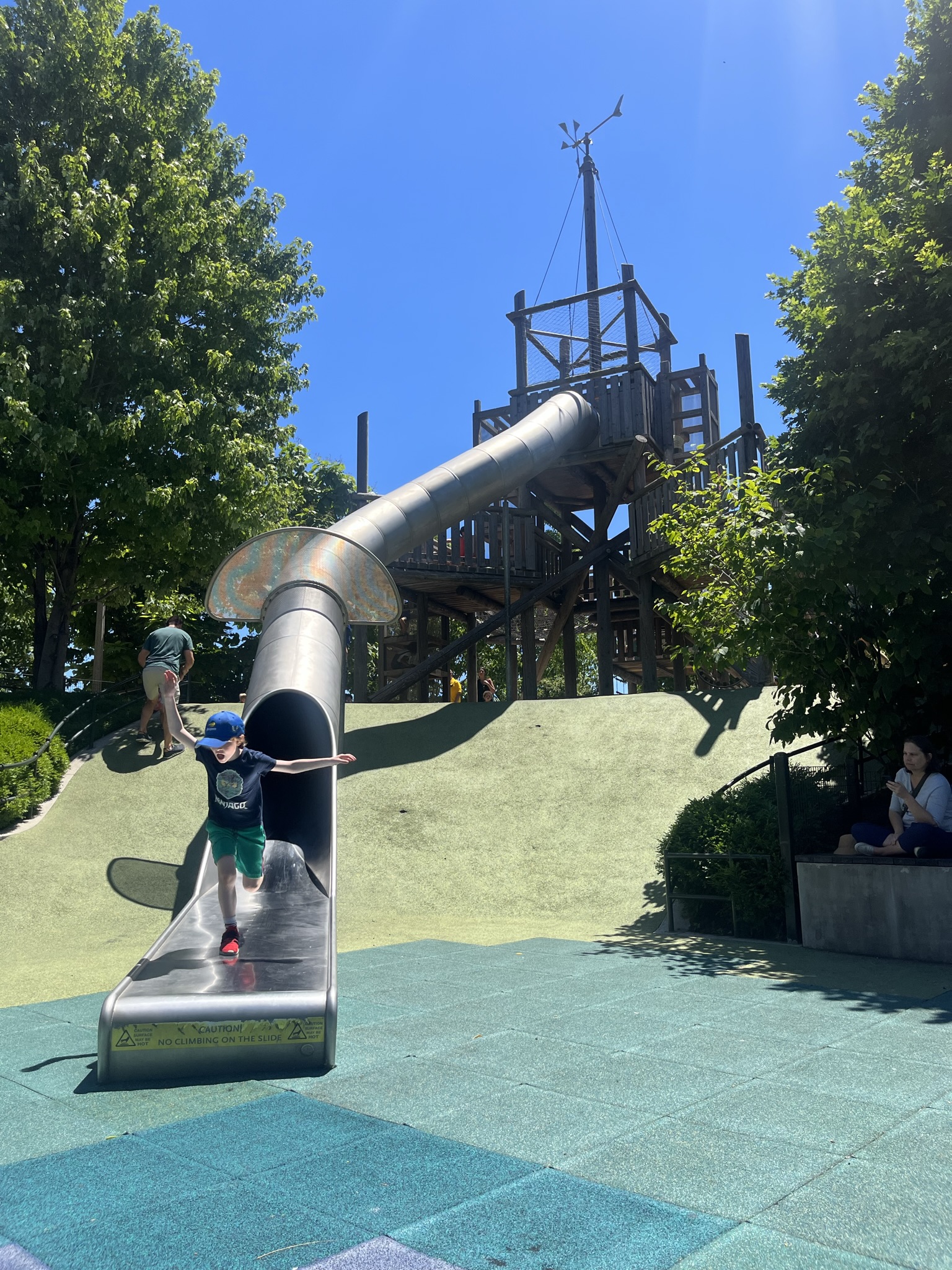
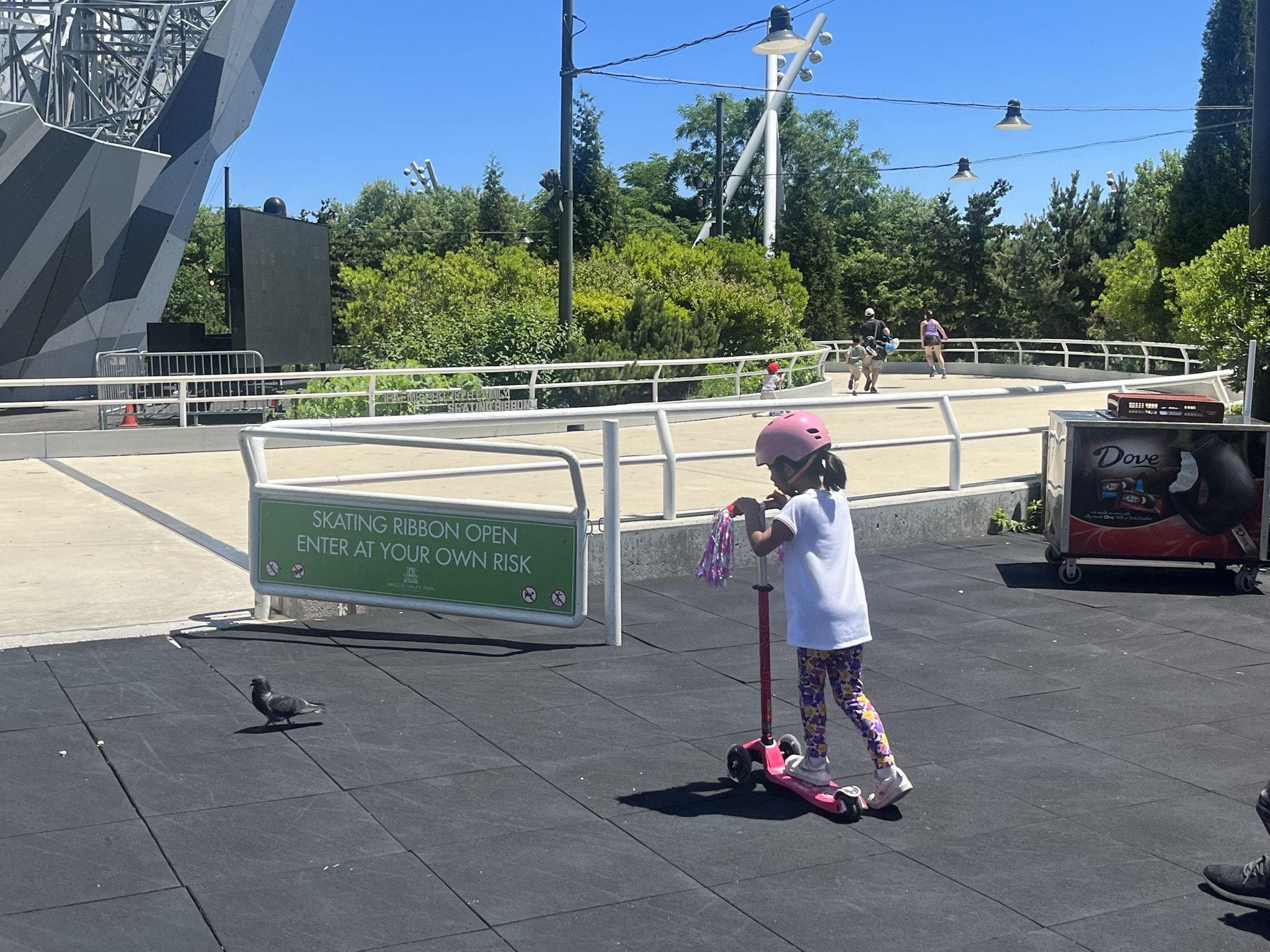
From Swissôtel to the massive Chicago Park District play area, Maggie Daley Park, is a 7-minute walk. The largest free activity is the Play Garden, a series of interconnected, imaginative play spaces integrating landscaping with the sculptures and structures. The Sea area features a large-scale ship and lighthouse tower with ladders, slides, talking tubes, and lookout scopes. The Watering Hole’s animal-themed splash pad includes a shady area with a bench for parents. A Harbor boat play zone, Enchanted Forest sensory exploration pathway, and Wave Lawn of rolling topography and sloped hills offer varied equipment and opportunities to engage all senses and stimulate imagination. Slide Crater’s giant suspension bridge slung between two towers is thrilling to run across while trying to keep your footing. Experience slides of all sizes and formations in this area (although the metal variety can be HOT in the summer sun!). Talk through tubes with others around the structure, rotate knobs to spin giant wheels, and be the lookout at the viewing scopes.
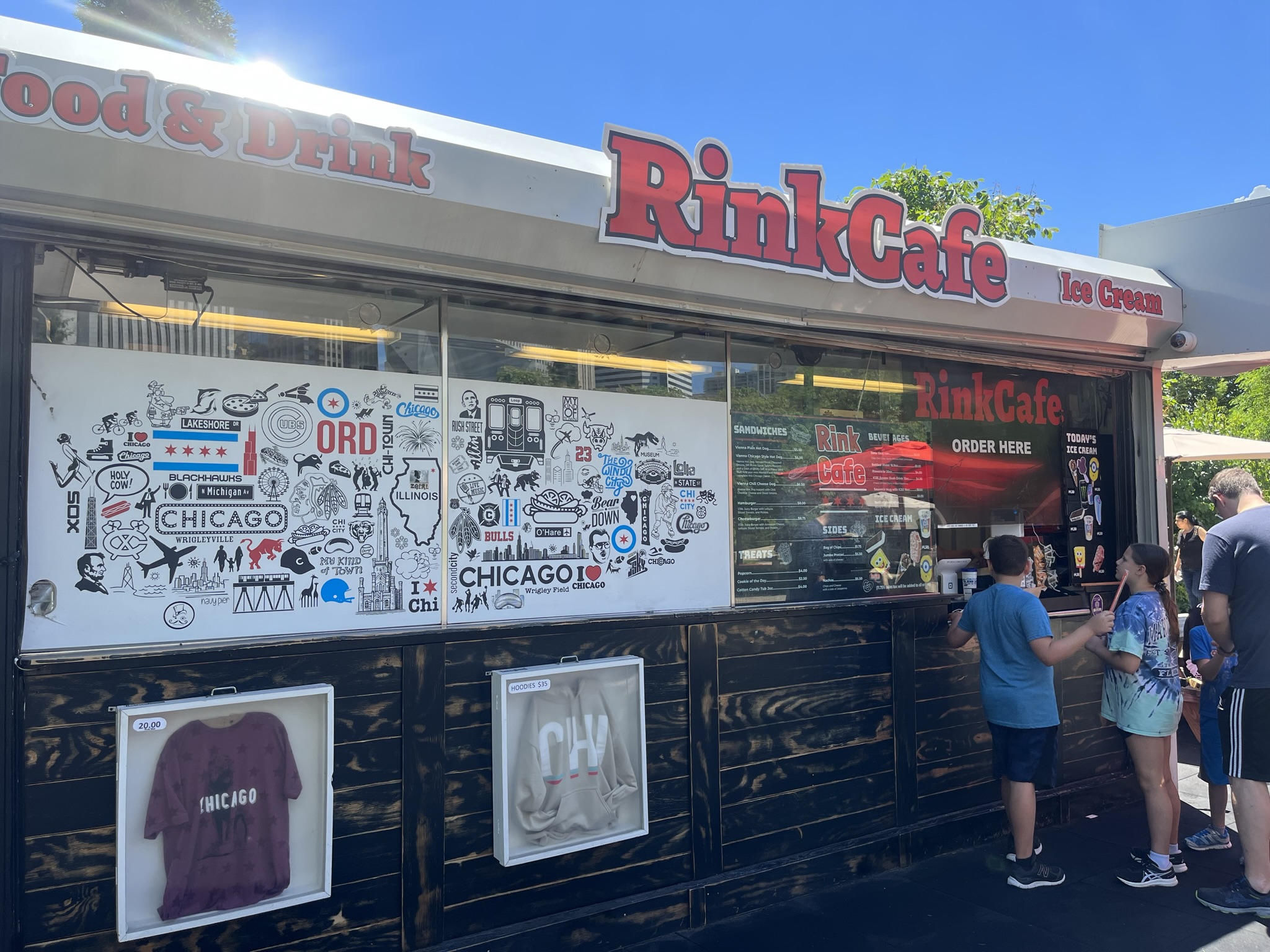
Other free areas include the tennis courts, picnic groves, Cancer Survivors’ Garden, and skating ribbon (rollerblades and Micro scooters are available to rent if you don’t bring your own equipment). For a fee and no reservations needed, visitors of any age can scale the Climbing Wall (shoes, helmet, and harness rental is offered), and kids aged 4-8 can even take a 15-minute climbing lesson with an instructor to assist them. Mini golf and a bungee jump are available for a fee. Conveniently located by the skating ribbon, the Rink Café food truck sells hot dogs, burgers, giant pretzels, ice cream, and other refreshments to enjoy under shady umbrellas.
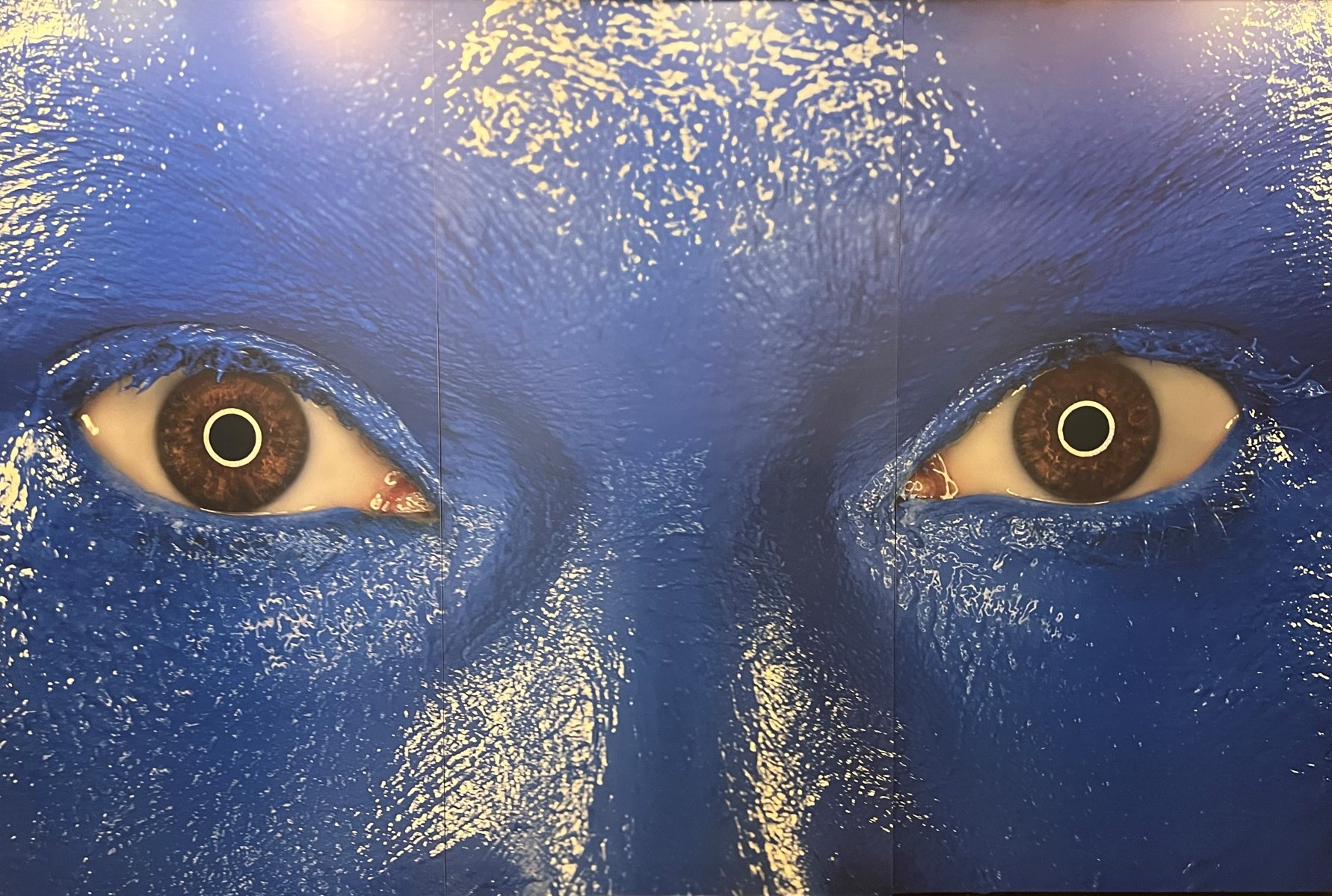
For an energetic, colorful, laughter-filled theater experience, bring the kids to the Blue Man Group at the Briar Street Theatre in the Lakeview neighborhood. While you wait for the show to begin, a scrolling marquee featuring jokes and ridiculous facts sets the tone for the event, warms up the crowd, and encourages audience participation. Through a series of comedic, surprising, awkward, and artful vignettes and instrumental songs involving PVC pipes, paints, lights, water, glow sticks, cereal, remastered instruments, and drums, the talented Blue Man Group cast opens an otherworldly dimension of sensory entertainment that enthralls and mesmerizes. Audience members in the front few rows don rain ponchos as protection from the show’s shower of water droplets, food, and paint. Several individuals were also singled out to participate in the show—on stage or from their seats—in “we’re laughing with you, not at you” situations. There is truly no comparison for this unique performance, and remembering those expressive, endearing blue faces will keep you smiling long after the lights go up.
Back at Swissôtel, the family can order refreshing drinks or nightcaps from the lobby bar and bring them upstairs to the suite, relaxing together in the living area to wind down for the night. A leisurely round of Pictionary or Connect Four or a warm shower under the rainfall showerhead brings an end to the eventful excursion in the city. Watch out the windows as Chicago dims its lights and rests up for a new day ahead.
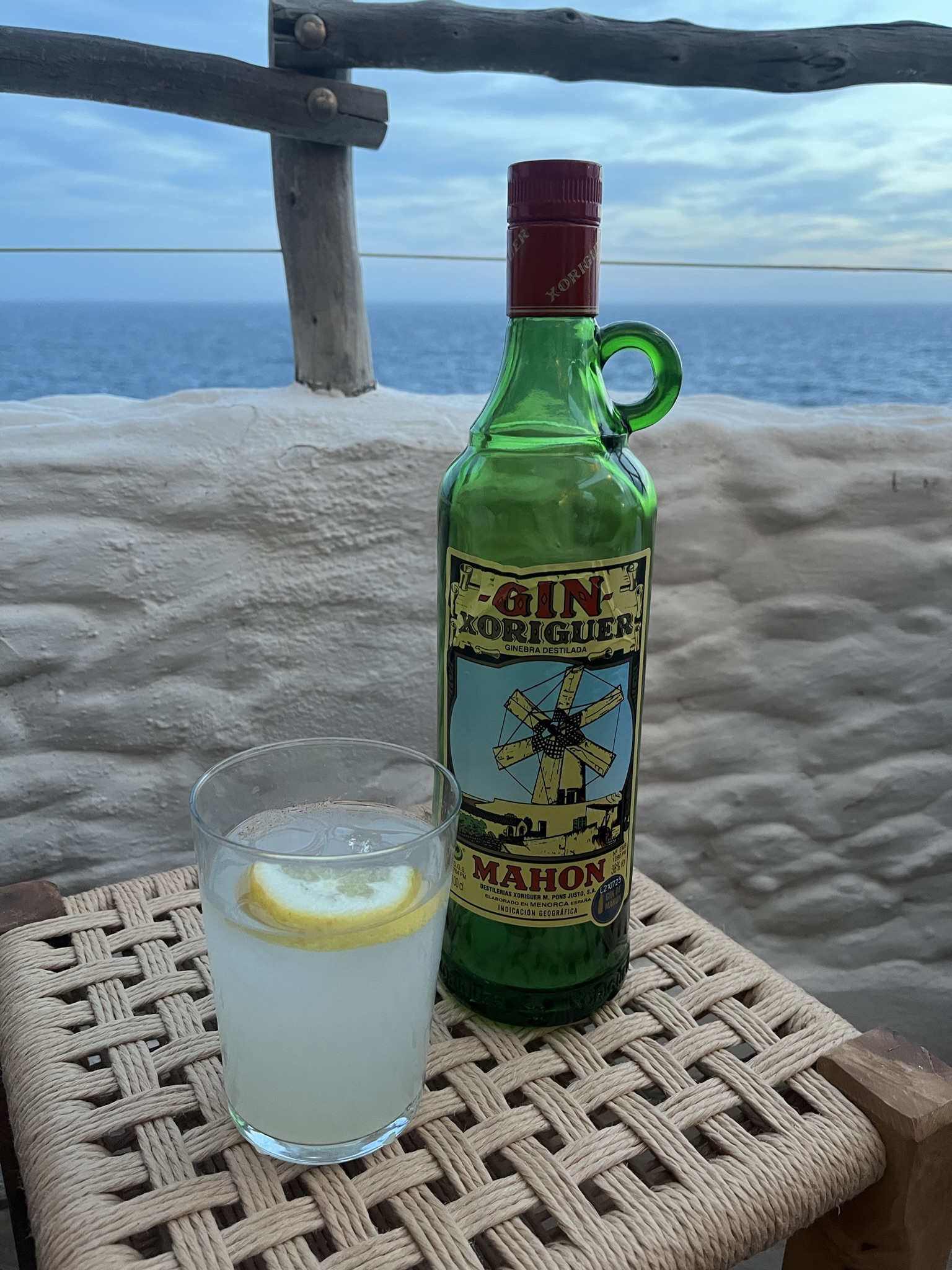
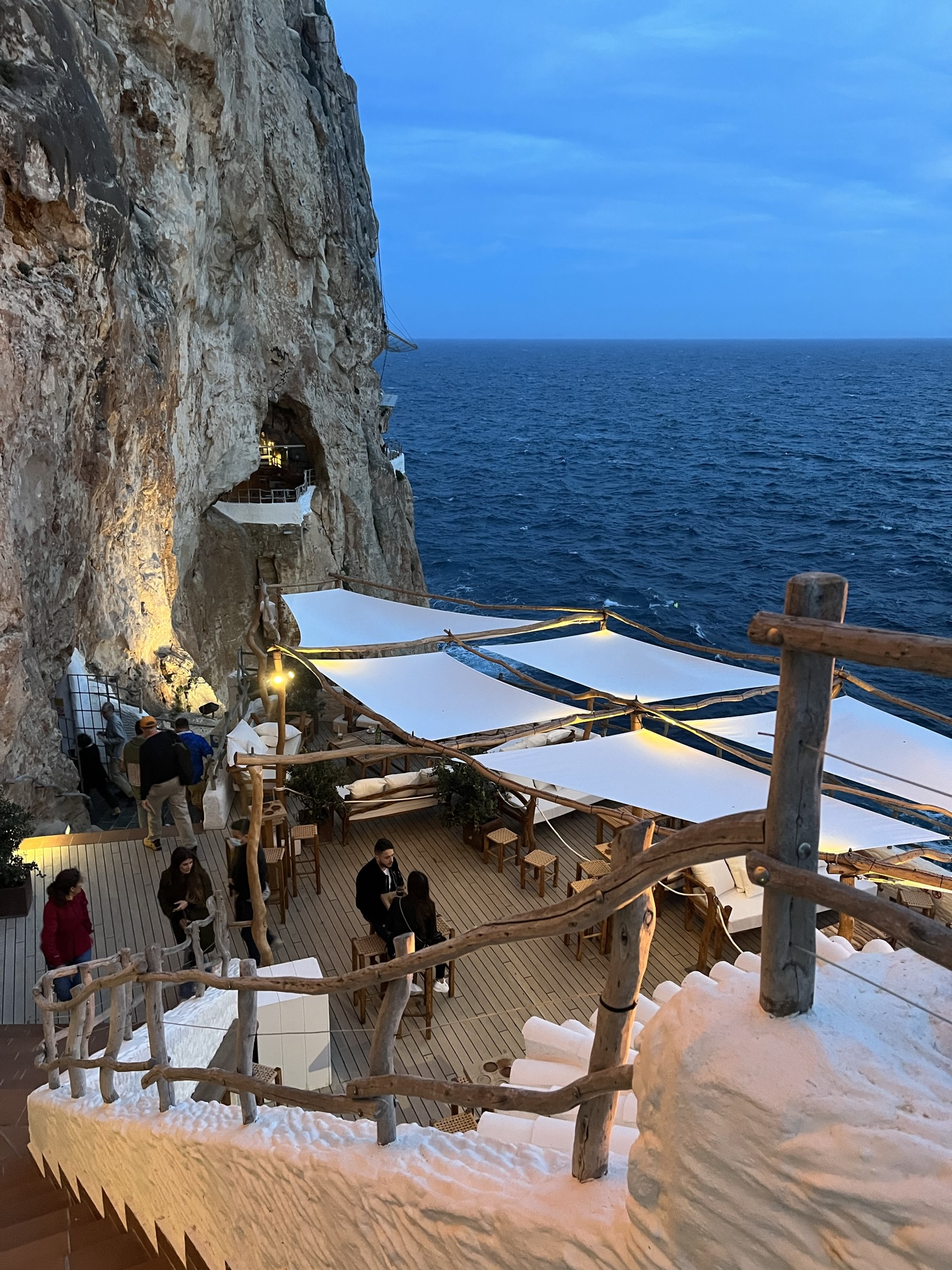
Best place to enjoy a lemonade + gin pomada? Cova d’en Xoroi—a daytime bar and afterhours club in a south coast cliffside cave that overlooks the beautiful Balearic Sea. Here on the outdoor patios you can watch the sun sink into the horizon and sip a drink in its glow. At 1 AM, a DJ starts spinning and the cavern becomes a dance club.
The recipe for Gin Xoriguer dates back to the early 1700s, and the distillery’s copper stills are more than 250 years old. The refreshing “pomada” cocktail consists of two parts lemonade and one part gin.
The Cova d’en Xoroi legend tells of a man named Xoroi who arrived by sea (perhaps a shipwreck survivor) and took refuge in the cave. During this time, a beautiful young woman from the country disappeared and was missing for years. One wintry day, a rare snowfall revealed footprints leading to the cave. Armed men stormed the cave and discovered Xoroi, the missing woman who had fallen in love with him, and their three children. Xoroi felt cornered and he and his eldest son jumped off the cliff into the sea, never to be seen again. The woman and her other children were taken back to Alaior, where they began a long lineage.
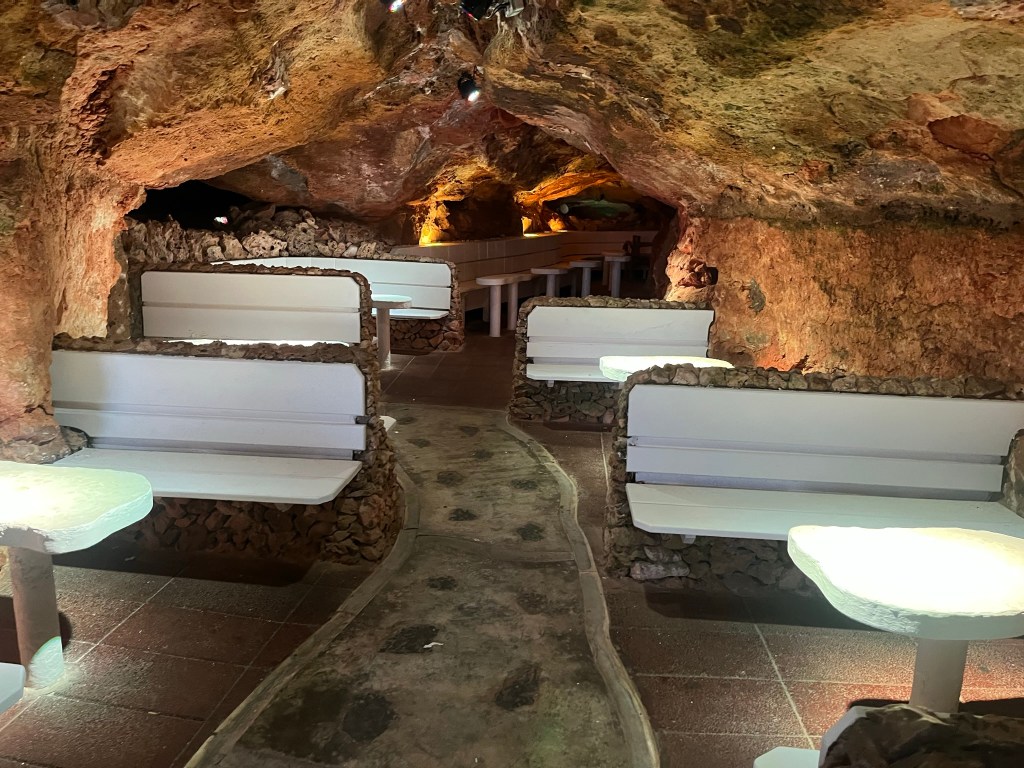
The cave’s interior has ample seating and booths with a sea view.
Nightlife at Cova d’en Xoroi features a variety of musical artists and themes, depending on the night. The live music schedule is posted online, and tickets can often be bought in advance.
Tickets are required for entry to the cave bar, with visiting hours segmented into a day session where children are welcome, an ambient sunset session suggested for adults, and an adults-only afterhours disco session. VIP seating is available for reservation, and the dress code restricts tank tops, beachwear, and sportswear, so dress to impress!
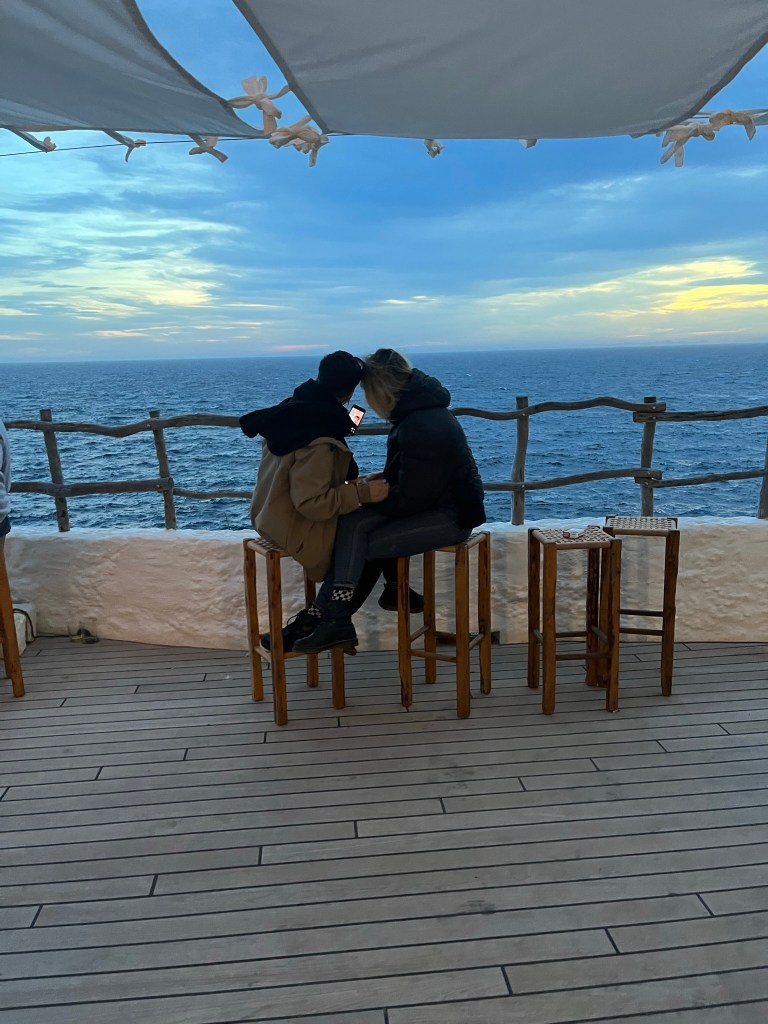
A picture-worthy setting, the sunset backdrop is ideal for capturing a cuddle.
Souvenir Spotlight
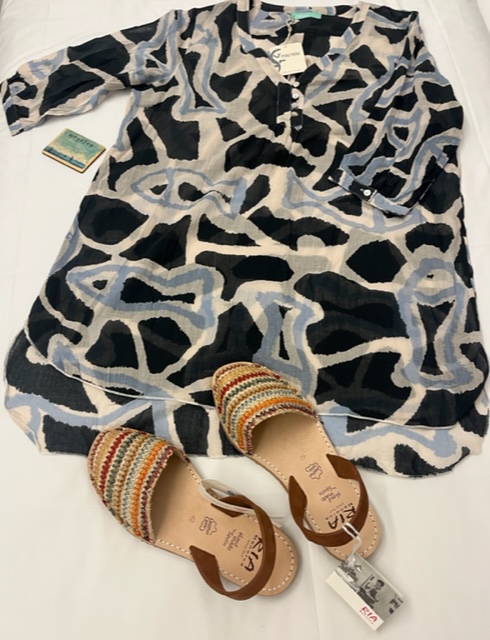
In addition to the incredible photos you will undoubtedly take home with you from the cave bar, stop for souvenirs in the fantastic gift shop up by the entryway. There you can browse a mix of locally made products, including handcrafted avarcas sandals by RIA Menorca and breezy Pou Nou island wear.
My gift shop souvenirs included colorful, woven RIA avarcas with a leather backstrap, and a lightweight Pou Nou tunic with shell buttons and a fish motif.
“Our company is based in Menorca, in the heart of the Mediterranean, and our designs are inspired by the island’s amazing elements—crystal-clear waters, magical beaches, and wild olive trees shimmering as the tramontana wind caresses them.”
Spreading a colorful 22″ x 30″ Deutsche Bahn (DB) railroad map out on the dining room table one evening, I savored the prospects of a European rail adventure.
I had seen many photos of the exciting and sleek European trains, and could actually name some of them, such as the Eurostar, the fast TGV’s and the ICE (InterCity Express) trains. I just had to ride some of the 160,000 miles of Europe’s railway lines to experience them for myself.
The DB rail map showed so many lines—there were electrified lines, lines for both long-distance and short-distance trains, private railways and high-speed lines under construction. There were even bus lines and rack railways.
As the first 15 minutes of map scanning lapsed into almost an hour because of all the rail possibilities, and places I wanted to go, I recognized that I’d have to scale back my plans for a 10-day trip, otherwise I’d never return home again. Besides, once I called up the DB rail schedules on the internet (www.bahn.de), I realized it would take as much as a full day of train riding to journey to some of the towns I wanted to see.
I knew I’d be able to secure good March airfares before the official traveling season began through American Airlines Vacations. I had found AA to offer quality air-hotel packages, so I booked one night in London (to recoup from the seven-hour trans-Atlantic flight), and an evening in Frankfort, Germany, the last city we’d visit.
My wife, Marilyn, would be an excellent travel companion as she could speak and understand enough German to allow us to eat (this is very important). We had planned a number of tight train connections during the trip, so her knowledge of German was a vital component in keeping to our schedule. She had a number of years of German in high school and college, as well as helped chaperone a tour group to Germany before. And the last time we went on a tour of Germany together, people from our bus followed us down the street so they could eat at the same establishments that we did, thinking they could ask Marilyn for help in translating the menu!
COMPLETELY ON OUR OWN
I had been to Europe several times before, as had Marilyn, but this would be a trip completely on our own without the help of a guide or any tourist service or agency. Thus it was with determination, and a bit of humility, that I set out to see just exactly how we could piece a 10-day European trip together using many original sources and no middlemen or travel agencies.
My idea was to travel on as many trains as possible, and on as many different trains as possible, see numerous points of popular interest and historic sites along the way, and also do some very specific sightseeing that we had in mind.
While American Airlines was the air carrier, Rail Europe (www.raileurope.com or call 888-382-7245) issued first class Eurail Flexipasses (cost $778 per person) which allowed us to travel 15 days during a two-month period in 17 countries, including Belgium, Denmark, Germany, France, Luxemburg, Spain, Switzerland, Portugal and Italy, among others. This was an absolute bargain because of the number of trains we could ride and the locations to which we could travel.
Other types of Rail Europe passes and terms are also available at different prices.
With the Eurailpass, you are afforded unlimited travel, as well as discounts for tourist railways, hotels and car rentals. You must purchase your ticket while in the U.S. prior to traveling to these places, however. Another requirement is that you have your ticket validated prior to boarding your first train (more on this later). Naturally, you’ll also need a passport, which you can obtain from designated post offices.
Our itinerary would take us to London, then Paris for two nights, then to Wernigerode in the Harz Mountains in former East Germany to ride the steam trains there, and then through Leipzig to Seiffen (the “toy village”) near the Czech Republic border, then to Frankfort. Between all these points were numerous towns we would travel through or at which we would change trains, and we were looking forward to making these connections part of our rail experience.
RAILFAN DREAM TRIP
What I had planned was a railfan’s dream trip throughout a portion of Europe that would not involve any transportation other than trains (both above ground or the underground species)—or the occasional DB bus. In Europe, you don’t need a taxi or a car in most cities if you’re willing to do some walking. The “ring” area of many European cities is best seen by walking anyway.
We left Chicago’s O’Hare International Airport on a cold, damp Thursday afternoon on a direct flight to London. After dinner, we had learned from previous flights to begin to relax and try to get some sleep. First-timers will find it hard to get much sleep because of all the excitement, but if you sleep even a few hours, it can pay off once you land.
On a seven-hour flight that begins at 5:20 p.m., you eat supper by 7 or 8 p.m., watch an in-flight movie, get some rest, and before you know it the flight attendants are serving breakfast prior to landing at Heathrow Airport.
We negotiated the famous London Tube from the airport okay, having purchased just a one-way tube ticket to a stop near the four-star Melia White House Hotel near Regent’s Park. After checking in at about 10 a.m. and finding that our room wasn’t ready, we were ushered to a comfortable sunken dining area of the hotel where hot coffee, fresh-squeezed orange juice and pastries were being served. This was very welcoming after a long flight and the cold, damp London winds that literally blew us into the hotel’s front door. When our room was ready about an hour and a half later, we found that the hotel clerk had upgraded us to a better room because we had to wait. I kinda like those British.
After sleeping off the effects of jet lag, we decided we still had time to walk to the British Museum, where a friend had said the Magna Carta was on display. While the Magna Carta is no longer in the museum, we did enjoy the museum’s food court. It’s a large, open space under a high sun roof that rivals most American shopping mall food courts. Later we were told the Magna Carta was moved to the British Library, but we did see plenty of ancient sculptures, rare books and paintings, nonetheless.
After a candlelight dinner of English fish and chips and Pilsner beer at the Green Man pub across the street from the hotel, we headed back to our room. By 7:30 p.m. we were asleep; that is, except for the unmistakable sound of Far Eastern religious chanting emanating from the next room, which mercifully stopped about 2 a.m.
We were up by 6:15 a.m. and carbed up on the hotel’s “Full English Breakfast” promised us. We noted we had only 10 British pounds left to spend, so we were glad the Eurostar beckoned.
EUROSTAR BECKONS
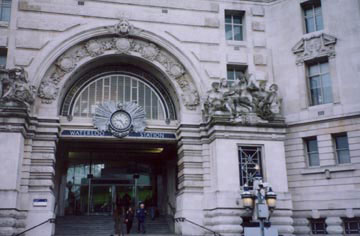
We had made reservations on the 10:39 a.m. Eurostar from London’s Waterloo Station, located not far from the Eye of London and the Royal Festival Hall. Just a couple of weeks before, I had spotted the Waterloo Station facade on a television travel program, and wanted to make sure I arrived in plenty of time to get a photo of it. It seems few people around the station actually know where the front of the station is because there are so many entrances to the structure, but finally a rail information clerk was able to tell me where it was.
After taking pictures (it has a marvelous front—nothing like that of most rail stations in the United States), and grabbing a quick mocha coffee, we headed for the Eurostar gate. I noticed seating in the station was at a premium, but a “Station News” bulletin in a rack mentioned that 40 additional station seats were to be added in early 2004.
The Eurostar departure gate is situated a long walk from the regular train platforms, and in this part of the station there’s another entire retail outlet section where I could have purchased coffee as well, plus numerous other items. But this section is really in need of more seating.
Seems like everyone north of the Thames was riding with us on the Eurostar to Paris that morning. We passed through security, but the attendant said I didn’t have to take off my shoes (which I usually do at airport security screenings because of the steel bars that support my Rockports). “Our X-ray machines aren’t that strong,” said a clerk.
After security came Passport Control, but our agent quickly waved us through and didn’t ask any questions such as, “Are you one of those insane railfans?”
My excitement mounted as the station clock ticked closer to departure time, and finally the doors were opened to the train platform. There were neatly-dressed, accommodating rail agents at nearly every passenger car door to help passengers. We found our seats in first class (there are 58 standard seats per car, for a total capacity of 560 passengers in standard class). In first class cars, there are up to 39 seats, for a total of 206 first class seats. Car #9 is reserved for 24 premium passengers.
I was able to get off the train for a few minutes before departure to photograph the front of the sleek train. After settling in my comfortable seat, I learned we’d be served champagne en route, followed by a complimentary three-course meal at our seats with a choice of wine. Premium passengers are served a four-course meal. I was already beginning to like this trip.
At 10:39 a.m. I noticed that we were moving, but had to tell Marilyn that we had begun our rail adventure—the departure from the station was so smooth she hadn’t even noticed. A Eurostar test train in 2003 hit a speed of 208 miles an hour. I must say, speeding from central London to Paris in 2-1/2 hours on this express train left me wondering why anyone would want to fly. Since 1994, the Eurostar has transformed cross-channel (they call it the Chunnel) travel, taking people to Avignon in Southern France for skiing, to Calais, to Disneyland Resort-Paris or to Lille. Of course, Paris itself never fails to charm and delight.
Last year, the Eurostar carried 1.7 million passengers in the fourth quarter alone, an increase of 15% from the year before. Eurostar says it savors a 66% share of the London to Paris rail/air route, and a new Channel Tunnel rail link in the United Kingdom cuts the journey by 40 minutes.
FEW BUMPS OR SQUEAKS
As the train left the outskirts of London, there was a noticeable difference in speed, but fewer bumps or squeaks than you’d encounter here in the U.S. on such a fast ride. The cars feature excellent lighting, they’re carpeted, seats are nearly 20″ across and windows are four feet long and 24″ high for good viewing. Each seat features footrests, and trays that unfold for food service. The cars have wide aisles and gray and red cloth interiors.
Our car purser (“chef de cabin”) was named Virginia Caron, a most pleasant and courteous young woman, who along with two other crew members, served us in their dark grey and charcoal Jacqueline de Baer-designed “non-uniform uniforms” which have a more relaxed, casual look to them.
Our train engineer (the English call them drivers), was Detlef Hofmann, the only German-born driver the Eurostar employs. David Hake, the train manager, reported that the train travels 186 miles or 300 kilometers an hour. He explained the line was built originally for TGV trains, and later used by the Eurostar. Watching out the window as we passed automobiles on the highway, I couldn’t help but wonder how fast the cars were going and how fast we were going. All I know is that we were passing cars faster than I’ve ever passed anything on land in my life, and I wasn’t all that used to it.
The scenery passed by so quickly that no sooner did I see it when another panorama appeared, and they all ran together. Crossing the English Channel, on the bottom side no less, might make some anxious, but it amounts to only 15 to 20 minutes of no scenery; anyway, by then first class passengers are well into their champagne, lunch and wine, and soon the enchanting rural French countryside appears. We never were able to see the tunnel entrance from the train, which is probably a good thing.
The Eurostar experience drew to a close as we headed into the Gard du Nord (North Station) in Paris. As the train drew near the station, I brushed up on a few more French phases just to make sure I had the language correct. One that I worked particularly hard on was, “Je ne parle pas francais.” The words mean, “I don’t speak any French.” If all else failed, at least I would have that excuse.
SERVED AT SEAT Not too far from Paris we were served a delicious breakfast at our seat, consisting of juice, coffee, rolls, a croissant with jelly, a chocolate pastry, several small pieces of cheese, ham and a prune fruit bowl.
The Thalys zipped through the countryside on a high-speed line with concrete ties and superelevated curves. There were more bumps than on the Eurostar, and when we passed another train, the air pressure between the two was noticeable.
In looking over my rail map, I saw we were to travel through Belgium, adding another country to our list of traveled lands. I really hadn’t noticed until then that Belgium was on the rail route to Cologne.
What I was already be-ginning to notice was that in Europe, modern, smooth-riding, comfortable passenger trains are taken for granted. You get on, sit in a comfortable seat, sometimes you’re served snacks, coffee or meals at your seat while the comfortable, clean trains zip you to your destination at great speed and on time. There’s little or no commotion about this feat, it’s just a fact of life.
I was getting a bit nervous that I might be enjoying this trip way too much already. It was easy to just sit back and relax, watch the scenery or read. My travel was in the hands of rail people who knew how to get me there on time and in style. I couldn’t help but think of the horror stories I’d heard about passenger train travel in the U.S., and I was glad I was in Europe.
Our train travel today would take about 9-1/2 hours, but I couldn’t think of anything else I’d rather be doing. We’d get to see the countryside, with several train changes that would allow us to stretch our feet.
IMPRESSIVE CATHEDRAL As we pulled into Cologne, from the train window we saw the tall, impressive two-spired cathedral in the city center near the station, something Marilyn had learned about in a high school German project, and recognized instantly. We had 41 minutes to wait at Cologne for our ICE train (InterCity Express) to Hannover. It was a chance to purchase a salami and/or turkey sandwich on fresh-baked bread in the station. Our train hadn’t appeared on the train schedule board yet, so I finally asked a DB agent who told us the platform was #2, and the departure time was 11:49 a.m, not 11:30. I guess you need to occasionally verify train information even in Germany. The ICE is an all-white train with what seem to be even roomier cars than on the Eurostar or the Thalys. Certainly there were wider aisles, large windows, light interiors and plastic and cloth seats and armrests. The ICE pulled out right on time, headed for Hannover.
The weather alternated between sunshine and rain; station stops along the way included Remscheid, Wuppertal, Hagen and Dortmund. I watched the overhead illuminated board from time to time to see the speed of the train—it reached 200 kilometers an hour at one point. I liked the ICE because it was roomy, and the large windows helped us enjoy the countryside.
TRICKY PART OF TRIP Probably the trickiest part of our entire journey was waiting for us at Hannover. As we left the ICE, we walked into the main train station area to find the typical train departure board, but our Regional Express (RE 3613) due to depart at 14:32 p.m. (2:32 p.m.) wasn’t listed on the departure board. Besides, Hannover station was a busy place, and everyone seemed to be in a hurry. As the minutes ticked away, and not having been able to determine which platform our train was to depart from, I scrambled up a platform stairway and asked a DB service agent for help. I knew time was getting very short, so I was anxious to find the right track quickly.
The DB agent, who spoke little or no English, looked at our schedule, grabbed Marilyn’s bags and motioned us to follow him as he hightailed it down one flight of stairs, and then shot up another flight of stairs to the tracks. As we ascended, I could hear the conductor’s whistle blow prior to departure, and my stomach knotted up when I realized that could be our train!
It was. The DB agent yelled to the conductor to wait as we literally jumped into the open car door, at which moment the train lurched forward and out of the station. Talk about a DB angel. We had one that day.
But now we were on the Regional Express, sitting in first class, out of breathe, but on board and on our way. This was the last train of the day, and it was still a two-hour trip to Wernigerode. The RE was a red two-car train with a distinctive whine, much like a gas-electric motorcar. It also could notch up the speed when the track allowed.
At Baddeckenstedt I spotted a small switch steam locomotive and an old coach on a siding near the station. I had no other information about it, but I did get a photo.
NEAR THE HARZ MOUNTAINS
Prior to our trip I had read about the intriguing Harz Mountains, and the railway map showed we were going to be traveling next to them. The lush forests in the Harz are home to many wild animals, and the entire region is dotted with towns and tiny old burgs of historical interest.
One of the significant towns near the Harz is the imperial town of Goslar. This medievel village boasts the Royal Chapel of St. Ulrich, the Imperial Palace and nearby 1,000-year-old Rammelsberg ore mine. Our train made only a quick stop here, but it is on a future agenda for us to visit.
The Harz is home to the Brocken Mountains, the highest point in northern Germany, and they began to loom in the distance, complete with layers of white clouds stacked above the peaks. A few miles from Wernigerode, the stately Schloss (castle) Wernigerode, built in the 13th Century, appeared dangling off the edge of a high cliff.
The town of Wernigerode itself is known for its many half-timbered buildings, but the real treat for railfans comes as you enter the station area. Off to one side I saw three—count ’em—three 2-10-2 steam locomotives all in shiny black paint with red trim sitting at the engine facilities.
These well-maintained steam locomotives pull passenger cars through the mountains and forests of the Harz.
STEAM IN 2004 I had to remind myself that this was 2004, and that these coal-powered locomotives ran nearly every day of the year here, and have been for 100 years! This was the Harzer Schmalspurbahnen (www.hsb-wr.de), and it features an extensive network of rails running 60 km between Nordhausen and Wernigerode, passing many of the Harz Mountains attractions. Other steam rail branches sprout in other directions into the mountains, and you’d need three solid days to see it all. It’s definitely a destination for dampflok (steam engine) railfans.
Because of our schedule, we had planned to ride the 9:10 a.m. train to the Brocken Mountain, arriving at the top at 12:04. We would return at 1:33 p.m. and arrive back at Wernigerode at 3:20 p.m, enough time to explore the town.
Upon arrival at the new and modern Ramada-Treff Hotel (www.ramada-treff.de), just a few short blocks from the Harz steam train station and the DB station, we learned the Brocken line was closed the day before because of 110 mph winds at the top! We made alternative train plans that evening pending the outcome of the morning’s weather report.
After a delicious German supper at the Ratskeller in the center of town, we awaited the next day’s adventure. Early in the morning we asked the hotel clerk to call the railroad for us to see what the weather was like on the mountain. Fortunately, the weather was clear, and there was no new snow or high winds, so we got to the station about 20 minutes prior to departure, enough time to check out the engine and cars. On the ready track was a 2-10-2 3-foot-gauge black-with-red-trim engine (very smart) with orange and white coaches; a snack car was also attached.
After having my picture taken in front of the locomotive (always a must), the train headed out (right on time) for the 1,125-meter ascent to the Brocken, the highest peak in northern Germany.
400 BRIDGES ON THE ROUTE The Harz railroad owns 25 steam engines, 17 of which are used to provide rail service between 41 stations all year round. The oldest locomotive dates to 1897. On the entire line there are three major routes, 400 bridges and the only tunnel in former East Germany.
About three quarters of the way up the mountain, snow began to appear on the right-of-way, and as the train chugged up the last few miles near the top, the landscape began to look like Antartica, with snow and ice caked on the mountains and trees.
At the top was a station, several restaurants and a viewing station, but we decided to take the next train down at 11:03 a.m. so we could change trains at Drei Annen Hohne for Eisfelder Talmuhle. That train left at 12:03, on the way down I think we were the only people on board besides the crew—we had our pick of seats.
The rest of the day we traveled by steam train through the forests and hills of the Harz; it’s a beautiful area with plenty of hunting, picnicking and hiking opportunities. We could have spent much longer investigating the various Harz rail lines, half of which we left unvisited.
The next day was another non-steam all-train day (and one bus), departing from the Wernigerode station at 8:32 a.m. One woman on the train, who spoke fairly good English, promised to send me details on the town of Heimburg, which the train passed from a few miles away.
LEIPZIG TRAIN STATION We again changed to the intercity train at Halle, then to another regional express at Leipzig. I like the Leipzig train station—it’s such a grand structure. I had been there about four years earlier and toured the station with a railfan friend. We caught the regional express here at 12:05 p.m. (after downing a delicious bratwurst from a station vendor). This train took us to Chemnitz, where we boarded a regional train for a 35 minute ride to Grunhainichen-Borstendorf, which was a very small unmanned station at the end of the line near forests and a fast-moving mountain stream.
We departed the train, walked through the tiny station and boarded a waiting DB bus, which took us to Seiffen. This 1 hour 11 minute ride took us through very hilly country, over curving roads where the tree trunks were nearly into the roadway, and where the woman bus “agent” asked us how long we’d be in Seiffen. We thought she wanted to know our length of stay so she would make sure we left the area afterwards! But she and the bus driver were very friendly, and even called our hotel on their cell phone as we arrived at the bus stop in Seiffen to have them pick us up. Otherwise it was a two-mile trek uphill in the snow with our luggage to the beautiful 64-room Hotel Wettiner Hohe.
Our four-year-old hotel overlooked beautiful forests and hills (always ask for a “zimmer mit blick” [room with a view]); we planned on staying here three nights. Seiffen, near the Czech Republic border, is a remote spot situated in “the land of the toys.” It’s here that about 100 families have produced handcrafted Christmas toys and decorations for the last 300 years. The small industry yields a town full of wonderful wooden toys and Christmas decoration surprises, marked by great German craftsmanship, and a toy museum.
Marilyn in Seiffen at a large outdoor pyramid and at a pyramid store.
FUN IN THE ERZGEBIRGE The region is dubbed the Erzgebirge, and small treasure-filled shops line the street. But it’s best if you speak some German here, because we found no one in town who could speak English, except Katja Frenzel, a reservation clerk at our hotel. It also helps to know the phrase “Guten Tag.” We toured the well-known octagonal Seiffen church after which many of the decorations are fashioned.
You may have heard of the German nutcracker, the smoking man, the flower child, the candleholder angel, the Christmas pyramid, the German music box, candle arch and others—all lovingly made here in the old-fashioned German way.
The first evening we were the only people staying at the hotel (March was their off season), and we woke up the next morning to our own buffet breakfast in the dining room. Talk about being pampered! We were served muesli, yogurt, breads, meats, cheeses, two types of juice and coffee. At the hotel that evening we met our friendly 19-year-old chef who also knew some English and who had traveled to England for two weeks.
After loading up with toys, including some wooden toy trains, we had to depart this unusual village and head for Frankfurt for our flight home. While at Seiffen, we had considered visiting the 3-foot-gauge steam train of the Fichtelbergbahn at Cranzahl, a 17-kilometer line to Oberwiesenthal, and the railway’s management graciously sent us tickets. But without a car, transportation in that part of Germany is only by bus and train, and the 40-mile trip would have taken about 3 hours. We decided to take a pass on this steam train and try to visit it on a future trip.
ON TO FRANKFORT AND HOME We caught the 9:46 a.m. bus from Seiffen and reversed the process to get back to Chemnitz, where we caught the 12:02 p.m. regional train to Nurnberg. This city has another German station I love! The grand train shed allows light to pour through onto the many tracks, and both the passenger and train activity is vibrant. Our InterCity train departed on time at 3:34 p.m, and we traveled the last two hours and five minutes by train, arriving at the main Frankfurt train station.
Our hotel was directly across the street, and we prepared for a quick “night on the town,” settling on the Ristorante Rustico near the downtown pedestrian plaza. We ordered a four-cheese pizza and a salmon/pasta/zucchini entree, and our favorite Pilsner beer. The atmosphere was quiet and warm inside the little cafe. Outside was chilly as we returned to the hotel, and we realized this year spring had not come early to Europe.
After breakfast we decided to get a few last shots of the trains at the station, and noticed that the station clock was an hour ahead of what we had on our watches. A thought struck us that perhaps Germany had “sprung” forward, and we had lost an hour. Sure enough, that was the case, and we scurried back to the hotel, checked out and boarded the S Bahn to the airport.
Our flight on American had been overbooked, and we toyed briefly with the idea of staying another night and getting free tickets on another future flight—return tickets to Europe perhaps? After 10 days away and a business to run back home, we decided we just couldn’t stay another day longer.
NEXT ADVENTURE MIGHT BE We landed safely on U.S. soil and were already dreaming about what our next European adventure might be. This trip was fun, exciting, and a lot less harried than we thought it would be. The people we met were friendly, even when we could only manage a few words in their language. The trains were excellent. On a scale of 1 to 10, we had to rate all of them a 10. They were punctual, clean and fast. Next time we’ll try to tour more of the small steam lines near Dresden. There are several of them worth investigating for a railfan. If you’re tired of trains in the U.S., try Europe. They have thousands of trains worth riding, and you’ll gain an appreciation of European history at the same time.
We’ll always remember this trip. It was a golden opportunity to meet people from other countries and see things we never thought existed or knew about. That’s what makes travel so exciting.