Christmas Markets Along the Danube

Explore the Christmas Markets with this easy river and rail adventure.

By Marilyn Heimburger
Photos by Don Heimburger

As the weather turns colder and stores begin playing Christmas music to heighten anxiety about getting everything done before Christmas, I yearn to spend the Advent season once again in Germany’s beautiful Christkindlmarkts.

Not long ago, a friend also expressed her longing to visit the famous Christkindlmarkts in Germany and Austria during Advent, but didn’t know where to begin. Which ones should she see? How do you find accommodations in each town, and arrange transportation from market to market? The planning seemed too daunting, and she just never got started.

European Traveler discovered the perfect plan to make that dream come true: last Advent we took a nine-day Christmas market tour by river and rail that was easy and convenient. We experienced more than a dozen Christmas markets along the Danube River in Germany and Austria, with guided tours in towns along the way.

VIKING AEGIR
The river portion of our “Advent along the Danube” trip was on the Viking Aegir, a 1-½-year-old Viking River Cruise ship which sailed from Budapest to Nuremberg. One of the best perks of a river cruise is that you unpack only once for the week. Meals are provided for you, and the ship delivers you from market to market, with local tour guides waiting when you dock, and activities onboard while you leisurely cruise from market to market. What could be easier?

On board the Viking Aegir, passengers relax in comfort with a beautiful view of Germany and Austria through panoramic floor to ceiling windows.

Although the cruise began in Budapest the day before, we chose to fly to Vienna and board the ship there. We moved into our spacious stateroom, complete with private bathroom with shower, drawers and closet for clothing, queen-sized bed, mini-fridge, TV and sliding glass doors on the balcony, offering a non-stop view along the Danube as Austria and Germany glided by.
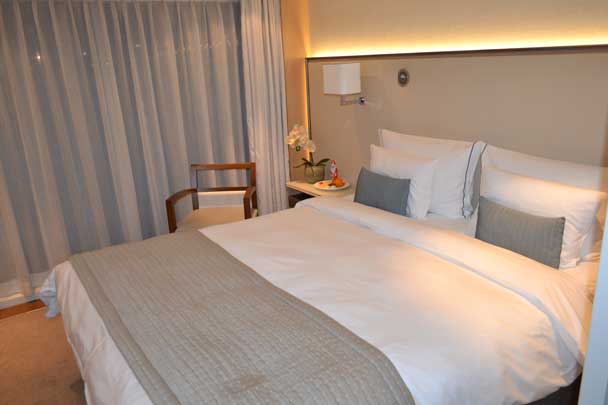
Comfortable cabins await the passengers aboard the Viking Aegir cruise ship.

VIENNA’S MAGIC OF ADVENT
Since the boat dock is some distance from the city center, Viking provides bus transportation to and from Vienna’s largest Christmas market, which glitters in the shadow of Vienna’s City Hall. Named “Wiener Adventzauber,” or “Vienna’s Magic of Advent,” it features hundreds of vendors in wooden huts offering local pastry, sausage and hot drink specialties, gifts, decorations, candles and accessories. There are pony rides, story reading on the Celestial Stage, appearances by the Viennese Christkind, and even arts and crafts and baking stations inside the Rathaus so children can make their own gifts and Christmas goodies.
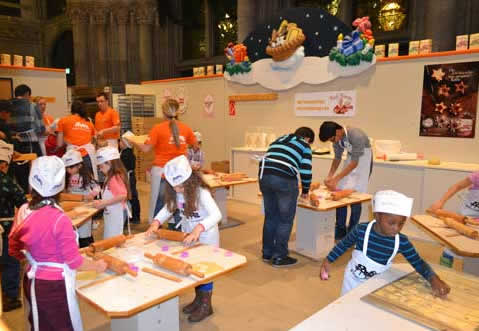
Located inside Vienna’s Rathaus is a baking workshop, where children can make their own cookies.

Within walking distance of the Rathaus market are several other Christmas markets, smaller but with their own local focus and definitely worth a visit. Markets in other parts of Vienna are on Maria-Theresien-Platz, in the Old AKH, on Freyung, the Am Hof Advent Market, at Belvedere Palace, on Karlslatz, on Spittelberg, at Stephansplatz, on Riesenradplatz, and at the Schönbrunn Palace. To see all of them would take an extra day or two! We saved some of our market visits for after the cruise, when we returned to Vienna by rail for our flight back home.

Vienna has several smaller Christmas markets each with their own style and specialties, and each worth a visit.

The local food experiences aren’t limited to the Christmas markets. Upon our chilly return to the ship, we were met with Lebkuchen and hot mulled wine, and Vienna’s famous Sachertorte for dessert after the onboard dinner.
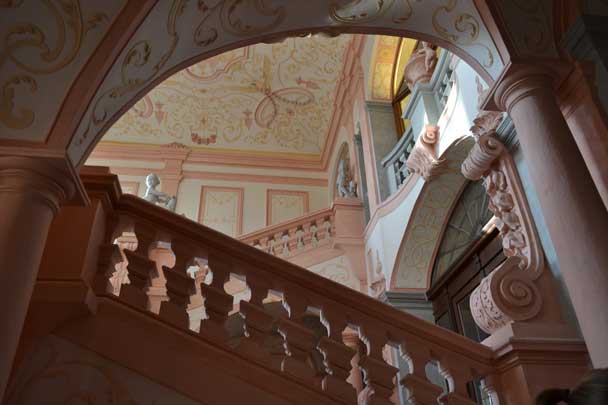
900-YEAR-OLD MELK ABBEY
The small Christmas market at Melk, Austria, our next port of call, is only open on weekends, and unfortunately not during our visit. But we enjoyed a guided tour of the beautiful 900-year-old baroque Melk Abbey, and bought the famous local apricot liqueur.

A “Taste of Austria” luncheon aboard the Viking Aegir featured plenty of sausage and a Lederhosen-clad accordion player.

Leisurely travel on the Danube with its many locks means plenty of time for relaxing. To add to our Advent experience during that time, local culture is brought onboard: “A Taste of Austria” lunch included music by a Lederhosen-clad accordion player. A strudel-making demonstration showed that a tea towel was the trick to rolling the paper-thin dough around the apple/raisin/rum filling. As we neared the Bavarian town of Passau, a traditional Black Forest cake was the featured dessert after dinner.

(left to right) The Simon family bakers demonstrate the art of making gingerbread in Passau.; A beautiful Advent wreath is easy to make, as demonstrated in Passau.

ADVENT TRADITIONS IN PASSAU
Our stop in Passau began a complete day of Advent tradition, all within easy walking distance from the boat dock. We learned the history and art of making Advent wreaths and the famous Simon family gingerbread, and were treated to a midday Advent organ concert at Passau’s St. Stephen’s Cathedral on the world’s largest cathedral organ. The main Passau Christmas market boasts a Bavarian flair with crafts and regional specialties, sausages, Glühwein and gingerbread.

Back on board our Viking ship we enjoyed tea time with plum cake, apple cake and other regional dessert specialties.

HISTORIC REGENSBURG
The next day’s stop in Regensburg included a town tour with visits to the Hutkönig, a world famous hatmaker; a cuckoo clock-making demonstration; and the oldest sausage kitchen in Germany, which has been serving sausages for 900 years, since catering to the workers who built the adjacent Stone Bridge.
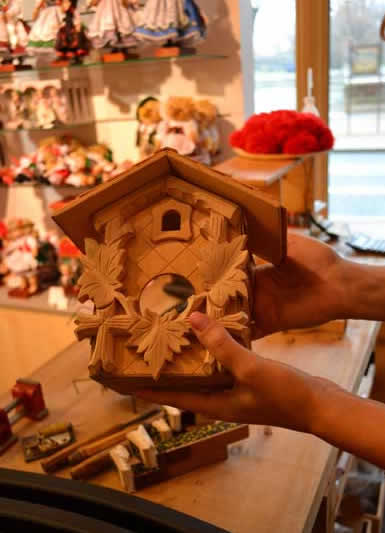
(left to right) A cuckoo clock-making demonstration was a tour option in Regensburg.; Regensburg’s famous Hutkönig had very special hats to offer.

ROMANTIC MARKET AT THE PALACE OF THURN AND TAXIS
Regensburg’s main Christmas market spreads out near the cathedral, but another Regensburg highlight is the Romantic Christmas Market set in the courtyard and surrounding park of the Palace of Thurn and Taxis. Here the pathways are lit by torches, lanterns and lighted ropes wrapped around wooden fences, and there are hay bales for seating and open fires for warming stations. The bough-covered wooden stalls offer unique products obviously chosen for their quality and beauty. Although there is a fee of 6 -7 Euros to enter this private market, it was one of our favorites, and well worth the price.

The beautiful Romantic Christmas Market is on the grounds of the Palace of Thurn and Taxis in Regensburg.

After a full day in Regensburg, the local Advent experience continued on board as we were greeted with hot Glühwein and heart- and star-shaped Lebkuchen.

Red- and white-striped awnings decorate this Lebkuchen stall at Nuremberg’s historic Christkindlmarkt. The Christkind stands high on the balcony of the church on the left to open the market.

NUREMBERG’S CENTURIES-OLD CHRISTKINDLMARKT
Our ship’s last stop was at Nuremberg, which boasts a 400-year-old Christmas market tradition. Once again, Viking provided bus transportation to and from the Christkindlmarkt on the Hauptmarkt square, since the boat dock is some distance away. Nearly 200 wooden stalls decorated with red- and white-striped awnings invite visitors from all over the world – more than two million each year – to sample the traditional gingerbread, sweets, sausages, potato pancakes and Glühwein, to buy their ornaments, candles, toys and prune men.
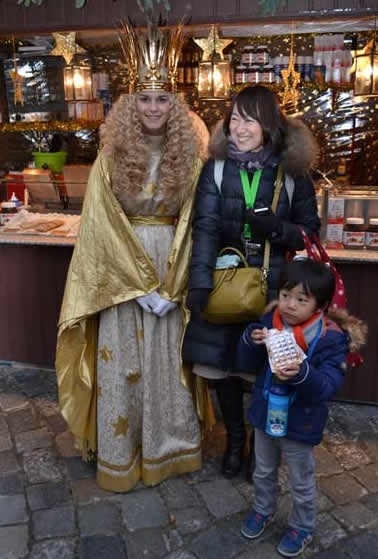
(left to right) The Children’s Christmas market in Nuremberg has rides and booths with hands-on activities for children, and appearances by Nuremberg’s Christkind.; Nuremberg’s unique Handwerkerhof is located at the distinctive Königtor within the historic city walls.

A few steps away is a children’s Christkindlmarkt with colorful rides, booths with hands-on activities, hot punch and Nuremberg’s beloved Christkind.

Don’t miss the nearby “Sister City” Christmas market featuring wares from Nuremberg’s sister cities around the world, and yet another Christmas market setting in Nuremberg’s distinctive Handwerkerhof, located at the Königstor within the historic city wall.

Though the river cruise part of our trip was over, and it was difficult to leave the cocoon of comfort we experienced on the ship, we had more markets to visit on our way back to Vienna.

INTER CITY EXPRESS SPEED AND COMFORT
With a first class Eurail pass in hand, we boarded the fast Inter City Express (ICE) train from Nuremberg to Vienna. The Eurail pass, which we had to purchase in the U.S., allowed us to hop on and off the train for more Christmas market visits enroute to Vienna. Sitting in a six-seat “quiet room” directly behind the engineer gave us a clear view of the tracks ahead, a rail buff’s dream. The track generally followed the Danube, busy with barge traffic, with snow-covered mountains in the distance and large balls of mistletoe visible in the bare trees along the route.

Through the panoramic windows we watched the snow-covered forests and villages speed by, looking like gingerbread creations sprinkled with powdered sugar. We saw firewood meticulously piled high in covered sheds in preparation for the long cold winter, and churchyard cemeteries somehow decked out with colorful plants: lavender, heather – where does all the winter floral color come from?

MORE CHRISTKINDLMARKTS AT LINZ
Soon we arrived at Linz, the location of our next Christmas market experience. We left our luggage in lockers at the train station and bought a ticket for the Linz City Express which took us through the town’s main shopping area to the Christkindlmarkt near the river on the Hauptplatz.

Nestled between the town’s centuries-old Baroque townhouses, this market featured wares by artists and artisans, with traditional hot drinks, Bratwürstlein and pastries. At the nearby Goldmann’s Bakery we sampled the town’s famous Linzer Torte. Lights above the stalls are designed to look like river waves, and a specially-designed light display above the river depicts angels blowing bubbles through a straw.

(left and bottom right) Vendors at the Schönbrunn Christmas Market offer painted pewter decorations and beautifully detailed figures for Nativity scenes.; Hot Glühwein in generous mugs, and stick-to-the-ribs comfort food hit the spot at the Schönbrunn Palace Christmas Market

Another short City Express ride delivered us to the Christmas market at the Folksgarten, which featured rides for children, stalls offering warm hats, scarves, decorations, and more hot drinks, pastries and comfort food.

Retrieving our luggage, we completed our train journey to Vienna, where one more very special Christmas Market beckoned.

SCHÖNBRUNN PALACE CHRISTMAS MARKET
Vienna’s famous Schönbrunn Palace hosts its own large and very beautiful Christmas market. Situated on the grounds in front of the UNESCO World Heritage site, this unique market still has plenty of room to wander through the juried product stalls. Six food stands are centrally located, as is a towering lighted tree and a magnificently carved nativity scene. The Schönbrunn Market celebrates its 21st year in 2014, and has grown in size and popularity each year. This market easily sets a new standard with its attention to detail in set-up and design.

For those wondering how to experience the Christmas markets in Germany and Austria in comfort and convenience, this trip by river and rail is the answer.

Websites to visit if you go:
vikingrivercruises.com
eurailpass.com
Vienna Christkindlmarkt
Nuremberg Christkindlmarkt
German Christmas Markets
Linz Austria Christmas Markets
Passau Christmas Market
Regensburg Christmas Market
German National Tourism Board
Austrian Tourism Board
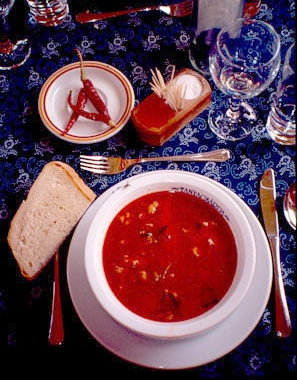
Great Goulashes!

Although goulash originated in Hungary, this popular dish later spread beyond its borders, first to the Austrian Empire, Germany, and the Balkans, and finally around the world.

Classic Hungarian goulash at a restaurant on Hungary’s Great Plain

By Sharon Hudgins
Photos by the author

Everyone loves a good goulash. But ask a dozen people what a goulash is—and you’ll get a dozen different answers: a soup, a stew, a meat dish served on a plate; brown, red, mild, hot-spicy; made with beef, pork, mutton, game, even vegetarian.

Although goulash originated in Hungary, this popular dish later spread beyond its borders, first to the Austrian Empire, Germany, and the Balkans, and finally around the world. That’s why there are so many versions of goulash today.

GOULASH ROOTS
Hungarian goulash traces its roots back to nomadic Magyar herdsmen in the ninth century. Shepherds cut meat into cubes and slowly stewed them in a heavy iron kettle over an open fire until the liquid evaporated. Then they spread the meat out in a single layer to further dry in the sun. This dried meat, an early convenience food, could be carried with them as they followed their flocks across the vast expanse of Hungary’s Great Plain. To reconstitute the meat they simply added water and heated it—sometimes with other ingredients, too—in a pot over a fire. If a lot of liquid was added, the dish was called goulash soup. With less liquid, it was simply goulash meat. In both cases it was eaten with spoons dipped into the communal cooking pot.

Goulash got its name from those early herdsmen, who were called gulyás in Hungarian. But goulash as we know it today did not develop until the end of the 18th century and beginning of the 19th, with the widespread cultivation of peppers in Hungary and the use of paprika as a popular spice. Originally it was considered peasant food, eaten primarily by country folk—farmers, shepherds, cowboys, and swineherds. With the rise of Hungarian nationalism in the second half of the 19th century, paprika-seasoned goulash moved from the campsites and farmhouses to the tables of middle class and wealthy city dwellers, to the menus of fashionable restaurants and eventually across the globe.

GOULASH VARIETIES
Goulash is now the Hungarian dish most widely known abroad. But in many parts of the world, dishes called “goulash” bear little resemblance to the gulyás that originated in Hungary and is eaten there today. In Hungary, gulyás is a meat dish halfway between a soup and a stew, made with small cubes of meat (usually beef), no more than 3/4-inch in size, and flavored with bacon or lard, onions and paprika. Gulyás is traditionally served in a bowl and eaten with a spoon.

Over time, Hungarian cooks also developed many variations on this theme, using such ingredients as garlic, tomatoes, mild banana peppers and hot cherry peppers, caraway seeds, root vegetables, cabbage, beans and tiny egg dumplings, as well as pork, mutton, venison and boar meat. Regional recipes abound, with each cook claiming his or her own version of goulash to be the best and most authentic.

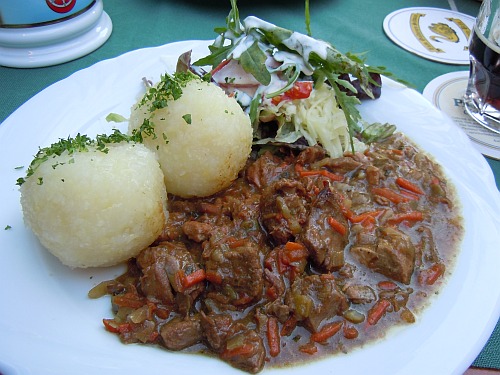
Germans adapted the basic Hungarian goulash recipe to their own tastes, producing the Gulaschsuppe (goulash soup) that is now so popular throughout Germany, where it’s traditionally served with a slice of rye bread and a mug of beer. Germans and Austrians also make a variety of thick, paprika-flavored meat stews called Gulasch, served on a plate and accompanied by boiled potatoes, egg noodles or dumplings. (The Hungarians, however, would call this kind of stew a pörkölt, not a goulash.) And Kesselgulasch (kettle goulash)—cooked outdoors in a pot suspended by an iron tripod over an open fire—is a Hungarian specialty that many Central Europeans now eat at their own backyard dinner parties and local festivals.

German “Beer Goulash” at brewery beer garden in Erfurt

As part of the former Austro-Hungarian Empire, the Austrians certainly love their own versions of Gulasch. There’s even a Cafe-Restaurant Gulaschmuseum in Vienna, where the menu lists more than a dozen varieties of goulash, including turkey or chicken-liver goulash with potatoes, bean goulash with paprika-seasoned sausage, veal goulash with little spinach dumplings, and even a dessert called Schokogulasch (chocolate goulash) containing cake, chocolate sauce and rum. In Prague I purchased a Czech cookbook devoted entirely to the subject of goulash—including versions identified as German, Austrian, Slovakian, Slovenian, Serbian, Bulgarian, even Chinese and Mexican! And recently in New Mexico I came across a Cajun goulash. What a mixture of geography and culinary cultures! From its humble beginnings on the plains of Hungary more than a thousand years ago, this simple peasant food has now become a truly global dish.

GOULASH-SPEAK
“Goulash” has also entered several languages as a word meaning more than just “a soup or stew.” In Hungary, “Goulash Communism” was a term for the Hungarians’ attempt in the late 1960s to create their own, more market-oriented, economic system distinct from the Soviet model. In Germany and Switzerland, a “goulash cannon” is military slang for a mobile field kitchen—a big, heavy, black, iron stewpot on wheels, with a cover on the top and a built-in firebox—which is also used for feeding crowds at festivals and other public events. And in the Czech Republic, political parties had a tradition of setting up their own “goulash cannons” in front of polling places at election time, where they dished out free goulash in a blatant attempt to influence voters’ choices on the ballot. As the Czechs said to each other when they headed to the polls to vote, “Have a good goulash!”

Eating in Oxford: From the Traditional to the Trendy

Food shop inside the Oxford Covered Market

By Sharon Hudgins
Photos by the author

Since the Middle Ages, the English university town of Oxford has been attracting scholars hungry for knowledge. Today it also draws hordes of tourists hungry to see its Gothic colleges, top-notch museums, colorful gardens, lively student hangouts and cozy pubs.

We all know that sightseeing is a strenuous activity that boosts your appetite. And Oxford offers plenty of places for filling empty stomachs as well as hungry minds. In this historic “city of dreaming spires,” you’ll find something to suit every taste, from traditional English pork pies to sushi rolls, from falafel sandwiches to chocolate fudge, from goat cheese pizza to the best of British cuisine.

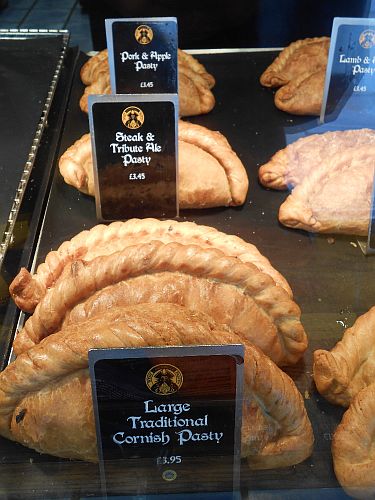
Classic Cornish pasties at West Cornish Pasty Company on Cornmarket Street

FAST FOOD
In a town full of students, there’s no dearth of fast-food joints. Skip the inevitable McDonald’s and KFC, and head for the simple eateries offering more typical British fare. The West Cornish Pasty Company on Cornmarket Street sells very good versions of these traditional English turnovers with a selection of savory fillings. Many other takeout places, including supermarkets, offer fresh sandwiches stuffed with prawns, sliced cucumbers or egg salad, perfect for a picnic on a hot summer day. And food trucks parked around the edges of the central city cater to eaters on the go, selling a variety of takeaway dishes from India, Pakistan and the Middle East, as well as British standards such as “toad-in-the-hole” (succulent sausages baked inside Yorkshire pudding batter).

Pasties
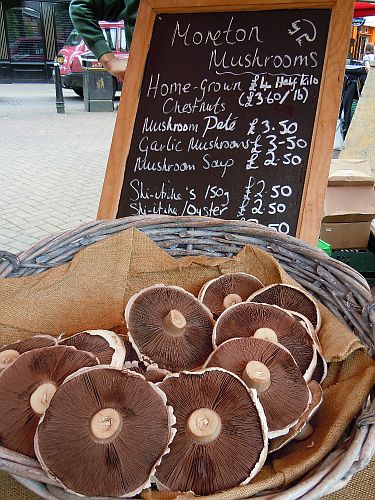
Mushroom stand at the weekly Oxford open-air market

OXFORD COVERED MARKET
Opened in 1774, Oxford’s venerable covered market is one of the city’s most popular tourist attractions. In addition to its fruit, vegetable, meat, fish and cheese stores, it includes several little shops selling cooked foods to nibble on site or take away. Choose from an eclectic group of eateries: a “Brazilian Cheeseball” stand, a “Sooshe” bar, Nash’s Oxford Bakery, David John’s traditional butchery and meat pie shop. An especially popular place is Pieminister, which offers several kinds of freshly made, double-crust, meat or vegetable pies served with “mash” (mashed potatoes), “groovy” (gravy) and “minty mushy peas” (just what they sound like).

Plates of custard
Traditional English pie with gravy at Pieminister in the Oxford Covered Market

PUB GRUB
Oxford’s historic pubs are famous as much for their denizens as for their beer. You can quaff a pint of British bitter or English ale in the same spots where Thomas Hardy, Lewis Carroll, J. R. R. Tolkien, C. S. Lewis, Graham Greene, the fictional Detective Inspector Morse and many other Oxford luminaries wet their whistles. Pubs also serve food, sometimes the best bargains for a full (and filling) meal in Oxford. Typical dishes include fish-and-chips (battered-and-fried fish filets with French fried potatoes), Scotch eggs (hard-boiled eggs surrounded by sausage meat and deep fried), “Ploughman’s Lunch” (thick wedges of cheese and a slice of ham served with apple slices, sweet pickle relish, bread and butter) and “jacket potatoes” (aka baked whole potatoes, in their skins) with a choice of toppings: Cheddar or blue cheese, pork and beans, sautéed mushrooms, even meaty (or vegan beany) chili.

Traditional English ale at an Oxford pub

(left to right) Food shop inside Oxford Covered Market; Cottage loaves for sale at the weekly Oxford open-air market; The Bear, one of Oxford’s famous traditional old pubs

Purchase a guide to Oxford’s pubs at the Visitor Information Center on Broad Street or at many bookstores. You can also buy a postcard depicting 36 classic pubs for an “Oxford Heritage Pub Crawl.” My own favorite pubs include The Bear, The White Horse Inn, The Rose and Crown, The Lamb and Flag, The Eagle and Child and The Head of the River.

Head of the River
Head of the River, a favorite Oxford pub with a large beer garden

TEA & SWEETS
You can’t visit England without having afternoon tea—a civilized sit-down with a pot of freshly brewed tea, finger sandwiches and baked goods (such as scones with jam and clotted cream, and a selection of scrumptious cakes). Several cafes advertise afternoon tea with a sign in their front windows. Some upscale restaurants also serve formal “teas” between 3:00 and 5:00 p.m. For an elegant experience in the grand old English manner (with prices to match), “take tea” in the drawing room of the Macdonald Randolph Hotel across from the Ashmolean Museum.

If you just need to satisfy your sweet tooth, stop in at Nash’s Bakery in the Covered Market for traditional British pastries, or head for the Fudge Kitchen on Broad Street, which sells more than 20 different flavors of fudge made fresh daily.

Man makes dough, Oxford
Handmade fudge at the Fudge Kitchen on Broad Street

RESTAURANTS
Oxford has a wide range of full-service restaurants to fit any budget. Local foodies especially like Brasserie Blanc, on Walton Street, owned by one of the most respected chefs in Britain, Raymond Blanc; Jamie’s Italian, on George Street, one of a chain owned by another famous chef, Jamie Oliver; Gee’s, an Oxford landmark on Banbury Road; The Old Parsonage, on Banbury Road; and Magdalen Arms, a “gastropub” on Iffley Road. Look for fixed-price lunches of two or three courses for approximately £12 to £17 per person. Some restaurants also offer the same deal for “early supper” between 5:30 and 7:00 p.m.

Oxford plate
Luncheon appetizer at Gee’s Restaurant on Banbury Road

Oxford has no lack of Asian restaurants, from Indian to Chinese, Japanese, Thai and “Asian fusion.” Popular Asian eateries include My Sichuan, Shanghai 30’s, Majliss, Saffron, Chiang Mai Kitchen and Wagamama.

And for your big splurge, drive out to Raymond Blanc’s Le Manoir aux Quat’ Saisons in Great Milton, just seven miles east of Oxford. This fine restaurant has garnered two Michelin stars and won many other culinary accolades. You’ll be tempted to stay overnight at the historic manor house, too. Just be sure to make reservations well in advance, for both the hotel and restaurant. Dining there is an experience you’ll never forget.

● Travel tip: The Oxford Visitors’ Guide, a handy booklet that costs only £1 at the Oxford Visitor Information Centre (15/16 Broad Street), contains a short history of the town, a map, a brief description of the colleges and their opening times, Top 10 Things to Do, a self-guided walking tour, and vignettes of Oxford’s most famous characters. Also pick up a free copy of the Oxford Restaurant Guide booklet.

● Online travel information: www.visitoxfordandoxfordshire.com/travel-information/Tourist-Information.aspx

Additional restaurant information online:

● www.oxfordrestaurantguide.com

● www.visitoxfordandoxfordshire.com/see-and-do/Eating-and-Drinking.aspx

Experiencing Great Britain in a Fresh Way

Photos courtesy Visit Great Britain

With summer approaching, it’s a good time to plan to visit the annual food and vegetable markets that pop up in the United Kingdom. Here are four of them that you might like to put on your “shopping list.”

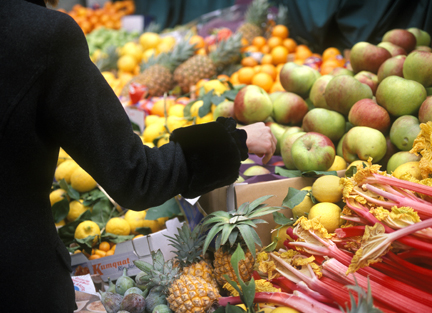
Selection of colorful fruit, Borough Market, London, England
Pecorino Favoloso, Borough Market, London, England.
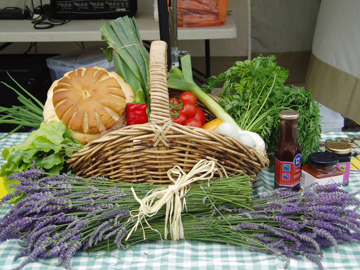
The farmers’ market in Winchester, England has a great variety of produce, organic vegetables and fruit.

For more info, go to Visit Britain.

Cruising Through Central Germany

By Marilyn Heimburger
Photos by Don Heimburger

Are you are looking for a vacation that combines relaxation, a bit of history, romantic castles, charming medieval villages, and excellent cuisine? This week-long river cruise on the Moselle, Rhine and Main rivers in Germany, offered by Avalon Waterways, may be the perfect choice for you.

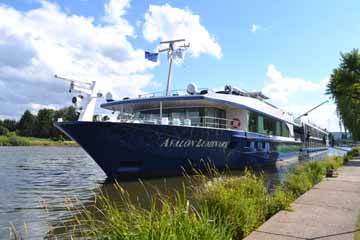
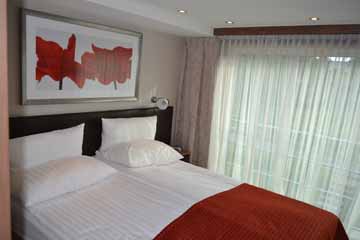
The MS Avalon Luminary, our ship for this cruise, was just recently added to Avalon’s fleet. Its 69 staterooms and suites are designed for efficiency, with plenty of space to stow personal items and luggage. Each room had a small bathroom with shower, comfortable memory foam mattress, a desk, lamp, mirror, fresh flowers, mini bar, and a safe for valuables. A television provided satellite programming and broadcast the view from a camera at the front of the ship. Floor-to-ceiling windows open to a private balcony in most rooms. It’s a luxury of river cruising to just unpack once and let the ship transport you with ease to each destination.

Another luxury on a cruise such as this is the excellent cuisine. The sumptuous breakfast buffet included breads, pastries and cereals, fruits, eggs, potatoes, sausages and bacon, and made-to-order entrees. The full lunch buffet served each day in the main dining room offered soups, salads, choice of main course and desserts. A lighter lunch option was also available in the lounge one deck above. Five-course dinners included an appetizer, choice of soups, salad, choice of meat, fish or vegetarian main course, and several dessert options. The well-trained staff served red, rose, or white wine or beer upon request.

BOARD IN LUXEMBOURG
Boarding the Luminary in Remich, Luxembourg, we were welcomed by cruise director Jean Loup Domart. Entertaining, energetic, and extremely organized, Jean excelled at keeping everything running smoothly.

Although we set sail while dinner was being served, we missed none of the excitement, since the dining room was designed for maximum viewing, with panoramic windows on both sides. A sense of intimacy was provided with fresh orchids in lighted open rectangles dividing the large space without interrupting with the view. The lounge on the level directly above the dining room was also designed for watching Germany glide by in the most comfortable of settings.

Our first stop was Trier, Germany, which boasts amazingly intact structures from the Roman Empire, including imperial baths, an amphitheater, and Constantine’s reception hall, which now serves as a protestant church. Did you ever wonder why Roman ruins always seem to be discovered 6 feet underground? We learned from our local guide that after Roman towns were abandoned, local residents built homes by taking usable stones from the old Roman buildings. Over the course of 600 years, this practice left a 6-foot-deep base of rubble, upon which the medieval towns were built. Trier’s Porta Nigra (black gate) is black from wood fire smoke from Roman times, and was left standing because it was a site that attracted pilgrims, who brought money to the church.

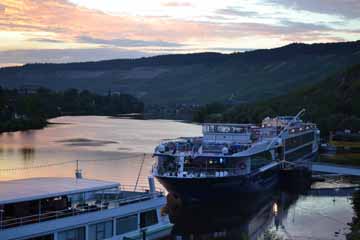
As our trip continued down the Moselle, we passed vineyard after vineyard and peaceful patchwork slopes, dotted with small villages and church steeples. The southern facing slopes provide the perfect environment for catching warm sunlight needed to grow grapes for Germany’s famous Riesling wines. And the ship’s outdoor decks were perfect for relaxing with a cup of coffee or listening to birds along the shore as the ship glided quietly along.

BERNKASTEL-KUES WEINFEST
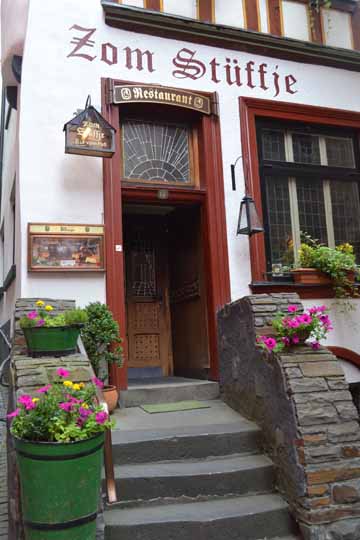
Our late afternoon arrival in Bernkastel-Kues allowed just enough time to explore the Old Town around the quaint market square. This town hosts the biggest Weinfest on the Moselle in September. One vineyard overlooking the town is the source of their “Doktor” wine. Legend has it that drinking some of the wine from this vineyard cured an archbishop of an ailment, so the wine became known as the “Doktor.”


Half-timbered buildings in Bernkastel

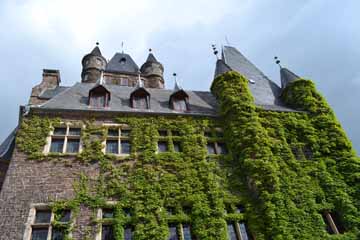
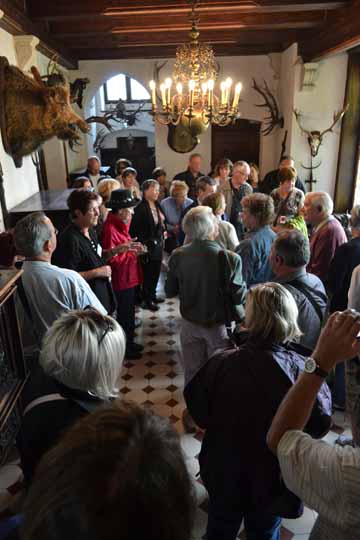
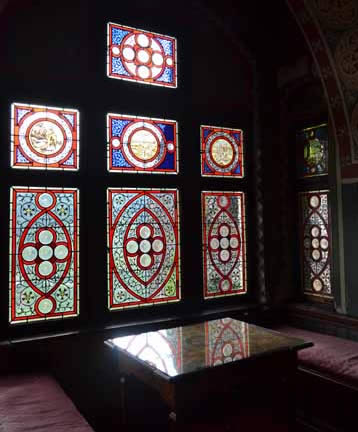
The next day brought us to the wine town of Cochem and a tour of Reichsburg Castle. The interior of the castle highlights not only only medieval artifacts, but Renaissance and Baroque furnishings selected by the 19th century restorers. The tour was informative and the view from the castle — spectacular.

 Passengers tour the castle

The Moselle joins the Rhine at Koblenz, an important center of trade during the Middle Ages. An imposing statue of Kaiser Wilhelm I mounted on a horse dominates the Deutches Eck (German Corner) where the two rivers meet. We arrived just before dinner, with enough time for a short walk into the square to see the many shops and restaurants. The fortress Ehrenbreitstein stands on the opposite bank of the river and provides a beautiful panoramic view of the area.

To begin our cruise down the Rhine Gorge (some say the most beautiful part of the Rhine) first thing in the morning, we docked overnight at Koblenz, and were entertained on board after dinner by a small ensemble of classical musicians.

THE MIDDLE RHINE
The next morning was filled with the history, legends and romance of the Middle Rhine. Cruise Director Jean Loup provided informative narration as the ship glided along, with passengers enjoying the view while relaxing on the sundeck. We learned that during the Middle Ages the Rhine River Gorge posed many hazards for travelers, and provided many opportunities for powerful kings to levy tolls for safe passage. They built castles and fortresses in the 12th and 13th centuries along the banks to collect tolls, make money, and enlarge territories.

Reichsburg Castle

The castles were usually built high on hills, close to a spring, and often on a curve with a view of the river. Stones for the castles were lifted with wheels and ropes, and the building projects provided work and security for locals, whose lifespan at the time was only about 40 years. Most castles were built with limestone, which was easier to work with than granite. Later palaces were built with marble, as techniques improved. To attack a fortress, enemies could try to break down a wall or door with a battering ram on wheels with a roof as protection from arrows shot from the castle. Or a catapult could throw fire over the castle walls. Castles residents used beehives, hot tar or hot water to fend off attackers. Some fortresses housed armies of 600.

In the town of Boppard we saw Sterrenberg and Liebenstein, known as the castles of the enemy brothers, and heard the legend: Two brothers both fell in love with their adopted sister. She wanted none of this, and entered a monastery in town to live as a nun. The brothers fought and finally built two castles next to each other with a wall in between.
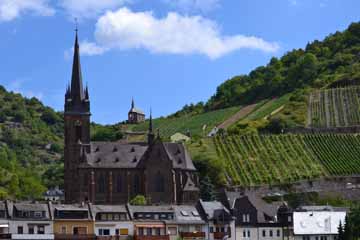
The 430-foot-high Lorelei rock is located where the river narrows, creating treacherous currents dangerous to ships. The famous legend of the beautiful maiden who sat on the rock luring sailors to their destruction with her singing is commemorated with a bronze statue.

The town of Oberwesel, below Schoenburg Castle, still has many fortification walls and towers still standing. When the river water is low, travelers can see the “rocks of the seven virgins.” Legend has it that a lord with seven sons wanted to arrange marriages for them. The seven chosen virgins didn’t want to marry, and threw themselves into the Rhine, where, because they were so hardhearted, they turned to stone.

Pfalz Castle (whose gold lion was to symbolize strength and power) was built in the 16-17th century as a customs tollhouse on a little island in the middle of the river. Gutenfels Fortress was built on the bank opposite Oberwesel to protect the tollhouse.

Sooneck Castle, a toll-enforcing castle from the 11th century, also housed pirates. It is one of the oldest along the Rhine and is restored as a cafe.

In an attempt to preserve the beauty and tranquility of the shoreline, many of the houses along the shore are painted in soft pastels, often pale yellow, a color made popular by Maria Theresa. Train tunnel entrances on this stretch of the river are built to look like castles, in order to blend in with the style of the area.

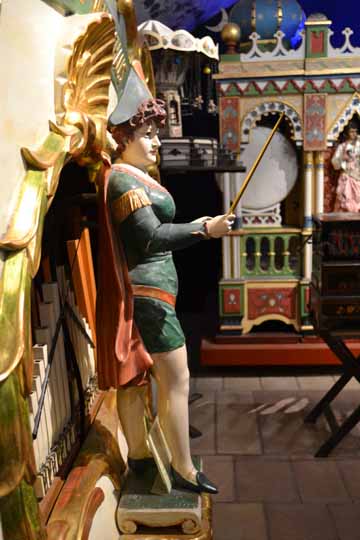
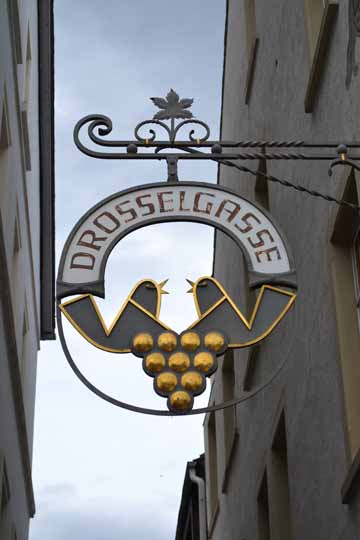
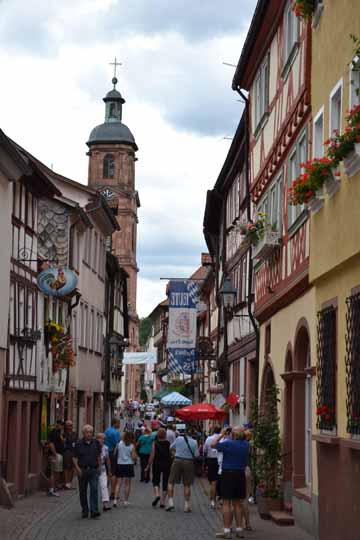
(left to right) Siegfried’s Mechanical Musical Instrument Museum; Drosselgasse, a lively street in Rudesheim.

DROSSELGASSE A FAVORITE
Our last stop on the Rhine River was in Rudesheim, where we enjoyed a guided tour of the Museum of Mechanical Musical Instruments (some imitating entire orchestras in one huge contraption!), and a local winery. Be sure to take time to explore the exciting main street, the Drosselgasse, with its many restaurants and shops.

Navigating the Main River is a slow process because of the many locks needed to raise or lower the ship along the route. So our ever resourceful cruise director kept passengers busy on board with an entertaining German lesson, and a cookie-baking demonstration by an “almost nun” from Miltenberg, our next port of call on the Main.

Miltenberg

Miltenberg was built against a hill at a curve in the river, a perfect place to collect tolls for the archbishop of Mainz. Many half-timbered houses are still preserved because the people here were too poor to tear them down and rebuild. If a floor sagged and sank, it was filled with sand and covered with another floor. In some recently renovated buildings, 30 centimeters of sand/wood layers were discovered beneath the floor. The original red “paint” on the houses was a mixture containing, among other things, oxblood and cattle dung, which provided the desired red color and also killed worms that might live in the wood. A unique naturally cool icehouse is located in the hill at the rear of the town.

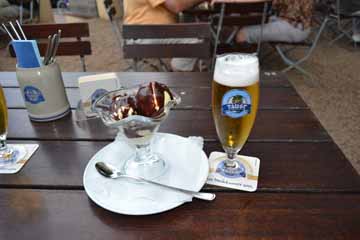
Cold beer and ice cream

While the ship slowly navigated through more locks, passengers rode by bus to Wurzburg, and met the ship when it finally docked after our tour. Wurzburg is the site of the Prince Bishop’s Residenz, which is one of the finest examples of a baroque palace, and also a UNESCO World Heritage Site. It was built to rival Versailles in France and the Schoenbrunn in Vienna. The unique mirrored room features the difficult technique of reverse painting. The famous ceiling fresco by Tiepolo miraculously survived bombing, and the original marble floor is still in the main reception hall. The “marble” pillars are actually a stone core with a ground marble coating so that colors could be controlled, a technique that was more expensive than using solid marble.

Wurzburg

WURZBURG AND X-RAYS
Wurzburg was also the home of Professor William Conrad Rundkin, winner of the Nobel Prize for the discovery of X-rays. Residents in Wurzburg are not x-rayed; they are “Rundkined.”

Bamberg

The terrain along the river from Wurzburg to Bamberg changes and becomes flatter, with fewer vineyards, more trees and shrubs, and more locks. This quiet time was perfect for relaxing with a book from the ship’s library, located in the small lounge at the rear of the ship. There passengers found English language books of all genres, games, and the most wonderful coffee machine which dispensed espresso drinks that rivaled any coffee shop. Iced tea, shortbread cookies and other snacks were available 24/7. The ship also had an exercise room with a treadmill, two types of exercycles and flat screen TV, and a small beauty salon.

Cruise ship surprises

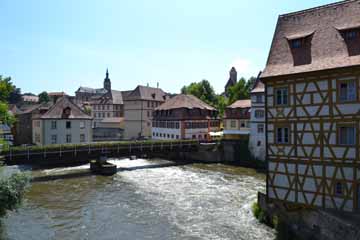
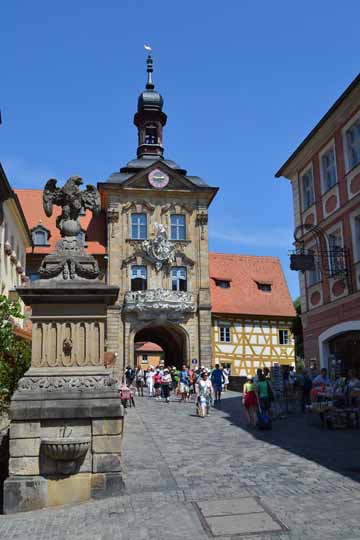
Busses again transported us to meet local tour guides in Bamberg, another UNESCO World Heritage Site. There we learned the local history of the cathedral, the Old Town Hall, which straddles the River Regnitz, had an opportunity to taste the local specialty, “Rauchbier” (smoked beer), and had time for browsing in the main pedestrian shopping area.

Our cruise ended the next morning upon arrival in Nuremberg, from which some passengers continued by bus to Prague, and others to charming Rothenburg ob der Tauber.

IF YOU GO..
Avalon Waterways, which has been in business for 80 years, has a number of different river cruises available in Europe. Their river cruise ships are small compared to ocean liners, which makes the service and trip more personal. They also have Europe’s youngest fleet of ships, with their fleet averaging just two years old, compared to seven years for other cruise companies.

There are full floor to ceiling sliding glass doors in 85% of the deluxe staterooms on Avalon’s fleet. Also, the Luminary had lots of space in the central passenger areas such as the dining room, lounge and library.

The Luminary offered five categories of rooms including Royal Deck suites; Royal Deck Category P; Sapphire Deck Forward, Category A; Sapphire Deck Aft, Category B; and Indigo Deck, Category E.

For more information, go to www.avalonwaterways.com or call 877-797-8791.