Christkindlmarkt Nuremberg-Style

By Marilyn Heimburger
Photos by Marilyn and Don Heimburger

When you think of Christmas markets in Germany, Nuremberg usually comes to mind first. It has a very long history and is considered the “queen” of the Christmas Markets.

The Christkindlmarkt of Nuremberg was first called “Kindelsmarkt” in an inscription on a wooden oval box dated 1628.

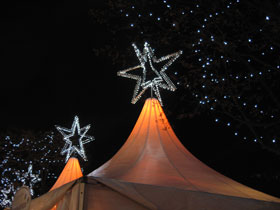
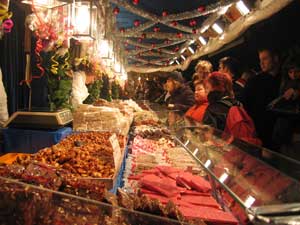
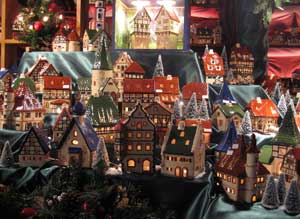
The main market square between the Schoener Brunnen (beautiful fountain) and the Frauenkirche (Church of Our Lady) is the site of this famous Christmas market. The 180 market stalls with their red and white-striped canvas roofs are arranged in rows and fill the area with the aromas and lights of the holiday season. The popular Christkindlmarkt has been called a “Little Town of Wood and Cloth.”

PRUNE MEN ARE SPECIALITY

Vendors offer the beautiful craft wares and decorations found in many markets. But one special item you can find here are prune men: figures 6-8 inches tall with arms and legs made of dried prunes and heads made of walnuts.

An edible specialty of Nuremberg is its tiny sausages, which weigh exactly 23 grams and are about the size of a little finger. According to legend, they were made small enough to fit through the keyhole of a door, just in case someone was locked out of the city gate after curfew and needed something to eat!

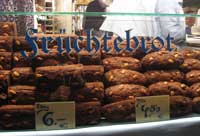
Another treat is Nuremberg’s famous Lebkuchen (gingerbread). Lebkuchen Schmidt ships its goods all over the world, and is available in beautifully decorated tins, even music boxes (www.lebkuchen-schmidt.com.)

Unique to the Nuremberg Christmas market is Christkind, who officially opens the market at 5:30 p.m. on the Friday before the first Sunday in Advent. The Christkind, or Christmas Angel, represents the Christ Child as the one who gives gifts on Christmas, as opposed to St. Nicholas, who delivers gifts into the waiting shoes of good children on December 6.

Every two years since 1969 a young girl is elected by a combination of popular vote and jury selection to represent the Christkind. Strict rules govern the age and height of a Christkind candidate. She must also be a good student, since her many appearances force her to miss school, and she must not be afraid of heights, because she must stand on a balcony near the top of the Church of Our Lady to deliver her market-opening pronouncement!

SPECIAL REQUIREMENTS

Nuremberg is understandably proud of its Christkindlmarkt. In order to protect the market’s reputation, war toys are banned, as are decorations of plastic firs, products displayed in cardboard boxes, and canned Christmas music.

A short walk away from the main market square is the Rathausplatz (Town Hall Square) where you can find 14 vendor stalls from Nuremberg’s partner cities offering their unique wares.

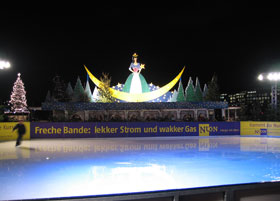
In addition to the Christkindlmarkt in Nuremberg’s main market square, a special Kinderweihnacht (Children’s Christmas Market) on the Hans-Sachs-Platz has entertained families since 1999. A 100-year-old steam Ferris wheel, a steam railway and a merry-go-round offer rides. Vendor stalls have lower counters to invite children to see and touch, decorate cookies and candles, and have pictures taken with Santa. Across from the children’s market is the Sternenhaus (Star House), which serves as headquarters for the Christkind and offers cultural programs for children.

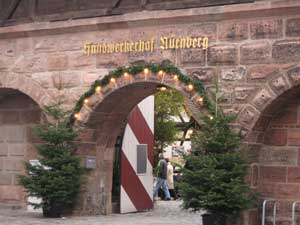
One very special market open all year round, but is especially magical during the Christmas season is the Handwerkerhof. Located across from the main train station, the stone and half-timbered structures look as old as the King’s tower and fortification walls that surround them. But the entire little town was built in 1971 as an additional attraction during the Albreacht Durer 500 anniversary celebration. It has remained a year-round attraction highlighting craftsmen who work with pewter, leather, glass, candles, precious metals, gingerbread and dolls.

You can watch bakers make Lebkuchen, shop for tin toys, wood and glass ornaments, have a mug of hot spiced wine, and then eat at the Bratwurstglocklein, a wonderful wood-paneled, low-ceilinged pub with waitresses dressed in traditional dirndls, and food served on pewter plates. Try the tiny sausages each of three ways: cooked with vinegar and onions, smoked and grilled. Served with potato salad, saurkraut and beer, it’s a tradional Nuremberger treat. The Handwerkerhof is open six days a week (seven days a week during Christkindlmarkt) from the middle of March through December 31 (www.handwerkerhof.de.)  

Wonderful accommodations for your Christkindlmarkt visit can be found at the Maritim Nuernberg (www.maritim.de.) It is conveniently located just a short walk from the main train station, and across the street from the Handwerkerhof. Another short walk takes you to the main market square and the Christkindlmarkt in the shadow of the Schoener Brunnen.

One more suggestion: before leaving the main market square, look carefully at the Schoener Brunnen until you find the gold ring. Make a wish and turn the ring three times to make your wish come true. Perhaps you will wish to return to this beautiful market again next year!

InterCity Hotels: In the Center of the Action

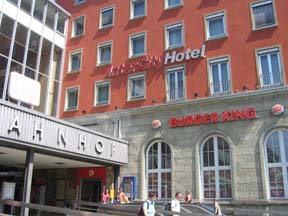
InterCity Hotel in downtown Munich

By Don Heimburger
Photos by the author

My business takes me to European cities several times a year, and I usually end up spending a lot of time in the “old town” or historic part of a city or town. It’s typically my favorite place to spend time, looking at the market squares, visiting hotels and restaurants, asking questions about town festivals and events, or visiting a museum or other local attraction.

When I’m done at the end of a day, I want to stay close to the center of town, because really I’m not done with my work. There’s always more to see and do in the evening, and that means generally after a late afternoon break, I’m back again, interviewing, taking pictures or attending some function. And again it’s usually near the center of town.

CENTER OF TOWN CLOSE TO TRAIN STATION
In Europe, the center of town means it’s in close proximity to the train station, because the railroads are and were instrumental in growing cities.

One company that likes to locate its hotels near the train stations is Steigenberger’s InterCity Hotel group, a chain of 31 facilities in Germany and one in Austria. Their own literature says, “If you are seeking a centrally located, functionally equipped and comfortable domicile, InterCityHotels are your perfect choice.”

In a recent business deal, the Egyptian tourism corporation Travco Group became a majority stockholder in the Steigenberger Hotel Group. “Particular focus will be given to international expansion of the brands Steigenberger Hotels and Resorts and InterCityHotel,” says Hamed El Chiaty, founder and owner of the Travco Group.

On a recent trip to Munich and Freiburg, I booked rooms at the InterCity Hotel in both cities. From the Munich train station, where I arrived from the airport, I only had a few steps before I saw the familiar InterCity sign at one end of the train station.

FEATURES OF HOTEL
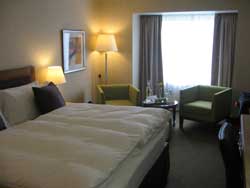
The five-story hotel has 198 rooms and suites, floors for non-smoking, with all rooms sound-proofed and air-conditioned. The soundproofing was a good idea, as next to a train station, it can be fairly noisy at times. Rooms feature a bathroom with shower, toilet, hair dryer, cable television and a writing desk. There was a WiFi connection in the room. The hotel featured two elevators and a restaurant (Fleming’s Brasserie & Wine Bar), where the morning’s complimentary breakfast was served.

I was happy to have room air conditioning when I was there, as it hit 95 degrees in the afternoon in Munich, a rarity for this city so close to the Alps.

A convenient part of any InterCity booking is a complimentary card that allows guests to use local public transportation free of charge. So if you want to go to the Marienplatz, as an example, which I did several times, I just presented my card at the train station when needed, and I enjoyed free transportation. The city center is less than a mile away.

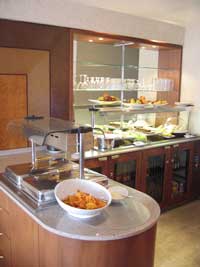
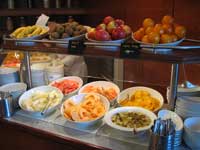
Intercity hotels are mid-range in price, clean and walkable to the inner city. In the morning, a buffet-style breakfast was served with scrambled and hard-boiled eggs, sausage (white Munchener sausages), several types of yogurt, two types of juice, hard rolls, whole grain breads, crossiants and pastries, bacon, large pretzels, a variety of soft and hard cheeses, six types of cereals and a variety of cold cut meats.

There was also dried fruits, fresh fruits such as watermelon, pineapple, and a bowl of mixed apples for guests. I was ready to start my day!

The lobby downstairs was sparse but featured comfortable chairs and couches for guests, as well as a few tables.

THE FREIBURG INTERCITY
Later on, I took the train to Freiburg near the Black Forest, where again a stay at the InterCity there kept me close to the train station and was only a few blocks from downtown. The hotel, in fact, is just a few steps from the entrance to the train station.

This multi-level hotel features 152 guestrooms, had non-smoking rooms, cable television, direct dial telephones, a modem/fax link, a writing desk and a mini-bar. There was no air conditioning, so with the hot weather, keeping the window open was a necessity; I was told the typical summer high temperature doesn’t require air, and it’s not available in most Freiburg hotels.

The room had a shower, toilet, hairdryer, and a restaurant and a bar downstairs. The hotel staff was pleasant and I noticed they was able to answer visitors questions about the train schedules and the city. Again the room was clean and had the basics. The hotel even had rooms for the disabled if needed.

In all, a stay at a InterCityHotel affords travelers a convenient location for a mid-range price, with breakfast included.

MORE HOTELS TO OPEN
More InterCity Hotels are scheduled to open with the merger of the Travco Group. Steigenberger’s Chief Executive Officer André Witschi says that the company will continue to invest in improving the quality of their hotels, and international expansion will help them to increase brand awareness for Steigenberger Hotels and Resorts and InterCityHotels.

In 2010 and 2011 InterCityHotels will open five new locations in Germany: at the Berlin-Brandenburg Airport and in Bonn, Darmstadt, Mannheim and Ingolstadt.

For more information, go to:
www.intercityhotel.com
www.muenchen.intercityhotel.de
www.freiburg.intercityhotel.de

Contact the hotels by e-mail: info@muenchen.intercityhotel.de
info@freiburg.intercityhotel.de

If you are arriving by train:
www.raileurope.com

Yodeling on the Shores of Lake Lucerne

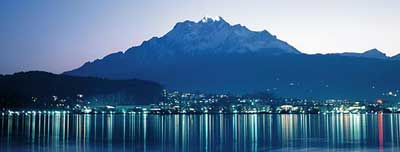
Approximately 200,000 spectators are expected to visit Lucerne, Switzerland for the 27th Swiss Yodeling Festival from June 26 to 29. More than 11,000 yodelers, flag throwers and alphorn players will participate in a number of contests along the shore of Lake Lucerne.
A festival parade winds through the Haldenstrasse and across Lucerne’s “Seebrücke.”

PROGRAM EVENTS

Thursday, 26 June 2008

  • Two national finals: 13th Swiss Young Talents’ Yodeling Competition and the 15th Swiss
    Young Musicians’ Competition

Friday, 27 June 2008

  • Competitive events for yodeling, alphorn blowing and flag throwing
  • Festival happenings in the yodelers’ pubs and at yodelers’ stands

Saturday, 28 June 2008

  • Competitive events for yodeling, alphorn blowing and flag throwing
  • Festival happenings in the yodelers’ pubs and at yodellers’ stands

Sunday, 29 June 2008

  • Ceremonial presentation of the flag
  • Reception of festival veterans, ceremonial church service and official festival ceremony
  • Festival parade
  • Festival happenings in the yodelers’ pubs and at yodelers’ stands

InterContinental Hotel Prague

Restful haven in a bustling capital

By Don Heimburger
Photos by the author

The InterContinental Hotel in Prague sits on the banks of the Vltava River in the city’s Jewish Quarter.

This is important because it offers a great view of the city and the Prague Castle and the river’s activities, but it also is convenient to the historical center, as well as transportation. The high-end shopping area called Parizska Street is a few steps outside the door.

I didn’t realize all this when I first spotted the hotel, but soon I realized that location sometimes can be everything. But for his hotel, it goes beyond that. It’s a luxury accommodation on the inside, as well as being centrally located.

OFFERS 372 ROOMS
The hotel offers 372 rooms and suites and another important feature, especially for the business traveler—the Club InterContinental (concierge service, a library, free internet access, copy machine, newspapers and refreshments).

The hotel’s rooms feature goose-down duvets, blackout curtains, Italian marble bathrooms, mini-bar, in-room safe, color television with 47 channels, telephone, voice mail, coffee machine, iron and ironing board and individually-controlled air conditioning.

I found plush towels in my room, fluffy pillows, chocolates at turn down time, bright, cheerful rooms with two comfy chairs and 3.4 ounce bottles of shampoo, lotion, conditioner and shower gel. The bathroom had two hand towels, two face towels and two shower towels. There was plenty of closet space, a storage cabinet and nice plush carpeting. The flat screen television was of the newest model, and the swimming pool was nice.

BREAKFAST: GOOD VARIETY
Breakfast, an important meal for business and leisure travelers alike, featured a large variety of meats and sausages, cheeses, cereals, potatoes, hot plates such as waffles or scrambled or fried eggs made to order, breads and rolls, juices, coffee and tea, and fruit, as well as whole fruit. The breakfast was delicious and there was plenty of it. The wait staff was pleasant and efficient.

The hotel’s staff is multilingual–good when you can’t understand the local language.

The Zlata Praha Restaurant in the hotel serves a wide variety of dishes, including Czech and international cuisine. A Sunday brunch is also offered between 11 a.m. and 3 p.m. A second restaurant on the first floor, the Primator, offers excellent views of the river. Duke’s Bar & Cafe offers a pleasant setting for a quiet drink or two, with live entertainment on Friday and Saturday evenings.

A Health club and spa are part of the hotel offerings, with whirlpool, saunas and solariums, as well as five treatment rooms.

To make a reservation, go to www.intercontinental.com/prague or www.icprague.com. The five-star InterContinental hotel is located at Curieovych 43/5, Prague 1, 110 00, Czech Republic. E-mail is prague@ihg.com.

Hotel Amigo Is a Friendly Place

By Don Heimburger
Photos by the author or as noted

“I am delighted to introduce the Hotel Amigo, which we restored to its rightful status as the best luxury hotel in Brussels,” said Rocco Forte when the hotel’s renovation was completed in 2002. Forte, owner of the Rocco Forte chain of 14 hotels (some currently under development), which are located in European capitals and in Marrakech, has assembled a group of upper-scale hotels that are designed to provide all the usual  higher class amenities and then some.  

Located at Rue de l’Amigo 1-3, only a block from the famous Grand Place, considered the center of Brussels and noted as likely the most beautiful square in Europe, the five-star Amigo is ideally situated near the key historical sites, shopping areas, restaurants and entertainment.

The doormen in their black top hats signal a welcome to the hotel; the lobby is small, but neat and classy with a dark-paneled reception counter and polite clerks. 

The air-conditioned room was bright, very clean, with a small suite adjoining the bedroom and bathroom. Comfort was key. There was a modern feel to the room which featured furniture and pictures from the Blaton collection and influences from Brussels’ history. The bright bathroom featured a red mosaic vanity top and excellent toiletries.

The room contained Brussels linens, red silk curtains with embroidered velvet details and Flemish chairs and desks. The bed was firm and comfortable. The room was quiet and provided a cozy getaway from busy shopping or touristy activities. I did not try the restaurant for dinner, or the bar, being there only one evening.

A BIT OF HISTORY

The hotel has a bit of history. The original structure on the lot was built before 1522 by a wealthy merchant family and later purchased by the city council and turned into a prison. In 1957 the Hotel Amigo was built by the Blaton family on the occasion of the Universal Exhibition of 1958. During the Rocco Forte renovation in 2000, it underwent a re-styling by Olga Polizzi, the hotel’s director of design. Canvases from artists such as Courtens, Dansaert and Wagemans, together with Flemish wall tapestries from the 18th century, give the hotel a pleasingly modern but still historic flavor.

The morning breakfast included all the necessary eggs, breads, meats and cheeses, juices, coffee, and fruits to satisfy many diverse tastes. The wait staff was pleasant and helpful.

Then hotel was won many awards, including being rated one of the top 100 hotels in the world by the Institutional Investor in 2007. Forbes Traveler rates it one of the top 400 hotels in the world.

European Traveler rates it extremely high as well. We liked virtually everything about it. 

The lowdown:

• Member of the Leading Hotels of the World
• 174 rooms, including 18 suites and the Blaton Suite (on the top floor with large terrace for excellent views of Brussels)
• In-room telephones, voice messaging, internet connection, cable TV, marble bathroom, minibar, safe, trouser press
• Ristorante Bocconi, with bar in the lobby
• Ballroom for up to 200 guests
• Fitness center
• Transfers from the airport (at a charge)
• 24-hour room service which “arrives on time” (the hotel guarantees this)
• In 2007, room rates for a classic room single were 590e; 720e for an executive room single
• General Manager: Ivan Artolli, since 2002 (fluent in French and English)
• Reservations: amigo@roccofortehotels.com