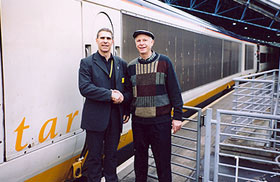
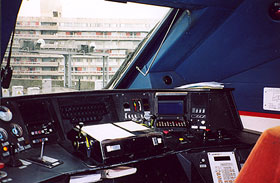
Don Heimburger and Eurostar Driver Detlef Hofmann shake hands prior to departure from Waterloo Station, London, when the train left from this station.
Nearly 22,000 travelers hop aboard a Eurostar train each day, and more than 75 million have traveled the Eurostar routes over the last decade.
That figure represents more rail passengers than all the airline passengers combined on both Eurostar routes out of London.
So what’s new with Eurostar for 2008?
NEW FOR 2008
For one, since November, 2007 Eurostar has moved to a new station, from Waterloo to St. Pancreas, reducing the rail journey between London and Paris by 20 minutes. (I loved Waterloo Station!) The travel time is now 2 hours and 15 minutes, and between London and Brussels it is only 1 hour and 51 minutes.
Also opened was Great Britian’s first high-speed line (called HS1) which carries the Eurostar exclusively. This allows travelers from London to Paris or Brussels to use the train for a one-day business or leisure trip. Every day the train runs 18 roundtrips between London and Paris and 10 between Brussels.
Eurostar trains feature 18 cars each, with car configurations changed depending on if the train is designated as a Business Premier train or a Leisure Select train. The train also runs to Lille, Eurodisney/Marne La Valle, Avignon (summer only), and Bourg St. Maurice (winter only).
TRAINS SEAT 766
Trains seat 766 persons, with special cars situated between cars 7 and 12, and standard class cars 1-5 and 14-18. There are always two bar cars, 6 and 13.
If you are a U.S. citizen, you will probably want to book your trip through Rail Europe, especially if you want to purchase a Eurail Pass that can include the Eurostar (and you can receive up to a 60% discount). Go to http://www.raileurope.com for the details.
In other European rail news, last summer the new French Railway TGV East train broke the world’s rail speed record, reaching a top speed on the trip of 357 miles per hour! A Rail Europe spokesman said, “This accomplishment is monumental for the SNCF and the rail community, and will have a positive impact on all who wish to travel east from Paris.”
The average speed, however, of the TGV East trains is 200 miles per hour. Each first class seat features its own electric power outlet, and broad seat cushions; first class passengers can book a taxi through the train conductor; and on-board messages are in French, German and English.
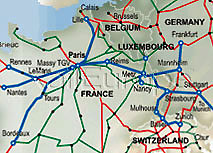
As an example of faster speeds on the TGV, here are new travel times posted by Rail Europe for travel between some stations:
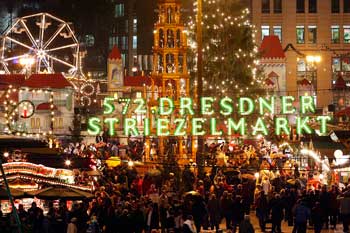
This holiday season, Rail Europe presents the “German Christmas Markets,” a seven day itinerary to five enchanting Christmas markets throughout Germany.
These unique and unforgettable markets invite travelers to experience the sights, smells and traditions of European Christmas festivities. Visitors can dive into a winter wonderland of regional traditions, handcrafts and culinary specialties such as Christmas Stollen (German Christmas cake), Lebkuchen (gingerbread) and Gluehwein (hot spiced wine). They can stroll through festively-decorated streets lit by thousands of twinkling lights and explore historic town centers as Christmas carols echo through the streets.
Travelers can begin their journey in Dresden, home to one of the most well-known Christmas Markets in the world. Best known for its long royal and political history, Dresden has emerged as the cultural and educational center of Germany.
Then, travel by train to Weimar, a city known for its rich history and architecture and home to scholars such as Goethe, Schiller and Herder. During the month of December, the city’s Gothic town hall on the market square is transformed into a life-sized Advent Calendar, where three children open a new window each day as Father Christmas greets them with a small gift. From Weimar, travelers will be whisked away to the medieval streets of Erfurt, where Christmas carols ring out and the air is filled with the aroma of gingerbread.
Next stop–Eisenach–where travelers fall head over heels for the romantic market nestled within Wartburg Castle’s walls. One of the best kept medieval castles in Germany, the Wartburg boasts a medieval marketplace with Christmas concerts and artists, craftsmen and knights, and colorful booths decked with boughs of holly.
The trip concludes in Frankfurt, a buzzing financial metropolis housing one of the oldest and most elaborate markets in Germany, attracting more than three million international visitors each year. Over 200 stalls offer arts and crafts, festive cuisine and a varied program of Advent concerts and trumpets playing from the balcony of St. Nicholas’ Church.
It’s an unforgettable experience–Christmas, Germany and trains!
Rail Europe offers hotels and train travel in their German Christmas Market package. For more information, go to www.raileurope.com.
Spreading a colorful 22″ x 30″ Deutsche Bahn (DB) railroad map out on the dining room table one evening, I savored the prospects of a European rail adventure.
I had seen many photos of the exciting and sleek European trains, and could actually name some of them, such as the Eurostar, the fast TGV’s and the ICE (InterCity Express) trains. I just had to ride some of the 160,000 miles of Europe’s railway lines to experience them for myself.
The DB rail map showed so many lines—there were electrified lines, lines for both long-distance and short-distance trains, private railways and high-speed lines under construction. There were even bus lines and rack railways.
As the first 15 minutes of map scanning lapsed into almost an hour because of all the rail possibilities, and places I wanted to go, I recognized that I’d have to scale back my plans for a 10-day trip, otherwise I’d never return home again. Besides, once I called up the DB rail schedules on the internet (www.bahn.de), I realized it would take as much as a full day of train riding to journey to some of the towns I wanted to see.
I knew I’d be able to secure good March airfares before the official traveling season began through American Airlines Vacations. I had found AA to offer quality air-hotel packages, so I booked one night in London (to recoup from the seven-hour trans-Atlantic flight), and an evening in Frankfort, Germany, the last city we’d visit.
My wife, Marilyn, would be an excellent travel companion as she could speak and understand enough German to allow us to eat (this is very important). We had planned a number of tight train connections during the trip, so her knowledge of German was a vital component in keeping to our schedule. She had a number of years of German in high school and college, as well as helped chaperone a tour group to Germany before. And the last time we went on a tour of Germany together, people from our bus followed us down the street so they could eat at the same establishments that we did, thinking they could ask Marilyn for help in translating the menu!
COMPLETELY ON OUR OWN
I had been to Europe several times before, as had Marilyn, but this would be a trip completely on our own without the help of a guide or any tourist service or agency. Thus it was with determination, and a bit of humility, that I set out to see just exactly how we could piece a 10-day European trip together using many original sources and no middlemen or travel agencies.
My idea was to travel on as many trains as possible, and on as many different trains as possible, see numerous points of popular interest and historic sites along the way, and also do some very specific sightseeing that we had in mind.
While American Airlines was the air carrier, Rail Europe (www.raileurope.com or call 888-382-7245) issued first class Eurail Flexipasses (cost $778 per person) which allowed us to travel 15 days during a two-month period in 17 countries, including Belgium, Denmark, Germany, France, Luxemburg, Spain, Switzerland, Portugal and Italy, among others. This was an absolute bargain because of the number of trains we could ride and the locations to which we could travel.
Other types of Rail Europe passes and terms are also available at different prices.
With the Eurailpass, you are afforded unlimited travel, as well as discounts for tourist railways, hotels and car rentals. You must purchase your ticket while in the U.S. prior to traveling to these places, however. Another requirement is that you have your ticket validated prior to boarding your first train (more on this later). Naturally, you’ll also need a passport, which you can obtain from designated post offices.
Our itinerary would take us to London, then Paris for two nights, then to Wernigerode in the Harz Mountains in former East Germany to ride the steam trains there, and then through Leipzig to Seiffen (the “toy village”) near the Czech Republic border, then to Frankfort. Between all these points were numerous towns we would travel through or at which we would change trains, and we were looking forward to making these connections part of our rail experience.
RAILFAN DREAM TRIP
What I had planned was a railfan’s dream trip throughout a portion of Europe that would not involve any transportation other than trains (both above ground or the underground species)—or the occasional DB bus. In Europe, you don’t need a taxi or a car in most cities if you’re willing to do some walking. The “ring” area of many European cities is best seen by walking anyway.
We left Chicago’s O’Hare International Airport on a cold, damp Thursday afternoon on a direct flight to London. After dinner, we had learned from previous flights to begin to relax and try to get some sleep. First-timers will find it hard to get much sleep because of all the excitement, but if you sleep even a few hours, it can pay off once you land.
On a seven-hour flight that begins at 5:20 p.m., you eat supper by 7 or 8 p.m., watch an in-flight movie, get some rest, and before you know it the flight attendants are serving breakfast prior to landing at Heathrow Airport.
We negotiated the famous London Tube from the airport okay, having purchased just a one-way tube ticket to a stop near the four-star Melia White House Hotel near Regent’s Park. After checking in at about 10 a.m. and finding that our room wasn’t ready, we were ushered to a comfortable sunken dining area of the hotel where hot coffee, fresh-squeezed orange juice and pastries were being served. This was very welcoming after a long flight and the cold, damp London winds that literally blew us into the hotel’s front door. When our room was ready about an hour and a half later, we found that the hotel clerk had upgraded us to a better room because we had to wait. I kinda like those British.
After sleeping off the effects of jet lag, we decided we still had time to walk to the British Museum, where a friend had said the Magna Carta was on display. While the Magna Carta is no longer in the museum, we did enjoy the museum’s food court. It’s a large, open space under a high sun roof that rivals most American shopping mall food courts. Later we were told the Magna Carta was moved to the British Library, but we did see plenty of ancient sculptures, rare books and paintings, nonetheless.
After a candlelight dinner of English fish and chips and Pilsner beer at the Green Man pub across the street from the hotel, we headed back to our room. By 7:30 p.m. we were asleep; that is, except for the unmistakable sound of Far Eastern religious chanting emanating from the next room, which mercifully stopped about 2 a.m.
We were up by 6:15 a.m. and carbed up on the hotel’s “Full English Breakfast” promised us. We noted we had only 10 British pounds left to spend, so we were glad the Eurostar beckoned.
EUROSTAR BECKONS
We had made reservations on the 10:39 a.m. Eurostar from London’s Waterloo Station, located not far from the Eye of London and the Royal Festival Hall. Just a couple of weeks before, I had spotted the Waterloo Station facade on a television travel program, and wanted to make sure I arrived in plenty of time to get a photo of it. It seems few people around the station actually know where the front of the station is because there are so many entrances to the structure, but finally a rail information clerk was able to tell me where it was.
After taking pictures (it has a marvelous front—nothing like that of most rail stations in the United States), and grabbing a quick mocha coffee, we headed for the Eurostar gate. I noticed seating in the station was at a premium, but a “Station News” bulletin in a rack mentioned that 40 additional station seats were to be added in early 2004.
The Eurostar departure gate is situated a long walk from the regular train platforms, and in this part of the station there’s another entire retail outlet section where I could have purchased coffee as well, plus numerous other items. But this section is really in need of more seating.
Seems like everyone north of the Thames was riding with us on the Eurostar to Paris that morning. We passed through security, but the attendant said I didn’t have to take off my shoes (which I usually do at airport security screenings because of the steel bars that support my Rockports). “Our X-ray machines aren’t that strong,” said a clerk.
After security came Passport Control, but our agent quickly waved us through and didn’t ask any questions such as, “Are you one of those insane railfans?”
My excitement mounted as the station clock ticked closer to departure time, and finally the doors were opened to the train platform. There were neatly-dressed, accommodating rail agents at nearly every passenger car door to help passengers. We found our seats in first class (there are 58 standard seats per car, for a total capacity of 560 passengers in standard class). In first class cars, there are up to 39 seats, for a total of 206 first class seats. Car #9 is reserved for 24 premium passengers.
I was able to get off the train for a few minutes before departure to photograph the front of the sleek train. After settling in my comfortable seat, I learned we’d be served champagne en route, followed by a complimentary three-course meal at our seats with a choice of wine. Premium passengers are served a four-course meal. I was already beginning to like this trip.
At 10:39 a.m. I noticed that we were moving, but had to tell Marilyn that we had begun our rail adventure—the departure from the station was so smooth she hadn’t even noticed. A Eurostar test train in 2003 hit a speed of 208 miles an hour. I must say, speeding from central London to Paris in 2-1/2 hours on this express train left me wondering why anyone would want to fly. Since 1994, the Eurostar has transformed cross-channel (they call it the Chunnel) travel, taking people to Avignon in Southern France for skiing, to Calais, to Disneyland Resort-Paris or to Lille. Of course, Paris itself never fails to charm and delight.
Last year, the Eurostar carried 1.7 million passengers in the fourth quarter alone, an increase of 15% from the year before. Eurostar says it savors a 66% share of the London to Paris rail/air route, and a new Channel Tunnel rail link in the United Kingdom cuts the journey by 40 minutes.
FEW BUMPS OR SQUEAKS
As the train left the outskirts of London, there was a noticeable difference in speed, but fewer bumps or squeaks than you’d encounter here in the U.S. on such a fast ride. The cars feature excellent lighting, they’re carpeted, seats are nearly 20″ across and windows are four feet long and 24″ high for good viewing. Each seat features footrests, and trays that unfold for food service. The cars have wide aisles and gray and red cloth interiors.
Our car purser (“chef de cabin”) was named Virginia Caron, a most pleasant and courteous young woman, who along with two other crew members, served us in their dark grey and charcoal Jacqueline de Baer-designed “non-uniform uniforms” which have a more relaxed, casual look to them.
Our train engineer (the English call them drivers), was Detlef Hofmann, the only German-born driver the Eurostar employs. David Hake, the train manager, reported that the train travels 186 miles or 300 kilometers an hour. He explained the line was built originally for TGV trains, and later used by the Eurostar. Watching out the window as we passed automobiles on the highway, I couldn’t help but wonder how fast the cars were going and how fast we were going. All I know is that we were passing cars faster than I’ve ever passed anything on land in my life, and I wasn’t all that used to it.
The scenery passed by so quickly that no sooner did I see it when another panorama appeared, and they all ran together. Crossing the English Channel, on the bottom side no less, might make some anxious, but it amounts to only 15 to 20 minutes of no scenery; anyway, by then first class passengers are well into their champagne, lunch and wine, and soon the enchanting rural French countryside appears. We never were able to see the tunnel entrance from the train, which is probably a good thing.
The Eurostar experience drew to a close as we headed into the Gard du Nord (North Station) in Paris. As the train drew near the station, I brushed up on a few more French phases just to make sure I had the language correct. One that I worked particularly hard on was, “Je ne parle pas francais.” The words mean, “I don’t speak any French.” If all else failed, at least I would have that excuse.
SERVED AT SEAT Not too far from Paris we were served a delicious breakfast at our seat, consisting of juice, coffee, rolls, a croissant with jelly, a chocolate pastry, several small pieces of cheese, ham and a prune fruit bowl.
The Thalys zipped through the countryside on a high-speed line with concrete ties and superelevated curves. There were more bumps than on the Eurostar, and when we passed another train, the air pressure between the two was noticeable.
In looking over my rail map, I saw we were to travel through Belgium, adding another country to our list of traveled lands. I really hadn’t noticed until then that Belgium was on the rail route to Cologne.
What I was already be-ginning to notice was that in Europe, modern, smooth-riding, comfortable passenger trains are taken for granted. You get on, sit in a comfortable seat, sometimes you’re served snacks, coffee or meals at your seat while the comfortable, clean trains zip you to your destination at great speed and on time. There’s little or no commotion about this feat, it’s just a fact of life.
I was getting a bit nervous that I might be enjoying this trip way too much already. It was easy to just sit back and relax, watch the scenery or read. My travel was in the hands of rail people who knew how to get me there on time and in style. I couldn’t help but think of the horror stories I’d heard about passenger train travel in the U.S., and I was glad I was in Europe.
Our train travel today would take about 9-1/2 hours, but I couldn’t think of anything else I’d rather be doing. We’d get to see the countryside, with several train changes that would allow us to stretch our feet.
IMPRESSIVE CATHEDRAL As we pulled into Cologne, from the train window we saw the tall, impressive two-spired cathedral in the city center near the station, something Marilyn had learned about in a high school German project, and recognized instantly. We had 41 minutes to wait at Cologne for our ICE train (InterCity Express) to Hannover. It was a chance to purchase a salami and/or turkey sandwich on fresh-baked bread in the station. Our train hadn’t appeared on the train schedule board yet, so I finally asked a DB agent who told us the platform was #2, and the departure time was 11:49 a.m, not 11:30. I guess you need to occasionally verify train information even in Germany. The ICE is an all-white train with what seem to be even roomier cars than on the Eurostar or the Thalys. Certainly there were wider aisles, large windows, light interiors and plastic and cloth seats and armrests. The ICE pulled out right on time, headed for Hannover.
The weather alternated between sunshine and rain; station stops along the way included Remscheid, Wuppertal, Hagen and Dortmund. I watched the overhead illuminated board from time to time to see the speed of the train—it reached 200 kilometers an hour at one point. I liked the ICE because it was roomy, and the large windows helped us enjoy the countryside.
TRICKY PART OF TRIP Probably the trickiest part of our entire journey was waiting for us at Hannover. As we left the ICE, we walked into the main train station area to find the typical train departure board, but our Regional Express (RE 3613) due to depart at 14:32 p.m. (2:32 p.m.) wasn’t listed on the departure board. Besides, Hannover station was a busy place, and everyone seemed to be in a hurry. As the minutes ticked away, and not having been able to determine which platform our train was to depart from, I scrambled up a platform stairway and asked a DB service agent for help. I knew time was getting very short, so I was anxious to find the right track quickly.
The DB agent, who spoke little or no English, looked at our schedule, grabbed Marilyn’s bags and motioned us to follow him as he hightailed it down one flight of stairs, and then shot up another flight of stairs to the tracks. As we ascended, I could hear the conductor’s whistle blow prior to departure, and my stomach knotted up when I realized that could be our train!
It was. The DB agent yelled to the conductor to wait as we literally jumped into the open car door, at which moment the train lurched forward and out of the station. Talk about a DB angel. We had one that day.
But now we were on the Regional Express, sitting in first class, out of breathe, but on board and on our way. This was the last train of the day, and it was still a two-hour trip to Wernigerode. The RE was a red two-car train with a distinctive whine, much like a gas-electric motorcar. It also could notch up the speed when the track allowed.
At Baddeckenstedt I spotted a small switch steam locomotive and an old coach on a siding near the station. I had no other information about it, but I did get a photo.
NEAR THE HARZ MOUNTAINS
Prior to our trip I had read about the intriguing Harz Mountains, and the railway map showed we were going to be traveling next to them. The lush forests in the Harz are home to many wild animals, and the entire region is dotted with towns and tiny old burgs of historical interest.
One of the significant towns near the Harz is the imperial town of Goslar. This medievel village boasts the Royal Chapel of St. Ulrich, the Imperial Palace and nearby 1,000-year-old Rammelsberg ore mine. Our train made only a quick stop here, but it is on a future agenda for us to visit.
The Harz is home to the Brocken Mountains, the highest point in northern Germany, and they began to loom in the distance, complete with layers of white clouds stacked above the peaks. A few miles from Wernigerode, the stately Schloss (castle) Wernigerode, built in the 13th Century, appeared dangling off the edge of a high cliff.
The town of Wernigerode itself is known for its many half-timbered buildings, but the real treat for railfans comes as you enter the station area. Off to one side I saw three—count ’em—three 2-10-2 steam locomotives all in shiny black paint with red trim sitting at the engine facilities.
These well-maintained steam locomotives pull passenger cars through the mountains and forests of the Harz.
STEAM IN 2004 I had to remind myself that this was 2004, and that these coal-powered locomotives ran nearly every day of the year here, and have been for 100 years! This was the Harzer Schmalspurbahnen (www.hsb-wr.de), and it features an extensive network of rails running 60 km between Nordhausen and Wernigerode, passing many of the Harz Mountains attractions. Other steam rail branches sprout in other directions into the mountains, and you’d need three solid days to see it all. It’s definitely a destination for dampflok (steam engine) railfans.
Because of our schedule, we had planned to ride the 9:10 a.m. train to the Brocken Mountain, arriving at the top at 12:04. We would return at 1:33 p.m. and arrive back at Wernigerode at 3:20 p.m, enough time to explore the town.
Upon arrival at the new and modern Ramada-Treff Hotel (www.ramada-treff.de), just a few short blocks from the Harz steam train station and the DB station, we learned the Brocken line was closed the day before because of 110 mph winds at the top! We made alternative train plans that evening pending the outcome of the morning’s weather report.
After a delicious German supper at the Ratskeller in the center of town, we awaited the next day’s adventure. Early in the morning we asked the hotel clerk to call the railroad for us to see what the weather was like on the mountain. Fortunately, the weather was clear, and there was no new snow or high winds, so we got to the station about 20 minutes prior to departure, enough time to check out the engine and cars. On the ready track was a 2-10-2 3-foot-gauge black-with-red-trim engine (very smart) with orange and white coaches; a snack car was also attached.
After having my picture taken in front of the locomotive (always a must), the train headed out (right on time) for the 1,125-meter ascent to the Brocken, the highest peak in northern Germany.
400 BRIDGES ON THE ROUTE The Harz railroad owns 25 steam engines, 17 of which are used to provide rail service between 41 stations all year round. The oldest locomotive dates to 1897. On the entire line there are three major routes, 400 bridges and the only tunnel in former East Germany.
About three quarters of the way up the mountain, snow began to appear on the right-of-way, and as the train chugged up the last few miles near the top, the landscape began to look like Antartica, with snow and ice caked on the mountains and trees.
At the top was a station, several restaurants and a viewing station, but we decided to take the next train down at 11:03 a.m. so we could change trains at Drei Annen Hohne for Eisfelder Talmuhle. That train left at 12:03, on the way down I think we were the only people on board besides the crew—we had our pick of seats.
The rest of the day we traveled by steam train through the forests and hills of the Harz; it’s a beautiful area with plenty of hunting, picnicking and hiking opportunities. We could have spent much longer investigating the various Harz rail lines, half of which we left unvisited.
The next day was another non-steam all-train day (and one bus), departing from the Wernigerode station at 8:32 a.m. One woman on the train, who spoke fairly good English, promised to send me details on the town of Heimburg, which the train passed from a few miles away.
LEIPZIG TRAIN STATION We again changed to the intercity train at Halle, then to another regional express at Leipzig. I like the Leipzig train station—it’s such a grand structure. I had been there about four years earlier and toured the station with a railfan friend. We caught the regional express here at 12:05 p.m. (after downing a delicious bratwurst from a station vendor). This train took us to Chemnitz, where we boarded a regional train for a 35 minute ride to Grunhainichen-Borstendorf, which was a very small unmanned station at the end of the line near forests and a fast-moving mountain stream.
We departed the train, walked through the tiny station and boarded a waiting DB bus, which took us to Seiffen. This 1 hour 11 minute ride took us through very hilly country, over curving roads where the tree trunks were nearly into the roadway, and where the woman bus “agent” asked us how long we’d be in Seiffen. We thought she wanted to know our length of stay so she would make sure we left the area afterwards! But she and the bus driver were very friendly, and even called our hotel on their cell phone as we arrived at the bus stop in Seiffen to have them pick us up. Otherwise it was a two-mile trek uphill in the snow with our luggage to the beautiful 64-room Hotel Wettiner Hohe.
Our four-year-old hotel overlooked beautiful forests and hills (always ask for a “zimmer mit blick” [room with a view]); we planned on staying here three nights. Seiffen, near the Czech Republic border, is a remote spot situated in “the land of the toys.” It’s here that about 100 families have produced handcrafted Christmas toys and decorations for the last 300 years. The small industry yields a town full of wonderful wooden toys and Christmas decoration surprises, marked by great German craftsmanship, and a toy museum.
Marilyn in Seiffen at a large outdoor pyramid and at a pyramid store.
FUN IN THE ERZGEBIRGE The region is dubbed the Erzgebirge, and small treasure-filled shops line the street. But it’s best if you speak some German here, because we found no one in town who could speak English, except Katja Frenzel, a reservation clerk at our hotel. It also helps to know the phrase “Guten Tag.” We toured the well-known octagonal Seiffen church after which many of the decorations are fashioned.
You may have heard of the German nutcracker, the smoking man, the flower child, the candleholder angel, the Christmas pyramid, the German music box, candle arch and others—all lovingly made here in the old-fashioned German way.
The first evening we were the only people staying at the hotel (March was their off season), and we woke up the next morning to our own buffet breakfast in the dining room. Talk about being pampered! We were served muesli, yogurt, breads, meats, cheeses, two types of juice and coffee. At the hotel that evening we met our friendly 19-year-old chef who also knew some English and who had traveled to England for two weeks.
After loading up with toys, including some wooden toy trains, we had to depart this unusual village and head for Frankfurt for our flight home. While at Seiffen, we had considered visiting the 3-foot-gauge steam train of the Fichtelbergbahn at Cranzahl, a 17-kilometer line to Oberwiesenthal, and the railway’s management graciously sent us tickets. But without a car, transportation in that part of Germany is only by bus and train, and the 40-mile trip would have taken about 3 hours. We decided to take a pass on this steam train and try to visit it on a future trip.
ON TO FRANKFORT AND HOME We caught the 9:46 a.m. bus from Seiffen and reversed the process to get back to Chemnitz, where we caught the 12:02 p.m. regional train to Nurnberg. This city has another German station I love! The grand train shed allows light to pour through onto the many tracks, and both the passenger and train activity is vibrant. Our InterCity train departed on time at 3:34 p.m, and we traveled the last two hours and five minutes by train, arriving at the main Frankfurt train station.
Our hotel was directly across the street, and we prepared for a quick “night on the town,” settling on the Ristorante Rustico near the downtown pedestrian plaza. We ordered a four-cheese pizza and a salmon/pasta/zucchini entree, and our favorite Pilsner beer. The atmosphere was quiet and warm inside the little cafe. Outside was chilly as we returned to the hotel, and we realized this year spring had not come early to Europe.
After breakfast we decided to get a few last shots of the trains at the station, and noticed that the station clock was an hour ahead of what we had on our watches. A thought struck us that perhaps Germany had “sprung” forward, and we had lost an hour. Sure enough, that was the case, and we scurried back to the hotel, checked out and boarded the S Bahn to the airport.
Our flight on American had been overbooked, and we toyed briefly with the idea of staying another night and getting free tickets on another future flight—return tickets to Europe perhaps? After 10 days away and a business to run back home, we decided we just couldn’t stay another day longer.
NEXT ADVENTURE MIGHT BE We landed safely on U.S. soil and were already dreaming about what our next European adventure might be. This trip was fun, exciting, and a lot less harried than we thought it would be. The people we met were friendly, even when we could only manage a few words in their language. The trains were excellent. On a scale of 1 to 10, we had to rate all of them a 10. They were punctual, clean and fast. Next time we’ll try to tour more of the small steam lines near Dresden. There are several of them worth investigating for a railfan. If you’re tired of trains in the U.S., try Europe. They have thousands of trains worth riding, and you’ll gain an appreciation of European history at the same time.
We’ll always remember this trip. It was a golden opportunity to meet people from other countries and see things we never thought existed or knew about. That’s what makes travel so exciting.
By Phyllis Schweikle Photos courtesy the Italian Government Tourist Board NA
It is said that 65% of the world’s art treasures are in Italy, and 50% of those are in Florence. Five of us wanted to stay there for a full month, so hotels were too costly, and any pensione were too “rustic” (I’m finished with group sharing of bathrooms).
I made a list of our basic needs: old Florence neighborhood, quiet, four bedrooms, three baths, a well-stocked kitchen for my chef husband, air conditioning and a washing machine.
Then I entered “apartment rentals Florence Italy” in my computer search engine. Pages appeared with links to user-friendly websites for every size apartment, location and price, often with neighborhood maps. Historic Florence is not large, but if your interests lie near San Marco, then San Spirito may not be the neighborhood for you, unless you really like to walk a lot.
That year we found a wonderful apartment on via del Corno, behind the Palazzo Vecchio. While affordability motivated us to rent, we came away with so much more from our experience that today renting is our favorite option wherever we plan a stay of six days or more. Rent and you become what the Italians call famigliari — “familiars,” recognized and greeted by the fruit and vegetable guy, the baker, the butcher. You become absorbed into the fabric of your temporary neighborhood. Today at Ristorante Buzzino, where we often regrouped that first year, we embrace and are embraced, welcomed home on annual visits.
In major tourist areas, most Italians speak English, so if language is not your gift, you will be fine (always carry a light weight dictionary). But think about it… you are moving into a neighborhood, so why not learn some basic pronunciation rules and a few simple phrases? You will be amazed at the response to your effort. Check out the website “CyberItalian” and see if this interactive language learning tool appeals to you (for a $25/year membership you have so much to gain and comparatively nothing to lose).
We have learned a few things from renting six different apartments (five in Florence, ranging in size from studio to four bedrooms, and a two bedroom in Rome). Here are a few thoughts to consider:
1) Rates depend on a number of factors, but Italians are pragmatic, so don’t be afraid to negotiate respectfully if you plan to rent for three weeks or more. Owners are willing to reduce rates rather than leave a unit vacant.
2) Study the photos of every room. In my experience searching for six different apartments, online photos are reliable. So that ‘fish-eye‘ picture you see really does reveal the struggle to showcase a small space (which may be fine for you). If you find an interesting description with a photo of the terrace, request photos of all the rooms. There may be nothing wrong, but I’m just saying…
3) Italians are used to living in much less space per person than Americans. An apartment listing for 3 to 4 persons may have one bedroom for two, and a full size sofa bed in the living room, and/or a daybed in your bedroom to accommodate someone. If that’s okay with you, then go for it.
4) “T” stands for “Terra” which means Ground Floor. In Italy, the 1st Floor (Primo Piano) is one flight up, so unless you are young or athletic, you may want to eliminate any apartment without an elevator which is above the 2nd floor . Remember you will be carrying suitcases filled with necessities on arrival, and treasures when you leave, daily groceries, that famous bottled effervescent water, and your tired self up those steps at least once a day.
Our second apartment was a penthouse with a terrace and wonderful views. It belonged to an artist whose lovely artworks and subtle personal touches made us feel instantly at home. I was entranced by the interior photos, and though the description said ‘4th floor walk-up’, we were in very good shape. After all, I had walked all 60 miles of the Breast Cancer 3-Day that year. A few steps weren’t going to be a deal-breaker! Unfortunately, Tony and I both caught the flu at a language school we were attending. Every day for three weeks, two in health and one in illness, at least once a day, I’d find myself sitting on that 65th stair, surrounded by books, or groceries, and that water, staring exhaustedly up at the final 70th step with its terrace gate like a pilgrim outside the pearly gates.
5) Arrival can be a bit overwhelming, but ask how to use the washing machine and the oven (your dictionary should have a conversion table for weights and temperatures). Most important: be sure to ask where your electric box is. In one apartment we lost power repeatedly until the owner explained we needed to turn off the water heater in the bathroom before heating the oven. Italian electric flow is not like ours. Your daughter cannot dry her hair while you wash clothes, and your husband watches the news in air conditioning. In Italy, the circuits will blow. Ask where the switchbox is located. Then, when it happens, you can turn the power back on and choose where to reduce your draw. Trust me.
7) I assume there are clothes driers at the lavanderia (laundromat), but I have never seen one in an apartment or home. An Italian drier is the sun and breeze, and rain is an extra rinse cycle. In city apartments without terraces, you will find a drying rack in a closet along with clothespins, but be sure to check outside your windows…another clothes line could be there. You will also find an ironing board and iron. Italians iron everything. Washers do not hold a large number of articles, and take a long time to cycle. I would not recommend washing jeans within 48 hours of departure unless you plan to wear them damp.
Anais Nin wrote “Life shrinks or expands in proportion to one’s courage.” May your adventures be joyous, your courage rewarded, your view expanded.
I expect other countries feel it’s just not fair…Switzerland has all the luck: snow-covered mountains, hundreds of deep blue lakes, small, quaint mountain towns with intriguing steepled churches, chalet-type houses decorated with cow bells and colorful hanging baskets of flowers, tempting chocolates and cheeses, and of course a variety of delicious wines and beers.
Another important Swiss fact: over the years, the Swiss have poured billions of dollars into their train and transportation systems. Today, there are 3,100 miles of track including 620 miles of mountain railway lines operated by 43 companies. A total of 98% of the Swiss people have access to public transportation within less than about half a mile of their home.
“The Swiss transportation system is concise and precise — there is no guessing when or where the next train or bus will show up. It’s well thought out, and usually with great accommodation to everyone. And it works — efficiently.” Don Heimburger
So should you take a vacation–or even a business trip–to Switzerland, you will likely find a virtually seamless ribbon of buses, trains, trams, gondolas or ships to get you where you’re going. Even at the very tops of mountains, the Swiss have built funiculars or gondolas to scale the heights, and have then built restaurants and/or hotels at the top so you can enjoy the views longer while you’re sipping a glass of wine.
RAILFANS APPRECIATE SWISS RAILS
The average American railfan would appreciate to be treated this royally, riding the Swiss Railway system trains to nearly any worthwhile destination, then jump on a boat or whatever to take you the rest of the distance. In fact, often there is an alternative transportation system, as we’ll see.
Before you go, however, you’ll want to obtain the correct tickets in the United States for traveling by train abroad, and that means either the Eurail Pass or the Swiss Pass.
The Eurail pass is available through www.raileurope.com or call 888-382-7245 in the US or 800-361-7245 in Canada. If you’re traveling to Switzerland and planning to spend several days or longer there, and plan to visit several bigger cities, you’ll probably want to obtain a Swiss Pass from Eurail. It gives you free admission to more than 400 museums and exhibits in Switzerland and gives double the discount (50%) on rail and cable car rides to places like the Schilthorn, Jungfrau, Pilatus and Rigi. With the Swiss Pass, you receive access to rail, city transport systems, buses, lake steamers and mountaintop excursion rides.
While many people in Switzerland and northern Italy speak English, it would be a good idea to know a few words and phrases in German, one of the four official languages of Switzerland. Two publishers have easy-to-use books and audio CD’s that I recommend. Bilingual Books, 1719 West Nickerson St., Seattle, WA 98119 publishes a 132-page 8 1/2 x 11″ softbound book titled German in 10 Minutes a Day that helps you learn the language faster, and there’s a 60-minute CD German language lab and 64-page phrase book from Penton Overseas, 1958 Kellogg Ave., Carlsbad, CA 92008 that is great. In tandem, these tools were beneficial.
On a spring tour of Switzerland and northern Italy, there are numerous places to see and things to do by rail and by not-too-stenuous walking.
BERN, SWISS CAPITAL
Bern, the capital of Switzerland, with a population of only 130,000, was founded in 1911 for strategic reasons, the old historic part surrounded by the River Aare. The city, noted for its red-tiled roofs (appreciated more when overlooking the city from the Rosengarten {Rose Gardens} high on an adjunct hill), and perhaps even more while dining at the lovely Restaurant Rosengarten, became a university town in 1834 and then in 1848, the Federal capital. Bern is Europe’s most flower-decorated city and features one of the the longest covered shopping promenades (nearly four miles) in Europe. Another interesting thing to note about Bern is one-third of its area consists of public parks and woods.
In the Old Town of Bern, Switzerland, this famous old clock tower chimes on a regular basis.
Bern museums: a good part of your free time in the city might be devoted to visiting the many museums, such as the Zentrum Paul Klee which features Paul Klee’s designs (4,000 works alone), but other exhibitions, music, theatre and dance as well. The Museum of Fine Arts, the Historical Museum of Bern with its unique Albert Einstein exhibit (until October 15–Einstein was an employee of the Swiss Patent Office in Bern in 1905), the Natural History Museum and the Museum of Communications which held an exhibit of the 100 Years of Yellow Postbuses in Switzerland in 2006, are also very worthwhile.
Other Bern attractions include the colorful trams that run throughout the city, the Munster Cathedral, the beautiful Zygloggeturm Clock Tower, the Bear Pits and free guided tours of Parliament. Multilingual city guides are recommended at the local tourism office at Laupenstrasse 20 (berninfo.com). The bahnhof is conveniently located at the Bahnhof Platz, and within easy walking distance of the Old Town. More Bern info is at www.berninfo.com.
The main market square in spring is filled with fruit and vegetable stands and concessionaires offering numerous handmade and commercial products, as well as food, pastries and drinks. If your hotel is near the center of the Bundes Platz where this market takes place, be aware that the surrounding noise can be disturbing as it bounces off the buildings.
(left to right) Passenger trains on the Brienz steam route.; Brienz steam loads water.
Eating tips: try Schwellenmatteli Restaurant at Dalmaziquai 11 near the Aare River falls, adjunct to the Kirchenfeld Bridge. The restaurant features great rigitoni and delicious red wine. A quick Apfelstrudel presented with style at Schmiedstube (address: am Schmiedenplatz 5) near the Kornhaus will perk you up on a hot afternoon.
From Bern, hop a Swiss train on the Loetschberg Line to Bologna to discover what northern Italy has to offer. Trains run like clockwork in Switzerland (excuse the pun), and you hardly need to check a train schedule ahead of time–something is always coming to take you where you want to go, usually no more than an hour between trains.
BRIENZ BAHN
For a completely different aspect of travel, the Brienz Rothorn Bahn in the small town of Brienz, Switzerland on Lake Lucerne is a choice spot. In 1892 the Brienz Bahn (railway) was opened to ascend the top of 7,710-foot-high Brienzer Rothorn.
From mid-May to the end of October, this oil-fired steam train travels 4.72 miles to the top where visitors can enjoy refreshments and meals or an overnight stay at Hotel Rothorn Kulm.
A 360 degree view is possible from the top, as you watch steamers ascend. The line owns and operates three generations of steam locomotives as well as several diesels. The first steamers are from 1891-1892, while the second set were constructed in 1933-1936, and the last set in 1991-1996.
Large glass windows offer wide views of the ascent and descent, and the 70-member staff is friendly; you can even purchase stock in the company!
It looks like a toy, but it’s just far away.
LOETSCHBERG LINE
The Loetschberg line train usually pulls out exactly on time from Bern, and firtst class car windows are big — 4 x 3 1/2 feet. A stop comes at Spiez on the Thunersee, and the line breaks there to head towards Brig and the Simplon Pass, then into Italy at Domodossola and onto Milano, where a change of trains is required.
As you travel by train, you’ll notice the concrete ties, the banked curves, the mile-after-mile of concrete infrastructure, and the steel girder overhead wire system. America could never afford this outpouring of funds.
The train travels fast through this land, and the Swiss Alps loom large off the left side of the train. If you check out the passenger car toilets, you’ll see hand dryers instead of towels. You’ll also notice how the lst class seats are wide, high and have two positions. At Brig you’ll notice the Glacier Express yard facilities that service trains going to Zermatt. At Brig an announcement will tell you a customs search is coming, so have your passports ready.
At Domodossola, Swiss and Italian flags alternately wave in the breeze on the station platform. At Stresa, with enchanting Lake Maggiore in the background, you spot island villas that appear Hollywood-like in size and stateliness, and you wonder who lives in these red-tiled-roof mansions.
The Milano station is a favorite. It’s busy, bustling and big. The large signboard in the terminal area next to the tracks is where passengers await arrival track information, and it’s a fun place to sit on your luggage and watch the world go by. Little shops lining the station walls sell Italian lattes or cappuccinos if you need an adrenalin boost.
The green and white Italian Eurostar is a high quality, high speed train that connects main cities in Italy. A seat reservation is required, and the trains are roomy and comfortable with large windows so you can view the many vineyards and monasteries. In Italy, it’s helpful to know that binario means track and biglietto means ticket.
WELL PRESERVED BOLOGNA
Bologna, judged the most beautiful Italian city as a whole, was a seat of great learning. After Venice, it has the best preserved historic center in Europe. The central part of the city consists of a complex of streets, towers, buildings and monasteries all linked by arcades (nearly 20 miles of them).
Walking through the city center, you will find a number of the city’s ring towers still standing (but perhaps leaning), ancient aqueducts still intact, centuries-old red brick floors, historic bridges and statues. The clay, selenite and sandstone are local materials from which many structures were built.
You’ll also note that streets fan out from the center of the city, the easiest route to the surrounding farmlands where citizens returned after selling their produce in the city market.
Bologna’s main piazza attraction — since 1200 — is the Piazza Maggiore, which features a Neptune Fountain built during the years of the Counter-Reformation, the work of a Palermitan architect and a Flemish sculptor. The inside of the St. Petronic Basilica in Maggiore Square, commissioned in 1390, is the church of the local patron saint, and exceptionally large. It was hoped it would be built bigger than St. Peter’s in Rome, but that idea was blocked.
The local university (Archiginnasio) has taken up space in many of the central buildings around the piazza. During the 9th through 12th centuries, Bologna and Paris were the first cities to offer examples of intellectual pursuits; in fact, by the mid-12th century, Bologna was seen as a law center throughout Europe.
If you enjoy modern hotels, the UNA Hotel at Via Pietramellara 41 in Bologna is a thoroughly new hotel representing the latest in style and design. It is comfortable and features many amenities, and it’s located directly across from the train station.
Retracing your steps northbound on the Italian Eurostar to Milano, if you want to leave in the morning, you can take the 8:52 a.m. train. The Eurostar features low lighting and individual seat lamps like on airplanes. The seats, wider than on a plane, are covered in light and dark gray fabric, and offer more legroom than on a plane. You’ll change trains again in Milano and head for Lugano.
Our beautiful wooden boat on Lake Lugano
LUGANO BY THE LAKE Back in Switzerland, Lugano is a picturesque village surrounded by tree-covered mountains and Lake Lugano (The Lake That Steals Your Heart). Lugano is situated in Ticino, the southernmost corner of Switzerland where the climate is exceptionally mild, and where palm trees and cactus thrive.
The Lugano waterfront is one long tree-lined promenade, with plenty of hotels set back from the shore, and mountains that rise precipitously from the lake. It’s a relaxing spot to recover from train-riding in Switzerland, and a couple of days here will set your mind straight for weeks to come. Its beautiful serenity, combined with quiet tradition, contrasts with the hustle-bustle of everyday life in America.
For a scenic boat tour, contact Societa’ Navigazione Del Lago Di Lugano that can take you to a number of locations on the lake, from cogwheel railways to funiculars to the Swiss Customs Museum (has been open since 1949 and offers attractive exhibits in a former customs officers barracks).
Lugano is blessed with many museums, both large and small, to keep you occupied including the Cantonal Art Museum, Municipal Fine Art Museum, the Modern Art Museum and the Galleria Gottardo (owned by the Bank of Gottardo). The Gottardo exhibit highlights the archaeological findings from Poggio Civitate (near Siena, Italy) which was controlled by Etruscan aristocrats, who wore zany pointed, broad-brimmed hats. Other museums include the Villa Saroli, the Cantonal Natural History Museum and the Wilhelm Schmid Museum. Many more museums are also in surrounding towns.
The Swiss Miniatur in Lugano is a permanent “little village” that opened in 1959 that “synthesizes, symbolizes and summarizes Switzerland “– in 1:25 scale. The exhibit consists of 120 models of houses, castles and cathedrals, mountains, lakes and towns, and 11,480 feet of scale track that can accommodate 18 trains, funiculars, rack railways and cable cars! A modeler would have to put this display on his agenda; kids and spouses would enjoy it as well.
To cap off a day of exploration in Lugano, take the funicular up to the top of 3,000-foot-high Monte San Salvatore (the last downhill train leaves at 11 p.m. in the summer) for a mediterranean supper at Le Ristorante Vetta. Overlooking Lugano, this outpost high above the city can be a memorable experience. While you’re there, look for the Daphne Odorosa, a rare plant with delicate pink flowers, found only on the mountain’s slopes.
Good local guides can be tricky to find, but Romeo Bozzini, Ra Cara 16, CH-6926 Montagnola, Switzerland (Fax 41 91 994 36 40) should not only give you excellent history details of the Lugano area, he is saavy about local foods, customs and people. He has a good sense of humor, as well.
One of the experiences you’ll want to try in Lugano is eating at a grotto. Grotto means cave, but today dining at a grotto means dining outside with twinkly white lights strung in the trees. Grotto Figini, located up the side of a steep slope in Gentilino, will fill your plate with delicious local Ticino foods such as hot minestrone, risotto with fresh mushrooms and onions, sliced local meats, small round cheeses and good, dry red wines (the area is home to elegant Merlots) poured from an earthenware pitcher known as a boccalino.
More Lugano information can be obtained from www.ticino.ch.
(left to right) Eating next to the water on Lake Lugano; A quiet restaurant reached by boat on Lake Lugano serves these specials.
CENTOVALLI RAILWAY From Lugano station, you can catch an SBB train to a fascinating, unspoiled region that begins at Locarno, Switzerland and ends in Domodossola, Italy. The Centovalli Railway is a 32-mile electric line that passes through numerous valleys as it snakes its way over high trestles and through tunnels (there are 83 bridges and viaducts on the line), over streams, past chesnut forests, vineyards and villages clinging to the sides of mountains. After Camedo the train crosses into Italy, and border guards may board the train at that point.
The countryside offers a lot to be explored, and you’d want to plan in advance if you want to stay overnight at any of the charming towns located on line. There are monuments, churches, paintings, embroidery, old streets, stucco work, old frescos, engraved glass, grottos, 500-year-old stoned roof houses and more to see tucked back into the hills and villages here. Go to www.lagomaggioreexpress.com and www.centovalli.ch for more information on these trains and the area.
This remote, beautiful region is accessible via numerous modern two-car wide-window Centovalli trains that leave from a tunnel station at Locarno. Soon the train encounters steep grades, as much as 6%, as it heads for Santa Maria Maggiore, the highest point on the line at 2,624 feet and approximately two-thirds of the way to Domodossola.
Three trainsets were built in 1959 and one in 1993, with scattered vestiges of older equipment on various sidings and yards. In all, the railway is very modern, well-kept, and it employs 95 people. It’s a railfan’s delight because of its scenery and because it’s a bit hard to “discover” unless you know it runs there.
There are special Lago Maggiore Express packages with both rail and boat transportation available, with featured locations such as the Borromeo Islands, Cannero castles and the resorts of Stresa and Ascona.
A tiny but richly-adorned church near LuganoView from the top of Mt. Salvatore at Lugano
WILLIAM TELL EXPRESS Leaving Lugano, you can board the popular northbound William Tell Express that combines rail and ship travel over the famous Gotthard Pass, the watershed between the Mediterranean and the North Sea. Be sure to ask for the small all-color 6 x 8″ William Tell Express guidebook when you make your reservations with Rail Europe back home. It gives a map and pictures of what you’ll be seeing on the route.
You’ll board a first-class Panoramic Car, which means you’ll be riding high with huge six-feet-wide windows (with sunshades) for excellent views. The seats are comfy and large, with two-abreast seating on one side of the car and one seat on the other side with wide aisles. Be forwarned, however, to board the train quickly when it arrives at the station. To maintain its schedule, it waits for no one!
Besides the mountains and waterfalls en route, you’ll see granite quarries, vineyards, small villages, churches and meadowlands. The Gotthard route sees 270 trains on peak days, with 50 international expresses and 100 merchandise freights on average. The Gotthard Tunnel itself is nine miles long, and it opened in 1881.
At Gurtnellen the first of three loop tunnels appears. At Wassen, look out the window at the quaint little church below you — you will pass it three times! Then at Wattinger spiral tunnel you are at the same height as the church, and at the Leggistein tunnel, you are lower than the church. Don’t miss this three spiral tunnel show — it’s worth noting.
Morning view from our room in the magnificent Palace Hotel, Lucerne
At Fluelen, the train station is a few steps from the paddle steamer boat ramp, and your luggage can be off-loaded to the boat using the Swiss railway’s Fast Baggage service which takes care of your luggage so you don’t have to load and unload it yourself.Check in your luggage at the station from which you depart.
On a clear day, the view from Fluelen towards Lake Lucerne as you await the Vier Waldstattersee steam paddle boat is as good as it gets: snow-covered Alps loom in the distance, contrasted by lush green hillsides filled with sheep, cows and farms.
A lake cruise between Fluelen and Lucerne is something one should experience at least once in a lifetime: it’s relaxing and dignified. Definitely a stress reliever.
The Lake Lucerne Navigation Company is Switzerland’s largest steam and motor ship operator with five paddle steamers and 15 motorized ships, transporting 2.3 million passengers each year. Since 1835 the ships have been plying the beautiful blue waters of Lake Lucerne, and recently the firm took over its food services on board the boats. The firm even owns its own shipyards.
In 2006 the steamboat Schiller, considered to be the most well designed steamer in the country, celebrated its 100th birthday. A portion of the ship is considered a national monument!
Watch for the Burgenstock Bahnen as you pass or stop at Burgenstock. It’s a funicular that takes visitors to the Burgenstock Resort high on the top of Hammetschwand.
LUCERNE ON THE RIVER REUSS Lucerne, located on the shores of Lake Lucerne and only 36 miles from Zurich, is a captivating medieval city steeped in history and surrounded by the Swiss Alps. As they say, you can arrive as a stranger and leave as a friend. Lucerne has a population of only 60,000 people, and the boat dock and Bahnhof are located across from one another to make transfers very easy.
The Old Town, straddling narrow waters of the River Reuss, is a particularly beckoning section, with quaint shops and restaurants that draw you up the cobblestone streets. Be sure to visit the Kapellbrucke (Chapel Bridge), the oldest wooden bridge in Europe built in the early 14th century. But there are many other treasures to investigate as well.
The late-Renaissance style Altes Rathaus was built between 1599 and 1606, and the Hofkirche, with an 80-rank organ and one of Switzerland’s finest, was built in 750.
The Swiss Transport Museum, at Lidostrasse 5, is the most comprehensive of its kind in Europe, and a railfan could easily spend the entire day there. A very extensive HO gauge Marklin train layout shows in miniature the Gotthard Tunnel track arrangements. There is a large selection of prototype locomotives and cars contained in 26,000 square feet of space, including 3,200 feet of track on which the cars and locos sit.
Swiss Transport Museum’s “Crocodile”
Special exhibits include the Limmat, a replica of the first Swiss steam locomotive; the Rigi No.7, the first European rack railway engine: the C 5/6 (the largest Swiss locomotive); and the legendary Be 6/8 Crocodile. There are numerous electric locos, SBB’s Red and Blue Arrows, and the Landi-Loco which was the most powerful Swiss locomotive. There’s even a cutaway view of an 0-6-0 to show how a steam locomotive operates.
An overhead walkway traverses the entire railway exhibit, making it easier to find the main attractions. There are also glassed-in exhibits of scale models to view. and special smaller exhibits such as one showing how the Langweis railway viaduct was constructed.
Other historical attractions of Lucerne include the Spreuerbrucke, an all-wood covered bridge dating from 1408, the Weinmarket, now a popular fountain square where passion plays were once conducted in the 15th to 17th centuries, and the Lion Monument (Lowendenkmal) called by Mark Twain “the most mournful and moving piece of stone in the world.”
You’ll want time to visit the local chocolate shops, and perhaps purchase a watch or Swiss Army knife in one of the stores. You’ll not have a problem locating this merchandise in town! Also take time to sit at an outside café for coffee and pastry (kuchen). It’s something Americans just don’t do enough.
For model railroad fans, stop in at Modellbahn Boutique at Frankenstrasse 5, next to the railway station.
A visit to the city landmark Palace Hotel (Haldenstrasse10), which celebrated its 100th birthday in 2006, is like visiting, well, a palace. The original owner of the hotel also built the Burgenstock funicular, as well as the Stanserhorn and San Salvatore funiculars, and the tramway system in Genoa, Italy. Franz-Josef Bucher wanted to build the most beautiful hotel in Switzerland, and spent 3.3 million francs to accomplish his dream in 1906. The current hotel has retained its old world charm but is respectful of what the 21st century traveler wants: attention to detail, more room — the hotel has reduced its rooms from 168 to 136 — and a good bit of pampering.
Two close-by Lucerne attractions that are easy to get to and worth your time are Mt. Pilatus and Mt. Rigi.
MT. PILATUS Mt. Pilatus (Mountain of Dragons), near Lucerne, is home to the world’s steepest cogwheel railway. At a maximum gradient of 48% over its nearly three miles of 31.5″ trackage, the line ends at 7,000-foot-high Pilatus Kulm, where two hotels, seven restaurants and hiking trails await the traveler. Opened in 1889 using steam, the line was electrified in 1937. Two of the former Pilatus steam locomotives are now in museums: #9 is at the Museum of Transport in Lucerne and #10 is at the Deutsches Museum in Munich.
Today, bright red 40-person cars travel the route from May to November at 6-8 miles an hour ascending in 30 minutes to the top through several climate zones. On the way up or down, you’re likely to witness trains passing at one of the unique “passing turnouts” on the line.
You can spend an entire day on Pilatus and its surroundings. Once on top, you can hike down, or take an aerial cable and panorama gondola down the back side. If you stop off part way down (at 4,640 feet), your kids can enjoy Switzerland’s largest rope park where they can swing and sway on all manner of ropes and bridges. The Pilatus Railway is adding more fun-related activities to the mountain rail experience, and last year 268,000 visitors rode to the top.
For a refreshing toboggan run, stop at Frakigaudi (www.rodelbahn.ch), the longest toboggan run in Switzerland at 4,428 feet. It’s located at Frakmuntegg, a cable car station stop between the top of Pilatus and the town of Kriens.
MT. RIGI Mt. Rigi (Queen of the Mountains), also located on Lake Lucerne but in the opposite direction from Mt. Pilatus, is 6,000 feet high, and the Vitznau-Rigi Railway ascends to the top. As the oldest cogwheel railway in Europe (1871), the line has enjoyed 135 years of service. In 2005, it carried 562,320 passengers to the top. The line was electrified in 1937, but today steam still operates on the line on special occasions.
The Rigi operates two steam engines built in 1923 and 1925, two 1873 carriages and a 1899 carriage, and the oldest self-propelled cogwheel train in the world from 1911. Much of this older equipment is reserved for special occasions.
Trains leave frequently for the mountaintop from the Vitznau station. As the line angles up the side of the Rigi slope, Lake Lucerne quickly falls away in the distance as the train continuously gains height. At the top, you can hike on the marked paths, take advantage of the restaurants and hotels, or just watch the clouds drift by.
Luzia Weber is a hostess on the luxurious Belle Epoque, an 1873 salon car.
From the top on a clear day, you can see 13 lakes and Germany and France. A total of 400 Swiss inhabit the mountain, but I bet there are more cows on the Rigi hillsides than that. To vary your route back to Lucerne, you can catch a cable car at Rigi Kaltbad that descends to Weggis where you can board a boat for Lucerne.
HOMEWARD BOUND Leaving Lucerne, you can take SBB trains that go directly to the Zurich airport located 7 miles north of downtown Zurich. That way you can skip having to change trains at the main train station in Zurich.
This Swiss-Italian journey would appeal to both railfans and their spouses. There are enough train adventures to more than satisfy the fan, and enough of life’s other historical attractions, dining and shopping experiences to please everyone. If you go, enjoy the trip, and be prepared to become a bit emotional when it’s time to leave. If you do, it means you had a great time!