Atlanta, We Have a Problem!

Flying with one engine on Delta Flight #131
By William Ewald
Photos by Tom Sullivan

What do you do when an engine fails over the Atlantic Ocean?

What can you do? What can the pilot do?

As regular international travelers know, the number of engines on the newer jet lines (Boeing 767s and 777s) has gone from a comforting four to a more disquieting two.

I had never thought about this situation or that it could occur on a flight I was on, but our group was about to find out.

The scene: a packed Delta Airlines flight from Munich to Atlanta. About three hours out of Munich, the overhead television monitor of our progress over the Atlantic showed we were passing just south of Iceland. There was only mild interest on my part.

An hour later, the calm and reassuring voice of the captain interrupted our flight movie to tell us that the right engine of our 767 has ceased to function, and that we would be flying to Keflavik Airport in Iceland as a safety precaution.

Admittedly, I was dozing when the announcement was made, but most people later indicated they hadn’t noticed anything when the engine went out. The captain added that these well-made Boeing planes were easily able to fly on one engine, and–thankfully–he was right.

17 GERMAN STUDENTS

My wife, Carol, and I were accompanying a group of 17 high school German students on their way home to Chicago via Atlanta after three weeks participating in a stimulating German exchange with their sister school in Hamburg, Germany. The kids were elated at the thought of spending the last hours of their trip in a country they had never hoped to visit.

“Parents can wait,” they thought. “We’re going to Iceland!” We chaperones thought, “If one engine can go out, what happens if the other one stops as silently and without warning like the first?” We hurriedly checked our life jackets and raft launching procedures on the flight safety card.

The rest of the trip was both a bit surreal and entertaining. Landing with only one engine was just a little different than other landings, as the pilot had to be careful using only one engine to assist with braking. We did notice the emergency fire equipment at the end of the runway when we landed, which the captain had assured us would be there as part of “normal procedure.”

We were told shortly before debarking, that a replacement plane would be flown from New York to pick us up, and that we should check the airport departure monitors to determine when to board the replacement plane.

THREE-HOUR TOUR

Thoughtfully, the airline had already made arrangements for all 280 passengers to take a three-hour tour of interesting sites surrounding the airport. Within an hour of landing they had found five luxury buses for our tour, even though Delta had no airline representative anywhere close to Iceland. We wished the drivers of the buses had given us more information about the sites we were seeing, but we sensed they had been hired to drive our group and not guide us, and that their English language skills were limited. We can understand that it would have been even harder for local officials to find five buses, drivers and guides for us on an emergency basis at 4:00 on a Sunday afternoon in a remote area of Iceland.

So on our own we enjoyed “The Blue Lagoon,” a smelly sulfur springs, a quiet fishing village, a bridge spanning a major Atlantic fault, and some hill climbing through the volcanic rocks which dominate this desolate part of Iceland. At each site, the kids hopped off the bus with great enthusiasm, cameras in tow.

After our sunny late afternoon tour, we returned to Keflavik Airport, were given supper in the single airport cafeteria, and, because by then flight monitors showed we wouldn’t be taking off on the reserve plane until 6:00 a.m., everyone started looking for a place to sack out for a few hours. No one objected when our students started pushing black leatherette chairs together to create a manger-like individual sleeping environment.

SHOPS STAY OPEN

There are no flights from Keflavik Airport after midnight, but the thoughtful personnel in the airport cafeteria and duty-free shop stayed open to meet the appetites and shopping needs of 280 unexpected visitors. Passengers had an entire airport to themselves, and the airport personnel couldn’t have been nicer or more tolerant.

In a continuing giddy mood, three of the girls in our group used some of the free cosmetics available in the duty-free shop to make up the faces of two willing boys, finally escorting them around for a little “makeup show.” Others purchased black T-shirts with the ironic inscription “Lost in Iceland.”

Fifteen hours after landing in Iceland, we took off in the morning dawn with the same flight crew we had out of Munich. Twelve hours later, weary students running on their last adrenaline, greeted their relieved parents at Chicago’s O’Hare International Airport. The trip was finally over.

Before leaving, the amiable kids we had just spent three weeks and a day with, were cautioned not to forget they had just spent three glorious weeks in Germany, and not to talk exclusively about Iceland when asked about their exchange trip.

Despite our warnings, we don’t doubt that many of them told friends that “Germany was great, but we had to make an emergency landing in Iceland!” One of the students started to write out plans for an exchange trip to Iceland, with volcanic rocks as “host parents.” Funny kids.

Biking Along the German Rivers

BIKING THE GERMAN RIVERS

Germany is famous for its rivers; they cut through beautiful landscapes from north to south, from east to west, from the sea to the mountains. The rivers have been the modes of mass transportation long before roads and today the Elbe, Rhine, Main, Moselle or Danube invite hundreds of thousands of tourists each year for river cruises. But you cannot only discover Germany’s rivers on a boat. Cycling paths follow them through ever changing landscapes, past old castles, romantic towns and buzzing cities.

The Elbe Cycling Path is one of the most attractive in Germany. It leads for 520 miles from Dresden in the southeast all the way to the North Sea. The route is split in several stages, all easily doable in a day, and you can choose between both sides of the river. Leading through fascinating landscapes from wetlands to hills, connecting UNESCO World Heritage Sites such as the city of Dresden, the Luther town of Wittenberg and the harbor city of Hamburg, there is plenty to discover along the way. The river has historic significance as part of the former West German-East German border and you can still see the transformation of this region in process. Along the way you will find plenty of bike-friendly hotels, hostels and camping grounds, and many package tours make this a very accessible route.

The Moselle Cycling Path in Germany’s west between the wine-growing region of the Elbling wine near Trier, a wine specialty of the Upper Moselle, and Koblenz invites you to a pleasurable bike tour. For 150 miles discover the 2,000-year-old history of the region, from old Roman ruins in Trier and Koblenz, to romantic wine villages such as Bernkastel or Cochem and great spas in Traben-Trabach. The trail is predominantly level, with an excellent network of cycle tracks and rural roads as well as old towpaths and accurate sign-posting, offer optimum conditions for the casual cyclist.  

For 360 miles the Main River Cycling path leads from east to west through the northern Bavarian Region of Franconia and the State of Hesse to Frankfurt. Highlights along the way are the majestic Wagner town Bayreuth, the UNESCO World Heritage Site of Bamberg, known as Germany’s beer capital and for its Baroque architecture, the wine growing region around Wuerzburg and the buzzing financial metropolis of Frankfurt. Stop along the way in one of the many local breweries or vineyards and be enchanted by 1,000-year-old castles and cathedrals. 

The second longest river in Europe, the Danube, springs unofficially in the park of the princely Fuerstenberg castle in Donaueschingen at the border of the Black Forest in southwestern Germany, contained in a magnificently decorated, circular fountain from the 18th Century. “Mother Bear” presides over the fountain and shows her “daughter,” the young Danube and all cyclists the way.

The Danube Cycling Path leads for 360 miles through the German states of Baden-Wuerttemberg and Bavaria from the Black Forest to Passau in the southeast. The cycling road is signposted and package tours with several itineraries from seven to 15 days are bookable. Highlights along the way are the Sigmaringen and Hohenzollern castles of the Hohenzollern dynasty that ruled Germany in Baden-Wuerttemberg. Also interesting are the cathedral and merchant town of Regensburg, with the largest core of undestroyed medieval houses in Germany, and the three-river city of Passau. Discover the Danube from its fast flowing beginnings until it grows into a wide and impressive river in Bavaria.  

www.cometogermany.com
www.elberadweg.de
www.mosellandtouristik.de
www.mainradweg.com
www.donau-radweg.info

Have a Very Good Trip…by Train

So, you want to show your wife or your date a very good time.

And you want to do it between Venice and Paris.

That can be arranged.

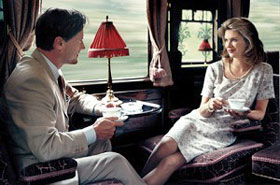
What is called the World’s Most Romantic Celebration consists of a train trip on the Orient-Express between Venice and Paris.

Here are the details. The trip is eight days and seven nights from $24,750: three nights in Venice; one night on the Venice Simplon-Orient-Express and three nights in Paris.

Departure dates, which are Sundays and Wednesdays, in 2008 are: March 30; April 6, 13, 20, 27; May 11, 14, 25;June 8, 11, 22, 29; July 20, 27; August 3, 10, 17, 24; September 10, 21, 24, 28; and October 12, 15.

The itinerary consists of:

Day 1 – Venice
Arrive in the romantic city of Venice and transfer by private water taxi boat to the Hotel Cipriani. A deluxe suite is reserved for three nights in the city of canals. 

Overnight in Venice.


Day 2 – Venice
A personally tailored guided tour of the city in the morning. In the afternoon, the private launch of Romilly, Lady McAlpine collects you from the hotel and takes you to her home for a visit and refreshments. 

Breakfast included. Overnight in Venice.

Day 3 – Venice
Explore the delights of La Serenissima before a final romantic evening, including a ride on a gondola before dinner, at one of Venice’s most exclusive restaurants. 

Breakfast and dinner included. Overnight in Venice.


Day 4 – On the Venice Simplon-Orient-Express
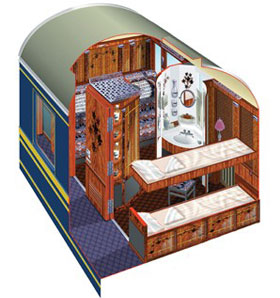
The train’s hostess completes check-in formalities for your journey on the Venice Simplon-Orient-Express train before your private transfer to the station. Board the train (cabin suite) for the overnight journey to Paris, enjoying superb cuisine and sparkling champagne. 

Breakfast, lunch and dinner included. Overnight on board.


Day 6 – Paris
After breakfast, a private car and driver takes you to the French countryside en route to Reims, capital of the Champagne region, where you have a private tasting before lunch at the two-star Michelin restaurant of Chateau Les Crayères, accompanied by fine wines and Prestige Champagne. After lunch, return to Paris. Breakfast and lunch included. Overnight in Paris.

Day 7 – Paris 
Time for final sightseeing or shopping in the boutiques and designer stores. In the evening a private car transfers you to Quai de Grenelle, where you board a luxurious private yacht. The vessel’s teak deck and sleek interiors allow you to relish the cozy atmosphere of a 1960s boat. Enjoy a glass of champagne as you cruise along the river Seine, before a romantic candlelit dinner served either on the outdoor deck or the inside cabin. A shower of roses completes the cruise before returning for a final night in Paris. Breakfast and dinner included. Overnight in Paris.

Day 8 – Paris
Your journey comes to an end. Breakfast included.  All aboard!

IF YOU GO…
Log onto www.orient-express.com for more details about the trip. Or, call (in the USA) 401-351-7518 or e-mail to: oesales.providence@orient-express.com. From France, call +33 1 55 62 18 00; from Germany, call +41 44 770 1407; from the Netherlands, call +31 35 6955111; and from the U.K., call +44 20 7805 5060

Ski or Just Relax in the Shadow of Mount Blanc

Photos courtesy Swiss Tourism

Perched on a wooded, sunny plateau above the Rhône Valley about halfway between Martigny and the Chateau de Chillon end of Lake Geneva, Villars offers activities that find the balance between recreation and relaxation.

Ever since the famous Orient Express arrived here, visitors to Villars have enjoyed the healthy air to be found on the natural balcony it rests on. At about 1,300 meters (4,225 feet) in the heart of the Vaud Alps, this idyllic setting has stunning views stretching from Lake Geneva to Mont Blanc.

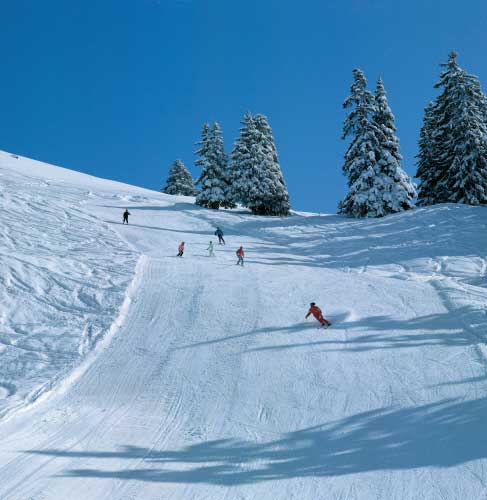
Winter sports fans can enjoy the wide range of attractions the area offers, including 125 kilometers (78 miles) of skiing terrain. In all, there are 52 runs which are 50 percent beginner, 42 percent intermediate and eight percent advanced. Sports enthusiasts wanting to be challenged can try the glacier at Les Diablerets, about 20 kilometers (13 miles) from Villars. There are four glaciers in the area available for heliskiing.

Those in search of relaxation can enjoy the facilities and wellness benefits of the thermal baths (Lavey-les-Bains). Children can enjoy the family programs that cater to adults and kids.

More information can be found at www.ski-europe.com/resorts/villars