Germany is famous for its rivers; they cut through beautiful landscapes from north to south, from east to west, from the sea to the mountains. The rivers have been the modes of mass transportation long before roads and today the Elbe, Rhine, Main, Moselle or Danube invite hundreds of thousands of tourists each year for river cruises. But you cannot only discover Germany’s rivers on a boat. Cycling paths follow them through ever changing landscapes, past old castles, romantic towns and buzzing cities.
The Elbe Cycling Path is one of the most attractive in Germany. It leads for 520 miles from Dresden in the southeast all the way to the North Sea. The route is split in several stages, all easily doable in a day, and you can choose between both sides of the river. Leading through fascinating landscapes from wetlands to hills, connecting UNESCO World Heritage Sites such as the city of Dresden, the Luther town of Wittenberg and the harbor city of Hamburg, there is plenty to discover along the way. The river has historic significance as part of the former West German-East German border and you can still see the transformation of this region in process. Along the way you will find plenty of bike-friendly hotels, hostels and camping grounds, and many package tours make this a very accessible route.
The Moselle Cycling Path in Germany’s west between the wine-growing region of the Elbling wine near Trier, a wine specialty of the Upper Moselle, and Koblenz invites you to a pleasurable bike tour. For 150 miles discover the 2,000-year-old history of the region, from old Roman ruins in Trier and Koblenz, to romantic wine villages such as Bernkastel or Cochem and great spas in Traben-Trabach. The trail is predominantly level, with an excellent network of cycle tracks and rural roads as well as old towpaths and accurate sign-posting, offer optimum conditions for the casual cyclist.
For 360 miles the Main River Cycling path leads from east to west through the northern Bavarian Region of Franconia and the State of Hesse to Frankfurt. Highlights along the way are the majestic Wagner town Bayreuth, the UNESCO World Heritage Site of Bamberg, known as Germany’s beer capital and for its Baroque architecture, the wine growing region around Wuerzburg and the buzzing financial metropolis of Frankfurt. Stop along the way in one of the many local breweries or vineyards and be enchanted by 1,000-year-old castles and cathedrals.
The second longest river in Europe, the Danube, springs unofficially in the park of the princely Fuerstenberg castle in Donaueschingen at the border of the Black Forest in southwestern Germany, contained in a magnificently decorated, circular fountain from the 18th Century. “Mother Bear” presides over the fountain and shows her “daughter,” the young Danube and all cyclists the way.
The Danube Cycling Path leads for 360 miles through the German states of Baden-Wuerttemberg and Bavaria from the Black Forest to Passau in the southeast. The cycling road is signposted and package tours with several itineraries from seven to 15 days are bookable. Highlights along the way are the Sigmaringen and Hohenzollern castles of the Hohenzollern dynasty that ruled Germany in Baden-Wuerttemberg. Also interesting are the cathedral and merchant town of Regensburg, with the largest core of undestroyed medieval houses in Germany, and the three-river city of Passau. Discover the Danube from its fast flowing beginnings until it grows into a wide and impressive river in Bavaria.
In terms of speed, comfort, travel connections and schedules, frequency and rail facilities, the countries served by Rail Europe offer travelers the best land transportation by almost any standards.
With Rail Europe’s newly-designed website now up and running, we interviewed both Frederick Buhr, vice president of eBusiness for Rail Europe and Samina Sabir, public relations manager for Rail Europe.
The European trains of today already seem miles ahead of what the U.S.– or most other countries — offer in terms of speed, comfort and on-time reliability. Would you agree with that assessment, and expound on the differences you see between European rails and those of other countries. The Swiss Federal Railways and French National Railroads are investing a great amount of public and private funds into a new hi-speed rail infrastructure which has resulted in a faster and more efficient form of train travel in Europe. Due to a high volume of travelers who use the European train network, there is a high frequency of train service that results in greater efficiency and punctuality. Train travel in Europe also allows people to seamlessly travel on multiple rail networks as European countries work together on public transportation. Rail Europe allows travelers to purchase train passes without restrictions that allows them to travel throughout the European continent.
If you could ride any European train for fun, which one would it be and why? The Chocolate Train in Switzerland. This involves a roundtrip panoramic train journey from Montreux in the Swiss Riviera to Gruyères, home of the Gruyères cheeses, and then onto the Nestle chocolate factory where chocolate sampling is included. The Chocolate Train is included in the price of a Swiss pass.
Name some important upcoming routes where you expect dramatic changes in terms of service, speed or new equipment. The TGV East in France now allows travelers to ride from Paris to the eastern regions of France faster and more conveniently than ever before. A route growing in popularity is the Paris/Reims journey–in just 45 minutes travelers are transported from the heart of Paris to the heart of the Champagne region.
The Spanish AVE train travels at speeds of 300 km/hour (186 mph) and covers the distance of 550 km (342 miles) between Madrid and Barcelona in less than 3 hours (travel time was previously 4 hours). New high-speed lines have also reduced travel times between Madrid and Valladolid; the journey, which previously took 2 hours, 30 minutes, now takes only 55 minutes. And what was a four-hour journey from Madrid to Málaga, now takes only 2 hours, 30 minutes. The city of Zaragoza is on the Madrid/Barcelona AVE line (1 hour, 18 minutes from Madrid, 1 hour, 29 minutes from Barcelona) and this is expected to be an emerging destination in Spain.
The Thalys train takes just 1 hour, 22 minutes to go from downtown Paris to Brussels, most of the journey made at 186 mph. By 2009, all Thalys tracks will be high-speed, and travel times Paris-Amsterdam (currently 4 hrs 11 min.) and Paris-Cologne (presently 3 hrs 50 min) will be cut to 3 hrs 9 min and 2 hrs 50 min, respectively. Up to 27 trains travel between Paris and Brussels in each direction daily, making the service convenient as well as fast.
In 10-15 years, how will the European rail travel scene have changed? At Rail Europe we believe that the developments in high-speed rail and the investments being made to continue to develop the rail networks of Europe will make Europe more easily and quickly accessible to all travelers. Day trips from the major cities to smaller towns and villages connected by train will become more popular.
European train travel also offers the time-saving benefit of bringing travelers right into the city center, eliminating the need for airport/city transfers. It is expected that this convenience, along with a growing awareness that trains are an eco-friendly way to travel, will continue to influence a shift from air traffic to rail.
What is the fastest train right now on Rail Europe tracks? The TGV in France runs at speeds of up to 200 mph and currently holds the world record for the fastest train.
For a first-time rail traveler in Europe, what can they expect when traveling on, say, an ICE train, the Eurostar and a regional train? All German Inter City Express (ICE) trains connect all the major German cities such as Frankfurt, Hamburg, Stuttgart, Munich, Cologne and Berlin. All trains feature comfortable amenities and cutting-edge services, including reclining seats with built-in tables and video screens, an integral audio system, notebook and laptop connections, as well as cellular-friendly zones that allow for undisturbed service.
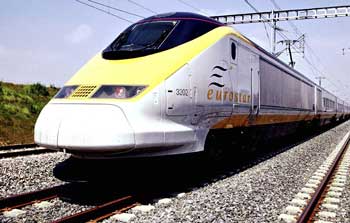
Eurostar takes you seamlessly from city center to city center within Belgium, France and the UK, as well as provides connecting services to more than 100 destinations. Business Premier class, which is the highest level of service, offers reclining seats and power outlets at each seat giving business passengers the freedom to work in comfortable surroundings. It also offers a choice of full service “at-seat” dining with champagne and wine and an “Express Breakfast” option. All 1st class cars for Leisure passengers offer comfortable seating, complimentary magazines/newspapers and the “at-seat” dining includes wine and hot and cold refreshments.
Regional trains are not high-speed trains and make more stops at more stations along the journey. At least one regional train journey is advisable, especially for the first time leisure traveler; it is a very real experience and has a certain air of romance to it. Buffet cars are available on most regional trains and offer sandwiches or hot and cold snacks.
Let’s say I wanted to fly to Frankfort and then travel by train to Passau and on to Vienna. What kind of travel times and service for this route would I find on your new website? You can choose a train which connects in Wein (Vienna) or choose the fastest train which is direct from Passau to Vienna – see example below:
TRAIN 21Fastest
10:33AM Passau Hbf, Germany
1:22PM Wien Westbahnhof, Austria
2 hr 49 min
I’ve heard there are a number of “Scenic Trains” available for shorter, fun excursions. Which ones are most popular and why? One very popular scenic train is The Glacier Express that connects the world-famous resorts of St. Moritz and Zermatt. Rail Europe offers a Glacier Express Tour which includes a Swiss Card with three transfers of rail travel, two nights accommodation in 3-star hotels (w/breakfast) and one night each in Zermatt and St. Moritz.
RAILTEAM AFFORDS ‘SEAMLESS’ TRAVEL
According to Buhr, Railteam (www.railteam.eu), a new venture, will make traveling on the European rail network easier and more seamless. Buhr says it will help “shrink Europe.”
It is a collaboration between Europe’s leading high-speed rail operators, currently DB (Germany), SNCF (France), Eurostar UK LTD (UK), NS Hispeed (Netherlands), ÖBB (Austria), SBB (Switzerland) and SNCB (Belgium), as well as their high-speed subsidiaries Thalys, Lyria and the DB/SNCF cooperation between France and Germany, with more train operators possibly joining in the future.
Access to the Railteam network is easy with interconnections at city center stations and Ffst local transfer services to and from departure points.
Unlike airports, when you travel with Railteam there are no lengthy boarding procedures, which means no lines. Swiftly on-board and settled in your reserved seat, travelers are able to work on their laptops, read, eat or relax.
Buhr also says that the European Union supplies large amounts of money to help the high-speed rail infrastructure budget for Europe, which allows more construction of new trackage and rail facilities throughout the continent.
Buhr is interested in hearing from passengers about how the new Rail Europe website works for them.
Fred Buhr, Vice President eBusiness, Rail Europe
Fred Buhr began his career with Rail Europe in 2000 to start up EuroVacations.com, the online one-stop shop for European vacation packages. In 2003 he became Rail Europe’s Director of Online Marketing, where he initiated the SEM and SEO strategies to grow market share. He currently holds the position of Vice President eBusiness and is in charge of eCommerce and online marketing. Fred was involved in leading a project dedicated to creating the newest version of the company’s website, RailEurope.com. He has extensive experience in the online travel industry and was responsible along with a business partner for creating one of the first full-service online agencies in Europe. Educated in Strasbourg, France, Fred also attended the Paris Business School where he earned a degree in International Business Relations.
Samina Sabir was educated in Ireland, and began her career in the retail/fashion industry. She joined Rail Europe in 1993, working in the Sales Department dealing specifically with Rail Europe National Accounts. In 2008 she became public relations manager for Rail Europ
The capital of the kingdom, yes kingdom, of Belgium–Brussels–is located pretty much in the center of Belgium, south of Antwerp. Brussels is a cosmopolitan city of more than 2 million people (total area) that loves food.
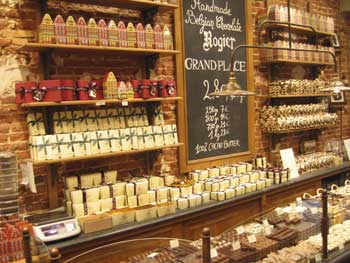
Known for its Grand-Place/Grote Markt with its filigree stonework, the city is fashionable, upscale and village-like all at the same time. Did I mention beer? It’s said Brussels offers 2,000 kinds of beer. Then there’s the food, and the chocolates.
Let’s take a tour through Brussels, using some of the internet sites available:
Both public and private transport are highly developed in the Brussels area, with a network of high-quality roads, airline routes and inland waterways. • Your arrival in Brussels–ways of entering the Brussels-Capital Region • Moving around Brussels–means of traveling, using public transport, on foot, by bicycle, by car, by motorbike, by air, etc. • Finding your way around Brussels–which are the best maps of the city available on the Net.
Brussels is served by Brussels Airport, located in the nearby Flemish municipality of Zaventem, and by the much smaller so-called Brussels South Charleroi Airport, located near Charleroi (Wallonia), some 50 km (30 mi) from Brussels. Brussels is also served by direct high-speed rail links to London by the Eurostar train via the Channel Tunnel (1hr 51 min); to Amsterdam; Paris and Cologne by the Thalys; and to Cologne and Frankfurt by the German ICE (Inter-City Express trains).
The Brussels metro dates back to 1976, but underground lines known as premetro have been serviced by tramways since 1968. A comprehensive bus and tram network also covers the city. Brussels also has its own port on the Willebroek Canal located in the northwest of the city.
An interticketing system means that a STIB/MIVB ticket holder can use the train or long-distance buses inside the city. The commuter services operated by De Lijn, TEC and SNCB/NMBS in the next few years will be augmented by a metropolitan RER rail network around Brussels.
Since 2003 Brussels has had a car-sharing service operated by the Bremen Company Cambio in partnership with STIB/MIVB and local ridesharing company taxi stop. In 2006 shared bicycles were also introduced.
Brussels contains more than 80 museums, including the Museum of Modern Art, and the Royal Museums of Fine Arts of Belgium. The museum has an extensive collection of various painters such as the Flemish painters such as Brueghel, Rogier van der Weyden, Robert Campin, Anthony van Dyck and Jacob Jordaens. Brussel’s museums cover areas such as art, technology, industry, science, folklore, literature, history and many other subjects, each presenting a different face of Brussels. They are astounding in the wealth of their collections and the new perspective they offer of cultures from all over the world.
FOODS Brussels is known for its local waffles, its chocolate, its French fries and its numerous types of beers. The Brussels sprout was first cultivated in Brussels, hence the name.
Brussel’s gastronomic offerings include approximately 1,800 restaurants with very good food and atmosphere. Connoisseurs consider Belgian cuisine among the best in Europe. In addition to traditional restaurants, there is an overwhelming number of cafes and bistros and the usual range of international fast food chains. The cafes are similar to bars that offer beers and small dishes. Also widespread are so-called brasseries that offer a large number of beers and typical national foods.
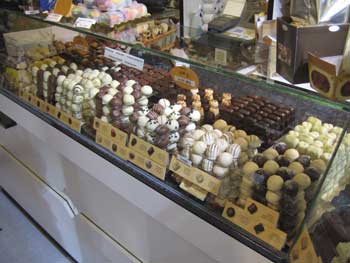
Belgian cuisine is characterized by the combination of French cuisine with more hearty Flemish recipes. Culinary specialties include Brussel’s waffles (Gaufres) and mussels (usually served with “Moules frites”–French fries). The city is a stronghold of chocolate and praline manufacturers, with traditional companies like Godiva, Neuhaus and Leonidas. In addition, the Belgian beer enjoys a good reputation—Hoegaarden, Leffe, Duvel, Jupiler, Stella Artois and Kriek (cherry beer) are all examples.
Brussels has become a significant center for international institutions, notably those of the European Union. The city also plays host to the headquarters of the North Atlantic Treaty Organization (NATO) which is based in the city, along with 1,000 other international organizations and 2,000 international corporations. Brussels is third in the number of international conferences it hosts and is one of the largest convention centers in the world. The presence of the EU and other international bodies means there are more ambassadors and journalists in Brussels than Washington D.C. International schools have also been established to serve this presence.
Usually before arriving in a large European city, I obtain a map of the main “ring” area and study it for hours.
A city map tells me where the Bahnhof (train station) is, the major tourist attractions such as museums, monuments, parks and buildings, as well as major streets and rivers or lakes. What I’m trying to obtain is a general impression of the size of the city and its environs, and the general layout of the city center.
When I first looked at the map of Berlin–the capital of Germany–after a few minutes I realized we were talking about a very large city, the square mileage of which is 552.
It wasn’t until I got to Berlin and starting walking around that I was able to piece together the whole Berlin attractions scene, and after two days there, started to get the picture. Berlin is big (it’s eight times the area of Paris), with 3.4 million people; nearly 140 million visit this northern Deutsche city each year.
Berlin is German’s greenest city, with more space devoted to woods, parks and cultivated areas than any other: there’s the very large English-style Tiergarten (originally a royal hunting reserve), the Botanical Gardens and the Zoological Gardens (the largest zoo in Europe with 13,000 animals representing 1,400 species). In walking the Tiergarten area, I was glad I had on comfortable shoes. In fact, in any larger city, be sure to take along comfortable shoes!
BERLIN ATTRACTS MILLIONS
With the fall of the infamous 13-foot, 99.4-mile-long Berlin Wall (erected August 3, 1961 by the Socialist Unity Party of Germany) in November of 1989, Berlin has come together to preserve its history, and celebrate the future with new, modern buildings of note. Europe by Rail, a Thomas Cook publication, says Berlin “now oozes cosmopolitan chic.”
Founded by traveling merchants as the twin settlements of Berlin and Coelin in the last quarter of the 12th century, the first mention in documents was in 1237 for Coelin and 1244 for Berlin.
Around 1650, and after nearly complete destruction of the city during the Thirty Years’ War, Berlin experienced an unprecedented cultural and economic boom, thanks to Elector Friedrich Wilhelm. He invited immigrants to settle the city, notably Jews and Hugenots, and by 1700 one of every five Berliners was a Hugenot.
In recent history, Berlin proper was divided up between the U.S., Britain, France and the USSR after World War II, with the Soviets instituting the People’s Democratic Republic. In June of 1991, the Bundestag decided by vote that Berlin should become the capital of the unified Germany.
If you go to Berlin for the first time, I suggest you take at least three full days to tour the city. Less than that, you won’t be able to spend much time at any one attraction. You will have gotten a quick overview only. Lines for some of the attractions such as the museums and the Reichstag Parliament Building can be very long, even in the “non-tourist” months.
GNT/Jochen Keute
TOP SIGHTS IN BERLIN
Some of the top sights in Berlin on your travel agenda should be:
–The impressive neo-Renaissance style Reichstag, which features a glass dome by Sir Norman Foster and offers a good overall view of the city. The building was opened in 1999 after restoration. It houses the Bundestag, the Lower House of the German Parliament. It’s open daily from 8 a.m. to midnight, with the last entry at 10 p.m.
–Brandenburg Gate (Tor)—This is Berlin’s most famous landmark and a symbol of the city’s reunification. It’s almost always crowded with people, but it encompasses a large area, and the area which it’s located can accommodate a large number of people. The gate was incorporated into the Wall at one time. Six Doric columns which are incorporated into the stonework support an antique entablature. It was built in 1789.
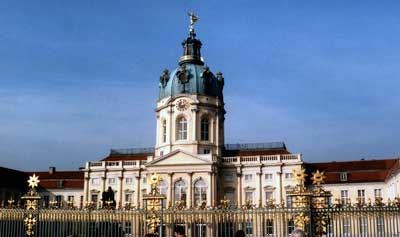
–Charlottenburg Palace is one of the oldest palaces in Berlin, built for Prussian Empress Sophie Charlotte. It’s said to be Berlin’s answer to Versailles, housing a great collection of German Romantic art. The castle offers guided tours only. Be sure to note the Porcelain Room, which contains beautiful vases, figurines and plates, mostly from China. Also note the White Room, which served as a banquet hall and throne room. Next to the castle is the Berggruen Museum which displays a 20th century collection of art, especially Picasso and Matisse. Both the castle and museum are closed on Mondays.
–Berlin Cathedral (Berliner Dom) is the largest 19th century Protestant church with a beautiful Sauer church organ and the Hohenzollern family crypt, part of which is open to the public. The church seats 1,500.
–The Kaiser Wilhelm Memorial Church, built at the end of the 19th century, was destroyed in 1943 during WWII and another new church built next to the ruins. It’s an interesting study in old and new.
–Topography of Terror is an outdoor exhibition on Nazi terror and crimes in the Third Reich, visited by thousands of people every day on Niederkirchnerstrasse. This exhibit is always well attended.
–Memorial to the Murdered Jews of Europe near the Brandenberg Gate is comprised of 2,700 concrete blocks which represent an “uneasy and confusing” atmosphere in an otherwise orderly society. Each concrete slab is between 8” and 15′ 9” tall.
–Checkpoint Charlie at Friedrichstrasse 43-45 in a busy shopping district is a museum that gives the history of the Berlin Wall, tells incidents that happened there, and displays original objects from successful escapes. The several-story museum is open daily from 9 a.m. to 10 p.m.
–New National Gallery at Potsdamer Strasse 50 features 20th century art, the ground floor of the Altes Museum (the first museum in Berlin in 1830) displays a collection of Classical Roman and Greek art and sculpture while the upper floor is devoted to an Egyptian Museum. The Bode-Museum features a sculpture collection and a museum of Byzantine Arts and a coin collection. The German Historical Museum on Unter den Linden is a permanent German history exhibition while the Gemaldegalerie Art Collection is ranked among the most important collections of 13th-to-18th-century European paintings in the world.
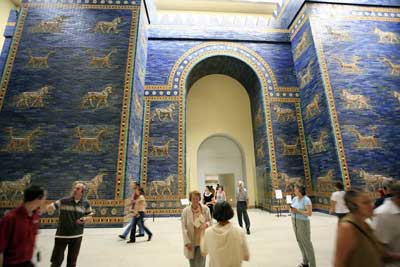
Three more museums of special note are the Museum of Contemporary Art, the Jewish Museum Berlin with an exhibition of on every aspect of German-Jewish history from the end of the Roman area to today, and the Pergamon Museum with its collection of classical antiquities, Museum of Islamic art, and Museum of ancient near-Eastern antiquities.
GNT/Eric Eichberger
170 MUSEUMS TO SEE
Berlin has more than 170 museums, more than enough to keep you interested; you can see why you’ll need extra time in Berlin.
Even the city squares in Berlin evoke interest, such as Alexanderplatz (named after Tsar Alexander’s visit to Berlin in 1805). This important public transportation junction is a focal point of city life in the eastern part of Berlin. The Gendarmenmarkt Square, named after Kind-Sergeant Frederick Wilhelm I’s “Gens d’Armes” regiment, is another location to see.
All sorts of other diversions are available in Berlin as well. There are eight major symphony orchestras including the Berlin Philharmonic, three opera houses, cabaret, variety and revue theaters, musicals and comedy. The Konzerthaus Berlin at Gendarmenmarkt- Mitte was built in 1818-1821 by the renowned Berlin architect Karl Friedrich Schinkel.
Numerous exclusive designer boutiques, international brand name outlet shops and more await shoppers in the Mitte district on Friedrichstrasse. Then there are the flagship stores, malls and the giant KaDeWe, a nearly 200,000-square-foot department store packed with attractive foods, clothing and all kinds of products and goods. It’s like a giant Harrods or the old Chicago Marshall Field’s store, with glitzy displays, helpful sales people and a do-it-right attitude.
Berlin hotels provide upwards of 11,000 beds in the luxury hotel category alone and a total of 88,000 beds overall. A click on http://www.visitBerlin.de will offer you more information and also offer 350 choices of where to stay. A list of youth hostels are also available at www.bock-auf-berlin.de.
GNT/Hans Peter Merten
TAKE A TOUR, SEE THE CITY
To see the city without all the walking necessary to cover the main attractions, try one of the several tour bus companies. You have a choice of BBS Berliner Baren Stadrundfahrt (www.sightseeing.de and www.bbsberlin.de) that offers tours in eight languages; Berlin City Tour, a 1 3/4-hour English and German tour on double-decker buses (www.berlin-city-tour.de), and Berliner City Tour-Eick’s Rundfahrten Berlin with open-topped buses (www.eick-berlin.de). Each tour line allows patrons to hop on and off the bus along the route.
Or, if you take city bus No. 100, which runs between the Zoo station, past the Tiergarten, Brandenberg Gate and along Unter den Linden (the main east-west thoroughfare), you’ll get to see a number of sites. Buses also run in the evening.
You can rent a bike for a city tour from 5 euros a day, with guided bike tours from 10 Euros a day (www.fahrradstation.de). There are also walking tours and boat tours provided by other companies.
Berlin has a new Hauptbahnhof that opened in 2006; it’s a clean railway station and easy to navigate, but the older European railway stations have more character. It’s also said the station lacks enough public toilets and seating for passengers. Shops and cafes are abundant in the station, and they are open seven days a week.
Berlin offers a good system of buses, trams, underground and surface trains (there are 24 different lines), and free maps showing these routes are available at tourist offices and hotel lobbies. A Berlin Welcome Card (valid 48 or 72 hours for 16 euros or 12 euros) allows unlimited travel on all public transportation and also a 50% reduction on city tours, museums, theaters and other attractions in Berlin and Potsdam (www.berlin-welcomecard.de).
There are numerous hotels to choose from in Berlin, with the more up-scale ones located in the center of the city; less expensive hotels and hostels are grouped around the Mitte district in the eastern part of central Berlin.
The #1 rated hotel out of a total of 552 Berlin hotels is the Ritz-Carlton, priced on average at $319 a night, with the Mercure Hotel rated #2 at $304 (average) a night. The Swissotel Berlin rated #3 is $144 a night and the Movenpick at #4 is $277 a night.
Berlin is certainly one of the more interesting cities in Germany, and I’m glad I went. From my visit, I only see Berlin as growing and becoming more popular in the future: it has a lot going for it!
By Carol Price Spurling Photos by the author and courtesy Belfast Welcome Center
The first time I visited the Emerald Isle more than 20 years ago I steered clear of troubled Belfast. But I’m older and wiser now, and Belfast, too, has grown up, transformed from a self-absorbed, divided town into an extroverted and welcoming world-class city.
Belfast offers Victorian charm in every quarter and has retained the best of what Ireland is famous for: warm hospitality, atmospheric historic and cultural sites, and easy access to the lush unspoiled countryside. In Belfast, they’re glad to see you, not just your wallet, and what a difference that makes.
BELFAST HIGHLIGHTS West Belfast’s Shankill and Falls neighborhoods saw most of the “Troubles” that erupted in the early 1970s. The Peace Walls that separate them are still standing, but visitors are welcomed on both sides and the practice of customers being searched before entering a store or office was retired years ago. For those interested in an insider’s view of Belfast’s political divide, Coiste Political Tours (www.coiste.ie/p_tours.htm) offers guided tours by Republican ex-political prisoners. Or, take a taxi tour to see wall murals and other relics from the bad old days (West Belfast Taxi Association, www.wbta.net).
The center of Belfast, Donegall Square, features Belfast City Hall (www.belfastcity.gov.uk), an embellished stone edifice built in 1888 as a monument to Belfast’s bright future.
All metro buses lead to the bustling square, also home to literary gem Linen Hall Library (www.linenhall.com). In this old linen warehouse, transformed into a library in 1788, visitors can access the cozy library’s unique archives such as the Northern Ireland Political Collection and the C.S. Lewis Collection. Enjoy the library’s tranquil wood-paneled ambiance and a view of City Hall by taking a tea break in the upstairs café.
A horse-drawn carriage strolls past the Ulster Transport Museum
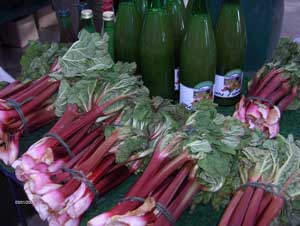
On Fridays and Saturdays the oldest Victorian-era covered market in Ireland, St. George’s, fills up with local shoppers intent on finding a bargain or tracking down the best fresh food in the region (www.belfastcity.gov.uk/markets). The Saturday market is devoted to food. You won’t go away hungry, with 250 stands offering everything from oysters to Irish cheeses to seaweed tapenade to tapas to sausages in curry sauce. Look for locally made “Belfast in a box” chocolates that celebrate Belfast landmarks, accompanied by an illustrated booklet (www.citycentres.com).
Everyone knows where the Titanic met her end but did you know she was born in Belfast? The city’s proud shipbuilding heritage is still obvious with the huge yellow cranes in the Harland and Wolff shipyard –- nicknamed Samson and Goliath — towering over Queen’s Island and the Titanic Quarter on the city’s eastern edge.
(left) Sampling seaweed at St. George’s Market
Belfast celebrates its past with the Titanic Made in Belfast Festival every March (www.belfastcity.gov.uk/titanicfestival), when free bus tours of Queen’s Island are offered by the city on Saturdays and Sundays.
My personal favorite from the tour: the inside of the design room at Harland and Wolff’s offices, where draftsmen labored under a cathedral-like arched ceiling to draw the ship’s plans.
Shores of the River Lagan
DO YOU NEED A CAR? Although Ireland and Northern Ireland aren’t famous for their extensive rail networks, between trains, buses, and taxis you can get anywhere you need to go in the greater Belfast area and environs without having to rent a car –- or drive on the left. Coach tours and trains also run directly north to Portrush, with convenient connections to Giant’s Causeway, Dunluce Castle, and Bushmills Distillery. Along the northern and southern shores of Belfast Lough, rail service is frequent and affordable, so getting to top attractions just outside Belfast, like Carrickfergus Castle (www.ehsni.gov.uk/carrick.shtml) or the must-see Ulster Folk and Transport Museum (www.uftm.org.uk/) is easy peasy. Day return tickets are offered at 1/3 off the standard rate if you leave after the morning rush hour, and families can get special ticket deals too (www.translink.co.uk).
But to see some of Northern Ireland’s diverse natural beauty and historic architecture (Environment and Heritage Service, www.ehsni.gov.uk/other-index/places.htm), a car will be very helpful. Most recommended is to make a day of driving north along County Antrim’s Causeway Coastal Route, where the craggy cliffs and wild sea spray on one side is balanced by charming villages and green pastures dotted with tranquil sheep on the other. Giant’s Causeway — a stunning outcropping of columnar basalt — can be busy during the tourist season but has been kept remarkably uncommercialized. Visit in the early morning or late afternoon for the best light at this geological wonderland (www.causewaycoastandglens.com).
Another lovely drive is west through the Fermanagh Lakelands, home of Belleek pottery, and National Trust gem Castle Coole (www.fermanaghlakelands.com).
WHERE TO EAT AND DRINK Celebrity chefs Paul and Jeanne Rankin have put Belfast on the culinary map with Cayenne Restaurant (www.rankingroup.co.uk) and Roscoff Brasserie. Up and down the Golden Mile on Dublin Road, foodies will be spoiled for choices of great pubs, cafés, bistros and restaurants.
Chef Michael Deane runs Northern Ireland’s only Michelin-starred eatery at Deane’s Restaurant (www.michaeldeane.co.uk); his newest venture is the contemporary bar and grill Deanes at Queens, located in the Queen’s University Common Rooms.
Coffee addicts never fear, Belfast baristas know what they’re doing. You can’t go wrong visiting any one of the seven Clement’s coffee shops, where coffee drinking is practically a spiritual pursuit, and the creamy hot chocolates are served in a large bowl.
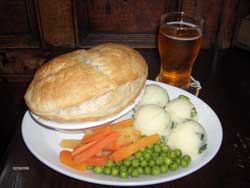
(left to right) Dining at one of Chef Michael Deane’s Belfast restaurants; Steak and Guinness pie is an Irish specialty
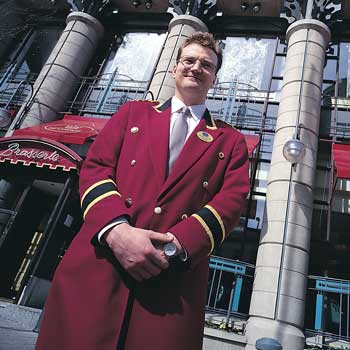
WHERE TO STAY In downtown Belfast itself, a famous landmark is the 4-star Europa Hotel (www.hastingshotels.com) conveniently located just in front of Great Victoria Street rail station and the Europa Buscentre. Head concierge Martin Mulholland will make sure you get everything you need, even if you’re not as famous as some guests who’ve stayed there, like Bill Clinton, Julia Roberts and Elton John.
For a more secluded getaway try the 5-star Culloden Hotel in Holywood, overlooking Belfast Lough (www.hastingshotels.com), or The Old Inn in picture-perfect Crawfordsburn (www.theoldinn.com), both within easy reach of the city.
For less expansive budgets there are dozens of guestshouses, B&Bs, self-catering holiday apartments, hostels, and budget hotels both in Belfast and in neighboring communities. Some are chic, some charming; choose according to your mood.
The Premier Inn hotel (www.premierinn.com) boasts a great central location and is spanking new to boot. The Ash-Rowan Town House (tel. 9066 1758) offers a choice of nine gourmet breakfasts, with a side of historic significance: the Ash-Rowan was once the home of Titanic designer Thomas Andrews.
If you get out into the Fermanagh Lakelands and wish you could stay, check out Belle Isle Castle (www.belleisle-estate.com), outside Enniskillen near Lisbellaw. The old stables and coach house have been transformed into comfortable holiday rentals, with a variety of outdoor activities available, as well as day-long cooking classes taught by Irish chef Liz Moore. You can even rent the castle for a group stay, or a small wedding.
WHEN YOU GO If you’re planning a trip to Belfast and Northern Ireland, be sure to visit the Belfast Welcome Centre website, www.gotobelfast.com. Like the office itself located at 47 Donegall Place in the city center, it is user-friendly, multi-lingual, and comprehensive. Be sure to pick up copies of their excellent themed city guides.
The Northern Ireland Tourist Board website is www.discovernorthernireland.com. Another free publication to pick up: Belfast In Your Pocket (www.inyourpocket.com). Published every couple of months, it always has the most up-to-date happenings, complete with maps of the city.










 European Traveler