New Designer Hotels in Germany’s ‘Magic Cities’

Photos courtesy German National Tourist Office

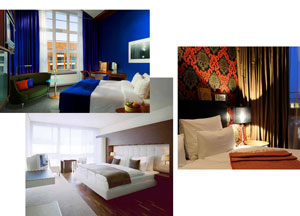
The cities belonging to Germany’s “Magic Cities” association, including Berlin, Cologne, Dresden, Duesseldorf, Frankfurt, Hamburg, Hannover, Leipzig, Munich and Stuttgart are centers of art, architecture, history and culture. Discover some of the newest additions of designer hotels that these cities offer:

In Berlin, the Soho House concept is being implemented for the first time in Germany. Stylish branches of this chain can already be found in London and New York. In the former “House of Unity” at the foot of Prenzlauer Berg, the hotel has 50 bedrooms. The luxurious fitness area, modern conference rooms and hotel with spacious apartments on the third and fourth floor will be open to all visitors. There will also be an exclusive area for club members only. Another highlight is planned on the second floor, where the office of the former State President of the GDR, Wilhelm Pieck, is being restored to its original condition.

Cologne

In Cologne, one hour from Frankfurt on the Rhine River, there is a new four-star hotel, Art’otel Cologne, in a prime location on the banks of the Rhine. Alongside the trapezoidal design and the colorful windows, the chief attraction of the hotel is the art-inspired interior design with a permanent exhibition of the works of the Korean artist SEO, a former master student of Georg Baselitz. The hotel has 218 rooms with a special twist: the glass walls partitioning the bath or shower rooms are colorfully painted with some of the best of SEO’s designs.

Duesseldorf lives up to its artistic reputation (Academy of Arts) with its own new designer hotels. The Stage 47 Hotel features a completely new, unique design. All 27 suites and rooms are named after famous artists. Their portraits adorn the walls of the individual rooms, creating a special atmosphere. British elegance combined with unpretentious comfort describe the Sir & Lady Astor hotels. Lovingly arranged details and charming decorations as well as discreet, attentive service give guests a feeling of a homecoming.

Dresden, the royal metropolis on the River Elbe in the eastern state of Saxony, has been restored to one of the most beautiful Baroque cities in Europe. Dresden offers beautiful architecture, world-class art and a variety of luxury hotels. A perfect example for the modern reinvention in the classic tradition is the QF Hotel, perfectly located near the Church of Our Lady in the heart of Dresden. The hotel, formerly the “Hotel Stadt Berlin,” has been known since 1804 as one of the best hotels in the city. The 96 rooms combine comfort and luxury with a clean and modern design.

Frankfurt, the financial metropolis in the middle of Germany, is not only the major airport hub, but also a fascinating city where great history meets modernity, world class contemporary art museums and galleries are placed alongside cultural giants such as Goethe. A new highlight of the hotel scene is the Roomers design hotel in the city center. This luxury hotel combines classic lines and innovative design in its 117 rooms.

Hamburg: The designer hotels in this port city combine themed interiors with the comforts and conveniences of the highest standard. Hamburg is also where you’ll find Germany’s highest-rated boutique hotel. The Side Hotel combines luxury and design with aplomb. This award-winning five-star establishment is characterized by a minimalist interior of dark wood and beige elements illuminated by unique lighting.

The George Hamburg holds an entirely different appeal as a four-star hotel with British charm. Rooms furnished in warm colors, an elegant library and an English Garden are all part of its homage to British style.

Hannover, in Germany’s north, has a long history as a royal seat of the English kings and queens, but also as a modern city that hosts many world-class conventions. A special place to overnight is the Sheraton Pelikan Hotel. Located in the former Pelikan factory, one of the most famous brands of fountain pens, the architects integrated the architecture of the old production facilities into the hotel design to create a distinctive loft atmosphere.
Leipzig

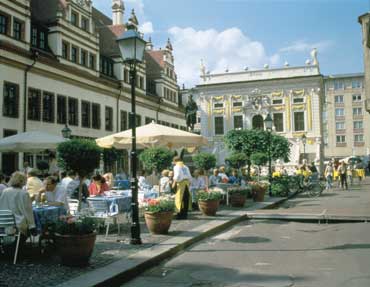
Leipzig, one of the most exciting cities in eastern Germany, invites visitors to stay in style in the newly-redesigned Pentahotel. The hotel was given a complete makeover in 2009 by Italian star designer Matteo Thun. The 356 new stylish and comfortable rooms have 32″ flat screen TVs, iPod or game consoles like Nintendo Wii, and other features catering to the needs of the modern and tech-savvy traveler.

Munich in southern Bavaria is known for its royal splendor. The new Louis Hotel that opened in September 2009 fits right in. The name Louis is intended as a reference to the appreciation of beauty as professed by King Ludwig II of Bavaria. Located in the heart of Munich, globetrotters will feel at home in the 72 rooms with carefully selected details and handcrafted furnishings. Natural stone and elegant tiling are reminiscent of the Parisian Metro and make the rooms an unforgettable experience.

Stuttgart

Stuttgart, home to the iconic car brands Mercedes and Porsche, now offers a very special experience for motorsports enthusiast. The V8 Hotel opened last fall and offers everything for high-octane car lovers. Individually designed rooms, antique and unique car models make this hotel a great experience. Its Bauhaus style combines function and comfort.
Central Germany’s Fast Trains

A Rail Europe ticket: your key to the country

By Marilyn Heimburger
Photos by Don Heimburger

Trains in Germany are fast, clean and on time. The comprehensive system that includes high speed trains, regional express trains, local trains, street cars and even buses, is so convenient that in the almost two dozen trips I’ve taken to Germany and bordering countries, I’ve never rented a car to get where I needed to be. But I have picked up some tips to make your train travel much easier.

For maximum flexibility in rail travel, a rail pass from Rail Europe is the way to go. Passes can be purchased for the number of days you need to travel over the course of a determined period of time. You must purchase your pass before leaving your country of origin.

On a recent two-week trip, which included a week-long river cruise in central Germany, I traveled by train before and after the boat trip. So my rail pass was for exactly five days of train travel (any days I chose) over the course of one month, starting on the day the pass is validated. Before boarding the train, fill in the date, have your passport with you on the train, and your ticket is valid for travel all day, on as many trains as you like. Some express trains may require an additional reservation fee; ask an agent if you’re unsure.

FIVE DAYS OF TRAIN TRAVEL
After landing in Frankfurt, I used the first of my five days of train travel to go from the airport to the main Frankfurt train station. Trains leave from the airport to the Frankfurt Hauptbahnhof every few minutes. From the train station I could walk to my hotel. Since the main train stations of major European cities are usually in the historic town centers, you can usually walk to most of the “must see” historic destinations. The historical centre of Hamburg, which is North of Frankfurt, is situated between the Main Station and Gansemarkt and there’s a variety of hotels available if heading that route. Sometimes bicycles are also available for rent from Deutsch Bahn train stations.

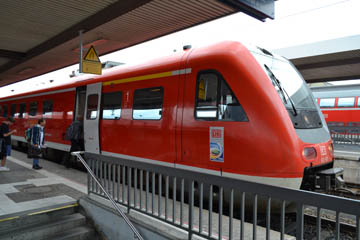
The next morning I again filled in the date on my rail pass for the day’s travel, which included an S Bahn train to Mainz, a regional express train to Saarbrucken, a Regionalbahn train to Merzig, and finally, a bus to Remich, Luxembourg, where the river cruise began.

The following local trains are available in Germany:

RegionalExpress (RE)
The RegionalExpress connects cities and offers travel in comfortable modern trains. It leaves at regular intervals and links local to long-distance trains.
Regionalbahn (RB)
The Regionalbahn offers a basic service from all local stations. It provides the connection between the regions and city centers. It also connects to the RegionalExpress.
S Bahn
The S Bahn services high-density areas, leaving in quick, regular intervals. Some S Bahn stations have access to longer distance regional trains, making travel within the city and between cities easier.

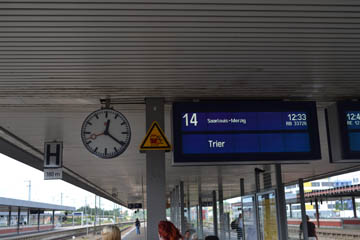
How do you find the right train? The very large train stations will have electronic signboards listing train destinations, the track (Gleis), and time of departure. If your train isn’t listed, wait a few minutes, and check again. The board is constantly updated as trains come and go. It will also list delays and cancellations. At smaller stations, a list of daily arrivals and departures is printed on signage on the platform. Go to the correct track number, and check the sign on the platform to make sure your destination is listed. Then keep an eye on the clock (there’s usually one on the platform at most midsize and major train stations) and watch your train arrive, usually right on time.

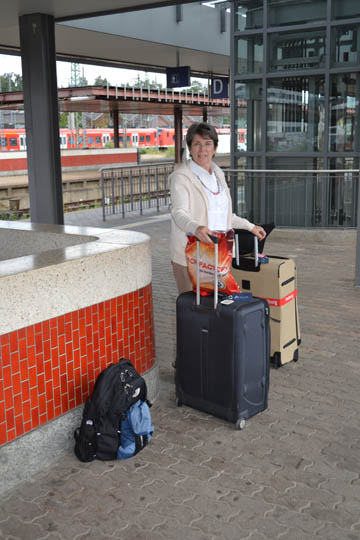
If your rail pass is for first class travel, as the train arrives, look for the cars with a number “1” on the side, indicating first class seating. While even second class sections are comfortable, first class is usually more luxurious, air-conditioned and roomier. Layover time at a station is often short, so it’s important to board quickly. You can move to the first class seating area once you’re on board, but it’s harder if you have a lot of bulky luggage.

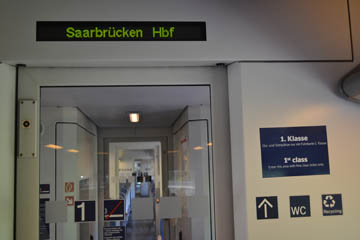
Look for the signs inside the train to learn your next stop.

MAKING CONNECTIONS
When you’ve found a seat, look for the automated sign inside the car that indicates the next stop, and be ready to exit when your destination approaches. Not all trains have this, so having a pre-printed schedule in your hand prior to boarding is helpful. You can print these out from the Rail Europe website before you leave home. To find your next connection at the next station if you need to, check the station train board for the time and track number. If the layover is long enough, stop for a coffee or a snack, or get a sandwich and drink to enjoy on the train at one of the many food shops located in the larger train stations.

The last leg of my day’s travel was by bus to Remich, where the cruise ship was waiting. Since my pass was for travel in Germany only, it was not valid for the bus to Remich. However, the bus ticket was easily purchased from the driver after boarding. Bus stations are usually right next to the train stations, and schedules between trains and busses are coordinated for easy connections.

After disembarking the cruise at Nuremburg, I made my way to the main train station by cab, checked the large signboard, and found the track for my next destination: Dresden. Once again, I wrote the date for my third day of travel in the appropriate square on the rail pass before boarding. You must write in this date prior to each day’s trip.

This inter-regional express train, one-fifth of which was devoted to first class seating, had some cars designated to leave the train at Bayreuth. Look for the signs on the sides and front of each car to be sure the car you’re riding is going all the way to your destination, since some cars may be transferred to other towns en route.

Even though this was a regional train, it traveled at upwards of 90 miles per hour, past farmland, forests, streams and rolling hills and through tunnels, often on super-elevated tracks, and in areas where double tracks allowed for quick, through traffic. The first-class seating area had a table at which I could comfortably eat the sandwiches I bought along. If you don’t have a chance to purchase food at the station, usually a snack cart on long-haul trains is wheeled through periodically, offering coffee, drinks and snacks.

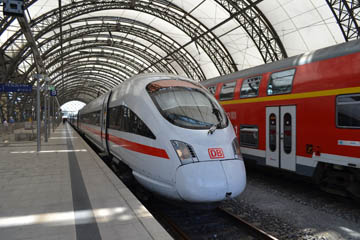
After four days in Dresden, I filled in the fourth travel date on my pass for the trip from Dresden to Frankfurt. In the Dresden Hauptbahnhof, I again bought food to eat on board while waiting for the signboard to list the train to Frankfurt. This trip would be on an ICE (InterCityExpress), one of the premier luxury trains on the Deutsch Bahn rail system. Once on the track platform, I looked for the chart listing the train equipment on this route. Waiting areas on the platform are designated “A”, “B”, “C” and “D”. Check this chart to find where the first class cars are in the train’s consist, and note where they line up in the ABCD waiting areas. You now know where the car you want will be as the train pulls into the station, allowing for quicker boarding.

RESERVATIONS MAY BE NEEED
Reserving a seat is recommended on some heavily-traveled routes, even if you have a first class reservation. Making a reservation costs a small amount and is easily accomplished at a Deutsch Bahn service counter at main train stations. The lines move quickly, most agents speak English and will efficiently take care of your request.

With a reservation you are assigned a specific seat in a specific car. The seat will have a sign above it designating it as “reserved,” and is reserved solely for you. Sometimes seats are reserved for a segment of the route beginning at a station down the line, and these seats must also be kept free for the passenger who reserved them, even if they are empty for the first part of the trip. Sometimes reservations on busy routes fill up quickly, so decide early if you want to be sure to have a seat. I didn’t bother with reservations on another trip from Vienna to Venice once, and ended up clutching my first class ticket while sitting on my suitcase the entire way in the vestibule of the standing-room only car.

Since Dresden was the starting point for this train, the equipment was already at the station ready for boarding when I arrived. I had plenty of time to check the “consist” at the platform, and found the car number and seat that was on the reservation. While I came prepared with sandwiches and snacks, dining car menus in first class offer coffee, tea, soft drinks, beer, wine, hot and cold sandwiches, soup, salads and pastries, which can be ordered and brought to your seat or purchased in the dining car. The menu changes monthly.

The ICE train is truly an express train. Super-elevated tracks allow for fast curves and a smooth ride, often at speeds of 100 to 120 miles per hour. The only stops were at main train stations along the route. As the beautiful German countryside sped by, I could see Wartburg Castle near Eisenach, and noted the exact location where the border and guard towers had at one time divided Germany into East and West.

Upon arrival (right on time) in Frankfurt, I walked to the hotel, and enjoyed another evening of exploring the city center on foot. The next morning I filled in the last date on the rail pass for the trip from Frankfurt’s main train station to the airport. Train travel through central Germany was easy and actually fun. I enjoyed the ride, taking it easy, and leaving the driving to someone else. These iron rails can be such a delight!

For more information, go to: www.raileurope.com or the DB website: www.bahn.com/i/view/USA/en/trains/index.shtml, but you will still need to purchase your ticket from Rail Europe before you go.

Beginner’s Budapest

By Don Heimburger
Photos by the author

The Eastern European capitals are becoming “closer” to visit each year with better airline routes, and in some cases, reasonably-priced tickets. It’s really not correct to call them “Eastern,” a friend of mine said, because if you look at a map of Europe, they are still close to the “West.” Consider perhaps cities in Belarus, the Ukraine and Romania as “Eastern,” he suggests.

So Budapest, a recent destination of mine and the capital of Hungary, was not particularly hard to reach, after I determined that a Rail Europe train ticket was the most economical form of transportation from Munich. It was, however, a 7 hour and 22-minute train ride from the Bavarian capital, but with trains being an easy and relatively inexpensive form of European travel, I opted for that.

FIRST IMPRESSION
My first impression of this city of about 2 million people (it’s much larger than Prague), came as I departed the train and walked among hundreds of train travelers to the door of the massive train station, where I met hundreds more people on the streets. The city seemed vibrant, active and alive. It also seemed like I should have studied the Hungarian culture a bit more before I arrived, just to ground myself better in what I was about to see.

Divided by the Danube, the city is really two cities in one—hilly Buda in which is located Castle Hill—and Pest, located on the east side, and flat. The most prominent building on the river is the Parliament Building, closed when I was there because of a national holiday. In fact, the whole area was roped off by the police.

Photo by Marilyn Heimburger

My overriding concern about going to Hungary was the language: I didn’t know a word of Hungarian, and I found it hard to pronounce words. I did learn that “Utca” meant “street,” “Hid” meant “bridge,” and “Furdo” meant ”bath.” I also found as I went along that I didn’t necessarily need to know any words in Hungarian. Most of the shopkeepers, hotel personnel and tourist guides knew enough English so that I could communicate well enough.

City trams in Budapest

GUIDEBOOK HELPS
I’d suggest picking up a guidebook at a local travel store before arrival, and then arranging for a city tour of the highlights before attempting to proceed on your own. The reason for the city tour is that because of the size of the city, you’ll not likely be able to find all the attractions yourself, or want to walk to them yourself.

The tour (www.cityrama.hu), will take several hours, but you will have seen the crème of the attractions of the city. If you plan to stay a few days, the Budapest Card provides free services or discounts at more than 100 places, from public transportation and museums, to thermal baths and restaurants.

The three-hour Cityrama “City Tour” costs 28 euro and includes free taxi pickup at your hotel. The tour starts at the Chain Bridge, which is especially beautiful at night; a romantic walk along the river near the Chain Bridge is memorable. The Parliament Building, built in 1896 for the city’s millennium celebration, features a unique Neo-Gothic design, and reminds one of its counterpart in London. At one time a large red communist star was anchored from the tallest spire. Guided tours are available in the portion of the building which was vacated by the House of Lords.

Behind the Parliament is Kossuth Ter, filled with monuments such as the one to Lajos Kossuth who led an uprising in 1848. The Museum of Ethography (focusing on folk art and country life) in the old Supreme Court Building houses artifacts from the pre-WWI days in Hungary.

Shops, theaters, cafes and more line the Andrassy Ut as the road connects the City Park where you’ll find the zoo with its playful buildings, the famous Szechenyi Baths with several different pools to soak in, the Vajdahunyad Castle (a replica of the famous castle in Transylvania), the Museum of Fine Arts, the Palace of Art and Heroes’ Square. At the baths, you’ll soak in water containing calcium-magnesium-hydrogen carbondate and sulphate-cloride.

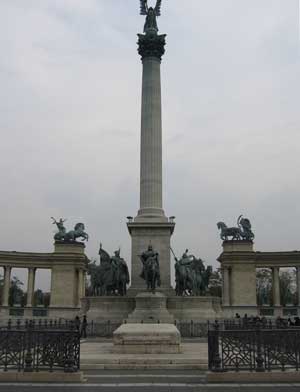
I spent quite of bit of time in this area of the city, and would have spent more if the weather had cooperated. Heroes’ Square is where you’ll meet the most “historic” Hungarians in statue form; the very large open area has as its backdrop the imposing Millennium Monument. In the adjacent City Park is where the famous Gundel Restaurant is located (see sidebar). During the 19th century, citizens used to ride their horses in this place and take along a picnic lunch. In the winter, the lake is frozen, so ice skating is a popular past time.

In the other direction, the House of Terror, former headquarters of the Nazi-sponsored Gestapo and secret police, Budapest Opera House, with its neo-Renaissance architecture, fits well with the similarly-elegant neighborhood on Andrássy Avenue. Hungary’s greatest architect, Miklós Ybl, designed the building for the Millennium celebrations. Construction started in 1875 and the building was finished in 1884. Ybl oversaw the work himself with painstaking care. Hundreds of statues and paintings decorate the building both inside and out.

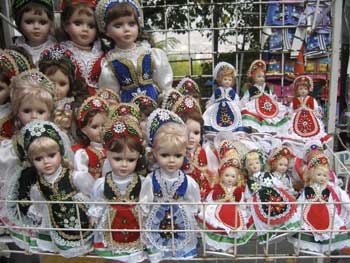
Another attraction in Pest is the Great Market Hall, a multi-level cavernous structure at the end of Vaci Utca, which should take care of most of your food needs if you’re looking for fresh meats, bakery goods, fruits or vegetables or paprika, and it will also satisfy your need for Hungarian souvenirs. This is a good place to hang out for a couple of hours and find lunch at one of the many fast food stalls,

At Buda Hill, you can walk up the hill (about 30 minutes), or take the chairlift to the top of Janos Hill (1,729 feet). The Erzsebet Lookout tower offers a panorama overview of the city below. The area is divided between the “royal” section and the civilian section, with Matthias Church and Fisherman’s Bastion highlights of the civilian section. Streets that lead away from Trinity Square are dotted with Baroque-style buildings and mansions that hide Gothic ruins.

For a rest and refreshment, try ice cream or a pastry at the Ruszmurm Cafe or sit for a while at Kapisztran Square and listen to the bells of the Magdalena Tower. Be sure to see the Royal Place complex. Once the home of lords and royals, it is now the home to museums.

There are more than 200 museums in Budapest, some of which include the Hungarian National Museum, the Budapest History Museum, the Hungarian National Gallery, Museum of Fine Arts, the Museum of Military History and the Ludwig Museum.

An interesting aspect of Budapest that many may not know about are the caves in the area. Monaco is the only other city that can boast a dripstone cave—Budapest has several open to the public: there’s the Palvogy, the Szemlo and Matthias Hill caves (qualified climbers only).

City park on Margaret Island

More highlights:

  • New York Cafe—The most ornate cafe of 320 that operated in the years preceding WWI, and it has remained the most elegant since. Gilded columns, reliefs and shining mirrors evoke the aesthetics of the early 1900s.
  • The square-shaped chocolate cake named after Jancsi Rigo, a gypsy musician, and its original creator Joseph Dobos, is a caramel-covered cake you’ll want to try while you’re in town.
  • Margaret Island, in the middle of the Danube, is a large, lovely park where you can escape the hustle and bustle of the city.

What have I left out? Actually quite a bit, but once there you’ll have plenty to do and see. Hungary’s capital is the hub of political, artistic and social energy. It’s full of history and grandeur, big bridges and wide boulevards. With impressive treasures and friendly people, Budapest is a spot you’ll not want to miss.

The New Etruscans

By Erla Zwingle
Photos courtesy the Italian Government Tourist Board NA

Say “Etruscan” to most people and they almost certainly know at least something about them: weird language, fabulous frescoed tombs, spectacular gold jewelry (lovers of trivia may also know that they called themselves “Rasna,” which may have meant “citizen,” that they gave the Romans the arch, and that their language had no “O”). This glamorous civilization began to be known about 968 B.C. and was a formidable economic and cultural power until its eventual decline and virtual disappearance in the 1st century B.C. — almost a millennium of indelible influence not only on the Romans, but on the many other Italic peoples who flourished on the Italian peninsula in the seven centuries before Christ. But recent excavations are revealing some surprising new facets of Etruscan life.

Below Massa Marittima, the hills that undulate toward the sea are brick-red from the copper enriching the well-named Colli Metallifere. On the forested slopes rising from the bright waters of the Lago dell’Accesa, archaeologist Stefano Giuntoli and his team have been working in an area of several dozen ettari (hectares), digging up the remains of clusters of small houses. These were the homes of Etruscans who, from the 9th to the 6th centuries B.C., managed the extraction and manufacturing of metals from the nearby mines of Serrabottini and Fenice Capanne.

HOUSES HARD TO FIND
“Houses are hard to find,” Giuntoli explained one sunny June morning; the air was already clinking with the music of many trowels in the stony soil. “The idea of the city was born by the Etruscans,” he said. “And the wealth of this city was due to extraction of metal.” Not only copper, but iron, lead and silver. The city of Vetulonia “had an explosion of wealth because of its bronze,” he said. “Traders came here from all over the Mediterranean. “

“This is the oldest and most extensive site we have,” he continued. “When the idea of a city began in the 6th century, walls come in. Long, communal retaining walls come in Etruria with the idea of democracy, not aristocracy. So here in Accesa it’s very strange to see only houses. Each area contained about 10 houses, which they put wherever they wanted, and its own cemetery. So it is a city, but an anomalous form of a city. A city of the 6th century had a wall, an acropolis, a temple, and streets. Here, no. It’s a strange thing for the period.”

Giuntoli’s team has opened five areas, and the entire site, open to the public as a Parco Tematico della Civilta’ Etrusca, can easily be visited in a morning. There are also some modest tombs dug in the earth, lined with stones, which have yielded treasures. “We’ve found many beautiful objects here,” Giuntoli said. “An iron axe, and a lance, and a strange bronze tool. And a small sort of decorated spatula.” One of the most striking is a 7th century woman’s bronze belt buckle made of two winged horses and sphinxes — common Middle Eastern motifs. Better yet, he shows me a piece of bucchero, a ceramic made only by the Etruscans and people of Asia Minor– dusty, but still distinctively black, and with the dull sheen that made it appear to be metal. It is part of a bowl that held food 2,500 years ago. “We also found a flint arrowhead from Neolithic times,” Giuntoli added, “put under the central post of the house to avert evil, part of the foundation ritual. Like laying the cornerstone. And we had never found tiny votive vessels in a house before — we usually find them in a temple. But we found some in that small room, to venerate the ancestors.”

Chiusi – Museo Nazionale Etrusco
Photo Courtesy Agenzia turismo Chianciano Terme – Valdichiana


CIRCULAR CAPANNA
In Area B, some houses larger than the usual one-room structures indicate how Etruscan society was changing. “Here the houses have walls of stone and tile roofs,” Giuntoli said. “For us, tiles are normal, but in antiquity the circular capanna (a kind of thatched hut) was normal, with a straw roof. In the second half of the 7th century in Etruria you see a rectangular house with many rooms and a roof of tiles. It must have been extremely important for the development of society, because one family could make a capanna, but a house with stones and tiles needs specialized workers who know how to make and to place them.” These workers, along with traders and scholars, also mingled the Etruscan culture with others. “We have a Greek man who worked here and made his fortune, so he was rebaptized with an Etruscan first name: ARNTHE PRAXIAS. And in the 5th century there was another person who had a Celtic last name, AVLE KATACINA.”

From the 5th century, the Etruscans began to struggle, then slowly decline, in the face of the growing power of the Samnites, Romans, Umbrians and Celts, the very people they once had taught. Accesa was abandoned in the 6th century, and commercial routes shifted to the Ionian coast. But in this unsettled period, the Etruscans continued to work, trade, and even fight. This is now visible on a hill outside Montalcino, where Dr. Luigi Donati has been bringing an Etruscan fortress to light.

“In November of 1990 I was walking along a trail from Montalcino to Sant’ Antimo,” Donati recalled, “and I saw on the map the name Poggio Civitella. It’s a name that evokes something, some place that was inhabited in the past. In these woods I saw this hillock, and you realized it wasn’t natural. Rummaging in the chestnut leaves, I found an Etruscan tile from the 6th century BC. So then I understood the name.”

ABANDONED VILLAGE
In the crunchy dry undergrowth, he showed me the remains of houses on the gently sloping sides of the hill; like Accesa, the village was abandoned in the 6th century. “There was a general crisis in the countryside then,” Donati explained. “It was like Italy in the 1960s–the people left the countryside for the city.” But in the second half of the 4th century BC, the Etruscans returned.

“Why was this fort born?” Donati asked. “It was a period of danger for the Etruscans. The Celts and Gauls came from the north, and the Etruscans felt the need to secure their territory, so this was a fort of the confine (border). There were many in the territory of Chiusi. This is our first chance to see an Etruscan fort in detail.”

What is surprising about this fort, among other things, is that it is circular. The builders exploited the previous village’s terraces to gain height, and constructed two walls, four meters apart and 150 meters around. The walls were at least six meters high. Most striking is the realization that they built it in a tremendous hurry to face some imminent danger. “The sandstone was quarried right here; we see the pick marks,” he said. “There were lines of men who passed stones hand to hand, and just put them down as they arrived. You can see it was built without care — they even put bigger stones on stop of smaller ones.”

From this vantage, the embattled Etruscans controlled all of Tuscany. On a clear day you can even see as far as Elba. But their days were ending. According to their sacred texts, the Rasna would live for ten centuries, and so it was. But now they are coming back to us. “Yes, it’s full of spirits,” Stefano Giuntoli admitted, smiling, in the woods at Accesa. “But we’re in amicizia (friendship).”

Wine Festivals Abound in Germany’s Historic Cities

From the first red wine produced along the Mosel River during Roman rule to the sweet Riesling for which the country is renowned, German wine is woven into the country’s culture and history.

Many member cities of the Historic Highlights of Germany are inviting travelers to experience this firsthand this fall with a series of wine-themed events, activities and offers.

In Mainz, more than 50 wine growers from throughout the region assemble during the first weekend in September for the annual Mainz Wine Market (photo at left). The event has craft stalls, rides, music and fireworks and, of course, dozens of wine stands. Wine-making goes back nearly 2,000 years in Trier, where several two-night packages feature special themes such as wine cultivation during Roman rule and a combination of World Heritage site visits and wine culture.

In Heidelberg, packages include the Heidelberg Wine and Chocolate Tasting with five wines from regional vineyards and five fine chocolates. Wine has long been central to life in Koblenz, located at the confluence of the Rhine and Mosel Rivers, where the “Wine Village” welcomes visitors to enjoy a glass of wine in the quiet setting of half-timbered houses.

Würzburg, situated on the Main River, is home to several wine estates, where visitors can enjoy tours and wine-tastings—including the Juliusspital, whose 400-year old, 800-foot long wine cellar makes it one of the oldest and largest German wineries.

Historic Highlights of Germany suggests two “Dream Routes” that focus on wine. Click on “Dream Routes” on our site at: www.historicgermany.com