By Don Heimburger Photos by Don and Marilyn Heimburger
Situated on a hill overlooking the small village of Melk, Austria, is the Melk Abbey, a Benedictine monastery with twin church towers that reach for the heavens.
The imposing Baroque abbey, high above the Danube, has two wings that project around the chapel, curving towards one another and connected by a balcony, framing the inset of the church. The builders succeeded in combining the natural surroundings with the structure.
Designed by Jacob Prandtauer and built between 1702 and 1736, the abbey monks provide pastoral care (the monastery oversees 23 parishes), and schooling (with 900 students). The theme of the abbey is “Ut In Omnibus Glorificetur Deus” (so that God is glorified in everything).
Visitors to the abbey can walk up steep steps to the entrance (walking through the small village of Melk) or drive up or take a taxi to the entrance. An abbey museum is located in the former Imperial Rooms and contains the exhibition “The Path from Yesterday to Today” which tells the story of the 900-year history. Beyond the museum, the must-see Marble Hall and library are two highlights of the structure.
In Marble Hall, Paul Troger’s beautiful frescoes (1731) adorn the ceiling; it is this room that was used as a guest room and dining hall for festive occasions, mostly for the imperial court. From the balcony, a grand view of the surrounding rivers, and town and fields is available.
Hundreds of inlaid bookshelves line the library room, which features similarly-bound books. A Paul Troger ceiling fresco is a counterpoint to the painting in the Marble Hall. On the upper floor of the library are two reading rooms, reached by a spiral staircase. The library contains 1,800 works, the oldest of which is a transcription of works by Venerable Bede from the early 9th century. Two-thirds of the manuscripts are from the reform period of the 15th century.
Gold, orange, ocher, gray and green combine to form a warm color accord in the church. In 1701 the church was completely rebuilt, and is now recognized as one of the most significant structures of the Baroque era. In its full light, its grandeur can take one’s breath away. The interior of the church has been shaped by the hand of Italian architect Antonio Beduzzi, with other artists actually doing the work.
Besides the abbey itself, there is also Abbey Park and the Baroque Garden Pavilion, and the abbey restaurant.
The whole Melk Abbey package is at least a two-hour visit, but to soak in everything, three hours seems more appropriate. Once there, you will undoubtedly want to stay longer.
The Melk Abbey is open all year. Admission is charged, with a reduction when other area attractions are combined. Guided tours are also available at the ticket office. The abbey is wheelchair accessible. For more information, go to www.stiftmelk.at or email kultur.tourismus@stiftmek.at
The year 2012 marks the 150th anniversary of the birth of Gustav Klimt (1862-1918). Vienna’s Kunsthistorisches Museum, Leopold Museum and Albertina are all staging major exhibitions dedicated to the work of this great turn-of-the-century modernist pioneer.
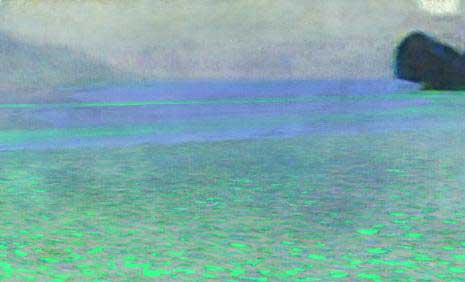
The Leopold Museum will be staging an exhibition titled “Gustave Klimt: A (time) Journey,” from February 24 to June 11 which will focus on the museum’s collection of hundreds of postcards, photographs and letters written by Gustav Klimt for over two decades to his partner in life Emilie Flöge. Among them there are art cards designed by the Wiener Werkstätte, tube mail, and telegrams as well as the correspondence that Klimt conducted with his friends and family in Vienna while enjoying his seasonal summer retreat at the Salzkammergut, at the Attersee and in Gastein or during his journeys that led him all across Europe to Italy, Paris, Brussels and London.
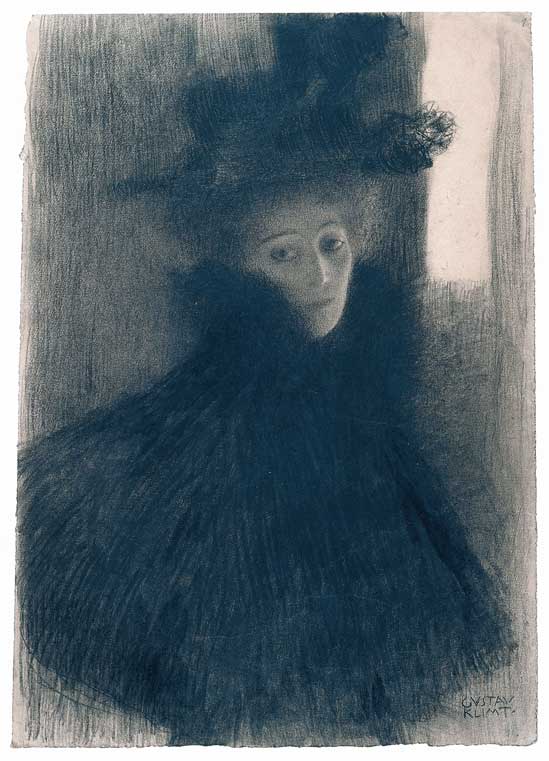
From March 16 until October 6, the Albertina Museum will celebrate Klimt’s 150th birthday with the exhibition “Klimt – Drawings” that will present the majority of the museum’s 170 drawings, as well as other items on loan. As a center for research on Gustav Klimt’s drawings, the museum will present pieces from all phases of the artist’s work. The focus will be on the unique drawing talent of Gustav Klimt, whose way of thinking and working is revealed in numerous figure studies and the precisely told allegories.
The Kunsthistorisches Museum in Vienna will hold a special exhibition from February 14-May 6 focusing on the 13 major paintings completed by Klimt for the grand staircase of the museum and the sketches they were based on. In 1890 Klimt, together with his brother Ernst and Franz Matsch, were entrusted with creating spandrel paintings and other narrow pieces to fill the spaces between the columns lining the grand staircase of the Kunsthistorisches Museum.
While Ernst Klimt and Franz Matsch kept to a more conservative style, the first signs of Art Nouveau symbolism can be clearly seen in Gustav Klimt’s pictures. These key paintings set the stylistic tone for Klimt’s world-famous work from about 1900 onwards.
Although goulash originated in Hungary, this popular dish later spread beyond its borders, first to the Austrian Empire, Germany, and the Balkans, and finally around the world.
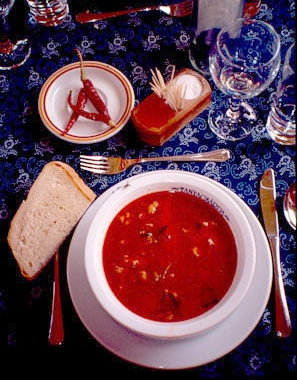
Classic Hungarian goulash at a restaurant on Hungary’s Great Plain
By Sharon Hudgins Photos by the author
Everyone loves a good goulash. But ask a dozen people what a goulash is—and you’ll get a dozen different answers: a soup, a stew, a meat dish served on a plate; brown, red, mild, hot-spicy; made with beef, pork, mutton, game, even vegetarian.
Although goulash originated in Hungary, this popular dish later spread beyond its borders, first to the Austrian Empire, Germany, and the Balkans, and finally around the world. That’s why there are so many versions of goulash today.
GOULASH ROOTS Hungarian goulash traces its roots back to nomadic Magyar herdsmen in the ninth century. Shepherds cut meat into cubes and slowly stewed them in a heavy iron kettle over an open fire until the liquid evaporated. Then they spread the meat out in a single layer to further dry in the sun. This dried meat, an early convenience food, could be carried with them as they followed their flocks across the vast expanse of Hungary’s Great Plain. To reconstitute the meat they simply added water and heated it—sometimes with other ingredients, too—in a pot over a fire. If a lot of liquid was added, the dish was called goulash soup. With less liquid, it was simply goulash meat. In both cases it was eaten with spoons dipped into the communal cooking pot.
Goulash got its name from those early herdsmen, who were called gulyás in Hungarian. But goulash as we know it today did not develop until the end of the 18th century and beginning of the 19th, with the widespread cultivation of peppers in Hungary and the use of paprika as a popular spice. Originally it was considered peasant food, eaten primarily by country folk—farmers, shepherds, cowboys, and swineherds. With the rise of Hungarian nationalism in the second half of the 19th century, paprika-seasoned goulash moved from the campsites and farmhouses to the tables of middle class and wealthy city dwellers, to the menus of fashionable restaurants and eventually across the globe.
GOULASH VARIETIES Goulash is now the Hungarian dish most widely known abroad. But in many parts of the world, dishes called “goulash” bear little resemblance to the gulyás that originated in Hungary and is eaten there today. In Hungary, gulyás is a meat dish halfway between a soup and a stew, made with small cubes of meat (usually beef), no more than 3/4-inch in size, and flavored with bacon or lard, onions and paprika. Gulyás is traditionally served in a bowl and eaten with a spoon.
Over time, Hungarian cooks also developed many variations on this theme, using such ingredients as garlic, tomatoes, mild banana peppers and hot cherry peppers, caraway seeds, root vegetables, cabbage, beans and tiny egg dumplings, as well as pork, mutton, venison and boar meat. Regional recipes abound, with each cook claiming his or her own version of goulash to be the best and most authentic.
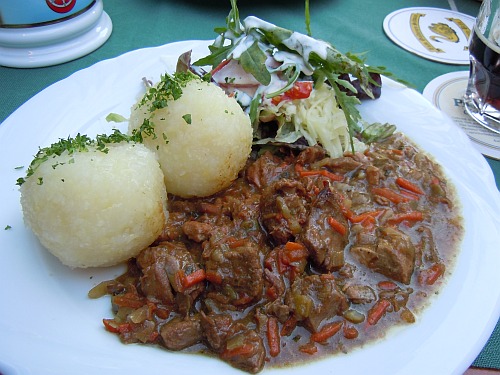
Germans adapted the basic Hungarian goulash recipe to their own tastes, producing the Gulaschsuppe (goulash soup) that is now so popular throughout Germany, where it’s traditionally served with a slice of rye bread and a mug of beer. Germans and Austrians also make a variety of thick, paprika-flavored meat stews called Gulasch, served on a plate and accompanied by boiled potatoes, egg noodles or dumplings. (The Hungarians, however, would call this kind of stew a pörkölt, not a goulash.) And Kesselgulasch (kettle goulash)—cooked outdoors in a pot suspended by an iron tripod over an open fire—is a Hungarian specialty that many Central Europeans now eat at their own backyard dinner parties and local festivals.
German “Beer Goulash” at brewery beer garden in Erfurt
As part of the former Austro-Hungarian Empire, the Austrians certainly love their own versions of Gulasch. There’s even a Cafe-Restaurant Gulaschmuseum in Vienna, where the menu lists more than a dozen varieties of goulash, including turkey or chicken-liver goulash with potatoes, bean goulash with paprika-seasoned sausage, veal goulash with little spinach dumplings, and even a dessert called Schokogulasch (chocolate goulash) containing cake, chocolate sauce and rum. In Prague I purchased a Czech cookbook devoted entirely to the subject of goulash—including versions identified as German, Austrian, Slovakian, Slovenian, Serbian, Bulgarian, even Chinese and Mexican! And recently in New Mexico I came across a Cajun goulash. What a mixture of geography and culinary cultures! From its humble beginnings on the plains of Hungary more than a thousand years ago, this simple peasant food has now become a truly global dish.
GOULASH-SPEAK “Goulash” has also entered several languages as a word meaning more than just “a soup or stew.” In Hungary, “Goulash Communism” was a term for the Hungarians’ attempt in the late 1960s to create their own, more market-oriented, economic system distinct from the Soviet model. In Germany and Switzerland, a “goulash cannon” is military slang for a mobile field kitchen—a big, heavy, black, iron stewpot on wheels, with a cover on the top and a built-in firebox—which is also used for feeding crowds at festivals and other public events. And in the Czech Republic, political parties had a tradition of setting up their own “goulash cannons” in front of polling places at election time, where they dished out free goulash in a blatant attempt to influence voters’ choices on the ballot. As the Czechs said to each other when they headed to the polls to vote, “Have a good goulash!”
Vienna has a well deserved reputation as a capital of cakes, confections and coffeehouses. The Viennese can’t seem to get through the day without stopping for a mid-morning pick-me-up snack at their favorite coffeehouse and for mid-afternoon coffee-and-cakes at a neighborhood pastry shop. And who could resist buying a little box of handmade chocolates at one of the many tempting candy stores, to nibble on at home?
Winter is a great time to visit Vienna, when the city is decorated for the holidays and the colorful Christmas markets are in full swing. Even after the holidays, Vienna remains a festive city, with concerts, operas and other events to brighten up the gray winter days.
At this time of year, everyone needs more calories to cope with the cold weather. So let that be your excuse for sampling the many sweet treats that Vienna has to offer. Besides, what could be more romantic than sitting on a plush banquette under a sparkling chandelier in an elegant pasty shop, eating a rich torte and sipping hot coffee topped with whipped cream, while watching the snowflakes outside settle silently over the city?
KAFFEEHÄUSER & KONDITOREIEN Vienna’s coffeehouses (Kaffeehäuser) are an institution dating back to the 17th century. The city claims to have more than 800 of them, including 150 “classic” coffeehouses with their traditional wooden floors, dark wood paneling, little marble-top tables, racks of newspapers on the wall, and waiters dressed in black.
Cafe Central, one of Vienna’s most elegant coffeehouses.
Most of them serve more than 20 different kinds of coffee drinks, hot and cold. If you don’t know the differences among a Grosser Brauner, a Franziskaner, a Kapuziner and an Einspänner, then ask the waiter to explain the coffees listed on the menu. Each will be served with a small glass of cold water on the side. And for the price of just one drink you’ve bought the right to sit in that spot for as long as you want, lingering over a newspaper or magazine, or writing your own journal or poetry, just like the historic figures who frequented that same coffeehouse in the past. Coffeehouses also serve a limited selection of sweet cakes and pastries as well as light meals (and sometimes more substantial fare).
Vienna’s most famous old coffeehouses include the elegant Café Central (corner of Herrengasse and Strauchgasse); Café Bellaria (Bellaria Strasse 6); Mozart bei der Oper (Albertinaplatz 2); Café Diglas (Wollzeile 10); Café Hofburg in the Imperial Palace (Hofburg/Innerer Burghof); Café Dommayer (Dommayergasse 1); Café Sperl (Gumpendorfer Strasse 11); and Café Sacher (Philharmonikerstrasse 4).
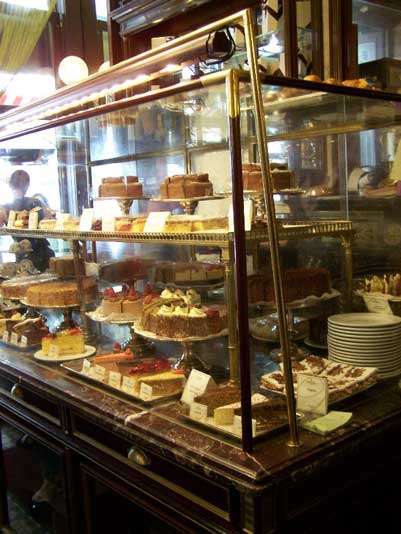
Vienna is equally famous for its pastry shops (Konditoreien), which are often packed with customers getting their mid-morning or mid-afternoon sugar fix. The 200-year-old Demel pastry shop (Kohlmarkt 14) attracts hordes of locals and tourists to its elegant showrooms and cafe. Demel’s high-quality cakes, pastries and confections are a temptation that can’t be resisted. After admiring the wares in the display cases downstairs, go upstairs to the chandeliered cafe to order your coffee and cake, stopping along the way to peer through the glass into the kitchens where the goodies are being made.
Cake counter at Demel’s pastry shop
Founded in 1847, A. Gerstner is another outstanding traditional Viennese Konditorei. Visit its original location at Kärntner Strasse 13-15 for a taste of Gerstner’s top-quality delights, perhaps dolled up with a dollop of Schlagobers (whipped cream). Both Demel and Gerstner have been official providers of sweets to the Hapsburg court in Austria, so you’ll eat like an emperor at either establishment.
(top) Making marzipan roses at Demel’s pastry and confection shop; (below) Stretching the dough for an apple strudel
Although there used to be a stronger distinction between coffeehouses and pastry shops in Vienna, that difference is now somewhat blurred. You can often get the same range of coffee drinks at a pastry shop as at a coffeehouse, and a good (but usually more limited) selection of pastries at a coffeehouse. Formerly Kaffeehäuser were mainly for men, whereas Konditoreien primarily served the ladies (and also sold prettily boxed pastries to take home). In our modern era these gender differences have almost faded away.
TORTE WARS Every visitor to Vienna wants to eat a slice of Sachertorte. Many pastry shops sell their own version of this rich chocolate cake, flavored with one or more layers of apricot jam and covered with a semi-sweet chocolate icing. But there are only two places that can claim to make the true Sachertorte: Hotel Sacher and Demel.
Pastry cook Franz Sacher invented this cake in 1832, and much later the recipe was further developed by one of Sacher’s sons while working at Demel’s bakery. In the 20th century a legal battle developed between the Hotel Sacher and Demel over who had the right to call this popular cake “The Original Sacher Torte.” After years of legal wrangling, the Hotel Sacher was given the right to attach a circular chocolate seal on top of its cakes and sell them as “The Original Sacher-Torte,” whereas Demel was allowed to attach a triangular seal on its cakes and call them “Eduard Sacher-Torte,” after the Sacher son who developed his recipe at Demel’s. (Now you’ll also see the cakes identified as “Demel’s Sachertorten.”) Each version is slightly different, so you’ll want to taste both of them, at their bakeries of origin, to decide which you like best!
(left) Marzipan confections cleverly colored and shaped to look like Austrian open-face sandwiches
HAVE A BALL If your sweet tooth is hungering for more, you can easily satisfy it at any of Vienna’s many candy shops, some of which make their own special confections. A number of them are concentrated around St. Stephen’s Cathedral in the heart of Vienna’s Altstadt. Look for Confiserie Heindl (Stephansplatz 11), which has 22 stores throughout Vienna; Manner (Stephansplatz 7); Metzger (also at Stephansplatz 7), which sells handmade confections, gingerbread and beeswax candles; and Lipizzaner (Stephansplatz 6), long known for its excellent chocolates, including some of the world’s first white chocolate candies.
Beyond St. Stephen’s, but still in the Altstadt, are Schokolade König (Freisingergasse 1), featuring handmade chocolates; City Confiserie (Bognergasse 5), with its extensive array of whimsical marzipan confections; Christian Rosenauer (Fleischmarkt 12), an old-fashioned Viennese candy store chock full of Mozartkugeln and other traditional sweets; and Leonidas (Fleischmarkt 9), which sells luxurious Belgian chocolates. Blühendes Konfect (Schmalzhofgasse 19) specializes in confections made from, and decorated with, flowers; and Xocolat (Strauchgasse 1) is a mecca for chocolate connoisseurs.
Wherever you go in Vienna, you can’t get away from those Austrian confections called Mozartkugeln. Invented in Salzburg in 1890, they’ve now taken all of Austria by storm. The original Mozart balls have a round center of sweetened green pistachio paste surrounded by a layer of hazelnut nougat, dipped in dark chocolate to coat the outside. Like all Mozartkugeln, they’re about the size of a small walnut. Other candy companies make their own versions, too, each a slightly different variation of the original confection. Mirabell-brand Mozart balls are the most widely marketed, in their distinct red-and-gold packages. You can’t leave Vienna without tasting this typical Austrian sweet.
MEHLSPEISEN Finally, any discussion of Viennese sweets should include mention of Mehlspeisen, those “flour foods” so beloved by the Austrians. This category of dishes made with flour includes Palatschinken, thin panckakes spread with jam, folded into quarters, and garnished with chocolate sauce and whipped cream; Kaiserschmarrn, a large buttery and sugary, raisin-studded pancake that looks like it has been hit by an earthquake; sweet Knödel, fruit-or jam-filled round dumplings garnished with confectioners’ sugar; Nockerln, big light-and-airy egg-white dumplings, sometimes served with berry sauce; and Strudel, layers of flaky pastry surrounding a filling of sweetened fruit, berries, or soft cheese. These are often listed in the dessert sections of restaurant menus, although they might be found under their own menu category, Mehlspeisen, reflecting the time when these dishes were also eaten as a main course, especially during fasting periods when meat products were prohibited.
Shelves of Mozart Kugeln at a Viennese candy store
► For more information about places to eat in Vienna (including restaurants, cafes, coffeehouses, pastry shops, and candy stores), get the 67-page booklet titled “Shopping, Wining & Dining” from the Vienna tourist office, WienTourismus (Albertinaplatz/Maysedergasse, www.vienna.info/en).
By Danielle Pruger Photos courtesy Austrian National Tourist Office
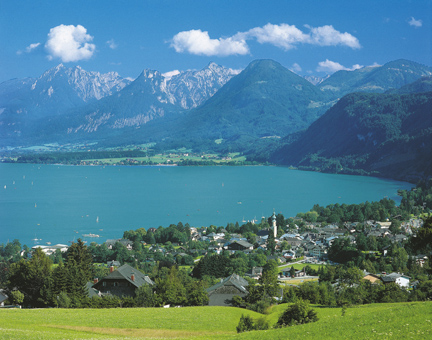
Lake Wolfgangsee
The Salzburg Lake District (Salzkammergut) is said to be one of the most charming regions in Austria: blue lakes, high mountains, green meadows and forests—a storybook landscape. The former emperor Franz Josef and his wife Sissi spent many holidays in this area and hence coined the term “Sommerfrische” (summer health resort).
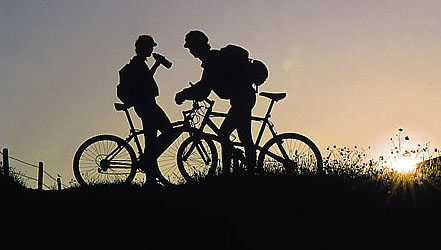
Aristocracy was easily persuaded, and it was not long until half of Vienna passed the hot summer months in the “healthy” region of the Salzkammergut. The artist Gustav Klimt was yet another regular, spending time on the lakes and trying to capture this stunning natural scenery in his paintings. This area is also known as both a cycling and hiking paradise.
One way to experience this region is through self-guided tours through the company Bike Tours Direct. Trails are well-marked and well-maintained, and the terrain varies from flat lakeside trails to hilly meadows to outright mountains. The region is dotted with gorges, waterfalls and other natural wonders, but it’s also filled with culture and history—quaint villages, medieval towns and imperial villas where the Austrian emperors spent their summers.
The self-guided tour is seven nights long. Highlights of the tour include a bike tour of Lake Wolfgangsee, a train ride into Salzkammergut and a stay at the Hallstatt lake resort.
Although the tour is self-guided, van support is available for transfers and shuttles.









 European Traveler