When in Malta, a visit to the Malta Maritime Museum is worthwhile.
The museum is located at the Vittoriosa waterfront. During the presence of the Knights of Malta on the island, the site was used as the arsenal where the Order’s galley fleet was maintained.
During the time of the British presence in Malta, the site was developed as the naval bakery, built between 1842 and 1845 by British architect and engineer William Scamp. The naval bakery supplied the Royal Navy’s Mediterranean fleet stationed in Malta with its daily requirements of bread and biscuits. The “Bakery,” as it was and still is affectionately known, remained part of the Royal Naval establishment up to the closure of the British base in March of 1979.
The museum illustrates Malta’s maritime history from prehistory to the present day; the ancient shipping section includes Roman lead anchors and amphoras. The section dedicated to the Order of St. John includes an important collection of authentic period models, some originally pertaining to the Congre-gazione delle Galere, and to the Order’s nautical school.
The French interlude (1798-1800) is represented by two large French republican guns, a prisoner-of-war wooden model of the French second-rater Bucentaur, documents, edged period weapons, and a host of water colors, engravings and lithographs.
The British period (1800-1979) is particularly well represented. The hall is divided into various sections illustrating the role of the Royal Navy in Malta.
Maltese traditional boat models, such as the Latin-rigged Gozo boat, the Ferilla and the Kajjik, tools and paintings constitute the basis of a small hall dedicated to boat building in Malta.
Everyone knows the story of the poor immigrants who arrived at Ellis Island in New York after a transatlantic journey from Europe. The “huddled masses yearning to breathe free” came by the millions in the late 19th and early 20th century, all with one dream—a better life in America. Their long voyage ended as they sailed into New York Harbor past the Statue of Liberty, a beacon of freedom and hope.
Many of us have visited the Ellis Island Immigration Museum and possibly even traced our ancestry there. But a new attraction in Antwerp, Belgium tells the flip side of the tale as it unfolded on the opposite shore of the ocean. In the actual brick warehouses where emigrants gathered to board, the Red Star Line Museum sheds light on the almost forgotten history of an American-owned shipping company that from 1873 to 1934 brought more than two million passengers from Antwerp to New York, Philadelphia, Boston and Halifax, most of them poor and oppressed peoples from Eastern Europe; about 25% were Jewish. Fewer than 200,000 were Belgians.
Among those dreamers was a Jewish family from a Russian town in what is now Belarus. The five-year-old son, Israel Isadore Baline, who traveled on Red Star Line’s Rijnland, went on to become a songwriter extraordinaire and changed his name to Irving Berlin. Had it not been for that voyage in 1893, “God Bless America” and “White Christmas” might not be part of the American songbook.
There were some rags-to-riches stories indeed, but it’s mostly the personal testimonies of ordinary folks that dominate the two exhibit floors of the Red Star Line Museum, located in Eilandje, a former dockyard district undergoing redevelopment. The museum is just a short walk from the Kattendijk Dock, where most European river cruise ships berth in Antwerp.
Curator Bram Beeleart confirms the museum is more about people than ships, emphasizing the importance of firsthand accounts of migrants before, during and after their transoceanic trips. “The overall theme we want to convey is that it’s about little people who imagined a better life for themselves on the other side of the ocean…little people who dreamed great things,” Beeleart says.
The fact that the museum occupies the original Red Star Line departure sheds on the Scheldt River’s Rijnkaai, or Rhine Quay, “adds power to the whole experience,” he says. The humble, decaying buildings had been empty since 2000; the oldest dates to 1894.
In putting together the museum’s exhibits, Beeleart and his team visited Ellis Island Immigration Museum and Hamburg’s Ballinstadt Emigration Museum, among others. Beyer Blinder Belle, the New York architecture firm that designed the Red Star Line Museum, also did the restoration work at Ellis Island.
The eight thematic areas abound with oversized photos and text (including excerpts from letters), artifacts, touchscreen computers, pullout drawers and audio and video stations. Visitors follow in the emigrant’s footsteps, starting at a Warsaw ticket agency similar to many such offices in Eastern Europe where passengers would have bought their Red Star Line tickets.
Next in the sequence is a train compartment for the trip to Antwerp, followed by glimpses of early 20th century Antwerp, procedures in the Red Star Line departure buildings, the deck of an ocean steamer, shipboard life, arrival at Ellis Island and a new future in the United States.
Prior to following the European emigrant’s path to the New World, visitors encounter a timeline of migration throughout human history and installations that spotlight “Six Star Witnesses,” including Red Star Line passengers Albert Einstein and Sonia Pressman Fuentes, the latter a renowned feminist who made the trip from Florida for the museum’s grand opening last fall.
The exhibit on 1910-1922 Antwerp, which features grainy film accompanied by sound effects like streetcars and the clip-clop of horses, describes how locals viewed the Eastern Europeans with curiosity and pity—exotic head scarves, weather-beaten faces and ragged appearance clearly set the migrants apart. Upon arrival in Antwerp, train passengers from small towns in Russia, Poland, Austria-Hungary and Germany were awed by the cathedral-like Central Station, still one of the city’s grandest sights and worth a look even if you’re not traveling by rail.
Before their 10-day ocean voyage, the rumpled travelers stayed in dingy, overcrowded migrant hotels and often were the target of crooks. But Basia Cohen, as a girl from Russia, had positive memories of her 1921 experience: “Antwerp was my favorite city of all. It was the first time I had ice cream. We used to hear about ice cream but we never even had seen it.”
Visitors also experience the anxiety that emigrants endured in the very building where they awaited the medical exams that resulted in 2 to 4% of ticket holders being rejected for the trip to America, as the line would be liable for repatriating anyone with a contagious disease. Everyone in third class had to take an hour-long shower using vinegar and other solutions; their clothes were fumigated and baggage was sterilized in large pressure boilers.
Once at sea, most of the emigrants wallowed in the bowels of the ship, where conditions were cramped. Those in third class, or steerage, slept on straw mattresses and had to scramble to stave off hunger. In the words of Golda Meir, a Russian immigrant who settled in Milwaukee and later became the prime minister of Israel: “It was not a pleasant trip. We spent the nights on sheetless beds and most of the days standing in line for food that was ladled out to us as though we were cattle.”
Passengers in first- and second-class (pleasure travelers, businessmen, even an occasional emigrant), however, enjoyed fine dining, deck games and evening entertainment. Sometimes they would throw fruit or candy down to the children traveling in steerage. On display are dishes, silverware, ashtrays and cigarette lighters with the Red Star insignia, plus sample menus, wine lists and pictures of ballroom dancing. Ironically, songs played in the first- and second-class lounges in the 1920s and ’30s included ones written by a now-famous Irving Berlin, who had traveled in steerage three decades earlier.
From its earliest days the Red Star Line promoted its product in artistic brochures and posters, but concentrated more and more on the vacation market once the U.S. clamped down on immigration in the early 1920s. Actual printed materials and touchscreen displays show how the line marketed cruises to “discriminating travelers” who could “leave boredom behind and find solace in the sun” on a trip from New York to Havana, Nassau, and Bermuda. Its 2,500-passenger flagship, BelgenlandII, touted a swimming pool and fake beach.
During Prohibition, Americans took “booze cruises” to Bermuda, and the line even did seven world cruises. Over the years Red Star operated 23 ships (all with “land” in the name—Pennland, Westernland, Lapland, etc.) and chartered other vessels. Unable to survive during the Great Depression, the company was finally liquidated in 1934. Its demise was a big blow to Antwerp, where “the pulse of the Red Star Line was felt in the very arteries of the city,” wrote one local newspaper reporter.
Exhibits on Ellis Island and tenement life in New York’s Lower East Side give way to the success stories, including the iconic example of composer/lyricist Berlin. A showpiece is one of Berlin’s composing pianos, on loan from his second daughter, Linda Emmet, who lives in Paris. Visitors are reminded of the many songs he penned, from “Alexander’s Ragtime Band” to “Puttin’ on the Ritz.”
A museum visit concludes with the stories of today’s immigrants in Antwerp and a chance to do online genealogical research of your own. Then climb or ride the elevator up the new concrete-and-steel observation tower, which mimics the chimney and bow of a Red Star Line ship. The open-air platform affords a panorama of quays along the Scheldt—the last scenes that passengers, on their way to an uncertain future, would have witnessed as Antwerp and the Old World slipped from view.
For anyone fascinated by maritime history and tales of human migration, the Red Star Line Museum is Antwerp’s star attraction. For information, visit redstarline.org.
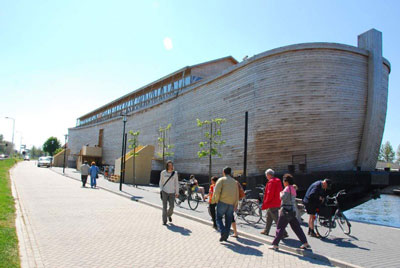
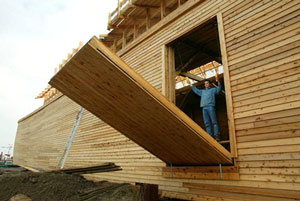
When the massive central door on the side of Noah’s Ark was opened, the first crowd of curious townsfolk was there to behold its wonder.
Of course, it’s only a replica of the biblical Ark, built by Dutch creationist Johan Huibers, as a testament to his faith in the literal truth of the Bible. The ark is 150 cubits long, 30 cubits high and 20 cubits wide. That’s two-thirds the length of a football field and as high as a three-story house.
LIFE-SIZE ANIMAL MODELS Life-size models of giraffes, elephants, lions, crocodiles, zebras, bison and other animals greet visitors as they arrive in the main hold. A contractor by trade, Huibers built the ark of cedar and pine. Biblical scholars debate exactly what wood was used by Noah for construction.
Huibers did the work mostly with his own hands, using modern tools and with help from his son, Roy. Construction began in May of 2005. On the uncovered top deck — which was not quite ready for the opening– will come a petting zoo, with baby lambs and chickens, and goats and one camel.
Visitors on the first day were stunned. “It’s past comprehension,” said Mary Louise Starosciak, who happened to be bicycling by with her husband while on vacation when they saw the ark looming over the local landscape.
There is enough space near the keel for a 50-seat film theater where kids can watch a video that tells the story of Noah and the ark. Huibers says he hopes the project will renew interest in Christianity in the Netherlands, where church going has fallen dramatically in the past 50 years.
For the millions of RMS Titanic lovers around the world, April 15 is a very significant date. On that day it will be exactly 100 years since the tragic sinking of the ship that changed so many lives and sparked one of the most captivating stories in human history.
On March 31 the world’s largest Titanic visitor attraction, Titanic Belfast, will officially open its doors, thrusting the ship’s physical and spiritual home firmly into the global spotlight.
The striking $152 million piece of modern architecture stands majestically at the head of the very slipways where the Titanic first glided into the waters of Belfast Lough.
Inside, nine walk-and-ride-through exhibition galleries equipped with the latest 3D, CGI and video technology uncover the true Belfast story of the Titanic, from its conception and construction in the Harland & Wolff Shipyard to its famous maiden voyage and subsequent place in history.
A host of experiences are offered—a thrilling ride through the shipyard with the Titanic under construction, or an exploration of the sumptuous luxury and superb craftsmanship of its interiors.
You can be drawn deep into the stories of the passengers, crew and the heroes of the day or re-live the drama of its tragic end and visit its resting place in the North Atlantic in a unique Ocean Exploration Center with live links to contemporary undersea exploration.
By Danielle Pruger Photos courtesy Burgundy Tourism
Auxerre, France
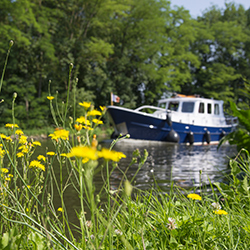
Burgundy, France offers more than 600 miles of waterways, making it a perfect destination for sailors of all experience levels. There are many ways to enjoy the rivers of Burgundy – sailing, sightseeing, waterskiing and bicycling along the river are just to name a few.
FUN AND RELAXATION BY THE WATER Visitors can relax on a sightseeing boat for a guided tour along the waters of the Burgundy Canal. The Seille, a river flowing between the French departments Tournus and Louhans, also offers cruising opportunities. Hotel barges are also a relaxing way to enjoy the Burgundy Canal.
The city of Clamecy and the medieval village of Cravant on the Nivernais Canal are great small towns to visit and explore. The little town of Semur-en-Auxois is few miles away from Burgundy and includes sights such as the Tour de l’Orle d’Or or the Collegiate Church of Notre-Dame. Large cities also have a lot to offer: the Dijon marina is a lively area with the Péniche Cancale, a boat converted into a floating gourmet bistro and cabaret that hosts concerts, exhibitions, dance performances and theatre.
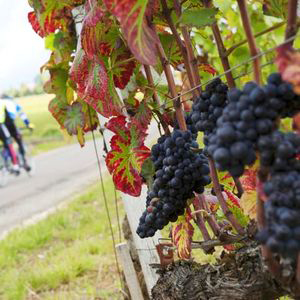
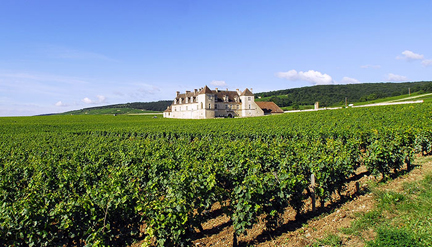
Burgundy, the birthplace of pinot noir and chardonnay, is home to world-class vineyards that produce some of the most prestigious wines in the world. Visitors can taste some of the best wines of Burgundy at the cellars of the vineyards of Auxerrois, Tonnerrois, Maranges or Santenay.
WATER SPORTS Water sports enthusiasts can choose other activities including water-skiing, sailing and rowing. The developed areas invite swimming in leisure centers in Auxerre or Decize. The tranquility of the waterway can be enjoyed by fishing on the region’s canals or lakes or by big game fishing on the Saône while accompanied by a qualified instructor.
OUTDOOR ACTIVITIES ALONG THE BANKS The towpaths along the canals and rivers, open to cyclists, are perfect for biking. These paths are also great for enjoying a walk along the waterfront.
The region is full of marked trails so there are plenty of routes to choose from. The Tour of Burgundy by bike runs along the canals of Nivernais and Burgundy, as well as the Canal du Centre. These paths take visitors through the region’s most beautiful landscapes – across vineyards, groves and forests and pass by historic monuments and charming residences.
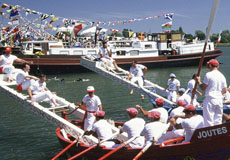
Pardone des mariniers in Saint-Jean de Losne
A region criss-crossed by waterways, every year Burgundy celebrates water with various events. Music, demonstrations, tournaments and tastings punctuate the shorelines all summer long. There are many events to choose from, including the Pardon des mariniers in Saint-Jean de Losne, the Fête du Flottage in Clamecy or the Halles en eaux in Decize.






 European Traveler