Swiss cuisine combines influences from France, Northern Italy, Germany and Austria. And specialities vary greatly from region to region closely aligned with the language borders. Many local specialities have become firm favorites throughout Switzerland.
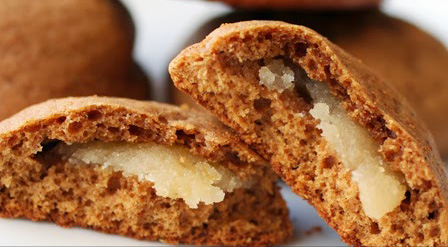
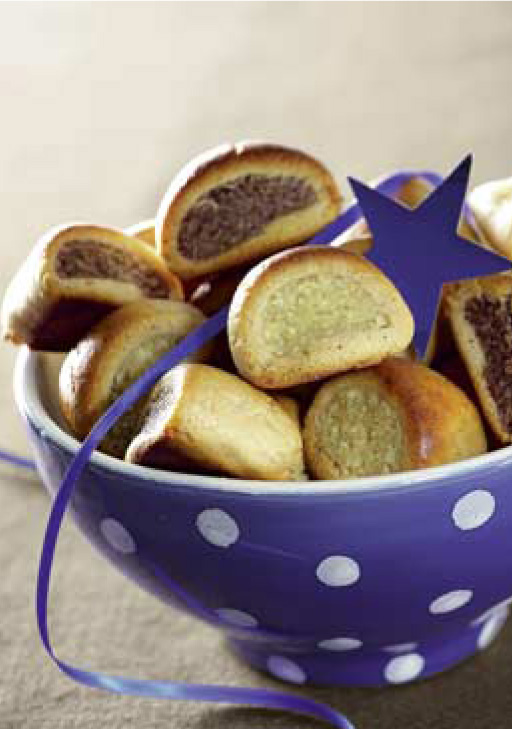
ST. GALLER & APPENZELLER BIBER St. Galler & Appenzeller Biber are two types of gingerbread with filling. One is from St. Gallen, the other from Appenzell. One is loaded with a hazelnut, the other with a white almond filling. But both are called “Biber” (beaver) or “Biberli” (little beaver) and have two layers of soft honey dough and one layer of yummy stuffing, so they might be totally different from the gingerbread you’ve had so far. No matter which one you try, they can be highly addictive.
BIBERLI WITH LEMONGRASS MARZIPAN Preparation time: approx. 50 minutes. Cooling time: approx. 13 hours. Baking time per baking sheet: approx. 8 minutes. Yield: 50 Biberli cookies
FOR DOUGH Mix in a bowl: 1 1/2 c. flour 1 teaspoon spice mix for Lebkuchen zest of 1/2 lime
Heat: 1/4 cup honey 2/3 cup powdered sugar 1 teaspoon water
Add sugar to flour with: 1 tablespoon milk 1 teaspoon baker’s salt (baker’s salt is ammonium bicarbonate and is available at pharmacies)
Knead into a soft, smooth dough and let rest for 12 hours in the refrigerator
FOR LEMONGRASS MARZIPAN Finely chop in a bowl: 2/3 cup peeled almonds 2–3 blades of Lemon grass (only the inside), cut in small pieces 1/4 cup white chocolate, broken up
Add and knead into a dense ball: 50 g Acacia honey ½ tablespoon lime juice
Shaping: Roll the dough with a little flour into a square shape (about 8 x 8″). Halve the squares lengthwise. Moisten edges with water. Halve the marzipan. Form 2 rolls (each about 12″ long, by 3/4″ diameter). Place 1 roll on the long side of the dough, form into a roll, cover and store in a cool place for 1 hour. Form a second roll. Cut the rolls diagonally into 1″ wide trapeze-shaped pieces. Place the Biberli on a baking sheet lined with parchment paper. Glaze with heavy cream.
Baking: Approx. 8 minutes in the center of the pre-heated oven, pre-heated to 400 degrees. Remove from oven and pull the parchment paper with the Biberli onto a wire cooling rack. Glaze once more with cream, let cool completely.
Storage: Biberli can be stored for approx. 1 week in a tin with a close fitting lid.
Alternate hazelnut-cinnamon filling: 2/3 cup hazelnuts, 1 teaspoon of cinnamon, 1/4 cup milk chocolate, broken into pieces; finely chop with a cutter. Add slightly less than 1/2 cup sweetened condensed milk and 1 tablespoon of water; knead until it forms a compact mass.
Grabbing a “taste” of Germany today doesn’t mean just visiting its Medieval castles like Neuschwanstein or Wartburg Castle, or visiting its thousands of half-timbered buildings such as you’ll find in Wernigerode, Bamberg and Cochem, or being one of the millions who take pictures of the famous Cologne Cathedral.
A “taste” of Germany in 2018 takes on a special meaning: this year Germany’s National Tourist Board officially unlocks its treasure chest of culinary delights as part of its promotion of the country, and there are many appetizing foods to be enjoyed, and 16 federal states in which to enjoy them.
With eight straight years of record growth in tourism, Germany is primed for more tourists in the year ahead who can also appreciate this country’s flavorful foods. In 2017, a total of 83.9 million overnight stays by foreign visitors in establishments with at least 10 beds were recorded, according to Petra Hedorfer, chief executive officer of the German National Tourist Board (GNTB).
The German Tourist Board is trying to get travelers’ attention by saying “Attention foodies: Germany is now open for tasting.” And there are many towns and regions in which to conduct this culinary research, as well as numerous restaurants, wineries, breweries and farms that are eager to show visitors what Germany has to offer.
HANNOVER CURRYWURST In Hannover you can stop in at an interesting restaurant called the Ständige Vertretung at Friedrichswall 10. The “StäV” as it is named, is not just any cafe, but a political reading book … where the history of political happenings and famous German politicians from past decades can be found on the walls and in photos. But go also for the famous “explosive” currywurst offerings. There’s the German Chancellor Filet “Schröder Art,” the Bundestag Filet, and the Chancellor Tarte, all part of the currywurst menu. All come with spicy sauce.
THE ARISTOCRAT OF VEGETABLES At Fritz Bormann’s 25-acre asparagus farm near Nienburg in Lower Saxony northeast of Hannover, vast fields of white asparagus (Spargel) covered by large plastic tarps, sit waiting for harvest. In early spring, workers pour into the fine sand-like fields, armed with long, sharp cutting tools and a bucket to pluck the revered savory asparagus stalks from underneath the heaped mounds of dirt.
The “white gold” is then cleaned, graded and quickly delivered to farmstands and markets where it is snapped up by eager eaters. Combined with a hollandaise sauce or hot melted butter, and perhaps a plate of potatoes and pork or ham, the pale, long-stemmed vegetables are a nationwide sensation.
Germany sets aside about 62,000 acres for growing asparagus every year, and it’s estimated the country consumes up to 125,000 tons of it, but some of that is grown in other nearby countries. And nearly every restaurant in the asparagus-growing regions feature Spargel specials on their lunch and dinner menus. The picking season ends promptly on June 24 every year.
If you’re lucky, you can even meet one of the local Spargel queens, like the 2017/2018 queen, Nicole Cybin from Nienburg, or visit the local asparagus museum, part of which is housed in an original 1663 building. The museum displays, among other things, old tools which were once used for harvesting asparagus, dishes and serving plates with asparagus themes painted on them and even molds in the shape of a bunch of asparagus.
ASPARAGUS ROUTE There’s even an Asparagus Route (Spargelstrasse) which begins in the town of Schwetzingen (it also claims the title of “Asparagus Capital of the World”). When you walk through the city, look for the statue of the Spargelfrau (literally means asparagus woman). The town holds an annual Spargelfest and in 2018 celebrates 350 years as a major Spargel grower.
While you are in Nienburg, be sure to stroll around this fascinating 1,000-year-old village and find the 16th century half-timbered Rathaus built in 1533, as well as the same period St. Martins Church. There are also medieval mansions, other carefully restored half-timbered homes, and a large town center with wide streets. The castle and town of Nienburg were once the residence of the Counts of Hoya, and their tombs can be found in St. Martins Church.
You can also visit the Dobberschuetz Fishery & Smokehouse alongside the banks of the Weser River which flows through the town and get the catch of the day. Eels are their speciality. Get there on a Saturday and enjoy their Saturday fisherman breakfast.
No sleepy little village, Nienberg today has as many as 100 trains a week stop there.
OTHER GERMAN CULINERY DELIGHTS At the sprawling Rotkäppchen winery in Freyburg, Sekt or sparkling wine is produced, with brothers Moritz and Julius Kloss and a friend establishing a wine store and producing Rotkäppchen champagne as early as 1856. The first 6,000 bottles were bottled in an apartment in the back of the house of the Kloss family.
In the large historic Rotkäppchen building in Freyburg, select grapes are used to make various cuvees, and the brand today is the most successful in Germany, and also holds a 30% international market share. This Sekt takes its name from the unique red cap on its bottles.
Every year the company sponsors a Jungweinprobe, where last years wines are sampled in the courtyard of the Rotkäppchen winery. It’s always a popular and crowded affair with everyone allowed to pour their own glass of wine from a staggering selection. Here, too, you can meet the local Wine Queen, and ask her which cuvees she prefers. In 2017/2018 the reigning queen was Juliana Beer, 22. Not just a queen in name only, she enjoys the aged wines, and can explain the nuances of wine growing and wine-making.
The Rotkäppchen winery boasts one of the largest storage barrels in Germany (from 1856) which can hold 160,000 bottles of wine. And you can also enjoy a great German meal as you sit near the giant wooden barrel and try to figure out how they made such an elaborate wooden vessel.
WEINGUT PAWIS IS A STANDOUT Also in Freyburg, Weingut Pawis is a standout winery housed in a renovated stone building. As a 10-year-old boy, Bernard Pawis didn’t have much luck with a hoe in his father’s vineyard. But when he learned the wine profession in Radebeul years later, he was on his way to gaining national recognition with his wine production.
Taking over from his father in 1998, he constructed a new wine cellar and later rebuilt an old horse stable into a modern, welcoming and innovative winery with 30 acres of vineyards.
The family produces a number of wine varieties, including Müller-Thurgau, Silvaner, Riesling, Bacchus, Kerner, Pinot Blanc and Pinot Gris, Portuguese, Dornfelder, Pinot Noir and Regent.
Their unique operating philosophy includes sustainable economics, conscious handling of nature, respecting the soil and the vine as their most important commodity, and they work according to environmentally friendly cultivation methods.
The innovative Pawises offer wine tastings, art exhibitions, guided vineyard tours, champagne receptions, a Christmas market, and even a lookout tower on the historic estate.
BLUEBERRY HEAVEN At Bickbeernhof, you’ll find just about every conceivable way to serve blueberries that you can think of. Owner Sylke Herse has already done the planting, growing, and the packaging for you, and draws upwards of 1,000 visitors a day to her blueberry world in Landesbergen. “Very busy, very organized. Long wait lines at peak times, but worth it. Big juicy blueberries. Every year a must!” are the typical comments from customers.
Blueberry fields are located right behind the processing plant and company store, and there is a wide variety of blueberry-made products offered in the gift shop including blueberry wines, jams, juices, books about blueberries and much more. In their restaurant, customers can order salads with blueberry dressing, blueberry marmalade blueberry pudding, blueberry smoothies and many other blueberry delicacies.
BORN FAMILY VINEYARD Motorcycle-riding Jochen Born and the small Born Family Weingut in Höhnstedt, located near the famous Luther Walking Trail, produces a variety of wines from its mostly “vertical” vineyards lining the slopes of the area hills. The hills around Höhnstedt contain a lot of limestone, and help from the sun, the wind and the rain make it an ideal place to grow grapes. Jochen is an amicable host and willing to tell his guests about the intricacies of his wine brands and its production in his compact and cozy tasting room adjacent to the wine gift shop.
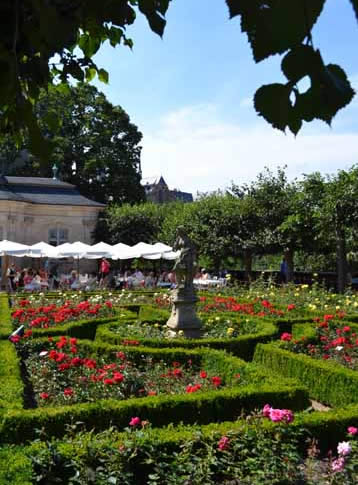
SCHLOSS WACKENBARTH Schloss Wackenbarth in Radebeul, is a well-situated, picturesque winery, and one of the oldest sparkling wine producers in Europe. On the well-manicured grounds is a Mediterranean-style palace erected by Augustus the Strong. Since the 18th century Schloss Wackerbarth has attracted hundreds of thousands of visitors because of the charming setting, and of course the delicious wines.
Tours through the winery and grounds are conducted, and many social events, including weddings and banquets, take place on the grounds each year. Interestingly, the federal state of Saxony owns the winery. The winery calls itself an ambassador for the state of Saxony, and indeed it has the stature and appeal of something regal.
While every year Germany is certain to attract millions of visitors for its culture, history, sights and its uniqueness, 2018 calls out for a visit for all of the above, and especially its many and varied succulent, edible delights. Guten appetit!
I didn’t know travel and culinary adventures could be so entertaining until I happen to watch my first episode of Phil Rosenthal’s “I’ll Have What Phil’s Having.” First I was drawn in by the name of the show which I heard about on my Chicago PBS station, and I thought, “Who has a television series name like this?”…but I was even more curious— “What does it mean?” I thought and thought, but couldn’t figure it out.
Then I happen to just be sitting down in the family room after supper and one of Phil’s episodes came on….it was his Barcelona program. It started with a flashback photo of Phil as a small kid…he was wrinkling up his nose at something in the photo. “Meat was a punishment,” he remembers from his childhood.
But today, Rosenthal, an Emmy award winner and a very funny guy, is visiting one of Spain’s — and the world’s — hippest spots, Barcelona. In this city, food is taken very seriously, with people in Barcelona planning supper while eating lunch, and when they plan a day trip, their most important concern is where they are going to eat. Just “grabbing a bite” is not an option here. In Barcelona eating comes first, and you have to think about it.
“The world can be a beautiful, delicious and friendly place when we travel and eat food together,” announces Phil as he begins his Barcelona food experience. Since Barcelona is located beside the Mediterranean, seafood abounds, with the long Catalan coast sheltering more than 30 fishing ports, and fish is a supreme passion with local gourmets.
Rosenthal, the creator of the TV hit “Everybody Loves Raymond,” is a passionate foodie who makes friends fast and warms up to excellent dishes even faster. “I’m Phil Rosenthal, and I’m here to say come on, you can have what I’m having.” His one-hour shows (I’ve also seen his Paris and Italy episodes), which focus on international culinary exploration, tend to grab you after just the first three or four minutes, as he investigates, samples, pokes and smells — and samples again — the culinary delights he discovers.
In Barcelona, he quips, “They start at 8 at night and they go from bar to bar eating tapas, and they’ll have three or four small plates, and then they go to the next bar— ‘Oh, we’ve got to try these small plates’ — until they’re full, which is around midnight, and then….dinner.”
Rosenthal apologizes on a late food outing that he might not make it through the evening: “They (the Barcelonians), love life. This is going to be a little difficult for me, because usually I’m in bed by 9,” he admits.
On a rooftop with new-found friends celebrating the Feast of San Juan, Phil savors a taste of grilled sausage and beef, talks to partygoers and his hosts, and generally adapts to his surroundings, shooting firecrackers off the roof when one comes sailing at him. “The only thing we can do,” he slyly suggests, “is retaliate” as he sends off a bright rocket into the sky, thus joining the aerial melee.
Following the party, he recovers the next morning just in time for breakfast, visiting the Boqueria Market where he discovers all varieties of fresh fish, fruits and vegetables; he ends up helping a market restauranteur and his brothers with the cooking, but says because of the tiny booth, “If my family worked here, we wouldn’t last five minutes.”
To add a bit of culture to the show, Phil drops in on two of Antoni Gaudi’s structures in the city, the 1882 Sagrada Familia church he started (when finished in 2028 it will be the tallest church in the world), and an apartment building—Çasa Mila— with an unusually distinctive roof.
With the mantra, “Why stop when you’re full?” Phil continues his Barcelona eating binge, devouring octopus, mullet, friend schrimp and eel, grouper and asparagus. Keeping in touch with his parents by Skype when overseas, he asks if they’d like to know what he’s been eating. At nearly the same time, his father responds, “Not really,” while his mother shouts, “Go ahead.”
Sitting down to the table at the restaurant Tickets, Rosenthal literally “hops for joy” when eating a plateful of tomato mozzarella. His last stop in town is at Vila Viniteca, where he puts on a humorous display of “jamon” slicing, devouring half of what he slices. As he leaves the store with a ham strapped to his bicycle—and says goodbye to Barcelona—he concludes that the city will give him memories for the rest of his life, and the jamon will last only about a week to a week and a half.
I can’t wait for the rest of the series — I do think I’ll have what Phil is having, and I’ll enjoy it.
THE SHOW: The PBS series features six one-hour episodes exploring a variety of foods and cultures as seen from Rosenthal’s perspective. Host Rosenthal explores culinary capitals of the world and dines on regional specialties, all the while pushing the boundaries of his palate – and the viewers’ – in his funny, unforgettable travels. In his search for the best of a city’s specialty, or one of its most unusual cuisines, Rosenthal entertains the audience while making connections all over the world.
PHIL SAYS: “My mother was not a fantastic cook; our oven had a setting for ‘shoe.’ But I’ve always loved family, food, travel and humor. That’s how I connect with people. I’m not your typical adventurer. So, I’m hoping folks will look at a nebbish like me exploring the world and trying new things and say, ‘If that guy can go outside maybe I can, too.’”
Described as the ‘Thuringian Rome,’ it is steeped in history
By Don Heimburger Photos by the author Home page photo by Barbara Neumann, courtesy Erfurt Tourism and Marketing
The reformer Martin Luther once said that Erfurt, Germany “is situated in the best location. It is the perfect place for a city.”
Little did he know 500 years later that Erfurt, the capital of Thuringia, with a population of 200,000 and right in the center of “modern” Germany, would attract large crowds of visitors, many just to see the city in which Luther became an ordained priest.
Erfurt is the capital city of the German state of Thuringia and the main city nearest to the geographical center of modern Germany, located 60 miles southwest of Leipzig. With the Luther Decade ending in 2017, Erfurt has put on its best face to show what is has to offer, and visitors won’t be disappointed.
Erfurt was all spit and polish for the 2015 German Travel Mart in April 2015, when thousands of journalists worldwide, buyers (travel agents and meeting planners) and German suppliers (hotels, Germany’s cities and regions, and commercial attractions) all met in Erfurt (and next-door Weimar) for a three-day-long conference to put Germany on display.
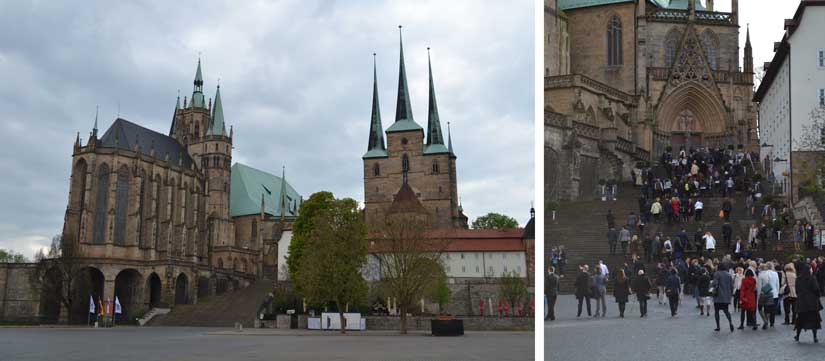
ONE OF LARGEST DOMPLATZ The town’s domplatz is said to be one of Europe’s largest, and it sits next to the impressive central church in Erfurt, St. Mary’s Cathedral, the oldest ecclesiastic building in the city, founded in the 8th century.
Initially the Romanesque-turned-Gothic cathedral served as the bishop’s seat, and up to the 19th century was the seat of the collegiate chapter of St. Mary. Martin Luther himself was ordained in the church in 1507.
The Mariendom (St. Mary’s) and St. Severi form an imposing backdrop for the annual Cathedral Steps Festival held in Erfurt.
The largest free-swinging bell in the world, the “Gloriosa,” with a diameter of 8 feet, hangs in the church today, but because of its age is only rung occasionally. Inside the cathedral there is an elaborate Gothic chancel with a series of 13 colored stained-glass windows which are 42 feet high and are among the greatest works of medieval stained-glass art. The cathedral contains a number of art treasures from various centuries. Guided tours of the church can be arranged in advance.
A flight of 70 steps that lead to the cathedral date back to the 14th century, and today many concerts and events are held on the steps.
Next to St. Mary’s on the hill is St. Severi Church, and together with St. Mary’s the two churches dominate the heart of this medieval city.
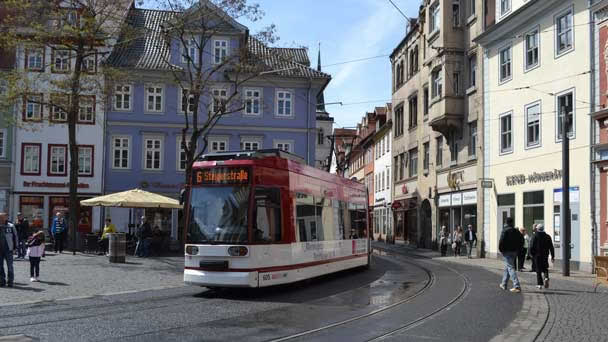
Nicknamed the “Rome of the North” for its profusion of some 30 spires and steeples, Erfurt is unquestionably one of Germany’s most beautiful cities. The old heart of the city with its half-timbered buildings looks like something out of the movies from years ago.
“Erfordia turrita” or “Erfurt, city of towers” is how Luther once praised Erfurt with its 25 parish churches, 15 religious foundations and 10 chapels. This impressive list of ecclesiastical buildings, in conjunction with the magnificent architectural motif of the cathedral and the Church of St. Severus (now the city’s emblem), inspired historians such as Ernst Stida (1585–1632) to refer to the city as the “The Thuringian Rome.”
Most of the churches are still intact and blend in with the beautifully restored half-timbered houses of the Andreas quarter and with the brightly-colored façades of Renaissance buildings. The medieval part of the city is one of the largest and best preserved historical city centers in Germany.
The Augustinian Monastery, built in 1277, is of Gothic design; stained glass windows date from the beginning of the 14th century. The monastery is considered one of the most famous places related to the Reformation.
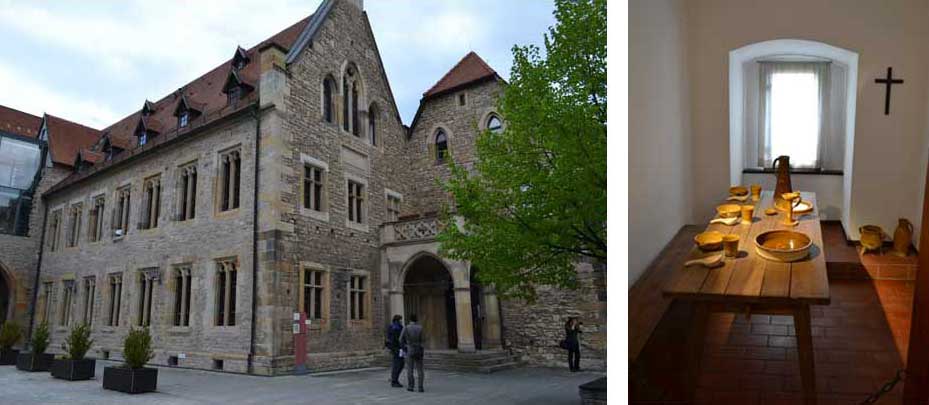
LUTHER’S MONASTERY In 1505, Luther became a monk and took up residency at the beautiful and peaceful Augustinian Monastery in Erfurt, built in 1277. Recently renovated, the gothic monastery has functioned as an Evangelical/Lutheran church and school since 1525. Visit the chapter house and enjoy the same wonderful acoustics that Luther did in his day, or see the reconstruction of Luther’s cell. The Augustinerkloster possesses valuable stained glass windows dating to the beginning of the 14th century. Martin Luther lived here as a monk from 1505 to 1511. You can also spend the night in one of the 51 comfortable guest rooms at the monastery. Today the abbey serves as an ecumenical conference center and a memorial to Luther.
The Luther Stone stands to the east of Stotternheim near Erfurt. On July 2, 1505 Martin Luther, then a law student at Erfurt University, was returning to Erfurt after visiting his parents in Mansfeld. He was making the journey on foot, and as he approached Stotternheim he witnessed a severe thunderstorm that put him in fear of his life. He is said to have cried out, “Help, St. Anne, I will become a monk.” The site where the memorial stone now stands is sometimes described as the birthplace of the Reformation.
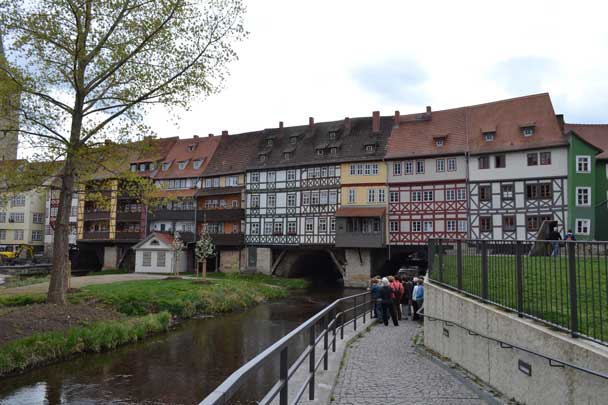
Merchant’s Bridge, a landmark in Erfurt, is the longest bridge in Europe covered by houses that are still inhabited today. In early times, traders sold their wares from this unique bridge.
The Krämerbrücke/Merchants’ Bridge is Erfurt’s most interesting example of secular architecture. This arched stone bridge was constructed in 1325 over the river Gera where the original ford was located along the “via regia” trading route. The Krämerbrücke is the only bridge north of the Alps to be built over entirely with houses that are still used as residences. In medieval times there were two churches built at each end of the bridge, one of which, the Ägidienkirche, is still in existence.
In 1695, the first foundation stone was laid for one of the few remaining 17th century city fortifications to be found in Germany. Today the Petersberg Citadel is an impressive example of European fortification construction dating from the 17th to the 19th centuries. Parts of the fortification were open to the public in 1964, but after 1990 it was extensively renovated, and today the greater part of the casemates, esplanades and bastions inside the fortification area are open to visitors. The completion of the citadel and the Petersberg are Erfurt’s largest undertaking.
(left to right) The Erfurt Rathaus is located at the Fischmarkt; origins of the building go back to the 11th century.; Erfurt city guide Matthias Gose points out aspects of the town on a scale model cast in metal.; Erfurt architecture
Haus zum Breiten Herd, historic Renaissance guild house, Fischmarkt square, Erfurt. In earlier times, rich merchants of the the city decorated the fronts of their homes with delicate carvings.
The neo-Gothic town hall at the Fischmarkt was built between 1870 and 1874. Inside the stairwells and the Festsaal (main function hall) there are numerous wall paintings depicting legends and scenes from the life of Luther, as well as pictures illustrating the history of Thuringia and Erfurt.
Erfurt city guide Matthias Gose points out aspects of the town on a scale model cast in metal
The Old Synagogue is one of very few preserved medieval synagogues in Europe. Thanks to the extensive preservation of the original structure, it has a special place in the history of art and architecture and is among the most impressive and highly rated architectural monuments in Erfurt and Thuringia. The synagogue was constructed during the Middle Ages on the “via regia,” at the heart of the historical old quarter very close to the Merchants Bridge and the town hall.
Many parts of the structure still remain today, including all four thick outer walls, the Romanesque gemel window, the Gothic rose window and the entrance to the synagogue room. After extensive restoration, the building was reopened in 2009. On display in the exhibition rooms is a collection of medieval treasures discovered during archaeological excavations. This includes 3,140 silver coins, 14 silver ingots, approximately 6,000 works of goldsmithery from the 13th and 14th centuries, and an intricate wedding ring of the period, of which only two others are known to exist in the world.
One of the buildings that reflects the history of Erfurt in a special and unique manner is the Kaisersaal in the Futterstrasse, which, after radical reconstruction, was reopened in 1994. It was built out of three patrician houses at the beginning of the 18th century to serve as the university’s ballroom. It is the oldest center for cultural events and meetings in Germany.
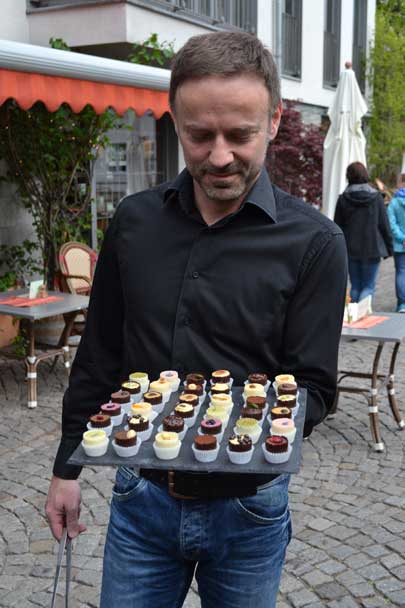
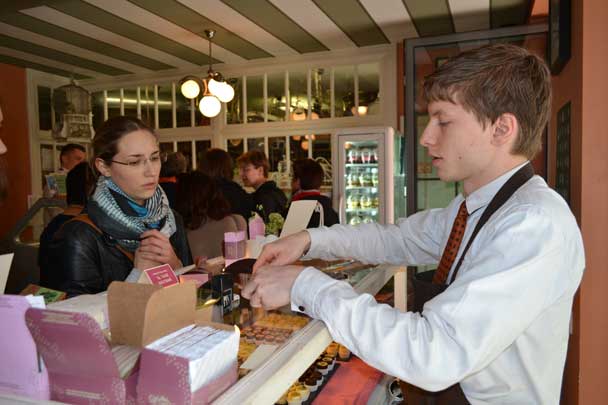
The Goldhelm Schokolade shop in Erfurt provides a selection of fresh chocolates every day
The Anger Museum with its variety of wood and stone sculptures is situated in the middle of the old part of the city. It was built between 1706 and 1712 as a packing and weighing station, both for Philipp Wilhelm Reichsgraf von Boineburg, the governor of the city, and for Archbishop Lothar Franz von Schönborn. It is one of the most important early 18th century buildings.
The Erfurt city museum, in the magnificent Haus zum Stockfisch building, was founded in 1886 to house the artworks that Erfurt inherited from one of its most famous sons, the Romantic painter Friedrich Nerly. The museum’s four floors present the city’s culture, economic development, politics and religion.
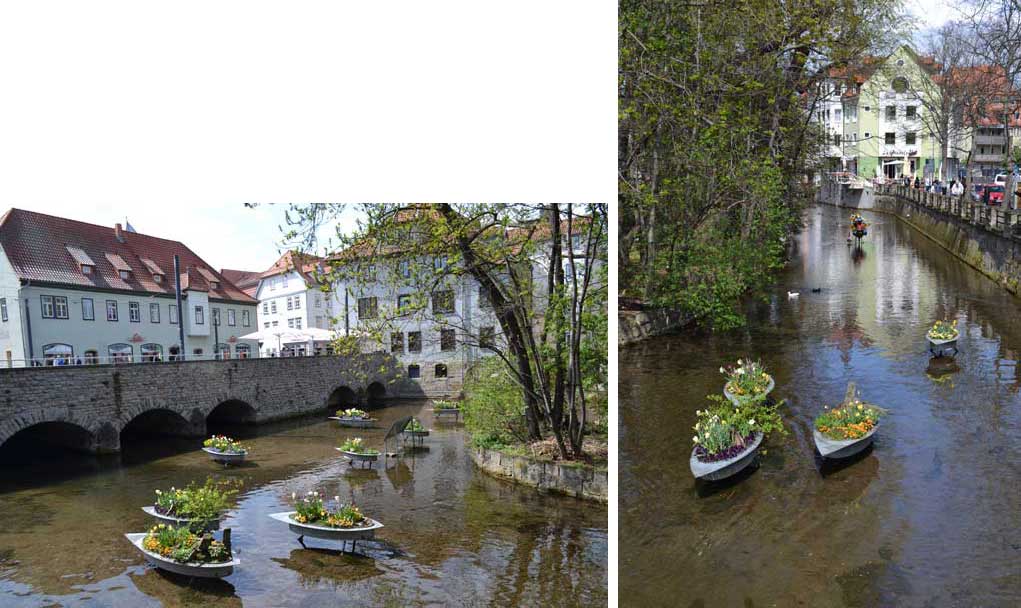
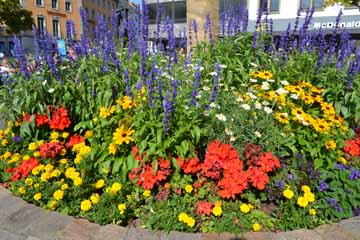
Flowers decorate the Gera River channels in Erfurt.
Erfurt’s last water mill to still be in use is located on the banks of the Gera River near the town hall. Besides the water-driven grinding mill, there are also exhibition rooms displaying historical machines. The museum also contains an illustrated history of Erfurt’s water mills in particular and of the history of hydraulic power in general.
Erfurt, said to be Germany’s largest single heritage site, is a popular destination for tourists, thanks to its medieval ambiance and storied history.
Are you are looking for a vacation that combines relaxation, a bit of history, romantic castles, charming medieval villages, and excellent cuisine? This week-long river cruise on the Moselle, Rhine and Main rivers in Germany, offered by Avalon Waterways, may be the perfect choice for you.
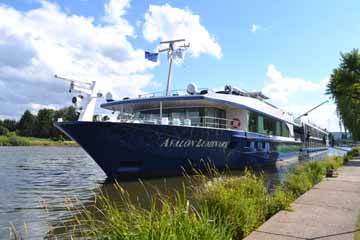
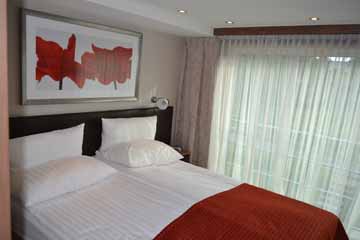
The MS Avalon Luminary, our ship for this cruise, was just recently added to Avalon’s fleet. Its 69 staterooms and suites are designed for efficiency, with plenty of space to stow personal items and luggage. Each room had a small bathroom with shower, comfortable memory foam mattress, a desk, lamp, mirror, fresh flowers, mini bar, and a safe for valuables. A television provided satellite programming and broadcast the view from a camera at the front of the ship. Floor-to-ceiling windows open to a private balcony in most rooms. It’s a luxury of river cruising to just unpack once and let the ship transport you with ease to each destination.
Another luxury on a cruise such as this is the excellent cuisine. The sumptuous breakfast buffet included breads, pastries and cereals, fruits, eggs, potatoes, sausages and bacon, and made-to-order entrees. The full lunch buffet served each day in the main dining room offered soups, salads, choice of main course and desserts. A lighter lunch option was also available in the lounge one deck above. Five-course dinners included an appetizer, choice of soups, salad, choice of meat, fish or vegetarian main course, and several dessert options. The well-trained staff served red, rose, or white wine or beer upon request.
BOARD IN LUXEMBOURG Boarding the Luminary in Remich, Luxembourg, we were welcomed by cruise director Jean Loup Domart. Entertaining, energetic, and extremely organized, Jean excelled at keeping everything running smoothly.
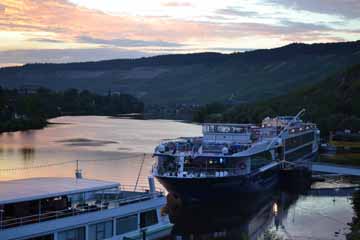
Although we set sail while dinner was being served, we missed none of the excitement, since the dining room was designed for maximum viewing, with panoramic windows on both sides. A sense of intimacy was provided with fresh orchids in lighted open rectangles dividing the large space without interrupting with the view. The lounge on the level directly above the dining room was also designed for watching Germany glide by in the most comfortable of settings.
Our first stop was Trier, Germany, which boasts amazingly intact structures from the Roman Empire, including imperial baths, an amphitheater, and Constantine’s reception hall, which now serves as a protestant church. Did you ever wonder why Roman ruins always seem to be discovered 6 feet underground? We learned from our local guide that after Roman towns were abandoned, local residents built homes by taking usable stones from the old Roman buildings. Over the course of 600 years, this practice left a 6-foot-deep base of rubble, upon which the medieval towns were built. Trier’s Porta Nigra (black gate) is black from wood fire smoke from Roman times, and was left standing because it was a site that attracted pilgrims, who brought money to the church.
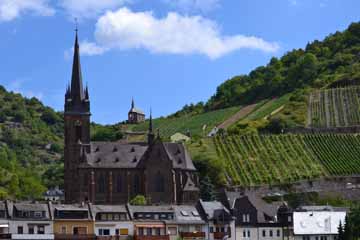
As our trip continued down the Moselle, we passed vineyard after vineyard and peaceful patchwork slopes, dotted with small villages and church steeples. The southern facing slopes provide the perfect environment for catching warm sunlight needed to grow grapes for Germany’s famous Riesling wines. And the ship’s outdoor decks were perfect for relaxing with a cup of coffee or listening to birds along the shore as the ship glided quietly along.
BERNKASTEL-KUES WEINFEST Our late afternoon arrival in Bernkastel-Kues allowed just enough time to explore the Old Town around the quaint market square. This town hosts the biggest Weinfest on the Moselle in September. One vineyard overlooking the town is the source of their “Doktor” wine. Legend has it that drinking some of the wine from this vineyard cured an archbishop of an ailment, so the wine became known as the “Doktor.”
Half-timbered buildings in Bernkastel
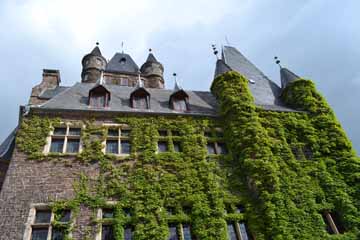
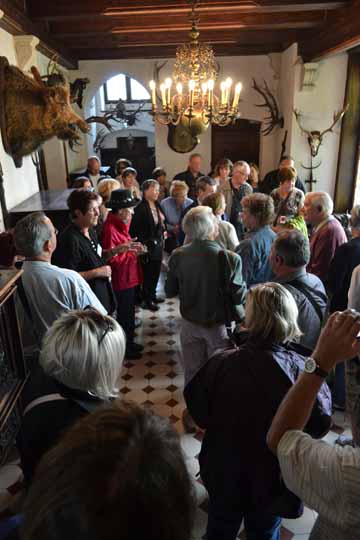
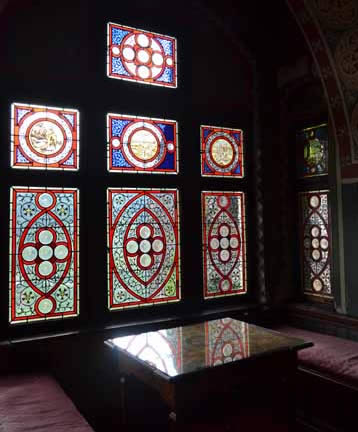
The next day brought us to the wine town of Cochem and a tour of Reichsburg Castle. The interior of the castle highlights not only only medieval artifacts, but Renaissance and Baroque furnishings selected by the 19th century restorers. The tour was informative and the view from the castle — spectacular.
Passengers tour the castle
The Moselle joins the Rhine at Koblenz, an important center of trade during the Middle Ages. An imposing statue of Kaiser Wilhelm I mounted on a horse dominates the Deutches Eck (German Corner) where the two rivers meet. We arrived just before dinner, with enough time for a short walk into the square to see the many shops and restaurants. The fortress Ehrenbreitstein stands on the opposite bank of the river and provides a beautiful panoramic view of the area.
To begin our cruise down the Rhine Gorge (some say the most beautiful part of the Rhine) first thing in the morning, we docked overnight at Koblenz, and were entertained on board after dinner by a small ensemble of classical musicians.
THE MIDDLE RHINE The next morning was filled with the history, legends and romance of the Middle Rhine. Cruise Director Jean Loup provided informative narration as the ship glided along, with passengers enjoying the view while relaxing on the sundeck. We learned that during the Middle Ages the Rhine River Gorge posed many hazards for travelers, and provided many opportunities for powerful kings to levy tolls for safe passage. They built castles and fortresses in the 12th and 13th centuries along the banks to collect tolls, make money, and enlarge territories.
Reichsburg Castle
The castles were usually built high on hills, close to a spring, and often on a curve with a view of the river. Stones for the castles were lifted with wheels and ropes, and the building projects provided work and security for locals, whose lifespan at the time was only about 40 years. Most castles were built with limestone, which was easier to work with than granite. Later palaces were built with marble, as techniques improved. To attack a fortress, enemies could try to break down a wall or door with a battering ram on wheels with a roof as protection from arrows shot from the castle. Or a catapult could throw fire over the castle walls. Castles residents used beehives, hot tar or hot water to fend off attackers. Some fortresses housed armies of 600.
In the town of Boppard we saw Sterrenberg and Liebenstein, known as the castles of the enemy brothers, and heard the legend: Two brothers both fell in love with their adopted sister. She wanted none of this, and entered a monastery in town to live as a nun. The brothers fought and finally built two castles next to each other with a wall in between.
The 430-foot-high Lorelei rock is located where the river narrows, creating treacherous currents dangerous to ships. The famous legend of the beautiful maiden who sat on the rock luring sailors to their destruction with her singing is commemorated with a bronze statue.
The town of Oberwesel, below Schoenburg Castle, still has many fortification walls and towers still standing. When the river water is low, travelers can see the “rocks of the seven virgins.” Legend has it that a lord with seven sons wanted to arrange marriages for them. The seven chosen virgins didn’t want to marry, and threw themselves into the Rhine, where, because they were so hardhearted, they turned to stone.
Pfalz Castle (whose gold lion was to symbolize strength and power) was built in the 16-17th century as a customs tollhouse on a little island in the middle of the river. Gutenfels Fortress was built on the bank opposite Oberwesel to protect the tollhouse.
Sooneck Castle, a toll-enforcing castle from the 11th century, also housed pirates. It is one of the oldest along the Rhine and is restored as a cafe.
In an attempt to preserve the beauty and tranquility of the shoreline, many of the houses along the shore are painted in soft pastels, often pale yellow, a color made popular by Maria Theresa. Train tunnel entrances on this stretch of the river are built to look like castles, in order to blend in with the style of the area.
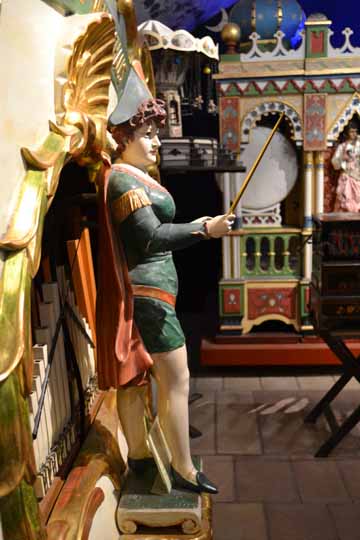
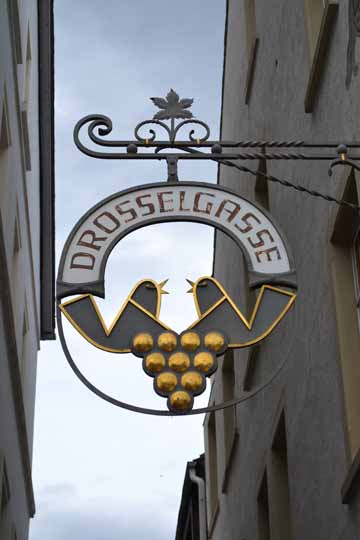
(left to right) Siegfried’s Mechanical Musical Instrument Museum; Drosselgasse, a lively street in Rudesheim.
DROSSELGASSE A FAVORITE Our last stop on the Rhine River was in Rudesheim, where we enjoyed a guided tour of the Museum of Mechanical Musical Instruments (some imitating entire orchestras in one huge contraption!), and a local winery. Be sure to take time to explore the exciting main street, the Drosselgasse, with its many restaurants and shops.
Navigating the Main River is a slow process because of the many locks needed to raise or lower the ship along the route. So our ever resourceful cruise director kept passengers busy on board with an entertaining German lesson, and a cookie-baking demonstration by an “almost nun” from Miltenberg, our next port of call on the Main.
Miltenberg
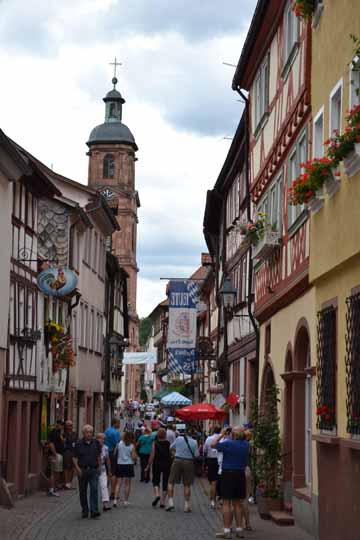
Miltenberg was built against a hill at a curve in the river, a perfect place to collect tolls for the archbishop of Mainz. Many half-timbered houses are still preserved because the people here were too poor to tear them down and rebuild. If a floor sagged and sank, it was filled with sand and covered with another floor. In some recently renovated buildings, 30 centimeters of sand/wood layers were discovered beneath the floor. The original red “paint” on the houses was a mixture containing, among other things, oxblood and cattle dung, which provided the desired red color and also killed worms that might live in the wood. A unique naturally cool icehouse is located in the hill at the rear of the town.
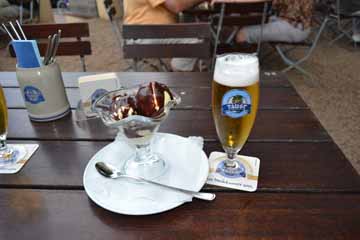
Cold beer and ice cream
While the ship slowly navigated through more locks, passengers rode by bus to Wurzburg, and met the ship when it finally docked after our tour. Wurzburg is the site of the Prince Bishop’s Residenz, which is one of the finest examples of a baroque palace, and also a UNESCO World Heritage Site. It was built to rival Versailles in France and the Schoenbrunn in Vienna. The unique mirrored room features the difficult technique of reverse painting. The famous ceiling fresco by Tiepolo miraculously survived bombing, and the original marble floor is still in the main reception hall. The “marble” pillars are actually a stone core with a ground marble coating so that colors could be controlled, a technique that was more expensive than using solid marble.
Wurzburg
WURZBURG AND X-RAYS Wurzburg was also the home of Professor William Conrad Rundkin, winner of the Nobel Prize for the discovery of X-rays. Residents in Wurzburg are not x-rayed; they are “Rundkined.”
Bamberg
The terrain along the river from Wurzburg to Bamberg changes and becomes flatter, with fewer vineyards, more trees and shrubs, and more locks. This quiet time was perfect for relaxing with a book from the ship’s library, located in the small lounge at the rear of the ship. There passengers found English language books of all genres, games, and the most wonderful coffee machine which dispensed espresso drinks that rivaled any coffee shop. Iced tea, shortbread cookies and other snacks were available 24/7. The ship also had an exercise room with a treadmill, two types of exercycles and flat screen TV, and a small beauty salon.
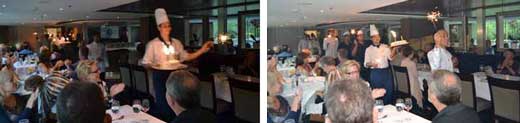
Cruise ship surprises
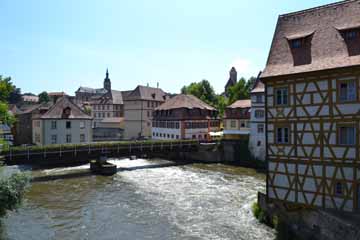
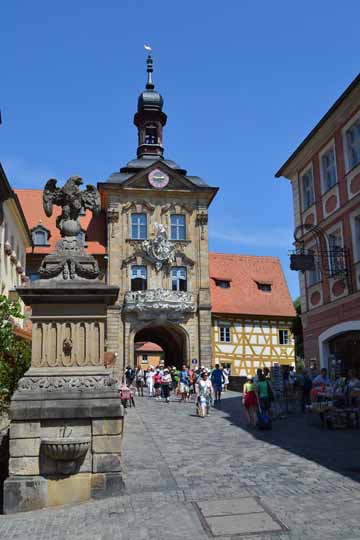
Busses again transported us to meet local tour guides in Bamberg, another UNESCO World Heritage Site. There we learned the local history of the cathedral, the Old Town Hall, which straddles the River Regnitz, had an opportunity to taste the local specialty, “Rauchbier” (smoked beer), and had time for browsing in the main pedestrian shopping area.
Our cruise ended the next morning upon arrival in Nuremberg, from which some passengers continued by bus to Prague, and others to charming Rothenburg ob der Tauber.
IF YOU GO.. Avalon Waterways, which has been in business for 80 years, has a number of different river cruises available in Europe. Their river cruise ships are small compared to ocean liners, which makes the service and trip more personal. They also have Europe’s youngest fleet of ships, with their fleet averaging just two years old, compared to seven years for other cruise companies.
There are full floor to ceiling sliding glass doors in 85% of the deluxe staterooms on Avalon’s fleet. Also, the Luminary had lots of space in the central passenger areas such as the dining room, lounge and library.
The Luminary offered five categories of rooms including Royal Deck suites; Royal Deck Category P; Sapphire Deck Forward, Category A; Sapphire Deck Aft, Category B; and Indigo Deck, Category E.



















 European Traveler