The Christmas Markets of Hamburg

Perhaps surprisingly, Hamburg’s Weihnachtsmarkt at the Rathaus in the center of Hamburg is a relative newcomer to the world of Christmas Markets in Germany.

Several years ago the city fathers decided to look for a new concept for its holiday market, and found a creative partner in Bernhard Paul, director of Roncalli’s Circus. With its colorful circus-themed market stalls and entertainment, including a nostalgic carousel and historic fairground organ, the Christmas market at the Rathausmarkt opened for only its eighth year in 2007. In that short time, however, it has become one of the most popular markets in northern Germany, with nearly three million visitors each year.

LEBKUCHEN AND GLUHWEIN ABOUND

About 80 dealers from all over Germany gather to sell their handicrafts and food specialties. Shoppers enjoy the smell of roasted almonds, Lebkuchen and Gluhwein as they stroll through the rows of vendors, who are grouped according to their wares.

One row is filled with toys, including model trains. Handcrafters such as glassblowers, makers of hats or lanterns and amber jewelry are in another aisle. There is a food specialties area that includes cheese from Tirol, Christstollen from Dresden, Lebkuchen from Nurnberg and candy makers in action. Tired shoppers can enjoy genuine German refreshments indoors at the colorful Art Nouveau Viennese café at the market.

Three times each day Santa Claus, in his sleigh pulled by reindeer, flies high over the market to the sound of American Christmas carols –is that Bing Crosby I hear? Standing in a basket suspended under the moving sleigh is the Christkind (Christmas angel who delivers gifts to the children), waving at the crowd in the market below.
A city as large as Hamburg will, of course, have more than one Christmas market to attract visitors.

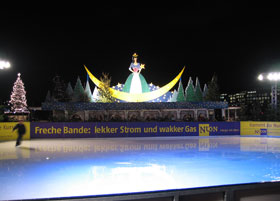
Of the 12—that’s correct, 12—Hamburg Christmas markets, one of the trendiest is Weihnachtsmarkt Jungfernstieg, which overlooks the beautiful Inner Alster Lake. White is the theme color of this market:
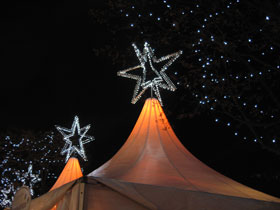
white lights highlight the vendor booths, which are covered by soaring white roofs, and are topped with white star-lit peaks. Open for only its second season in 2007, this unique market boasts an ice-skating rink and an open-air lounge, which supplies warm blankets to customers. Shoppers can find clothes and jewelry along with traditional nutcrackers and food specialties.
MINIATUR WUNDERLAND

If rainy weather limits your time at the outdoor Christmas Markets, take advantage of some of the many attractions that Hamburg has to offer. Miniatur Wunderland is the world’s largest model railway and is housed next to the Elbe River in Hamburg’s warehouse district. The trains run on several different levels of the building, and a full-time paid staff monitors the miniature world.
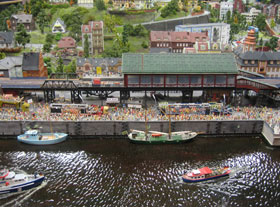
Allow several hours to enjoy the more than 700 model trains, which run through scenery modeled after Germany, Austria, Switzerland, Scandinavia, and even the Western United States. See a circus in action, cars driving on highways and ships sailing the ocean. See fires break out and emergency trucks speed to the rescue. And then there are the trains—they are everywhere—and they are of every kind, all running as if they were on prototype railroads. And every half hour, daylight becomes nighttime inside this miniature HO scale world. There is an admission, and a nice gift shop.

It will be hard to pull kids away; perhaps dads won’t want to leave, either! Check out this fascinating world at www.miniatur-wunderland.de

BALLINSTADT EMIGRATION MUSEUM

Hamburg’s BallinStadt Museum offers an amazing and detailed look at the history of emigration to America via the port of Hamburg.

The museum is named after Albert Ballin, director of the HAPAG shipping company, who had a 30-building departure city built between 1901 and 1907 for emigrants. The museum is located on this site and housed in three reconstructed Housing Pavilions.
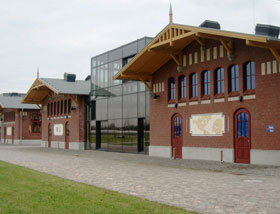
A model constructed beneath the floor and viewed from above through glass, shows the layout of the original departure city. Interactive exhibits tell the emigrants’ stories, and show what daily life was like as they awaited their journey to America. A family research center at the museum offers the opportunity to access Hamburg passenger lists from 1850 to 1934.

Easily reached by public transportation, the BallinStadt Museum shows how the Port of Hamburg became known as the emigrant’s gateway to the world. www.ballinstadt.de

If you’re ready for more shopping, and weather is still dampening the outdoor markets, try indoor shopping at the Europa Passage. Architect Hadi Teherani designed this structure with a glass ceiling and 21 arches, which connects five floors filled with 130 shops and restaurants. Located with a view of the Inner Alster, (one of Hamburg’s lakes), the mall offers modern, upscale shopping in light-filled arcades. www.europa-passage.de

For accommodations within walking distance from the Europa Passage, the Rathausmarkt, and the Christmas market Jungfernstieg, try the Hotel Atlantic Kempinski. First opened in 1909, this luxury hotel next to the Outer Alster served passengers awaiting their departure on ocean liners. Now it is a local landmark, recognized from afar by its white-lit rooftop globe and ladies emblem, which was used in the James Bond film “Tomorrow Never Dies.”

A sumptuous breakfast buffet and beautifully appointed lobby with tea service, offer the traveler warmth and welcome after a full day of rewarding Hamburg experiences.
www.kempinski.atlantic.de

For more information about Hamburg, visit their website at www.hamburg-tourism.de
Paris Avec Famille

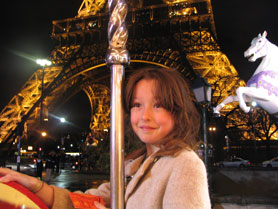
Sophie at the Eiffel Tower

By Susan MacCallum-Whitcomb
Photo by the author

Ahh, Paree! For most of us, the City of Light is synonymous with culture, cuisine and romance.

When you visit, you’re supposed to spend your time in world-class museums and Michelin-starred restaurants. You’re supposed to take intimate strolls by the River Seine. You’re not supposed to take your children. Right? Wrong.

In fact, Paris is extremely kid-friendly. Part of the reason is that the locals-–who tend to take their own enfants everywhere-–are so welcoming. But it is also because Paris itself seems reassuringly familiar to children.

Some discover the French capital as toddlers courtesy of Ludwig Bemelman’s Madeline books; other make vicarious visits with Eloise, the Aristocats, the Rugrats, even the ubiquitous Olsen Twins. Hence its big-ticket attractions already have a built-in appeal. Take Notre Dame Cathedral: 800-year old churches don’t normally top a child’s itinerary. But, as the setting for Disney’s Hunchback movies, this one is an exception to the rule. Since it is literally the center of the city–the place from which all distances are measured-–it also makes a fitting starting point for your family’s monumental adventure.

CAVERNOUS INTERIOR
After spinning around the cavernous interior and “reading” the stories in the stained-glass windows, older kids can drop a few euros to descend into the pre-Roman Crypte Archeologique or climb the towers for a close-up look at Quasimodo’s home turf.

Younger ones, meantime, may prefer to plop on a bench in adjacent Viviani Square. Thanks to the uncluttered view of Notre Dame it offers, they can amuse themselves by playing “spot the gargoyle” (one looks suspiciously like Disney’s Laverne) and feeding the world’s most gregarious pigeons.

Compared to the cathedral, the Eiffel Tower is a relative newcomer. Yet it’s a certifiable icon, and you’ll likely feel compelled to scale it. Of course, every other tourist in town will too. So to avoid the worst crowds, try arriving early on a weekday and taking the elevator straight to the third level. Tickets are steep (11.50€ /6.30€ for ages 3-11); but on a clear morning the vista is priceless. Alternately, bring the kids after dark to see the tower lit up like a super-sized Christmas tree. For the full effect, arrive on the hour (dust to 2 a.m. in summer) when 20,000 individual bulbs sparkle in a 10-minute display.

ARC DE TRIOMPHE
For those who’d rather look at the Eiffel Tower than be on it, the Arc de Triomphe is another option. Napoleon’s tribute to his troops might not seem like a natural choice for families: after all, it’s perched on the site where Paris’ 12 main avenues converge and is surrounded by an obscenely-busy traffic circle. Nevertheless, children routinely give it the “Coolest Tall Thing” award. That’s because it’s wide open at the top. Unlike the Eiffel Tower (which is enveloped in mesh) there is nothing creepy or cage-like to impede their view-–and the sight of Paris, laid out like a star below–is impossible to beat.

Once you’ve soaked it all in, it’s time to hit the city’s famed museums-–some of which are aimed squarely at families. One such venue is the Science and Industry Museum. Its interactive “Cité des Enfants” is undeniably inviting: five – to 12 year-olds, for instance, can program robots while younger siblings play Bob the Builder at a mini construction site. However, the rules can be off-putting. Registration is required, limited numbers of guests are admitted and visits are restricted to 90 minute sessions. Kids are also streamed by age. So depending on your family structure, the trip can be a logistical nightmare.

Luckily, though, there’s no need to stick to the kiddy category when it comes to Parisian museums. Musée Rodin is a case in point. The esteemed sculptor’s estate in the seventh arrondissement is an ideal place to introduce youngsters to fine art. Sure its walls hide orderly flowerbeds, ornamental pools and a grand 18th-century mansion. But don’t let the formality fool you. In the garden, kids are free to play among famous statues; and inside visitors as young as four can sign up for regularly-scheduled activities (including tours complete with games and drawing sessions) that are priced between €4.50 and €6. 

KID PLEASERS
Musée d’Orsay, on the Left Bank, and the Pompidou Centre’s t&L=2″ Musée National d’Art Moderne, on the Right, are kid-pleasers as well. The former has a dazzling Impressionist and Post-Impressionist collection (think works by Monet, Renoir, Van Gogh and Cézanne), while the latter focuses on Modern masters like Picasso and Matisse. Both have intriguing architecture, plus bright bold canvases that appeal to kids. But the fabled Louvre, with its exhaustive-–and exhausting!-–supply of religious and historical paintings will seem pretty staid by comparison.

If seeing Mona Lisa’s smile is high on your personal to-do list, consider taking turns with   another adult. When one of you dips in, the family can relax just outside on the expansive lawns of Jardin du Tuileries. It’s easy to while away hours there bouncing on tres chic trampolines, sailing toy bateaus, riding carousel horses or graduating to real ponies (à la carte activities that cost a couple of euros each). Many of the same simple pleasures can be enjoyed across the Seine in Jardin du Luxembourg: a sixth arrondissement park which also happens to house the city’s best-loved marionette theater.

JARDINS ARE BACKYARDS

The beauty of both spots is that they’re not merely tourist attractions. In a city of apartment dwellers, these jardins serve as a backyard for countless families. So lingering in them qualifies as an authentic cultural experience, especially on weekends or Wednesday afternoons when local children are out of school. If your offspring have a smattering of French they can strike up a conversation with their Parisian peers. If not, don’t worry: they’ll quickly learn that the language of child’s play is universal.

For playtime on a grander scale, you can take the gang 20 miles north to Parc Astérix (35€/ 25€ for ages 3-11). Inspired by France’s favorite cartoon hero, it features dozens of amusements ranging from a classic wooden roller coaster to an ultra-modern corkscrew model. Twenty miles east of the city, meanwhile, is Disneyland-Paris: a 2,225-acre resort that proves it really is “a small world after all.” Said to be Europe’s #1 tourist attraction, it consists of two parks-–a Magic Kingdom and Walt Disney Studios-–with one-day passes to each costing  46€  (38€ for ages 3-11). 

FUN ANYWAY
Since these resemble their U.S. counterparts and recreate many popular rides (“Dumbo’s Flight” and “Rock’n’Roller Coaster” among them), Disneyland-Paris is often dismissed as an unnecessary Americanism. Who, naysayers may ask, needs a kingdom built around a faux castle when the countryside is full of the genuine article? For that matter, who needs a movie park dedicated to a foreign director when Jean-Luc Godard and François Truffaut are native sons? Well, nobody does. But they’re fun anyway. Besides, a dose of Disney is a great antidote for kids suffering a temporary case of culture shock.

The truth is that no matter how well prepared you are, your children will feel slightly disoriented at times. Moreover, touring with them will always be an added responsibility. Yet there are upsides. Kids, literally and figuratively, look at things from a different angle. Hence being with them will reveal sites and scenes that are typically hidden from vacationers. All you have to do is slow down and savor the experience. Remember, parents don’t get bonus points for ticking off every attraction listed in their guidebook. The real reward comes from building a store of family memories that you all can share. ET

Take a Pass: Admission charges add up fast, so a  Paris Museum Pass is just the ticket for pennywise parents. Priced from €30 for a two-day version, it gives adults unlimited entry to more than 60 museums and monuments – including all of those mentioned above except for the Eiffel Tower. Children don’t need one because so many of the attractions are already free for guests under 18 (that’s a big plus when your traveling companions have short attention spans!). Better still, the whole family benefits since the pass also allows all of you to jump those lengthly lines.

ABOUT THE WRITER
Living up to her turn-of-the-millennium resolution, freelancer Susan MacCallum-Whitcomb jettisoned her professorial robes and traded teaching for full-time travel writing. In the years since, she has spent an inordinate amount of time doing research in Europe — much of it with her family in tow!  The results can be read in Fodor’s guidebooks (she’s contributed to six thus far) as well as Fodor’s online newsletter, and a host of Canadian magazines and newspapers. When not jaunting around the continent, Susan enjoys taking it easy in her sublime home base: Halifax, Nova Scotia.

European Christmas Markets Celebrate the Season

Advent is the season in Europe when thousands of communities–large and small–set up Christmas trees, colorful lights and craft stalls in their central market square. For decades, Europeans have been getting together at these unique Christmas markets to share conversation, to enjoy a glass of hot mulled wine, or to find just the right specialty gift for a family member or friend.

European Traveler offers a quick glance at some of these fascinating markets, which normally last until Christmas Eve.

Belgium

Every town in French-speaking Wallonia hosts its own Christmas Market. The central square of Liège and the neighbouring Place du Marché stage one of Belgium’s largest Christmas Markets, attracting more than 1 million visitors with 190 wooden chalets full of tempting goodies, sweets and original hand crafted products and presents. If you’re in Brussels between November 27 and January 3, enjoy the Brussels Winter Wonderland featuring a Christmas Market with many stalls, a giant illuminated ferris wheel, street activities and a large skating rink. 


Switzerland

In Lucerne, a number of Christmas events take place, including the Christ Child Market at Railcity, the train station, between November 28 – December 21. Around 50 festively-decorated market stalls bring a  Christmas atmosphere feel to the station.

Every year between December 3-20 Lucerne’s Christmas Market takes place at the Franziskanerplatz. There are a large variety of stands with Christmas decorations, sweets, food and beverages.  The Christmas Tree Market usually starts one week before Christmas along the Schweizerhofquai. Then between December 17-20, 20 stands from 20 countries  present typical Christmas items from their homelands. There is always a stage featuring Christmas productions from all over the world. For more information, go to www.luzern.com/en/welcome.cfm?

Germany

Thuringia is primarily famous for its festive Christmas markets and especially the large selection of glass Christmas tree decorations. The Lauscha Ball Market (always held during two weekends in Advent) has the largest selection, but these traditional decorations are also available at other Thuringian Christmas markets.

In Frankfurt you are invited to the large, time-honored Christmas market where you can become acquainted with the market’s many culinary specialities and its traditions. You can join tour guides in ascending to the rooftop gallery of St. Nicholas Church, from where you’ll be able to enjoy a wonderful panoramic view of the entire market and the Frankfurt skyline. Next, join young and old for a nostalgic ride on a vintage carousel. Warm yourself with a hot cup of mulled wine at the end of the tour and take in the wonderful view of the market’s beautifully illuminated Christmas tree. The 1 1/2 hour tours include a carousel ride, hot mulled wine and special marzipan candy. Tours are available in English and German from the first day in Advent until Christmas.

Thanks to the Tourist Boards of Germany, Belgium, Austria and Switzerland for the photos in the report.

Have a Very Good Trip…by Train

So, you want to show your wife or your date a very good time.

And you want to do it between Venice and Paris.

That can be arranged.

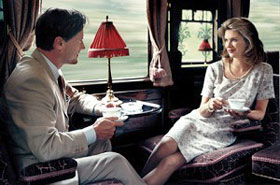
What is called the World’s Most Romantic Celebration consists of a train trip on the Orient-Express between Venice and Paris.

Here are the details. The trip is eight days and seven nights from $24,750: three nights in Venice; one night on the Venice Simplon-Orient-Express and three nights in Paris.

Departure dates, which are Sundays and Wednesdays, in 2008 are: March 30; April 6, 13, 20, 27; May 11, 14, 25;June 8, 11, 22, 29; July 20, 27; August 3, 10, 17, 24; September 10, 21, 24, 28; and October 12, 15.

The itinerary consists of:

Day 1 – Venice
Arrive in the romantic city of Venice and transfer by private water taxi boat to the Hotel Cipriani. A deluxe suite is reserved for three nights in the city of canals. 

Overnight in Venice.


Day 2 – Venice
A personally tailored guided tour of the city in the morning. In the afternoon, the private launch of Romilly, Lady McAlpine collects you from the hotel and takes you to her home for a visit and refreshments. 

Breakfast included. Overnight in Venice.

Day 3 – Venice
Explore the delights of La Serenissima before a final romantic evening, including a ride on a gondola before dinner, at one of Venice’s most exclusive restaurants. 

Breakfast and dinner included. Overnight in Venice.


Day 4 – On the Venice Simplon-Orient-Express
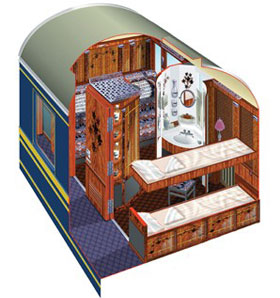
The train’s hostess completes check-in formalities for your journey on the Venice Simplon-Orient-Express train before your private transfer to the station. Board the train (cabin suite) for the overnight journey to Paris, enjoying superb cuisine and sparkling champagne. 

Breakfast, lunch and dinner included. Overnight on board.


Day 6 – Paris
After breakfast, a private car and driver takes you to the French countryside en route to Reims, capital of the Champagne region, where you have a private tasting before lunch at the two-star Michelin restaurant of Chateau Les Crayères, accompanied by fine wines and Prestige Champagne. After lunch, return to Paris. Breakfast and lunch included. Overnight in Paris.

Day 7 – Paris 
Time for final sightseeing or shopping in the boutiques and designer stores. In the evening a private car transfers you to Quai de Grenelle, where you board a luxurious private yacht. The vessel’s teak deck and sleek interiors allow you to relish the cozy atmosphere of a 1960s boat. Enjoy a glass of champagne as you cruise along the river Seine, before a romantic candlelit dinner served either on the outdoor deck or the inside cabin. A shower of roses completes the cruise before returning for a final night in Paris. Breakfast and dinner included. Overnight in Paris.

Day 8 – Paris
Your journey comes to an end. Breakfast included.  All aboard!

IF YOU GO…
Log onto www.orient-express.com for more details about the trip. Or, call (in the USA) 401-351-7518 or e-mail to: oesales.providence@orient-express.com. From France, call +33 1 55 62 18 00; from Germany, call +41 44 770 1407; from the Netherlands, call +31 35 6955111; and from the U.K., call +44 20 7805 5060

The ‘Champs-Elysees’ of Burgundy Wines

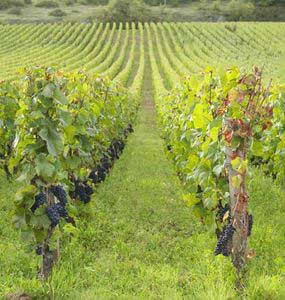
The wines of Burgundy are rich and varied, and are divided into regional appellations, village appellations, Premiers crus and Grands crus. The Appellation d’Origine Contrôlée (AOC) is your guarantee of the characteristics of the regional wines. Fall is a beautiful time to drive or bike through the wine routes.

The Côte de Nuits extends from the south of Dijon to Corgoloin and forms the northern section of the Grands Crus route. It is a prestigious hillside that is home to villages bearing the names of the greatest red wines in the world. Here you will find 24 of the 33 grands crus in Burgundy: Chambertin, Clos de Vougeot, Romanée-Conti and many more.

The Côte de Beaune follows on from the Côte de Nuits towards the south, from Ladoix-Serrigny to the hillside of the Maranges. This soil, blessed with the Chardonnay grape, is where the greatest dry white wines in the world are produced (Corton-Charlemagne and Montrachet, among others). Outside of the city of Beaune, which is the capital of Burgundy’s wine regions, the countryside becomes gentler as you approach Santenay and the département of Saône-et-Loire.

Burgundy hiker

ROUTE OF THE GRANDS VINS DE BOURGOGNE – THE ROUTE THROUGH NATURE
The route of the Grands Vins runs from Santenay to Saint-Gengoux-le-National, and is the extension of the route of the Grands Crus towards the south: more than 100 signposts connect around 40 towns via the vineyards of Maranges, the Couchois and the Côte Chalonnaise. This varied route combines villages with nature, and vineyards with wooded countryside, and is dotted with Romanesque churches and castles. You can discover it by car, but also along the water of the Canal du Centre, or by bike along the the many cycling routes.

ROUTE OF THE MÂCONNAIS-BEAUJOLAIS, THE SOUTHERN WINE-GROWING AREA
This route in the south of Saône-et-Loire is the extension of all the wine routes from Dijon. The eight circuits enable you to break away from the main route and explore the most southerly vineyards in Burgundy in greater depth. The main route itself crosses the Mâcon wine-growing region in a straight line and finishes at Romanèche-Thorins (Saône-et-Loire) on the hillsides of the Beaujolais region.

ROUTE OF THE VINEYARDS OF THE YONNE ALONGSIDE THE RIVERS
In the département of the Yonne, the vineyards have developed alongside rivers: the Jovinien and the Auxerrois in the Yonne Valley, the Chablisien in the Serein Valley, the Tonnerrois in the Armançon Valley, and the Vézelien in the Cure Valley. The wines of the Yonne are undergoing a renaissance and deserve to be discovered in all their diversity just as much as the highly famous Chablis.

ALONG THE LOIRE AROUND THE NIÈVRE
The vineyards of the Nièvre, which extend along the right bank of the Loire, belong not to Burgundy but to the Centre-Loire, and have long suffered from a certain lack of recognition. Now another wine route enables visitors to discover all their charms, from the hillsides of Pouilly-sur-Loire, where the famous Pouilly-Fumé is produced, to the Coteaux du Giennois overlooking Cosne-Cours-sur-Loire. This route also takes in Sancerre on the other side of the river in the Cher.

For more information on Burgundy, go to www.burgundy-tourism.com.