By Don Heimburger Photos by the author or as noted
Wacker’s Kaffee is a third generation family-owned and run coffee shop in Frankfurt, Germany, which I heard about while on a city tour bus.
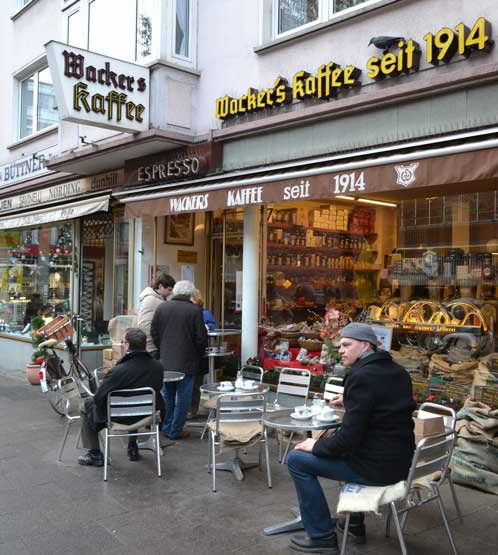
As the bus zipped past the small shop at Kornmart 9, I had just enough time to see its facade and notice all the customers lined up for coffee. The tour guide recommended the little establishment, which has been in business since 1914, or nearly 100 years.
It’s taken a while for me to actually “like” a good cup of strong German coffee, but now when I return to the U.S., I miss its rich flavor. So a taste-testing trip to this shop was in order, especially since I knew how to find it, and the small shop looked interesting.
When time allowed, it was back to the shop, and trying to squeeze in the shop among the other customers was a challenge. Customers were lined up both for coffee to drink right there—Germany hasn’t become tuned in yet to the term “to go”—and to buy coffee beans in bags.
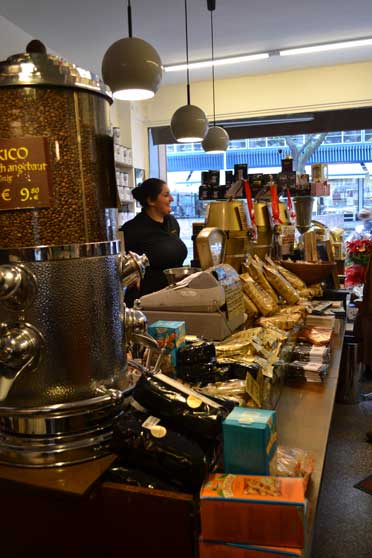
FILLED WITH CUSTOMERS The several tables outside were filled with customers in December savoring their hot cups of Wacker’s kaffee, while others at the inside counter were purchasing bags of coffee beans and other Wacker’s products (they sell coffee mugs and other coffee-related items).
To keep customers a bit warmer outside, the seats are covered in the burlap bags from the coffee beans, a nice touch.
In the rear of the shop, customers were crowded around several tables, enjoying their coffee and kuchen, which is also served.
The business began when Luise Wacker opened a coffee shop at the location in 1914. Previous to this, a store was located here where the famous writer Johann Wolfgang von Goethe purchased his milk supplies.
Comments about the store on Trip Advisor include these two:
“Definitely the best coffee shop in Frankfurt. There are generally two lines, both often stretching out the door; the one on the left is for those who want to order drinks, while the one on the right is for those who want to buy coffee beans. The shop is also very small with limited seating, so when the weather is nice (or even just tolerable), you will see customers spread out both in front of the shop, and sitting on the stone wall across the street, enjoying their coffee and pastries.
“What non-German speakers may find intimidating is that, when the shop is quite busy, the cashier will shout out to customers further back in the line, asking them for their order. Luckily, the words for cappuccino, espresso and latte are generally the same in both English and German, so you should feel comfortable simply shouting your order back to her. “
Another customer said: “Great coffee. The smell is worth it alone.”
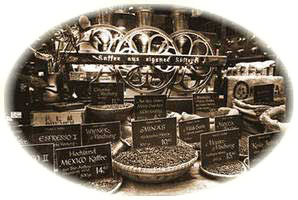
Wacker’s offers a long list of ready to drink coffees, and beans, so you’ll need a moment to figure out what you want. Coffee beans, available in bags of 500 grams each, include beans from Mexico, Java, India, Nicaragua, Galapagos, Cuba and Brazil, and expresso beans come from Jamaica, Guatemala, Costa Rica and other locations. I counted 40 bean types available from the shop.
Once your order is ready, you’ll be treated to some really good coffee, German-style!
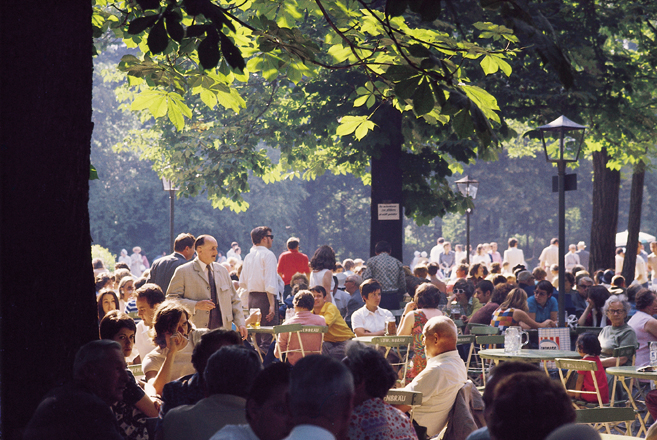
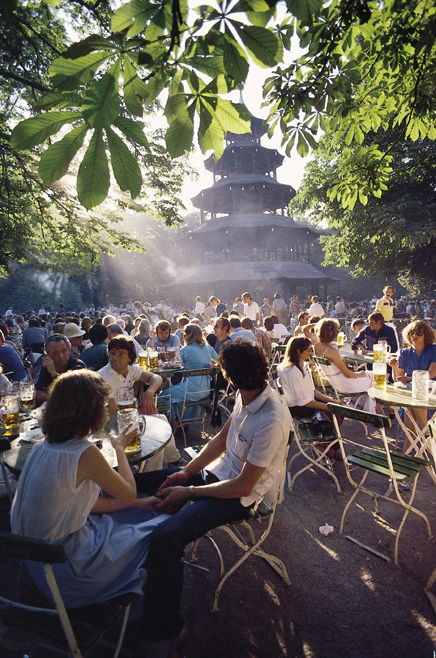
In 2012, Munich and Upper Bavaria are celebrating an old Bavarian tradition. The 200th anniversary of the edict which permitted beer brewers to sell retail quantities of their own beer in their beer cellars from June until September and to serve beer and bread to their guests will be celebrated this year. The city and the breweries of Munich will offer numerous events in local beer gardens.
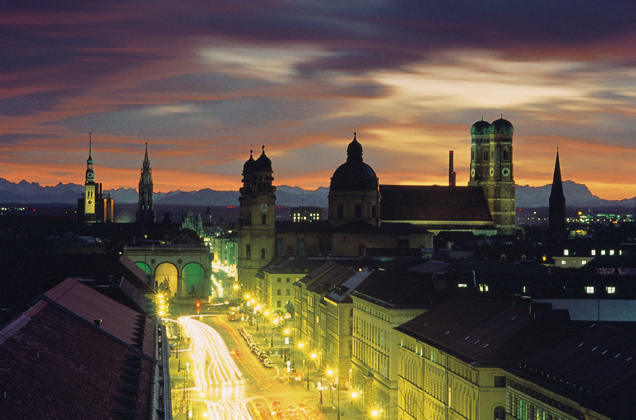
MUNICH – THE WORLD CITY OF BEER Big city, high-tech atmosphere mixed with rural charm, art treasures and traditional customs create a very special “Munich mix” which has helped the capital of Bavaria to achieve world renown. But what adds the final touch to the city’s popularity is the drink associated with Munich throughout the world: beer.
BEER GARDEN ETIQUETTE Bavarian beer gardens fulfill an important social function, as they have always been considered to be a popular meeting point for a wide spectrum of the populace. Visitors should not hesitate to take a seat and start up a conversation with their neighbors at the table. Munich’s beer gardens and the beer gardens in Upper Bavaria are the epitome of Bavarian Gemütlichkeit – the uniquely Bavarian atmosphere of good living, warmth and comfort. And it’s been that way for 200 years.
BRING YOUR OWN FOOD Bring your own food! A special element of visiting a traditional beer garden in Munich is the fact that guests can bring their own food with them. A perfect Brotzeit, as a beer garden picnic is known, might contain the following: Obazda (a delicious and very Bavarian soft cheese dip), Emmental cheese, radishes, freshly-baked pretzels, butter and salt and pepper. A table cloth is also important (preferably a cotton red and white check), as are wooden boards to eat from, a sharp knife, cutlery and napkins.
But those who come unprepared don’t have to miss out on a Bavarian Brotzeit. Most beer gardens offer a range of typical treats, such as Wurstsalat (finely sliced sausage, dressed with vinaigrette and onions), Leberkäse (Bavarian meat loaf) or Steckerlfisch (barbecued whole fish, normally mackerel).
In a Bavarian beer garden, self-service is the rule, unless it is clear that tables have been readied for service. Typical beer garden drinks, such as beer or Radler (a mix of beer and lemonade or lemon soda), are generally only served in one liter steins. Alcohol-free drinks, such as Spezi (a mixture of cola and orange soda) or Apfelschorle (a mixture of apple juice and mineral water), are normally served in half-liters.
The most important rule when toasting with others at your table is to do it as often as possible, so creating a sense of community and giving you the chance to make contact with your new friends. But don’t forget to look your drinking partners in the eye as you touch steins.
The reason horse chestnut trees can be found in every “real” Bavarian beer garden is a matter of history. According to a decree from the 16th century, brewing beer was banned in the summer months, due to the increased danger of fire. Therefore, beer that was brewed in spring for summer was made with a higher alcohol content to help preserve it. In order to keep the beer cool, beer cellars were constructed close to the breweries, but because Munich has a high groundwater level, deep cellars were out of the question, meaning that those that could be built had to be protected from the sun. And that is why trees which provide a lot of shade, such as horse chestnut trees, were planted above them.
BIER UND OKTOBERFEST MUSEUM, BEER TOURS & MORE Munich is the capital of beer – with six breweries, the Hofbräuhaus and the Oktoberfest. Interested in the story of beer? How German beer effected the monasteries and the purity law? Why is the quality of Munich’s beer so unique? Did you know that Oktoberfest was established as the national festival for the wedding of King Ludwig I with Princess Therese of Saxe-Hildburghausen? Visit the Bier und Oktoberfest Museum for the answer to these questions and a lot more.
Dining in the Dordogne most certainly brings opportunities to pair wine with the other specialties of the area: foie gras, strawberries, walnuts and truffles.
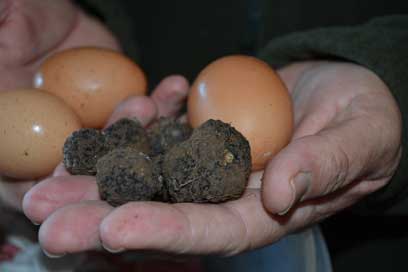
In fact, the Perigord is known for producing the very best black truffle, an aromatic fungus resembling a small black potato. To experience this local treasure, I spent a delightful morning at Truffiere de Pechalifour, the truffle farm of Edouard Aynaud, learning the art of truffle hunting.
Truffle farmer Edouard Aynaud
After meeting the high-energy Edouard, we entered a glass-doored, yellow stone building, where Edouard snaps open the lid of a large plastic bowl holding several black truffles, and thrusts it in my face. “Smell this,” he says in French, insisting that once you have this scent in your head, you’ll never forget it.
Edouard’s truffle-sniffing border collie
The valuable black truffle, sometimes called the Black Diamond, can command 1,000 Euros per kilogram, since the demand is always greater than the supply. Our host holds up a kiwi-sized truffle and we play “how much is this truffle worth?” My husband wins with his guess of 10 Euros, when the small scale records the truffle’s weight as 10 grams.
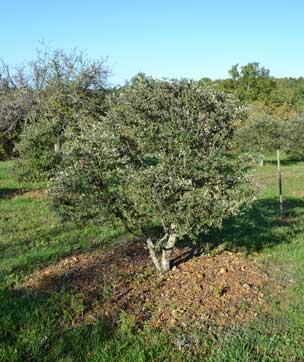
Now the lesson begins: truffles grow at the base of oak and hazelnut trees. The spores of the truffle form a web of mycorrhizal filaments that permeate both the soil and the roots of the trees. These filaments help the trees obtain nutrients from the soil, and in turn, the trees provide the truffle with needed sugars. Once this network spreads, there is a telltale brown circular area around the base of the tree called a “burn.” In the wild, this symbiotic relationship occurs with luck.
Here on the 10-acre Pechalifour farm, Edouard’s father planted his first trees in 1968. Today new tree seedlings with truffle spores grafted onto their roots are planted in the hopes of increasing the truffle crop. Edouard holds up a 2-foot-tall oak seedling to illustrate, and tells us that you must plant it and pray, and maybe in several years (3? 6? 10?) the telltale “burn” will appear. He explains that sadly, not many young people are getting into this business because it requires so much patience and optimism.
Edouard, however, personifies optimism and joy, explaining his craft in rapid-fire French (admirably translated by our local guide) and punctuated with animated facial expressions and gestures worthy of Marcel Marceau.
Once the “burn” is identified, there are three methods to locate the truffles beneath it:
With a pig. Grinning, Edouard holds up a Cracker-Jack-toy-sized pink plastic pig to illustrate. Furthermore, he continues, it must be a female pig. Why? Because the truffle scent mimics that of a male pig sex hormone.
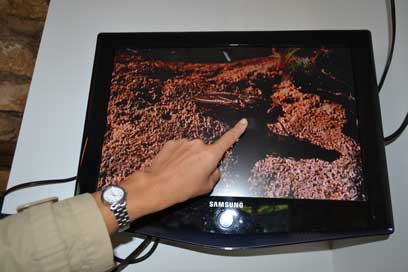
With a stick. Now he whacks a slender willow stick several times across the length of the table. Tapping a stick around the area of the “burn” disturbs a little brown fly that likes to lay its eggs on a ripe truffle, so that its larvae can feed on the nutrients. A short video illustrates that the fly’s brown color renders it invisible at rest. But once disturbed, the fly will rise up and then return to the location of the truffle, which must be harvested before the egg-laying, larva-eating process begins.
With a dog. The dogs must be trained while they are very young to recognize and search for the truffle scent. For that, Edouard uses the plastic film containers used before the age of digital photography. He pokes holes into the container and fills it with cotton that has been moistened with truffle oil. Then for one week he plays fetch with his canine student, rolling the container a little distance away, and rewarding the pup with treats and love when the prize is returned. The next week he hides the container in corners or behind something, and again rewards its return with treats and praise. The third week he buries the container outside under a little bit of soil and waits three days so that it no longer carries his human scent, but only the scent of the truffle, before sending the dog to find it. At the end of three weeks, with lots of praise and treats, the dog is trained.
Suddenly we are aware of a yellow labrador and a young black and white border collie snuffling around our feet, obviously eager to get to work. Edouard grabs a basket, some dog treats and a digging tool, and assuring us that he did not hide truffles ahead of time for us to find, we begin our spirited trek though the trees.
Pointing out brown fly in “burn” area where truffle lie
Walking slightly ahead of us, Edouard sees the telltale “burn” around the base of a tree, and gives his dog the command. Within seconds, the dog sniffs and puts his paw on a spot. Edouard scoops up a handful of the moist soil and sniffs it, crowing gleefully when he detects the scent of the hidden truffle. He pushes into my hands the special two-sided truffle-digging tool: pointed pick at one end, flat scraping blade at the other, and tells me to dig — but gently! We’re not digging up potatoes!
Tree with signs of a truffle underneath
Soon my delicate poking isn’t fast enough for him and he rakes his fingers through the mud until he isolates the prize. After pointing to exactly where I should look, he lets me make the final discovery. Voila! There it is — and it’s tennis-ball HUGE! But, alas, it is spoiled inside because of the recent unfavorable weather. Edouard rewards his dog with a treat and a cuddle, and then crushes the truffle with his fingers and reburies it on the spot, so its spores can sprout again.
The best months for harvesting ripe truffles in the Perigord is December, January and February, and then only if the weather conditions have been favorable — too much rain and they grow too fast and don’t ripen at the right time. All in all, it’s a business that needs luck — and lots of dog treats. www.truffe-perigord.com
Explore the Christmas Markets with this easy river and rail adventure.
By Marilyn Heimburger Photos by Don Heimburger
As the weather turns colder and stores begin playing Christmas music to heighten anxiety about getting everything done before Christmas, I yearn to spend the Advent season once again in Germany’s beautiful Christkindlmarkts.
Not long ago, a friend also expressed her longing to visit the famous Christkindlmarkts in Germany and Austria during Advent, but didn’t know where to begin. Which ones should she see? How do you find accommodations in each town, and arrange transportation from market to market? The planning seemed too daunting, and she just never got started.
European Traveler discovered the perfect plan to make that dream come true: last Advent we took a nine-day Christmas market tour by river and rail that was easy and convenient. We experienced more than a dozen Christmas markets along the Danube River in Germany and Austria, with guided tours in towns along the way.
VIKING AEGIR The river portion of our “Advent along the Danube” trip was on the Viking Aegir, a 1-½-year-old Viking River Cruise ship which sailed from Budapest to Nuremberg. One of the best perks of a river cruise is that you unpack only once for the week. Meals are provided for you, and the ship delivers you from market to market, with local tour guides waiting when you dock, and activities onboard while you leisurely cruise from market to market. What could be easier?
On board the Viking Aegir, passengers relax in comfort with a beautiful view of Germany and Austria through panoramic floor to ceiling windows.
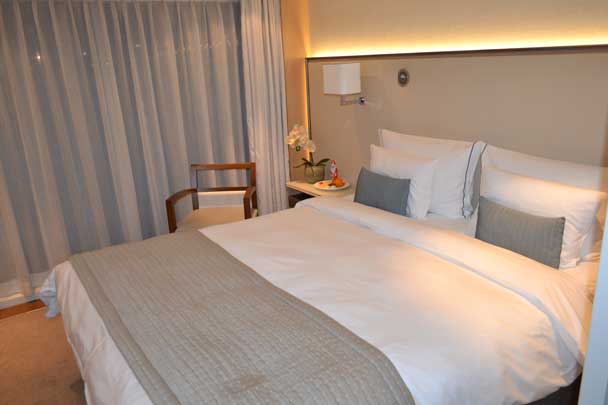
Although the cruise began in Budapest the day before, we chose to fly to Vienna and board the ship there. We moved into our spacious stateroom, complete with private bathroom with shower, drawers and closet for clothing, queen-sized bed, mini-fridge, TV and sliding glass doors on the balcony, offering a non-stop view along the Danube as Austria and Germany glided by.
Comfortable cabins await the passengers aboard the Viking Aegir cruise ship.
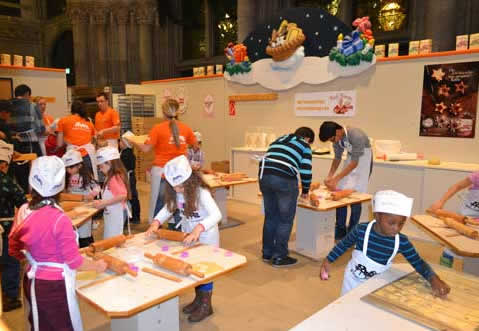
VIENNA’S MAGIC OF ADVENT Since the boat dock is some distance from the city center, Viking provides bus transportation to and from Vienna’s largest Christmas market, which glitters in the shadow of Vienna’s City Hall. Named “Wiener Adventzauber,” or “Vienna’s Magic of Advent,” it features hundreds of vendors in wooden huts offering local pastry, sausage and hot drink specialties, gifts, decorations, candles and accessories. There are pony rides, story reading on the Celestial Stage, appearances by the Viennese Christkind, and even arts and crafts and baking stations inside the Rathaus so children can make their own gifts and Christmas goodies.
Located inside Vienna’s Rathaus is a baking workshop, where children can make their own cookies.
Within walking distance of the Rathaus market are several other Christmas markets, smaller but with their own local focus and definitely worth a visit. Markets in other parts of Vienna are on Maria-Theresien-Platz, in the Old AKH, on Freyung, the Am Hof Advent Market, at Belvedere Palace, on Karlslatz, on Spittelberg, at Stephansplatz, on Riesenradplatz, and at the Schönbrunn Palace. To see all of them would take an extra day or two! We saved some of our market visits for after the cruise, when we returned to Vienna by rail for our flight back home.
Vienna has several smaller Christmas markets each with their own style and specialties, and each worth a visit.
The local food experiences aren’t limited to the Christmas markets. Upon our chilly return to the ship, we were met with Lebkuchen and hot mulled wine, and Vienna’s famous Sachertorte for dessert after the onboard dinner.
900-YEAR-OLD MELK ABBEY The small Christmas market at Melk, Austria, our next port of call, is only open on weekends, and unfortunately not during our visit. But we enjoyed a guided tour of the beautiful 900-year-old baroque Melk Abbey, and bought the famous local apricot liqueur.
A “Taste of Austria” luncheon aboard the Viking Aegir featured plenty of sausage and a Lederhosen-clad accordion player.
Leisurely travel on the Danube with its many locks means plenty of time for relaxing. To add to our Advent experience during that time, local culture is brought onboard: “A Taste of Austria” lunch included music by a Lederhosen-clad accordion player. A strudel-making demonstration showed that a tea towel was the trick to rolling the paper-thin dough around the apple/raisin/rum filling. As we neared the Bavarian town of Passau, a traditional Black Forest cake was the featured dessert after dinner.
(left to right) The Simon family bakers demonstrate the art of making gingerbread in Passau.; A beautiful Advent wreath is easy to make, as demonstrated in Passau.
ADVENT TRADITIONS IN PASSAU Our stop in Passau began a complete day of Advent tradition, all within easy walking distance from the boat dock. We learned the history and art of making Advent wreaths and the famous Simon family gingerbread, and were treated to a midday Advent organ concert at Passau’s St. Stephen’s Cathedral on the world’s largest cathedral organ. The main Passau Christmas market boasts a Bavarian flair with crafts and regional specialties, sausages, Glühwein and gingerbread.
Back on board our Viking ship we enjoyed tea time with plum cake, apple cake and other regional dessert specialties.
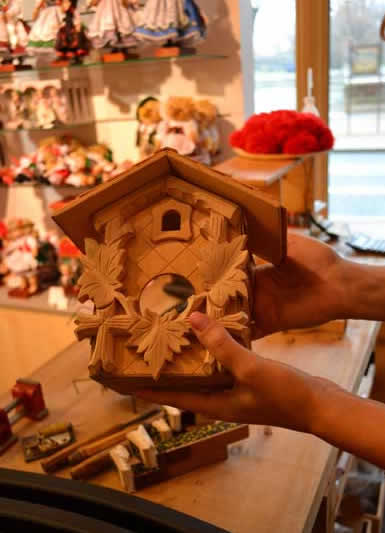
HISTORIC REGENSBURG The next day’s stop in Regensburg included a town tour with visits to the Hutkönig, a world famous hatmaker; a cuckoo clock-making demonstration; and the oldest sausage kitchen in Germany, which has been serving sausages for 900 years, since catering to the workers who built the adjacent Stone Bridge.
(left to right) A cuckoo clock-making demonstration was a tour option in Regensburg.; Regensburg’s famous Hutkönig had very special hats to offer.
ROMANTIC MARKET AT THE PALACE OF THURN AND TAXIS Regensburg’s main Christmas market spreads out near the cathedral, but another Regensburg highlight is the Romantic Christmas Market set in the courtyard and surrounding park of the Palace of Thurn and Taxis. Here the pathways are lit by torches, lanterns and lighted ropes wrapped around wooden fences, and there are hay bales for seating and open fires for warming stations. The bough-covered wooden stalls offer unique products obviously chosen for their quality and beauty. Although there is a fee of 6 -7 Euros to enter this private market, it was one of our favorites, and well worth the price.
The beautiful Romantic Christmas Market is on the grounds of the Palace of Thurn and Taxis in Regensburg.
After a full day in Regensburg, the local Advent experience continued on board as we were greeted with hot Glühwein and heart- and star-shaped Lebkuchen.
Red- and white-striped awnings decorate this Lebkuchen stall at Nuremberg’s historic Christkindlmarkt. The Christkind stands high on the balcony of the church on the left to open the market.
NUREMBERG’S CENTURIES-OLD CHRISTKINDLMARKT Our ship’s last stop was at Nuremberg, which boasts a 400-year-old Christmas market tradition. Once again, Viking provided bus transportation to and from the Christkindlmarkt on the Hauptmarkt square, since the boat dock is some distance away. Nearly 200 wooden stalls decorated with red- and white-striped awnings invite visitors from all over the world – more than two million each year – to sample the traditional gingerbread, sweets, sausages, potato pancakes and Glühwein, to buy their ornaments, candles, toys and prune men.
(left to right) The Children’s Christmas market in Nuremberg has rides and booths with hands-on activities for children, and appearances by Nuremberg’s Christkind.; Nuremberg’s unique Handwerkerhof is located at the distinctive Königtor within the historic city walls.
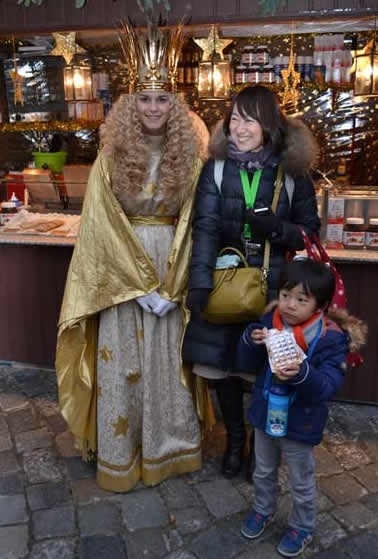
A few steps away is a children’s Christkindlmarkt with colorful rides, booths with hands-on activities, hot punch and Nuremberg’s beloved Christkind.
Don’t miss the nearby “Sister City” Christmas market featuring wares from Nuremberg’s sister cities around the world, and yet another Christmas market setting in Nuremberg’s distinctive Handwerkerhof, located at the Königstor within the historic city wall.
Though the river cruise part of our trip was over, and it was difficult to leave the cocoon of comfort we experienced on the ship, we had more markets to visit on our way back to Vienna.
INTER CITY EXPRESS SPEED AND COMFORT With a first class Eurail pass in hand, we boarded the fast Inter City Express (ICE) train from Nuremberg to Vienna. The Eurail pass, which we had to purchase in the U.S., allowed us to hop on and off the train for more Christmas market visits enroute to Vienna. Sitting in a six-seat “quiet room” directly behind the engineer gave us a clear view of the tracks ahead, a rail buff’s dream. The track generally followed the Danube, busy with barge traffic, with snow-covered mountains in the distance and large balls of mistletoe visible in the bare trees along the route.
Through the panoramic windows we watched the snow-covered forests and villages speed by, looking like gingerbread creations sprinkled with powdered sugar. We saw firewood meticulously piled high in covered sheds in preparation for the long cold winter, and churchyard cemeteries somehow decked out with colorful plants: lavender, heather – where does all the winter floral color come from?
MORE CHRISTKINDLMARKTS AT LINZ Soon we arrived at Linz, the location of our next Christmas market experience. We left our luggage in lockers at the train station and bought a ticket for the Linz City Express which took us through the town’s main shopping area to the Christkindlmarkt near the river on the Hauptplatz.
Nestled between the town’s centuries-old Baroque townhouses, this market featured wares by artists and artisans, with traditional hot drinks, Bratwürstlein and pastries. At the nearby Goldmann’s Bakery we sampled the town’s famous Linzer Torte. Lights above the stalls are designed to look like river waves, and a specially-designed light display above the river depicts angels blowing bubbles through a straw.
(left and bottom right) Vendors at the Schönbrunn Christmas Market offer painted pewter decorations and beautifully detailed figures for Nativity scenes.; Hot Glühwein in generous mugs, and stick-to-the-ribs comfort food hit the spot at the Schönbrunn Palace Christmas Market
Another short City Express ride delivered us to the Christmas market at the Folksgarten, which featured rides for children, stalls offering warm hats, scarves, decorations, and more hot drinks, pastries and comfort food.
Retrieving our luggage, we completed our train journey to Vienna, where one more very special Christmas Market beckoned.
SCHÖNBRUNN PALACE CHRISTMAS MARKET Vienna’s famous Schönbrunn Palace hosts its own large and very beautiful Christmas market. Situated on the grounds in front of the UNESCO World Heritage site, this unique market still has plenty of room to wander through the juried product stalls. Six food stands are centrally located, as is a towering lighted tree and a magnificently carved nativity scene. The Schönbrunn Market celebrates its 21st year in 2014, and has grown in size and popularity each year. This market easily sets a new standard with its attention to detail in set-up and design.
For those wondering how to experience the Christmas markets in Germany and Austria in comfort and convenience, this trip by river and rail is the answer.
Although goulash originated in Hungary, this popular dish later spread beyond its borders, first to the Austrian Empire, Germany, and the Balkans, and finally around the world.
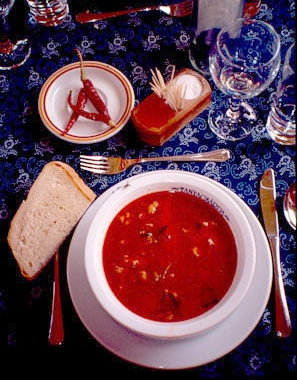
Classic Hungarian goulash at a restaurant on Hungary’s Great Plain
By Sharon Hudgins Photos by the author
Everyone loves a good goulash. But ask a dozen people what a goulash is—and you’ll get a dozen different answers: a soup, a stew, a meat dish served on a plate; brown, red, mild, hot-spicy; made with beef, pork, mutton, game, even vegetarian.
Although goulash originated in Hungary, this popular dish later spread beyond its borders, first to the Austrian Empire, Germany, and the Balkans, and finally around the world. That’s why there are so many versions of goulash today.
GOULASH ROOTS Hungarian goulash traces its roots back to nomadic Magyar herdsmen in the ninth century. Shepherds cut meat into cubes and slowly stewed them in a heavy iron kettle over an open fire until the liquid evaporated. Then they spread the meat out in a single layer to further dry in the sun. This dried meat, an early convenience food, could be carried with them as they followed their flocks across the vast expanse of Hungary’s Great Plain. To reconstitute the meat they simply added water and heated it—sometimes with other ingredients, too—in a pot over a fire. If a lot of liquid was added, the dish was called goulash soup. With less liquid, it was simply goulash meat. In both cases it was eaten with spoons dipped into the communal cooking pot.
Goulash got its name from those early herdsmen, who were called gulyás in Hungarian. But goulash as we know it today did not develop until the end of the 18th century and beginning of the 19th, with the widespread cultivation of peppers in Hungary and the use of paprika as a popular spice. Originally it was considered peasant food, eaten primarily by country folk—farmers, shepherds, cowboys, and swineherds. With the rise of Hungarian nationalism in the second half of the 19th century, paprika-seasoned goulash moved from the campsites and farmhouses to the tables of middle class and wealthy city dwellers, to the menus of fashionable restaurants and eventually across the globe.
GOULASH VARIETIES Goulash is now the Hungarian dish most widely known abroad. But in many parts of the world, dishes called “goulash” bear little resemblance to the gulyás that originated in Hungary and is eaten there today. In Hungary, gulyás is a meat dish halfway between a soup and a stew, made with small cubes of meat (usually beef), no more than 3/4-inch in size, and flavored with bacon or lard, onions and paprika. Gulyás is traditionally served in a bowl and eaten with a spoon.
Over time, Hungarian cooks also developed many variations on this theme, using such ingredients as garlic, tomatoes, mild banana peppers and hot cherry peppers, caraway seeds, root vegetables, cabbage, beans and tiny egg dumplings, as well as pork, mutton, venison and boar meat. Regional recipes abound, with each cook claiming his or her own version of goulash to be the best and most authentic.
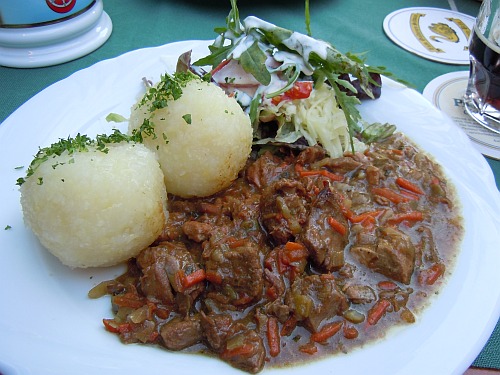
Germans adapted the basic Hungarian goulash recipe to their own tastes, producing the Gulaschsuppe (goulash soup) that is now so popular throughout Germany, where it’s traditionally served with a slice of rye bread and a mug of beer. Germans and Austrians also make a variety of thick, paprika-flavored meat stews called Gulasch, served on a plate and accompanied by boiled potatoes, egg noodles or dumplings. (The Hungarians, however, would call this kind of stew a pörkölt, not a goulash.) And Kesselgulasch (kettle goulash)—cooked outdoors in a pot suspended by an iron tripod over an open fire—is a Hungarian specialty that many Central Europeans now eat at their own backyard dinner parties and local festivals.
German “Beer Goulash” at brewery beer garden in Erfurt
As part of the former Austro-Hungarian Empire, the Austrians certainly love their own versions of Gulasch. There’s even a Cafe-Restaurant Gulaschmuseum in Vienna, where the menu lists more than a dozen varieties of goulash, including turkey or chicken-liver goulash with potatoes, bean goulash with paprika-seasoned sausage, veal goulash with little spinach dumplings, and even a dessert called Schokogulasch (chocolate goulash) containing cake, chocolate sauce and rum. In Prague I purchased a Czech cookbook devoted entirely to the subject of goulash—including versions identified as German, Austrian, Slovakian, Slovenian, Serbian, Bulgarian, even Chinese and Mexican! And recently in New Mexico I came across a Cajun goulash. What a mixture of geography and culinary cultures! From its humble beginnings on the plains of Hungary more than a thousand years ago, this simple peasant food has now become a truly global dish.
GOULASH-SPEAK “Goulash” has also entered several languages as a word meaning more than just “a soup or stew.” In Hungary, “Goulash Communism” was a term for the Hungarians’ attempt in the late 1960s to create their own, more market-oriented, economic system distinct from the Soviet model. In Germany and Switzerland, a “goulash cannon” is military slang for a mobile field kitchen—a big, heavy, black, iron stewpot on wheels, with a cover on the top and a built-in firebox—which is also used for feeding crowds at festivals and other public events. And in the Czech Republic, political parties had a tradition of setting up their own “goulash cannons” in front of polling places at election time, where they dished out free goulash in a blatant attempt to influence voters’ choices on the ballot. As the Czechs said to each other when they headed to the polls to vote, “Have a good goulash!”















 European Traveler