Mechelen, Belgium, about 15 miles north of Brussels, is a city of about 79,000 that features more than 300 monuments, eight historic Catholic churches and four UNESCO world heritage sights. You can reach the city by a short train ride from the main railway station in Brussels.
Mechelen is worth visiting not only because of its sights, but its people flourish because of a built-in determination and a friendliness that transcends nationalities. Maybe its because the Mecheleners have been perfecting humanity since 500 BC, when the first traces of human habitation of the area were discovered.
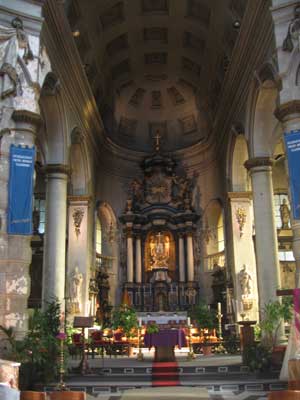
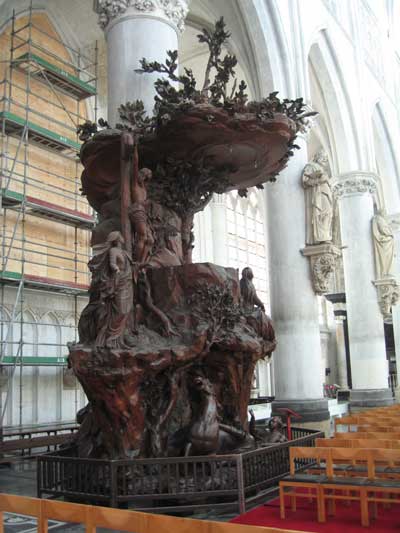
At one time, more than 100 firms in the city made furniture and word carvings, as evidenced by the many large and ornate church carvings seen here. Be sure to look for them as you discover this cobblestoned town, whose city center is only about a half mile across.
Some of the city’s sights include the early Gothic Brussels Gate, the last remnant of the medieval fortification constructed around the inner part of the city, built about 1300. At one time, all traffic entering and leaving had to pass through its limestone gates.
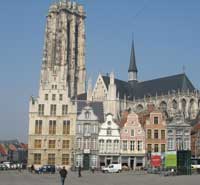
ST. RUMBOLD TOWER You can’t miss St. Rumbold Tower—it dominates the city skyline. If you have the time, conquer the 514 steps to the top of the tower to the skywalk for a great view of the area. Original plans for the tower were made when Mechelen was a rich and powerful commercial and political center, and thus the tower of St. Rumbold’s Cathedral was to become the highest tower in the Low Countries. Completed, it would have reached the dizzying height of 547 feet. Financial problems in the 16th century halted construction. The tower now reaches a height of 318 feet, still plenty tall.
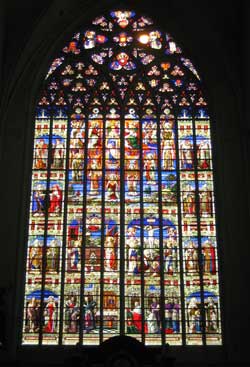
Inside the cathedral is a scale model of what the tower should have looked like had it been completed. Also inside the church are two of the largest stained glass windows in Europe. Jo Haazen and other guest carillonneurs present a carillon concert at the church every Monday evening from 8.30 p.m. to 9.30 p.m. These recitals are free.
A third highlight of the city is the Large Beguinage, where widows and unmarried women of class were invited to live together, submitting themselves to pledges of obedience and chastity. Parts of this community are still visible and are inter-woven into the city’s many old structures that line narrow streets in the center. Still in tact are the Beguines’ church, the infirmary, the house of the grand mistress and other structures.
(middle) One of the largest stained glass windows in Europe in Mechelen’s cathedral.
PALACE OF MARGARET OF AUSTRIA Another important site is the Palace of Margaret of Austria of the Court of Savoy. This was the first renaissance building in the Low Countries and perhaps outside of Italy. The facade features Margaret’s coat of arms, and between 1616 to 1795 it was the seat of the Great Council. Its interior garden area is a fine place to rest your feet for a while.
Another spot worth visiting is St. John’s Church, which is open to the public. A very fine wood carving on the interior is one of Ruben’s masterpieces, The Adoration of the Magi. The church furniture, paintings and statues date largely from the 17th and 18th centuries.
For a respite from walking or touring the city, find Windels at Iron Leen 48 (not far from the main railway station), the oldest cigar store in Belgium (from 1875) that continues to make fine cigars, and offers them in beautiful hand-made wooden boxes. The store, now being run by the fifth generation of Windels, also carries a good selection of whiskeys.
The Jef Denyn Royal Carillon School, at Frederik de Merodestraat 63, is a state-subsidized educational institute that offers a six-year program to obtain a laureate’s diploma. Even the Vienna Boys Choir visited the school during the last few years. When you realize Belgium is one of the carillon capitals of the world, this school makes sense, and attracts students from as many as a dozen different countries. The heaviest carillon in Belgium—there are five different carillons in town–is in one of the local church towers.
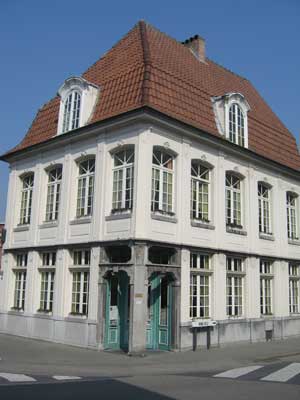
The Jef Denyn Royal Carillon School in Mechelen
The De Wit Royal Manufacturers of Tapestry, operating since 1889, is the only workshop in Flanders to retain this age-old tradition. Offering a complete range of tapestry services, the firm offers individual tours on Saturdays at 10:30 a.m. and group tours on other days. The De Wit is housed in a beautiful old Abbey at Schoutetraat 7, and plays a key role in many old and expensive tapestry restorations throughout Europe.
TIME FOR SOME CUCKOO Perhaps at lunch time you’ll want something unique and that is a local delicacy. Find a restaurant that serves the town’s famous Mechelse koekoek, or Mechelen cuckoo (chicken). This chicken, with black-gray feathers, is a feature on many local menus, and is often served with fresh vegetables or with a Mechelen beer sauce. You’ ll likely get a large side dish of round roasted potatoes to go with the chicken.
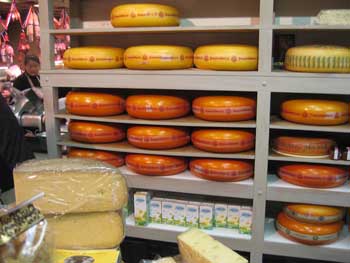
Delicious cheese lines the shelves in a Mechelen shop.
After lunch, stop in at one of the two local Gauthier chocolate shops (one is at Guldenstraat 2), and soak in the atmosphere. Store candies are hand-made, made from traditional Belgium customs, and follow a unique recipe, so you’ll likely leave with a bag full of something good to eat. The Gauthier family, with master chocolate maker Edouard Gauthier, has been making candy in town since 1964.
Round out your afternoon with a boat trip on the Inner Dyle River. A multilingual audio-guide tells you about the sights along the river banks. The departure is at the Jetty at Lamot/Haverwerf and costs €6 for adults.
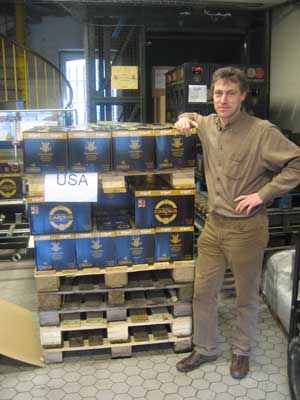
MUCH MORE TO SEE Many more Mechelen sights are available if you have the time, such as the Watchmaker’s Museum, the Jewish Museum of Deportation and Resistance, the Museum in City Hall (the old Rathaus), and the Het Anker Brewery Museum. At this small family brewery, best known for its local beers such as Gouden Carolus, you’ll get a feel for quality. The brewery also has its own restaurant and 22-room hotel.
Around the year 1500 more than 100 breweries operated in Mechelen, but like most things, the businesses and other important history of the city has faded over time. But this quaint Belgium town continues to re-count its traditions and rich past, and brings it forth today for all to enjoy.
From the first red wine produced along the Mosel River during Roman rule to the sweet Riesling for which the country is renowned, German wine is woven into the country’s culture and history.
Many member cities of the Historic Highlights of Germany are inviting travelers to experience this firsthand this fall with a series of wine-themed events, activities and offers.
In Mainz, more than 50 wine growers from throughout the region assemble during the first weekend in September for the annual Mainz Wine Market (photo at left). The event has craft stalls, rides, music and fireworks and, of course, dozens of wine stands. Wine-making goes back nearly 2,000 years in Trier, where several two-night packages feature special themes such as wine cultivation during Roman rule and a combination of World Heritage site visits and wine culture.
In Heidelberg, packages include the Heidelberg Wine and Chocolate Tasting with five wines from regional vineyards and five fine chocolates. Wine has long been central to life in Koblenz, located at the confluence of the Rhine and Mosel Rivers, where the “Wine Village” welcomes visitors to enjoy a glass of wine in the quiet setting of half-timbered houses.
Würzburg, situated on the Main River, is home to several wine estates, where visitors can enjoy tours and wine-tastings—including the Juliusspital, whose 400-year old, 800-foot long wine cellar makes it one of the oldest and largest German wineries.
Historic Highlights of Germany suggests two “Dream Routes” that focus on wine. Click on “Dream Routes” on our site at: www.historicgermany.com
Travelers who like continental lake districts should set their sights on Mecklenburg-Lower Pomerania, Germany’s least densely populated federal state.
More than 1,000 lakes and ponds speckle the countryside terrain. Seven of those are right inside Schwerin’s municipal confines—plenty enough to give this Landeshaupstadt state capital (population 97,100) the appeal of curving shoreline pathways, footbridges, causeways, pleasure-boat docks and south-side Zippendorf’s sandy beach. To reach the city, take an InterCity Deutsche Bahn train from Hamburg, a 57-minute trip (check www.raileurope.com).
Get acquainted with the Schweriner See (biggest of the inner-city lakes) by way of a short Weisse Flotte cruise to Kaninchenwerder and Ziegelwerder, a pair of woodsy nature sanctuaries frequented by 100 species of birds. Even more central, crisscrossed by ferryboats, the oval-shaped Pfaffenteich features spouting fountains and a terrace café.
If this local water world doesn’t satisfy outdoor enthusiasts, you can hike-bike-paddle through the beechwood-forested Warnotal valley, 43 miles northbound toward coastal Rostock-Warnemünde via hidden-away riverside villages.
First though, one of Europe’s most flamboyantly spectacular castles, inspired by Grand Duke Friedrich Franz II, fairly shouts for attention. Its pentagonal bulk stands on a lake (the Burgsee), consciously imitating Château de Chambord in France’s Loire Valley. Rising from medieval fortress foundations on a mini-island accessed by ornamental bridges, ongoing construction and impulsive add-ons produced the neo-Renaissance, gilded-domed Schweriner Schloss, finally completed in 1857. End result, amidst terra-cotta trimmings: a splurge of pinnacles, belfries and 15 turrets. For dramatic impact, floodlights illuminate the ensemble during nighttime hours. Surely an extravagant setup for the state’s Landtag parliamentary offices.
PORTRAITS, PORCELAINS AND OLD MASTERS PAINTINGS For visitors touring the premises, however, bureaucratic doings play second fiddle to the castle’s cultural finery. Not to be missed: galleries devoted to portraits covering 600 years of ancestral dukedom, plus important Mecklenburg landscape paintings. Also here: a lavish oak-paneled banquet hall, chapel and big-windowed orangerie. Inlaid-wood floor patterns and silk brocade wall hangings embellish the ducal throne room.
Watch for the Schloss museum’s displays of furniture, jewelry and weaponry, but especially its sizeable porcelain collection (Meissen, Sèvres, Fürstenberg). Relax in the rococo tea salon or stroll through the flowery Schlossgarten, accentuated by allegorical statues (www.schloss-schwerin.de).
Thanks to past acquisitions made by Mecklenburg Duke Christian Ludwig II and his son Friedrich, the state’s Staatliches Museum Kunstsammlung ranks high as an outstanding fine arts repository. Surrounded by linden groves on Werderstrasse’s northern edge of lakeside Alter Garten greenery, this cultural gem (built 1877-82) resembles a Grecian temple. Gallery-goers ponder Dutch-Flemish “Golden Age” materpieces (Rubens-Rembrandt-Hals-Breugel), but influential German works (Cranach the Elder-Caspar David Friedrich-Max Liebermann-Lovis Corinth) shouldn’t be ignored. Also prominent: Thomas Gainsborough’s full-length, 18th-century Queen Charlotte rendition and (surprise!) a comprehensive French array of dadaist-surrealist Marcel Duchamp canvases.
The Beaux-Arts Mecklenburgisches Staatstheater, another Alter Garten edifice, stages operatic-ballet-theatrical performances—and is “home hall” of the Mecklenburg Court Orchestra, established 448 years ago for eminence as Germany’s third-oldest symphony orchestra, after Dresden’s Staatskapelle and Leipzig’s Gewandhaus.
PANORAMIC VIEWS FROM THE CATHEDRAL TOWER Schwerin’s cityscape emerged in remakably good shape from the economically skimpy GDR decades. So take in the architectural mix. Dom St. Maria und St. Johannes (on Bischofstrasse) exemplifies soaring early-Gothic north-German brick cathedrals. Climbing 219 spiral stairs to the tower rewards sightseers with terrific panoramics from a 320 foot altitude. Evocative tidbit: the 15th century golden cross crowning the steeple was salvaged from Wismar’s war-damaged (and, in 1990, GDR-dynamited) Marienkirche.
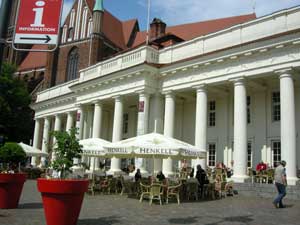
On the Marktplatz, you’ll see an unusual kind of Rathaus—basically Gothic but scrunched behind an English mock-Tudor façade. It stands near Schwerin’s 18th century Säulengebäude market hall, fronted by a dozen white Doric columns.
(right) Monument commemorating Henry the Lion, Duke of Saxony, founding father of Schwerin.
In 1707, a planned Schwerin Neustadt community named Schelfstadt came into existence. Narrow streets, clustered half-timbered Fachwerk houses, Baroque Nikolai Church and tidy kitchen gardens comprise a worthwhile visitor attraction. Same for this lakeside setting’s Freilichtmuseum Schwerin-Muess, recalling 18th-19th century rural folkways.
WHERE TO EAT, WHERE TO SLEEP The Sorat organization converted a 1936 wheat warehouse into Speicher am Ziegelsee, where spacious guest rooms complement a 55-seat restaurant (www.speicher-hotel.de). Another Ziegelsee choice, Best Western’s Seehotel Frankenhorst, has boat dock, swimming pool and whirlpool-sauna amenities (www.seehotel.bestwestern.de).
Tops in town for deluxe ambience and Pffanteich vistas, Niederländischer Hof includes a wood-paneled library and mirrored restaurant (www.niederlaendischer-hof.de). Centrally situated Alt Schweriner Schankstuben is a budget category 16-room Gasthaus (www.alt-schweriner-schankstuben.de).
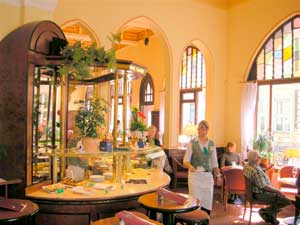
Among recommendable in-town dining options are upscale Weinhaus Uhle (www.weinhaus-uhle.de), beer-pouring Zum Stadtkrug Alstadt Brauhaus (www.altstadtbrauhaus.de), sophisticated Friedrichs, occupying a circa-1801 neoclassical mansion (www.restaurant-friedrichs.com) and ever popular Wallenstein, on a Schweriner See embankment, where patrons seated on the open-air pavilion are treated to views of the castle (www.restaurant-wallenstein.de). For a coffeehouse break, find elegant Café Prag, with sidewalk tables overlooking Schusterstrasse, and Röntgen on the Markplatz.
PLANNING YOUR TRIP Tourist Information Schwerin (www.schwerin.com) is located longside the Rathaus. Or, go to the German National Tourist Office for answers (www.cometogermany.com).
ET: How many times have you taken your kids along with you on a foreign trip, and where?
The kids have been traveling with us since before they could walk (they are 10 and eight now), so on many, many trips to places like the British Isles, France, Italy, Greece, Peru, Costa Rica, Alaska, Florida, Mexico and the Caribbean.
ET: At what age do you feel it’s worthwhile for children to be taken on an overseas trip to Europe? Please explain your reasoning.
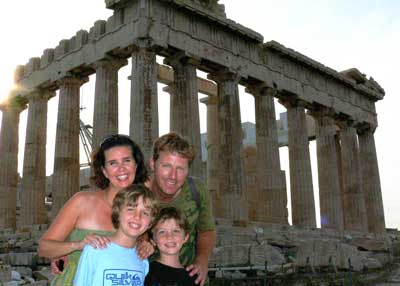
I think each age has its own benefits and drawbacks. When they are babies they are easy to travel with (before they can walk) and babies seem to open up a whole new door with the locals…you will meet other parents and talk about universal issues and be introduced to a whole different world than a typical traveler…people love babies! The drawback is babies come with a lot of gear and long overseas flights can be tough with a crier. Toddlers are fun to travel with because you see things entirely differently. They are fascinated by everything and leave nothing unexplored. What we might see as a famous monument a toddler might see as a cool worm inching its way across a stone surface. It gives perspective to things and adds a playfulness you might not get with older kids. However, toddlers can be unpredictable, and you still have to deal with added gear and schedules. My favorite is school-age kids. They still see things differently: our boys spent a good 20 minutes watching an ant carrying a toothpick across the Parthenon last summer, but they are more able to comprehend the historical and cultural significance of destinations. They are learning about the places in school and they bring that with them as well. Plus, they don’t have as much stuff, and are able to carry their own bags and they actually want to spend time with their parents still. The drawback is that they are in school, so homework has to become a part of their trip as well. Pre-teens and teens, depending on what stage they are in, can still be excited by exotic destinations, especially if you put an adventurous spin on it (i.e., zip lining through the Amazon, hiking the Inca Trail), but they are harder to impress and a mopey teenager can put a damper on the vacation for everyone. But, don’t let this stop you, as they will appreciate it later, and it gives them a global view on life that many kids their age don’t have.
ET: Language differences may or may not be a big barrier to children on a trip to Europe when accompanied by their parents, especially when the children are younger. At what age do you recommend children study the language before they travel overseas, and how might they best learn a language, say, when they’re going over for only a week or two? I always encourage travelers of every age to learn at least a few words in the country they are visiting. Saying “s’il vous plaît” in Paris will get you a much warmer reception than instantly assuming everyone knows English. And its fun for kids to practice the language with local kids. It is by no means necessary. There are very few places on earth that you can’t find at least one person who speaks English. However, if you plan on getting far off the beaten path, I would suggest a phrase book. There are lots of smart phone applications available as well now. We usually download one of those and practice a few key phrases in the weeks before the trip and while we are on long plane or train rides.
ET: Are there some things that are vitally important to take with you when you take younger kids along, that you may not find in Europe?
For the most part, you can find anything in Europe that you will need supply-wise. If there is a specialty item that is unique to your child, you may want to bring that…for example, a certain diaper rash cream for kids with sensitive skin, or a formula that your child needs. Also, any prescription medications. But don’t be afraid to try local things as well. Europe has lots of independent companies producing natural kids’ items that you can’t find in the States.
ET: What about the added expense by taking kids with you to Europe? Does it cost a lot extra to travel around, lodge and feed them?
Airline tickets are the main extra expense. Big hotels will be able to accommodate most small families in a regular room without additional expense. Booking a condo/apartment helps save on lodging costs and gives extra room for the while family to spread out. Plus, the kitchen can help save money on eating out. We usually do breakfast and sometimes lunch or dinner in the condo, but we like to eat out as well to get a feel for the local cuisine.
ET: Food. What do you suggest about finding “kid foods”– good, nutritious food at reasonable prices when overseas?
Go where the locals go. You don’t need to spend a lot to taste the local cuisine. The kids love street stalls. too. Just make sure to ask for guidance from locals to avoid getting sick. Crepe stands in Paris, panini cafes in Italy, pasty shops in England…all these foods let you get a taste of real local foods at a fraction of the cost of a sit-down restaurant.
ET: Can you recommend some special “kid-friendly” hotels in Europe, or cities or attractions that seem to especially cater to kids?
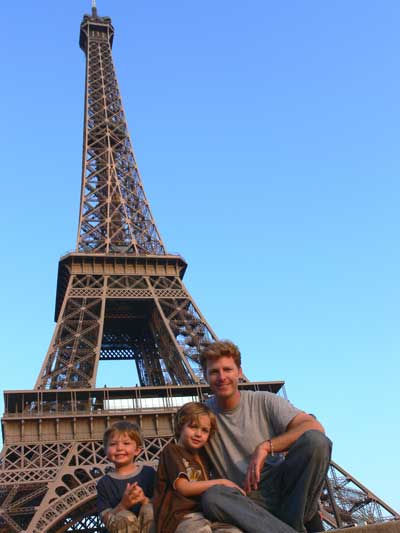
It’s not always the cities you would think that are exciting for kids. There doesn’t have to be an amusement park to interest kids. Our kids were fascinated by Venice, a city many people would not think of taking kids to. They loved taking the boats up and down the canals and wandering the tiny streets. Big cities are fun for kids, too. Paris and London are on the top of our kids’ destinations list. They love riding the tube and double decker buses and visiting big time attractions like the Eiffel Tower. Really anything can be interesting to kids if you prep them for it. Learn about a destination before you go. The kids learned about gladiators and Rome before we went to Italy, and it really came to life in Roman ruins all over Europe. They had a blast pretending to be gladiators in colosseums from Wales to Rome. Walks Inside Rome had a great tour with history on a kid’s level and a visit to Gladiator School…the kids learned from “real gladiators” how to fight with swords and defend against wild animals. Very fun! Many attractions have kid versions of audio tours, scavenger hunts, or something to engage kids. Just ask. If they don’t, you can always make your own. When the kids were younger (ages 5 and 7) we visited the Louvre. I was worried about keeping them interested, so I printed out pictures of some of the more famous exhibits and sent them on an art treasure hunt. They had a blast, and even enlisted the security guards to help them, and we enjoyed extra time at the museum.
As far as hotels go, apartment rentals are always great with kids. The apartments are often in local neighborhoods, so you get a better feel for local life. We rented apartments from Frenchy Rentals in Paris, a villa in Tuscany from Italy Perfect and apartments in Rome from Parker Villas. When we are staying in a hotel, we try to stay in family-owned, smaller hotels. These are usually located in the more culturally rich or historically significant parts of town. A lot of it is also about location. We don’t want to have to take a 20 minute taxi everytime we want to go into the old part of town. We like to be where the action is.
ET: Teenage tensions can be a problem. How do you handle this on a long European trip?
Lots of luck. Just kidding. Teenagers are a different breed, and since I don’t have any yet, I can’t give too much advice here. What I have noticed with my niece and nephews is that when they are out of their element (like you are in a foreign culture), some of that attitude fades away. I went on a trip to New York with my 15-year-old niece last year, and we had a blast. I asked for her input on everything we did, and I think that helped a lot. Let the kids (of all ages) help plan what you are doing. That helps them feel invested in the trip ahead of time and keeps them engaged while you are on the road.
ET: What foreign trips/areas might you not want to take your kids on and why?
I don’t think there are any areas I would say don’t take kids accept for areas I would not go myself because of dangers or violence. I guess there are some third world countries for which I would want to edit the itinerary. It would be very hard for the kids to comprehend such abject poverty. I might also stay away from long trips in which passengers are contained and there are no breaks. Kids who are cooped up and bored for long periods of time can get irritating fast.
Many people ask if I am scared to travel because of coverage they see on television. Fortunately, I have never felt any hostility from locals stemming from my being an American. In fact, quite the opposite. I have always been welcomed with open arms. When we traveled through the Middle East I was not sure what to expect, but everyone was very warm and welcoming. What you see in the news is not always how it is in real life. I would be cautious, of course, as things can happen when you travel, just as they could at home. Be aware of what is going on around you, ask the locals for perspective and trust your instincts.
ET: What do you suggest on a European trip if the parents want to occasionally go out alone in the evening and the kids need to go to bed. Who watches the kids?
Many hotels offer babysitting service. I have never used them as I would not feel comfortable leaving my kids with a stranger. However, I hear stories from other people who did this, and it turned out just fine. I would say that for me, the point of a family vacation is to spend time with your kids. At some point, they won’t want to hang around with us anymore, so I try to cash in on all the time I can with them now. Schedules are a bit more flexible when we travel. So, the kids stay up later which is just fine as the town squares in the evening are packed with families strolling and kids playing. It’s a time where we really get to know the locals, and the kids love it!
ET: What do you think is the most important thing to remember when going to Europe with your kids?
Take time to absorb it all. Often times when we travel (and I am just as guilty of it as anyone else), we pack in as much as we can. There’s so many wonderful things to see and do in Europe. And we end up moving so fast that we don’t take time to just sit and soak it all in. Sitting in the town square, watching life go by, is a great tradition in southern European countries, and it’s a great time to reflect and just spend time with your kids…time bonding and re-connecting with one another, which is really what it’s all about anyway.
Travel With Kids takes viewers on an educational journey through each destination visited, presenting history and culture in an innovative way, as well as showing the kid-friendly things to do and see. Whether planning a trip, or just wanting to learn more about a destination, Travel With Kids will entertain the whole family. For more information on Travel With Kids, or to purchase a DVD visit www.TravelWithKids.tv
Paris appears to top the destination wish list on a first trip to France. But after that, the Dordogne area of southwestern France is an enticing destination known for history, culture, wine, gastronomy and relaxation.
The Dordogne, also known by its former name, the Perigord, is an hour’s drive east of Bordeaux. The Dordogne River runs east to west through its center, carving out a winding river valley scattered with more than 1,000 picturesque castles and chateaus. From vineyards in the west to pre-historic sites along the Vezere River tributary in the east, and fortified villages from the Hundred Years War, there is plenty to see.
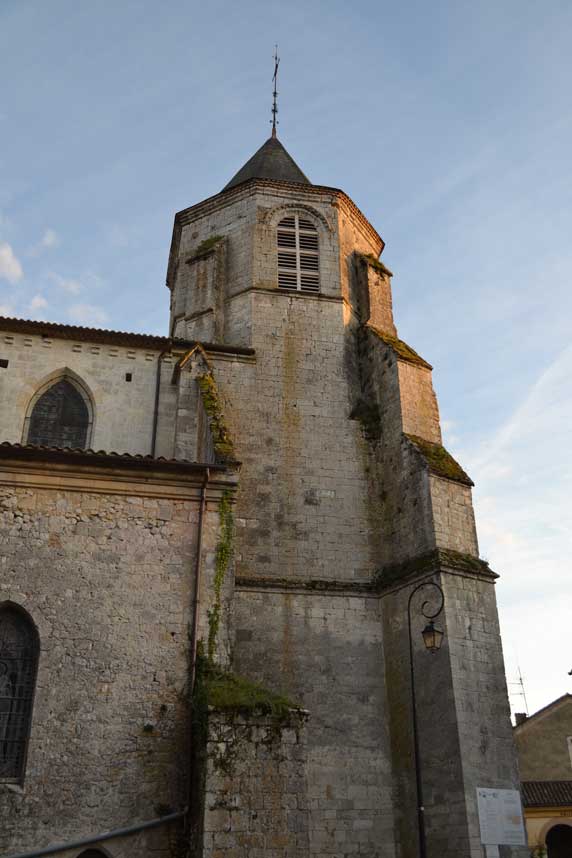
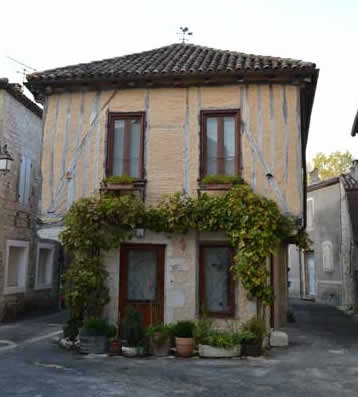
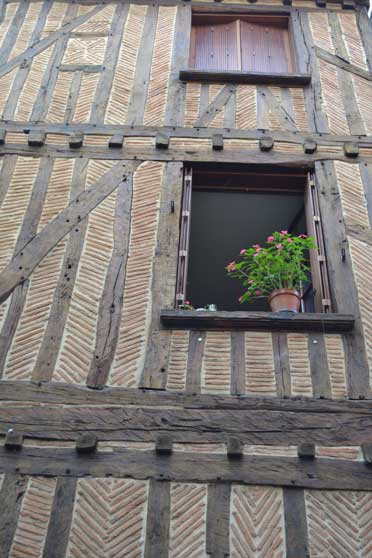
ISSIGEAC In the tiny medieval village of Issigeac a circular wall surrounds winding streets dominated by the octagonal bell tower of the 15th century Church of Saint Felicien. The 13th century stone buildings with Gothic arches and charming half-timbered houses with beautiful inlaid brick detail are lovingly preserved, not to attract tourists, but to be lived in and used by the less than 1,000 inhabitants. Look for the “Mushroom House,” built with an overhanging second story, to allow carts access to the narrow streets that surround it. An active market is held in the central square on Sunday mornings, but a stroll through the quiet town at dusk calms the spirit and prepares you for a relaxing dinner.
Church of Saint Felicien“Mushroom House”
La Bruceliere restaurant in Issigeac is family-run and serves gourmet local cuisine with regional wines. A pleasant surprise in rural France, it also offers five rooms for overnight accommodations. www.labruceliere.com
BERGERAC The historic town of Bergerac was founded with the castle built to manage river traffic on the Dordogne, and the 9th century bridge accommodating pilgrims on the road to Santiago de Compostela. In the old town, see the picturesque stone buildings constructed with local yellow stone, and the half-timbered houses on the Rue St. Clar. The National Tobacco Museum is housed in the 17th century Peyrarede House.
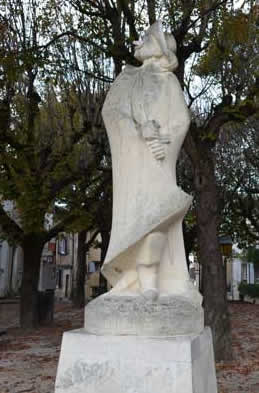
In the medieval town square, restored in the 1970’s, you’ll discover a stone statue of Cyrano de Bergerac – the comic/tragic hero made famous by Edmond Rostand’s 1897 fictional story about the brilliant and poetic swordsman with a very large nose, in love with the beautiful Roxane. The real-life Savinien de Cyrano, upon whom the fictional character was loosely based, was born in the 17th century near Paris. When he joined the Cadets of Gascony, he changed his name to Cyrano de Bergerac, after a family estate of that name. The town of Bergerac is nevertheless happy to adopt him as a symbol of boldness and generosity.
Unfortunately, Cyrano’s famous stone nose is routinely broken off by admiring fans. So a new colorful bronze Cyrano with a more permanent nose was erected in 2005 in the Place Pelissiere, in the shadow of the picturesque church of Saint-Jacques.
Stone Cyrano
In the 18th century flat-bottomed boats called Gabarre carried wine and wood for barrel-making from Bergerac’s riverfront to Bordeaux for export. Replica Gabarre today offer tours on the Dordogne in Bergerac and in the castle-rich area near La Roque-Gageac.
A peaceful courtyard is at the center of the Recollets Cloister, now home to Bergerac’s House of Wines. Here a Wine Journey exhibit explains the history and appellations of Bergerac wines. Visitors can also taste the local wines and visit with a winemaker from the Dordogne Wine Route.( www.vins-bergerac.fr/en/p/maison-des-vins-or-house-wines.) What is there to learn at the House of Wines?
The vineyards in the geographic area of Bergerac are classified into 13 appellations that are grouped into five different types:
Reds: Bergerac, Cotes de Bergerac, Montravel and Pecharmant Roses: Bergerac rose Dry Whites: Bergerac and Montravel Sweet Wines Monbazillac and Saussignac Dessert Wines: Cotes de Bergerace Blanc, Cotes de Montravel, Haut Montravel and Rosette
France’s system of appellations consists of a set of strict rules covering which grape types may be used in a particular wine, the areas in which the grapes can be grown, the maximum permitted yields, the pruning type and sometimes the harvesting techniques.
Particularly popular in the area is Monbazillac, a sweet white wine made from grapes harvested after they have begun to shrivel and develop “noble rot.” Each individual grape must be hand picked from the bunch at just the right time — a labor intensive, painstaking job.
Edouard de Saint-ExuperyChateau Tiregan
WINEGROWERS The vineyards of Bergerac cover almost 30,000 acres in 93 villages on both sides of the Dordogne. Although traditionally overshadowed by the more well-known wines of its neighbor Bordeaux, many of the Bergerac wines compete favorably with them, and at a lower cost.
Chateau Puy-Servain (www.puyservain.com) owners Daniel and Catherine Hecquet have nearly 120 acres of vineyards (the average for wine growers in the area is 50 acres) and export 60% of their wine.
The Chateau VARI estate in the town of Monbazillac is an organic vineyard. Their wine bar, la maison Vari, offers wine along with a simple, but delicious menu for a light lunch. www.chateau-vari.com
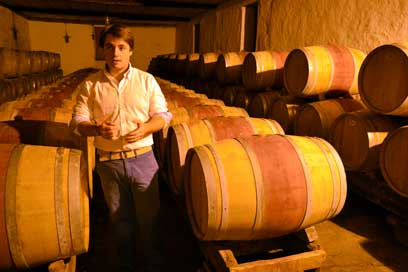
Winegrower Edouard de Saint-Exupery of the Chateau Tiregand in Creysse (whose famous literary relative wrote The Little Prince in 1943) welcomes visitors for free wine tastings or for a guided tour of the 17th century family estate, located just 10 minutes east of Bergerac. www.chateau-de-tiregand.com
PREHISTORIC SITES The valley of the Vezere River, which flows into the Dordogne, has been called the prehistoric capital of the world: the part of Europe that claims the longest period of continuous human habitation. Cro-Magnon man was discovered here in 1868 during excavation for the construction of the railroad. A national museum of prehistory is located in the cliffs above Les Eyzies-de-Tayac. www.musee-prehistoire-eyzies.fr
The valley boasts 147 prehistoric sites dating from the Paleolithic age, and 25 decorated caves, the most famous of which is the Lascaux Cave in Montignac. The site of 17,000-year-old paintings and engravings, it was discovered in 1940 and opened to the public for viewing. The paintings had survived beautifully for centuries in the stable and somewhat sterile environment. However, visitors unwittingly exposed the cave and drawings to destructive elements such as algae and carbon dioxide, which forced the closure of the cave for viewing in 1963.
Today visitors to the Dordogne can view an exact three-dimensional replica of largest two areas of the cave in Lascaux II, a remarkable achievement that took 10 years to construct. Since 2012, a traveling replica called Lascaux III will be on exhibit in museums around the world, starting with the Field Museum in Chicago, and continuing to Houston and Montreal, not to return to France until 2020. www.lascaux.culture.fr; www.semitour.com/site-touristique/lascaux-ii
Walking through the Grand Roc Caves in Les Eyzies de Tayac is like being inside an illuminated geode. Well-placed lighting showcases the incredibly delicate stalagmites, stalactites and crystallizations of this Unesco World Heritage site. www.les-grands-sites-du-perigord.com
A few steps away from the Grand Roc is Laugerie Basse showcasing two prehistoric rock shelters and displays of prehistoric mobile art.
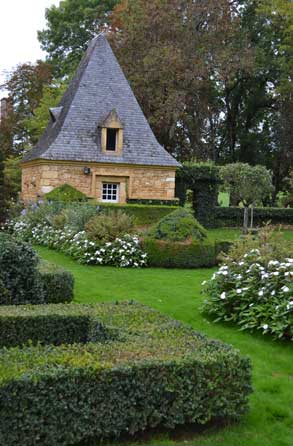
EYRIGNAC MANOR GARDEN Eyrignac Manor Garden is one of France’s most beautiful private gardens. Known for its topiary art, the gardens and manor have been in the same family for 500 years. Owner Patrick Sermadiras is often on hand to meet guests and share his design and gardening expertise. A well-written visitor’s guide and audio tour is available in English to lead you through the seven distinct gardens. An on-site restaurant offers a varied menu for a tasty lunch. www.eyrignac.com
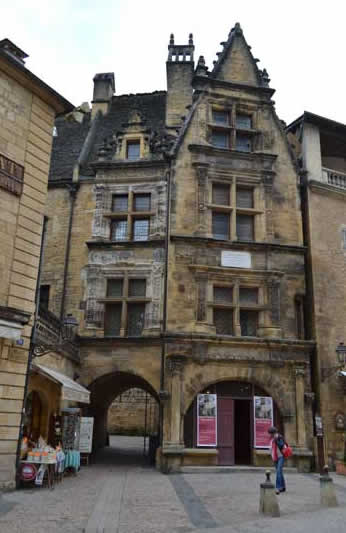
MEDIEVAL TOWN OF SARLAT A medieval jewel, Sarlat boasts one of the largest medieval urban areas in the world. Locals are especially proud to showcase the birth-house of political philosopher Etienne La Boetie as a gem of Italian Renaissance architecture. Throughout the town, note the roofs made of overlapping flat stones, the inexpensive, readily available roofing material of the time. These stones made the roofs extremely heavy, necessitating steep roof angles for stability. A little jarring, yet noteworthy nonetheless, are the huge metal doors that open into Sainte-Marie church, which now serves as a covered market. World famous architect Jean Nouvel, who was born near Sarlat, designed the doors to replace the destroyed apse. He also designed the glass elevator that bursts through the open roof of the bell tower, offering a spectacular panoramic view of the surrounding old town.
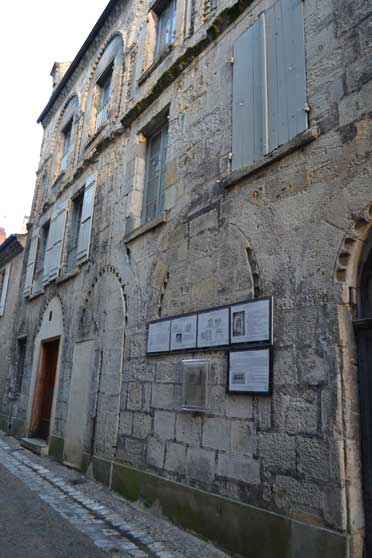
Boetie House
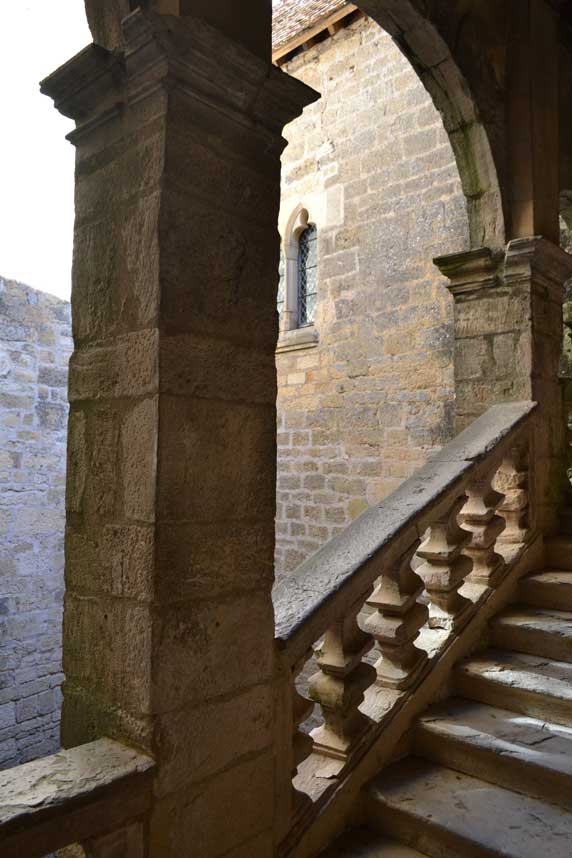
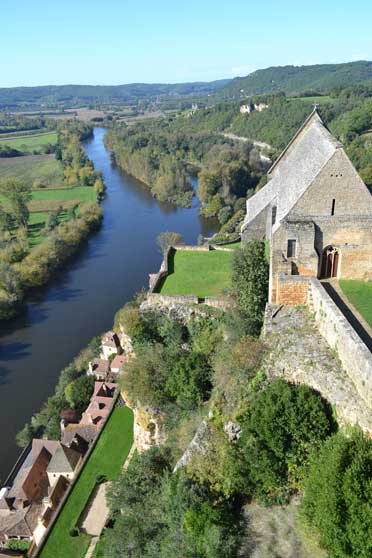
VILLAGE OF BEYNAC Bring your walking shoes and climb up the winding stone streets of the beautiful medieval village of Beynac. Your goal is the 12th century fortress at the top of the cliffs overlooking the Dordogne. From there, the view of the surrounding countryside, the town below, the winding Dordogne River and the Castelnaud Castle on the opposite riverbank is unforgettable. A walk through the restored castle is a living history lesson.
During the Hundred Years War, the Dordogne River was the border between France and England. Beynac Castle was French and Castelnaud was English. All along the Dordogne River struggles for supremacy meant the bastides (fortified towns built by either the French or the English during the 13th century to contain invasions) were shuffled back and forth between the two countries.
Beynac Castle and village served as the location for more than a dozen films, including Joan of Arc in 1999, Ever After in 1998 and Chocolat in 2000.
After climbing and touring Beynac Castle on the cliff, enjoy a meal at LaPetite Tonnelle, a quaint restaurant tucked against the cliff on the way down. Their menu offers homemade dishes with locally sourced gourmet food and regional wines, served on their patio with a beautiful view of the village or in their dining room, built right into the rock wall. www.restaurant-petite-tonnelle.fr
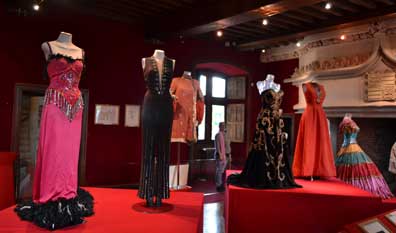
CHATEAU DES MILANDES On the other side of the river in the town of Castelnaud le Chapelle is the Chateau des Milandes, a beautiful 15th century castle, and the former home of musical entertainer Josephine Baker. Born in St. Louis, Missouri, Josephine’s popularity sky-rocketed during the 20’s in Paris when she appeared in the Revue Negre at the Theatre des Champs-Elysees. During her time at the Chateau de Milandes she adopted 12 multi-national children (her “Rainbow Tribe”) and became beloved by the locals because of her generosity and kindness, even working for the French Resistance during WWII. Poor financial planning caused the house and its contents to be put up for auction in 1968. Four families have owned the Chateau des Milandes since the auction. Current owner Angelique de Labarre has passionately collected items from Josephine’s past to fill the 14 rooms with original costumes, music, photos and furnishings. Beautiful gardens and a live birds-of-prey show on the grounds outside the castle complete an entertaining visit. www.milandes.com
PERIGUEUX Périgueux, located along the Isle River, is the largest town in the Perigord region, and its contemporary face makes finding the hidden medieval gems a little more difficult.
Périgueux began as two distinct towns. Easy to see are the historic remnants of the older one: Gallo-Roman town of Vesunna. The ruins of the inner sanctum of the temple for the goddess Vesunna and remnants of the ancient amphitheater stand near Jean Nouvel’s newly-designed Gallo-Roman Museum. The Romanesque gate of Porte Normande leads to what is left of the Barriere Castle and Romanesque-style house built in the Middle Ages on Roman foundations. The Saint-Etienne de la Cité Church was the cathedral of Périgueux until 1669, when that title was transferred to the Saint Front Cathedral in the second nearby settlement that comprises today’s Périgueux.
Streets of Périgueux
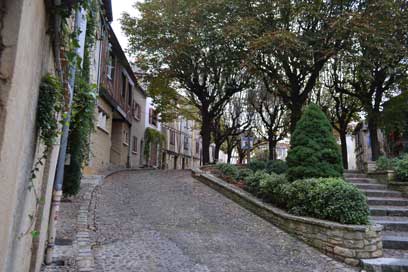
Further to the east, the more commercial city of Puy St. Front, the second “building block” in what is now Périgueux, developed in the 12th century. Look carefully down narrow streets of the old town for half-timbered houses, towers, walls with evidence of ancient arched windows and gateways, bricked-in and changed to fit the needs of the century. Beautiful ancient stone staircases still lie hidden in entryways of private houses, accessible to guides with keys.
Dominating the skyline is the Byzantine-style bell tower of the Saint Front Cathedral. The church is in the shape of a Greek cross, with five domes dating from the 12th Century. It was restored by Architect Paul Abdie between 1852 and 1895. His award winning design of the Sacre Coeur Basilica in Montmartre in Paris was inspired by the style of the Saint Front Cathedral.
ACCOMMODATIONS The Chateau des Vigiers in Monestier on the western edge of the Perigord is one of the few places in the area that can accommodate large groups. This luxury hotel, with a spa and a 27-hole golf course, offers 36 romantic rooms in a 16th century chateau and annex and 40 more in its contemporary, eco-friendly Relais des Vigiers. www.vigiers.com
For peaceful and luxurious accommodations five miles south of Bergerac, LaChartreuse du Bignac offers 12 rooms and a restaurant in a 1630 stone chateau with vaulted ceilings and exposed beams. Extensive grounds with terraces, a swimming pool and a park lead to a small lake. www.abignac.com
The recently renovated Hotel Les Glycines in les Eyzies de Tayac is centrally located near the Cro-Magnon museum and Grand Roc cave, and is a short drive to Lascoux cave. The hotel features beautiful romantic rooms, extensive gardens, a pool and a wonderful restaurant. Order the “Victoria pineapple” for dessert, aim your video camera, and watch the magic begin. The waiter pours warm rum/passion fruit syrup over a hollow chocolate ball until the surprise pineapple tidbits, pina colada and vanilla ice cream appear. Entertaining and delicious! www.les-glycines-dordogne.com
Vieux Logis in Tremolat is a lovely 4-star country inn, formerly a priory and then a farmstead, that is not to be missed. Rustic comfort in 14 rooms and nine apartments, with a one-star Michelin chef, gourmet restaurant, bistro, seminar rooms and lovely garden and terrace. Once there, you won’t want to leave. www.vieux-logis.com
NEED A GUIDE? For a professional travel guide in the Dordogne, European Traveler recommends Frances and Sandra Ho Tham Kouie.
They have more than 20 years of experience in tailor-made tours for English speaking travelers – either individuals or groups. Their knowledge of history and attention to detail will smooth your way to an enjoyable discovery of the Dordogne. www.voyages-france-impressions.com.














 European Traveler