Photos courtesy Paris Convention and Visitors Bureau
Designer hotels: everything started in Paris a few years ago with the trend toward boutique hotels.
The term is used for small capacity hotels with three or four stars, which offer clients a personalized and attentive welcome and a particularly refined and cozy decor.
Following the success of this type of hotel, certain hotels decided to take the concept further by entrusting their decor to interior designers and architects and providing their guests with a contemporary atmosphere: designer furniture, use of new materials, the latest technologies and contemporary works of art.
Some hotel groups have made this design orientation their speciality. This is the case for the Murano Hotels and Resorts, which owns the Murano Urban Resort Hotel and the Kube Rooms and Bars Hotel in Paris. The first, located between République and Bastille on the edge of the Marais, drew attention with its immaculate white design aesthetic, its bar lounge with colored seats, its lobby with a huge contemporary fireplace and its guest rooms which mix high-tech and state-of-the-art design. The second, located in the north of the capital, applies the same formula to the design of its guestrooms and offers an out-of-the-ordinary experience with its bar completely made of ice.
The Astotel group also offers 15 Parisian hotels where the designer touch captivates guests in search of a contemporary atmosphere. This is the case at Le 1223 Elysees, a hotel where beautiful materials (Swarovski crystal, marble, etc.) provide a contemporary feel, or at the Hotel Joyce, which combines the latest technology gadgets (iPod stations) with products answering to the needs of today’s travelers (a range of organic products), all in a contemporary decor that play on the codes of traditional hotel charm and character (outlines of bed heads and features of interior decor drawn on the bedroom walls).
The Relais de Paris group reinvents the classic Relais style with a contemporary, designer version. The BLC Design Hotel offers an immaculate white setting in the Charonne district. The 29 guest rooms all have a monochrome look, combining refined furniture with black and white photographs.
At the Standard Design Hotel, not far from the lively Bastille District, black and white begins in the reception areas. The young designers invited to decorate the hotel have created a contemporary, trendy place. The Color Design Hotel, between Bastille and the Gare de Lyon, lives up to its name and offers guests lively colors with special touches in the guest rooms and bathrooms. The vaulted breakfast room follows the same concept with a contrast provided by exposed stonework. Located in the picturesque Montmartre district, the Chat Noir Design Hotel plays the designer card while respecting the traditional Parisian style of this area. The decoration amusingly evokes the shadow plays that gave the Théâtre du Chat Noir its reputation, while offering refined white furniture complemented by warm orange and brick tones.
The wave of designer hotels can be found in all districts of Paris, each revealing a leading concept and specific style of decoration. Another example in the Latin Quarter is the Five Hotel. This hotel’s concept is the awakening of the five senses: smell with fragrances created just for the Five, touch with the use of sensual materials in the guestrooms and particularly the ultra-contemporary reinterpretation of Chinese lacquer, taste with a breakfast of the best Viennese pastries from the Monge bakery, sight with the fibre-optic lighting effects and luminous atmosphere of the bedrooms, and hearing appeased by the hotel’s silence.
In the same neighborhood, the Hotel Design de la Sorbonne has had a makeover and offers an upscale and elegant designer stay. Dark wallpaper, luxury fabrics and a contemporary photography exhibition on every level set the tone of the establishment.
The Hotel Le A, in the heart of the fashion district between the Champs-Élysées and the rue Saint Honore, mixes an ultra-designer look of the interior decor with a cozy feel in the reception areas designed to look like those of a private apartment, with a contemporary-style fireplace, comfortable couches, lounge with a library filled with art books, a bar under a 19th century glass roof and 25 sumptuous guestrooms where a refined sober style contrasts with bold contemporary drawings decorating the walls.
In a more understated style, design is also honored at the Hotel Arvor Saint-Georges, in the peaceful 9th arrondissement. The 30 guestrooms offer the tranquility of a contemporary and convivial private residence. In the 14th arrondissement, LeFabe Hotel stands out from the rest with its 17 guestrooms, each offering an original atmosphere. The names of the rooms (Mona Lisa, Orchidées, Together, etc.) are an indication of the designer decoration offered to guests. In the 16th arrondissement, Mon Hotel, a small establishment of 37 guestrooms a few steps from the Champs-Élysées, boasts luxury designer decor with the use of materials like leather, Alcantara fabric, and wood.
Paris appears to top the destination wish list on a first trip to France. But after that, the Dordogne area of southwestern France is an enticing destination known for history, culture, wine, gastronomy and relaxation.
The Dordogne, also known by its former name, the Perigord, is an hour’s drive east of Bordeaux. The Dordogne River runs east to west through its center, carving out a winding river valley scattered with more than 1,000 picturesque castles and chateaus. From vineyards in the west to pre-historic sites along the Vezere River tributary in the east, and fortified villages from the Hundred Years War, there is plenty to see.
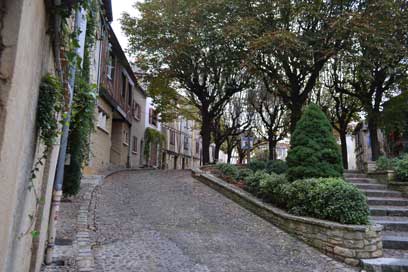
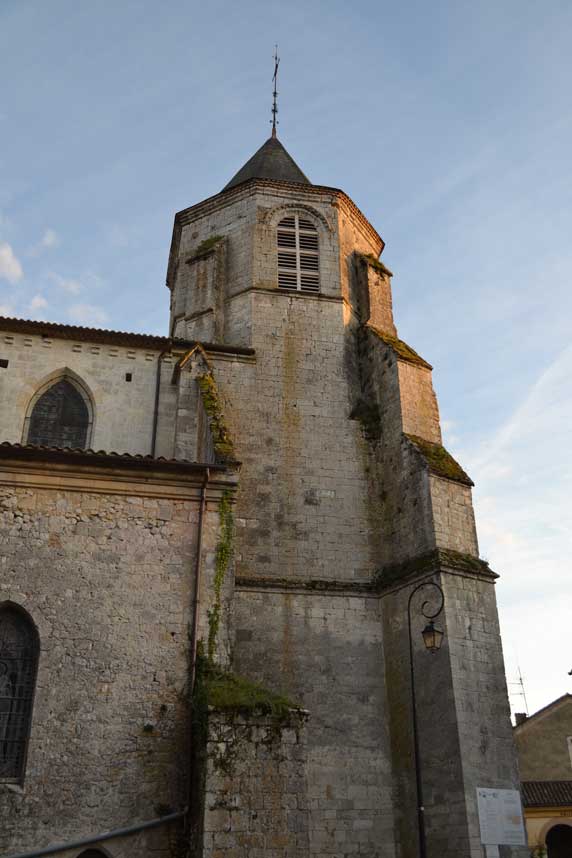
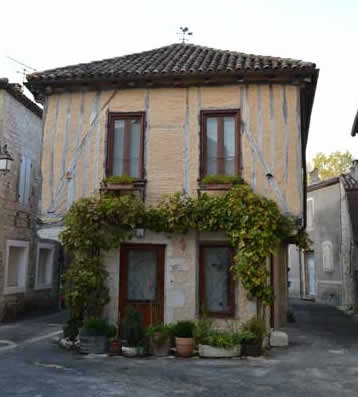
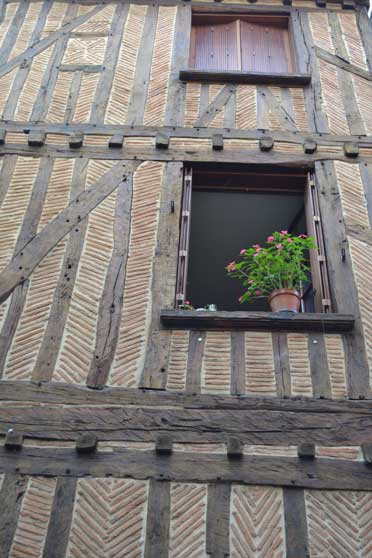
ISSIGEAC In the tiny medieval village of Issigeac a circular wall surrounds winding streets dominated by the octagonal bell tower of the 15th century Church of Saint Felicien. The 13th century stone buildings with Gothic arches and charming half-timbered houses with beautiful inlaid brick detail are lovingly preserved, not to attract tourists, but to be lived in and used by the less than 1,000 inhabitants. Look for the “Mushroom House,” built with an overhanging second story, to allow carts access to the narrow streets that surround it. An active market is held in the central square on Sunday mornings, but a stroll through the quiet town at dusk calms the spirit and prepares you for a relaxing dinner.
Church of Saint Felicien“Mushroom House”
La Bruceliere restaurant in Issigeac is family-run and serves gourmet local cuisine with regional wines. A pleasant surprise in rural France, it also offers five rooms for overnight accommodations. www.labruceliere.com
BERGERAC The historic town of Bergerac was founded with the castle built to manage river traffic on the Dordogne, and the 9th century bridge accommodating pilgrims on the road to Santiago de Compostela. In the old town, see the picturesque stone buildings constructed with local yellow stone, and the half-timbered houses on the Rue St. Clar. The National Tobacco Museum is housed in the 17th century Peyrarede House.
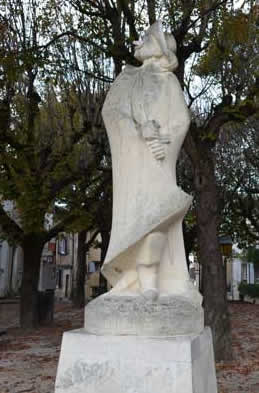
In the medieval town square, restored in the 1970’s, you’ll discover a stone statue of Cyrano de Bergerac – the comic/tragic hero made famous by Edmond Rostand’s 1897 fictional story about the brilliant and poetic swordsman with a very large nose, in love with the beautiful Roxane. The real-life Savinien de Cyrano, upon whom the fictional character was loosely based, was born in the 17th century near Paris. When he joined the Cadets of Gascony, he changed his name to Cyrano de Bergerac, after a family estate of that name. The town of Bergerac is nevertheless happy to adopt him as a symbol of boldness and generosity.
Unfortunately, Cyrano’s famous stone nose is routinely broken off by admiring fans. So a new colorful bronze Cyrano with a more permanent nose was erected in 2005 in the Place Pelissiere, in the shadow of the picturesque church of Saint-Jacques.
Stone Cyrano
In the 18th century flat-bottomed boats called Gabarre carried wine and wood for barrel-making from Bergerac’s riverfront to Bordeaux for export. Replica Gabarre today offer tours on the Dordogne in Bergerac and in the castle-rich area near La Roque-Gageac.
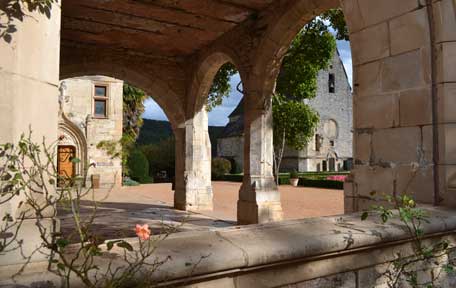
A peaceful courtyard is at the center of the Recollets Cloister, now home to Bergerac’s House of Wines. Here a Wine Journey exhibit explains the history and appellations of Bergerac wines. Visitors can also taste the local wines and visit with a winemaker from the Dordogne Wine Route.( www.vins-bergerac.fr/en/p/maison-des-vins-or-house-wines.) What is there to learn at the House of Wines?
The vineyards in the geographic area of Bergerac are classified into 13 appellations that are grouped into five different types:
Reds: Bergerac, Cotes de Bergerac, Montravel and Pecharmant Roses: Bergerac rose Dry Whites: Bergerac and Montravel Sweet Wines Monbazillac and Saussignac Dessert Wines: Cotes de Bergerace Blanc, Cotes de Montravel, Haut Montravel and Rosette
France’s system of appellations consists of a set of strict rules covering which grape types may be used in a particular wine, the areas in which the grapes can be grown, the maximum permitted yields, the pruning type and sometimes the harvesting techniques.
Particularly popular in the area is Monbazillac, a sweet white wine made from grapes harvested after they have begun to shrivel and develop “noble rot.” Each individual grape must be hand picked from the bunch at just the right time — a labor intensive, painstaking job.
Edouard de Saint-ExuperyChateau Tiregan
WINEGROWERS The vineyards of Bergerac cover almost 30,000 acres in 93 villages on both sides of the Dordogne. Although traditionally overshadowed by the more well-known wines of its neighbor Bordeaux, many of the Bergerac wines compete favorably with them, and at a lower cost.
Chateau Puy-Servain (www.puyservain.com) owners Daniel and Catherine Hecquet have nearly 120 acres of vineyards (the average for wine growers in the area is 50 acres) and export 60% of their wine.
The Chateau VARI estate in the town of Monbazillac is an organic vineyard. Their wine bar, la maison Vari, offers wine along with a simple, but delicious menu for a light lunch. www.chateau-vari.com
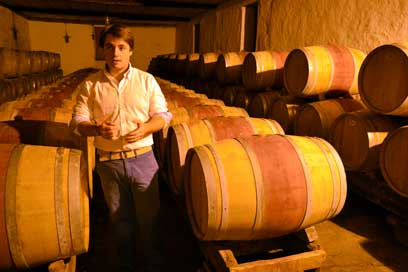
Winegrower Edouard de Saint-Exupery of the Chateau Tiregand in Creysse (whose famous literary relative wrote The Little Prince in 1943) welcomes visitors for free wine tastings or for a guided tour of the 17th century family estate, located just 10 minutes east of Bergerac. www.chateau-de-tiregand.com
PREHISTORIC SITES The valley of the Vezere River, which flows into the Dordogne, has been called the prehistoric capital of the world: the part of Europe that claims the longest period of continuous human habitation. Cro-Magnon man was discovered here in 1868 during excavation for the construction of the railroad. A national museum of prehistory is located in the cliffs above Les Eyzies-de-Tayac. www.musee-prehistoire-eyzies.fr
The valley boasts 147 prehistoric sites dating from the Paleolithic age, and 25 decorated caves, the most famous of which is the Lascaux Cave in Montignac. The site of 17,000-year-old paintings and engravings, it was discovered in 1940 and opened to the public for viewing. The paintings had survived beautifully for centuries in the stable and somewhat sterile environment. However, visitors unwittingly exposed the cave and drawings to destructive elements such as algae and carbon dioxide, which forced the closure of the cave for viewing in 1963.
Today visitors to the Dordogne can view an exact three-dimensional replica of largest two areas of the cave in Lascaux II, a remarkable achievement that took 10 years to construct. Since 2012, a traveling replica called Lascaux III will be on exhibit in museums around the world, starting with the Field Museum in Chicago, and continuing to Houston and Montreal, not to return to France until 2020. www.lascaux.culture.fr; www.semitour.com/site-touristique/lascaux-ii
Walking through the Grand Roc Caves in Les Eyzies de Tayac is like being inside an illuminated geode. Well-placed lighting showcases the incredibly delicate stalagmites, stalactites and crystallizations of this Unesco World Heritage site. www.les-grands-sites-du-perigord.com
A few steps away from the Grand Roc is Laugerie Basse showcasing two prehistoric rock shelters and displays of prehistoric mobile art.
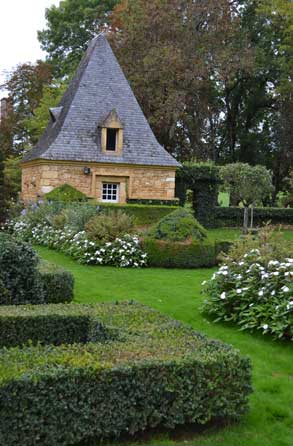
EYRIGNAC MANOR GARDEN Eyrignac Manor Garden is one of France’s most beautiful private gardens. Known for its topiary art, the gardens and manor have been in the same family for 500 years. Owner Patrick Sermadiras is often on hand to meet guests and share his design and gardening expertise. A well-written visitor’s guide and audio tour is available in English to lead you through the seven distinct gardens. An on-site restaurant offers a varied menu for a tasty lunch. www.eyrignac.com
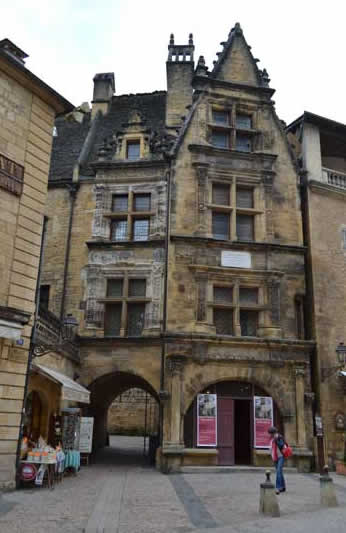
MEDIEVAL TOWN OF SARLAT A medieval jewel, Sarlat boasts one of the largest medieval urban areas in the world. Locals are especially proud to showcase the birth-house of political philosopher Etienne La Boetie as a gem of Italian Renaissance architecture. Throughout the town, note the roofs made of overlapping flat stones, the inexpensive, readily available roofing material of the time. These stones made the roofs extremely heavy, necessitating steep roof angles for stability. A little jarring, yet noteworthy nonetheless, are the huge metal doors that open into Sainte-Marie church, which now serves as a covered market. World famous architect Jean Nouvel, who was born near Sarlat, designed the doors to replace the destroyed apse. He also designed the glass elevator that bursts through the open roof of the bell tower, offering a spectacular panoramic view of the surrounding old town.
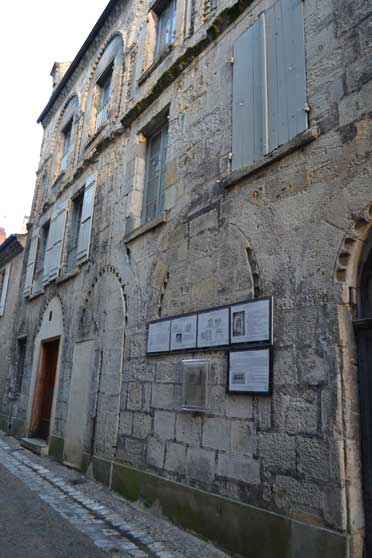
Boetie House
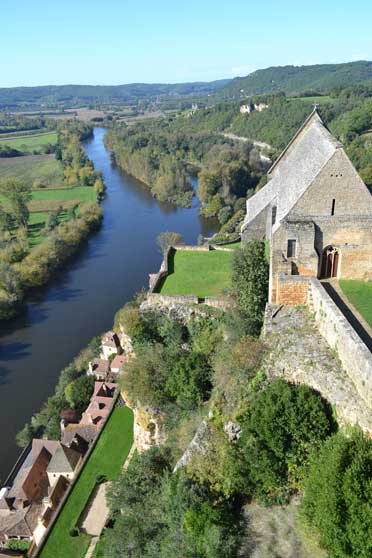
VILLAGE OF BEYNAC Bring your walking shoes and climb up the winding stone streets of the beautiful medieval village of Beynac. Your goal is the 12th century fortress at the top of the cliffs overlooking the Dordogne. From there, the view of the surrounding countryside, the town below, the winding Dordogne River and the Castelnaud Castle on the opposite riverbank is unforgettable. A walk through the restored castle is a living history lesson.
During the Hundred Years War, the Dordogne River was the border between France and England. Beynac Castle was French and Castelnaud was English. All along the Dordogne River struggles for supremacy meant the bastides (fortified towns built by either the French or the English during the 13th century to contain invasions) were shuffled back and forth between the two countries.
Beynac Castle and village served as the location for more than a dozen films, including Joan of Arc in 1999, Ever After in 1998 and Chocolat in 2000.
After climbing and touring Beynac Castle on the cliff, enjoy a meal at LaPetite Tonnelle, a quaint restaurant tucked against the cliff on the way down. Their menu offers homemade dishes with locally sourced gourmet food and regional wines, served on their patio with a beautiful view of the village or in their dining room, built right into the rock wall. www.restaurant-petite-tonnelle.fr
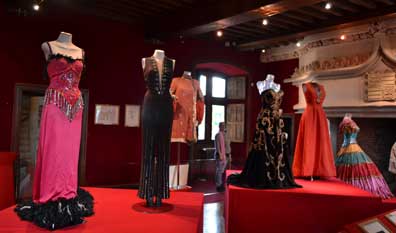
CHATEAU DES MILANDES On the other side of the river in the town of Castelnaud le Chapelle is the Chateau des Milandes, a beautiful 15th century castle, and the former home of musical entertainer Josephine Baker. Born in St. Louis, Missouri, Josephine’s popularity sky-rocketed during the 20’s in Paris when she appeared in the Revue Negre at the Theatre des Champs-Elysees. During her time at the Chateau de Milandes she adopted 12 multi-national children (her “Rainbow Tribe”) and became beloved by the locals because of her generosity and kindness, even working for the French Resistance during WWII. Poor financial planning caused the house and its contents to be put up for auction in 1968. Four families have owned the Chateau des Milandes since the auction. Current owner Angelique de Labarre has passionately collected items from Josephine’s past to fill the 14 rooms with original costumes, music, photos and furnishings. Beautiful gardens and a live birds-of-prey show on the grounds outside the castle complete an entertaining visit. www.milandes.com
PERIGUEUX Périgueux, located along the Isle River, is the largest town in the Perigord region, and its contemporary face makes finding the hidden medieval gems a little more difficult.
Périgueux began as two distinct towns. Easy to see are the historic remnants of the older one: Gallo-Roman town of Vesunna. The ruins of the inner sanctum of the temple for the goddess Vesunna and remnants of the ancient amphitheater stand near Jean Nouvel’s newly-designed Gallo-Roman Museum. The Romanesque gate of Porte Normande leads to what is left of the Barriere Castle and Romanesque-style house built in the Middle Ages on Roman foundations. The Saint-Etienne de la Cité Church was the cathedral of Périgueux until 1669, when that title was transferred to the Saint Front Cathedral in the second nearby settlement that comprises today’s Périgueux.
Streets of Périgueux
Further to the east, the more commercial city of Puy St. Front, the second “building block” in what is now Périgueux, developed in the 12th century. Look carefully down narrow streets of the old town for half-timbered houses, towers, walls with evidence of ancient arched windows and gateways, bricked-in and changed to fit the needs of the century. Beautiful ancient stone staircases still lie hidden in entryways of private houses, accessible to guides with keys.
Dominating the skyline is the Byzantine-style bell tower of the Saint Front Cathedral. The church is in the shape of a Greek cross, with five domes dating from the 12th Century. It was restored by Architect Paul Abdie between 1852 and 1895. His award winning design of the Sacre Coeur Basilica in Montmartre in Paris was inspired by the style of the Saint Front Cathedral.
ACCOMMODATIONS The Chateau des Vigiers in Monestier on the western edge of the Perigord is one of the few places in the area that can accommodate large groups. This luxury hotel, with a spa and a 27-hole golf course, offers 36 romantic rooms in a 16th century chateau and annex and 40 more in its contemporary, eco-friendly Relais des Vigiers. www.vigiers.com
For peaceful and luxurious accommodations five miles south of Bergerac, LaChartreuse du Bignac offers 12 rooms and a restaurant in a 1630 stone chateau with vaulted ceilings and exposed beams. Extensive grounds with terraces, a swimming pool and a park lead to a small lake. www.abignac.com
The recently renovated Hotel Les Glycines in les Eyzies de Tayac is centrally located near the Cro-Magnon museum and Grand Roc cave, and is a short drive to Lascoux cave. The hotel features beautiful romantic rooms, extensive gardens, a pool and a wonderful restaurant. Order the “Victoria pineapple” for dessert, aim your video camera, and watch the magic begin. The waiter pours warm rum/passion fruit syrup over a hollow chocolate ball until the surprise pineapple tidbits, pina colada and vanilla ice cream appear. Entertaining and delicious! www.les-glycines-dordogne.com
Vieux Logis in Tremolat is a lovely 4-star country inn, formerly a priory and then a farmstead, that is not to be missed. Rustic comfort in 14 rooms and nine apartments, with a one-star Michelin chef, gourmet restaurant, bistro, seminar rooms and lovely garden and terrace. Once there, you won’t want to leave. www.vieux-logis.com
NEED A GUIDE? For a professional travel guide in the Dordogne, European Traveler recommends Frances and Sandra Ho Tham Kouie.
They have more than 20 years of experience in tailor-made tours for English speaking travelers – either individuals or groups. Their knowledge of history and attention to detail will smooth your way to an enjoyable discovery of the Dordogne. www.voyages-france-impressions.com.
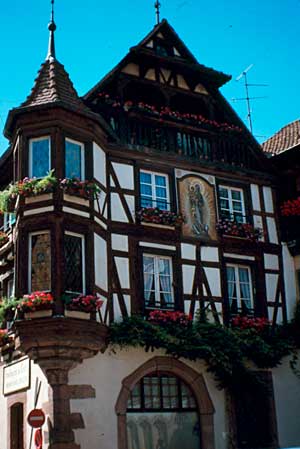
Typical half-timbered house in Kayserberg, on the Alsatian Wine Route
By Sharon Hudgins Photos by the author
Quick: Which region of France has also belonged to Germany—and is a top culinary destination for travelers from all over the world?
If you answered “Alsace,” then immediately pass GO, collect $200 from the nearest ATM, and head for a memorable meal in one of the most famous culinary regions of the country.
Bonus: You can drink well there, too.
Alsace produces fine wines from Riesling, Sylvaner, Gewürztraminer, and other types of grapes, as well as clear, potent, aromatic distilled liquors (eaux-de-vie) from the many varieties of fruits and berries that grow in abundance in this northeastern corner of the country. Located along the Rhine River across from Germany and Switzerland, Alsace is also the main beer-producing region of France.
And all of these local beverages pair perfectly with a cuisine that anchors Alsace solidly on France’s gastronomic map.
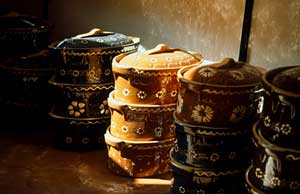
Traditional earthenware casseroles from the pottery village of Soufflenheim
TRADITION MEETS MODERNITY Alsace has long been known for the high quality of its cooking, from home kitchens to cozy bistros and brasseries to some of the top-rated restaurants in France. Based on locally grown crops, farm-raised animals, and wild game from the forests and fields, traditional Alsatian cuisine reflects the rustic simplicity of rural life, influenced by next-door Germany (to which Alsace has belonged at different times in history), but with a decidedly French twist.
Modern Alsatian restaurant chefs have sought to reduce the butter, cream and lard so prevalent in past preparations, and to lighten the load of pork products and heavy casseroles that once characterized the cuisine. Some have even fallen for the fancy foams and deconstructed dishes of the latest food fads. But most of the region’s modern chefs remain true to their roots, using fresh, local ingredients in creative ways that still pay homage to the established traditions of Alsatian cooking.
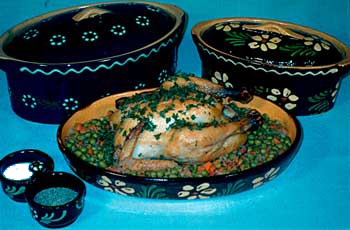
Poulet Grand-Mère (Grandmother’s-Style Chicken), cooked and served in traditional earthenware pottery from Soufflenheim
WHERE TO EAT Modern Alsatian cuisine can be tasted at many of the region’s highly rated upscale restaurants (see list). For more traditional fare, look for smaller, family-run restaurants, bistros, bakeries and pastry shops. Some of the best of these are located along the Route des Vins d’Alsace (Alsatian Wine Route) between Marlenheim and Thann, in little villages of old half-timbered houses, their window boxes bursting with red geraniums in summer.
Many traditional restaurants serve their dishes in rustic handmade earthenware from the pottery town of Soufflenheim. And they pour excellent Alsatian white wines out of handmade blue-and-gray stoneware pitchers, from the pottery village of Betschdorf, into tall, thin, green-stemmed wine glasses set on tables covered with Alsatian-made linens. Dining in Alsace is a feast for both your palate and your eyes.
WHAT TO EAT ► Kugelhopf, a richly flavored, light-textured, yeast-raised cake studded with raisins and almonds, baked in a special fluted mold shaped like a Turk’s turban. Traditionally eaten for Sunday breakfast, accompanied by big cups of café au lait (coffee with milk). Also served in the afternoon with coffee or tea and sometimes after dinner as a dessert dressed up with sweet sauces and whipped cream.
► Choucroûte garnie, mild sauerkraut cooked in white wine, beer or cider and seasoned with juniper berries and black peppercorns. Considered a “national dish of Alsace,” the big mound of sauerkraut is served on a large platter and topped with a variety of meats—especially ham, bacon, sausages and other smoked pork products—along with cooked whole carrots and boiled potatoes. Traditionally served as the Sunday midday meal, but now available on many restaurant menus every day of the week.
► Bäckeoffe, a stick-to-your ribs casserole made with layers of sliced potatoes and leeks with two or three kinds of meats (beef, pork, lamb), cooked together in white wine inside an earthenware casserole hermetically sealed with a strip of bread dough. In earlier times, Bäckeoffe was assembled at home on Monday mornings, then taken to the local bakery to be cooked in the wood-fired oven while the housewives were busy doing their laundry by hand.
► Tarte flambée, the Alsatian answer to pizza, made from a very thin crust of bread dough topped with a layer of crème fraîche (slightly soured cream) or fromage blanc (fresh white cheese), thinly sliced onions, and small pieces of smoked bacon. Known in Alsatian dialect as Flammekueche, the best of these are baked in wood-fired ovens.
► Munster cheese, from the Alsatian town of Munster. When ripe, this cow’s milk cheese has a slightly creamy interior and a deliciously pungent aroma. Often served at the end of the meal, accompanied by slices of fresh fruits or garnished with a sprinkling of caraway, fennel or anise seeds.
► Fruit tarts, from rhubarb in spring to apple and pear in autumn. The Alsatians have a well deserved reputation as excellent bakers of breads, cakes, tarts and cookies. Their bakeries and pastry shops are among the most tempting in France.
Ahh, Paree! For most of us, the City of Light is synonymous with culture, cuisine and romance.
When you visit, you’re supposed to spend your time in world-class museums and Michelin-starred restaurants. You’re supposed to take intimate strolls by the River Seine. You’re not supposed to take your children. Right? Wrong.
In fact, Paris is extremely kid-friendly. Part of the reason is that the locals-–who tend to take their own enfants everywhere-–are so welcoming. But it is also because Paris itself seems reassuringly familiar to children.
Some discover the French capital as toddlers courtesy of Ludwig Bemelman’s Madeline books; other make vicarious visits with Eloise, the Aristocats, the Rugrats, even the ubiquitous Olsen Twins. Hence its big-ticket attractions already have a built-in appeal. Take Notre Dame Cathedral: 800-year old churches don’t normally top a child’s itinerary. But, as the setting for Disney’s Hunchback movies, this one is an exception to the rule. Since it is literally the center of the city–the place from which all distances are measured-–it also makes a fitting starting point for your family’s monumental adventure.
CAVERNOUS INTERIOR After spinning around the cavernous interior and “reading” the stories in the stained-glass windows, older kids can drop a few euros to descend into the pre-Roman Crypte Archeologique or climb the towers for a close-up look at Quasimodo’s home turf.
Younger ones, meantime, may prefer to plop on a bench in adjacent Viviani Square. Thanks to the uncluttered view of Notre Dame it offers, they can amuse themselves by playing “spot the gargoyle” (one looks suspiciously like Disney’s Laverne) and feeding the world’s most gregarious pigeons.
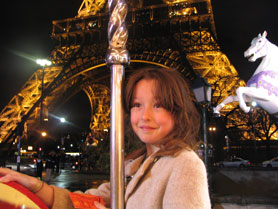
Compared to the cathedral, the Eiffel Tower is a relative newcomer. Yet it’s a certifiable icon, and you’ll likely feel compelled to scale it. Of course, every other tourist in town will too. So to avoid the worst crowds, try arriving early on a weekday and taking the elevator straight to the third level. Tickets are steep (11.50€ /6.30€ for ages 3-11); but on a clear morning the vista is priceless. Alternately, bring the kids after dark to see the tower lit up like a super-sized Christmas tree. For the full effect, arrive on the hour (dust to 2 a.m. in summer) when 20,000 individual bulbs sparkle in a 10-minute display.
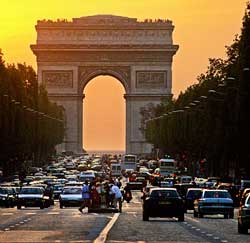
ARC DE TRIOMPHE For those who’d rather look at the Eiffel Tower than be on it, the Arc de Triomphe is another option. Napoleon’s tribute to his troops might not seem like a natural choice for families: after all, it’s perched on the site where Paris’ 12 main avenues converge and is surrounded by an obscenely-busy traffic circle. Nevertheless, children routinely give it the “Coolest Tall Thing” award. That’s because it’s wide open at the top. Unlike the Eiffel Tower (which is enveloped in mesh) there is nothing creepy or cage-like to impede their view-–and the sight of Paris, laid out like a star below–is impossible to beat.
Once you’ve soaked it all in, it’s time to hit the city’s famed museums-–some of which are aimed squarely at families. One such venue is the Science and Industry Museum. Its interactive “Cité des Enfants” is undeniably inviting: five – to 12 year-olds, for instance, can program robots while younger siblings play Bob the Builder at a mini construction site. However, the rules can be off-putting. Registration is required, limited numbers of guests are admitted and visits are restricted to 90 minute sessions. Kids are also streamed by age. So depending on your family structure, the trip can be a logistical nightmare.
Luckily, though, there’s no need to stick to the kiddy category when it comes to Parisian museums. Musée Rodin is a case in point. The esteemed sculptor’s estate in the seventh arrondissement is an ideal place to introduce youngsters to fine art. Sure its walls hide orderly flowerbeds, ornamental pools and a grand 18th-century mansion. But don’t let the formality fool you. In the garden, kids are free to play among famous statues; and inside visitors as young as four can sign up for regularly-scheduled activities (including tours complete with games and drawing sessions) that are priced between €4.50 and €6.
KID PLEASERS Musée d’Orsay, on the Left Bank, and the Pompidou Centre’s t&L=2″ Musée National d’Art Moderne, on the Right, are kid-pleasers as well. The former has a dazzling Impressionist and Post-Impressionist collection (think works by Monet, Renoir, Van Gogh and Cézanne), while the latter focuses on Modern masters like Picasso and Matisse. Both have intriguing architecture, plus bright bold canvases that appeal to kids. But the fabled Louvre, with its exhaustive-–and exhausting!-–supply of religious and historical paintings will seem pretty staid by comparison.
If seeing Mona Lisa’s smile is high on your personal to-do list, consider taking turns with another adult. When one of you dips in, the family can relax just outside on the expansive lawns of Jardin du Tuileries. It’s easy to while away hours there bouncing on tres chic trampolines, sailing toy bateaus, riding carousel horses or graduating to real ponies (à la carte activities that cost a couple of euros each). Many of the same simple pleasures can be enjoyed across the Seine in Jardin du Luxembourg: a sixth arrondissement park which also happens to house the city’s best-loved marionette theater. JARDINS ARE BACKYARDS The beauty of both spots is that they’re not merely tourist attractions. In a city of apartment dwellers, these jardins serve as a backyard for countless families. So lingering in them qualifies as an authentic cultural experience, especially on weekends or Wednesday afternoons when local children are out of school. If your offspring have a smattering of French they can strike up a conversation with their Parisian peers. If not, don’t worry: they’ll quickly learn that the language of child’s play is universal.
For playtime on a grander scale, you can take the gang 20 miles north to Parc Astérix (35€/ 25€ for ages 3-11). Inspired by France’s favorite cartoon hero, it features dozens of amusements ranging from a classic wooden roller coaster to an ultra-modern corkscrew model. Twenty miles east of the city, meanwhile, is Disneyland-Paris: a 2,225-acre resort that proves it really is “a small world after all.” Said to be Europe’s #1 tourist attraction, it consists of two parks-–a Magic Kingdom and Walt Disney Studios-–with one-day passes to each costing 46€ (38€ for ages 3-11).
FUN ANYWAY Since these resemble their U.S. counterparts and recreate many popular rides (“Dumbo’s Flight” and “Rock’n’Roller Coaster” among them), Disneyland-Paris is often dismissed as an unnecessary Americanism. Who, naysayers may ask, needs a kingdom built around a faux castle when the countryside is full of the genuine article? For that matter, who needs a movie park dedicated to a foreign director when Jean-Luc Godard and François Truffaut are native sons? Well, nobody does. But they’re fun anyway. Besides, a dose of Disney is a great antidote for kids suffering a temporary case of culture shock.
The truth is that no matter how well prepared you are, your children will feel slightly disoriented at times. Moreover, touring with them will always be an added responsibility. Yet there are upsides. Kids, literally and figuratively, look at things from a different angle. Hence being with them will reveal sites and scenes that are typically hidden from vacationers. All you have to do is slow down and savor the experience. Remember, parents don’t get bonus points for ticking off every attraction listed in their guidebook. The real reward comes from building a store of family memories that you all can share. ET
Take a Pass: Admission charges add up fast, so a Paris Museum Pass is just the ticket for pennywise parents. Priced from €30 for a two-day version, it gives adults unlimited entry to more than 60 museums and monuments – including all of those mentioned above except for the Eiffel Tower. Children don’t need one because so many of the attractions are already free for guests under 18 (that’s a big plus when your traveling companions have short attention spans!). Better still, the whole family benefits since the pass also allows all of you to jump those lengthly lines.
ABOUT THE WRITER Living up to her turn-of-the-millennium resolution, freelancer Susan MacCallum-Whitcomb jettisoned her professorial robes and traded teaching for full-time travel writing. In the years since, she has spent an inordinate amount of time doing research in Europe — much of it with her family in tow! The results can be read in Fodor’s guidebooks (she’s contributed to six thus far) as well as Fodor’s online newsletter, and a host of Canadian magazines and newspapers. When not jaunting around the continent, Susan enjoys taking it easy in her sublime home base: Halifax, Nova Scotia.
So, you want to show your wife or your date a very good time.
And you want to do it between Venice and Paris.
That can be arranged.
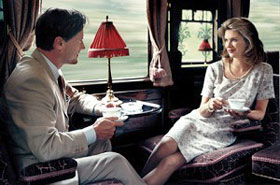
What is called the World’s Most Romantic Celebration consists of a train trip on the Orient-Express between Venice and Paris.
Here are the details. The trip is eight days and seven nights from $24,750: three nights in Venice; one night on the Venice Simplon-Orient-Express and three nights in Paris.
Departure dates, which are Sundays and Wednesdays, in 2008 are: March 30; April 6, 13, 20, 27; May 11, 14, 25;June 8, 11, 22, 29; July 20, 27; August 3, 10, 17, 24; September 10, 21, 24, 28; and October 12, 15.
The itinerary consists of:
Day 1 – Venice Arrive in the romantic city of Venice and transfer by private water taxi boat to the Hotel Cipriani. A deluxe suite is reserved for three nights in the city of canals. Overnight in Venice.
Day 2 – Venice A personally tailored guided tour of the city in the morning. In the afternoon, the private launch of Romilly, Lady McAlpine collects you from the hotel and takes you to her home for a visit and refreshments. Breakfast included. Overnight in Venice.
Day 3 – Venice Explore the delights of La Serenissima before a final romantic evening, including a ride on a gondola before dinner, at one of Venice’s most exclusive restaurants. Breakfast and dinner included. Overnight in Venice.
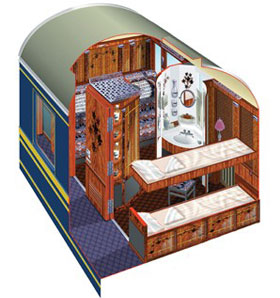
Day 4 – On the Venice Simplon-Orient-Express The train’s hostess completes check-in formalities for your journey on the Venice Simplon-Orient-Express train before your private transfer to the station. Board the train (cabin suite) for the overnight journey to Paris, enjoying superb cuisine and sparkling champagne. Breakfast, lunch and dinner included. Overnight on board.
Day 6 – Paris After breakfast, a private car and driver takes you to the French countryside en route to Reims, capital of the Champagne region, where you have a private tasting before lunch at the two-star Michelin restaurant of Chateau Les Crayères, accompanied by fine wines and Prestige Champagne. After lunch, return to Paris. Breakfast and lunch included. Overnight in Paris.
Day 7 – Paris Time for final sightseeing or shopping in the boutiques and designer stores. In the evening a private car transfers you to Quai de Grenelle, where you board a luxurious private yacht. The vessel’s teak deck and sleek interiors allow you to relish the cozy atmosphere of a 1960s boat. Enjoy a glass of champagne as you cruise along the river Seine, before a romantic candlelit dinner served either on the outdoor deck or the inside cabin. A shower of roses completes the cruise before returning for a final night in Paris. Breakfast and dinner included. Overnight in Paris.
Day 8 – Paris Your journey comes to an end. Breakfast included. All aboard!
IF YOU GO… Log onto www.orient-express.com for more details about the trip. Or, call (in the USA) 401-351-7518 or e-mail to: oesales.providence@orient-express.com. From France, call +33 1 55 62 18 00; from Germany, call +41 44 770 1407; from the Netherlands, call +31 35 6955111; and from the U.K., call +44 20 7805 5060










 European Traveler