Bremen’s Unique Tradition

Kohl…and what??

By Amy Formolo
Photos by the author

Pinkel! 
The word is strange enough, but  I recently learned how these six little letters can stir a whole region to party the day away in true Germanic style.

I thought I knew roughly what to expect in terms of German traditions and festivities. I was familiar, of course, with festivals like Oktoberfest and Weihnachtsmarkt, and with traditional victuals like cabbage and wurst. But little did I know I had yet to discover one of Bremen, Germany’s most unique traditions–one centered on green cabbage, a mysterious meat product called Pinkel, and plenty of alcoholic spirits.

It’s called “Kohlfahrt” (translation— “cabbage tour”) and recently I was told what this festival was all about. 

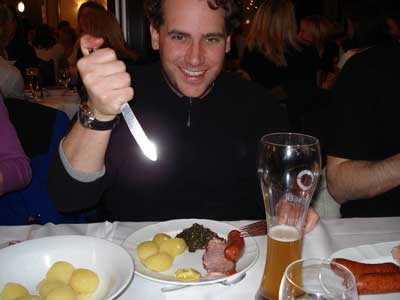
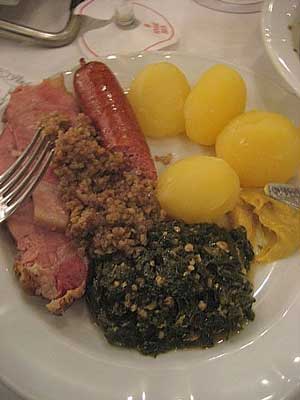
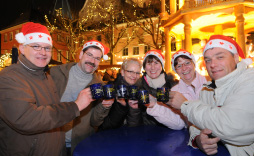
Kohlfart is a tradition practiced only in Northwest Germany, and is a beloved annual ritual in the Bremen area. The idea is that a group of friends or colleagues assemble on a Saturday afternoon in January or February, load up a “Bollerwagen” with an assortment of schnapps, whiskeys and beer, and amble through the countryside playing wacky party games and replenishing liquor at every opportunity. The event is organized months in advance by the group’s Kohlkoenig and Kohlkoenigin— the cabbage king and queen. After a couple hours of walking, when the participants’ bladders are full and their stomachs growling, the group descends on a pub or restaurant to enjoy the culmination of the day’s festivities–a meal of Kohl und Pinkel (the Kohl is green cabbage and Pinkel is something along the lines of bacon, oats, lard and spices packed together). And then they dance the night away—literally. I never knew the Germans loved to dance so much, especially to cheesy ’80’s cover bands. Although I will admit I hit the dance floor for several numbers (who can resist the Abba and AC/DC tribute?).

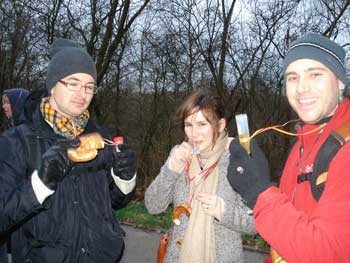
I didn’t know much about Kohlfahrt going into it, but once our group was assembled, and we were handed pretzels (sustenance is crucial) and plastic scientific sample vials to wear around our necks (it really is a cheap and logical way to hold liquor), I knew we were in for some surprises. It only got more interesting when our first two games tested who could maneuver a spoon down their shirt and pants the fastest, and who could throw a teabag the farthest using only their teeth.
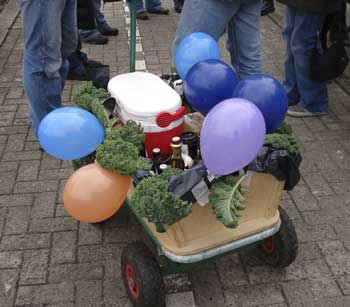
Kohlfahrt was definitely worth experiencing for the sheer fun and folly of it all. But it’s a serious business here in Bremen, as evidenced by the multiple Kohlfahrt parties we passed on the road, some of which sported Bollerwagens decked out with flashing lights and loud speakers. The restaurant resembled more of a banquet hall, with about 100 long tables full of rosy-cheeked Kohlfahrters, swaying arm in arm and singing along to “Que Sera, Sera.” It’s experiences like these that remind me how different some things are here than in the States. Germans have no open container law to contend with and are perfectly free (and encouraged, in this case) to walk around toting shot-glass necklaces, singing songs, and pulling a wagon full of alcohol.

Although my observation is that even during the public inebriation and silliness of Kohlfahrt, Germans still manage to act fairly civilized. But civilized or not, it was obvious that everyone was having what seemed like the best Kohlfahrt ever. Until next year, that is…

Celebrate the Season at Festive German Christmas Markets

Frankfurt Christmas Market

Photos courtesy German Christmas Market

Every year the magic of German Christmas Markets enchants millions of visitors. Crafts, culinary specialties like Gluhwein (mulled wine), baked apples and gingerbread biscuits (Lebkuchen) contribute to the traditional atmosphere.

Frankfurt (until Dec 22)
Situated in the Roemerberg marketplace with St. Paul’s church as a backdrop, the Frankfurt Christmas Market is regarded as one of Germany’s most important. Organized events include the tower concert on the balcony of the Nikolai church, the Christmas Market of Frankfurt’s artists and the Frankfurt city peal of bells. Children can ride on multiple carousels, marvel at the gigantic Christmas tree and meet St. Nicholas on December 6. Guided tours of Frankfurt are also available. www.frankfurt.de

Mainz Christmas Market

Mainz (until Dec 23)
The Mainz Christmas Market is set in the historic market square against the impressive backdrop of the 1,000-year-old cathedral of St. Martins. Highlights of the Christmas Market include the traditional fairy-tale performance in the city theater, the popular print shop of the Gutenberg museum and the 36-foot-high Christmas pyramid with its numerous figures and lights. Also, there is a wide choice of family programs at the Liebfrauenplatz. www.mainz.de

Wiesbaden (through Dec 23)
“Twinkling Star Market” is the name of the Wiesbaden Christmas Market. Visitors enter the old castle square through four gates decorated with stars. Not to miss is the crèche with its life-sized wooden figures representing the Christmas story. www.wiesbaden.de/en

Wiesbaden Christmas Market

Aschaffenburg (through Dec 22)
The Christmas Market is situated against the picturesque backdrop of the castle, with the Franconian Christmas crèche as its center. Also, during this festive season various other charming Christmas Markets can be found in the Aschaffenburg region. www.aschaffenburg.eu

Aschaffenburg Christmas Market

Bad Homburg (All advent weekends)
One of the most beautiful Christmas markets in Germany is the romantic Christmas Market Bad Homburg at the Castle “Landgrafenschloss,” which is surrounded by an historical setting. Highlights include the traditional fairy-tale performances on the Kurtheater Bad Homburg. www.bad-homburg.de (German only)

Stuttgart Christmas Market

Stuttgart (through Dec 23)
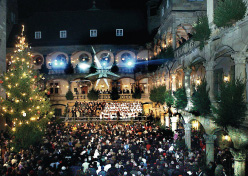
With its more than 280 decorated stands, is one of the oldest and largest Christmas markets in Europe. The Stuttgart Christmas Market is traditionally opened with a ceremonial concert in the inner courtyard of the Old Palace (Altes Schloss). Around the Altes Schloss, Schillerplatz, Kirchstrasse, Marktplatz and Hirschstrasse, small decorated wooden houses offer a range of Christmas items and gift ideas including Christmas tree decorations, crib figures, toys, woodcuts, puppets, lambskin shoes and candles. Culinary delights include hot chestnuts, German lebkuchen (gingerbread), roasted almonds, grilled sausages and mulled wine.www.stuttgart-tourist.de

Bremen Christmas Market

Bremen, on the River Weser close to the northern coast, puts a maritime twist on the classic Christmas market when the promenade along the river is transformed into Schlachte magic, a festive market offering historical, seasonal and maritime attractions. Another market with more than 160 beautifully decorated Christmas stalls are clustered in front of Bremen’s Church of Our Lady and the Roland Statue in the historical market square. www.bremen-tourism.de

Ruedesheim (through Dec 21)
The Christmas market in Ruedesheim on the Rhine brings a festive feel to the romantic old town and its popular Drosselgasse Lane. More than 120 stands from 12 nations offer Christmas customs and traditions from around the world. Europe’s biggest Nativity scene can also be found in the market square. www.ruedesheim.de

For more info: www.germany-christmas-market.org

Wacker’s at Kornmarkt 9

A coffee shop with history and flavor

By Don Heimburger
Photos by the author or as noted

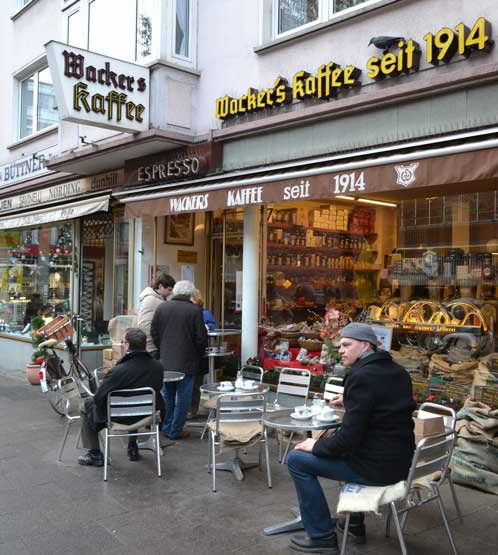
Wacker’s Kaffee is a third generation family-owned and run coffee shop in Frankfurt, Germany, which I heard about while on a city tour bus.

As the bus zipped past the small shop at Kornmart 9, I had just enough time to see its facade and notice all the customers lined up for coffee. The tour guide recommended the little establishment, which has been in business since 1914, or nearly 100 years.

It’s taken a while for me to actually “like” a good cup of strong German coffee, but now when I return to the U.S., I miss its rich flavor. So a taste-testing trip to this shop was in order, especially since I knew how to find it, and the small shop looked interesting.

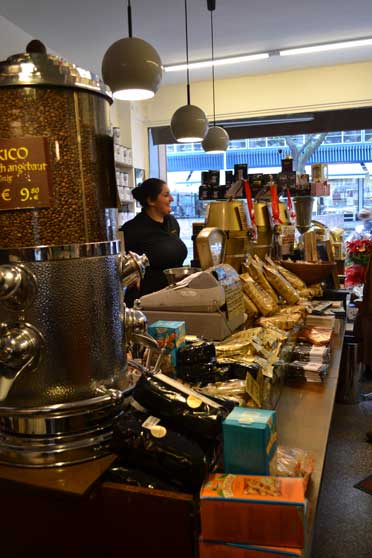
When time allowed, it was back to the shop, and trying to squeeze in the shop among the other customers was a challenge. Customers were lined up both for coffee to drink right there—Germany hasn’t become tuned in yet to the term “to go”—and to buy coffee beans in bags.

FILLED WITH CUSTOMERS
The several tables outside were filled with customers in December savoring their hot cups of Wacker’s kaffee, while others at the inside counter were purchasing bags of coffee beans and other Wacker’s products (they sell coffee mugs and other coffee-related items).

To keep customers a bit warmer outside, the seats are covered in the burlap bags from the coffee beans, a nice touch.

In the rear of the shop, customers were crowded around several tables, enjoying their coffee and kuchen, which is also served.

The business began when Luise Wacker opened a coffee shop at the location in 1914. Previous to this, a store was located here where the famous writer Johann Wolfgang von Goethe purchased his milk supplies.

Comments about the store on Trip Advisor include these two:

“Definitely the best coffee shop in Frankfurt. There are generally two lines, both often stretching out the door; the one on the left is for those who want to order drinks, while the one on the right is for those who want to buy coffee beans. The shop is also very small with limited seating, so when the weather is nice (or even just tolerable), you will see customers spread out both in front of the shop, and sitting on the stone wall across the street, enjoying their coffee and pastries.

“What non-German speakers may find intimidating is that, when the shop is quite busy, the cashier will shout out to customers further back in the line, asking them for their order. Luckily, the words for cappuccino, espresso and latte are generally the same in both English and German, so you should feel comfortable simply shouting your order back to her. “

Another customer said: “Great coffee. The smell is worth it alone.”

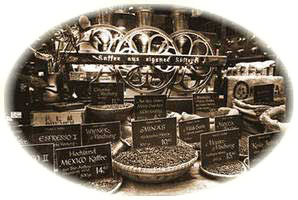
Wacker’s offers a long list of ready to drink coffees, and beans, so you’ll need a moment to figure out what you want. Coffee beans, available in bags of 500 grams each, include beans from Mexico, Java, India, Nicaragua, Galapagos, Cuba and Brazil, and expresso beans come from Jamaica, Guatemala, Costa Rica and other locations. I counted 40 bean types available from the shop.

Once your order is ready, you’ll be treated to some really good coffee, German-style!

For more information, go to www.wackers-kaffee.de.

InterContinental Hotel at Frankfurt City Center

By Don Heimburger
Photos by the author

I haven’t been to perhaps more than six InterContinental hotels in my lifetime, but I have to admit that each one more than exceeded my expectations.

Many are oases in the middle of busy cities, with street noise and lots of hustle and bustle; yet, entering the lobby of the Frankfurt (Germany) hotel, I found myself already starting to relax.

The Frankfurt City Center hotel on Wilhelm-Leuschner Strasse, managed by Thomas Hilberath, who has a knack for pleasing his upscale guests, attracts a clientele with above average income. This includes many businessmen, but also leisure travelers, who come to Frankfurt to take in the sites. And when the annual Christmas Market begins in Advent, it’s just a 15 minute walk from the hotel to the Roemer Platz, where this popular event is held.

BUSY LOBBY
The lobby exudes a warm atmosphere and is a very busy place at 10 a.m., with professionals having discussions in the hotel’s lobby lounges. At the same time, bags await transfer to waiting cabs, and the hotel staff keeps busy helping guests find directions, check out and check in.

This 21-story hotel towers above the Main River and affords spectacular views of the city center as well as the Main. One of my night shots of the river from the top floor could probably win a prize.

The 770 rooms available are classed as standard, deluxe and suites, and a different range of services and room footage come with each type of room.

From my corner room I got a sweeping view of the skyscrapers from one set of windows and what was going on near the river on the other side of the room out the other windows.

Standard rooms of 280 square feet feature warm room colors and are equipped with high-speed internet connections. Bathrooms feature a black and cream and gold design. Bathrobes, hair dryers, in-room safe, coffee maker/tea-maker, mini-bar and iron/ironing board are featured in all standard rooms, as is a work desk, television with cable and satellite channels.

Deluxe rooms are on the 19th and 20th floors of the River Wing (the hotel has two wings, one across the street from the other), and measure about 540 square feet. There is turn-down service at night, complimentary morning newspaper and a separate check-in area at the front desk for these guests. Deluxe rooms also feature a separate sitting area, and the bathrooms are roomier and even more upscale with more features. A valet service is also available in Deluxe rooms.

The Panorama Suites feature an elegant living room, a more luxurious bedroom, a whirlpool and even a complimentary meeting room.

24-HOUR FITNESS ROOM
Strolling around the hotel, you’ll find a 24-hour health-fitness center on the ground floor, which is complimentary; massages, manicures and facials can be arranged. The business center offers high speed internet and wireless LAN in public areas such as the hotel lobby.

On the 21st floor is the Club InterContinental Lounge for guests of this floor. The bar on the first floor, which takes its name from the German stock market index, DAX, and Frankfurt’s skyscraper-inspired nickname, DAXx Mainhattan’s Bar, is located just off the lobby and stays open until 1 a.m.

Two restaurants offer guests modern cuisine as well as Italian specialties. Signatures Veranda Restaurant features a fusion of haute cuisine from across Europe, with a menu to suit every palate featuring varying themes. Regional dishes, steak, or fish are available and served in the private dining room, summer terrace or veranda, depending on the weather. The dining room is also where breakfast is served.

Breakfast is a hearty meal, with juice, eggs, scrambled or to order, sausages, bacon, potatoes, toast, tomatoes, beans, breads, jams and jellies, cold cuts, cereals, coffee and even champagne, plus plenty more for those who need to carb up for a long day. The wait staff is pleasant and courteous.

Leons Italian Restaurant, inside the hotel, is where you can enjoy a long, leisurely meal in the ambiance of a 1920s-style Italian cafe. Popular classics include pasta, pizza and meat and fish dishes, and a cold glass of beer or wine tops off the meal. The large bar area and live piano music lure young professionals, who often stop by for drinks after work.

Trip Advisor customer comments about the hotel include these two: “Excellent, quick check-in. Room may have been small, but it was clean and comfortable, along with nice large towels. Breakfast was very good with great coffee. Very close to the train station and a beautiful walk along the river to the Christmas market. “

A second comment was, “The staff (was) quick to complete the check-in formalities. The travel desk is also very informative. Breakfast is good and location is very close to main station.”

I’d stay at the InterContinental again. Good location next to the busy train station and to the main part of busy “Mainhattan,” good food and service, and a competitive price add up to what I’d call a hotel with staying power.

For more information, go to www.frankfurt.intercontinental.com or www.intercontinental.com.

200 Years of German Beer Gardens

Munich, Germany

Photos courtesy Munich Tourist Office

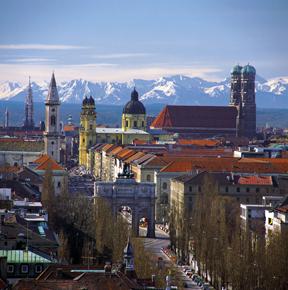
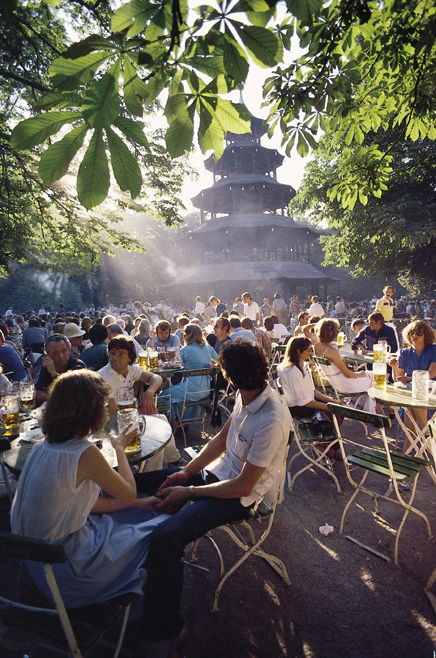
In 2012, Munich and Upper Bavaria are celebrating an old Bavarian tradition. The 200th anniversary of the edict which permitted beer brewers to sell retail quantities of their own beer in their beer cellars from June until September and to serve beer and bread to their guests will be celebrated this year. The city and the breweries of Munich will offer numerous events in local beer gardens.

MUNICH – THE WORLD CITY OF BEER
Big city, high-tech atmosphere mixed with rural charm, art treasures and traditional customs create a very special “Munich mix” which has helped the capital of Bavaria to achieve world renown. But what adds the final touch to the city’s popularity is the drink associated with Munich throughout the world: beer.

BEER GARDEN ETIQUETTE
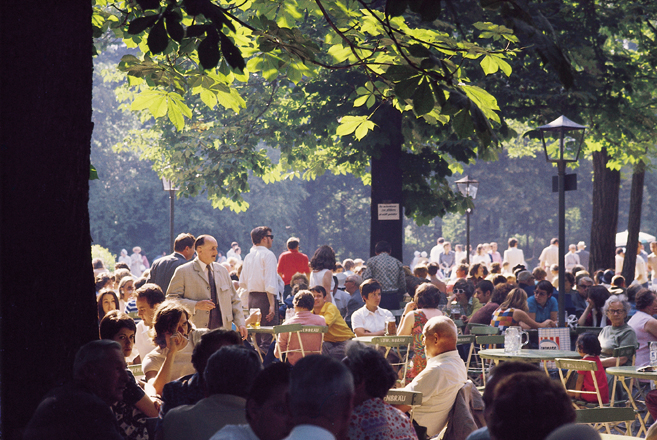
Bavarian beer gardens fulfill an important social function, as they have always been considered to be a popular meeting point for a wide spectrum of the populace. Visitors should not hesitate to take a seat and start up a conversation with their neighbors at the table. Munich’s beer gardens and the beer gardens in Upper Bavaria are the epitome of Bavarian Gemütlichkeit – the uniquely Bavarian atmosphere of good living, warmth and comfort. And it’s been that way for 200 years.

BRING YOUR OWN FOOD
Bring your own food! A special element of visiting a traditional beer garden in Munich is the fact that guests can bring their own food with them. A perfect Brotzeit, as a beer garden picnic is known, might contain the following: Obazda (a delicious and very Bavarian soft cheese dip), Emmental cheese, radishes, freshly-baked pretzels, butter and salt and pepper. A table cloth is also important (preferably a cotton red and white check), as are wooden boards to eat from, a sharp knife, cutlery and napkins.

But those who come unprepared don’t have to miss out on a Bavarian Brotzeit. Most beer gardens offer a range of typical treats, such as Wurstsalat (finely sliced sausage, dressed with vinaigrette and onions), Leberkäse (Bavarian meat loaf) or Steckerlfisch (barbecued whole fish, normally mackerel).

In a Bavarian beer garden, self-service is the rule, unless it is clear that tables have been readied for service. Typical beer garden drinks, such as beer or Radler (a mix of beer and lemonade or lemon soda), are generally only served in one liter steins. Alcohol-free drinks, such as Spezi (a mixture of cola and orange soda) or Apfelschorle (a mixture of apple juice and mineral water), are normally served in half-liters.

The most important rule when toasting with others at your table is to do it as often as possible, so creating a sense of community and giving you the chance to make contact with your new friends. But don’t forget to look your drinking partners in the eye as you touch steins.

The reason horse chestnut trees can be found in every “real” Bavarian beer garden is a matter of history. According to a decree from the 16th century, brewing beer was banned in the summer months, due to the increased danger of fire. Therefore, beer that was brewed in spring for summer was made with a higher alcohol content to help preserve it. In order to keep the beer cool, beer cellars were constructed close to the breweries, but because Munich has a high groundwater level, deep cellars were out of the question, meaning that those that could be built had to be protected from the sun. And that is why trees which provide a lot of shade, such as horse chestnut trees, were planted above them.

BIER UND OKTOBERFEST MUSEUM, BEER TOURS & MORE
Munich is the capital of beer – with six breweries, the Hofbräuhaus and the Oktoberfest. Interested in the story of beer? How German beer effected the monasteries and the purity law? Why is the quality of Munich’s beer so unique? Did you know that Oktoberfest was established as the national festival for the wedding of King Ludwig I with Princess Therese of Saxe-Hildburghausen? Visit the Bier und Oktoberfest Museum for the answer to these questions and a lot more.

For more info, go to www.muenchen.de