PULTENEY BRIDGE WEIR The stunning weir beneath Bath’s Georgian Pulteney Bridge plays the part of the River Seine in the film version of Les Misérables. Pay Bath a visit and see it for yourself (but don’t jump in, like they do in the film!)
St. John’s Church
ST. JOHN’S CHURCH London’s St John’s Church in Smith Square was used in Atonement for the wedding scene. It’s a fine example of English baroque architecture and is a venue for concerts and recitals.
TEMPLE CHURCH Built by the Knights Templar in the 12th century, this historic church exudes mystery. It has a circular nave based on the Church of the Holy Sepulchre in Jerusalem and was used as a location in The Da Vinci Code.
Inverness
INVERNESS Inverness is a gateway to the Highlands and so makes a great base for exploring the surrounding countryside, historic battlefields and beautiful lochs. The Highland capital is friendly, welcoming, full of history and compact enough for wandering around by foot. Scenes for the TV drama Outlander were shot in and around the city.
MOMO Probably London’s most famous Moroccan restaurant, Momo is a glamourous spot to enjoy fine North African dishes. You might also recognize it as one of the locations in the UK film Bridget Jones’s Diary.
Rye
RYE One of East-Sussex’s most popular locations, Rye is a half-timbered medieval town full of unique shops and plenty of atmosphere. A great place to get a taste of traditional English life and to enjoy a good pub lunch or fish and chips overlooking the town quay.
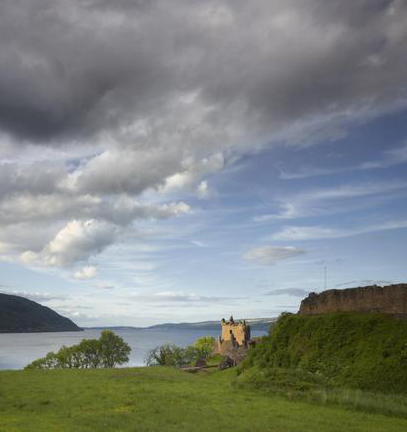
OLD WARDOUR CASTLE Built in the 14th century as a luxury house, Old Wardour Castle slowly became a fashionably romantic ruin. It’s a beautiful place to spend a day, and you might even recognize it as one of the locations used in Robin Hood: Prince of Thieves.
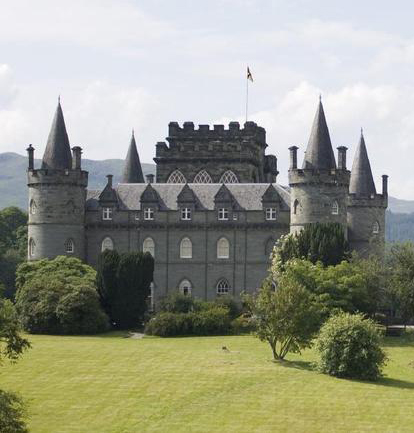
Inveraray Castle
INVERARAY CASTLE This magnificent stately home on the shores of Loch Fyne boasts tremendous views across the Scottish countryside. You might recognize its fairy-tale turrets from the Christmas 2012 episode of Downton Abbey when the Crawleys holiday in Scotland.
BROMPTON CEMETERY One of Britain’s Royal Parks is also a historic cemetery. Expect an atmospheric array of spectacular tombs and more than a few famous names. Look for Brompton in a suitably Gothic scene from the 2009 film Sherlock Holmes.
MI6 (THE SECRET INTELLIGENCE SERVICE) The HQ of MI6 (the Secret Intelligence Service) is off limits to visitors but you can get a great view of this imposing structure from the river. Take a speedboat tour with Thames RIB for fascinating anecdotes about Ian Fleming, the British Secret Service, and of course, James Bond himself.
Berlin, Germany’s capital, is the home to numerous impressive museums. With a section of Berlin dedicated to museums, Museum Island, as well as with museums around the rest of the city, it is easy to see the importance museums have on the cultural landscape of Berlin. The list of museums keeps growing as new ones continue to open and others re-open after renovations.
TSHOBAN FOUNDATION – MUSEUM FOR ARCHITECTURAL DRAWINGS Open since 2013 at the former Pfefferberg Brewery complex, the private Museum for Architectural Drawings houses the renowned Tchoban Foundation’s collection, as well as temporary exhibits from leading international cultural institutions. Conceived by Berlin- and Moscow-based architect Sergei Tchoban, the museum presents three changing exhibitions annually. The architecturally striking building extends from a fire-wall, seemingly latching onto a row of typical Berlin houses. Evoking the image of a set of oversized piled blocks, the four story building’s silhouette is defined by a regression and progression of a colored concrete and glass facade. Open daily, admission is approximately $5.
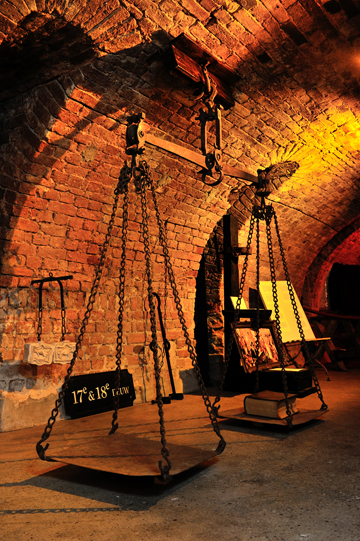
MAGICUM – BERLIN MAGIC MUSEUM Witchcraft and magical powers, mythical knowledge, secrets, the supernatural and ancient wisdom can be explored in the cellars of a historic former blacksmith building close to Berlin’s Hackesche Market. Open since summer 2014, Berlin’s Magic Museum features some 450 exhibits displayed over 6,500 square feet. Included are ritualistic objects and magic devices ranging from a Dutch witches scale and torture instruments to African totem masks, crystal balls and a historic Samurai sword. Curated to be more entertaining rather than strictly academic, the spellbinding exhibition encourages intuitive exploration. Open daily, admission is approximately $8.
Magicum Museum
KUNSTHAUS DAHLEM TO OPEN SUMMER 2015 Following extensive renovations, the Kunsthaus Dahlem will open in the summer of 2015 as an exhibition venue for Postwar German Modernism from East and West Germany (1945-61). The opening exhibition will focus primarily on sculptural works, complemented by paintings, graphics and photography. The historic building was constructed between 1939 and 1942 as a studio for infamous sculptor Arno Breker, who, alongside Josef Thorak, was one of the popular sculptors of the Third Reich, producing ornamental sculptures for Albert Speer’s monumental constructions. In addition to a café and a museum shop, there will also be a permanent exhibition on the building’s eventful past. Free admission.
BERLIN SPY MUSEUM Espionage has been the subject of many movies and books set in Berlin. Now the city is finally getting a museum that focuses on the mysteries of agents, double agents, betrayals, heroes and their stories, as well as the tools they used. The Berlin Spy Museum will feature approximately 21,500 square feet of exhibition space. One of the more well-known pieces on display will be the famous German coding machine “Enigma” from World War II, which was used for enciphering and deciphering secret messages. The exhibition will unveil the mysteries of intelligence services and espionage in the East and the West with a focus on Berlin during WWII and the Cold War. The interactive exhibits cater to all age groups, including children. www.deutsches-spionagemuseum.de/
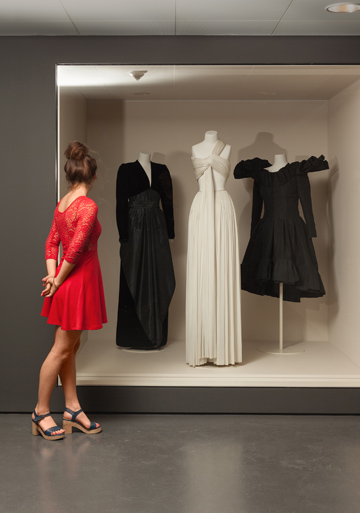
MUSEUM OF DECORATIVE ARTS OPEN AGAIN AT KULTURFORUM After three years of renovations, Germany’s oldest museum of decorative arts, the Kunstgewerbemuseum Berlin, reopened in November 2014 with a new gallery dedicated to the history of fashion. Located at Berlin’s Kulturforum museum complex, the new permanent exhibition of dresses, hats, bags, gloves and accessories from the 18th to the 21st century is based on an international collection acquired by the museum in 2009. Since its re-opening, the Kunstgewerbemuseum has been providing an overview of the key achievements in European design, from the Middle Ages to the present day. In addition to the Fashion Gallery, the museum features new departments of Design and Jugendstil/Art Deco.
Museum of Decorative Arts
BERLINISCHE GALLERY REOPENS MAY 2015 After a year-long modernization, the Berlinische Gallery is scheduled to reopen on May 28, 2015. The gallery’s permanent exhibition focuses exclusively on art in Berlin from 1880-1980, ranging from late 19th century paintings, to Expressionism and the East European avant-garde, to post-war modern architecture and the “wild” works of the 1970s. Reflecting the interdisciplinary nature of the collection, the exhibition will illustrate a diversity of artistic styles and credos, but also tensions, polarization and fresh departures, which remain hallmarks of Berlin as an artistic hub. Two other temporary exhibitions are opening on May 25, 2015: Radically Modern, which focuses on building styles in the 1960s and an exhibition on contemporary German painter Bernhard Martin. A retrospective on Max Beckmann and Berlin will open November 20, 2015 and is poised to be a major highlight of Berlin’s cultural winter for 2015/2016.
Although goulash originated in Hungary, this popular dish later spread beyond its borders, first to the Austrian Empire, Germany, and the Balkans, and finally around the world.
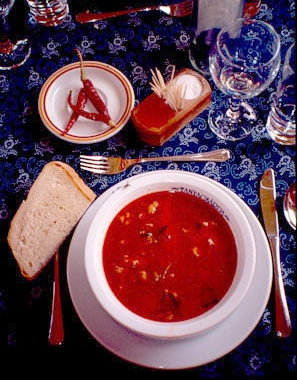
Classic Hungarian goulash at a restaurant on Hungary’s Great Plain
By Sharon Hudgins Photos by the author
Everyone loves a good goulash. But ask a dozen people what a goulash is—and you’ll get a dozen different answers: a soup, a stew, a meat dish served on a plate; brown, red, mild, hot-spicy; made with beef, pork, mutton, game, even vegetarian.
Although goulash originated in Hungary, this popular dish later spread beyond its borders, first to the Austrian Empire, Germany, and the Balkans, and finally around the world. That’s why there are so many versions of goulash today.
GOULASH ROOTS Hungarian goulash traces its roots back to nomadic Magyar herdsmen in the ninth century. Shepherds cut meat into cubes and slowly stewed them in a heavy iron kettle over an open fire until the liquid evaporated. Then they spread the meat out in a single layer to further dry in the sun. This dried meat, an early convenience food, could be carried with them as they followed their flocks across the vast expanse of Hungary’s Great Plain. To reconstitute the meat they simply added water and heated it—sometimes with other ingredients, too—in a pot over a fire. If a lot of liquid was added, the dish was called goulash soup. With less liquid, it was simply goulash meat. In both cases it was eaten with spoons dipped into the communal cooking pot.
Goulash got its name from those early herdsmen, who were called gulyás in Hungarian. But goulash as we know it today did not develop until the end of the 18th century and beginning of the 19th, with the widespread cultivation of peppers in Hungary and the use of paprika as a popular spice. Originally it was considered peasant food, eaten primarily by country folk—farmers, shepherds, cowboys, and swineherds. With the rise of Hungarian nationalism in the second half of the 19th century, paprika-seasoned goulash moved from the campsites and farmhouses to the tables of middle class and wealthy city dwellers, to the menus of fashionable restaurants and eventually across the globe.
GOULASH VARIETIES Goulash is now the Hungarian dish most widely known abroad. But in many parts of the world, dishes called “goulash” bear little resemblance to the gulyás that originated in Hungary and is eaten there today. In Hungary, gulyás is a meat dish halfway between a soup and a stew, made with small cubes of meat (usually beef), no more than 3/4-inch in size, and flavored with bacon or lard, onions and paprika. Gulyás is traditionally served in a bowl and eaten with a spoon.
Over time, Hungarian cooks also developed many variations on this theme, using such ingredients as garlic, tomatoes, mild banana peppers and hot cherry peppers, caraway seeds, root vegetables, cabbage, beans and tiny egg dumplings, as well as pork, mutton, venison and boar meat. Regional recipes abound, with each cook claiming his or her own version of goulash to be the best and most authentic.
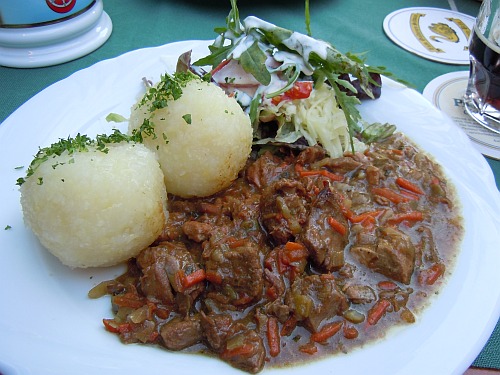
Germans adapted the basic Hungarian goulash recipe to their own tastes, producing the Gulaschsuppe (goulash soup) that is now so popular throughout Germany, where it’s traditionally served with a slice of rye bread and a mug of beer. Germans and Austrians also make a variety of thick, paprika-flavored meat stews called Gulasch, served on a plate and accompanied by boiled potatoes, egg noodles or dumplings. (The Hungarians, however, would call this kind of stew a pörkölt, not a goulash.) And Kesselgulasch (kettle goulash)—cooked outdoors in a pot suspended by an iron tripod over an open fire—is a Hungarian specialty that many Central Europeans now eat at their own backyard dinner parties and local festivals.
German “Beer Goulash” at brewery beer garden in Erfurt
As part of the former Austro-Hungarian Empire, the Austrians certainly love their own versions of Gulasch. There’s even a Cafe-Restaurant Gulaschmuseum in Vienna, where the menu lists more than a dozen varieties of goulash, including turkey or chicken-liver goulash with potatoes, bean goulash with paprika-seasoned sausage, veal goulash with little spinach dumplings, and even a dessert called Schokogulasch (chocolate goulash) containing cake, chocolate sauce and rum. In Prague I purchased a Czech cookbook devoted entirely to the subject of goulash—including versions identified as German, Austrian, Slovakian, Slovenian, Serbian, Bulgarian, even Chinese and Mexican! And recently in New Mexico I came across a Cajun goulash. What a mixture of geography and culinary cultures! From its humble beginnings on the plains of Hungary more than a thousand years ago, this simple peasant food has now become a truly global dish.
GOULASH-SPEAK “Goulash” has also entered several languages as a word meaning more than just “a soup or stew.” In Hungary, “Goulash Communism” was a term for the Hungarians’ attempt in the late 1960s to create their own, more market-oriented, economic system distinct from the Soviet model. In Germany and Switzerland, a “goulash cannon” is military slang for a mobile field kitchen—a big, heavy, black, iron stewpot on wheels, with a cover on the top and a built-in firebox—which is also used for feeding crowds at festivals and other public events. And in the Czech Republic, political parties had a tradition of setting up their own “goulash cannons” in front of polling places at election time, where they dished out free goulash in a blatant attempt to influence voters’ choices on the ballot. As the Czechs said to each other when they headed to the polls to vote, “Have a good goulash!”
By Danielle Pruger Photos courtesy Giraffe Childcare and Early Learning
Europe is famous for its decadent chocolate and many countries are known for their tasty treats. However, chocolate was originally only enjoyed in Central America where cacao beans grew. The Olmec Indians were the first to harvest the cacao beans and 1,000 years later the Mayans were the first to bring the cacao tree from the rain forest onto plantations in modern day Mexico and Guatemala. It wasn’t until 1530 that chocolate was introduced to the European population by Hernan Cortes, who added cane sugar to “xocaltl,” a traditional chocolate drink, to make it more appealing to Spanish royalty and aristocracy. From there many new chocolate concoctions were created throughout Europe, such as Pralines and chocolate milk and many other treats we enjoy today.
For more information visit the timeline created by Giraffe Childcare and Early Learning that covers more than 4,000 years of chocolate’s history: Chocolate History Timeline
Described as the ‘Thuringian Rome,’ it is steeped in history
By Don Heimburger Photos by the author Home page photo by Barbara Neumann, courtesy Erfurt Tourism and Marketing
The reformer Martin Luther once said that Erfurt, Germany “is situated in the best location. It is the perfect place for a city.”
Little did he know 500 years later that Erfurt, the capital of Thuringia, with a population of 200,000 and right in the center of “modern” Germany, would attract large crowds of visitors, many just to see the city in which Luther became an ordained priest.
Erfurt is the capital city of the German state of Thuringia and the main city nearest to the geographical center of modern Germany, located 60 miles southwest of Leipzig. With the Luther Decade ending in 2017, Erfurt has put on its best face to show what is has to offer, and visitors won’t be disappointed.
Erfurt was all spit and polish for the 2015 German Travel Mart in April 2015, when thousands of journalists worldwide, buyers (travel agents and meeting planners) and German suppliers (hotels, Germany’s cities and regions, and commercial attractions) all met in Erfurt (and next-door Weimar) for a three-day-long conference to put Germany on display.
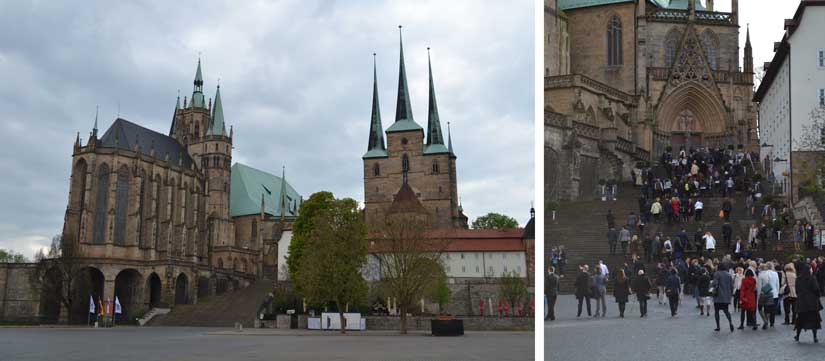
ONE OF LARGEST DOMPLATZ The town’s domplatz is said to be one of Europe’s largest, and it sits next to the impressive central church in Erfurt, St. Mary’s Cathedral, the oldest ecclesiastic building in the city, founded in the 8th century.
Initially the Romanesque-turned-Gothic cathedral served as the bishop’s seat, and up to the 19th century was the seat of the collegiate chapter of St. Mary. Martin Luther himself was ordained in the church in 1507.
The Mariendom (St. Mary’s) and St. Severi form an imposing backdrop for the annual Cathedral Steps Festival held in Erfurt.
The largest free-swinging bell in the world, the “Gloriosa,” with a diameter of 8 feet, hangs in the church today, but because of its age is only rung occasionally. Inside the cathedral there is an elaborate Gothic chancel with a series of 13 colored stained-glass windows which are 42 feet high and are among the greatest works of medieval stained-glass art. The cathedral contains a number of art treasures from various centuries. Guided tours of the church can be arranged in advance.
A flight of 70 steps that lead to the cathedral date back to the 14th century, and today many concerts and events are held on the steps.
Next to St. Mary’s on the hill is St. Severi Church, and together with St. Mary’s the two churches dominate the heart of this medieval city.
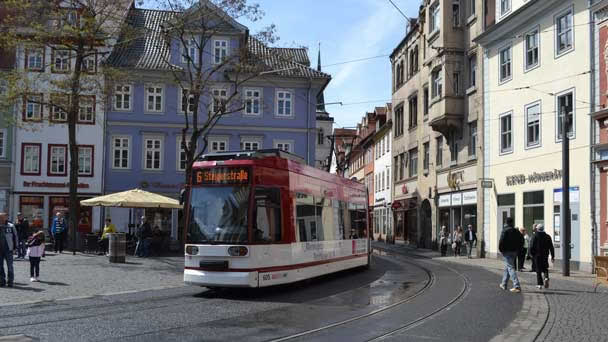
Nicknamed the “Rome of the North” for its profusion of some 30 spires and steeples, Erfurt is unquestionably one of Germany’s most beautiful cities. The old heart of the city with its half-timbered buildings looks like something out of the movies from years ago.
“Erfordia turrita” or “Erfurt, city of towers” is how Luther once praised Erfurt with its 25 parish churches, 15 religious foundations and 10 chapels. This impressive list of ecclesiastical buildings, in conjunction with the magnificent architectural motif of the cathedral and the Church of St. Severus (now the city’s emblem), inspired historians such as Ernst Stida (1585–1632) to refer to the city as the “The Thuringian Rome.”
Most of the churches are still intact and blend in with the beautifully restored half-timbered houses of the Andreas quarter and with the brightly-colored façades of Renaissance buildings. The medieval part of the city is one of the largest and best preserved historical city centers in Germany.
The Augustinian Monastery, built in 1277, is of Gothic design; stained glass windows date from the beginning of the 14th century. The monastery is considered one of the most famous places related to the Reformation.
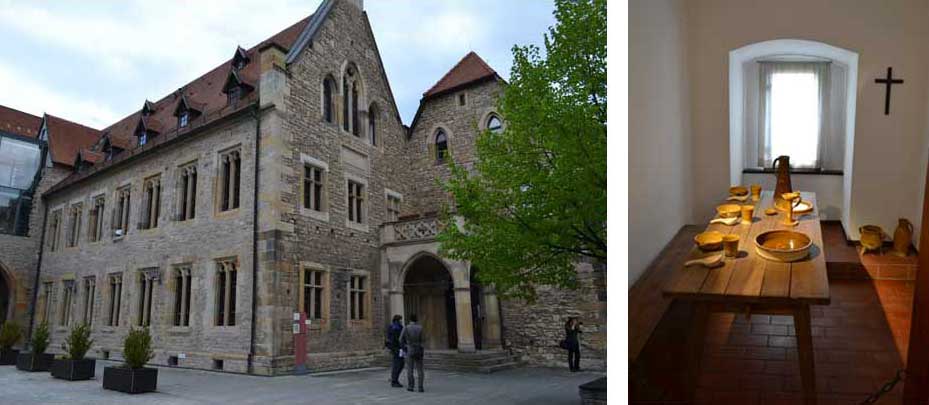
LUTHER’S MONASTERY In 1505, Luther became a monk and took up residency at the beautiful and peaceful Augustinian Monastery in Erfurt, built in 1277. Recently renovated, the gothic monastery has functioned as an Evangelical/Lutheran church and school since 1525. Visit the chapter house and enjoy the same wonderful acoustics that Luther did in his day, or see the reconstruction of Luther’s cell. The Augustinerkloster possesses valuable stained glass windows dating to the beginning of the 14th century. Martin Luther lived here as a monk from 1505 to 1511. You can also spend the night in one of the 51 comfortable guest rooms at the monastery. Today the abbey serves as an ecumenical conference center and a memorial to Luther.
The Luther Stone stands to the east of Stotternheim near Erfurt. On July 2, 1505 Martin Luther, then a law student at Erfurt University, was returning to Erfurt after visiting his parents in Mansfeld. He was making the journey on foot, and as he approached Stotternheim he witnessed a severe thunderstorm that put him in fear of his life. He is said to have cried out, “Help, St. Anne, I will become a monk.” The site where the memorial stone now stands is sometimes described as the birthplace of the Reformation.
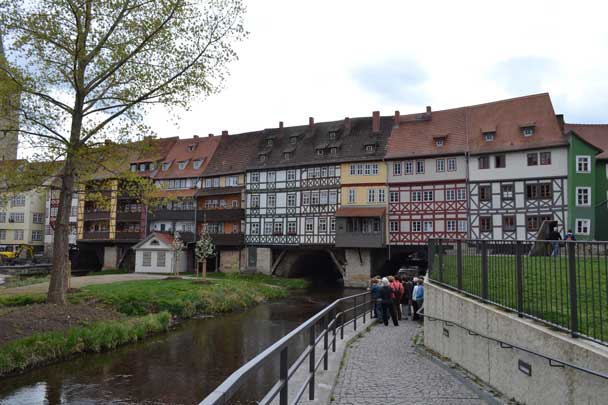
Merchant’s Bridge, a landmark in Erfurt, is the longest bridge in Europe covered by houses that are still inhabited today. In early times, traders sold their wares from this unique bridge.
The Krämerbrücke/Merchants’ Bridge is Erfurt’s most interesting example of secular architecture. This arched stone bridge was constructed in 1325 over the river Gera where the original ford was located along the “via regia” trading route. The Krämerbrücke is the only bridge north of the Alps to be built over entirely with houses that are still used as residences. In medieval times there were two churches built at each end of the bridge, one of which, the Ägidienkirche, is still in existence.
In 1695, the first foundation stone was laid for one of the few remaining 17th century city fortifications to be found in Germany. Today the Petersberg Citadel is an impressive example of European fortification construction dating from the 17th to the 19th centuries. Parts of the fortification were open to the public in 1964, but after 1990 it was extensively renovated, and today the greater part of the casemates, esplanades and bastions inside the fortification area are open to visitors. The completion of the citadel and the Petersberg are Erfurt’s largest undertaking.
(left to right) The Erfurt Rathaus is located at the Fischmarkt; origins of the building go back to the 11th century.; Erfurt city guide Matthias Gose points out aspects of the town on a scale model cast in metal.; Erfurt architecture
Haus zum Breiten Herd, historic Renaissance guild house, Fischmarkt square, Erfurt. In earlier times, rich merchants of the the city decorated the fronts of their homes with delicate carvings.
The neo-Gothic town hall at the Fischmarkt was built between 1870 and 1874. Inside the stairwells and the Festsaal (main function hall) there are numerous wall paintings depicting legends and scenes from the life of Luther, as well as pictures illustrating the history of Thuringia and Erfurt.
Erfurt city guide Matthias Gose points out aspects of the town on a scale model cast in metal
The Old Synagogue is one of very few preserved medieval synagogues in Europe. Thanks to the extensive preservation of the original structure, it has a special place in the history of art and architecture and is among the most impressive and highly rated architectural monuments in Erfurt and Thuringia. The synagogue was constructed during the Middle Ages on the “via regia,” at the heart of the historical old quarter very close to the Merchants Bridge and the town hall.
Many parts of the structure still remain today, including all four thick outer walls, the Romanesque gemel window, the Gothic rose window and the entrance to the synagogue room. After extensive restoration, the building was reopened in 2009. On display in the exhibition rooms is a collection of medieval treasures discovered during archaeological excavations. This includes 3,140 silver coins, 14 silver ingots, approximately 6,000 works of goldsmithery from the 13th and 14th centuries, and an intricate wedding ring of the period, of which only two others are known to exist in the world.
One of the buildings that reflects the history of Erfurt in a special and unique manner is the Kaisersaal in the Futterstrasse, which, after radical reconstruction, was reopened in 1994. It was built out of three patrician houses at the beginning of the 18th century to serve as the university’s ballroom. It is the oldest center for cultural events and meetings in Germany.
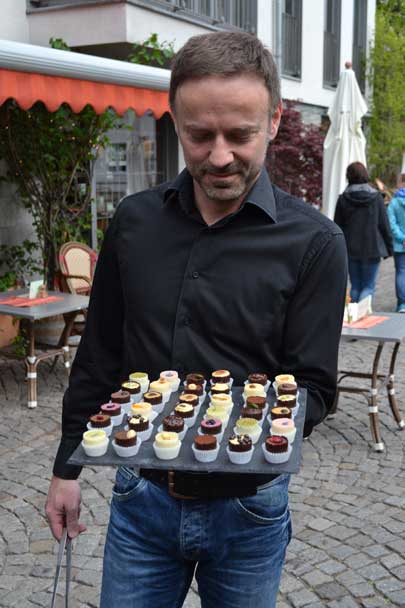
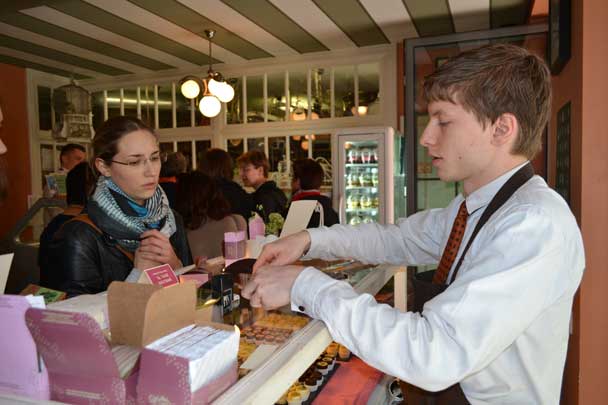
The Goldhelm Schokolade shop in Erfurt provides a selection of fresh chocolates every day
The Anger Museum with its variety of wood and stone sculptures is situated in the middle of the old part of the city. It was built between 1706 and 1712 as a packing and weighing station, both for Philipp Wilhelm Reichsgraf von Boineburg, the governor of the city, and for Archbishop Lothar Franz von Schönborn. It is one of the most important early 18th century buildings.
The Erfurt city museum, in the magnificent Haus zum Stockfisch building, was founded in 1886 to house the artworks that Erfurt inherited from one of its most famous sons, the Romantic painter Friedrich Nerly. The museum’s four floors present the city’s culture, economic development, politics and religion.
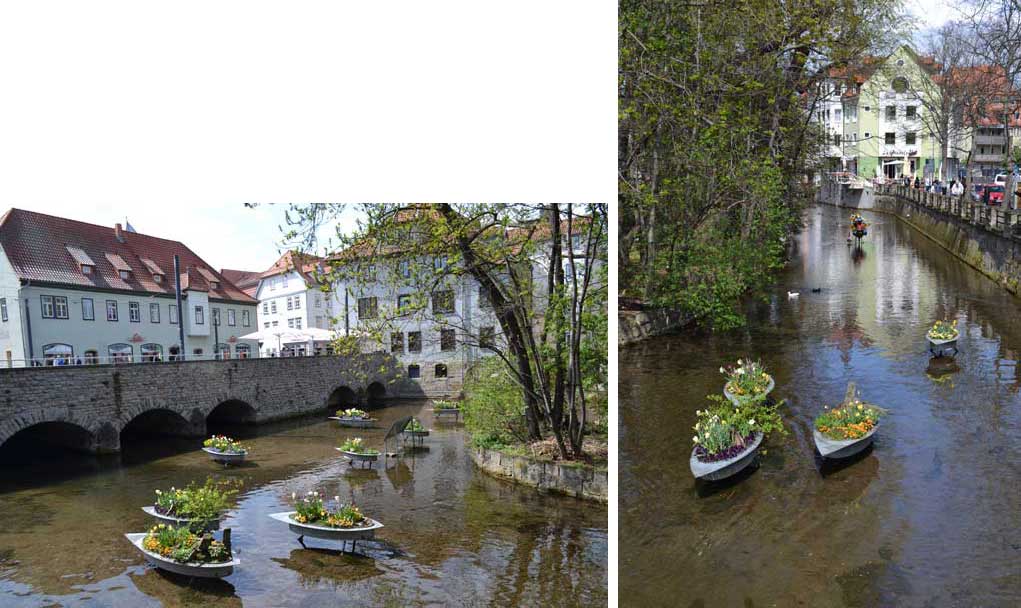
Flowers decorate the Gera River channels in Erfurt.
Erfurt’s last water mill to still be in use is located on the banks of the Gera River near the town hall. Besides the water-driven grinding mill, there are also exhibition rooms displaying historical machines. The museum also contains an illustrated history of Erfurt’s water mills in particular and of the history of hydraulic power in general.
Erfurt, said to be Germany’s largest single heritage site, is a popular destination for tourists, thanks to its medieval ambiance and storied history.