The New Etruscans

By Erla Zwingle
Photos courtesy the Italian Government Tourist Board NA

Say “Etruscan” to most people and they almost certainly know at least something about them: weird language, fabulous frescoed tombs, spectacular gold jewelry (lovers of trivia may also know that they called themselves “Rasna,” which may have meant “citizen,” that they gave the Romans the arch, and that their language had no “O”). This glamorous civilization began to be known about 968 B.C. and was a formidable economic and cultural power until its eventual decline and virtual disappearance in the 1st century B.C. — almost a millennium of indelible influence not only on the Romans, but on the many other Italic peoples who flourished on the Italian peninsula in the seven centuries before Christ. But recent excavations are revealing some surprising new facets of Etruscan life.

Below Massa Marittima, the hills that undulate toward the sea are brick-red from the copper enriching the well-named Colli Metallifere. On the forested slopes rising from the bright waters of the Lago dell’Accesa, archaeologist Stefano Giuntoli and his team have been working in an area of several dozen ettari (hectares), digging up the remains of clusters of small houses. These were the homes of Etruscans who, from the 9th to the 6th centuries B.C., managed the extraction and manufacturing of metals from the nearby mines of Serrabottini and Fenice Capanne.

HOUSES HARD TO FIND
“Houses are hard to find,” Giuntoli explained one sunny June morning; the air was already clinking with the music of many trowels in the stony soil. “The idea of the city was born by the Etruscans,” he said. “And the wealth of this city was due to extraction of metal.” Not only copper, but iron, lead and silver. The city of Vetulonia “had an explosion of wealth because of its bronze,” he said. “Traders came here from all over the Mediterranean. “

“This is the oldest and most extensive site we have,” he continued. “When the idea of a city began in the 6th century, walls come in. Long, communal retaining walls come in Etruria with the idea of democracy, not aristocracy. So here in Accesa it’s very strange to see only houses. Each area contained about 10 houses, which they put wherever they wanted, and its own cemetery. So it is a city, but an anomalous form of a city. A city of the 6th century had a wall, an acropolis, a temple, and streets. Here, no. It’s a strange thing for the period.”

Giuntoli’s team has opened five areas, and the entire site, open to the public as a Parco Tematico della Civilta’ Etrusca, can easily be visited in a morning. There are also some modest tombs dug in the earth, lined with stones, which have yielded treasures. “We’ve found many beautiful objects here,” Giuntoli said. “An iron axe, and a lance, and a strange bronze tool. And a small sort of decorated spatula.” One of the most striking is a 7th century woman’s bronze belt buckle made of two winged horses and sphinxes — common Middle Eastern motifs. Better yet, he shows me a piece of bucchero, a ceramic made only by the Etruscans and people of Asia Minor– dusty, but still distinctively black, and with the dull sheen that made it appear to be metal. It is part of a bowl that held food 2,500 years ago. “We also found a flint arrowhead from Neolithic times,” Giuntoli added, “put under the central post of the house to avert evil, part of the foundation ritual. Like laying the cornerstone. And we had never found tiny votive vessels in a house before — we usually find them in a temple. But we found some in that small room, to venerate the ancestors.”

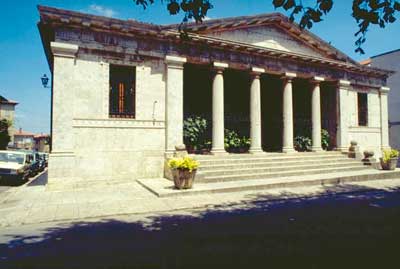
Chiusi – Museo Nazionale Etrusco
Photo Courtesy Agenzia turismo Chianciano Terme – Valdichiana


CIRCULAR CAPANNA
In Area B, some houses larger than the usual one-room structures indicate how Etruscan society was changing. “Here the houses have walls of stone and tile roofs,” Giuntoli said. “For us, tiles are normal, but in antiquity the circular capanna (a kind of thatched hut) was normal, with a straw roof. In the second half of the 7th century in Etruria you see a rectangular house with many rooms and a roof of tiles. It must have been extremely important for the development of society, because one family could make a capanna, but a house with stones and tiles needs specialized workers who know how to make and to place them.” These workers, along with traders and scholars, also mingled the Etruscan culture with others. “We have a Greek man who worked here and made his fortune, so he was rebaptized with an Etruscan first name: ARNTHE PRAXIAS. And in the 5th century there was another person who had a Celtic last name, AVLE KATACINA.”

From the 5th century, the Etruscans began to struggle, then slowly decline, in the face of the growing power of the Samnites, Romans, Umbrians and Celts, the very people they once had taught. Accesa was abandoned in the 6th century, and commercial routes shifted to the Ionian coast. But in this unsettled period, the Etruscans continued to work, trade, and even fight. This is now visible on a hill outside Montalcino, where Dr. Luigi Donati has been bringing an Etruscan fortress to light.

“In November of 1990 I was walking along a trail from Montalcino to Sant’ Antimo,” Donati recalled, “and I saw on the map the name Poggio Civitella. It’s a name that evokes something, some place that was inhabited in the past. In these woods I saw this hillock, and you realized it wasn’t natural. Rummaging in the chestnut leaves, I found an Etruscan tile from the 6th century BC. So then I understood the name.”

ABANDONED VILLAGE
In the crunchy dry undergrowth, he showed me the remains of houses on the gently sloping sides of the hill; like Accesa, the village was abandoned in the 6th century. “There was a general crisis in the countryside then,” Donati explained. “It was like Italy in the 1960s–the people left the countryside for the city.” But in the second half of the 4th century BC, the Etruscans returned.

“Why was this fort born?” Donati asked. “It was a period of danger for the Etruscans. The Celts and Gauls came from the north, and the Etruscans felt the need to secure their territory, so this was a fort of the confine (border). There were many in the territory of Chiusi. This is our first chance to see an Etruscan fort in detail.”

What is surprising about this fort, among other things, is that it is circular. The builders exploited the previous village’s terraces to gain height, and constructed two walls, four meters apart and 150 meters around. The walls were at least six meters high. Most striking is the realization that they built it in a tremendous hurry to face some imminent danger. “The sandstone was quarried right here; we see the pick marks,” he said. “There were lines of men who passed stones hand to hand, and just put them down as they arrived. You can see it was built without care — they even put bigger stones on stop of smaller ones.”

From this vantage, the embattled Etruscans controlled all of Tuscany. On a clear day you can even see as far as Elba. But their days were ending. According to their sacred texts, the Rasna would live for ten centuries, and so it was. But now they are coming back to us. “Yes, it’s full of spirits,” Stefano Giuntoli admitted, smiling, in the woods at Accesa. “But we’re in amicizia (friendship).”

Wine Festivals Abound in Germany’s Historic Cities

From the first red wine produced along the Mosel River during Roman rule to the sweet Riesling for which the country is renowned, German wine is woven into the country’s culture and history.

Many member cities of the Historic Highlights of Germany are inviting travelers to experience this firsthand this fall with a series of wine-themed events, activities and offers.

In Mainz, more than 50 wine growers from throughout the region assemble during the first weekend in September for the annual Mainz Wine Market (photo at left). The event has craft stalls, rides, music and fireworks and, of course, dozens of wine stands. Wine-making goes back nearly 2,000 years in Trier, where several two-night packages feature special themes such as wine cultivation during Roman rule and a combination of World Heritage site visits and wine culture.

In Heidelberg, packages include the Heidelberg Wine and Chocolate Tasting with five wines from regional vineyards and five fine chocolates. Wine has long been central to life in Koblenz, located at the confluence of the Rhine and Mosel Rivers, where the “Wine Village” welcomes visitors to enjoy a glass of wine in the quiet setting of half-timbered houses.

Würzburg, situated on the Main River, is home to several wine estates, where visitors can enjoy tours and wine-tastings—including the Juliusspital, whose 400-year old, 800-foot long wine cellar makes it one of the oldest and largest German wineries.

Historic Highlights of Germany suggests two “Dream Routes” that focus on wine. Click on “Dream Routes” on our site at: www.historicgermany.com

Munich to Budapest the ‘Rail’ Way

By Don Heimburger
Photos by the author

As I usually do, before making reservations for any European trip, I study a map to see where I’d like to go. Sometimes I am not aware of towns or attractions near where I’m traveling to, so a map can help identify those in short order.

The European map came in handy again recently when I booked a flight between Chicago and Munich, the first of what was to be a two-part air journey between Chicago and Budapest. When I discovered the Munich to Budapest air fare would be about as much as the Chicago to Munich fare ($746.00), I quickly gave second thoughts to how I would travel there. And who wouldn’t.

I didn’t want to drive through three countries (Germany-Austria-Hungary) because of gas prices, and my unfamiliarity with the laws and the roads. A bus would take too long, but a train, despite a journey of some seven hours, 22 minutes, would be economical and fun. And I had not ridden those rails before. In fact, Hungary was an altogether new adventure for me.

Munich’s Hauptbahnhof

RAIL COST WAS NOMINAL
A check at www.raileurope.com‘s new website quickly showed that a one-way trip to Budapest’s Keleti Station would cost only $171 U.S. dollars 2nd class ($269.00 first class), and once on board I could sleep or relax from my Atlantic crossing. With the new Rail Europe website, all I had to do was key in my departure and arrival cities, and up popped the cost for the date I wished to travel.

I would arrive Munich via Lufthansa at 5:55 a.m. and have plenty of time to travel on the S Bahn (covered by my Rail Europe ticket) from Munich Airport to the main Munich train station (Hauptbahnhof) to catch Train #63 at 9:27 a.m. to Budapest.

The flight over was uneventful, and the plane landed a few minutes early. Not having been in Germany since the spring, I was craving a croissant made the way the Germans make it, so I waited at an airport restaurant, indulging in coffee and croissants, until 7 a.m. and a Deutsche Bahn office opened to have my train ticket validated (you must validate tickets purchased in the U.S. prior to boarding a train in Europe).

I made a small deposit to reserve an assigned seat in first-class just to be sure. If the agent tells you the route can become crowded with passengers, paying a little extra for a reserved first-class seat can save you from transferring to second class if all the first class seats are taken.

LARGE MUNICH STATION DEPARTURE BOARD
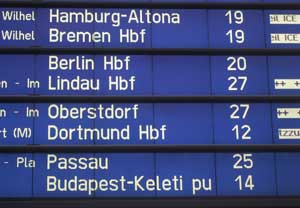
The large train departure board in Munich’s station is fascinating to watch, as new train numbers with boarding tracks pop up every few minutes, and people rush to that platform to board. My train’s notice appears on the board, I see my train roll into the station, and I board car #262 and settle into a comfortable, high-backed leather seat. The train, headed by an electric locomotive, the locomotive of choice in Europe, grabbed onto our string of passenger cars and eased us out of the station on time. Nothing new there—Europe’s trains are almost always on time.

Outside of Munich proper, I look out the window and guess we’re traveling between 95 and 100 miles per hour. I’m likely accurate on this, as European trains can move. A short time later the conductor confirms the train speed at 160 kilometers or 100 miles an hour. One reason trains can travel so fast is that the European track system is much stronger and can hold up much better at high speed. European rail lines have been investing heavily in their train tracks and facilities for years and years, and this is the payoff.

After a while, I note that the heat in the car is a bit excessive, but the conductor enters the car soon enough and announces the heat will be adjusted; it was. By 10 a.m. a porter with a trolley of beer, sandwiches, candy, rolls and chips arrives in the car to ward off any hunger pangs of the passengers.

As we near Salzburg, I can start seeing the snowed-covered Alps that I’ve come to be fond of; I see the Festung on the top of the hill in Salzburg, but only for a moment as the train rolls on. We’ve changed conductors since entering Austria. By the time we arrive at Linz the train is 8 minutes late, and continues to be behind schedule for a while.

Dining in the Speisewagen

TRAIN IS NEARLY FULL
Looking around at the seats and the various cars, I found that 90% of the train was full, and all but about 10 first-class seats had been reserved. If the seat is reserved in the first-class section, a small stub will be attached to the seat with the person’s name on it as well as their boarding and departure stations.

Walking up through the train to the Bord Restaurant, I found it not crowded, and serving Hungarian-style food, including goulash and Hungarian beers. The service was fast and the price was very reasonable.

We roll through St. Polten 10 minutes late, and by Vienna we are 17 minutes late and running into fog. I don’t remember if we arrived late in Budapest, but we were nearly on time nevertheless. The Budapest train station was massive, with a large arching trainshed, similar to many large city trainsheds in Europe.

The trip was as advertised, it allowed me to catch up on my sleep from the flight over, and it allowed me to get into the “European mood” for my travels for the next two weeks. I also saved a lot of money. And in this current rough economy, that’s a good thing.

Castle-on-a-Lake in Northeastern Germany

Schweriner Schloss

By Tom Bross
Photos by the author

Travelers who like continental lake districts should set their sights on Mecklenburg-Lower Pomerania, Germany’s least densely populated federal state.

More than 1,000 lakes and ponds speckle the countryside terrain. Seven of those are right inside Schwerin’s municipal confines—plenty enough to give this Landeshaupstadt state capital (population 97,100) the appeal of curving shoreline pathways, footbridges, causeways, pleasure-boat docks and south-side Zippendorf’s sandy beach. To reach the city, take an InterCity Deutsche Bahn train from Hamburg, a 57-minute trip (check www.raileurope.com).

Get acquainted with the Schweriner See (biggest of the inner-city lakes) by way of a short Weisse Flotte cruise to Kaninchenwerder and Ziegelwerder, a pair of woodsy nature sanctuaries frequented by 100 species of birds. Even more central, crisscrossed by ferryboats, the oval-shaped Pfaffenteich features spouting fountains and a terrace café.

If this local water world doesn’t satisfy outdoor enthusiasts, you can hike-bike-paddle through the beechwood-forested Warnotal valley, 43 miles northbound toward coastal Rostock-Warnemünde via hidden-away riverside villages.

First though, one of Europe’s most flamboyantly spectacular castles, inspired by Grand Duke Friedrich Franz II, fairly shouts for attention. Its pentagonal bulk stands on a lake (the Burgsee), consciously imitating Château de Chambord in France’s Loire Valley. Rising from medieval fortress foundations on a mini-island accessed by ornamental bridges, ongoing construction and impulsive add-ons produced the neo-Renaissance, gilded-domed Schweriner Schloss, finally completed in 1857. End result, amidst terra-cotta trimmings: a splurge of pinnacles, belfries and 15 turrets. For dramatic impact, floodlights illuminate the ensemble during nighttime hours. Surely an extravagant setup for the state’s Landtag parliamentary offices.

PORTRAITS, PORCELAINS AND OLD MASTERS PAINTINGS
For visitors touring the premises, however, bureaucratic doings play second fiddle to the castle’s cultural finery. Not to be missed: galleries devoted to portraits covering 600 years of ancestral dukedom, plus important Mecklenburg landscape paintings. Also here: a lavish oak-paneled banquet hall, chapel and big-windowed orangerie. Inlaid-wood floor patterns and silk brocade wall hangings embellish the ducal throne room.

Watch for the Schloss museum’s displays of furniture, jewelry and weaponry, but especially its sizeable porcelain collection (Meissen, Sèvres, Fürstenberg). Relax in the rococo tea salon or stroll through the flowery Schlossgarten, accentuated by allegorical statues (www.schloss-schwerin.de).

Thanks to past acquisitions made by Mecklenburg Duke Christian Ludwig II and his son Friedrich, the state’s Staatliches Museum Kunstsammlung ranks high as an outstanding fine arts repository. Surrounded by linden groves on Werderstrasse’s northern edge of lakeside Alter Garten greenery, this cultural gem (built 1877-82) resembles a Grecian temple. Gallery-goers ponder Dutch-Flemish “Golden Age” materpieces (Rubens-Rembrandt-Hals-Breugel), but influential German works (Cranach the Elder-Caspar David Friedrich-Max Liebermann-Lovis Corinth) shouldn’t be ignored. Also prominent: Thomas Gainsborough’s full-length, 18th-century Queen Charlotte rendition and (surprise!) a comprehensive French array of dadaist-surrealist Marcel Duchamp canvases.

The Beaux-Arts Mecklenburgisches Staatstheater, another Alter Garten edifice, stages operatic-ballet-theatrical performances—and is “home hall” of the Mecklenburg Court Orchestra, established 448 years ago for eminence as Germany’s third-oldest symphony orchestra, after Dresden’s Staatskapelle and Leipzig’s Gewandhaus.

PANORAMIC VIEWS FROM THE CATHEDRAL TOWER
Schwerin’s cityscape emerged in remakably good shape from the economically skimpy GDR decades. So take in the architectural mix. Dom St. Maria und St. Johannes (on Bischofstrasse) exemplifies soaring early-Gothic north-German brick cathedrals. Climbing 219 spiral stairs to the tower rewards sightseers with terrific panoramics from a 320 foot altitude. Evocative tidbit: the 15th century golden cross crowning the steeple was salvaged from Wismar’s war-damaged (and, in 1990, GDR-dynamited) Marienkirche.

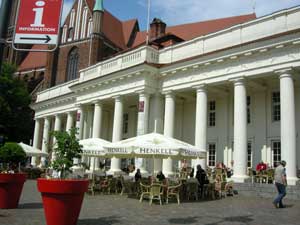
On the Marktplatz, you’ll see an unusual kind of Rathaus—basically Gothic but scrunched behind an English mock-Tudor façade. It stands near Schwerin’s 18th century Säulengebäude market hall, fronted by a dozen white Doric columns.

(right) Monument commemorating Henry the Lion, Duke of Saxony, founding father of Schwerin.

In 1707, a planned Schwerin Neustadt community named Schelfstadt came into existence. Narrow streets, clustered half-timbered Fachwerk houses, Baroque Nikolai Church and tidy kitchen gardens comprise a worthwhile visitor attraction. Same for this lakeside setting’s Freilichtmuseum Schwerin-Muess, recalling 18th-19th century rural folkways.

WHERE TO EAT, WHERE TO SLEEP
The Sorat organization converted a 1936 wheat warehouse into Speicher am Ziegelsee, where spacious guest rooms complement a 55-seat restaurant (www.speicher-hotel.de). Another Ziegelsee choice, Best Western’s Seehotel Frankenhorst, has boat dock, swimming pool and whirlpool-sauna amenities (www.seehotel.bestwestern.de).

Tops in town for deluxe ambience and Pffanteich vistas, Niederländischer Hof includes a wood-paneled library and mirrored restaurant (www.niederlaendischer-hof.de). Centrally situated Alt Schweriner Schankstuben is a budget category 16-room Gasthaus (www.alt-schweriner-schankstuben.de).

Among recommendable in-town dining options are upscale Weinhaus Uhle (www.weinhaus-uhle.de), beer-pouring Zum Stadtkrug Alstadt Brauhaus (www.altstadtbrauhaus.de), sophisticated Friedrichs, occupying a circa-1801 neoclassical mansion (www.restaurant-friedrichs.com) and ever popular Wallenstein, on a Schweriner See embankment, where patrons seated on the open-air pavilion are treated to views of the castle (www.restaurant-wallenstein.de). For a coffeehouse break, find elegant Café Prag, with sidewalk tables overlooking Schusterstrasse, and Röntgen on the Markplatz.

PLANNING YOUR TRIP
Tourist Information Schwerin (www.schwerin.com) is located longside the Rathaus. Or, go to the German National Tourist Office for answers (www.cometogermany.com).

Traveling Rail Europe’s ‘Little Lines’

German rail trains are fast and sleek.

By Don Heimburger
Photos by the author


One of my favorite things to do when planning a European trip by rail is to pull out my European rail route guide and investigate the towns and topography of the area through which I’ll be traveling.

Thus, when I recently organized a trip to Oberammergau, Germany from the Black Forest village of Villingen-Schwenningen, to visit the Passion Play theater and interview some of the play’s directors, I was delighted to see that I’d be changing trains at Pasing, a suburb of Munich, then heading south into the Alps. Pasing station is undergoing a major remodeling around the platform area, and it needs it. Hopefully by now the station is done and the passengers can more easily maneuver on the platform.

The schedule called for me to arrive Pasing at 11:20 a.m. on an Intercity Express from Ulm. Then a Regionalbahn train left at 11:39 a.m. for Murnau, which was slightly under an hour trip. At Murnau, I took the last leg of the trip to Oberammergau. End of story? Not quite, because the fun in travel is actually traveling, not going just from point A to point B.

WHAT THE FUN IS
The fun is waiting for the train, watching the other passengers and seeing what pulls up at the station when its your train. The fun is checking out the cars and seating arrangements, finding the diner and having a meal, or watching the scenery go by. And that’s where my research came in. I knew that the fun part of this trip—any train trip in Europe–is watching the scenery, and I was in for some spectacular scenery.

Not far out of Pasing I could tell the tracks were heading southwest, and towards the Alps. Actually, on a very clear day, you can see the Alps from Munich itself, but I hadn’t been able to see them when I flew in until the very last moment before we touched down. Now, however, it was a beautiful clear day, but it wasn’t until about Murnau that I could see the landscape starting to suggest something big was going to happen.

At Murnau the track split, with one line going to Garmisch-Partenkirchen and then onto Innsbruck: that would have been an awesome route to follow. The other line made a large loop, ending up in Oberammergau. Had the line been straight, the schedule for that segment of the trip would have been much less than the allotted 40 minutes. After Murnau, and a quick on-board lunch that I had packed, the track started to conform to the undulating hills.

Oberammergau Mayor Arno Nunn is in charge of the world-famous Passion Play 2010.
Sit back and relax with a cold beer under a tavern umbrella.

MOUNTAINS LOOM LARGER
We rolled further south, and there finally the mountains appeared and were growing bigger at every turn in the tracks. Our regional train, with a loud squeak for a horn, signaled for road crossings and little dirt paths that wound up into the foothills. Colorful mountain flowers along the way were welcoming enticements to follow the increasingly curvy path to my destination.

Small, interesting German villages, rich green forests, rolling meadows and the looming Alps were all reasons to continue the journey and discover what Oberammergau had in store. A word of caution: don’t step off at “Unterammergau” when you want to get off at Oberammergau. The town names, when you aren’t German and the conductor speaks fast, can be very similar!

At Obergrammergau the track abruptly ends at the station–there’s one track in–and it’s the same track out of the station. From there, you can walk into the center of town, or get a bus or cab. This little city, where the world-famous Passion Play is held every 10 years, is usually very active and touristy. But you feel like you’re in a “real” German town when you’re finally relaxing with a cold beer at a small tavern under the shade of an umbrella, and the Alps rise majestically above you. That’s living, that’s Germany, and trains will take you there. Next time, try the “small rail routes.”

For more information, go to www.raileurope.com and www.oberammergau.de or www.cometogermany.com.