Beginner’s Budapest

By Don Heimburger
Photos by the author

The Eastern European capitals are becoming “closer” to visit each year with better airline routes, and in some cases, reasonably-priced tickets. It’s really not correct to call them “Eastern,” a friend of mine said, because if you look at a map of Europe, they are still close to the “West.” Consider perhaps cities in Belarus, the Ukraine and Romania as “Eastern,” he suggests.

So Budapest, a recent destination of mine and the capital of Hungary, was not particularly hard to reach, after I determined that a Rail Europe train ticket was the most economical form of transportation from Munich. It was, however, a 7 hour and 22-minute train ride from the Bavarian capital, but with trains being an easy and relatively inexpensive form of European travel, I opted for that.

FIRST IMPRESSION
My first impression of this city of about 2 million people (it’s much larger than Prague), came as I departed the train and walked among hundreds of train travelers to the door of the massive train station, where I met hundreds more people on the streets. The city seemed vibrant, active and alive. It also seemed like I should have studied the Hungarian culture a bit more before I arrived, just to ground myself better in what I was about to see.

Divided by the Danube, the city is really two cities in one—hilly Buda in which is located Castle Hill—and Pest, located on the east side, and flat. The most prominent building on the river is the Parliament Building, closed when I was there because of a national holiday. In fact, the whole area was roped off by the police.
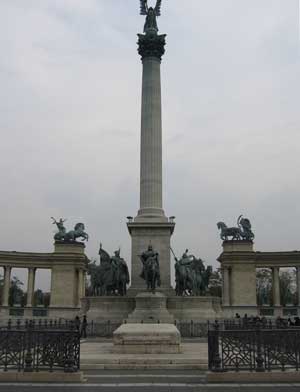
Photo by Marilyn Heimburger

My overriding concern about going to Hungary was the language: I didn’t know a word of Hungarian, and I found it hard to pronounce words. I did learn that “Utca” meant “street,” “Hid” meant “bridge,” and “Furdo” meant ”bath.” I also found as I went along that I didn’t necessarily need to know any words in Hungarian. Most of the shopkeepers, hotel personnel and tourist guides knew enough English so that I could communicate well enough.

City trams in Budapest

GUIDEBOOK HELPS
I’d suggest picking up a guidebook at a local travel store before arrival, and then arranging for a city tour of the highlights before attempting to proceed on your own. The reason for the city tour is that because of the size of the city, you’ll not likely be able to find all the attractions yourself, or want to walk to them yourself.

The tour (www.cityrama.hu), will take several hours, but you will have seen the crème of the attractions of the city. If you plan to stay a few days, the Budapest Card provides free services or discounts at more than 100 places, from public transportation and museums, to thermal baths and restaurants.

The three-hour Cityrama “City Tour” costs 28 euro and includes free taxi pickup at your hotel. The tour starts at the Chain Bridge, which is especially beautiful at night; a romantic walk along the river near the Chain Bridge is memorable. The Parliament Building, built in 1896 for the city’s millennium celebration, features a unique Neo-Gothic design, and reminds one of its counterpart in London. At one time a large red communist star was anchored from the tallest spire. Guided tours are available in the portion of the building which was vacated by the House of Lords.

Behind the Parliament is Kossuth Ter, filled with monuments such as the one to Lajos Kossuth who led an uprising in 1848. The Museum of Ethography (focusing on folk art and country life) in the old Supreme Court Building houses artifacts from the pre-WWI days in Hungary.

Shops, theaters, cafes and more line the Andrassy Ut as the road connects the City Park where you’ll find the zoo with its playful buildings, the famous Szechenyi Baths with several different pools to soak in, the Vajdahunyad Castle (a replica of the famous castle in Transylvania), the Museum of Fine Arts, the Palace of Art and Heroes’ Square. At the baths, you’ll soak in water containing calcium-magnesium-hydrogen carbondate and sulphate-cloride.
I spent quite of bit of time in this area of the city, and would have spent more if the weather had cooperated. Heroes’ Square is where you’ll meet the most “historic” Hungarians in statue form; the very large open area has as its backdrop the imposing Millennium Monument. In the adjacent City Park is where the famous Gundel Restaurant is located (see sidebar). During the 19th century, citizens used to ride their horses in this place and take along a picnic lunch. In the winter, the lake is frozen, so ice skating is a popular past time.

In the other direction, the House of Terror, former headquarters of the Nazi-sponsored Gestapo and secret police, Budapest Opera House, with its neo-Renaissance architecture, fits well with the similarly-elegant neighborhood on Andrássy Avenue. Hungary’s greatest architect, Miklós Ybl, designed the building for the Millennium celebrations. Construction started in 1875 and the building was finished in 1884. Ybl oversaw the work himself with painstaking care. Hundreds of statues and paintings decorate the building both inside and out.

Another attraction in Pest is the Great Market Hall, a multi-level cavernous structure at the end of Vaci Utca, which should take care of most of your food needs if you’re looking for fresh meats, bakery goods, fruits or vegetables or paprika, and it will also satisfy your need for Hungarian souvenirs. This is a good place to hang out for a couple of hours and find lunch at one of the many fast food stalls,

At Buda Hill, you can walk up the hill (about 30 minutes), or take the chairlift to the top of Janos Hill (1,729 feet). The Erzsebet Lookout tower offers a panorama overview of the city below. The area is divided between the “royal” section and the civilian section, with Matthias Church and Fisherman’s Bastion highlights of the civilian section. Streets that lead away from Trinity Square are dotted with Baroque-style buildings and mansions that hide Gothic ruins.

For a rest and refreshment, try ice cream or a pastry at the Ruszmurm Cafe or sit for a while at Kapisztran Square and listen to the bells of the Magdalena Tower. Be sure to see the Royal Place complex. Once the home of lords and royals, it is now the home to museums.

There are more than 200 museums in Budapest, some of which include the Hungarian National Museum, the Budapest History Museum, the Hungarian National Gallery, Museum of Fine Arts, the Museum of Military History and the Ludwig Museum.

An interesting aspect of Budapest that many may not know about are the caves in the area. Monaco is the only other city that can boast a dripstone cave—Budapest has several open to the public: there’s the Palvogy, the Szemlo and Matthias Hill caves (qualified climbers only).

City park on Margaret Island

More highlights:

  • New York Cafe—The most ornate cafe of 320 that operated in the years preceding WWI, and it has remained the most elegant since. Gilded columns, reliefs and shining mirrors evoke the aesthetics of the early 1900s.
  • The square-shaped chocolate cake named after Jancsi Rigo, a gypsy musician, and its original creator Joseph Dobos, is a caramel-covered cake you’ll want to try while you’re in town.
  • Margaret Island, in the middle of the Danube, is a large, lovely park where you can escape the hustle and bustle of the city.

What have I left out? Actually quite a bit, but once there you’ll have plenty to do and see. Hungary’s capital is the hub of political, artistic and social energy. It’s full of history and grandeur, big bridges and wide boulevards. With impressive treasures and friendly people, Budapest is a spot you’ll not want to miss.
Munich to Budapest the ‘Rail’ Way

By Don Heimburger
Photos by the author

As I usually do, before making reservations for any European trip, I study a map to see where I’d like to go. Sometimes I am not aware of towns or attractions near where I’m traveling to, so a map can help identify those in short order.

The European map came in handy again recently when I booked a flight between Chicago and Munich, the first of what was to be a two-part air journey between Chicago and Budapest. When I discovered the Munich to Budapest air fare would be about as much as the Chicago to Munich fare ($746.00), I quickly gave second thoughts to how I would travel there. And who wouldn’t.

I didn’t want to drive through three countries (Germany-Austria-Hungary) because of gas prices, and my unfamiliarity with the laws and the roads. A bus would take too long, but a train, despite a journey of some seven hours, 22 minutes, would be economical and fun. And I had not ridden those rails before. In fact, Hungary was an altogether new adventure for me.

Munich’s Hauptbahnhof

RAIL COST WAS NOMINAL
A check at www.raileurope.com‘s new website quickly showed that a one-way trip to Budapest’s Keleti Station would cost only $171 U.S. dollars 2nd class ($269.00 first class), and once on board I could sleep or relax from my Atlantic crossing. With the new Rail Europe website, all I had to do was key in my departure and arrival cities, and up popped the cost for the date I wished to travel.

I would arrive Munich via Lufthansa at 5:55 a.m. and have plenty of time to travel on the S Bahn (covered by my Rail Europe ticket) from Munich Airport to the main Munich train station (Hauptbahnhof) to catch Train #63 at 9:27 a.m. to Budapest.

The flight over was uneventful, and the plane landed a few minutes early. Not having been in Germany since the spring, I was craving a croissant made the way the Germans make it, so I waited at an airport restaurant, indulging in coffee and croissants, until 7 a.m. and a Deutsche Bahn office opened to have my train ticket validated (you must validate tickets purchased in the U.S. prior to boarding a train in Europe).

I made a small deposit to reserve an assigned seat in first-class just to be sure. If the agent tells you the route can become crowded with passengers, paying a little extra for a reserved first-class seat can save you from transferring to second class if all the first class seats are taken.

LARGE MUNICH STATION DEPARTURE BOARD
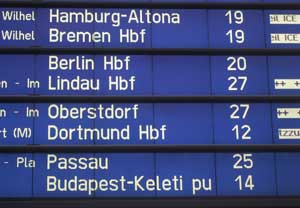
The large train departure board in Munich’s station is fascinating to watch, as new train numbers with boarding tracks pop up every few minutes, and people rush to that platform to board. My train’s notice appears on the board, I see my train roll into the station, and I board car #262 and settle into a comfortable, high-backed leather seat. The train, headed by an electric locomotive, the locomotive of choice in Europe, grabbed onto our string of passenger cars and eased us out of the station on time. Nothing new there—Europe’s trains are almost always on time.

Outside of Munich proper, I look out the window and guess we’re traveling between 95 and 100 miles per hour. I’m likely accurate on this, as European trains can move. A short time later the conductor confirms the train speed at 160 kilometers or 100 miles an hour. One reason trains can travel so fast is that the European track system is much stronger and can hold up much better at high speed. European rail lines have been investing heavily in their train tracks and facilities for years and years, and this is the payoff.

After a while, I note that the heat in the car is a bit excessive, but the conductor enters the car soon enough and announces the heat will be adjusted; it was. By 10 a.m. a porter with a trolley of beer, sandwiches, candy, rolls and chips arrives in the car to ward off any hunger pangs of the passengers.

As we near Salzburg, I can start seeing the snowed-covered Alps that I’ve come to be fond of; I see the Festung on the top of the hill in Salzburg, but only for a moment as the train rolls on. We’ve changed conductors since entering Austria. By the time we arrive at Linz the train is 8 minutes late, and continues to be behind schedule for a while.

Dining in the Speisewagen

TRAIN IS NEARLY FULL
Looking around at the seats and the various cars, I found that 90% of the train was full, and all but about 10 first-class seats had been reserved. If the seat is reserved in the first-class section, a small stub will be attached to the seat with the person’s name on it as well as their boarding and departure stations.

Walking up through the train to the Bord Restaurant, I found it not crowded, and serving Hungarian-style food, including goulash and Hungarian beers. The service was fast and the price was very reasonable.

We roll through St. Polten 10 minutes late, and by Vienna we are 17 minutes late and running into fog. I don’t remember if we arrived late in Budapest, but we were nearly on time nevertheless. The Budapest train station was massive, with a large arching trainshed, similar to many large city trainsheds in Europe.

The trip was as advertised, it allowed me to catch up on my sleep from the flight over, and it allowed me to get into the “European mood” for my travels for the next two weeks. I also saved a lot of money. And in this current rough economy, that’s a good thing.

Paprika: Hungary’s ‘Red Gold’

By Sharon Hudgins
Photos by the author

Many people travel to Hungary for the architectural treasures, historical sites, and cultural life of Budapest, the cosmopolitan capital. Some venture farther into the wine country of Tokaj and Lake Balaton. Others float down the Danube on leisurely boat cruises.

But I go for the food.

And what would Hungarian food be without paprika, the red spice so characteristic of Hungarian cooking?

Paprika is an essential ingredient in Hungarian goulash

PAPRIKA PAST

Although many Hungarian dishes use paprika as an ingredient, this colorful, flavorful spice is actually a relative newcomer to Hungarian cuisine. Pepper cultivation was established in Hungary during the Turkish occupation of that country in the 16th and 17th centuries. But it wasn’t until the late 18th century that paprika gained widespread acceptance as a spice in Hungarian foods. Formerly found only in peasant dishes, it gradually entered the culinary repertoire of the gentry and the nobility, dispersing throughout all levels of society so thoroughly that today it would be hard to imagine Hungarian cooking without paprika.

PICK A PEPPER

Many different kinds of peppers are cultivated in Hungary, including those grown specifically to be dried and ground into paprika. These include several kinds of long red peppers commonly used for making the milder paprikas, and small round red “cherry peppers” used for some of the hotter varieties of the spice.

After being picked, the peppers are left to rest for two to three weeks, to let their flavor and color develop even further. Then they’re washed, dried, and ground into a powder. Paprika is now such an important cash crop that the locals even call it “Red Gold.”

Before the Industrial Revolution, farmers would string all their ripe peppers by hand, hang them up in a protected place to dry, and then complete the drying process in large earthenware ovens. The dried peppers were crushed underfoot, then ground into a fine powder by hand, using a huge mortar with a large pestle. Water mills, windmills and steam engines eventually replaced the hand method for grinding paprika. And today modern automatic machines wash, dry, crush, sort and grind the peppers all in one continuous process.

PAPRIKA PLACES

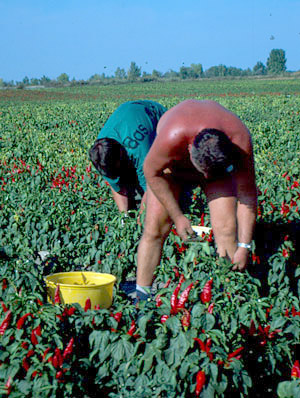
Much of Hungary’s paprika comes from the fields and factories around the small town of Kalocsa, near the Danube River, and the larger industrial city of Szeged, on the Tisza River, both located on the country’s Southern Great Plain. These two centers of paprika production have just the right combination of soil characteristics, temperature, rainfall and sunshine necessary to cultivate the pepper plants successfully. Harvesting starts at the end of the first week in September and lasts for about a month, depending on weather conditions.

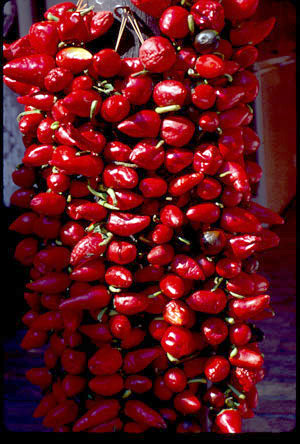
For three to four weeks every autumn, more than 8,000 acres of fields around Kalocsa are filled with farm workers picking bright red peppers and stacking them in small wooden crates or big plastic mesh bags. In the town itself, strings of shiny red peppers hang from balconies, porches, and eaves, like colorful ribbons on a peasant girl’s costume. And on some of the houses, long cylindrical mesh bags full of peppers are suspended from the eaves like giant sausages.

During September the entire town, its population swelled by busloads of tourists, celebrates the pepper harvest with a paprika festival called “Kalocsa Paprika Days,” featuring exhibitions of food products, a variety of sports competitions and a cooking contest (with paprika as an ingredient, of course). The highlight of the festival is the Paprika Harvest Parade, complete with local bands and colorful folk-dancing groups, followed that evening by a Paprika Harvest Ball.

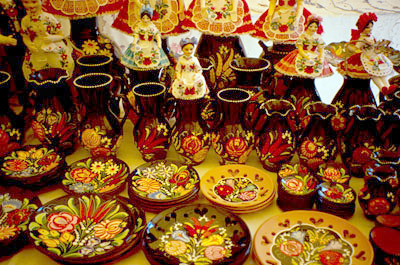
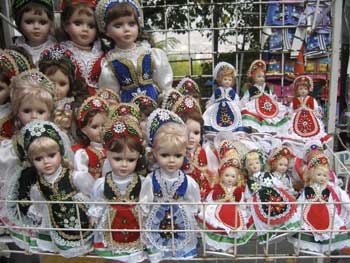
Regardless of the time of year, however, the visitor is never far removed from paprika in Kalocsa. In addition to its pepper fields and commercial paprika factories, Kalocsa has a Paprika Street and a Paprika Museum. Strings of dried peppers festoon store windows and roadside stands. Souvenir shops are filled with folk-art gifts adorned with images of bright red peppers, including hand-painted eggs, decorated dishware and embroidered linens. And walls of houses and restaurants are painted with murals depicting traditional floral motifs, often with red peppers incorporated into the design. A sleepy little town that was once just an agricultural center has become a tourist mecca, especially at harvest time, attracting travelers from all over Europe and beyond.

The much larger city of Szeged also has a paprika museum, as well as a pepper-and-paprika festival in early September.

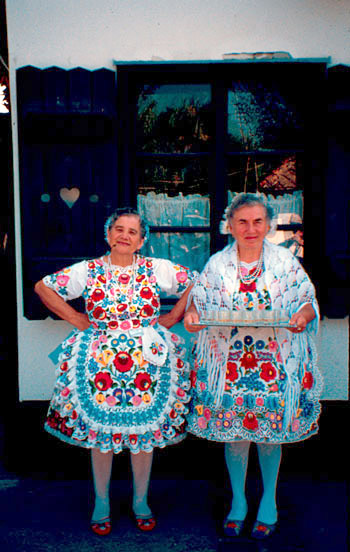
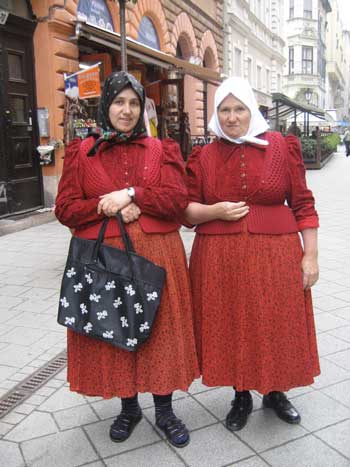
Hungarian women in traditional folk costumes from Kalocsa

TYPES OF HUNGARIAN PAPRIKA

The Hungarians produce a range of paprikas from mild to very hot—although the milder versions are used most often in Hungarian dishes. Contrary to popular belief, the brightest red paprika powders are the mildest and sweetest in taste, whereas the pale-red and light-brown colored paprikas are usually the hottest.

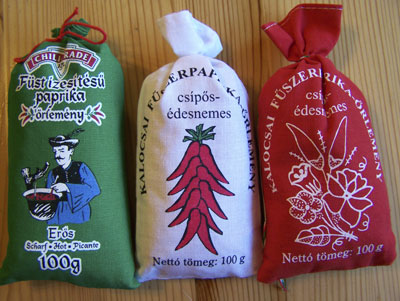
Heat levels range from édes (sweet, mild) to félédes (semi-sweet, medium-hot) to erös (hot). Füszer on the package just means “spice,” and orlemeny means “powder.” What’s important is the type of paprika you choose.

  • Különleges (Special): The brightest red paprika of all, with a good aroma and very mild, sweet flavor.
  • Édesnemes (Noble Sweet): Bright red in color but with only a mildly spicy flavor. Most of the paprika exported to the rest of the world is this type.
  • Csípmentes Csemege (Delicate): Mild-tasting, richly flavored, light- to bright-red paprika.
  • Csemege (Exquisite Delicate): Similar in color and aroma to “Delicate,” but with a slightly spicier taste.
  • Csípös Csmege (Pungent Exquisite Delicate): Similar in color and aroma to Delicate and Exquisite Delicate, but a bit spicier in flavor. One of the most popular of the hotter varieties of paprika in Hungary.
  • Félédes (Semi-Sweet): Medium-hot paprika.
  • Rozsa (Rose): Paler-red in color, with a strong aroma and hot-spicy taste.
  • Erös (Hot): The hottest variety, pale rust-red to light brownish-yellow in color.

PAPRIKA PACKAGING

Paprika is a popular souvenir to bring back from your trip to Hungary. The largest (and freshest) selection can be found at the Great Market Hall in Budapest. If you travel in the countryside, you’ll find paprika sold at many souvenir shops and roadside stands, too.

Kalocsa paprika is often packaged for retail sale in small cloth bags sometimes stamped with the image of a ripe pepper plant, or decorated with red, white and green ribbons, the colors of the Hungarian flag. Paprika also comes in less expensive, but still colorful, tin boxes and even cheaper cellophane or plastic bags.

In the United States, where Kalocsa paprika is less commonly available, you’re more likely to find tins of paprika from Szeged at gourmet stores and major supermarkets.

Paprika peppers are also made into bright-red pastes and packaged in cans, jars, and even tubes (like toothpaste).

Since all powdered paprikas lose color and flavor as they age, it’s best to purchase paprika that was harvested and milled during the past year. Keep it in your kitchen cabinet, away from heat and sunlight, and use it within a year after buying it.

COOKING WITH PAPRIKA

Hungarian souvenirs with pepper motifs on them

As the spice that defines many Hungarian dishes, paprika is often in combination with other traditional Hungarian ingredients such as lard, onions and sour cream. Hungarian cooks always have several kinds of paprika in their kitchens, in a whole range of hues and flavors.

Just remember that when cooking with paprika, you should always stir the spice into HOT fat, to dissolve the powder and release its full flavor and aroma. Then quickly stir in the meat or a liquid to lower the temperature, to keep the paprika from burning, or it will turn bitter and ruin the dish.

Once you’ve tasted true Hungarian paprika—and mastered the simple technique of cooking with it—you’ll never again think of paprika as just a pretty spice, good only for garnishing potato salad and devilled eggs.

As the Hungarians say, “Jó étvágyat kívánunk!” (“Enjoy your meal!”)

For more information:

www.budapest-tourist-guide.com/hungarian-paprika.html
www.budapest-tourist-guide.com/great-market-hall.html
www.1hungary.com/info/kalocsa/
www.countypress.hu/touristinfo/uk/kalocsa.htm
WWW.hungary.szegedhotels.com/visitorinfo.php

Corinthia Grand Hotel

By Don Heimburger
Photos by the author

In the sea of humanity which is Budapest, there is an oasis of calm and sophistication called the Corinthia Grand Hotel Royal.

Situated at Erzsebet krt 43-49 in the city center, this posh five-star hotel presents a grand facade, behind which lies 414 rooms, including 98 executive guestrooms on six floors, six junior suites, 22 one-bedroom deluxe suites and even 1-, 2- and 3-bedroom apartments.

From the Grand Ballroom, which features 72 tons of inlaid marble (a centerpiece of the hotel), to the plush lobby, to the quiet and well-staffed restaurant, this well-appointed hotel is tops.

As Rick Steves has suggested, a top hotel is where he likes to stay when in a Eastern European city because of the service, food and cleanliness. Certainly the Corinthia fits this category.

SIX-STORY ATRIUM
As guests enter, a sweeping six-story atrium tops out with a glass roof, and a broad statue-lined staircase soars upwards to the mezzanine. Light-colored columns, delicate trimmed railings, large flower arrangements and pleasant desk personnel add to the atmosphere.

interiors of Corinthia

Relaxing at the hotel isn’t hard. It offers a Royal Spa, the first of which opened in 1886, with all the latest spa facilities and treatments, plus its own 50-foot-long swimming pool, saunas, steam bath, jacuzzi, fitness room, mud/seaweed baths and more.

The rooms are nicely appointed, with laundry and dry cleaning services available, tea/coffee makers in the room, iron and ironing board, and room service is available. Elevators take guests to their floors. Terrycloth bathrobes are available for guests in the rooms.

room at the Corinthia

Languages spoken by the staff include English, Hungarian, German, French, Spanish and Italian. A concierge is available, as is a currency exchange, non-allergic pillows and a safe deposit box at the front desk. Parking is also available. There is a 24-hour security staff, complimentary access to WiFi wireless internet access, and internet access in rooms.

buffet

The breakfast buffet, one of the highlights of the morning, includes a variety of breads, croissants, muffins, coffee, champagne, hot and cold meats (bacon, sausage), eggs (scrambled and fried and made-to-order), fruits, pastries, cereals, juices, cheeses, baked beans, hash brown potatoes, pancakes, waffles, fresh vegetables, yogurts, and more. I came away fully satisfied with the morning breakfast. Service in the restaurant was always fast and friendly.

breakfast

The Corinthia features five restaurants/bars, a nightclub, a number of retail outlets and 26 apartments for long term stays.

Room rates at the Corinthia vary depending on the season, but one night in May 2009 would start at about $245 U.S.

The hotel first opened for the Millennium Exhibition in 1896, where Josephine Baker, Heinz Rühmann and many other celebrities stayed at the time. Over the years, many famous writers and artists have been guests at the hotel.

During the last renovation, the hotel had a $100 million facelift that virtually gutted the entire building, leaving a beautiful hotel in the central part of Budapest.

For more information, contact www.corinthiahotels.com or www.corinthia.hu. E-mail is budapest@corinthia.hu.