The New Etruscans

By Erla Zwingle
Photos courtesy the Italian Government Tourist Board NA

Say “Etruscan” to most people and they almost certainly know at least something about them: weird language, fabulous frescoed tombs, spectacular gold jewelry (lovers of trivia may also know that they called themselves “Rasna,” which may have meant “citizen,” that they gave the Romans the arch, and that their language had no “O”). This glamorous civilization began to be known about 968 B.C. and was a formidable economic and cultural power until its eventual decline and virtual disappearance in the 1st century B.C. — almost a millennium of indelible influence not only on the Romans, but on the many other Italic peoples who flourished on the Italian peninsula in the seven centuries before Christ. But recent excavations are revealing some surprising new facets of Etruscan life.

Below Massa Marittima, the hills that undulate toward the sea are brick-red from the copper enriching the well-named Colli Metallifere. On the forested slopes rising from the bright waters of the Lago dell’Accesa, archaeologist Stefano Giuntoli and his team have been working in an area of several dozen ettari (hectares), digging up the remains of clusters of small houses. These were the homes of Etruscans who, from the 9th to the 6th centuries B.C., managed the extraction and manufacturing of metals from the nearby mines of Serrabottini and Fenice Capanne.

HOUSES HARD TO FIND
“Houses are hard to find,” Giuntoli explained one sunny June morning; the air was already clinking with the music of many trowels in the stony soil. “The idea of the city was born by the Etruscans,” he said. “And the wealth of this city was due to extraction of metal.” Not only copper, but iron, lead and silver. The city of Vetulonia “had an explosion of wealth because of its bronze,” he said. “Traders came here from all over the Mediterranean. “

“This is the oldest and most extensive site we have,” he continued. “When the idea of a city began in the 6th century, walls come in. Long, communal retaining walls come in Etruria with the idea of democracy, not aristocracy. So here in Accesa it’s very strange to see only houses. Each area contained about 10 houses, which they put wherever they wanted, and its own cemetery. So it is a city, but an anomalous form of a city. A city of the 6th century had a wall, an acropolis, a temple, and streets. Here, no. It’s a strange thing for the period.”

Giuntoli’s team has opened five areas, and the entire site, open to the public as a Parco Tematico della Civilta’ Etrusca, can easily be visited in a morning. There are also some modest tombs dug in the earth, lined with stones, which have yielded treasures. “We’ve found many beautiful objects here,” Giuntoli said. “An iron axe, and a lance, and a strange bronze tool. And a small sort of decorated spatula.” One of the most striking is a 7th century woman’s bronze belt buckle made of two winged horses and sphinxes — common Middle Eastern motifs. Better yet, he shows me a piece of bucchero, a ceramic made only by the Etruscans and people of Asia Minor– dusty, but still distinctively black, and with the dull sheen that made it appear to be metal. It is part of a bowl that held food 2,500 years ago. “We also found a flint arrowhead from Neolithic times,” Giuntoli added, “put under the central post of the house to avert evil, part of the foundation ritual. Like laying the cornerstone. And we had never found tiny votive vessels in a house before — we usually find them in a temple. But we found some in that small room, to venerate the ancestors.”
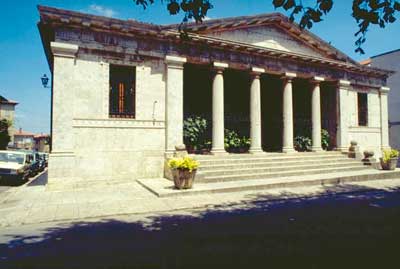
Chiusi – Museo Nazionale Etrusco
Photo Courtesy Agenzia turismo Chianciano Terme – Valdichiana


CIRCULAR CAPANNA
In Area B, some houses larger than the usual one-room structures indicate how Etruscan society was changing. “Here the houses have walls of stone and tile roofs,” Giuntoli said. “For us, tiles are normal, but in antiquity the circular capanna (a kind of thatched hut) was normal, with a straw roof. In the second half of the 7th century in Etruria you see a rectangular house with many rooms and a roof of tiles. It must have been extremely important for the development of society, because one family could make a capanna, but a house with stones and tiles needs specialized workers who know how to make and to place them.” These workers, along with traders and scholars, also mingled the Etruscan culture with others. “We have a Greek man who worked here and made his fortune, so he was rebaptized with an Etruscan first name: ARNTHE PRAXIAS. And in the 5th century there was another person who had a Celtic last name, AVLE KATACINA.”

From the 5th century, the Etruscans began to struggle, then slowly decline, in the face of the growing power of the Samnites, Romans, Umbrians and Celts, the very people they once had taught. Accesa was abandoned in the 6th century, and commercial routes shifted to the Ionian coast. But in this unsettled period, the Etruscans continued to work, trade, and even fight. This is now visible on a hill outside Montalcino, where Dr. Luigi Donati has been bringing an Etruscan fortress to light.

“In November of 1990 I was walking along a trail from Montalcino to Sant’ Antimo,” Donati recalled, “and I saw on the map the name Poggio Civitella. It’s a name that evokes something, some place that was inhabited in the past. In these woods I saw this hillock, and you realized it wasn’t natural. Rummaging in the chestnut leaves, I found an Etruscan tile from the 6th century BC. So then I understood the name.”

ABANDONED VILLAGE
In the crunchy dry undergrowth, he showed me the remains of houses on the gently sloping sides of the hill; like Accesa, the village was abandoned in the 6th century. “There was a general crisis in the countryside then,” Donati explained. “It was like Italy in the 1960s–the people left the countryside for the city.” But in the second half of the 4th century BC, the Etruscans returned.

“Why was this fort born?” Donati asked. “It was a period of danger for the Etruscans. The Celts and Gauls came from the north, and the Etruscans felt the need to secure their territory, so this was a fort of the confine (border). There were many in the territory of Chiusi. This is our first chance to see an Etruscan fort in detail.”

What is surprising about this fort, among other things, is that it is circular. The builders exploited the previous village’s terraces to gain height, and constructed two walls, four meters apart and 150 meters around. The walls were at least six meters high. Most striking is the realization that they built it in a tremendous hurry to face some imminent danger. “The sandstone was quarried right here; we see the pick marks,” he said. “There were lines of men who passed stones hand to hand, and just put them down as they arrived. You can see it was built without care — they even put bigger stones on stop of smaller ones.”

From this vantage, the embattled Etruscans controlled all of Tuscany. On a clear day you can even see as far as Elba. But their days were ending. According to their sacred texts, the Rasna would live for ten centuries, and so it was. But now they are coming back to us. “Yes, it’s full of spirits,” Stefano Giuntoli admitted, smiling, in the woods at Accesa. “But we’re in amicizia (friendship).”

Stretching Your Dollar in Italy

Dine at the local bar

By Kristi Nelson Cohen

Rising exchange rates don’t have to put you in the red when traveling in Italy. With record high Euro exchange rates, travelers can stretch their dollar when dining by trying some new dining options.

Eating is a pure pleasure for Italians and visiting guests. Italians take their meals very seriously and a full 3-5 course dinner in a fancy ristaurante can eat into a travel budget quickly. In order to stretch a budget, try these simple tips.

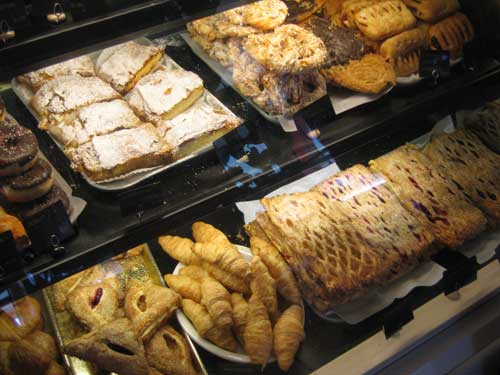
Breakfast is often included in a hotel’s room package. If it is not, follow the locals to a neighborhood bar for your morning coffee and pastry. A bar in Italy is not a place to consume alcohol and dance the night away. They are fancy little candy box establishments, found on nearly every corner. Italian bars are the place where patrons socialize over their morning coffee (sometimes several times each morning), return for a light lunch, and arrive again in the evening for an apertivo or cocktail before dinner.

Bars in busier cities, especially those in tourist areas, traditionally charge one price to stand at the counter (al banco) or a higher price to sit at one of their café-style tables (al tavolo). If you want to sit and enjoy the view, then the price is usually worth it. A coffee that might cost 1.50 Euro at the counter could cost twice as much to sit at a table. During the late morning/afternoon and evening hours, service at a table traditionally includes some salty snacks like potato chips or nuts, even olives, with your beverage.

If you choose to stand at the counter, patrons traditionally pay the cashier, and then present their receipt to the barista who will complete the coffee order.

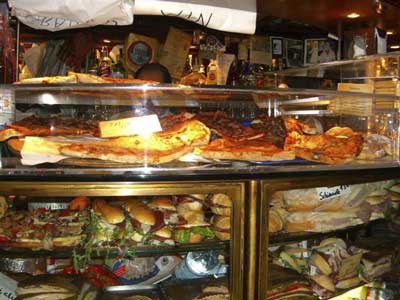
Most bars have a tasty selection of pizza and panini.

ITALIAN COFFEE
Italians consume a variety of coffee drinks throughout the day. Most will start the day with a cappuccino which is a shot of espresso served in a large cup with steamed milk and topped with frothy milk foam. Most Italians will not drink cappuccino after mid morning but switch to other coffee drinks. Of course, they’re happy to accommodate tourist requests for cappuccino at any time of the day.

Later in the morning, and throughout the day and into the evening, Italians consume what they call caffe which is espresso, or a small cup of very strong coffee topped with a delicious caramel colored foam called crema. This coffee is rich and strong, and usually sweetened with sugar. Espresso is the basis for most Italian coffee drinks.

If you want a weaker version of coffee that resembles what Americans drink, order a caffe Americano which is a shot of espresso with steamed hot water in a larger cup. This is also called caffe lungo.

If you want to be more adventurous, order a caffe corretto which is espresso corrected with a shot of liquor like grappa, cognac or flavored liquor. Nothing warms your heart faster or settles a full stomach.

EATING AT BARS
Besides serving fantastic coffee throughout the day, an Italian bar usually offers a selection of sandwiches called pannini. These can make an affordable option for lunch or dinner. Some bars also offer a limited selection of pre-made one dish meals, like pasta or vegetables. These establishments are referred to as tavolo caldo. A simple one-course meal with a mineral water aqua minerale or a house wine (vino della casa) is an exceptional value for the traveler.

APERTIVO AND ANTIPASTO FOR DINNER
Italians traditionally dine relatively late (8-9 p.m.) for dinner. After a long day of touring, visitors might opt for a lighter, less expensive option for dinner. Many of the local bars offer light snacks to entice cocktail business. Some wine bars also offer a variety of little sandwiches, potato croquettes and grilled vegetables either complementary or for a very reasonable price.

In Venice in particular, this selection of snacks is referred to as Cichetti. Combined with a spritz (cocktail made from Campari and Prosecco) or a great glass of local wine, these light snacks can make for a satisfying dinner.

Each region of Italy offers regional food fares, typical for that area. The Cichetti in Venice may include such items as marinated sardines, Bacala which is a salt fish cod spread for bread or polenta and deep friend calamari. Antipasto offerings in Tuscany may be a selection of salamis, cheeses and olives.

In Rome, the antipasto might be crusty bread with tomato, herb and olive oil topping called Buschetta or a sampling of small slices of freshly-made pizza.

Whatever, the region, the food is delicious, fresh and attractively prepared. Even the simple selections from a bar will satisfy your hunger and your quest for a delicious yet affordable meal.

European Easter Breads

A Mix of Symbolism and Satisfying Taste

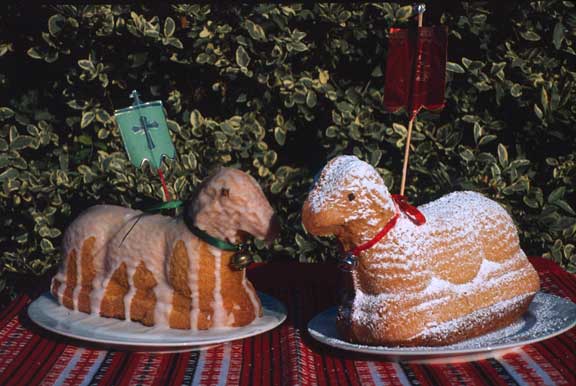
Lamb-shaped cakes and breads for Easter are made in the Alsace region of France, as well as in Germany, Austria and Eastern Europe. Photo by Sharon Hudgins


by Sharon Hudgins

When the Easter season approaches, European kitchens are filled with the yeasty aromas of freshly baked breads, as cooks all over the Continent prepare the special loaves and buns traditionally associated with this important religious holiday.

In the past, devout Christians observed a strict fast during Lent, the six or seven weeks before Easter, when they abstained from eating animal products of any kind: red meat, poultry, milk, butter, lard, cheese and eggs.

In some parts of Europe, even sugar, honey, olive oil, and certain kinds of fish were on the list of forbidden foods. When Easter finally arrived, people celebrated with a huge meal featuring dishes made from all the ingredients that had been prohibited during Lent. Even though few people follow such strict fasts today, the tradition of feasting on special foods at Easter is still an important part of many European cultures.

Rich, yeast-raised breads full of milk, butter and eggs are an essential element of the Easter meal in most European countries. Often the breads are made in symbolic shapes and elaborately decorated with sugar icing, candied fruits or colored eggs. Homemade or bakery bought, these breads represent a continuity of traditions from centuries past, including much earlier, pre-Christian times.

Different countries, regions and towns of Europe have their own characteristic breads baked especially for Easter. In some places, these special breads are taken to church to be blessed at the Easter midnight mass or the Easter Sunday morning service, before proudly being displayed on the festive dinner table at home. And in Russia and many Eastern European countries, the table also has a little three-dimensional lamb modeled out of butter, for spreading on the bread after it is cut.

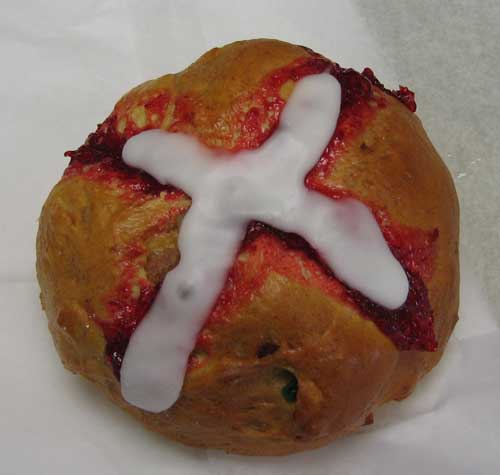
Hot cross buns are an Easter favorite.
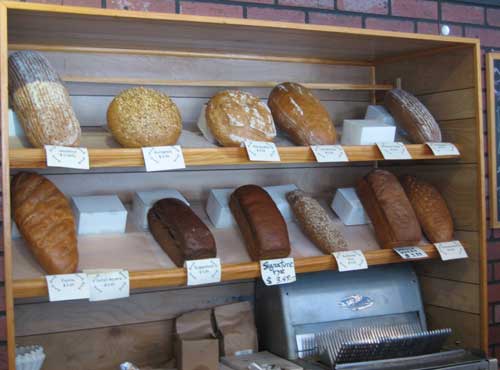
Breads of all kinds are offered at Easter-time; these were baked by Michael Mikusch at his Austrian bakery.

GERMANY AND CENTRAL EUROPE

Bakers in Germanic communities make Easter breads in a variety of shapes, secular and religious. Breads shaped like rabbits, lambs, baby chicks and fish are symbols of springtime, fertility and birth. Braided loaves—long and straight, round or wreath-shaped—are made with three strands of dough representing the Holy Trinity of Father, Son and Holy Spirit. Germans and Austrians make several versions of Osterzopf (Easter braid), Osterkranz (Easter wreath or crown), and Striezel (stacked braided bread), as well as Osternester (Easter nests) or Eier im Nest (Easter-egg nest) with white or colored hard-boiled eggs surrounded by the dough. The circular braided Osterkranz is also symbolic of Christ’s crown of thorns, and the red-dyed eggs decorating many Easter breads are said to represent Christ’s blood and resurrection—although the egg’s significance as a symbol of rebirth and regeneration actually dates further back in time to the pre-Christian era.

Other special Germanic Easter breads include the Osterfladen—a flat, rectangular bread with a sweet filling of apples, raisins and almonds—and several varieties of Osterbrot (Easter bread) flavored with raisins, currants, candied orange peel, grated lemon zest, anise and cardamom. The Osterkarpfen (Easter carp) is a bread shaped like a fish, glazed with white icing, and studded with sliced almonds to represent fish scales. Germans also make Osterkorbe breads formed like Easter baskets and rabbit-shaped Osterhasen breads, all of them holding real or candy eggs. And the Eiermännle (Little Egg Man) is a flat bread shaped like a boy or man, with an unshelled hard-boiled Easter egg baked in the center of his body or inside a basket that he carries on his back.

Lamb-shaped cakes and breads can be found at Easter-time from Alsace to Austria, from Germany to the Czech Republic, Poland, Slovakia and Hungary. Baked in three dimensional metal or pottery molds, these represent Christ as the sacrificed Lamb of God, although their origin can probably be traced to earlier, pre-Christian rites in which baked dough effigies of sacrificial animals were substituted for live animals. Lamb breads are made from the same kind of sweet, yeast-raised doughs used for Alsatian Kugelhopf, Austrian Gugelhupf,and Polish baba (or babka). The cake versions are made from a simple white cake batter, although both chocolate and marble (mixed chocolate and white) lamb cakes sometimes show up in the flocks of Easter lambs sitting in bakery windows at this time of year.

The simplest lamb breads and cakes are merely dusted with a coating of confectioners’ sugar or drizzled with a light glaze of sugar icing. More elaborate cakes are covered with fluffy white frosting, sometimes garnished with shredded coconut, or spread with chocolate icing decorated with white icing swirls. The eyes are made from raisins, whole cloves, or coffee beans, and a small silk ribbon, often with a tiny bell attached, is tied around the lamb’s neck. Many of these lambs also hold a colored foil banner bearing the emblem of a lamb or a cross—recalling similar banners carried by Christian crusaders to the Holy Land a thousand years ago.

When you’re in Europe around Easter, look for the special Easter breads in local bakeries. You’ll likely be tempted by all the good pastries as well.
This shop offers Austrian breads and pastries which are as good as they look.

ITALY

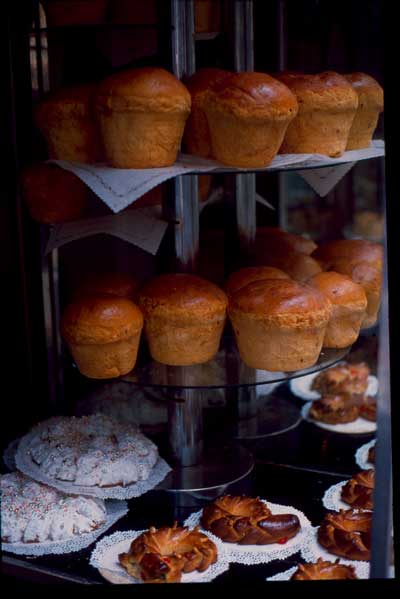
Italy offers a rich variety of regional Easter breads, including Genoa’s pane dolce (sweet bread) full of raisins, candied fruit peel and pine nuts; Umbria’s cylindrical, cheese-flavored crescia; Venice’s large fugassa di Pasqua buns; and Cesenatico’s ring-shaped ciambelle, seasoned with anise and lemon peel. In Sicily, the edible centerpiece of the Easter meal is a large yeast bread shaped like a crown, with colored hard-boiled eggs embedded in the top. In some parts of Italy an old custom is still followed when Easter breads are made: the shell of the first egg put into the dough is cracked on the head of a young boy—supposedly to keep bad luck at bay.

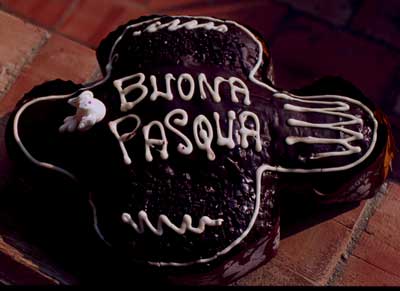
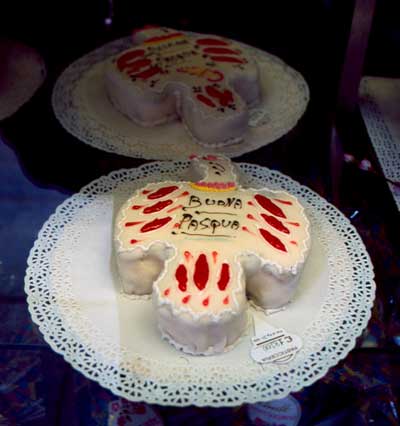
The Easter bread most popular throughout all of Italy is a specialty originally from Lombardy—the columba di Pasqua (or columba pasquale), a sweet yeast bread full of candied orange peel, raisins, and almonds, made in the shape of a dove. Some of the fancier columbe have pockets of orange- or champagne-flavored pastry cream inside. Others are made with swirls of light and dark (chocolate-flavored) dough, like marble cakes. The plainest ones are garnished with only a simple sugar glaze, but the more elegant columbe are elaborately decorated with almond paste, white or pastel icing, chocolate, nuts or sugar-paste flowers.

(bottom left and right) Italian Easter dove cakes (columbe di Pascua) are a symbol of springtime, the Holy Spirit, and peace.; Italian cheese-flavored crescia loaves for Easter, at a bakery in Umbria

GREECE

Maundy Thursday, three days before Easter, is the time when Greeks bake their holiday breads. Known as tsoureki or lambropsomo, these sweet, eggy breads are traditionally flavored with mahlepi, an unusual spice made from the finely-ground seeds of a type of cherry. Other Greek bakers add mastikha, pulverized crystals of sap from mastic shrubs that grow on the island of Chios. Cinnamon, nutmeg, cardamom and allspice can also go into the dough, as well as orange and lemon peel.

Greek Easter bread is made in different shapes from one region to another: a long braid, a braided wreath, a round loaf with bread-dough decorations on top in the form of leaves, flowers or a Byzantine cross. Each shape has its own symbolism. The three strands of braided dough represent the Holy Trinity. Wreaths and rings not only recall Christ’s crown of thorns but are also pre-Christian fertility symbols. Round shapes represent the life-giving sun, rebirth and resurrection. And no Greek Easter bread would be complete without one or more red-colored eggs—customarily dyed on Maundy Thursday—pressed into the top before baking.

SPAIN

The Spanish corona de Pascua (Easter crown) is another bread whose shape and symbolism is similar to Easter breads in many Mediterranean countries. Made from a sweet yeast-raised dough, the corona de Pascua is flavored with raisins, almonds, candied fruit peel, lemon and olive oil. Three strands of dough are first braided together, then formed into a ring. Whole, hard-boiled eggs are nestled into the top of the braid, usually one egg for each member of the family. Some people leave the eggshells white; others dye them red or a variety of spring colors.

Another Spanish Easter bread known as monja (nun) probably got its name from the nuns who traditionally baked breads, pastries and confections to sell from behind their convent walls. This orange-flavored bread—much like ones also found in Greece, Macedonia and Bulgaria—is round in shape, with a cross made of bread dough on top and four red-dyed eggs embedded at each point of the cross.

In the Castile region of Spain, Easter is celebrated with a large round loaf of bread in which shelled hard-boiled eggs, diced bacon,and chunks of Spanish sausages were imbedded in the dough before baking. And at Easter-time in some parts of Spain, godparents give their godchildren tortas de aceite, small savory buns made from yeast dough seasoned with orange, anise, and olive oil, with a single hard-boiled egg nestled in the center.

RUSSIA AND UKRAINE

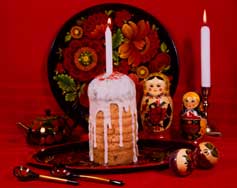
Since Easter is a springtime celebration of new life, it’s not surprising that many traditional Easter breads are made in the form of ancient fertility symbols. The most graphic of these are the tall, cylindrical breads with a puffy dome on top, whose phallic symbolism is unmistakable. Festive breads of this shape are made in both France and Italy, but the most famous is Russia’s kulich, a saffron-scented yeast bread flavored with raisins, almonds and candied fruit peel. The domes are frosted with white icing that dribbles down the sides in a further reinforcement of the fertility image. The kulichi can also be decorated with colored sugar sprinkles or candied fruits, and a long thin red candle is usually stuck into the top of the dome. On Easter, Russian Orthodox churches are often filled with these special breads, their candles lighted, awaiting blessing by the priest.

Velikodnia babka is the Ukrainian version of this tall, yeasty Easter bread, with raisins, almonds and candied peel kneaded into the dough. Another traditional Ukrainian Easter bread is velikodnia paska, made from a rich yeast dough containing plenty of butter, sugar, and eggs, and shaped into large rounds. The tops are fancily decorated with ornaments made out of dough, usually with a cross as the center motif surrounded by elaborate swirls, small birds, leaves,or flowers. Perekladnets is a special, colorful Easter treat, a kind of coffee-cake loaf made with lemon-scented yeast dough and three different layers of filling: chopped dried peaches or apricots with candied fruits; chopped figs, dates and walnuts; and chopped almonds with candied cherries.

Russian kulich, a tall cylindrical Easter bread often baked in a coffee can.

GREAT BRITAIN

Hot-cross buns are the most typical Easter bread in Great Britain. Baked on Good Friday, these round, slightly sweet buns often have chopped fruit peel and currants, raisins or sultanas in the dough. A cross is cut into the top of each bun before baking, or a strip of dough is used to make the form of a cross on top, to keep away evil on this sad day of remembering Christ’s crucifixion.

In some parts of Britain, a hot-cross bun is hung up in the house to keep away bad luck (fire, theft, illness) until Good Friday of the following year. Buns are also hung in the barns to protect the grain from rodents. As in the rest of Europe, these British hot-cross buns are an example of the powerful symbolism of breads baked for the Easter season.

Have a Very Good Trip…by Train

So, you want to show your wife or your date a very good time.

And you want to do it between Venice and Paris.

That can be arranged.

What is called the World’s Most Romantic Celebration consists of a train trip on the Orient-Express between Venice and Paris.

Here are the details. The trip is eight days and seven nights from $24,750: three nights in Venice; one night on the Venice Simplon-Orient-Express and three nights in Paris.

Departure dates, which are Sundays and Wednesdays, in 2008 are: March 30; April 6, 13, 20, 27; May 11, 14, 25;June 8, 11, 22, 29; July 20, 27; August 3, 10, 17, 24; September 10, 21, 24, 28; and October 12, 15.

The itinerary consists of:

Day 1 – Venice
Arrive in the romantic city of Venice and transfer by private water taxi boat to the Hotel Cipriani. A deluxe suite is reserved for three nights in the city of canals. 

Overnight in Venice.


Day 2 – Venice
A personally tailored guided tour of the city in the morning. In the afternoon, the private launch of Romilly, Lady McAlpine collects you from the hotel and takes you to her home for a visit and refreshments. 

Breakfast included. Overnight in Venice.

Day 3 – Venice
Explore the delights of La Serenissima before a final romantic evening, including a ride on a gondola before dinner, at one of Venice’s most exclusive restaurants. 

Breakfast and dinner included. Overnight in Venice.


Day 4 – On the Venice Simplon-Orient-Express
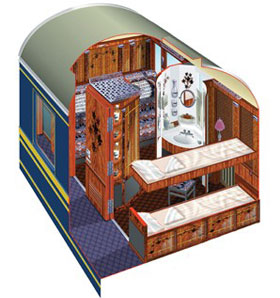
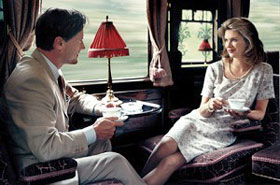
The train’s hostess completes check-in formalities for your journey on the Venice Simplon-Orient-Express train before your private transfer to the station. Board the train (cabin suite) for the overnight journey to Paris, enjoying superb cuisine and sparkling champagne. 

Breakfast, lunch and dinner included. Overnight on board.


Day 6 – Paris
After breakfast, a private car and driver takes you to the French countryside en route to Reims, capital of the Champagne region, where you have a private tasting before lunch at the two-star Michelin restaurant of Chateau Les Crayères, accompanied by fine wines and Prestige Champagne. After lunch, return to Paris. Breakfast and lunch included. Overnight in Paris.

Day 7 – Paris 
Time for final sightseeing or shopping in the boutiques and designer stores. In the evening a private car transfers you to Quai de Grenelle, where you board a luxurious private yacht. The vessel’s teak deck and sleek interiors allow you to relish the cozy atmosphere of a 1960s boat. Enjoy a glass of champagne as you cruise along the river Seine, before a romantic candlelit dinner served either on the outdoor deck or the inside cabin. A shower of roses completes the cruise before returning for a final night in Paris. Breakfast and dinner included. Overnight in Paris.

Day 8 – Paris
Your journey comes to an end. Breakfast included.  All aboard!

IF YOU GO…
Log onto www.orient-express.com for more details about the trip. Or, call (in the USA) 401-351-7518 or e-mail to: oesales.providence@orient-express.com. From France, call +33 1 55 62 18 00; from Germany, call +41 44 770 1407; from the Netherlands, call +31 35 6955111; and from the U.K., call +44 20 7805 5060

Learning the ‘Art of Travel’ on the Orient Express

A luxurious learning experience complete with a guide from London’s National Gallery

The Orient Express is launching a series of special vacation packages called “The Art of Travel,” including tours to Venice, Paris and within England. Travelers will learn about the lives of artists such as Canaletto, Bellini, Titian, Veronese, Monet, Rubens, Turner and Constable while seeing the places that inspired their work and visiting the places that house their work today, accompanied by an expert from London’s National Gallery.

All tours include at least one night at London’s Goring Hotel and begin at The National Gallery, where a specialist will give a guided introduction to selected masterpieces before the journey begins. Trips include:

THE VENICE OF CANALETTO: This seven-day tour will give travelers the opportunity to view Venice through Canaletto’s eyes. Travel from London aboard the Venice Simplon-Orient-Express through France, the snow-capped Alps and northern Italy. While in Venice, guests stay at the Hotel Cipriani and trace the footsteps of Canaletto, who is forever associated with magnificent Venetian views. Trips are limited to 20 people and depart on April 9, October 8 and October 22, 2011. 

VENETIAN PAINTERS: This is a six-day tour that introduces the traveler to the great Venetian masters, from Giovanni Bellini and Titian to Veronese. Starting in London with a tour and dinner at the National Gallery, travelers will fly to Venice, where they will step back into the Italian Renaissance and explore great sights such as the Doge’s Palace, the Accademia and Ca’ Rezzonica with an expert from the National Gallery. The journey ends with a return to London on the Venice Simplon-Orient-Express. The trip is limited to 20 people and departs on April 30, 2011.

IMPRESSIONS OF PARIS: Also offered will be a series of five-day tours focusing on French Impressionism, where travelers will trace Claude Monet’s long, dynamic life and will learn about the birth of a new artistic movement, when painters first began painting in the open air to capture the effects of light. From London, guests board the Venice Simplon-Orient-Express and can marvel that two of the restored carriages aboard the Art Deco train were already carrying passengers when Monet was producing his last masterpieces. Departures are April 9, May 7, June 25, July 27, August 24, September 24 and October 22, 2011. 

BRITISH PULLMAN: These tours combine the thrill of a steam-hauled luxury train, complemented by gourmet dining — brunch on the outbound journey and a three-course supper on the return — with delightful scenery and include visits to Bath’s finest art collections.

  • Collectors and Collecting: This trip is timed to coincide with the reopening of the Holburne Museum in May 2011 following a major restoration.  After a guided tour of the museum, there will be a tour of “Beckford’s Bath,” including the eccentric William Beckford’s house and the grounds leading up to Beckford’s Tower. The trip will depart on June 28, 2011.
  • Thomas Gainsborough: This journey focuses on landscape paintings by notable British and European artists including Rubens, Turner and Constable. Highlights include the new exhibition “Gainsborough’s Landscapes: Themes and Variation,” at the Holburne Museum and a walking tour of artists’ Bath.  This tour will depart on October 11, 2011.

For more information on “The Art of Travel,” visit www.orient-express.com/nationalgallery.