Le Meridien Parkhotel

Prime location in the center of Frankfurt’s bustling downtown

By Don Heimburger
Photos by the author

This German 297-room hotel is more than 100 years old, having been built in 1905 as a palace with 77 rooms and suites, designed in the Art Nouveau style.

There are also 220 guest rooms in the newer wing which are highlighted by clean lines and modern design. At night, the hotel’s welcoming exterior sign, in lights and in a script style of writing, gives the hotel’s entrance a unique flair.

Located within easy walking distance of the main Frankfurt train station, the hotel is convenient for leisure as well as business travelers, as the main Frankfurt Trade Fair Center is only five minutes away. The museum district is also close by.

NEAR IDYLLIC PARK AREA
The hotel is located on the quiet and idyllic Wiesenhuttenplatz, and in the summer months you can sit underneath the towering chestnut trees in the beer garden La Jardin and sip your favorite beverage.

Concierge

Marble lobby floors, dark wood paneling accents and plenty of room to maneuver luggage give the hotel’s entrance floor a graciousness and style. A cozy bar, the Morocco-style Casablanca with high-backed leather chairs, at one end of the lobby, beckons thirsty guests to come in for some relaxation. The sign over the bar’s door from the lobby side is a light-projected image. Just down the street is a lively bar/restaurant area should you want to mingle with the street crowd. The reception desk or concierge can direct you.

The Casablanca

As at many of the other hotels in the vicinity, there is a choice of room types, with varying degrees of comfort, space and amenities. There are 25 Classic rooms located in the historical palace portion of the hotel, with high ceilings and real Italian marble in the bathrooms. The average room size here is about 130 square feet.

Superior rooms, and there are 177 of them, are in the modern business wing of the hotel and offer 270 square feet of space. Modern in design, the rooms feature a television with a LCD and plasma screens (and a handy mirror on the other side of the screen), a safe and a complimentary bottle of mineral water.

Room1

Executive rooms— with about 322 square feet of space—are in the historical palace portion of the building and provide decor in the Art Nouveau style but with modern amenities. The Deluxe rooms, with 355 square feet of space, offer more room for a comfortable stay. There are also Junior Suites, with about 485 square feet of space— available with separate living and sleeping areas. These are in the Art Nouveau style, and offer classical elegance with very high ceilings, inviting color tones and bathrooms featuring Italian marble. The hotel also says you receive the “VIP” treatment when you book a room of this category.

Room2

INVITING BREAKFAST
Buffet-style breakfasts consist of smoked salmon, cold cuts and cheese, eggs to order, soft boiled eggs, dried cereals, yogurt, juices and coffee, fresh cut fruits, apples, oranges, bananas, jams and jellies, a variety of breads and pastries, plus more.

Le Parc

The spacious, modern Restaurant La Parc off the lobby, with Sven Frambach as chef, offers a mix of both traditional classics and newer dishes. Using fresh ingredients, seasonal accents and Frambach’s expertise, each dish is “a little piece of art.” The menu is a la carte, with monthly specials, and culinary events are planned throughout the year. As an example, pumpkin was recently featured through the first week of November, then goose was the specialty of the house.

Restaurant

The restaurant is open between 6:30 a.m. and 11 p.m. There is also a business lunch buffet that alternates specialties from time to time. Every Friday starting at 6:30 p.m. there’s a special Laurent’s dinner buffet, inspired by French cuisine and accompanied by piano music. The price also includes a glass of Laurent-Perrier champagne, a carafe of the red or white house wine and mineral water.

The White Stone Lounge wellness center in the hotel offers saunas, herbal steam rooms, massages, cosmetic treatments, manicures and pedicures and exotic applications such as lotus petal facials and body peelings. A gym is also open daily between 5 a.m. and midnight.

Having come to the hotel from the main train station, and it was raining heavily, I was glad to see the Le Meridien such a short walk from the station. The reception clerk offered a friendly greeting, and quickly I was off to my room.

Convenient location, personable employees and some historic atmosphere make for a good mix at the Le Meridien.

For more information, go to www.lemeridienparkhotelfrankfurt.com or www.lemeridien.com.
Finding the Black Diamonds

Hunting truffles in the Dordogne

By Marilyn Heimburger
Photos by Don Heimburger

Dining in the Dordogne most certainly brings opportunities to pair wine with the other specialties of the area: foie gras, strawberries, walnuts and truffles.

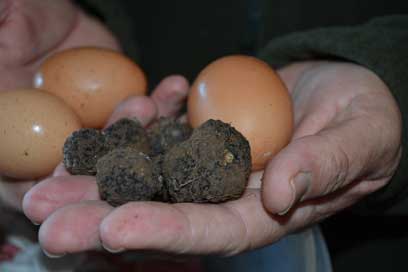
In fact, the Perigord is known for producing the very best black truffle, an aromatic fungus resembling a small black potato. To experience this local treasure, I spent a delightful morning at Truffiere de Pechalifour, the truffle farm of Edouard Aynaud, learning the art of truffle hunting.

Truffle farmer Edouard Aynaud

After meeting the high-energy Edouard, we entered a glass-doored, yellow stone building, where Edouard snaps open the lid of a large plastic bowl holding several black truffles, and thrusts it in my face. “Smell this,” he says in French, insisting that once you have this scent in your head, you’ll never forget it.

Truffle farm
Edouard’s truffle-sniffing border collie

The valuable black truffle, sometimes called the Black Diamond, can command 1,000 Euros per kilogram, since the demand is always greater than the supply. Our host holds up a kiwi-sized truffle and we play “how much is this truffle worth?” My husband wins with his guess of 10 Euros, when the small scale records the truffle’s weight as 10 grams.

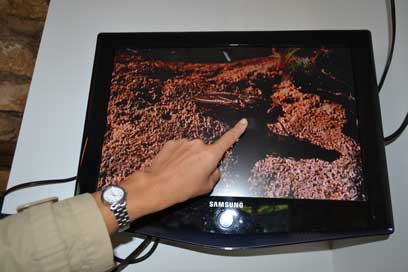
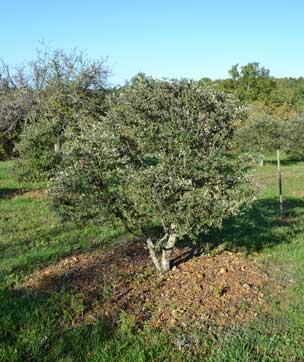
Now the lesson begins: truffles grow at the base of oak and hazelnut trees. The spores of the truffle form a web of mycorrhizal filaments that permeate both the soil and the roots of the trees. These filaments help the trees obtain nutrients from the soil, and in turn, the trees provide the truffle with needed sugars. Once this network spreads, there is a telltale brown circular area around the base of the tree called a “burn.” In the wild, this symbiotic relationship occurs with luck.

Map of truffle "burn"

Here on the 10-acre Pechalifour farm, Edouard’s father planted his first trees in 1968. Today new tree seedlings with truffle spores grafted onto their roots are planted in the hopes of increasing the truffle crop. Edouard holds up a 2-foot-tall oak seedling to illustrate, and tells us that you must plant it and pray, and maybe in several years (3? 6? 10?) the telltale “burn” will appear. He explains that sadly, not many young people are getting into this business because it requires so much patience and optimism.

Edouard, however, personifies optimism and joy, explaining his craft in rapid-fire French (admirably translated by our local guide) and punctuated with animated facial expressions and gestures worthy of Marcel Marceau.

Once the “burn” is identified, there are three methods to locate the truffles beneath it:

  1. With a pig. Grinning, Edouard holds up a Cracker-Jack-toy-sized pink plastic pig to illustrate. Furthermore, he continues, it must be a female pig. Why? Because the truffle scent mimics that of a male pig sex hormone.
  2. With a stick. Now he whacks a slender willow stick several times across the length of the table. Tapping a stick around the area of the “burn” disturbs a little brown fly that likes to lay its eggs on a ripe truffle, so that its larvae can feed on the nutrients. A short video illustrates that the fly’s brown color renders it invisible at rest. But once disturbed, the fly will rise up and then return to the location of the truffle, which must be harvested before the egg-laying, larva-eating process begins.
  3. With a dog. The dogs must be trained while they are very young to recognize and search for the truffle scent. For that, Edouard uses the plastic film containers used before the age of digital photography. He pokes holes into the container and fills it with cotton that has been moistened with truffle oil. Then for one week he plays fetch with his canine student, rolling the container a little distance away, and rewarding the pup with treats and love when the prize is returned. The next week he hides the container in corners or behind something, and again rewards its return with treats and praise. The third week he buries the container outside under a little bit of soil and waits three days so that it no longer carries his human scent, but only the scent of the truffle, before sending the dog to find it. At the end of three weeks, with lots of praise and treats, the dog is trained.

Suddenly we are aware of a yellow labrador and a young black and white border collie snuffling around our feet, obviously eager to get to work. Edouard grabs a basket, some dog treats and a digging tool, and assuring us that he did not hide truffles ahead of time for us to find, we begin our spirited trek though the trees.

Pointing out brown fly in “burn” area where truffle lie

Walking slightly ahead of us, Edouard sees the telltale “burn” around the base of a tree, and gives his dog the command. Within seconds, the dog sniffs and puts his paw on a spot. Edouard scoops up a handful of the moist soil and sniffs it, crowing gleefully when he detects the scent of the hidden truffle. He pushes into my hands the special two-sided truffle-digging tool: pointed pick at one end, flat scraping blade at the other, and tells me to dig — but gently! We’re not digging up potatoes!

Tree with signs of a truffle underneath

Soon my delicate poking isn’t fast enough for him and he rakes his fingers through the mud until he isolates the prize. After pointing to exactly where I should look, he lets me make the final discovery. Voila! There it is — and it’s tennis-ball HUGE! But, alas, it is spoiled inside because of the recent unfavorable weather. Edouard rewards his dog with a treat and a cuddle, and then crushes the truffle with his fingers and reburies it on the spot, so its spores can sprout again.

The best months for harvesting ripe truffles in the Perigord is December, January and February, and then only if the weather conditions have been favorable — too much rain and they grow too fast and don’t ripen at the right time. All in all, it’s a business that needs luck — and lots of dog treats.
www.truffe-perigord.com

Eating in Oxford: From the Traditional to the Trendy

Food shop inside the Oxford Covered Market

By Sharon Hudgins
Photos by the author

Since the Middle Ages, the English university town of Oxford has been attracting scholars hungry for knowledge. Today it also draws hordes of tourists hungry to see its Gothic colleges, top-notch museums, colorful gardens, lively student hangouts and cozy pubs.

We all know that sightseeing is a strenuous activity that boosts your appetite. And Oxford offers plenty of places for filling empty stomachs as well as hungry minds. In this historic “city of dreaming spires,” you’ll find something to suit every taste, from traditional English pork pies to sushi rolls, from falafel sandwiches to chocolate fudge, from goat cheese pizza to the best of British cuisine.

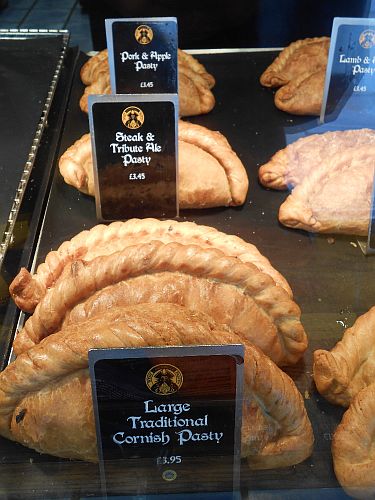
Classic Cornish pasties at West Cornish Pasty Company on Cornmarket Street

FAST FOOD
In a town full of students, there’s no dearth of fast-food joints. Skip the inevitable McDonald’s and KFC, and head for the simple eateries offering more typical British fare. The West Cornish Pasty Company on Cornmarket Street sells very good versions of these traditional English turnovers with a selection of savory fillings. Many other takeout places, including supermarkets, offer fresh sandwiches stuffed with prawns, sliced cucumbers or egg salad, perfect for a picnic on a hot summer day. And food trucks parked around the edges of the central city cater to eaters on the go, selling a variety of takeaway dishes from India, Pakistan and the Middle East, as well as British standards such as “toad-in-the-hole” (succulent sausages baked inside Yorkshire pudding batter).

Pasties
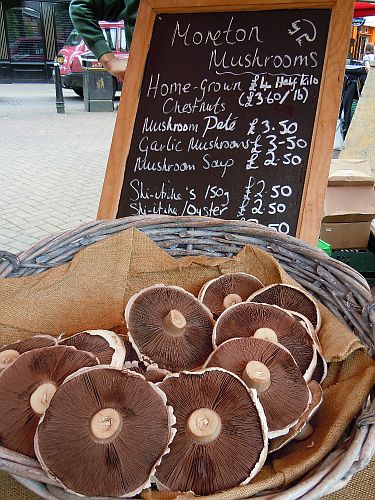
Mushroom stand at the weekly Oxford open-air market

OXFORD COVERED MARKET
Opened in 1774, Oxford’s venerable covered market is one of the city’s most popular tourist attractions. In addition to its fruit, vegetable, meat, fish and cheese stores, it includes several little shops selling cooked foods to nibble on site or take away. Choose from an eclectic group of eateries: a “Brazilian Cheeseball” stand, a “Sooshe” bar, Nash’s Oxford Bakery, David John’s traditional butchery and meat pie shop. An especially popular place is Pieminister, which offers several kinds of freshly made, double-crust, meat or vegetable pies served with “mash” (mashed potatoes), “groovy” (gravy) and “minty mushy peas” (just what they sound like).

Plates of custard
Traditional English pie with gravy at Pieminister in the Oxford Covered Market

PUB GRUB
Oxford’s historic pubs are famous as much for their denizens as for their beer. You can quaff a pint of British bitter or English ale in the same spots where Thomas Hardy, Lewis Carroll, J. R. R. Tolkien, C. S. Lewis, Graham Greene, the fictional Detective Inspector Morse and many other Oxford luminaries wet their whistles. Pubs also serve food, sometimes the best bargains for a full (and filling) meal in Oxford. Typical dishes include fish-and-chips (battered-and-fried fish filets with French fried potatoes), Scotch eggs (hard-boiled eggs surrounded by sausage meat and deep fried), “Ploughman’s Lunch” (thick wedges of cheese and a slice of ham served with apple slices, sweet pickle relish, bread and butter) and “jacket potatoes” (aka baked whole potatoes, in their skins) with a choice of toppings: Cheddar or blue cheese, pork and beans, sautéed mushrooms, even meaty (or vegan beany) chili.

Traditional English ale at an Oxford pub

(left to right) Food shop inside Oxford Covered Market; Cottage loaves for sale at the weekly Oxford open-air market; The Bear, one of Oxford’s famous traditional old pubs

Purchase a guide to Oxford’s pubs at the Visitor Information Center on Broad Street or at many bookstores. You can also buy a postcard depicting 36 classic pubs for an “Oxford Heritage Pub Crawl.” My own favorite pubs include The Bear, The White Horse Inn, The Rose and Crown, The Lamb and Flag, The Eagle and Child and The Head of the River.

Head of the River
Head of the River, a favorite Oxford pub with a large beer garden

TEA & SWEETS
You can’t visit England without having afternoon tea—a civilized sit-down with a pot of freshly brewed tea, finger sandwiches and baked goods (such as scones with jam and clotted cream, and a selection of scrumptious cakes). Several cafes advertise afternoon tea with a sign in their front windows. Some upscale restaurants also serve formal “teas” between 3:00 and 5:00 p.m. For an elegant experience in the grand old English manner (with prices to match), “take tea” in the drawing room of the Macdonald Randolph Hotel across from the Ashmolean Museum.

If you just need to satisfy your sweet tooth, stop in at Nash’s Bakery in the Covered Market for traditional British pastries, or head for the Fudge Kitchen on Broad Street, which sells more than 20 different flavors of fudge made fresh daily.

Man makes dough, Oxford
Handmade fudge at the Fudge Kitchen on Broad Street

RESTAURANTS
Oxford has a wide range of full-service restaurants to fit any budget. Local foodies especially like Brasserie Blanc, on Walton Street, owned by one of the most respected chefs in Britain, Raymond Blanc; Jamie’s Italian, on George Street, one of a chain owned by another famous chef, Jamie Oliver; Gee’s, an Oxford landmark on Banbury Road; The Old Parsonage, on Banbury Road; and Magdalen Arms, a “gastropub” on Iffley Road. Look for fixed-price lunches of two or three courses for approximately £12 to £17 per person. Some restaurants also offer the same deal for “early supper” between 5:30 and 7:00 p.m.

Oxford plate
Luncheon appetizer at Gee’s Restaurant on Banbury Road

Oxford has no lack of Asian restaurants, from Indian to Chinese, Japanese, Thai and “Asian fusion.” Popular Asian eateries include My Sichuan, Shanghai 30’s, Majliss, Saffron, Chiang Mai Kitchen and Wagamama.

And for your big splurge, drive out to Raymond Blanc’s Le Manoir aux Quat’ Saisons in Great Milton, just seven miles east of Oxford. This fine restaurant has garnered two Michelin stars and won many other culinary accolades. You’ll be tempted to stay overnight at the historic manor house, too. Just be sure to make reservations well in advance, for both the hotel and restaurant. Dining there is an experience you’ll never forget.

● Travel tip: The Oxford Visitors’ Guide, a handy booklet that costs only £1 at the Oxford Visitor Information Centre (15/16 Broad Street), contains a short history of the town, a map, a brief description of the colleges and their opening times, Top 10 Things to Do, a self-guided walking tour, and vignettes of Oxford’s most famous characters. Also pick up a free copy of the Oxford Restaurant Guide booklet.

● Online travel information: www.visitoxfordandoxfordshire.com/travel-information/Tourist-Information.aspx

Additional restaurant information online:

● www.oxfordrestaurantguide.com

● www.visitoxfordandoxfordshire.com/see-and-do/Eating-and-Drinking.aspx

Making Tracks to Dinner on the Diner

From tea in a British buffet car, to luxury dining on the Trans-Siberian Express, eating on trains can be a true culinary adventure.

By Sharon Hudgins
Photos by the author

I grew up riding trains across America just before the era of classic passenger service ended on the railroads and before Amtrak was a gleam in the government’s eye. Later I rode trains all over Europe from northern Scotland to central Italy, from the coast of France to the plains of Hungary. And in Russia I’ve logged nearly 40,000 miles on the legendary Trans-Siberian Railroad, crossing the continents of Europe and Asia between Moscow and Vladivostok several times.

That’s also a lot of dining on trains, snacking on railroad station platforms and eating at station buffets.

DINING ON BRITISH TRAINS
I remember riding first class on British Rail across England and Scotland many years ago, when smartly uniformed stewards served tea in your private train compartment, first spreading a starched white cloth on the little table under the window, then pouring the hot brown brew from a silver-plated teapot into a porcelain cup (with milk added first or last depending on where you stand on that contentious issue). A small plate of sweet biscuits (cookies, in American English) always accompanied the tea. What a civilized way to spend a morning or afternoon, sipping tea, nibbling on biscuits, and watching the British countryside roll by outside the window.

Morning coffee and afternoon tea were included in the price of the ticket. But like many travelers on trains all over the world, I often chose to save money on meals by purchasing food from station vendors to eat on the train. Once in a while, however, I’d splurge on a meal in the dining car, luxuriating in the “white-tablecloth service” and the selection of foods that were so different from those I’d eaten on American trains.

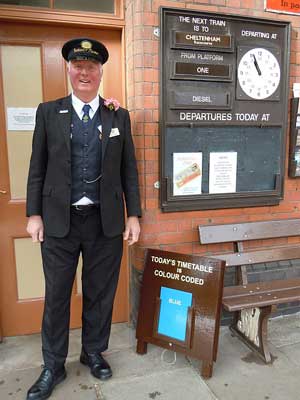
(left) Conductor on the Cheltenham Flyer, historic steam train of the Gloucestershire Warwickshire line of the British Great Western Railway.

Traditional English pork pie from the buffet aboard the Cheltenham Flyer

Alas, in 2011 contemporary trains in Britain did away with the last of their full-service dining cars, replacing them with airline-type meals served at the seats of first-class passengers and microwaved snacks sold in the buffet car for everyone else. But there’s hope for the future: In 2013 the First Great Western Railway re-introduced full-service “Pullman dining,” with fine wines and locally-sourced foods, on the UK’s only remaining regularly scheduled train with a real restaurant car. But, strangely, the dining services don’t operate on weekends or public holidays!

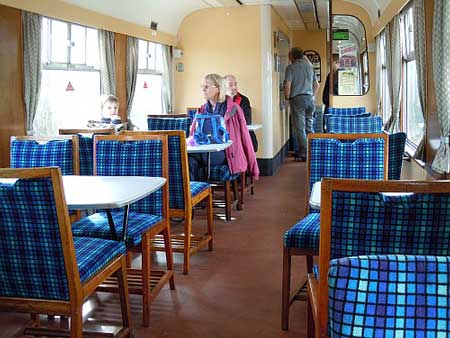
Restored 1950s-era buffet saloon car on the Cheltenham Flyer

However, special tourist trains in Britain, including many historic trains, still provide a range of enjoyable culinary experiences. Recently I traveled through England’s lovely Cotswolds countryside on the historic Cheltenham Flyer, a 1930s-era steam train that chugs along the Gloucestershire Warwickshire branch of the Great Western Railway, which has been operating trains in western England since 1838. The train included a restored 1950s “buffet saloon car” whose menu offered Scotch eggs, pork pies, bacon rolls, homemade flapjacks and homemade cakes, along with a range of hot and cold drinks, alcoholic and non-. At certain times of the year, the historic trains running on these rails also offer special culinary tours, from Fish & Chips Specials to Ale & Steam Weekends (sampling 24 real English ales) to Luxury Pullman Style Dining Experiences with multi-course meals served on china plates, accompanied by wines poured into crystal glasses.

CONTINENTAL RAILROAD DINING
The railroad dining experience on the European continent varies from country to country, type of train, and distance of travel. Some local trains have no dining facilities at all. Others have only a small snack bar or buffet, or vendors who come through the train with a cart stacked with packaged foods and canned drinks. Some have a full-service dining car, with a menu featuring multi-course meals and a selection of wines. If fine food and white-tablecloth dining are an important to you on a rail journey, then you need to seek out the trains that have a separate dining car and well rated menus.

For the ultimate in Old World luxury train travel (and dining), book a journey on the Venice-Simplon Orient Express, a modern revival of that classic train, which operates several tours of different lengths between London and Istanbul. The trains also feature three beautifully restored dining cars from the 1920s, with haute cuisine to match. Wear period dress to dinner, and you’ll feel like you’ve stepped back in time into an Agatha Christie novel.

Who could resist the special Swiss Chocolate Train that takes you on a day trip to a cheese-making factory, Gruyères Castle, and the Cailler-Nestlé Chocolate Factory in Broc for cheese and chocolate tastings at those stops? Travel in a vintage Pullman Belle Epoque-era train car or in a sleek, ultramodern panoramic car with large windows for viewing the Swiss Alps, the vineyards surrounding Montreux and the medieval town of Gruyères along the route. Bring along a shopping bag and leave your calorie counter behind.

Don’t overlook the foods to be found inside train stations, too. If you don’t want to spend big bucks to travel on a luxury train but you still like to eat well, you’ll find plenty of choices at many of Europe’s train stations, particularly those in the larger cities. I’ve been especially impressed with the train station buffets and take-out selections at major Swiss, German and French stations, as well as those in capital cities such as Budapest and Madrid. But for the ultimate in elegant, nostalgic, train-station dining, don’t miss the beautifully restored Le Train Bleu (The Blue Train) restaurant in Paris’s Gare de Lyon—a Belle Epoque-style restaurant with a pricey French menu and a gorgeous decor to match.

DINING ACROSS CONTINENTS
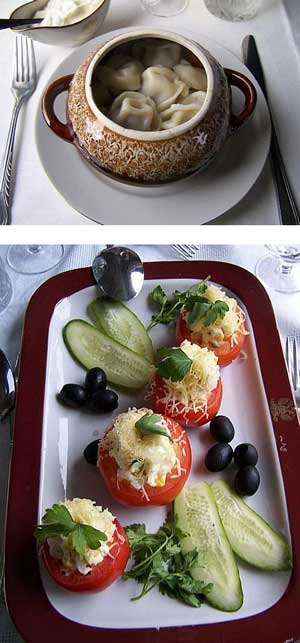
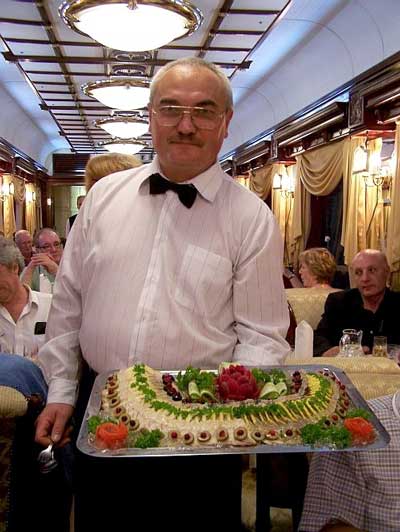
Finally, for the travel adventure of a lifetime, board the British-owned, Russian-operated Golden Eagle Trans-Siberian Express whose route covers nearly 6,000 miles between Moscow and Vladivostok. Almost half that distance is on the European side of Russia, from Moscow to Kazan to the Ural Mountains. Each comfortable cabin on this luxury train has its own private bathroom. And three times a day, professional chefs in the a fully equipped kitchen car turn out freshly cooked meals featuring regional specialties, all served in an elegant dining car designed to evoke the Golden Age of train travel. During the 12-day journey across Europe and Asia, the menu is different at every meal except breakfast. On this longest train trip on earth, you’ll have plenty of time to enjoy the best of Russian cuisine and international wines while watching the fascinating changes of scenery outside the dining car windows.

So wherever you travel by train in Europe, enjoy the experience of dining on (and off) the diner. It’s a great way to taste a wide variety of regional foods and expand your culinary and geographic horizons at the same time.

For more information see:

Experience Meissen Culture

The Meissen Manufactory in Meissen, Germany, home of the famous Meissen porcelain, should be added to any visit of this German city. Taking a tour of Albrechtsburg Castle, where it all began, is also necessary to learn the origins of this porcelain, followed by a factory tour in town.

At the factory, you can also sign up for special events, such as the two listed below, led by the knowledgeable Beate Debernitz.

TEA, COFFEE AND HOT CHOCOLATE—THE THREE EXOTIC HOT BEVERAGES
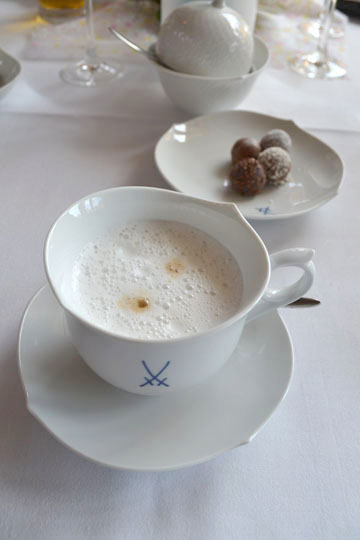
Funny and interesting facts about the three exotic hot beverages—tea, coffee and hot chocolate, and about the varied shapes of Meissen tableware are presented in an entertaining manner. Coffee, tea and hot chocolate are served in an appropriate cup of Meissen porcelain, together with a small sweet delicacy. Visitors can enjoy the proverbial Saxon Gemutlichkeit. The tour takes about an hour.

TABLE CULTURE AT MEISSEN
A three-course meal served on famous Meissen porcelain services from three centuries provides pleasant insights into table culture, past and present. Entertaining stories are shared about table culture, table manners and the delights of the table, as well as table arrangements then and now. Duration of the program is approximately two hours.

For more information, go to Meissen.com