The Museum Shops of Paris

Photos courtesy the Paris Convention and Visitor’s Bureau


Museum shops. Parisian museums present the opportunity to combine culture with shopping. After a visit, you can pick up the hottest new design object to take home; find a special work on architecture, science, or cinema; or choose the latest trendy image or object as a souvenir.

THEMATIC AND SPECIFIC SHOPS
Museum shops offer works and objects of a high quality representative of those found in the exhibitions themselves. They often present the opportunity to find rare or very specialized objects, recordings, or books.

Close to the Jardin des Plantes, the bookshop of the Institut du Monde Arabe, designed by Jean Nouvel, has many precious items. Once through the entrance of this magnificent institution encased in moucharabiehs, the shop offers insight into Arab culture with high-quality exhibition catalogs and books on photography, architecture and craftsmanship.

Cinematique Francaise
Cinémathèque Française

In the Bercy district, the bookshop of the Cinémathèque Française is housed in a building designed by the architect Frank O. Gerhy. This bookshop for cinema buffs is situated on the mezzanine of the Cinèmathèque and is the main reference for cinema in Paris. Books about the history of cinema, experimental cinema and film music, as well as posters, and photos are for sale.

The bookshop at the Jeu de Paume, at the Place Concorde, is a landmark bookshop for all areas of photography, the visual arts and cinema, and has built a collection of more than 10,000 titles. The bookshop also operates a high-quality mail-order service for visitors abroad.

The huge bookshop Harmonia Mundi is located between the concert hall and the Musee de la Cita de la Musique, at the entrance to the Parc de la Villette, in north Paris. Lovers of classic, jazz and world music can choose from among the 9,000 CD and DVD references and benefit from the advice of professionals.

Linked to the Cité de l’Architecture et du Patrimoine, just across from the Eiffel Tower, the Moniteur Bookshop is entirely devoted to the subject of architecture and stocks works on architecture, town planning and heritage.

NATIONAL MUSEUMS
The national museums in Paris also have their prestigious shops. The Musée du Louvre shops, in several locations at the Carrousel, sell elegant objects like reproductions of jewelery and sculpture from the museum’s collections, as well as a selection of monographs by artists, essays and art books.

The Musée d’Orsay, a former train station built for the World Fair of 1900, has a delightful shop inspired by the collections of the museum selling posters, table and home decor objects, and exhibition catalogs.

Finally, the Flammarion bookshop at Beaubourg, in the Centre Pompidou, offers exhibition catalogs, postcards and multimedia products as well as a large selection of publications on art and design.

Musee d’Orsay

CONTEMPORARY SHOPS
Some museums boast highly-contemporary shops designed like a second exhibition area to extend the length of a visit and offer a sales area with a striking decor. The ultra-trendy Palais de Tokyo, powerhouse of the contemporary artistic avant-garde, close to the Eiffel Tower, asked the graffiti artist André, the creator of the character of Monsieur A., to design its Blackblock gift shop. The design of the shop was inspired by a gas station in the suburbs of Stockholm. Encircled by refrigerated glass windows with integrated pink lights, the shop displays rare objects and limited editions. The space is also regularly used for special events.

In another vein, Le Laboratoire has opened near the Louvre; it is an experimental venue at the crossroads of science and contemporary creation with a bookshop called Laboshop. A veritable bubble in white, the shop invites visitors to discover a variety of prototypes that have been devised and created by participants at the venue, and which it is possible to test or buy. Among the most astonishing, “the Whiff” is a process which enables you to eat by inhalation, while “the Bel-Air” is a filter that enables plants to filter the air. These unique objects are signed by Designer Mathieu Lehanneur, and scientist and founder of this unique place, David Edwards.

The mezzanine of the Centre Pompidou, a dynamic Parisian cultural institution, houses the Printemps du Design, a shop with a grey concrete floor and minimalist windows. It offers 3,000 types of objects around five themes: living, savoring, charming, communicating, getting around and playing. Eggcups, seats, cameras, jewelery, sweets and spinning tops catch the eye. Striking for its selection and display of objects, it offers design classics as well as the latest in contemporary creations.

The 107 Rivoli is the sales area of the Musée des Arts Décoratifs, close to the Tuileries Gardens in the center of the capital. Specializing in specific areas of the decorative arts, fashion and design, the shop offers a rare selection of books, accessories, stationary, tableware and toys. For more up-to-date shopping, celebrities and designers are invited to suggest a selection of special objects for the duration of an exhibition or an event.

The new Galerie de l’Opéra is a gem of a shop situated within the prestigious Palais Garnier. A place to discover talents and trends in Europe, it specializes in the operatic and choreographic arts and is divided into four areas: multimedia library, art for children, memory, and performance, and is linked to the artistic program of the famous institution. Educational games, designer objects, books, technological or even signature and showcase objects already make this a cult address for the latest in museum shopping.

Shop of l'Opera
Galerie de l’Opéra

Palais de Tokyo

The prestigious Pinacothèque de Paris, situated opposite the Madeleine church, rounds off this tour of contemporary museum shops. Its shop showcases French and European designers who are not well-known to the general public, like the La Tonkinoise jewelery brand, for example. There is also a great selection of items for children: memory games, card games, wooden toys; and for adults, superb decorative objects and even luxury stationary.

For the curious and contemporary art buffs, there is the Merle Moqueur, situated in the north wing of the Halle Curial at the Centquatre, the city of Paris art establishment in northeast Paris. The shop features an epoxy floor, suspended acoustic cassettes and ramps with fluorescent lighting. Reference works for children and adults are offered in the different sections: general, youth and arts.

Also centered on contemporary creations, the bookshop of the Maison Rouge in Paris, Bookstorming, has wall decoration by the artist Jean-Michel Alberola. Books on art, monographic works, and critical essays, as well as many original works are on sale. Numerous events and encounters with artists and authors, like book signings, talks and video displays are featured regularly.

The bookshop of the Musée du Quai-Branly, situated on the Seine quayside near the Eiffel Tower, is devoted to art from outside Europe. This unique place offers a variety of ethnic objects while advocating the values of fair trade, for example with A-Typik and its Colombian jewelery, whose profits go to the reconstruction of schools in Colombia.

UNUSUAL SHOPS
Reflecting the museums in which they are housed, this type of shop offers unusual and miscellaneous articles.

At the Musée de la Poste, the shop Correspondances offers a fine choice of objects linked to the role and history of the Post Office: original postcards, objects and ideas for gifts.

Below Sacré-Coeur in Montmartre, the Halle Saint-Pierre is an exhibition area showing unusual and popular primitive art. The bookshop of the Halle Saint-Pierre is as surprising as the museum. Built of iron and glass, it houses books on art and literature, often illustrated and covering all types of contemporary creation.

Not far from the Halle Saint-Pierre, in north Paris, the shop of the Musée de l’Érotisme caters to shopping with an aphrodisiac edge. On sale are books of modern art and erotic photographs, and old films and comic strips on the same theme.

There is also the bookshop of the Hôtel de Sully, located in a 17th-century mansion. This exceptional establishment presents national heritage treasures and heritage publications.

The shop of the Monnaie de Paris delights fans of coins, medals and jewelery.

The bookshop of the Musée de la Chasse et de la Nature, situated near City Hall, offers atypical shopping opportunities with very specialized literary and artistic publications on the subjects of nature and hunting.

For honing technical and scientific knowledge, the shop of the Musée des Arts et Métiers offers fine objects and books linked to the current exhibitions. Badges, fans, model aircraft, and literary works provide a close-up view of the fascinating world of technology.

Finally, in the Hôtel de Saint-Aigan, in the heart of the Marais, the bookshop of the Musée d’Art et d’Histoire du Judaïsme offers a selection of varied objects and books on religion, philosophy, history and ethnography, continually updated according to what’s at the museum.
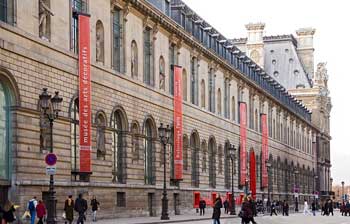
Musee des Arts Decoratifs
Hotel de Sully

Designer Hotels of Paris

Photos courtesy Paris Convention and Visitors Bureau

Designer hotels: everything started in Paris a few years ago with the trend toward boutique hotels.

The term is used for small capacity hotels with three or four stars, which offer clients a personalized and attentive welcome and a particularly refined and cozy decor.

Following the success of this type of hotel, certain hotels decided to take the concept further by entrusting their decor to interior designers and architects and providing their guests with a contemporary atmosphere: designer furniture, use of new materials, the latest technologies and contemporary works of art.

Some hotel groups have made this design orientation their speciality. This is the case for the Murano Hotels and Resorts, which owns the Murano Urban Resort Hotel and the Kube
Rooms and Bars Hotel
 in Paris. The first, located between République and Bastille on the edge of the Marais, drew attention with its immaculate white design aesthetic, its bar lounge with colored seats, its lobby with a huge contemporary fireplace and its guest rooms which mix high-tech and state-of-the-art design. The second, located in the north of the capital, applies the same formula to the design of its guestrooms and offers an out-of-the-ordinary experience with its bar completely made of ice.

The Astotel group also offers 15 Parisian hotels where the designer touch captivates guests in search of a contemporary atmosphere. This is the case at Le 1223 Elysees, a hotel where beautiful materials (Swarovski crystal, marble, etc.) provide a contemporary feel, or at the Hotel Joyce, which combines the latest technology gadgets (iPod stations) with products answering to the needs of today’s travelers (a range of organic products), all in a contemporary decor that play on the codes of traditional hotel charm and character (outlines of bed heads and features of interior decor drawn on the bedroom walls).

The Relais de Paris group reinvents the classic Relais style with a contemporary, designer version. The BLC Design Hotel offers an immaculate white setting in the Charonne district. The 29 guest rooms all have a monochrome look, combining refined furniture with black and white photographs.

At the Standard Design Hotel, not far from the lively Bastille District, black and white begins in the reception areas. The young designers invited to decorate the hotel have created a contemporary, trendy place. The Color Design Hotel, between Bastille and the Gare de Lyon, lives up to its name and offers guests lively colors with special touches in the guest rooms and bathrooms. The vaulted breakfast room follows the same concept with a contrast provided by exposed stonework. Located in the picturesque Montmartre district, the Chat Noir Design Hotel plays the designer card while respecting the traditional Parisian style of this area. The decoration amusingly evokes the shadow plays that gave the Théâtre du Chat Noir its reputation, while offering refined white furniture complemented by warm orange and brick tones.

The wave of designer hotels can be found in all districts of Paris, each revealing a leading concept and specific style of decoration. Another example in the Latin Quarter is the Five Hotel. This hotel’s concept is the awakening of the five senses: smell with fragrances created just for the Five, touch with the use of sensual materials in the guestrooms and particularly the ultra-contemporary reinterpretation of Chinese lacquer, taste with a breakfast of the best Viennese pastries from the Monge bakery, sight with the fibre-optic lighting effects and luminous atmosphere of the bedrooms, and hearing appeased by the hotel’s silence.

In the same neighborhood, the Hotel Design de la Sorbonne has had a makeover and offers an upscale and elegant designer stay. Dark wallpaper, luxury fabrics and a contemporary photography exhibition on every level set the tone of the establishment.

The Hotel Le A, in the heart of the fashion district between the Champs-Élysées and the rue Saint Honore, mixes an ultra-designer look of the interior decor with a cozy feel in the reception areas designed to look like those of a private apartment, with a contemporary-style fireplace, comfortable couches, lounge with a library filled with art books, a bar under a 19th century glass roof and 25 sumptuous guestrooms where a refined sober style contrasts with bold contemporary drawings decorating the walls.

In a more understated style, design is also honored at the Hotel Arvor Saint-Georges, in the peaceful 9th arrondissement. The 30 guestrooms offer the tranquility of a contemporary and convivial private residence. In the 14th arrondissement, LeFabe Hotel stands out from the rest with its 17 guestrooms, each offering an original atmosphere. The names of the rooms (Mona Lisa, Orchidées, Together, etc.) are an indication of the designer decoration offered to guests. In the 16th arrondissement, Mon Hotel, a small establishment of 37 guestrooms a few steps from the Champs-Élysées, boasts luxury designer decor with the use of materials like leather, Alcantara fabric, and wood.

LE 123 ÉLYSÉES
123 rue du Faubourg-Saint-Honoré, Paris 8th
Tel +33( 0)1 53 89 01 23
www.astotel.com/hotel-le-123-elysees-paris.php
HOTEL LE A
4 rue d’Artois, Paris 8th
Tel +33 (0)1 42 56 99 99
www.paris-hotel-a.com
HOTEL ARVOR SAINT-GEORGES
8 rue Laferrière, Paris 9th
Tel +33 (0)1 48 78 60 92
www.arvor-hotel-paris.com
BLC DESIGN HOTEL
4 rue Richard-Lenoir, Paris 11th
Tel +33 (0)1 40 09 60 16
www.blcdesign-hotel-paris.com
CHAT NOIR DESIGN HOTEL
68 bd de Clichy, Paris 18th
Tel +33 (0)1 42 64 15 26
www.hotel-chatnoir-paris.com
COLOR DESIGN HOTEL
35 rue de Citeaux, Paris 12th
Tel +33 (0)1 43 07 77 28
www.colordesign-hotel-paris.com
HOTEL DESIGN DE LA SORBONNE
6 rue Victor-Cousin, Paris 5th
Tel +33 (0)1 43 54 58 08
www.hotelsorbonne.com
LE FABE HOTEL
113 bis rue de l’Ouest, Paris 14th
Tel +33 (0)1 40 44 09 63
www.lefabehotel.fr
FIVE HOTEL
3 rue Flatters, Paris 5th
Tel +33 (0)1 43 31 74 21
www.thefivehotel.com
HOTEL JOYCE
29 rue la Bruyère, Paris 9th
Tel +33 (0)1 55 07 00 01
www.astotel.com/hotel-joyce-paris.php
KUBE ROOMS AND BARS
1-5 passage Ruelle, Paris 18th
Tel +33 (0)1 42 05 20 00
www.muranoresort.com
MON HÔTEL
1 rue d’Argentine, Paris 16th
Tel +33 (0)1 45 02 76 76
www.monhotel.fr
MURANO URBAN RESORT
13 bd du Temple, Paris 3rd
Tel +33 (0)1 42 71 20 00
www.muranoresort.com
STANDARD DESIGN HOTEL
9 rue des Taillandiers, Paris 11th
Tel +33 (0)1 48 05 30 97
www.standard-hotel.com

Paris Avec Famille

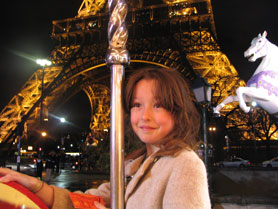
Sophie at the Eiffel Tower

By Susan MacCallum-Whitcomb
Photo by the author

Ahh, Paree! For most of us, the City of Light is synonymous with culture, cuisine and romance.

When you visit, you’re supposed to spend your time in world-class museums and Michelin-starred restaurants. You’re supposed to take intimate strolls by the River Seine. You’re not supposed to take your children. Right? Wrong.

In fact, Paris is extremely kid-friendly. Part of the reason is that the locals-–who tend to take their own enfants everywhere-–are so welcoming. But it is also because Paris itself seems reassuringly familiar to children.

Some discover the French capital as toddlers courtesy of Ludwig Bemelman’s Madeline books; other make vicarious visits with Eloise, the Aristocats, the Rugrats, even the ubiquitous Olsen Twins. Hence its big-ticket attractions already have a built-in appeal. Take Notre Dame Cathedral: 800-year old churches don’t normally top a child’s itinerary. But, as the setting for Disney’s Hunchback movies, this one is an exception to the rule. Since it is literally the center of the city–the place from which all distances are measured-–it also makes a fitting starting point for your family’s monumental adventure.

CAVERNOUS INTERIOR
After spinning around the cavernous interior and “reading” the stories in the stained-glass windows, older kids can drop a few euros to descend into the pre-Roman Crypte Archeologique or climb the towers for a close-up look at Quasimodo’s home turf.

Younger ones, meantime, may prefer to plop on a bench in adjacent Viviani Square. Thanks to the uncluttered view of Notre Dame it offers, they can amuse themselves by playing “spot the gargoyle” (one looks suspiciously like Disney’s Laverne) and feeding the world’s most gregarious pigeons.

Compared to the cathedral, the Eiffel Tower is a relative newcomer. Yet it’s a certifiable icon, and you’ll likely feel compelled to scale it. Of course, every other tourist in town will too. So to avoid the worst crowds, try arriving early on a weekday and taking the elevator straight to the third level. Tickets are steep (11.50€ /6.30€ for ages 3-11); but on a clear morning the vista is priceless. Alternately, bring the kids after dark to see the tower lit up like a super-sized Christmas tree. For the full effect, arrive on the hour (dust to 2 a.m. in summer) when 20,000 individual bulbs sparkle in a 10-minute display.

ARC DE TRIOMPHE
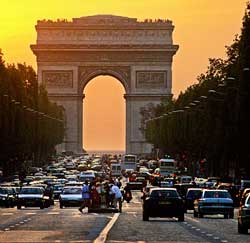
For those who’d rather look at the Eiffel Tower than be on it, the Arc de Triomphe is another option. Napoleon’s tribute to his troops might not seem like a natural choice for families: after all, it’s perched on the site where Paris’ 12 main avenues converge and is surrounded by an obscenely-busy traffic circle. Nevertheless, children routinely give it the “Coolest Tall Thing” award. That’s because it’s wide open at the top. Unlike the Eiffel Tower (which is enveloped in mesh) there is nothing creepy or cage-like to impede their view-–and the sight of Paris, laid out like a star below–is impossible to beat.

Once you’ve soaked it all in, it’s time to hit the city’s famed museums-–some of which are aimed squarely at families. One such venue is the Science and Industry Museum. Its interactive “Cité des Enfants” is undeniably inviting: five – to 12 year-olds, for instance, can program robots while younger siblings play Bob the Builder at a mini construction site. However, the rules can be off-putting. Registration is required, limited numbers of guests are admitted and visits are restricted to 90 minute sessions. Kids are also streamed by age. So depending on your family structure, the trip can be a logistical nightmare.

Luckily, though, there’s no need to stick to the kiddy category when it comes to Parisian museums. Musée Rodin is a case in point. The esteemed sculptor’s estate in the seventh arrondissement is an ideal place to introduce youngsters to fine art. Sure its walls hide orderly flowerbeds, ornamental pools and a grand 18th-century mansion. But don’t let the formality fool you. In the garden, kids are free to play among famous statues; and inside visitors as young as four can sign up for regularly-scheduled activities (including tours complete with games and drawing sessions) that are priced between €4.50 and €6. 

KID PLEASERS
Musée d’Orsay, on the Left Bank, and the Pompidou Centre’s t&L=2″ Musée National d’Art Moderne, on the Right, are kid-pleasers as well. The former has a dazzling Impressionist and Post-Impressionist collection (think works by Monet, Renoir, Van Gogh and Cézanne), while the latter focuses on Modern masters like Picasso and Matisse. Both have intriguing architecture, plus bright bold canvases that appeal to kids. But the fabled Louvre, with its exhaustive-–and exhausting!-–supply of religious and historical paintings will seem pretty staid by comparison.

If seeing Mona Lisa’s smile is high on your personal to-do list, consider taking turns with   another adult. When one of you dips in, the family can relax just outside on the expansive lawns of Jardin du Tuileries. It’s easy to while away hours there bouncing on tres chic trampolines, sailing toy bateaus, riding carousel horses or graduating to real ponies (à la carte activities that cost a couple of euros each). Many of the same simple pleasures can be enjoyed across the Seine in Jardin du Luxembourg: a sixth arrondissement park which also happens to house the city’s best-loved marionette theater.

JARDINS ARE BACKYARDS

The beauty of both spots is that they’re not merely tourist attractions. In a city of apartment dwellers, these jardins serve as a backyard for countless families. So lingering in them qualifies as an authentic cultural experience, especially on weekends or Wednesday afternoons when local children are out of school. If your offspring have a smattering of French they can strike up a conversation with their Parisian peers. If not, don’t worry: they’ll quickly learn that the language of child’s play is universal.

For playtime on a grander scale, you can take the gang 20 miles north to Parc Astérix (35€/ 25€ for ages 3-11). Inspired by France’s favorite cartoon hero, it features dozens of amusements ranging from a classic wooden roller coaster to an ultra-modern corkscrew model. Twenty miles east of the city, meanwhile, is Disneyland-Paris: a 2,225-acre resort that proves it really is “a small world after all.” Said to be Europe’s #1 tourist attraction, it consists of two parks-–a Magic Kingdom and Walt Disney Studios-–with one-day passes to each costing  46€  (38€ for ages 3-11). 

FUN ANYWAY
Since these resemble their U.S. counterparts and recreate many popular rides (“Dumbo’s Flight” and “Rock’n’Roller Coaster” among them), Disneyland-Paris is often dismissed as an unnecessary Americanism. Who, naysayers may ask, needs a kingdom built around a faux castle when the countryside is full of the genuine article? For that matter, who needs a movie park dedicated to a foreign director when Jean-Luc Godard and François Truffaut are native sons? Well, nobody does. But they’re fun anyway. Besides, a dose of Disney is a great antidote for kids suffering a temporary case of culture shock.

The truth is that no matter how well prepared you are, your children will feel slightly disoriented at times. Moreover, touring with them will always be an added responsibility. Yet there are upsides. Kids, literally and figuratively, look at things from a different angle. Hence being with them will reveal sites and scenes that are typically hidden from vacationers. All you have to do is slow down and savor the experience. Remember, parents don’t get bonus points for ticking off every attraction listed in their guidebook. The real reward comes from building a store of family memories that you all can share. ET

Take a Pass: Admission charges add up fast, so a  Paris Museum Pass is just the ticket for pennywise parents. Priced from €30 for a two-day version, it gives adults unlimited entry to more than 60 museums and monuments – including all of those mentioned above except for the Eiffel Tower. Children don’t need one because so many of the attractions are already free for guests under 18 (that’s a big plus when your traveling companions have short attention spans!). Better still, the whole family benefits since the pass also allows all of you to jump those lengthly lines.

ABOUT THE WRITER
Living up to her turn-of-the-millennium resolution, freelancer Susan MacCallum-Whitcomb jettisoned her professorial robes and traded teaching for full-time travel writing. In the years since, she has spent an inordinate amount of time doing research in Europe — much of it with her family in tow!  The results can be read in Fodor’s guidebooks (she’s contributed to six thus far) as well as Fodor’s online newsletter, and a host of Canadian magazines and newspapers. When not jaunting around the continent, Susan enjoys taking it easy in her sublime home base: Halifax, Nova Scotia.

Ireland Tops Paris for Best Destination in 2011

An imprint of the global publishing giant Wiley, Frommer’s is one of the travel market’s leading authorities and most trusted online content and guide book producers. Every year its editors, authors and experts from around the world select the best cities, islands, beaches and other vacation destinations and decide on the destinations that are going to be big news for travelers in the coming year.

Its Top Destinations list aims to steer travelers clear of too-hot spots or places so under the radar that travelers could find themselves lost. The list also includes the Frommer’s Readers’ Favorite Destination.

“Last year’s favorite Paris was beat out this year by the very tourist-friendly nation of Ireland,” the company says. “During the nominations process, supporters told us why they were putting the Emerald Isle on their wish lists for the following year.”

Those reasons were comments praising Ireland’s rugged beauty, the people, the history, lush countryside and opportunities to ramble and explore.

Ireland received 29% of the overall vote from the 10 destinations up for nomination and pipped Paris in the readers’ vote for best destination by just 1%.

The other places up for nomination were Alaska, Hawaii, Australia, Egypt, Italy, Germany, New Zealand, Greece and Paris. More than 7,300 ballots were cast for the awards.

www.frommers.com
www.discoverireland.com

Christmas in Paris

By Sharon Hudgins
Photos by the author

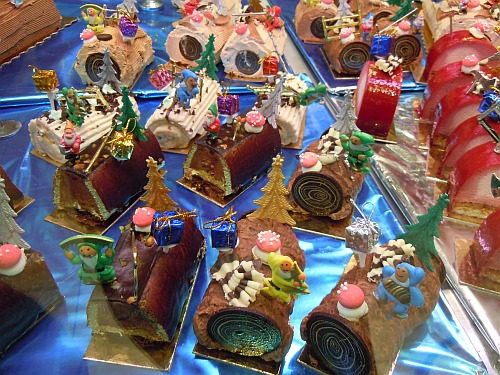
Parisian bakeries sell many versions of the traditional Buche de Noel (Yule Log) Christmas cake.

Paris is a great city to visit any time of the year—for fine foods, outstanding museums, and romantic walks along the Seine in the pink glow that often suffuses the city at twilight.

Many tourists want to see Paris in the spring. Remember the song, “April in Paris”? Or the movie of that name, with Ray Bolger and Doris Day? And who could forget Gene Kelly dancing among the blossoms with Leslie Caron in An American in Paris? But did you know that Paris is also a wonderful place to spend the winter holidays?

WINTER ROMANCE
Paris in winter has something for everyone. Open-air and indoor Christmas markets throughout the city. Nativity scenes and sacred music concerts in historic churches. Menorahs and special Hanukkah foods in the Jewish delis and bakeries. Strings of sparkling lights across the grand boulevards. Outdoor ice-skating rinks decorated with Christmas trees. Children’s noses pressed against the glass of department store windows animated with fanciful displays. Cheerful families toting wrapped packages in the subway. Smiling vendors at the food stalls. Even friendly waiters in the restaurants.

More than a dozen colorful Christmas markets brighten up the city, some open for only a few days in December, others lasting six weeks or longer, from the start of Advent (the fourth Sunday before Christmas) through Epiphany (Three Kings Day on January 6). Some Christmas markets specialize in products from a particular part of France, such as Alsace, whereas others feature handmade crafts by local artisans. Paris’s newest food fair, Noël Gourmand, is also held in December, at the Carrousel du Louvre, a glitzy underground shopping mall in the heart of the city. There you can taste French regional products such as artisanal cheeses from the Basque region, wines from the Loire, meats from the Ardennes, and sweets from Provence. And no Christmas market anywhere in Paris would be complete without roasted chestnuts, chewy nougat, and hot spiced wine.

CHRISTMAS DINNER
If you want to enjoy a special meal at a restaurant on Christmas Eve, make reservations early. Many restaurants are closed on the evening of December 24, and even more are shut on Christmas Day. A fun alternative is to pick up some good wine, cheese, bread, and a traditional French Christmas cake, a bûche de Noël (Yule log), to take back to your hotel for a private holiday picnic in your room. Then head to one of the gorgeous gothic churches for a memorable midnight service by candlelight.

You can feast even more lavishly if you rent an apartment through Airbnb or one of the other agencies that offer apartments in Paris year round. Have fun (and save money) by purchasing foods and wines at little local grocery stores and big open-air markets, then bring them back to your apartment for a cozy dinner at home. Even if you don’t want to cook, you can buy excellent prepared foods such as pâtés, cheeses, rotisserie chickens, cooked seafood, Burgundy beef stew, Spanish paella, North African couscous, fresh breads, and luscious French pastries at the delis, department stores, bakeries, and pastry shops all over Paris. Wine shops will also recommend the best vintages to accompany your store-bought meal. And if you don’t feel like lugging all that food back to your apartment, some stores will even deliver groceries and wines free of charge or for a small fee.

RING IN THE NEW YEAR
New Year’s Eve on December 31 is the time to party at a restaurant, with friends and strangers, until the early hours of the morning. Many Parisian restaurants offer a special Réveillon dinner, a fixed-price, multi-course, New Year’s Eve meal with champagne. Some smaller places charge as little as €50 per person (with wine extra), or you can splurge at the high-end eateries for several hundred euros apiece. Wherever you choose to eat, reservations are a must.

On a recent New Year’s Eve, my husband and I celebrated at Restaurant Polidor, a relic of France’s culinary heritage. Polidor still serves the same kind of simple, old-fashioned, very affordable comfort food like you could find in little Paris bistros half a century ago. Nothing trendy or minimalist-modern here—just small wooden tables covered with red-and-white checked paper tablecloths, bentwood chairs set close together, dark wood wainscoting, big mirrors on the wall, and plenty of nostalgia atmosphere. Filmgoers will recognize Polidor as the place in Woody Allen’s film, Midnight in Paris, where Gil Pender meets Ernest Hemingway back in the 1920s. And indeed, Polidor has been feeding the famous and the not-so-famous ever since it was established in 1845.

If you’re a cat lover and missing your own felines when you’re away from home, you can even celebrate New Year’s Eve in the company of 16 rescue cats at the cozy Cafe des Chats Bastille, one of Paris’s two cat cafes, where the furry friends roam free among the tables. And wherever you choose to party, you don’t have to worry about drinking that extra glass of champagne and staying out really late. From 6 p.m. on New Year’s Eve until 5 a.m. the next day, the Paris subway runs continually overnight, and it’s even free of charge.

GIFTS OF THE MAGI
Finally, finish up your Parisian holiday with a special treat on January 6, Three Kings Day. In all the pastry shop windows you’ll see round, flat pastries with a gold paper crown on top. These are galettes des Rois, the traditional King’s Cakes of northern France. A small porcelain or plastic prize is baked inside the cake, which is made from layers of puff pastry often with a frangipane filling. Whoever gets the slice with the prize inside is crowned “king for a day.” At some Three Kings Day parties, the prize-winner also has to buy drinks for everyone around the table.

So let Paris wish you not only a bon appetit, but also a Joyeux Noël (Merry Christmas), a Bonne Année (Happy New Year), and a Bonne Fête des Rois (Happy Three Kings Day) on your next trip to France!

For more information:

Paris Christmas markets 2016

Noël Gourmand 2016

Restaurant Polidor

Le Cafe des Chats

Apartment rentals in Paris (Airbnb)

Apartment rentals in Paris