Even a 45-minute lecture can prepare you for the sights and scenes of Germany
Story and photos by Sharon Hudgins
Cruise Lecture Teaches History, Culture If you watch Masterpiece and other programs on public television in America, you’re probably familiar with the phrase, “Viking. Proud sponsor of…”—accompanied by images from Viking’s “longboat” cruises on the Rhine, Mosel, and Danube rivers in Europe. Other times you see wanderlust-invoking scenes from Viking’s ocean-going fleet, which sails the Atlantic and Pacific oceans, the Baltic and Mediterranean seas, and beyond, encircling the globe. And occasionally you’ll see the two new Viking polar-class expedition ships, the “Octantis” and “Polaris,” that sail to Antarctica in the Southern Hemisphere and the Great Lakes in the Northern Hemisphere.
Since 2017 I’ve had the pleasure of being a guest speaker on Viking Ocean Cruises in Europe, giving lectures on historical, cultural, and culinary topics aboard ships sailing from Viking’s home port in Bergen, Norway, to most of the countries bordering on the Baltic Sea.
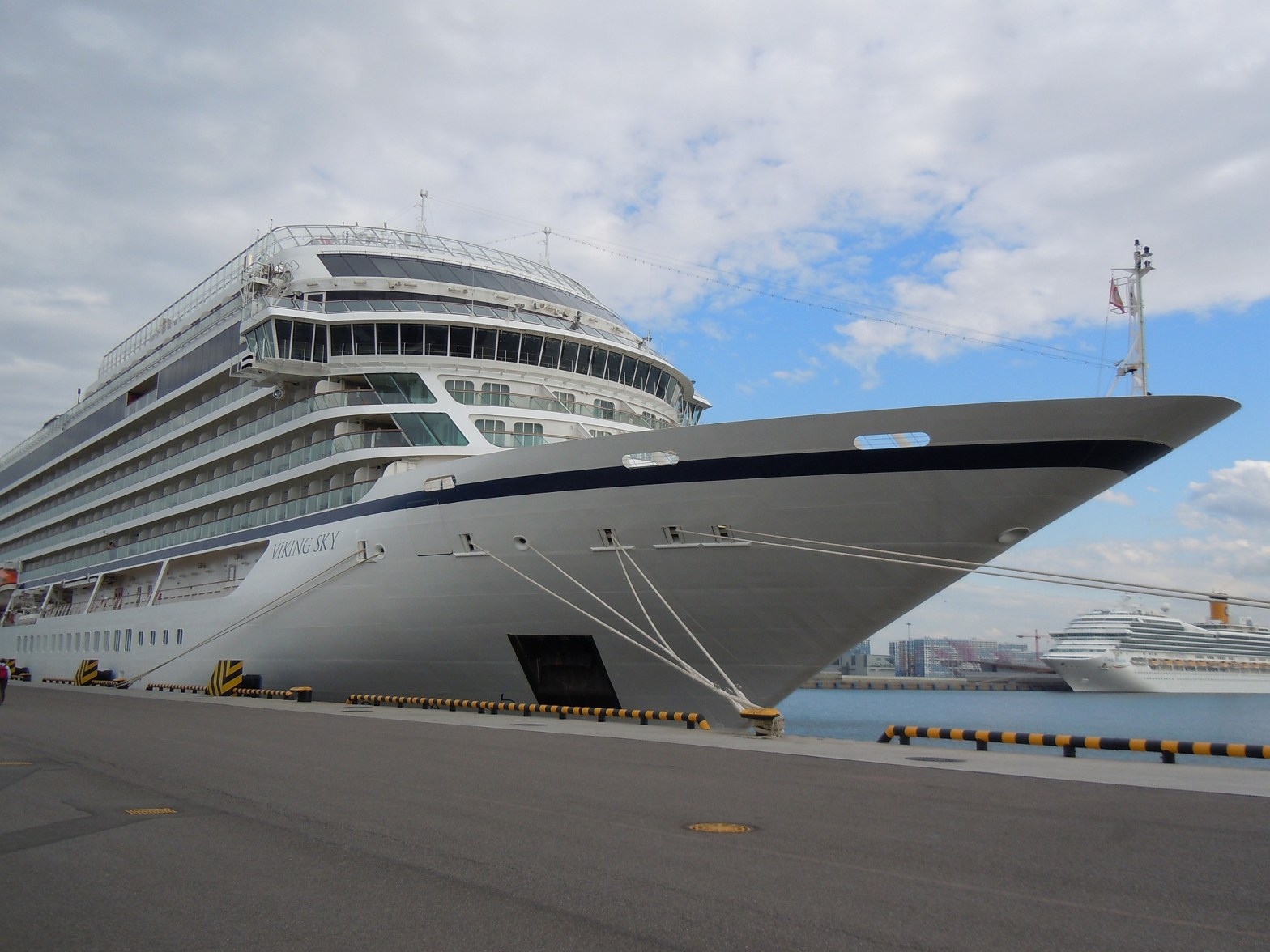
The “Viking Sea” ship docked at a Baltic port.
That itinerary follows the routes of the Hanseatic League, the medieval trading confederation that linked the countries of England, northern Europe, and Russia, and also the routes of the earlier, historical Vikings, who plied the waters of the Baltic, too.
Viking prides itself on focusing on the history and cultures of every country on its itineraries. So the cruise director on each ship schedules lectures about those destinations one or two days before the ship arrives in a port, to prepare passengers for the sights, sounds, and tastes of each new country they visit.
While the cruise ship guests are away during the day on shore excursions to a variety of places in those countries, the ship’s staff refills the vessel’s fuel tanks, cleans the guest rooms and public spaces, restocks food supplies, and prepares meals for hungry passengers when they come back on board. The singers, dancers, and musicians also use that time to rehearse their next shows on stage.
Cultural Stereotypes and Truths So what does that have to do with Germany? Many cruise lines sailing in the Baltic dock at the busy German port of Warnemünde. I’ve lost count of how many times I’ve been to Warnemünde and the surrounding area, as a guest speaker on Viking, National Geographic-Lindblad, and Oceania cruises, as well as on press trips for journalists gathering new material for articles to write. But only on Viking cruises have I had the opportunity to present a 45-minute illustrated lecture about that entire country of Germany, a nation I often think of as “my second home.”
I begin with a short introduction telling how long I lived in Germany (15 years) and what I was doing there (teaching for the University of Maryland’s education programs at U.S. military bases, writing for the Stars and Stripes newspaper). I also mention that for 28 years I was a writer for German Life magazine in America, too. Then I launch into my lecture: “Germany: Land of Laptops and Lederhosen.”
A lecture on “all-of-Germany” in 45 minutes? How is that possible? Not easy without being superficial, I assure you. And that’s exactly how I begin my lecture, showing pictures of the stereotypes that many people have about Germany: Men in Lederhosen. Women wearing Dirndls. Oompah bands and choral groups clothed in traditional Trachten, too. Half-timbered houses and fairy-tale castles. Foaming mugs of beer. Strings of sausages. Pretzels!
Then I point out that stereotypes often contain a grain of truth. But they’re only one part of a many-faceted story (or country), factors that exist side-by-side with all of them being true simultaneously.
Modern Germany – Regions and Festivals So I segue easily into modern Germany: High-speed highways. High-speed trains. High-tech industries. High fashion. Avant-garde art and architecture. Michelin-starred restaurants and Turkish döner kebab stands. And all those oh-so-wonderful German breads and pastries!
There’s no way anyone could condense centuries of German history into such a lecture. So I focus on Germany today, starting with Berlin and the country’s government (with a nod to the rise and fall of the Berlin Wall), and an overview of Germany’s population, literacy rate, national health insurance program, religions, and economy. The rest of my presentation is about the characteristics of its four main regions, from North to South, East to West, including those regions’ differing landscapes, architecture, industries, and cuisines. Then I conclude with—what else?—Oktoberfest! That world-renowned German beer festival brings me full circle back to the beginning of my lecture: The coexistence of stereotypes and deeper, often contrasting, realities in Germany today, a land of computers and cowbells indeed.
Viking Ships and Excursions Viking’s ocean vessels carry 960 guests, plus a large, well-trained crew. While in port, most of the passengers head off on shore excursions, and even some of the ship’s employees have a few hours of shore leave, too. When the ship is docked in Warnemünde, Viking offers half-day and full-day excursions to several locations in northern Germany: the Hanseatic cities of Rostok, Lübeck, and Wismar; a classic 19th-century spa town reached by steam train; the magnificent castle in Schwerin; the grim concentration camp at Sachsenhausen.
But the most popular destination is Berlin—six hours round-trip by special train, plus six hours of touring various parts of the city and its historical sites, by chartered buses and on foot with knowledgeable guides, or just exploring Berlin on your own. One excursion even includes lunch at the Reichstag, along with a special tour of that iconic building so important in Germany’s history.
Clockwise from left: The German Reichstag in Berlin, as seen from the Spree River. The modernistic Marie-Elizabeth-Lueders-Haus government building near the Reichstag in Berlin. The facades of many Berlin buildings are best viewed from a boat ride on the Spree River.
On my first Baltic cruise with Viking, the only time available for my Germany lecture was at 9 p.m. on the night before we docked at Warnemünde. Since half the 960 guests on that ship had signed up for the 12-hour shore excursions to Berlin the next day—and since they all had to get up at 5 a.m. to board the train at 6 that morning—I expected only a few people to attend my lecture that night. After all, passengers could always watch a video of it on television in their own cabins, any time later during the cruise. So I was surprised when half the ship showed up for that introduction-to-Germany lecture, filling the lecture hall.
The next evening we all returned from Berlin, tired but happy, after a full day of riding the rails through the German countryside, visiting one of the world’s great capital cities, and learning so much about Berlin’s special place in history. But another treat awaited us back in Warnemünde. A red carpet led from the cruise ship terminal across the pier to the ship’s gangway. Lined up along the sides were the ship’s officers and staff, from the captain to the cabin cleaners. At the terminal each guest was handed a glass of sparkling wine, which we all tried to balance in one hand while dancing along the red carpet to lively music, with many of the crew joining in, as we made our way back to the ship.
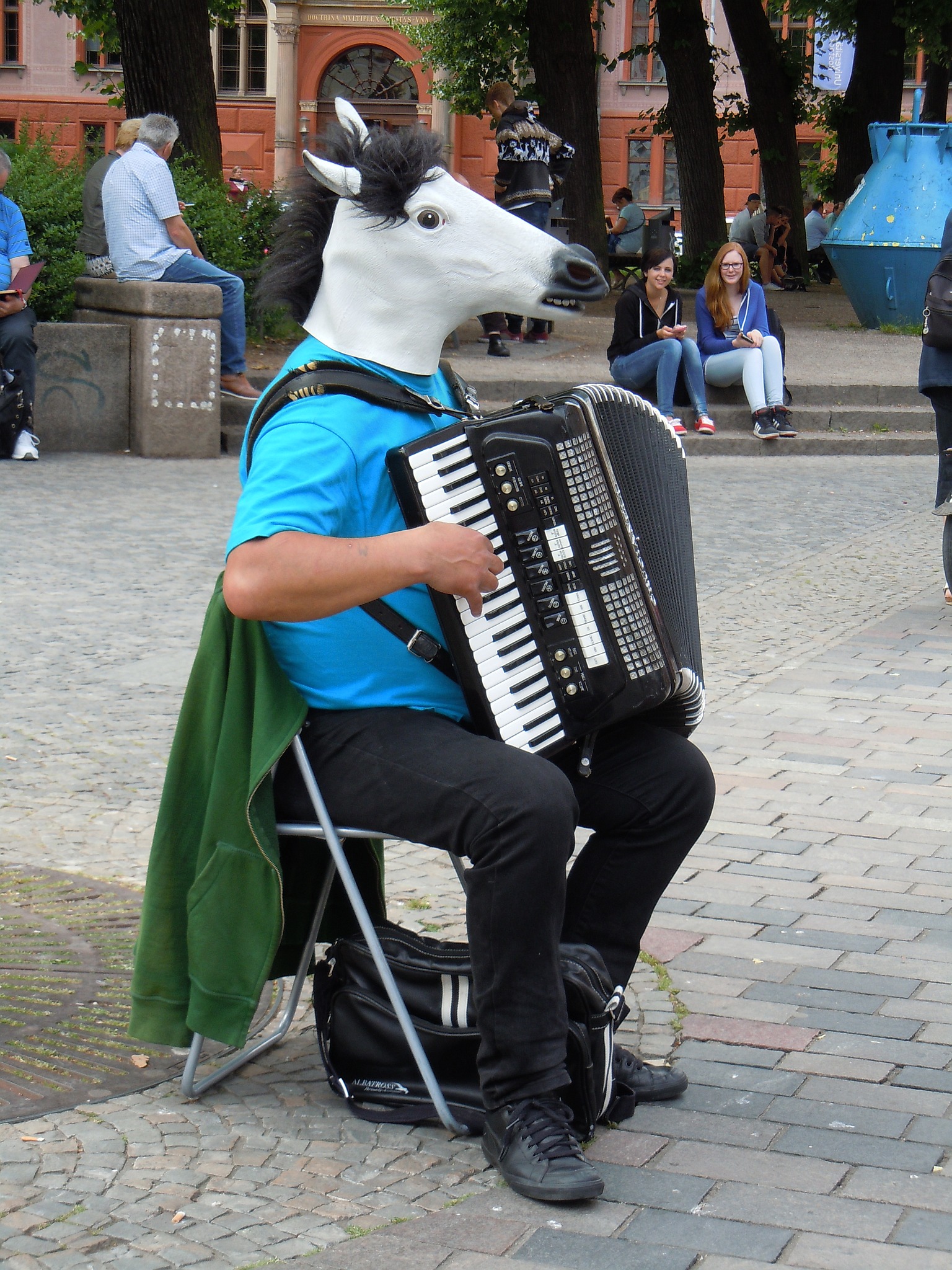
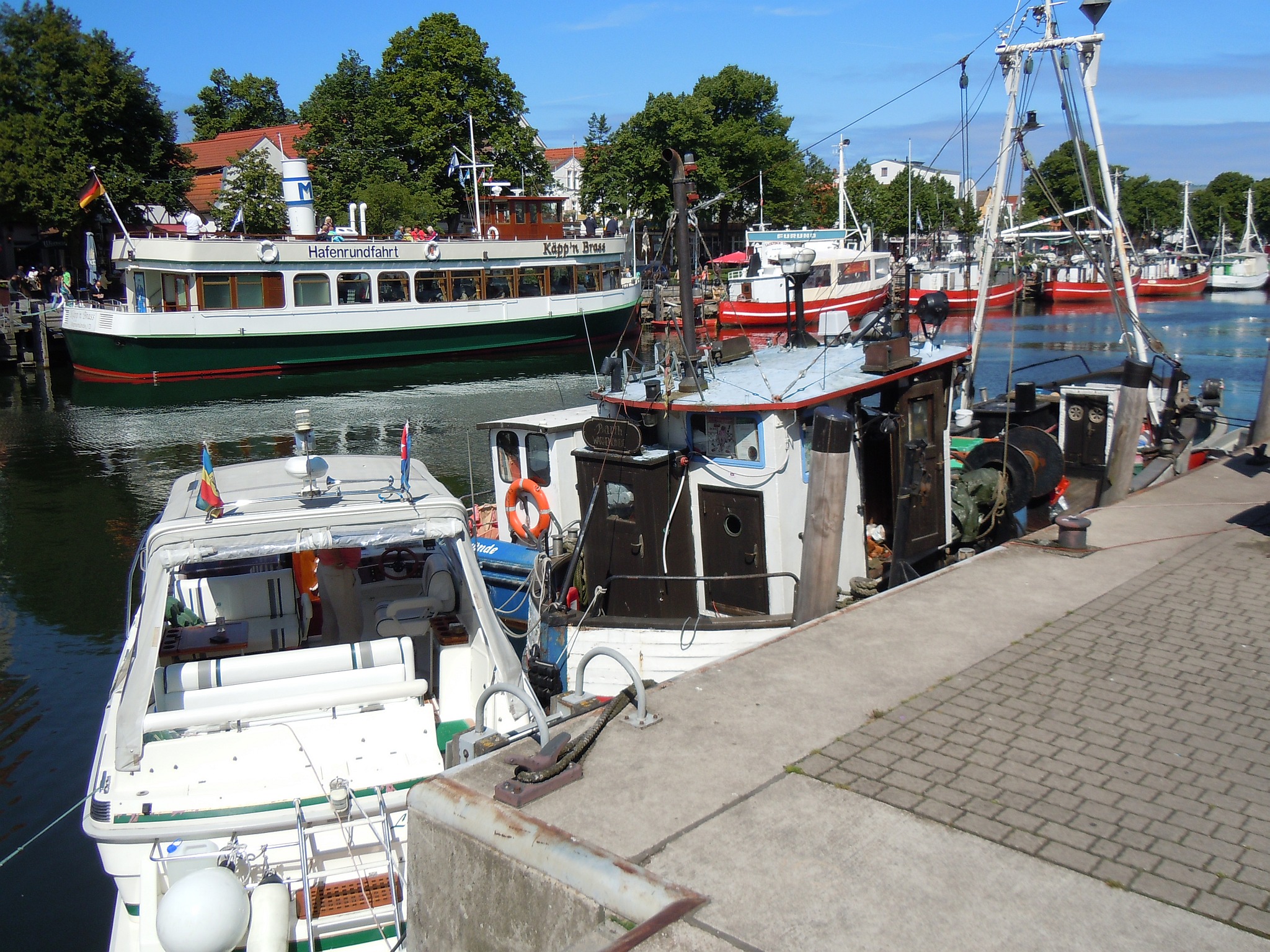
Top: One of the modernistic fountains in Rostock, a shore excursion destination on Viking Baltic cruises. Lower left: Street musician in Rostock, one of the cities on shore excursions from Viking ships docked at Warnemünde, Germany, on Baltic cruises. Middle and lower right: The colorful Alter Strom inner harbor at Warnemünde is always filled with small fishing boats and sightseeing boats.
German Culinary Delights on Deck Dinners on board that evening featured traditional German specialties, from Sauerbraten to Schnitzel, Black Forest Cherry Cake to Bavarian Cream. And of course plenty of German beers and wines, too! As we sailed away from Warnemünde, the only regret for me was leaving a country where I have such deep roots. But we still had five other Baltic countries to visit on that cruise, so who was I to complain about new adventures awaiting the next day? And there was always the prospect of another cruise, or even a different kind of job, bringing me back to Germany in the future.
One of the greatest rewards of working on tours in Germany has been introducing other people to such a fascinating country. Nothing compares with the feeling I get when a member of our tour group comes up to me and says, “Thank you for your lecture about Germany. Because of you, I saw the country with different eyes when we were there.”
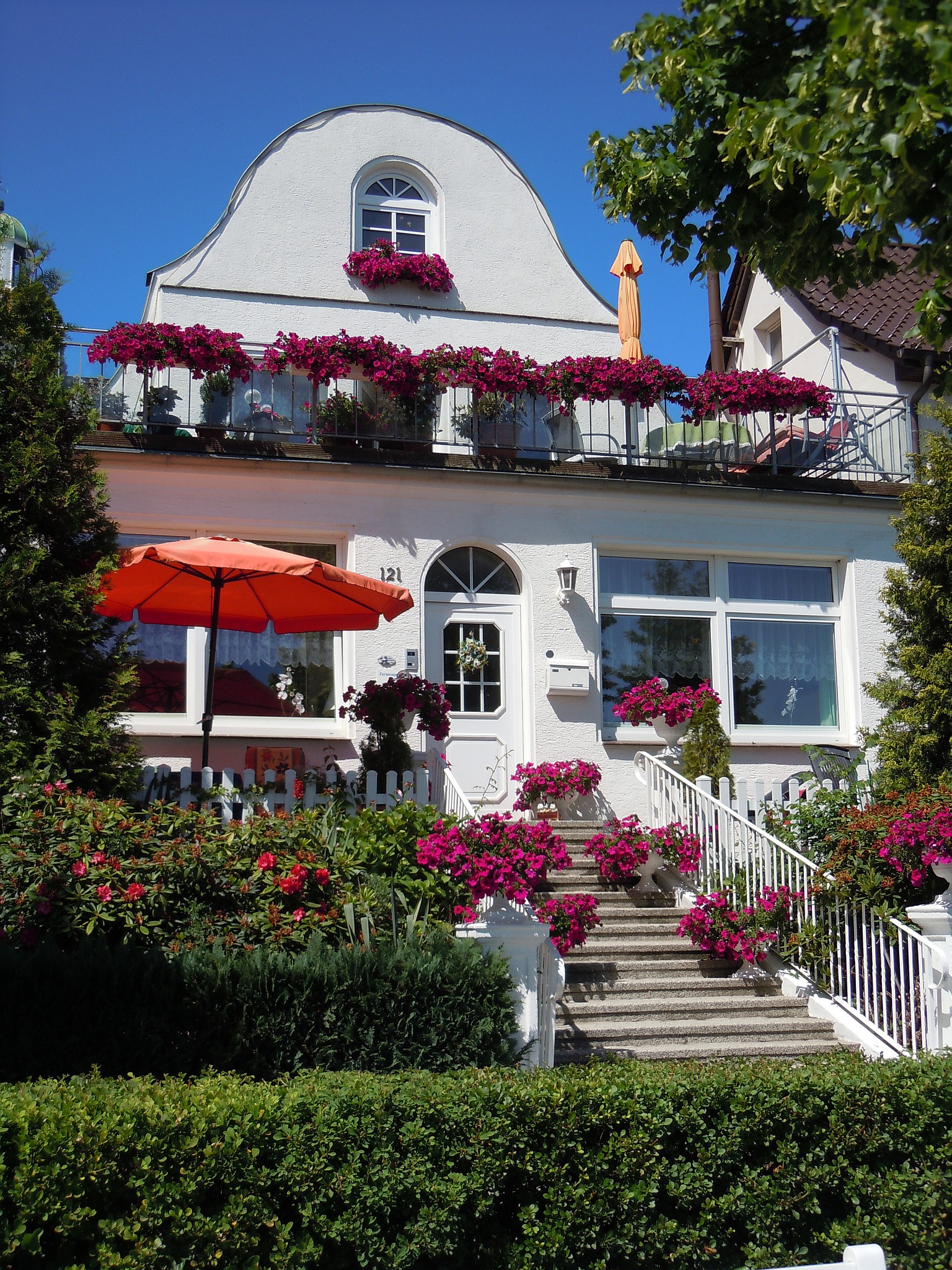
Left: One of the many pretty villas overlooking the waterfront at Warnemünde. Right: Sand sculpture at the cruise ship dock in Warnemünde.
Sharon Hudgins is a professional writer and a lecturer on educational tours to Europe, Alaska, and North Asia. See more at www.sharonhudgins.com
Visit Viking Cruises to explore cruise destinations and itineraries.
Wedged between Germany and France, this northern Swiss city abounds with traditional restaurants offering classic fare and Old World flair
By Randy Mink
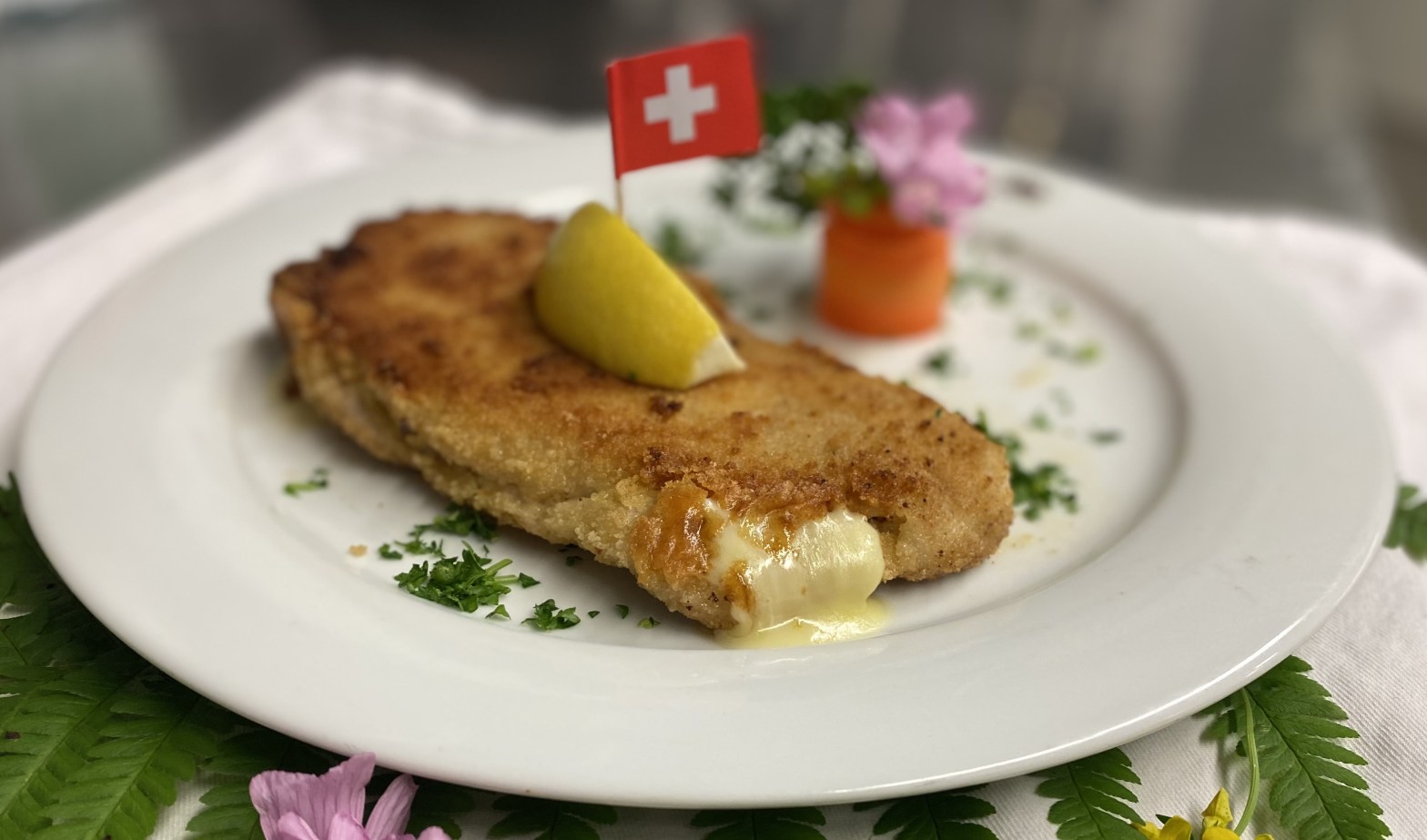
Served piping-hot and oozing with cheesy goodness, the veal cordon bleu at Zum Gifthüttli restaurant is something to savor, even drool over. Lunch in the wood-paneled dining room remains the warmest memory of my visit to Basel, the third-largest city in Switzerland.
After disembarking there from my week-long Rhine River cruise, I was most looking forward to exploring the medieval Old Town with its museums, churches, riverside promenades and specialty shops lining atmospheric alleyways paved with cobblestones. What turned out to be just as inviting, though, were the traditional, pub-style restaurants scattered about the historic core.
Cordon bleu is the house specialty at Zum Gifthüttli. We ordered the Classique, a juicy, golden-breaded schnitzel filled with ham and melted cheese, taking advantage of the Tagesteller (“daily plate”), a deal for 36.50 Swiss francs (about $43) that included french fries, pumpkin soup and dessert.
Gifthüttli, a traditional restaurant in Basel’s atmospheric Old Town, offers dining in the main-floor Bierstube, the upstairs Weinstube and at outdoor tables ideal for people-watching. (Randy Mink Photo)
Zum Gifthüttli’s menu lists cordon bleu variations, like the one with ham, cheese, asparagus, cherry tomatoes and Hollandaise sauce. Another consists of chorizo, mozzarella and herbs. The Florentiner has ham, cheese, spinach and a fried egg on top, while the Schweizer features two Swiss delicacies—Bündner air-dried ham and scrapings of raclette cheese. Opting for pork cordon bleu, instead of veal, can shave a bit off your bill, but any meal in Switzerland will cost much more than at home.
Guests at Gifthüttli can dine in the main-floor Bierstube, upstairs in the white-tablecloth Weinstube or, in warm weather, at outdoor tables offering the bonus of people-watching in Old Town’s pedestrian zone.
The white-tablecloth Weinstube at Gifthüttli offers a refined atmosphere. (Photo credit: Basel Tourism)
Fans of cordon bleu and antique charm also gravitate to Old Town eateries like Zum Braunen Mutz and Restaurant Löwenzorn. The latter offers tables in its historic rooms and in the idyllic courtyard garden, where blankets, furs and electric heaters keep patrons toasty in cooler weather. Löwenzorn favorites include the wienerschnitzel and traditional Swiss fondue.
Löwenzorn, a traditional restaurant in Basel’s Old Town, offers seating in historic rooms and in the courtyard garden. (Photo credit: Basel Tourism)
Restaurant Kunsthalle, a sophisticated but friendly Old World restaurant in the same building as the Kunsthalle Basel contemporary art museum, every winter opens its Fondue Stübli, a cozy fondue chalet next to the landmark Tinguely Fountain. Additional city-center spots for fondue (and other Swiss classics) are Walliserkanne and Safran Zunft.
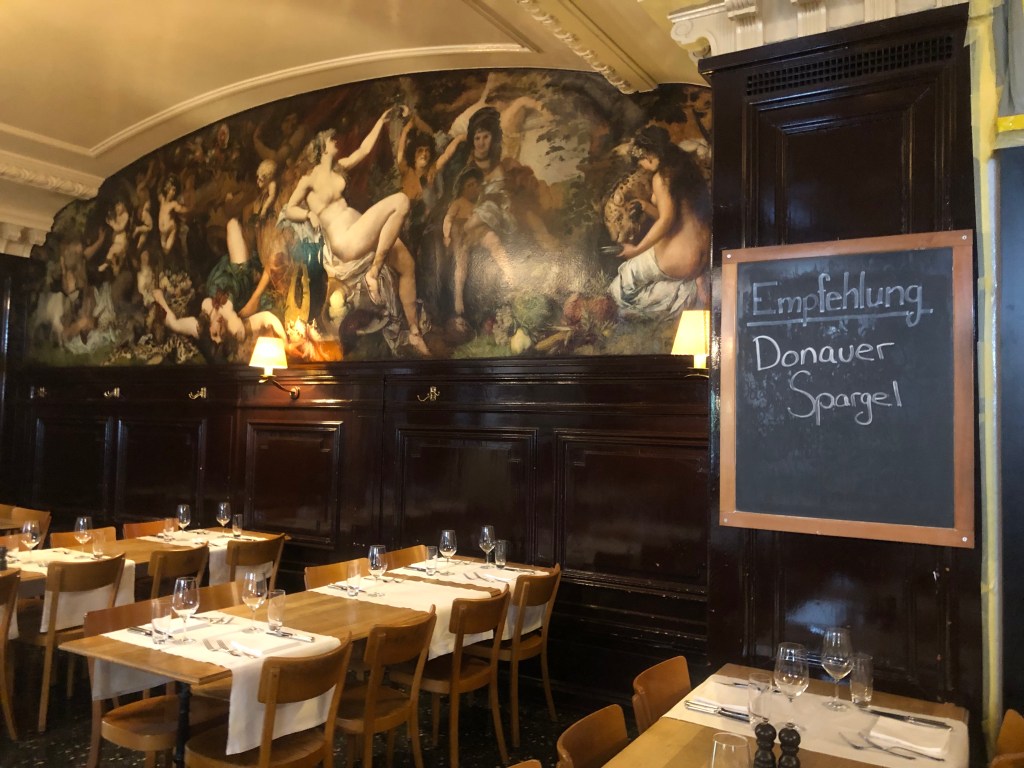
Patrons at Basel’s Restaurant Kunsthalle enjoy an Old World atmosphere in the vaulted Schluuch room. (Randy Mink Photo)
On our springtime visit to Restaurant Kunsthalle, we had a lunch of pasta amidst dark wood and classical cherub murals in the cozy, vaulted Schluuch room. The more formal “white” room overlooks the chestnut tree-shaded patio, one of Basel’s prime spots for alfresco dining. The Kunsthalle’s menu reveals typical Swiss fare, including Zürcher Geschnetzeltes (veal strips in a sauce of white wine, cream and mushrooms) with rösti, the ubiquitous Swiss version of hash browns offered at most restaurants that serve french fries.
No discussion of traditional dining spots is complete without a mention of Gasthof zum Goldenen Sternen, Basel’s oldest restaurant. Though it’s been at its current riverside location for only 50-some years, it date backs to 1412. In the 1970s the ancient building was dismantled and rebuilt stone by stone along with the original ceiling paintings and all the wood paneling. Highlighting the menu are highly regarded fish dishes—I had the lightly fried salmon filet with linguine. It also offers lamb shank, steaks and wienerschnitzel, among other entrees. The restaurant looks out on the Rhine River, and there’s outdoor seating under trees on the riverfront promenade.
Gasthof zum Goldenen Sternen, Basel’s oldest restaurant, enjoys a setting on the Rhine River. There is seating under trees on the riverfront promenade. (Photo credit: Basel Tourism)
The Goldenen Sternen (“Golden Star”) is located in the picturesque St. Alban quarter, a quiet neighborhood noted for its patrician townhouses, half-timbered buildings, narrow streets and a stream that powers the waterwheel at the Basel Paper Mill. Now a fascinating museum about the history of paper making and printing, the medieval mill, just steps from the Rhine and not far from Old Town, was one of many in St. Alban that made Basel a book publishing center for centuries.
Though skeptical about how interesting a paper museum could be, we found it eye-opening. Especially fun was watching demonstrations of how a pulpy goop is transformed into paper. We had a chance to make our own sheet as a souvenir. And we were surprised to learn that until the 19th century paper was made almost entirely from old rags and ropes that were sorted, cleaned, cut into strips and left to decay in a rag cellar’s rotting vats. There are even exhibits on the evolution of toilet paper, which was considered a luxury product when first introduced in the late 1800s.
Visitors learn about the history of paper and witness the paper-making process at the Basel Paper Mill, a museum housed in a medieval paper mill. (Randy Mink Photo)
Claiming nearly 40 museums, Basel has a museum for every interest, showcasing subjects ranging from cartoons and musical instruments to city history and Jewish culture. Most visited are its two leading art museums.
Kunstmuseum Basel, whose three-building complex holds the world’s oldest municipally owned public art collection, presents seven centuries of European art and boasts the world’s largest collection of paintings by the Holbein family. On the outskirts of Basel, Fondation Beyeler, comprising a main building designed by noted architect Renzo Piano, houses some 400 masterpieces of modern and contemporary art, including pieces by Picasso, Monet, Matisse and Cezanne.
Kunstmuseum Basel holds an impressive collection of paintings by Hans Holbein. (Photo credit: Basel Tourism)
The Basel Historical Museum, with exhibition halls under the vaulted ceilings of a former 13th century church, focuses on the intersection of the cultures of Switzerland, France and Germany. (From Basel, Germany and France are just a hike or bike ride away. Visible on the horizon are the Vosges Mountains of France and Germany’s Black Forest.)
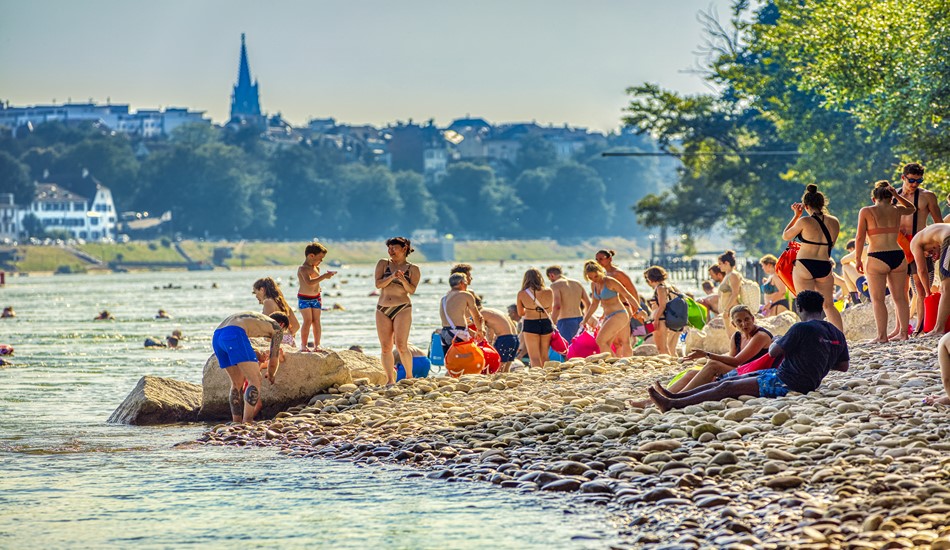
In the summer you’ll see people sunning on the riverbanks and swimming or floating in the river. Basel Tourism offices and retail stores sell something called a Wickelfisch, a brightly colored, fish-shaped waterproof bag for keeping your clothes dry as you whoosh down the river past city landmarks. It’s not to be used as a flotation device.
Frolicking in the Rhine River is a popular pastime with tourists and locals alike. (Photo credit: Basel Tourism)
Sightseeing cruises provide another way of experiencing the Rhine. Or you can take one of the small passenger ferries that shuttle back and forth between the larger southern part of the city (Grossbasel, or Greater Basel) to the northern side (Kleinbasel, or Little Basel) at four crossing points. Attached to a cable that spans the river, the non-motorized boats are guided deftly by expert ferry operators.
We took the five-minute ride from St. Alban to the opposite bank, then walked along the riverside path for 11 minutes before reaching the Museum Tinguely, a showplace for monumental mechanical sculptures created by world-renowned artist Jean Tinguely (1925-1991), who grew up and studied in Basel. Buttons allow visitors to activate some of the playful, mischievous and wacky creations, causing them to rattle, shake and whirl.
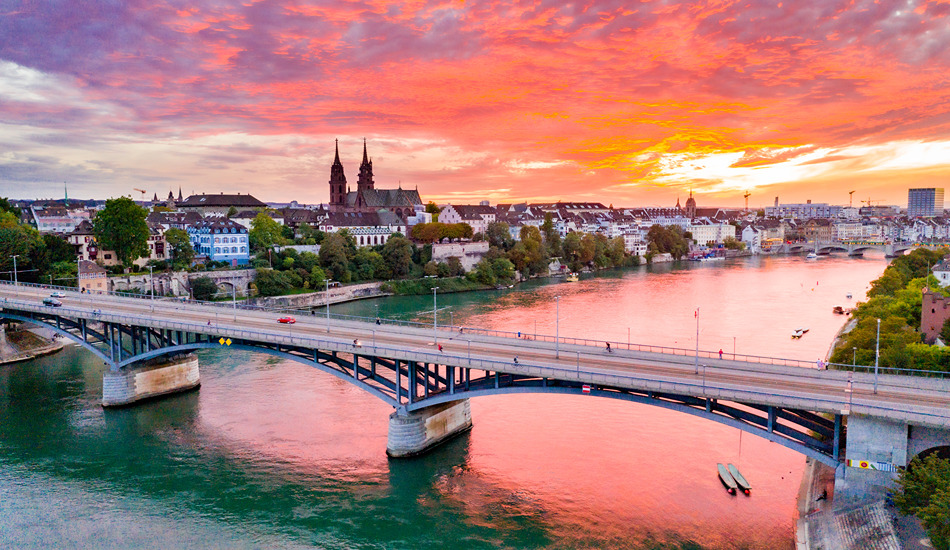
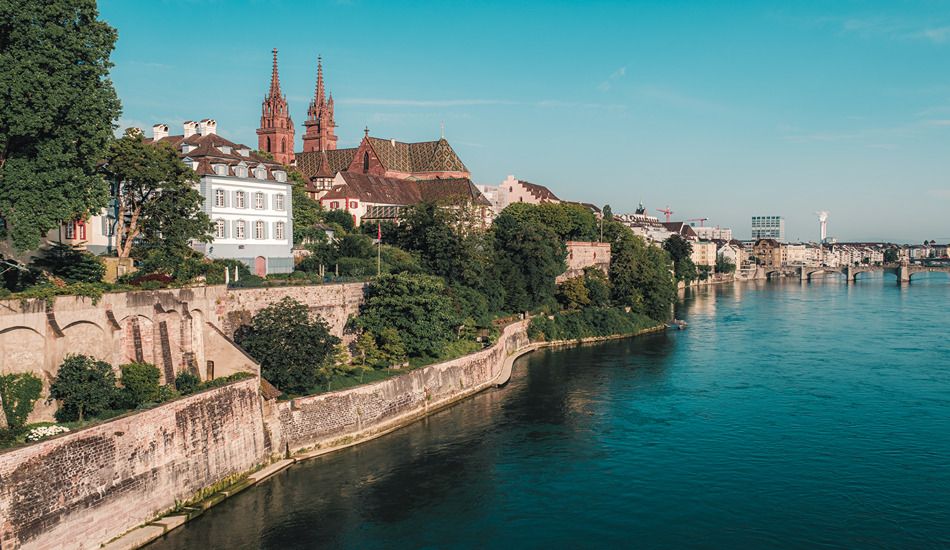
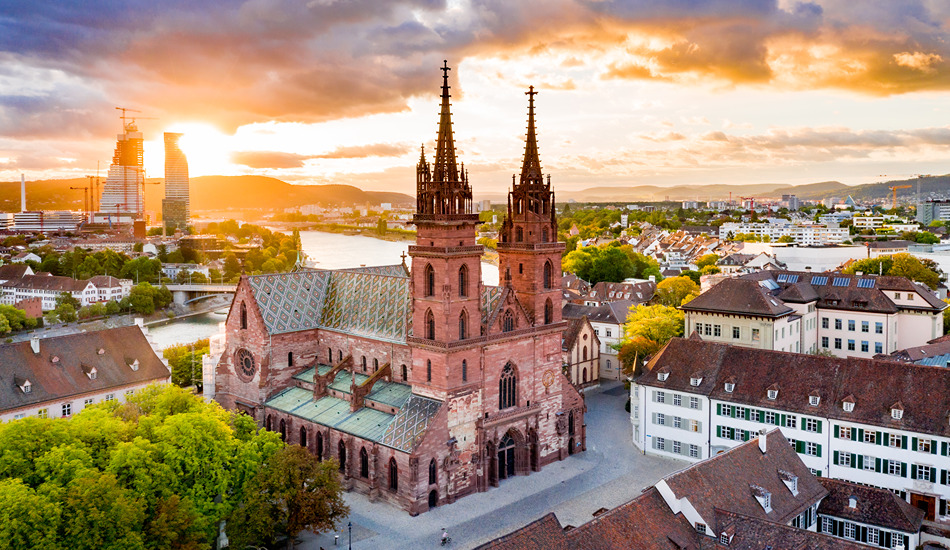
Sweeping views of the Rhine can be enjoyed from the tree-shaded terrace of Basel Cathedral. Sporting impressive twin towers, it is the city’s most prominent landmark. Built mainly in the 12th and 13th centuries, the Romanesque-Gothic church contains the tomb of the Dutch humanist Erasmus (1466-1536), who lived in Basel. Ambitious types can climb the towers’ narrow staircases (about 250 steps).
The twin spires of Basel Cathedral dominate the skyline of Basel, which lies on the Rhine River in northern Switzerland. (Photo credit: Basel Tourism)
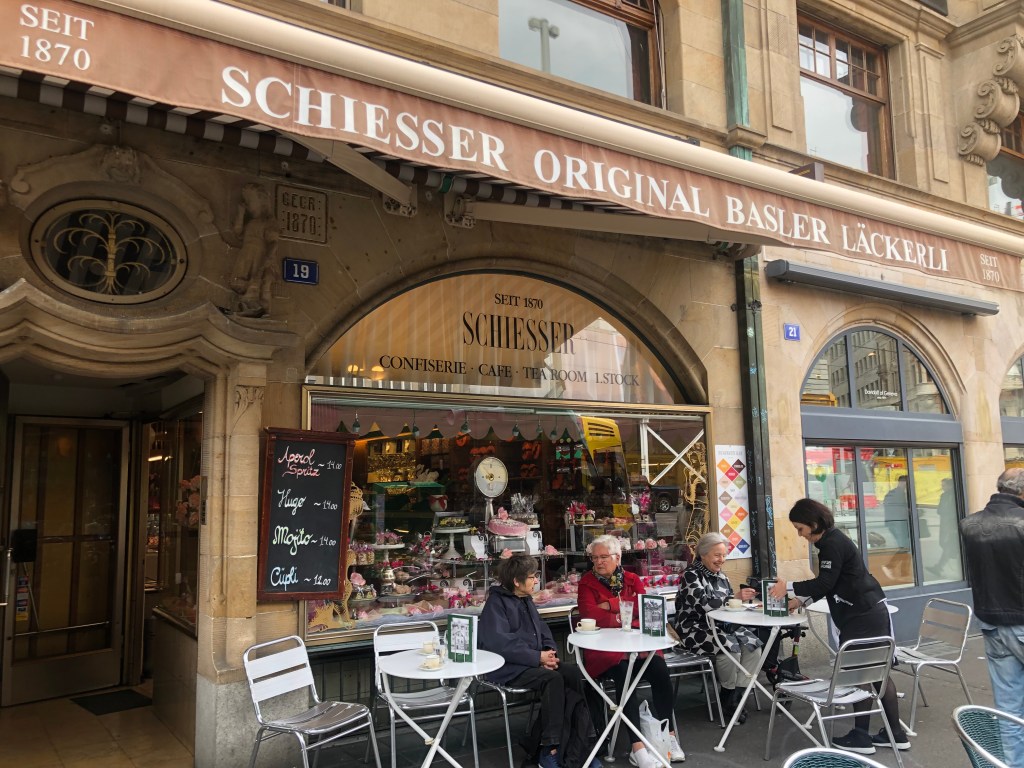
One of the best places to take a break from sightseeing is Confiserie Schiesser, a cafe/tea room/confectionery with an on-site chocolate factory and bakery. Founded in 1870 and now in its fifth generation of family ownership, Schiesser faces Old Town’s vivid red Rathaus (Town Hall) and market square. A tantalizing array of chocolates, cookies and pastries tempts the sweet tooth. Distinctive to Basel are the Basler Läckerli, a ginger cookie made with honey, spices, almonds, and candied orange and lemon peel.
Confiserie Schiesser, a cafe/tea room/confectionery founded in 1870, is famous for its chocolates, cookies and pastries. (Randy Mink Photo)
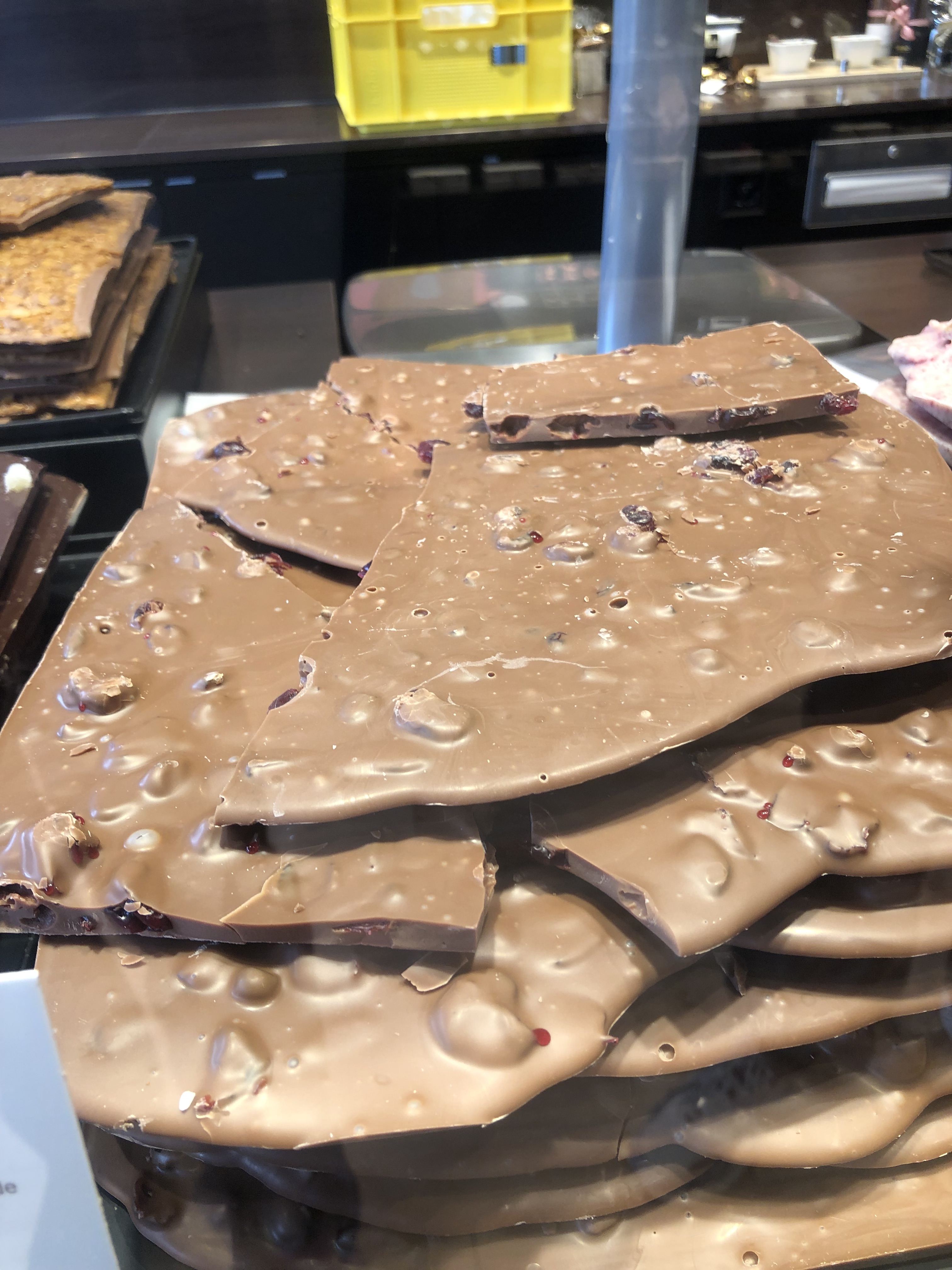
A few doors down from Confiserie Schiesser, high-end Läderach chocolatier sells slabs of melt-in-your-mouth chocolate called Frisch Schoggi. Sold by the gram, the uneven pieces are studded with everything from hazelnuts and almonds to cranberries and cornflakes.
Visitors in Basel’s Old Town can indulge their sweet tooth at Läderach, a high-end Swiss chocolatier. (Randy Mink Photo)
Indulging in Basel’s tasty treats is the epitome of Swiss bliss.
For more information, visit the Basel Tourism website, www.basel.com.
I can’t think of a more relaxing way of seeing Europe than cruising in luxury along its great rivers. Unlike a multi-country bus tour or train journey, you unpack just once, as your ship is home sweet home for the week. And as these sleek white vessels often dock in the center of town, the tourist highlights lie just steps from the gangway.
My most recent magic-carpet ride to adventure was “Charming Castles & Vineyards of the Rhine and Moselle,” a seven-night trip filled with shore excursions in southwestern Germany, northeastern France and the Grand Duchy of Luxembourg. Delivering us to these enchanting places was the 163-passenger Scenic Opal, one of 12 ships in the Europe fleet of Scenic, an Australian-owned cruise line geared to English-speaking guests.
The 163-passenger Scenic Opal, shown here on the Moselle River in Bernkastel, Germany, is one of Scenic’s 12 luxury river ships in Europe. (Randy Mink Photo)
The Scenic Difference
At first glance, most river ships in Europe seem to offer a similar product, but Scenic stands out in two ways. First, guests have a little more elbow room, as the vessels offer a higher-than-usual passenger-to-space ratio. Whereas many ships of the same size take on 180 or more passengers, Scenic’s four-deck floating hotels carry 163 guests maximum. (Our sailing counted 129 passengers, including 53 Americans, 27 Canadians, 37 British, nine Australians and a smattering of other nationalities.) The Scenic Opal and sister ships Scenic Amber and Scenic Jasper were built in 2015/2016 and refurbished in 2019.
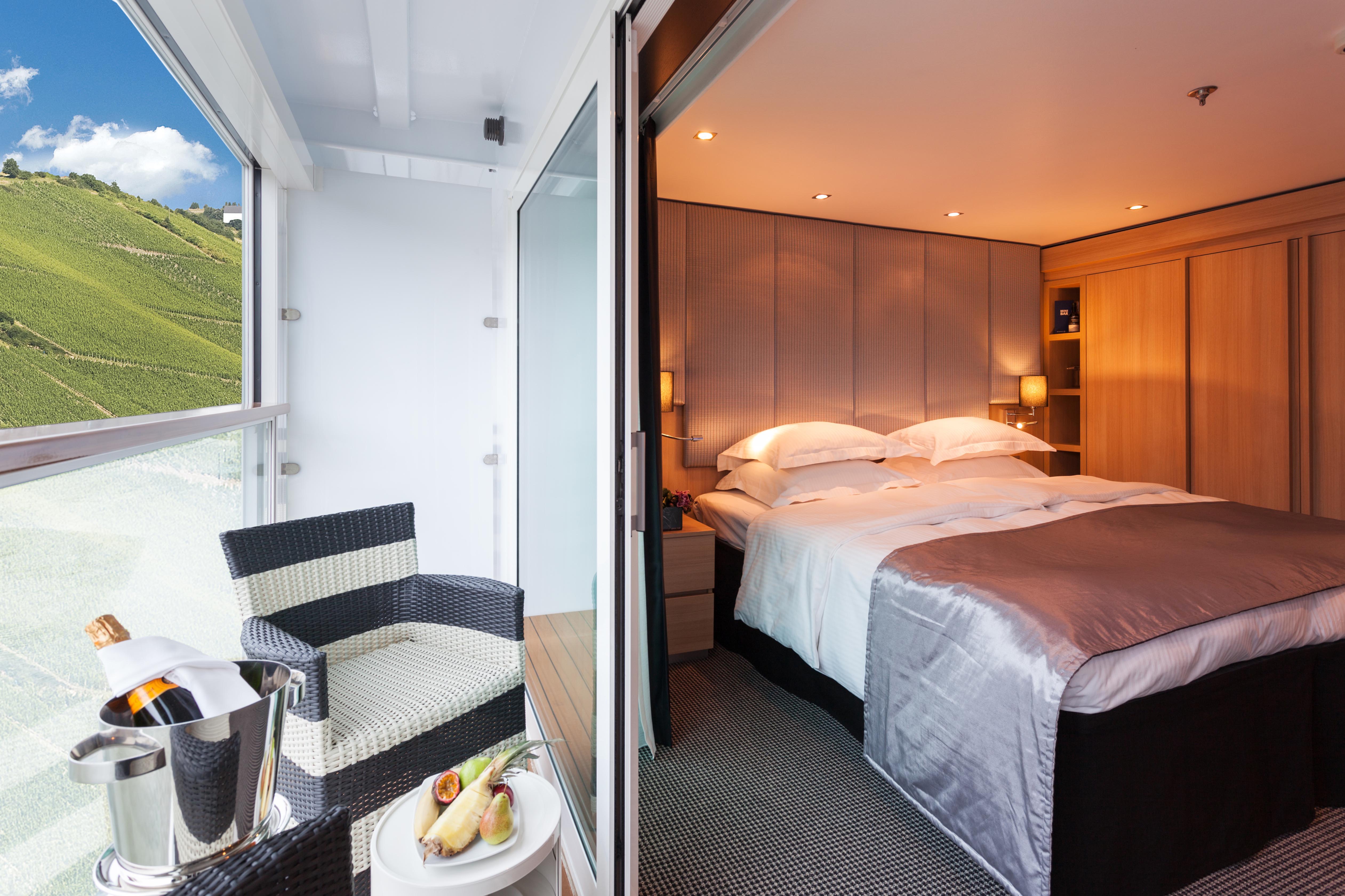
Floor-to-ceiling windows in both public areas and most staterooms, moreover, give the feeling of added space. All cabins on the Sapphire and Diamond (second and third) decks feature a full-length, enclosed balcony with two padded wicker chairs, a table and a wide horizontal window that glides up or down at the push of a button. A curtain and a glass door can be used to close off the bedroom from the peaceful nook, called a Scenic Sun Lounge. For this sense of extra space, Scenic ships are marketed as “Space-Ships” (not because they’re futuristic-looking). Smaller staterooms on the less-populated lower deck, the Jewel Deck, have a large picture window but no balcony.
The other chief takeaway about Scenic is the all-inclusive price. You never have to take out your wallet and won’t even be asked for a credit card at check-in. The cruise fare includes not only gratuities, airport and hotel transfers, laundry service once per cruise, shore excursions and multiple dining options but also unlimited complimentary beverages (soda, beer, wine, cocktails, spirits) all day, not just with meals. You don’t even need to worry about using your room’s mini-bar—just help yourself to free drinks and snacks when the mood strikes. Treats in my cabin included Pringles chips and a favorite of mine—Manner cocoa-flavored hazelnut-creme wafers from Vienna. The refrigerator, replenished daily, was stocked with everything from Coke, beer and juices to German wines and miniature bottles of rum, gin and whiskey.
Left: Most cabins on the Scenic Opal have an enclosed balcony, or Sun Lounge, with a window that glides up and down at the push of a button. (Photo credit: Gillies & Zaiser) Right: The Junior Balcony Suite offers a little more space than standard staterooms on the Scenic Opal. (Photo credit: Gillies & Zaiser)
Food, Glorious Food
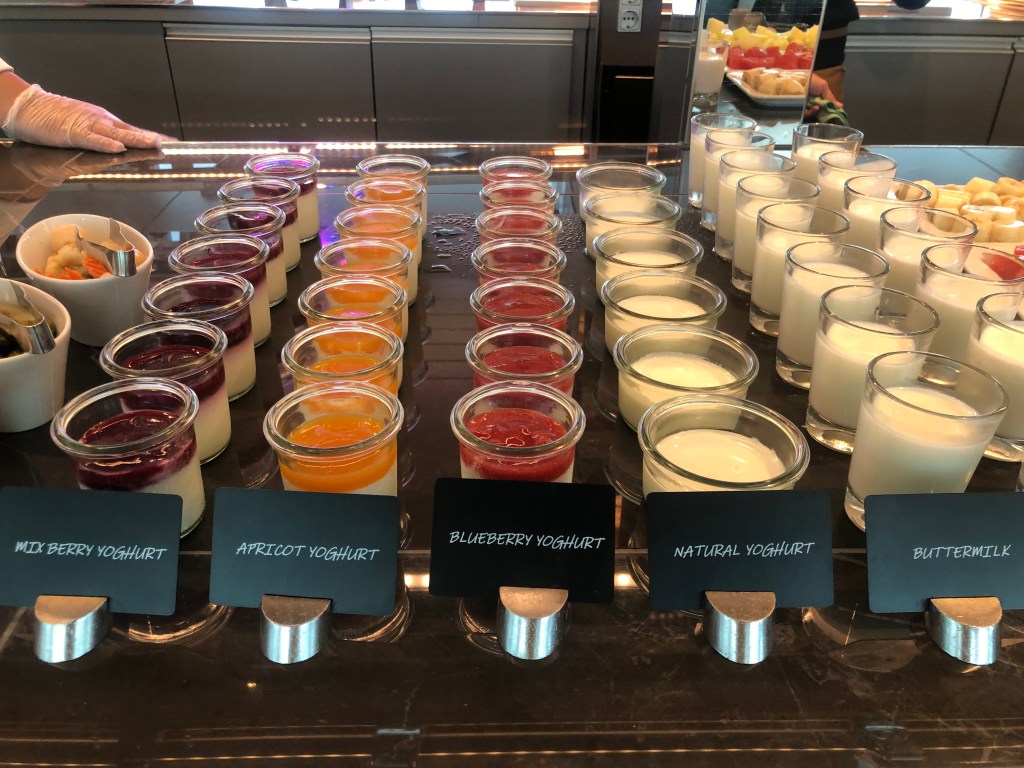
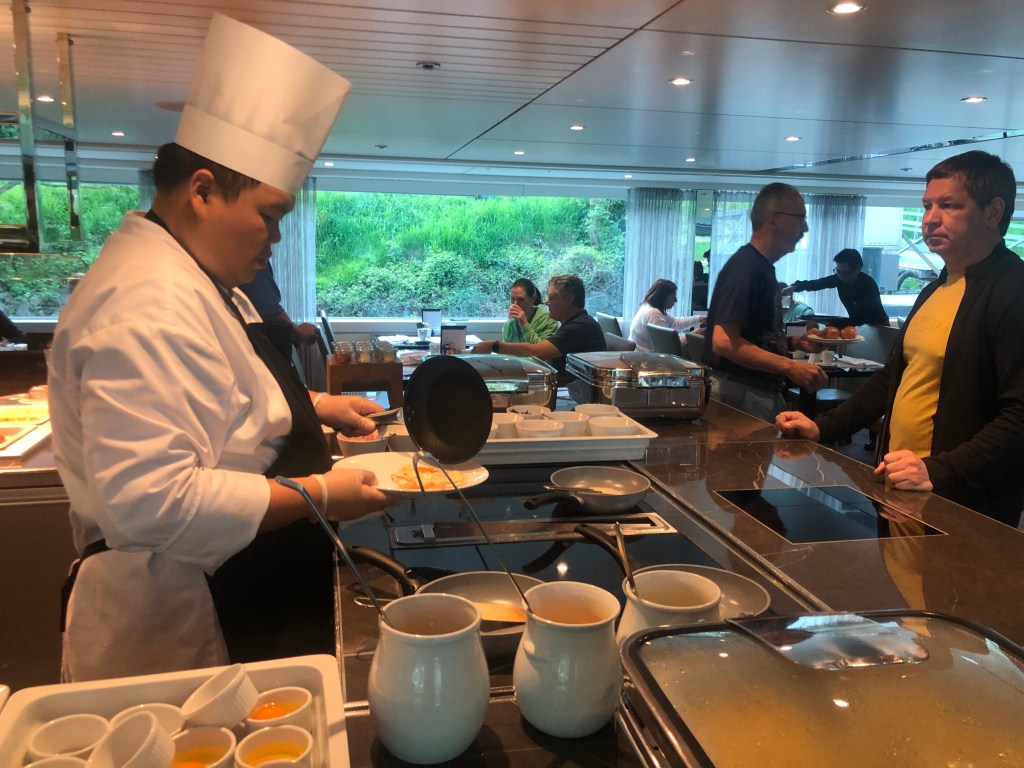
In the Crystal Dining Room, I always tried to get a window table so as to look out on the sloping vineyards and fairy-tale towns flanking the Rhine and Moselle rivers. The daily breakfast buffet featured a million different items—well, at least 100 anyway—and even offered chilled Champagne. There were bagels and artisan breads, yogurts and fruits of all kinds, and hot-off-the-griddle pancakes or waffles, not to mention made-to-order omelets. The Brits and Australians appreciated the baked beans, porridge, English bacon, and grilled tomatoes and mushrooms. One morning we had bread-and-butter pudding.
The breakfast buffet also offered cheeses, cold cuts and smoked fish (herring, rollmops, halibut, salmon). What’s more, we could order from a menu that featured lamb chops, French toast and perfectly done, oh-so-decadent eggs Benedict.
Lunch also was a smorgasbord. I really enjoyed the German buffet, a special meal that put an exclamation point on our morning transit through the castle-studded Rhine Gorge and got us in a jolly mood for the tourist-thronged wine town of Rüdesheim. The spread included three types of sausage—bratwurst, Käsekrainer (cheese-filled) and Weisswurst (white veal sausage)—and three mustards. There were sauerkraut, parsley potatoes and both bread and potato dumplings. Cheesy spaetzle, freshly tossed, was served hot from the pan. I didn’t have room for the fried chicken (Backhendl), pan-seared river trout in almond butter or even a morsel of the pork knuckle.
Recorded oom-pah band music lent a Munich beer hall vibe as I washed down traditional German foods with a tall glass of Erdinger Weissbier, a classic wheat brew. Dessert was Dampfnudel, a pillowy steamed dumpling filled with blueberries. Other lunch buffets usually featured at least one food representative of the region we were traveling through.
On King Charles III’s coronation day, the River Cafe, an area of the Opal Lounge that offers a daily lunch buffet, we had fish ’n’ chips while watching the ceremony on big-screen TVs. The lounge’s coffee and tea stations had scones with jam and clotted cream, another British touch.
The River Cafe, open during the day for sandwiches, salads, ice cream and pastries, is transformed each evening into Portobellos, a five-course Italian dining experience for which each guest receives a printed invitation once during the week. Table La Rive, a sophisticated chef’s table offered once a cruise to Diamond Deck and Junior Suite guests, stars innovative fare with wine matching in a small-group setting in the dining room.
Every night, the restaurant’s a la carte dinner menu gave us appetizer, main course and dessert choices. If we didn’t want one of the three entree selections, we could order a salmon steak, sirloin steak or chicken breast.
Rather eat in privacy on your balcony? An extensive room service menu is available from 6 a.m. to midnight.
On any cruise, I tend to overeat (don’t we all?), so every day I hit the walking track on the expansive Sun Deck, a breezy area with tables, chairs, loungers and a vitality pool. Happily for me, the track was lighted after dark. I recall one night making my rounds as floodlit Reichsburg Castle loomed beyond the storybook Moselle River town of Cochem, Germany, a magical moment indeed.
Left to right: The Scenic Opal’s daily breakfast buffet offers choices galore, including many varieties of yogurt. (Randy Mink Photo) An omelet station is part of the Crystal Dining Room’s breakfast buffet. (Randy Mink Photo) Alcoholic drinks in the Opal Lounge and dining room are included in the cruise fare. (Photo credit: Gillies & Zaiser) The River Cafe is the place for a wide variety of tempting small bites throughout the day. (Photo credit: Gillies & Zaiser)
A Superlative Staff
Every evening we all gathered in the spacious lounge with cruise director Alex Thurein, who briefed us on the next day’s schedule. An affable German who was born in Wiesbaden and currently lives in Salzburg, Austria, he set the upbeat tone of the cruise. From Day 1 we knew we could go to Alex for travel advice or any problem. (On a personal note, I will be forever grateful to him for helping me contact credit card companies after a pickpocket incident during a shore excursion in Colmar, France.)
One morning Alex gave a brilliant presentation on “Germany and the Germans: A Brief Overview of 1,200 Years of Central European History.” Another day his topic was Europe’s rivers, canals and lock systems.
The Scenic Opal’s crew, 53 in all, represented 14 nationalities, from Thai and Indonesian to Serbian and Polish. Our captain was Hungarian. The women staffing the reception desk always had smiles and couldn’t wait to assist or answer a question.
Also smoothing the way was the stateroom’s TV, an encyclopedia of information and entertainment options. We could watch television shows (I mostly caught the live BBC newscasts), choose from a wide selection of movies and music, view the daily schedule and lounge presentations, and bone up on the ports of call. A keyboard even let us use the screen as a computer.
With high-tech gadgetry, an all-inclusive approach and plenty of space to unwind, Scenic has thought of everything to ensure a worry-free journey on the rivers of Europe.
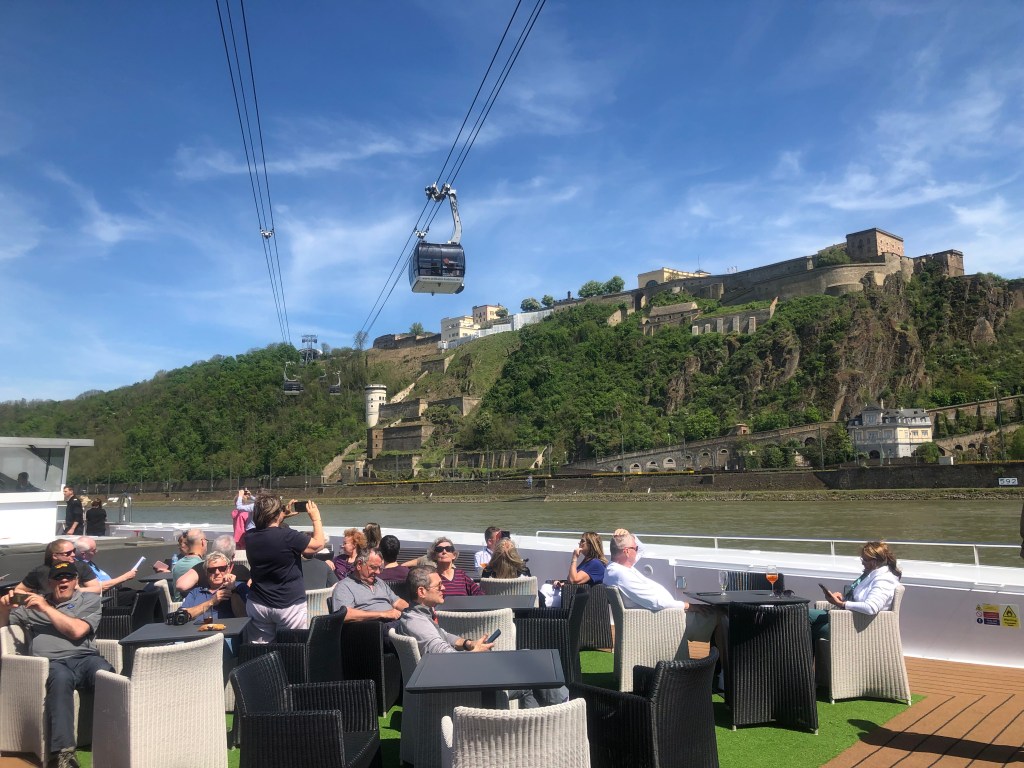
1: Champagne is served at the first-night welcome reception onboard the Scenic Opal. (Photo credit: Gillies & Zaiser) 2: In the Rhine River city of Koblenz, passengers relax on the Sun Deck of the Scenic Opal as cable cars to Ehrenbreitstein Fortress pass overhead. (Randy Mink Photo) 3: The Scenic Opal’s reception desk is located just off the Opal Lounge. (Photo credit: Gillies & Zaiser) 4: A passing parade of hilltop castles enchants passengers on the Scenic Opal. (Photo credit: Scenic)
A dozen days of unique European history, adult fun, fantastic food, and a good bit of pampering
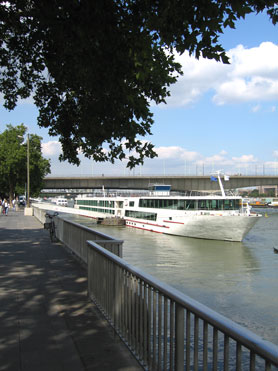
Photo: Courtesy Viking River Cruises
By Don Heimburger Photos by the author
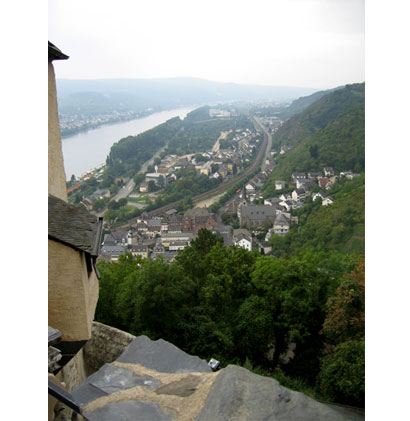
Gazing down on the wide and meandering Rhine River, from a spot at the outer courtyard of high Marksburg Castle that overlooks the 1,300-year-old German town of Braubach, the historic significance of where I am begins to sink in. And it hits me hard, in a good sort of way.
I’m in the midst of fortresses and castles, neatly-planted vineyards, small ancient villages, all in close proximity to the driving force behind this beautiful valley–Germany’s beautiful and romantic Rhine River.
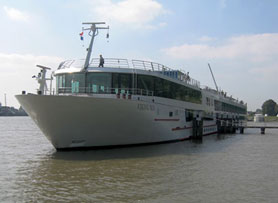
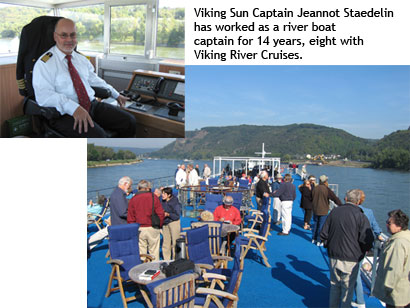
My adventure is a 12-day floating history tour on the sleek Viking Sun, one of many cruise ships that Viking operates on the Rhine, Main, Moselle and Danube rivers in Europe and elsewhere. This ship, a three-deck, 198-passenger liner with its own restaurant with panoramic views, large observation lounge, library and an internet cafe, cruises from Antwerp to Basel, Switzerland, a 677-mile journey back into time.
BRUSSELS AND BAGS
Many passengers arrive in Brussels, a 45-minute train ride away, before boarding the ship that caters to English-speaking travelers. With bags tucked away in the cabin (there are 89 deluxe and 10 standard cabins on the ship, all with outside river views), passengers settle into a sit-down dinner in the evening.
But the meals are only a small, but very inviting, reason for taking this cruise. The historic sights and beautiful scenery is dazzling, and it is laid out before me every day, all the time, from the comfort of a lounge chair, or a sundeck chair, or even the comfort of my on-board bedroom if I chose not to wander about the ship.
BRUGGE IS BEAUTIFUL
The first off-ship tour was by bus to Brugge, a beautifully preserved medieval town from 1128 that was famous for its wool and weaving. Much of the historic city center remains intact. The town boasts the Church of Our Lady with one of the world’s highest brick towers at 400 feet high. Walking through the historic section, with classic buildings and elegant houses of former wealthy textile merchants, I felt like time had stood still, and that I was a resident of this quiet village in its heyday.
At Rotterdam, passengers boarded buses for a trip to Delft to see the birthplace of the famous Dutch Master Jan Vermeer. Delft is known for its pottery called delftware, produced in this town for more than 500 years. A tour through this small but amazing factory, and a look at the numerous products it makes, gave me an insight into what makes this blue-and-white glazed earthenware, highly prized throughout the world.
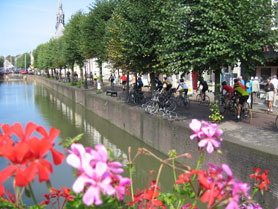
Holland is more water than land, it seems, and the Viking Sun floats through Rhine waterways and canals until it reaches Schoonhoven, a quaint 12,000-population riverside town, full of charm, canals of its own, and a large Town Gate (Ferry Gate) as you enter.
The town formed around a castle that was built here in 1220, and shipping, brewing, fishing and agriculture have been the main industry. Little shops, with plenty of jewelry stores loaded with tempting rings, necklaces and bracelets, line the main street, which is divided by–you guessed it—a canal. This was an inviting town to visit, and the local beer tasted good as well which I sampled under a cafe umbrella on the town square.
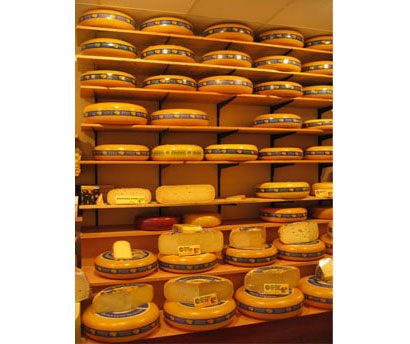
Next up on the land tours was Gouda, one of Holland’s most famous cheese-making towns. In the center of town and the market square, a beautiful Gothic Town Hall sits smack in the middle, drawing lots of attention to itself. Try the cheeses while you’re there!
AMSTERDAM AND ANNE FRANK The Viking Sun’s arrival on a Sunday in Amsterdam was greeted by a crowd of, I’d guess, 50,000 people near the dock. Well, at least I thought they were welcoming us, until I realized that they were attending an annual Music Festival that weekend which was held right at the main cruise ship dock in downtown Amsterdam.
Let me say a bit about Amsterdam. I had not been to this city of three-quarters of a million people before, but I had heard about the red light district and how multi-cultural the city was. Well, it’s true.
During the Dutch Golden Age, this 12th century fishing village was the most important port in the world, and likely because of its location, the city has attracted people from 177 different nationalities who now live there. With all the canals running through the city (it’s called the Venice of the North), trams, autos, cabs, trains and especially bikes, there is no shortage of means to get around town, and it’s densely populated. The “extra fare” entertainment districts (red light area) and the “liberal” coffeeshops that dot the city are interesting only by the fact that they exist. There is no redeeming social value to that segment of the city.
On a higher plane, what is worth seeing is Anne Frank’s home where she hid from the Nazis until she was betrayed and sent to her death in Bergen-Belsen. This is not a long walk (20-25 minutes) from the Central Train Station, but a cab, tram or a bicycle is also an alternative. There are 50 museums in Amsterdam that beckon you as well—more museums per square mile than any other European city.
After a busy day in this large city, relaxing in the evening on the boat was welcome. After breakfast the next morning, the ship had docked at Arnhem, the last Netherlands port before entering Germany.
THREE DELICIOUS MEALS A DAY At this point in the trip, passengers had already became spoiled with dinners such as Greek salad and warm bread; cream of cauliflower soup; pink grilled Duck breast with orange sauce; or napkin dumplings with creamy mushroom ragout and herbs; and cr̬eme brulee with chocolate ice cream. Of course, each dinner menu had several choices of appetizers, main dish and dessert. There was also a complimentary selection of international cheeses offered at each meal, as well as beers, wines and apertifs (at additional cost).
Wait staff on board the Viking Sun.; Sven Hansen, Viking Sun’s Maitre d’ (left) and Executive Chef Reiner Eggert.
A lighter buffet-style luncheon was offered in the lounge or a more complete sit-down meal at noon in the restaurant. I found that the lighter lunch was more than I would eat anyway, and usually opted for that. For breakfast a complete menu was available by 7 a.m. of hot and cold meats, cereals, eggs, waffles, fruits, breads and rolls, juices, coffee, and even champagne and made-to-order dishes like omelets and French Toast. Believe me, I never eat that much at breakfast, and there was a treasure trove of goodies each morning that the cooks had been working on the night before. For early birds, there were even fresh pastries and richly-flavored coffee from 6 to 7 a.m. Meals on board were always delicious, there was plenty of food, and it was displayed as a work of art. The servers were often funny and always accommodating (hello Cata and Michael–may I have another cup of coffee please?).
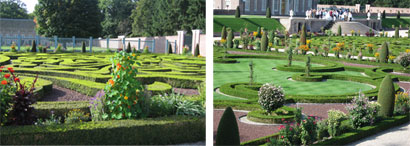
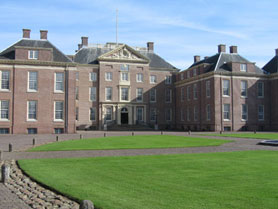
From the dock at Arnhem, we boarded buses (it took five busloads to hold all the ships’ passengers, plus local tour guides), and traveled to the magnificent Paleis Het Loo, and I emphasize the word magnificent. This large, sprawling complex was the summer residence of the Royal House of Orange from 1686 to 1975, and royal indeed it was–and still is. Walking through the house or the colorful formal gardens is a rare treat to the eye. The gardens, especially, combine classical planting symmetry with intricate landscaping. You can, and I did, spend a lot of time in the gardens. If you have time, grab a hot coffee and sweet pastry at the coffee shop and enjoy it outside in the palace courtyard. Then stroll down a long row of trees to the barns where a large collection of royal sleighs, carriages and coaches are on display. It’s worth the walk.
INTO THE DEUTSCHE DOMAIN
Around dinnertime, our ship got under way again and headed for Cologne, arriving there the next morning around breakfast. Many passengers were eager to enter the German Rhine because the Middle Rhine, where the many fortresses and castles are located, was something they had heard about, and it was a main draw of the trip.
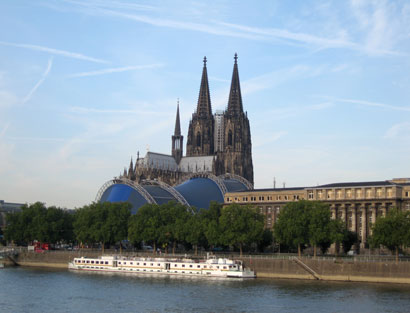
Cologne is noted for the tall, striking Gothic cathedral seen from anywhere in the old part of the city. Passengers crowded along the sundeck railings as we entered Cologne to admire the stately church spires and the city’s imposing skyline.
In Cologne we received a guided walking tour, after which there was just enough time to check out the shops selling Erzgebirge items such as smokers and nutcrackers, or visit the Roman Museum or visit the Brauhaus (included in the ship’s tour) to partake of one of the city’s delights: Kolsch beer, a very tasty beverage made in Cologne. Many passengers returned to the city for an evening walk after dinner on the boat. I could have easily spent more time here, but the rest of Germany beckoned, and I literally didn’t want to miss the boat.
Stained glass windows inside the Gothic cathedral in Cologne.
Next up was Koblenz, the spot where the Moselle and Rhine rivers come together; the exact spot is called the German Corner, punctuated by a massive statue of Wilhelm I on a horse. Our ship docked right down from the statue.
Koblenz was originally a Roman outpost, so when they said the town was 2,000 years old, I could believe it; it was founded in 9 B.C. Even the fortress across the Rhine at Kolenz, the Ehrenbreitstein, with its vast fortified construction and enormous parade ground, was built in the 11th century, and was re-built in 1816-1823. It was never attacked, but looking up at it from across the river, I could see why an army would have difficulty making any headway.
MOSELLE MOMENTS
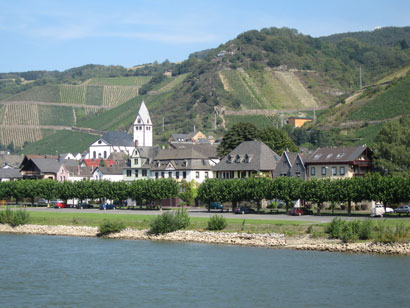
To see the Moselle and its neat, green vineyards, we boarded buses and headed to Cochem, located about 30 miles west of Koblenz. In this little riverside town, dominated by the 1,000-year-old Reichsburg Castle built by the Palatinate Dukes, the atmosphere was that of fun, with local wine being sold in many shops. Half-timbered houses dot the cityscape, narrow cobblestone streets lead to taverns and quaint cafes, and everyone seemed to be in a party mood.
At Braubach, a treat was in store. The Marksburg Castle, one of the few along the Rhine that was never destroyed, sits high above the town, and passengers were taken by bus to the castle “parking lot” where we walked steep steps to continue to the castle gate. From there, a tour guide with a very large castle key gave a detailed tour in English. References to this remarkable fortress go back as early as the 13th century, and little has changed inside since then. You can see the Knight’s Hall and the castle chapel, dedicated to Saint Mark, from whom the castle gets its name.
From the garden area of the castle, I could look down on the Rhine and see the vast, commanding view of the entire countryside north, south and east. I could see why enemies would not be able to storm the castle as they could be easily watched from this fortress.
On the way to Rudesheim, we pass the cat-and-mouse castles (Katz Castle and Maus Castle–neither of which have anything to do with animals), and the Pfalzgrafenstein fortress that sits on a rock in the river. In high water, you can’t even see the rock: the castle appears as if it’s floating.
At this point the Viking Sun also passed the Lorelei, a 440-foot-high legendary rock that I could see on the left as the ship cruised south. The Lorelei gets its name from the German word ley or rock, and the Middle High German word lure, which means treacherous.
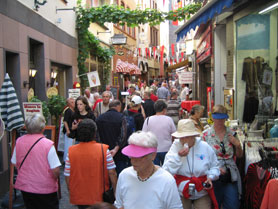
Docking at Rudesheim, a small village next to the Rhine, allowed passengers to walk the streets to visits shops and cafes, or to visit a colorful, narrow street called the Drosselgasse, featuring live German music and dancing, charming taverns and restaurants, and beckoning shops. An evening stroll down this street with twinkling lights, delicious smells and friendly laughter is a must.
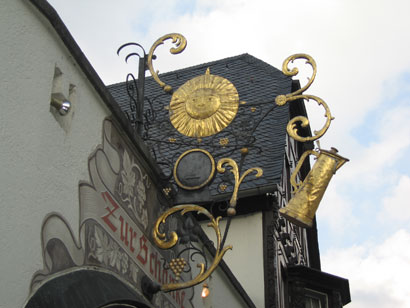
(left to right) The Kammerzell House is a famous restaurant in Strasbourg, France.; A store-front sign in Rudesheim, Germany.
At Mannheim, tour buses whisked passengers to romantic Heidelberg, noted as a university town which sits in a narrow gorge on the Neckar River. Built in the 17th century, the beautiful city is dominated by Heidelberg Castle which sits above the city, and which is being restored. A guided tour of this vast fortress was part of our tour package. Another dominate marker of the city is the handsome, turreted Old Bridge, built in 1788 on the banks of the Neckar. Not far from that is a very long street which winds its way for seemingly miles. It’s a good place to sit for a while and order some German food and bier (during warm weather), and watch people.
GRAND SPEYER
Speyer, an important center of Jewish culture, is best described as a grand city. Everything is large here–the buildings, the monuments, the city park and the Kirches (churches). The town’s Old Gate, a centerpiece of the city, still stands today, dating to 1176. The massive tower is 180 feet high. The Kaiserdom, founded in 1030 and consecrated in 1060, is Germany’s largest Romanesque building and is a UNESCO World Heritage site. Peeking in one of the churches further up the street, I listened to a men’s choir practice for an upcoming service. In the quiet of the church, with only a handful of others listening before the service, I was awestruck at the power of mens’ singing voices, and grateful for the chance to hear the soothing German songs in such a magnificant setting.
Docked in the Strasbourg suburb of Kehl, we boarded buses for a guided tour of this multicultural city. Strasbourg is where the Palais de L’Europe is located and where the European Parliament meets. It’s one of the richest medieval cities in Europe, and its Old Town is completely surrounded by the Ill River. Cozy cafes and restaurants abound here, such as the Kammerzell House, next to the Hirsch Chemist (www.maison-kammerzell.com).
My trip was nearing an end, but not without a bit of fanfare! At the captain’s farewell dinner on board, passengers and crew were in a celebratory mood, with a special menu of meat pate with cumberland sauce and Waldorf salad; cappuccino of forest mushrooms; honey glazed salmon or grilled beef tenderloin with truffle crust, vegetable basket and macaire potatoes; baked Alaska and pralines. Music and sparklers added a festival atmosphere during the dessert, followed by brief remarks from the crew.
On the last day before docking in Basel, our end point, the ship came into Breisach in the early morning, and after breakfast, the group took an excursion to the Black Forest. This densely-forested, mountainous region encompasses 7,500 square miles in southwestern Germany. It’s long and narrow (124 miles long, 37 miles wide), and tourism is the most important industry in the region. Pines and firs make up the foliage, and a number of birds and small creatures populate the forest. Cuckoo clocks, wood carvings and cherry schnapps are favorite souvenirs for visitors. I could have spent more time in the Black Forest area–the villages seemed so neat, tranquil and friendly, and the surrounding forests and mountains were unbelievably quiet and beautiful.
BASEL BECKONS
After 12 days, the cruise ship pulled quietly into Basel, which borders Switzerland and France, and is Switzerland’s third largest city. After our final breakfast–at which everyone lingered a bit longer–and farewells were made to friends that we met on board, we all departed for planes, trains or other transportation to take us home or to continue our journey.
It had been a dozen days of cruising one of the most famous rivers in Europe in total comfort and passing some of the most important historical towns and places in Europe. It had been educational, relaxing and fun, and I’d do it again in a heartbeat.
The trip was an up-close, personal encounter with European history, people and culture that would have been hard to duplicate on my own. And it was done in style, with a shipload of friends, and at a pace that was relaxing and enjoyable. Hopefully, my first river adventure down the Rhine won’t be my last!
HELPFUL HINTS:
To catch any of the numerous river cruises that Viking offers, call 877-668-4546 or visit vikingrivercruises.com. There is a wide range of itineraries, rivers, countries and prices to choose from. Viking cruises may also have add-on features that allow you to extend your vacation even longer. Viking can also book flights to your ship’s arrival and departure destinations.
All meals on board are included in the price. You won’t go hungry. Room service is not provided.
All off-ship tours are included in the price, except those that are announced as special tours once you board. Viking offers English-speaking tours (such as this one), as well as international tours that encompass other languages.
The three-deck Viking Sun (built in 2005/2006) holds 198 passengers and has a crew of 44. Rooms have a private bathroom/shower, phone, television, safe, hairdryer and individual climate controls. On-board voltage is 220V; razor outlet is 115V.
The ship’s Category A, B and C cabins at 155 square feet are larger than I thought they would be. Standard cabins are 120 square feet. The queen-size bed in my room was quite wide. There were drawers in the room to hold all of my belongings.
The ship’s promenade deck and its many panoramic windows allowed passengers good viewing in all kinds of weather.
The ship’s personnel will do your laundry (for a fee), sell you a limited amount of clothing should you need it, or if you forget something, provide internet service and phone service for a fee, and offer you a special drink package that saves money.
Shore excursion details were announced the evening before by the Cruise Manager in the lounge. His talks were detailed and informative, as well as funny, and passengers depended on him and his able assistants for answers to their many questions. He made the trip fun.
Special demonstrations and activities on board during the evenings–such as dancing troupes, silversmithing exhibits or games—were entertaining, and helped passengers mingle with others on board.
A galley tour, and a tour of the wheelhouse with the captain, were provided for those to wanted to participate.
A doctor was not on board, but the ship was always within a few minutes of the shore if a medical emergency arose, which it did not. All the crew are trained in life-saving techniques.
By all means, bring comfortable clothing and comfortable shoes. Ties and jackets are not required, but I found that many passengers dressed up for evening dinners. Tipping on board was also not required, but was encouraged, although it was not a hard sell. By the end of the trip, I wanted to offer some of the crew a tip for the excellent service I received.
Was 12 days on board a ship too long? Viking offers shorter trips, but I found that passengers took numerous shore excursions that made the time on board go quickly. The 12 days were nicely offset by the guided land tours.
I found a number of passengers had already been on a river cruise–a Viking cruise, in fact–and a number of them had been on at least two previous Viking river cruises. A number of passengers were vacationing with another couple or a group of friends.
The crew made the trip very pleasant; they were always accommodating. Returning from some land trips, the crew stood at the ship’s entrance with hot towels and glasses of fresh, chilled orange juice.
For those who get seasick easily, the Rhine is tame. I barely felt a wave all trip.



























 European Traveler