Afloat on the Rhine and Moselle

A dream river voyage on the Scenic Opal spotlights cozy towns in the heart of Europe

By Randy Mink

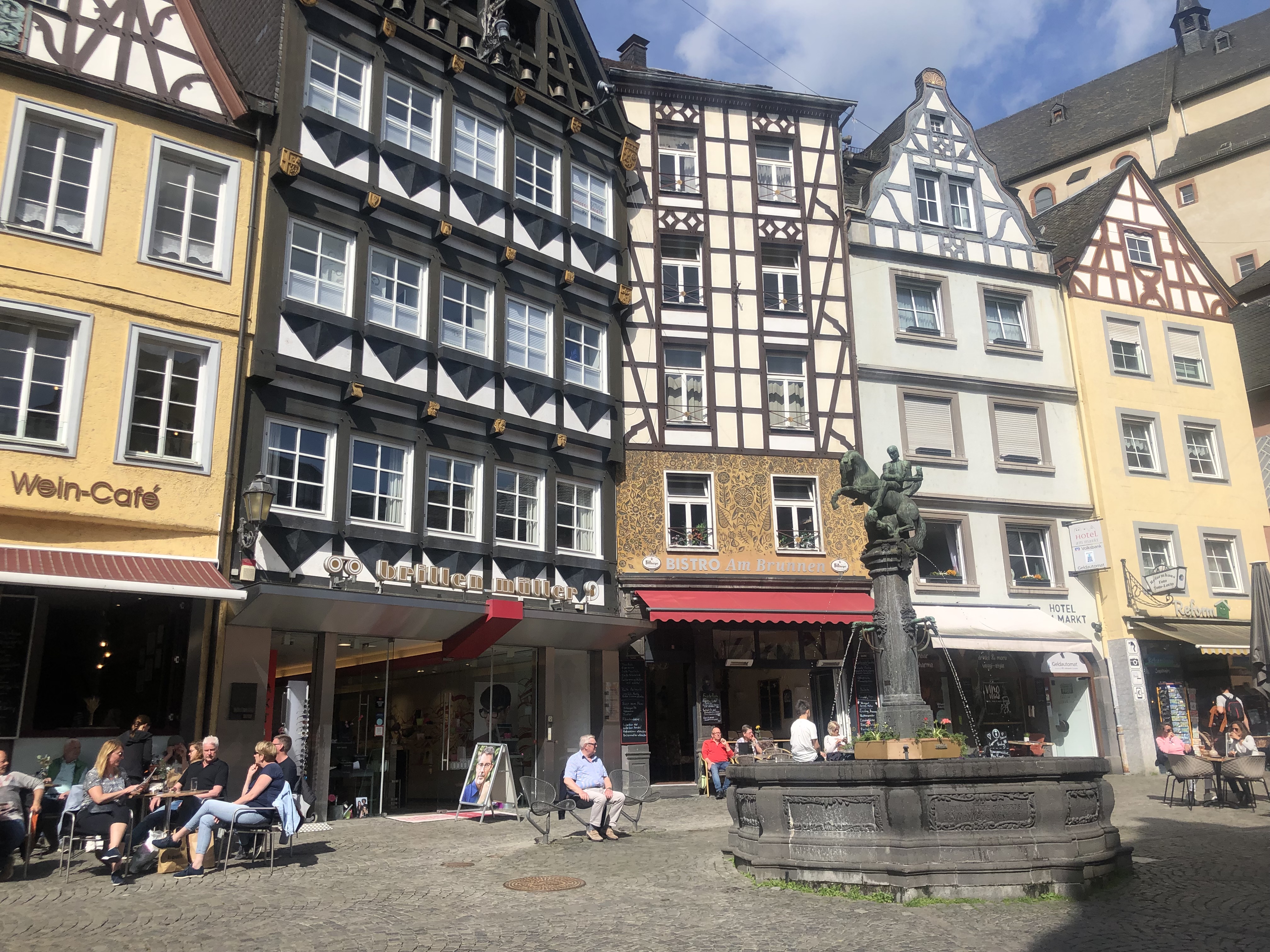
With its half-timbered houses, tangle of cobbled alleyways and picture-perfect castle perched on a crag high above the market square, the German village of Cochem struck me as something plucked from a medieval fairy tale.

Almost too good to be true, the Moselle River town of 5,500 was one of several stops on “Charming Castles & Vineyards of the Rhine & Moselle,” a seven-night cruise itinerary offered by Scenic, an Australia-based company with 12 luxury river ships in Europe. My brother and I were aboard the 163-passenger Scenic Opal, our floating hotel for the week.

Happily, in Cochem and some other ports of call, the historic town centers lay just steps from the ship’s gangway. I love being in the middle of everything within minutes of disembarking.

Clockwise: The Moselle River town of Cochem, Germany, as seen from hilltop Reichsburg Castle. (Photo credit: German National Tourist Board)
Reichsburg Castle looms high above the Moselle River town of Cochem.  (Larry Mink Photo)
Cochem charms visitors with its ancient, half-timbered buildings. (Randy Mink Photo)

Because of my ancestry and the fact that my first trip to Europe was a summer German language program in Austria, I’ve always had an affinity for German-speaking countries. Until this cruise, however, I had never been to the Rhine or Moselle valleys.

It was the Moselle’s inclusion that steered me to the itinerary, as not all Rhine cruises venture to this narrower, slower-moving, more intimate tributary, which twists and turns more than 100 picturesque miles between the German cities of Trier and Koblenz. Many Rhine journeys spend time in the more industrial stretches to the north.

I also liked this particular circuit because it touched four countries. Besides shore excursions in Germany, Scenic offered tours in France and the Grand Duchy of Luxembourg. The cruise ended in Basel, Switzerland, where we stayed two nights in a hotel before flying home.

The Rhine travels nearly 800 miles from the Swiss Alps to Rotterdam on the North Sea, forming the border of southwestern Germany and eastern France. From the Vosges Mountains, the Moselle flows through northeastern France and Luxembourg to Germany, joining the Rhine at Koblenz, our first port after embarking the day before at Mainz, a city of 200,000 about 40 minutes from the Frankfurt airport.

Both waterways dish up a passing parade of vineyard-covered slopes, hilltop castles and idyllic towns with gabled houses, church steeples and leafy riverside promenades—an eye-popping feast for those of us who thronged the railings or drank it in from deck chairs. Steady streams of barges, sightseeing boats and pleasure craft also kept us engaged. One afternoon on the Moselle, the Scenic Opal went through three locks, the first one upon leaving Koblenz for the pretty Moselle Valley, my favorite part of the trip.

Koblenz: At the Confluence

In Koblenz I opted for a ship-arranged walking tour but easily could have wandered on my own. The colorful squares and alleys of Old Town, a largely pedestrianized shopping zone with plenty of cafes and bakeries, were a short walk from our berth at the beautifully landscaped Rhine Promenade. (My brother chose the e-biking excursion, exploring on one of the ship’s electrically assisted bicycles.)

The park-like river walk led to Deutsches Eck, or German Corner, the point where the mighty Rhine meets little sister Moselle. Lording over the tip of land is a monumental equestrian statue of Kaiser Wilhelm I (1797-1888), first emperor of the New German Empire. Destroyed in World War II and replaced in 1993 after the fall of the Berlin Wall, the statue now represents German unity. Nearby stand three concrete slabs from the infamous wall and text about life under Communism in East Germany. Overlooking the confluence is Ehrenbreitstein Fortress, a massive complex reached by cable car from the promenade.

Clockwise (Randy Mink Photos): An equestrian statue of Kaiser Wilhelm I, the first emperor of the New German Empire, overlooks the confluence of the Rhine and Moselle rivers in Koblenz, Germany. The meeting point is called Deutsches Eck, or German Corner.
Scenic Opal passengers explore Koblenz, Germany, on a guided bike tour.
Tempting bakeries and cafes are just a few blocks from cruise ships’ Rhine River berths.

Little Luxembourg

From our next stop, the Moselle Valley town of Bernkastel, we took a morning excursion to Luxembourg City, an hour-and-a-half away. Our guided ramble through the capital city’s oldest quarter, famed for the stone bastions and battlements rising above dramatic ravines, focused on the shop-filled pedestrian zone and included panoramic lookout points. After the tour my brother and I relaxed over hot chocolate at the Chocolate House, snaring an outdoor table across from the Grand Ducal Palace, where we earlier had snapped pictures of the soldiers on guard duty. Passengers who didn’t sign up for Luxembourg could choose to visit a Bernkastel winery and sample the valley’s renowned Rieslings.
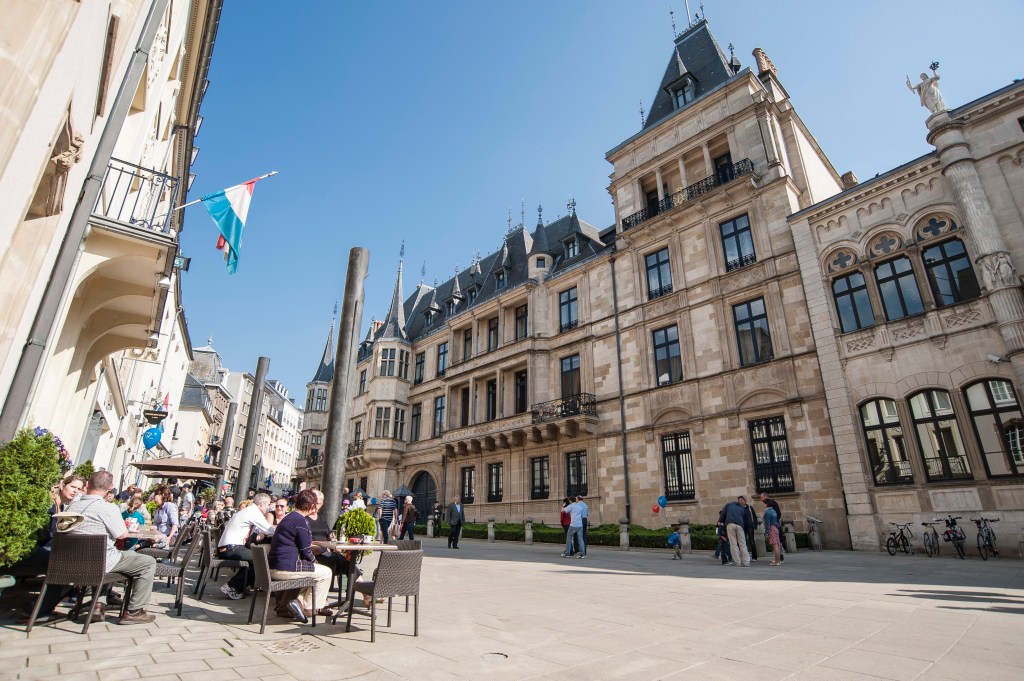
1: The imposing Grand Ducal Palace captivates river cruise passengers on the Luxembourg City shore excursion. (Photo credit: LFT/Christian Millen)
2: Soldiers stand guard at the Grand Ducal Palace. (Randy Mink Photo)
3: Ancient fortifications charm visitors to Luxembourg City, a shore excursion option from the Moselle River town of Bernkastel, Germany. (Photo credit: LFT/Alfonso Sagueiro)
4: Stunning panoramas abound in Luxembourg City. (Randy Mink Photo)

Moselle Crowd-Pleasers: Bernkastel & Cochem

After lunch on the Scenic Opal, moored across the bridge from Bernkastel, we explored the storybook German town. Its riverfront facade didn’t look unusually quaint, but as we probed deeper into the web of little streets, the place just kept getting cuter and cuter. I wanted to photograph every square, crooked lane and antique building in my path, and slip into every wine tavern. Had we more time, I would have hiked up to Landshut Castle, frequented centuries ago by the territorial lords of Trier. Built in 1277 and in partial decay since 1692, it houses a restaurant and cafe.
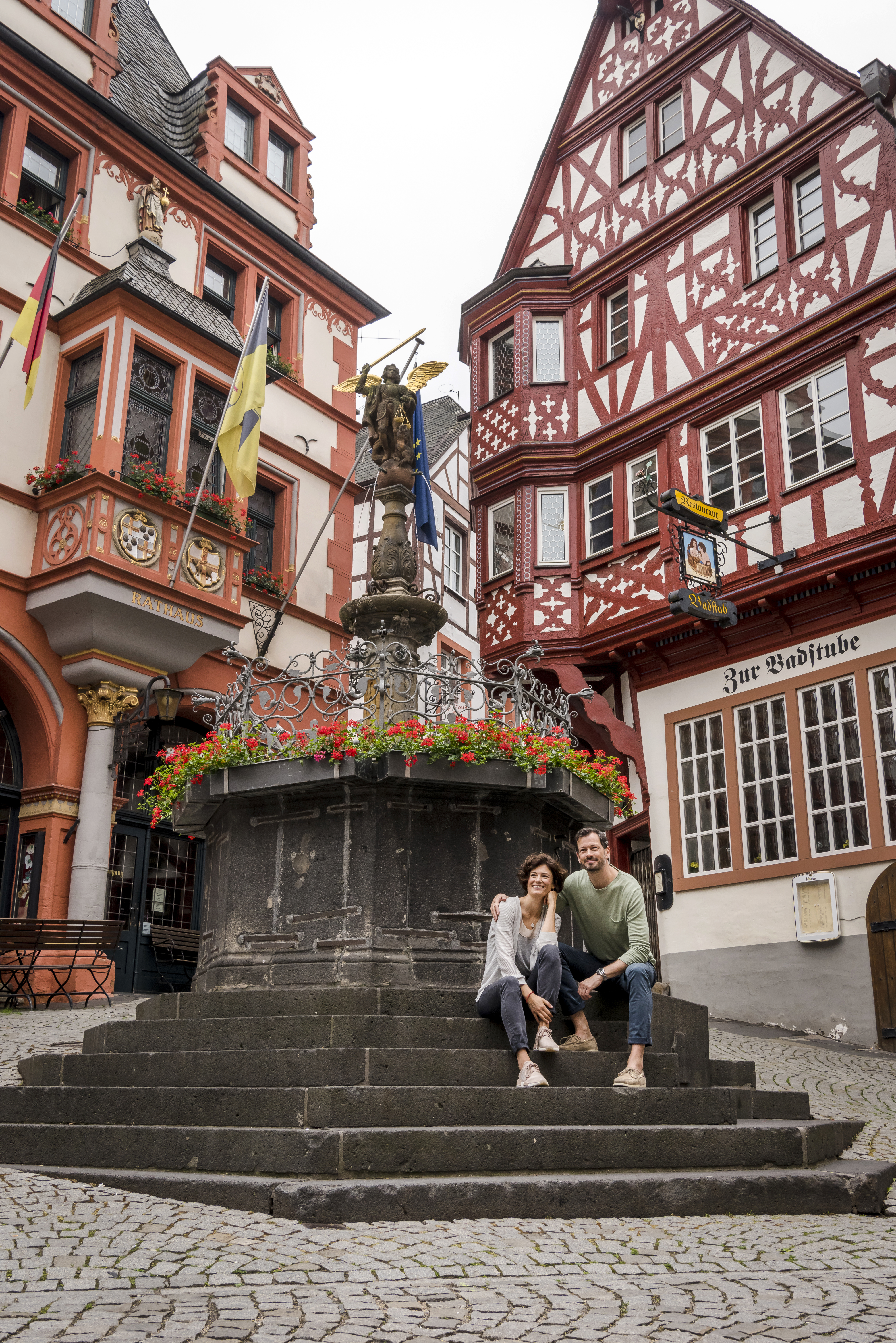
Left: The fairy-tale town of Bernkastel is a popular stop on Moselle River cruises in Germany. (Photo credit: German National Tourist Board)
Right: Landshut Castle, dating back to 1277, overlooks Bernkastel.  (Randy Mink Photo)

In the evening, we all boarded buses for Trier, where Scenic had arranged a private classical concert staged amid the Gothic grandeur of the 13th century Liebfrauenkirche. Riding through Germany’s oldest city to reach the church, we grabbed glimpses of the famous Porta Nigra, the best-preserved Roman city gate north of the Alps.

Scenic Opal passengers attended a private classical concert at the 13th century Liebfrauenkirche in Trier, Germany. (Randy Mink Photo)

In Cochem, the hub of the Middle Moselle, our excursion featured a visit to Reichsburg Castle. From its lofty vantage point we enjoyed sweeping views of the river, the steep vineyard abutting the castle grounds and a skyline dominated by the onion-dome spire of St. Martin Church. Dating from the 11th century, Reichsburg was restored in the late 1800s by a wealthy Berliner who created an idealized version of a medieval stronghold. Although not architecturally faithful, it certainly gives Cochem a photogenic landmark, and three-fourths of the main tower is original. Mounted animal heads, suits of armor and period furniture set the mood inside. Afterwards, our walking tour of Cochem showcased its compact central square, Baroque town hall and ancient town gates.

Clockwise (Photo credits: German National Tourist Board): Cochem’s Reichsburg Castle has all the trappings of a rustic baronial estate.
The Middle Ages come alive on tours of Reichsburg Castle.
Reichsburg Castle and the onion-dome spire of St. Martin Church frame this view of the Moselle River town of Cochem, Germany.

On the Romantic Rhine

Next we traveled the 32 miles from Cochem back to Koblenz, where our ship overnighted in order to get in position for a morning journey to Rüdesheim that would spotlight the Upper Middle Rhine Valley, or Rhine Gorge, the river’s most castle-studded corridor. This would be our big day, the one we’d been waiting for.

As we looked out from the breezy top deck, it was castle after castle, many of them, romantically, in various states of ruin. Some crowned distant summits, others rose straight from the shore. Vine-ribboned hillsides and timeless villages seemed to be waiting around every bend.

As we learned from the cruise director’s narration and from Tailormade (the Scenic smartphone app), some of the fortresses have been repurposed as museums, restaurants, hotels or private residences. Castle Stahlek in Bacharach, now a youth hostel, once served as a Nazi indoctrination center and military hospital during World War II.  (The app’s commentary also came in handy for exploring ashore and helped us identify the towns and landmarks we passed while cruising.)

In Rüdesheim, a tourist-packed village crammed with wine taverns and souvenir shops, we hiked through vineyards to Niederwald Monument, a grandiose memorial that commemorates the 1871 founding of the German Empire after the end of the Franco-Prussian War. Our uphill trek was challenging, the cable car ride down a lot more fun.
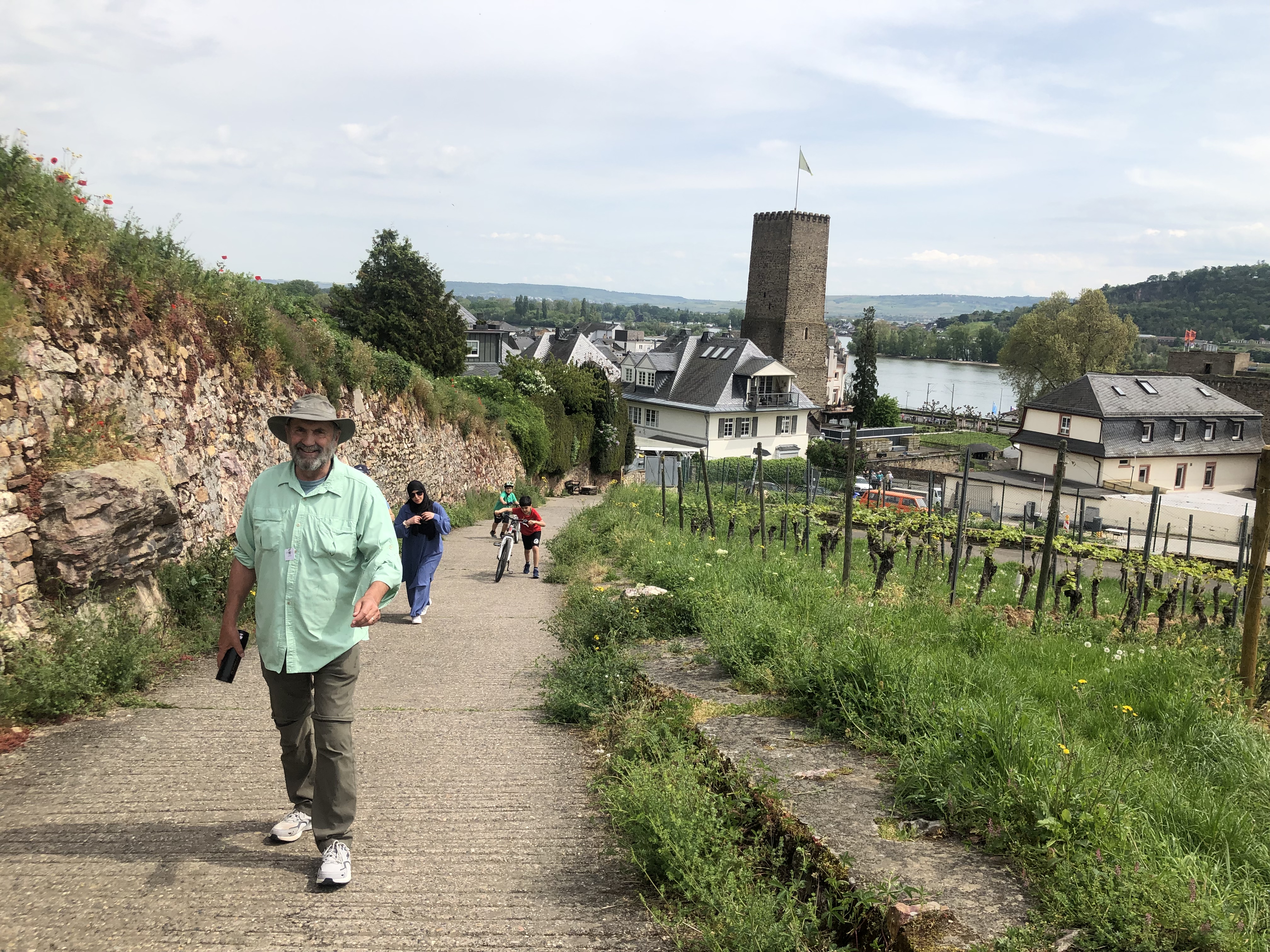
Left: It’s an uphill trek for Scenic Opal passengers who choose to walk to the hilltop Niederwald Monument high above Rüdesheim. (Randy Mink Photo)
Right: Shore excursions in the Rhine River town of Rüdesheim visit the Niederwald Monument, a grandiose memorial that celebrates the 1871 founding of the German Empire after the end of the Franco-Prussian War. (Photo credit: German Tourist Board)

Forays into France

Heading south on the Rhine, the Scenic Opal tied up at two more German towns. From Rastatt we were torn between a tour to the German spa town of Baden-Baden and one to Strasbourg, capital of France’s Alsace, a region that historically has flipped back and forth between German and French control. In Breisach, our last port of call before Basel, we had to weigh Colmar, Alsace’s most beautiful town, against Freiburg, a Black Forest gem renowned for its medieval Old Town.

Since we had seen plenty of Germany, we went all in for Alsace and enjoyed walking tours of Strasbourg and Colmar, both with cozy, traffic-free historic cores chockablock with pastel, flower-laden, Hansel-and-Gretel houses. It’s just that touch of fairy-tale fantasy we needed to put a happily-ever-after ending to our trip through the enchanting heart of Europe—the Europe of our dreams.

Left: The Cathedral of Notre-Dame, a towering landmark cast in red sandstone, dominates this view of Strasbourg’s historic core. (Randy Mink Photo)
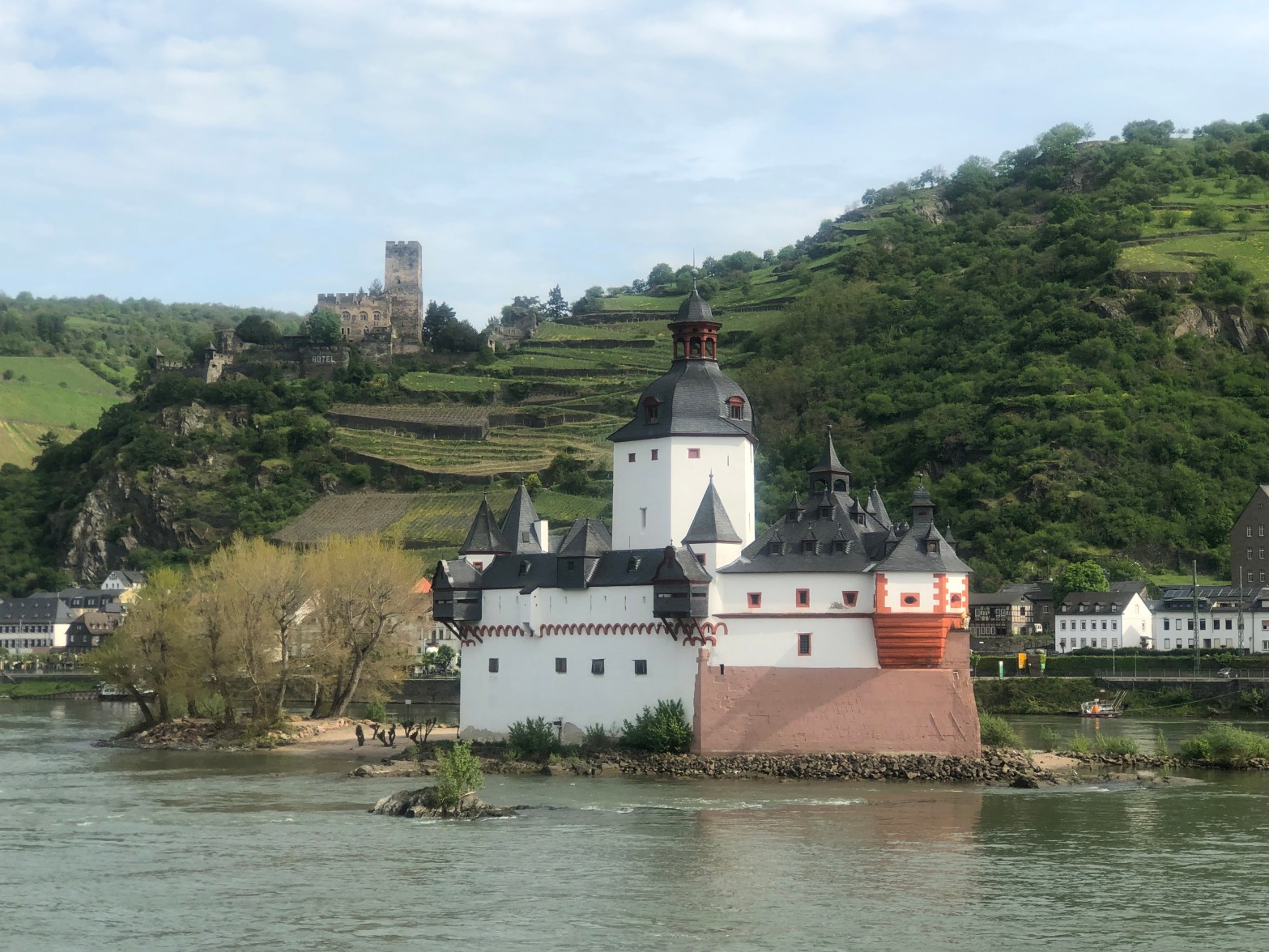
Right: Rheinstein Castle, near the German town of Trechtingshausen, is one of many medieval castles that captivates Rhine River cruise passengers. (Photo credit: German National Tourist Board)


To read about the Scenic Opal luxury river ship, including its accommodations and dining experiences, please visit https://europeantraveler.net/2023/10/19/cruising-through-the-heart-of-europe/

Biking Along the German Rivers

BIKING THE GERMAN RIVERS

Germany is famous for its rivers; they cut through beautiful landscapes from north to south, from east to west, from the sea to the mountains. The rivers have been the modes of mass transportation long before roads and today the Elbe, Rhine, Main, Moselle or Danube invite hundreds of thousands of tourists each year for river cruises. But you cannot only discover Germany’s rivers on a boat. Cycling paths follow them through ever changing landscapes, past old castles, romantic towns and buzzing cities.

The Elbe Cycling Path is one of the most attractive in Germany. It leads for 520 miles from Dresden in the southeast all the way to the North Sea. The route is split in several stages, all easily doable in a day, and you can choose between both sides of the river. Leading through fascinating landscapes from wetlands to hills, connecting UNESCO World Heritage Sites such as the city of Dresden, the Luther town of Wittenberg and the harbor city of Hamburg, there is plenty to discover along the way. The river has historic significance as part of the former West German-East German border and you can still see the transformation of this region in process. Along the way you will find plenty of bike-friendly hotels, hostels and camping grounds, and many package tours make this a very accessible route.

The Moselle Cycling Path in Germany’s west between the wine-growing region of the Elbling wine near Trier, a wine specialty of the Upper Moselle, and Koblenz invites you to a pleasurable bike tour. For 150 miles discover the 2,000-year-old history of the region, from old Roman ruins in Trier and Koblenz, to romantic wine villages such as Bernkastel or Cochem and great spas in Traben-Trabach. The trail is predominantly level, with an excellent network of cycle tracks and rural roads as well as old towpaths and accurate sign-posting, offer optimum conditions for the casual cyclist.  

For 360 miles the Main River Cycling path leads from east to west through the northern Bavarian Region of Franconia and the State of Hesse to Frankfurt. Highlights along the way are the majestic Wagner town Bayreuth, the UNESCO World Heritage Site of Bamberg, known as Germany’s beer capital and for its Baroque architecture, the wine growing region around Wuerzburg and the buzzing financial metropolis of Frankfurt. Stop along the way in one of the many local breweries or vineyards and be enchanted by 1,000-year-old castles and cathedrals. 

The second longest river in Europe, the Danube, springs unofficially in the park of the princely Fuerstenberg castle in Donaueschingen at the border of the Black Forest in southwestern Germany, contained in a magnificently decorated, circular fountain from the 18th Century. “Mother Bear” presides over the fountain and shows her “daughter,” the young Danube and all cyclists the way.

The Danube Cycling Path leads for 360 miles through the German states of Baden-Wuerttemberg and Bavaria from the Black Forest to Passau in the southeast. The cycling road is signposted and package tours with several itineraries from seven to 15 days are bookable. Highlights along the way are the Sigmaringen and Hohenzollern castles of the Hohenzollern dynasty that ruled Germany in Baden-Wuerttemberg. Also interesting are the cathedral and merchant town of Regensburg, with the largest core of undestroyed medieval houses in Germany, and the three-river city of Passau. Discover the Danube from its fast flowing beginnings until it grows into a wide and impressive river in Bavaria.  

www.cometogermany.com
www.elberadweg.de
www.mosellandtouristik.de
www.mainradweg.com
www.donau-radweg.info

Christmas Is a Time of Food and Fun

European Traveler has gathered Christmas holiday recipes from around Europe, and we present them here in a special tribute to the countries from which they come. You’ll find a variety of tasty foods in these selections, from desserts and breads to main dishes, to cookies and candies. As December progresses, we plan to add more, so stay tuned!

Please note that some of the recipes are in metric measurements and may need to be converted.

Bon Appetit!

AUSTRIA

VIENNESE VANILLA CRESCENTS (VANILLEKIPFERL)

Eva Draxler / Vienna Tourist Board

INGREDIENTS
1 1/2 sticks (6 ounces) unsalted butter
2/3 cup finely ground nuts (almonds or hazelnuts)
1/2 cup confectioner’s sugar
2 egg yolks
1 1/2 cups all purpose flour
dash of salt

PREPARATION
Knead all ingredients together quickly – keep them cool. Cool in refrigerator for several hours. When forming crescents, take out only the amount of dough you are working with. Form into large, sausage-like rolls with a diameter of about 2 inches. Cut thin slices and quickly roll each of them in the palms of your hands, thus forming small crescents. Place on greased cookie sheet. Bake at 325 degrees Fahrenheit for about 20 minutes. Let cool for no more than five minutes. While still warm, roll in vanilla sugar.

THE AZORES

HOTEL MARINA ATLANTICO
THE AZORES

Courtesy Monica Bensaude Fernandes/Bensaude Turismo

COD “COM TODOS” STYLE

INGREDIENTS
2 cod steaks
300 grs of cooked chickpeas
1 Portuguese cabbage
200 grs carrots chopped in thin circles
2 dls extra virgin olive oil
30 grs fresh coriander
1 salted pickled red pepper cut length wise
6 dry garlic cloves
200 grs crumbed corn bread
100 ml cream
Salt and white pepper
PREPARATION
Boil cod for 5 minutes. Remove skin and bones. Grate chickpeas in a tasse-vite. Add cream and season with salt and pepper. Blanch cabbage, drain and sauté in olive oil and garlic.
Sauté carrots in olive oil and garlic.
PLATE PRESENTATION
Using a rim, first layer chickpeas, and then carrots. On top, place cod, broken apart. Cover it with sautéed cabbage and lastly, the crumbed corn bread. Give it a little color by briefly placing in a very hot oven. Decorate with olive oil and fresh coriander.

DUCK BREAST WITH ORANGE AND DRIED FRUITS
INGREDIENTS
2 boneless duck breasts
300 grs red cabbage, julienned
4 oranges
300 grs potatoes, cut in extra fine rounds (chip style)
50 grs crushed walnuts
50 grs crushed pine nuts
50 grs S.Jorge cheese sliced thin
½ cup Brandy
Salt and white pepper
2 tablespoons balsamic vinegar
10 grs sugar
PREPARATION
Sauté duck in high heat for 5 minutes. Season with salt and pepper. Zest the orange. Set aside. Juice the oranges and add it to pan. Let it reduce and set aside the sauce. Bake potatoes in a fan format with the thinly sliced cheese on top. Sauté cabbage with a little olive oil. Add balsamic vinegar, sugar and dried fruit.
PLATE PRESENTATION
At the top, place the fanned potatoes. In the center, place red cabbage and beneath position the laminated duck. Cover with sauce and orange zest.

VEAL LOIN VERDELHO
INGREDIENTS
400 grs veal loin
300 grs potatoes
400 grs carrots
Verdelho wine from Pico Island
Onions
Leeks
Salt and pepper (local, if possible)
PREPARATION
Season veal with salt and pepper. Blush or sauté loin in high heat for 5 minutes. Remove veal, add onions and leeks and brown. Add red wine and let it reduce. Season and sift sauce. Grate carrots and sauté in a little olive oil. Bake potatoes, which have been previously stuffed with a bay leaf and bacon, in alternating cuts.
PLATE PRESENTATION
Place carrots at the center, potatoes in the back, veal in the front of plate, and cover with sauce.

GERMANY

MULLED WINE
(GLUHWEIN)
Victoria Keefe Larson/German National Tourist Office

Perfect for those dark and cold winter evenings.

INGREDIENTS:
2 bottles red wine
1 cup sugar
3 cups water
1 lemon, sliced
20 whole cloves
6 to 8 cinnamon sticks
1 orange, sliced for garnish

PREPARATION:
Mix water, lemon and spices and simmer for an hour. Strain. Heat but do not boil the red wine. Add wine to hot water mixture. Ladle into cups and serve with half a slice of orange.

HUNGARY

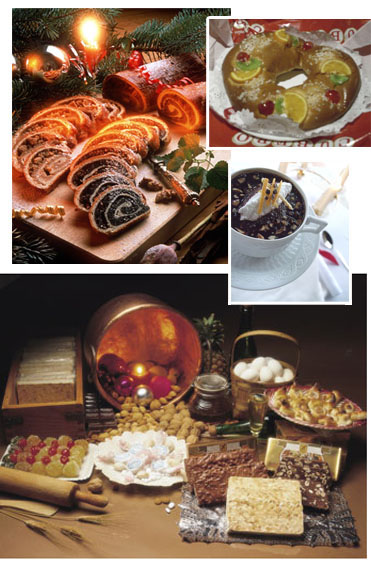
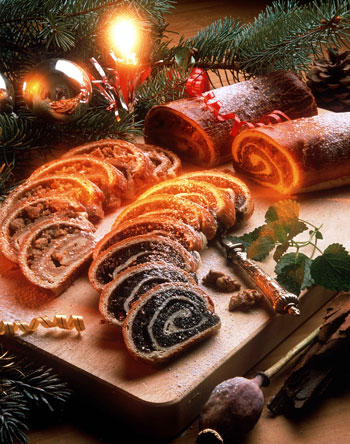
Dios es Makos beigli
Poppy seed and nut rolls (bagels)

From Culinary Hungary/courtesy Elvira Vida/Hungarian National Tourist Office

Makes 4 rolls; the filling ingredients are calculated for 2 rolls respectively.

INGREDIENTS
For the dough:
1 cup sugar
1/2 cup/120 ml milk
1 cake/15 g compressed yeast
1/2 cup/5O g confectioner’s sugar
3 1/4 cup/500 g flour
6 1/2 tbsp/100 g butter
6 1/2 tbsp/100 g lard
2 eggs
1 tsp grated lemon zest
pinch of salt

For the nut filling:
Scant 1/2 cup/100 ml milk
1OO g superfine sugar
1 envelope of vanilla sugar
1/2 tsp grated lemon zest
3 tbsp/30 g raisins
Pinch of cinnamon
3 cups/250 g ground nuts
3-4 tsp honey (or 1-2 apples or 2-3 tsp apricot jam)

For the poppy seed filling:
Scant 1/2 cup/lOO ml milk
1 1/4 cups/250 g confectioners sugar
1 sachet of vanilla sugar
1 2/3 cups/250 g ground poppy seeds
3 tbsp/30 g raisins
1 tsp grated lemon zest
4 tbsp honey

Other:
Butter or lard for the baking sheet
1 egg yolk for glazing

PREPARATION:
Dissolve the sugar in the lukewarm milk, then add the yeast. Mix the remaining dough ingredients wilh the yeast mixture and knead thoroughly. Cover the dough with a dish towel and leave to rise for about 30 minutes.

To make the nut filling, put the milk in a pan with the sugar and vanilla sugar and bring to a boil. Add the lemon zest, raisins, cinnamon, nuts, and honey (or peeled, grated apples or apricot jam).

For the poppy seed filling, mix the milk with the confectioners’ sugar and vanilla sugar. Bring to a boil and add the poppy seeds and raisins. Simmer for a few minutes, stirring constantly, then remove from the heat and stir in the lemon zest and honey.

Divide the dough into four and roll out each piece into a rectangle measuring about 12 x 14 inches/30 x 35 cm. Spread the dough with the nut or poppy seed filling and roll up lengthwise, ensuring that the rolls remain firm. Grease a baking sheet and carefully transfer the rolls onto the sheet and brush with egg yolk.

Bake in a preheated (medium) oven until golden brown. Only remove from the oven when completely cool. If kept covered and stored in a cool, dry place the bagel will stay fresh for a long time. Do not slice until just before serving, arranging the slices like roof tiles on a plate, and sprinkle with confectioners’ sugar.

PORTUGAL

REBANADAS CASA OS MOINHOS

INGREDIENTS

16 egg yolks
500 g sugar
1 kg Portuguese white bread
Cinnamon
Lemon

PREPARATION
Mix the eggs with 16 tablespoons sugar until it is a thick mix — make a thin syrup out of the rest of the sugar. Use one glass of water for this, then slice the bread, — after letting it sit for one day. Dip the slices into the syrup, drain, and dip in the egg yolk mix. Gently pan sear on a medium stove top, and sprinkle with cinnamon and lemon zest.

SPAIN

ROSCON DE REYES
(Holiday Bread)

This recipe is from The Foods and Wines of Spain by Penelope Casas
Courtesy Patricia Wood Winn/Tourist Office of Spain

No holiday is more eagerly awaited in Spain than El Dia de los Reyes Magos-the Day of the Three Kings (Epiphany) on January 6. On this date every year, so the legend goes, the Three Wise Men journey to Spain on camels, bearing gifts for all Spanish children. They use ladders to gain access to city apartments aud leave presents in the children’s shoes, which have been carefully laid out the night before, along with fodder for the hungry camels. Kids who have not been good during the year fear the worst: that the kings will fill their shoes with black coal instead of toys.

Rascon de Reyes is baked and eaten only at this time of year. It is a delicious sweetened bread, coated with sugar and candied fruits, and it always contains a surprise-either a coin or a small ceramic figurine, which is to bring luck for the year to the fortunate person who finds it in his piece of bread.

Makes 1 large bread ring

INGREDIENTS
1 package dry yeast
3/4 cup warm water
1 tablespoon orange flower water (often found in Italian food shops. If unavailable, substitute strong tea)
1/2 teaspoon grated lemon rind 6 cloves
1/4 pound butter
1 tablespoon lard or vegetable shortening
1/2 cup sugar
1/2 teaspoon salt
2 eggs
1 tablespoon brandy, preferably Spanish brandy, or Cognac
1/2 cup milk, scalded and cooled
5 cups unbleached, all-purpose flour
Candied fruit slices (orange, lemon, etc.)
1 egg, lightly beaten
1 1/2 tablespoons sugar, preferably coarse, for sprinkling

PREPARATION
Dissolve the yeast in 1/4 cup of the warm water. Simmer the remaining 1/2 cup of warm water with the orange flower water, lemon rind, and cloves for 10 minutes, covered. Cool. Discard the cloves. Cream the butter, lard, the sugar, and the salt. Beat in the 2 eggs, then add the brandy, milk, the water-and-lemon mixture, and the softened yeast. Gradually mix in the flour with a wooden spoon until a soft and slightly sticky dough is obtained. Knead on a floured working surface, adding more flour as needed, about 5 minutes, until smooth and elastic. Place the dough in a large oiled bowl, turn to coat with the oil, cover with a towel, and place in a warm spot, such as an unlit oven, to double in size, about 2 hours. Punch down and knead again 5 minutes. Insert a good luck coin – perhaps a silver dollar or half-dollar – or some other appropriate object, such as a cute miniature ceramic animal.

Shape the dough into a large ring, pinching the ends to seal. Place on a lightly greased cookie sheet. Decorate with the fruit slices, pushing them slightly into the dough. Let the ring rise in a warm spot about 1 hour, or until double in size. Brush with the egg, which has been mixed with a teaspoon of water, sprinkle with sugar, and bake in a 350° F oven 35-40 minutes, or until a deep golden brown.

Destination Erfurt: Germany’s City of Towers

Described as the ‘Thuringian Rome,’ it is steeped in history

By Don Heimburger
Photos by the author
Home page photo by Barbara Neumann, courtesy Erfurt Tourism and Marketing

The reformer Martin Luther once said that Erfurt, Germany “is situated in the best location. It is the perfect place for a city.”

Little did he know 500 years later that Erfurt, the capital of Thuringia, with a population of 200,000 and right in the center of “modern” Germany, would attract large crowds of visitors, many just to see the city in which Luther became an ordained priest.

Erfurt is the capital city of the German state of Thuringia and the main city nearest to the geographical center of modern Germany, located 60 miles southwest of Leipzig. With the Luther Decade ending in 2017, Erfurt has put on its best face to show what is has to offer, and visitors won’t be disappointed.

Erfurt was all spit and polish for the 2015 German Travel Mart in April 2015, when thousands of journalists worldwide, buyers (travel agents and meeting planners) and German suppliers (hotels, Germany’s cities and regions, and commercial attractions) all met in Erfurt (and next-door Weimar) for a three-day-long conference to put Germany on display.

ONE OF LARGEST DOMPLATZ
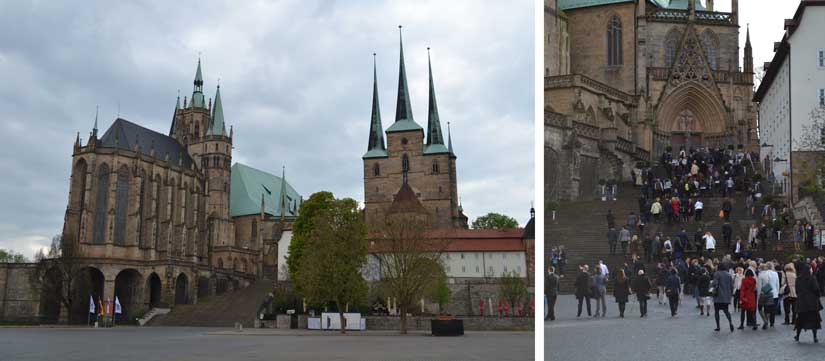
The town’s domplatz is said to be one of Europe’s largest, and it sits next to the impressive central church in Erfurt, St. Mary’s Cathedral, the oldest ecclesiastic building in the city, founded in the 8th century.

Initially the Romanesque-turned-Gothic cathedral served as the bishop’s seat, and up to the 19th century was the seat of the collegiate chapter of St. Mary. Martin Luther himself was ordained in the church in 1507.

The Mariendom (St. Mary’s) and St. Severi form an imposing backdrop for the annual Cathedral Steps Festival held in Erfurt.

The largest free-swinging bell in the world, the “Gloriosa,” with a diameter of 8 feet, hangs in the church today, but because of its age is only rung occasionally. Inside the cathedral there is an elaborate Gothic chancel with a series of 13 colored stained-glass windows which are 42 feet high and are among the greatest works of medieval stained-glass art. The cathedral contains a number of art treasures from various centuries. Guided tours of the church can be arranged in advance.

A flight of 70 steps that lead to the cathedral date back to the 14th century, and today many concerts and events are held on the steps.

Next to St. Mary’s on the hill is St. Severi Church, and together with St. Mary’s the two churches dominate the heart of this medieval city.

Nicknamed the “Rome of the North” for its profusion of some 30 spires and steeples, Erfurt is unquestionably one of Germany’s most beautiful cities. The old heart of the city with its half-timbered buildings looks like something out of the movies from years ago.

“Erfordia turrita” or “Erfurt, city of towers” is how Luther once praised Erfurt with its 25 parish churches, 15 religious foundations and 10 chapels. This impressive list of ecclesiastical buildings, in conjunction with the magnificent architectural motif of the cathedral and the Church of St. Severus (now the city’s emblem), inspired historians such as Ernst Stida (1585–1632) to refer to the city as the “The Thuringian Rome.”

Most of the churches are still intact and blend in with the beautifully restored half-timbered houses of the Andreas quarter and with the brightly-colored façades of Renaissance buildings. The medieval part of the city is one of the largest and best preserved historical city centers in Germany.

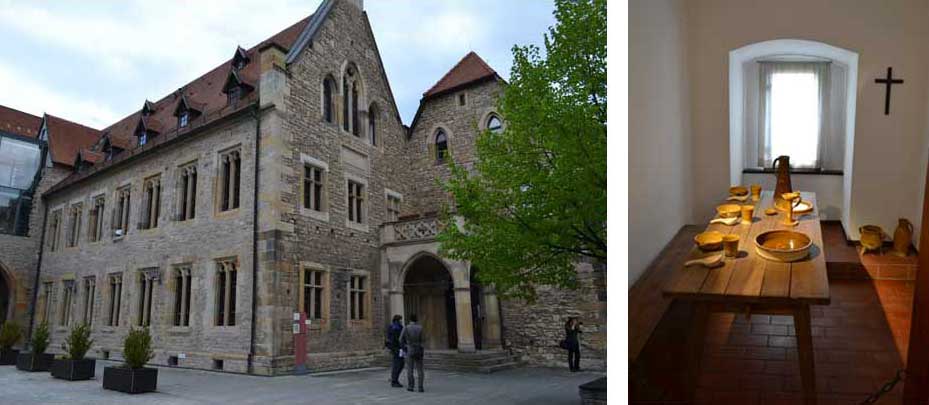
The Augustinian Monastery, built in 1277, is of Gothic design; stained glass windows date from the beginning of the 14th century. The monastery is considered one of the most famous places related to the Reformation.

LUTHER’S MONASTERY
In 1505, Luther became a monk and took up residency at the beautiful and peaceful Augustinian Monastery in Erfurt, built in 1277. Recently renovated, the gothic monastery has functioned as an Evangelical/Lutheran church and school since 1525. Visit the chapter house and enjoy the same wonderful acoustics that Luther did in his day, or see the reconstruction of Luther’s cell. The Augustinerkloster possesses valuable stained glass windows dating to the beginning of the 14th century. Martin Luther lived here as a monk from 1505 to 1511. You can also spend the night in one of the 51 comfortable guest rooms at the monastery. Today the abbey serves as an ecumenical conference center and a memorial to Luther.

The Luther Stone stands to the east of Stotternheim near Erfurt. On July 2, 1505 Martin Luther, then a law student at Erfurt University, was returning to Erfurt after visiting his parents in Mansfeld. He was making the journey on foot, and as he approached Stotternheim he witnessed a severe thunderstorm that put him in fear of his life. He is said to have cried out, “Help, St. Anne, I will become a monk.” The site where the memorial stone now stands is sometimes described as the birthplace of the Reformation.

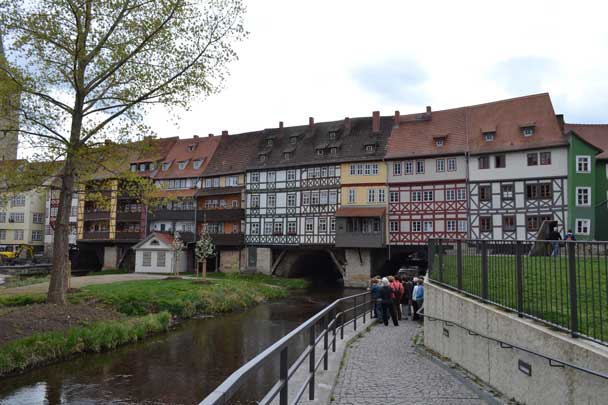
Merchant’s Bridge, a landmark in Erfurt, is the longest bridge in Europe covered by houses that are still inhabited today. In early times, traders sold their wares from this unique bridge.

The Krämerbrücke/Merchants’ Bridge is Erfurt’s most interesting example of secular architecture. This arched stone bridge was constructed in 1325 over the river Gera where the original ford was located along the “via regia” trading route. The Krämerbrücke is the only bridge north of the Alps to be built over entirely with houses that are still used as residences. In medieval times there were two churches built at each end of the bridge, one of which, the Ägidienkirche, is still in existence.

In 1695, the first foundation stone was laid for one of the few remaining 17th century city fortifications to be found in Germany. Today the Petersberg Citadel is an impressive example of European fortification construction dating from the 17th to the 19th centuries. Parts of the fortification were open to the public in 1964, but after 1990 it was extensively renovated, and today the greater part of the casemates, esplanades and bastions inside the fortification area are open to visitors. The completion of the citadel and the Petersberg are Erfurt’s largest undertaking.

(left to right) The Erfurt Rathaus is located at the Fischmarkt; origins of the building go back to the 11th century.; Erfurt city guide Matthias Gose points out aspects of the town on a scale model cast in metal.; Erfurt architecture

Haus zum Breiten Herd, historic Renaissance guild house, Fischmarkt square, Erfurt. In earlier times, rich merchants of the the city decorated the fronts of their homes with delicate carvings.

The neo-Gothic town hall at the Fischmarkt was built between 1870 and 1874. Inside the stairwells and the Festsaal (main function hall) there are numerous wall paintings depicting legends and scenes from the life of Luther, as well as pictures illustrating the history of Thuringia and Erfurt.

Erfurt city guide Matthias Gose points out aspects of the town on a scale model cast in metal

The Old Synagogue is one of very few preserved medieval synagogues in Europe. Thanks to the extensive preservation of the original structure, it has a special place in the history of art and architecture and is among the most impressive and highly rated architectural monuments in Erfurt and Thuringia. The synagogue was constructed during the Middle Ages on the “via regia,” at the heart of the historical old quarter very close to the Merchants Bridge and the town hall.

Many parts of the structure still remain today, including all four thick outer walls, the Romanesque gemel window, the Gothic rose window and the entrance to the synagogue room. After extensive restoration, the building was reopened in 2009. On display in the exhibition rooms is a collection of medieval treasures discovered during archaeological excavations. This includes 3,140 silver coins, 14 silver ingots, approximately 6,000 works of goldsmithery from the 13th and 14th centuries, and an intricate wedding ring of the period, of which only two others are known to exist in the world.

One of the buildings that reflects the history of Erfurt in a special and unique manner is the Kaisersaal in the Futterstrasse, which, after radical reconstruction, was reopened in 1994. It was built out of three patrician houses at the beginning of the 18th century to serve as the university’s ballroom. It is the oldest center for cultural events and meetings in Germany.

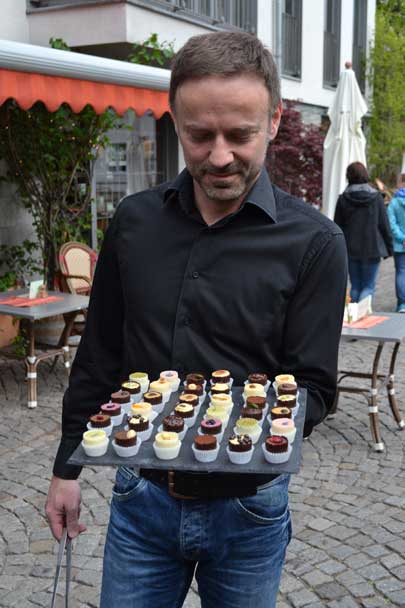
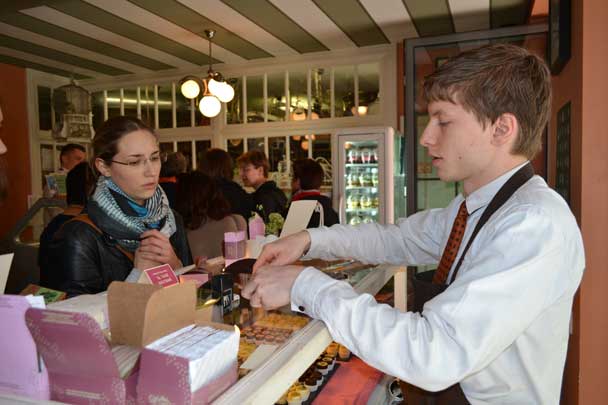
The Goldhelm Schokolade shop in Erfurt provides a selection of fresh chocolates every day

The Anger Museum with its variety of wood and stone sculptures is situated in the middle of the old part of the city. It was built between 1706 and 1712 as a packing and weighing station, both for Philipp Wilhelm Reichsgraf von Boineburg, the governor of the city, and for Archbishop Lothar Franz von Schönborn. It is one of the most important early 18th century buildings.

The Erfurt city museum, in the magnificent Haus zum Stockfisch building, was founded in 1886 to house the artworks that Erfurt inherited from one of its most famous sons, the Romantic painter Friedrich Nerly. The museum’s four floors present the city’s culture, economic development, politics and religion.

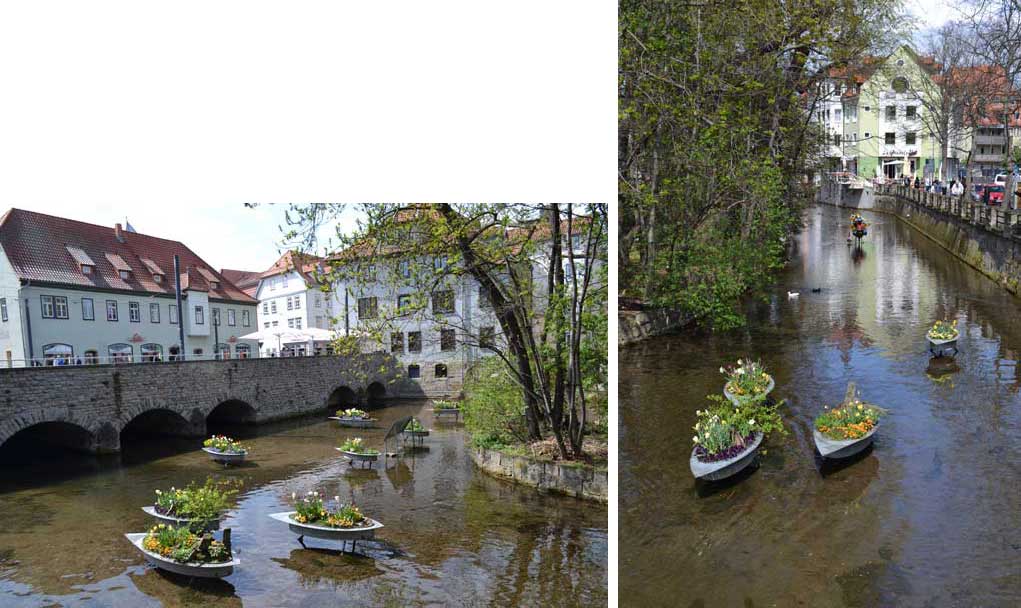
Flowers decorate the Gera River channels in Erfurt.

Erfurt’s last water mill to still be in use is located on the banks of the Gera River near the town hall. Besides the water-driven grinding mill, there are also exhibition rooms displaying historical machines. The museum also contains an illustrated history of Erfurt’s water mills in particular and of the history of hydraulic power in general.

Erfurt, said to be Germany’s largest single heritage site, is a popular destination for tourists, thanks to its medieval ambiance and storied history.

For more information, go to erfurt-tourismus.de or www.germany.travel.

Magdeburg: State Capital of Saxony-Anhalt and the ‘City of Otto’

From an historic Cathedral to a Green Citadel and a Millennium Tower, this city is thriving

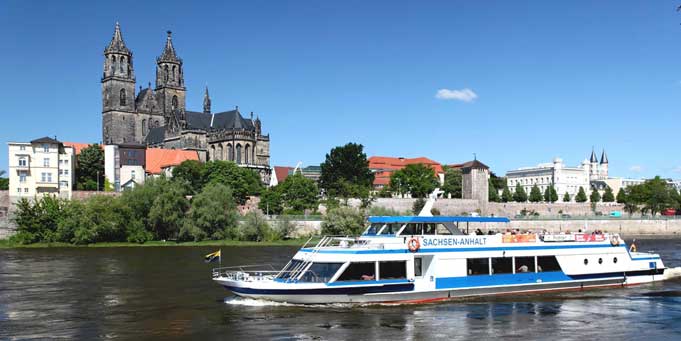
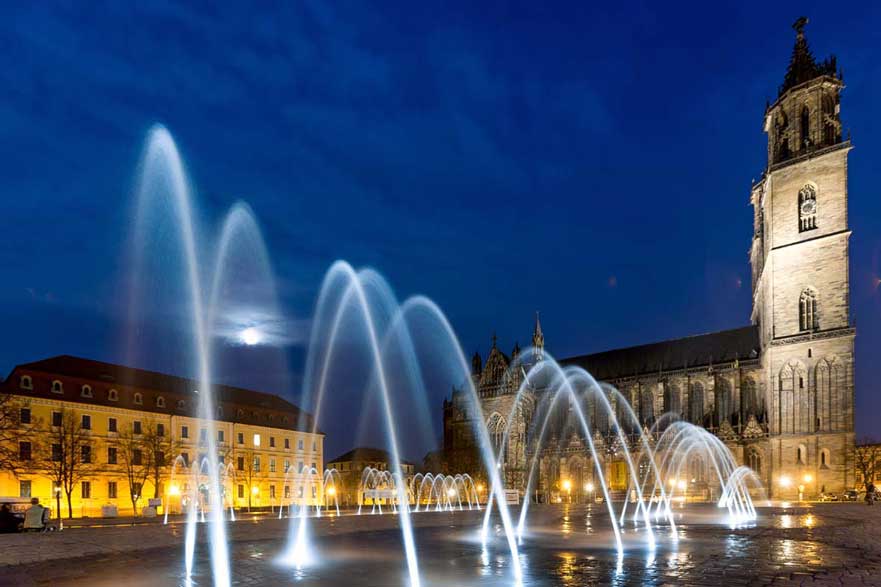
Magdeburg Cathedral ©www.AndreasLander.de

By Don Heimburger
Photos courtesy of the author, German National Tourist Office and Magdeburg Marketing

The Elbe River cuts through the heart of Magdeburg, offering this historic German city an idyllic landscape and picture-perfect views through a camera. But the city has seen its share of severe destruction over the centuries, such as in the Thirty Years War and World War II.

Today, this city of 240,000 in central Germany has rebounded nicely and combines its important and long history with new architecture, innovative cultural events and green spaces to make it an appealing attraction for tourists.

Aerial view of Magdeburg on the Elbe River
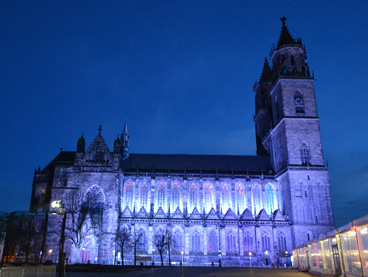
Magdeburg Cathedral shines at night.

MAGDEBURG CATHEDRAL
The town’s huge cathedral is a “must-see” and is the largest church building in this part of Germany. Surprisingly, the Magdeburg Cathedral can be traced back as early as 937, when Emperor Otto the First founded a monastery dedicated to St. Maurice. In 955, the church building was extended before becoming the cathedral of the established bishopric of Magdeburg in 968. Otto the First had a number of high quality pieces of antique art shipped to Magdeburg from northern Italy to the cathedral. These included columns made of purple-red porphyry, marble and granite, many of which still provide finishing touches to the architecture of the cathedral today.

Magdeburg Cathedral architecture

When Emperor Otto died in 973, his remains were brought to Magdeburg Cathedral, where he was buried in a stone sarcophagus. In 1207, the Ottonian cathedral was damaged in a city fire. Archbishop Albrecht II then began construction on a new Gothic cathedral, which was consecrated in 1362. The cathedral’s 341-foot-high west towers were completed in 1520.

Today, visitors to Magdeburg Cathedral can see the rich interior stone work which displays impressive architecture. The building is also full of unique and internationally renowned original exhibits representing nearly all periods of art history, including spolia from the building’s Ottonian predecessor, the original tomb of Emperor Otto I and his first wife Edith.

Magdeburg Cathedral ©www.AndreasLander.de

In addition, there are Romanesque bronze grave markers, early Gothic sandstone sculptures including the famous figures of the “Clever and Stupid Virgins,” the carvings on the choir stalls of the canons dating back to the 14th century, and Renaissance paintings, as well as 20th century art such as the famous war memorial designed by Ernst Barlach. The cathedral, which became protestant in 1567, is now the seat of a Protestant bishopric and home to members of a congregation in the city center.

Monastery of Our Lady

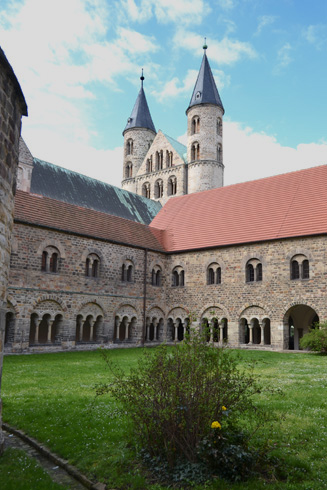
MONASTERY OF OUR LADY
Said to be the “pearl of the Romanesque Road,” the Monastery of our Lady in Magdeburg is considered the oldest surviving building in the city.

The unique well-house, magnificent barrel-vaults and sublime monastery church with its slender towers comprise an architectural marvel which is the centerpiece of all Romanesque buildings in Saxony-Anhalt. The structure holds both the Magdeburg Art Museum and the Georg Philipp Telemann concert hall. Archbishop Gero of Magdeburg ordered the erection of the building in 1017-18. However, nothing remained of the original construction, and it was Archbishop Werner (1063-1078) who arranged for the reconstruction which was finally completed in the 12th century by the Premonstratensian order.

The rotunda with its pointing cones, resembling a monk’s tonsure, is a remarkable architectural feature of the eastern wing. Together with its 32 arcades, the rotunda forms an ensemble considered one of the most amazing and interesting structures in European monastery architecture. After 1220, the monastery church was vaulted in early Gothic style. Also deserving a special mention is a collection of sculptures ranging from medieval to contemporary in the museum of the monastery. The surrounding area includes a sculpture park created in 1989.

St. John’s Church is Magdeburg’s oldest parish church, first mentioned in 941. The western section of the church, which features a late Romanesque design, and the Gothic hall church, have both been preserved. A monument of Martin Luther and the crypt of the Otto von Guericke family can be found in front of and inside the church.

The history of the church was marked by many changes: St. John’s fell victim to many city fires and was destroyed when General Tilly’s army invaded Magdeburg in 1631. However, the citizens never tired of rebuilding the church. St. John’s Church left its mark on history when an important and far-reaching event took place: on June 26, 1524, Martin Luther held a famous sermon on right and wrong justice in the greatly overcrowded church, whereupon all parishes of the city center converted to Protestantism, as laid down in the annals of Magdeburg.

Today St. John’s is open to the public and has become a popular venue for a wide variety of events.

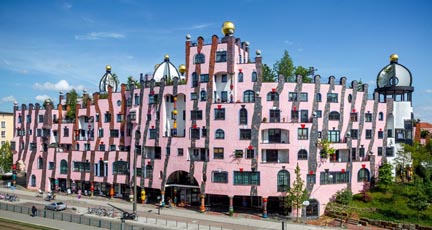
Hundertwasser’s Green Citadel ©www.AndreasLander.de

GREEN CITADEL OF MAGDEBURG
One of Magdeburg’s most eye-catching attractions for visitors is also one of the last architectural masterpieces designed by the artist Friedensreich Hundertwasser. The Green Citadel of Magdeburg is located among a mixture of Baroque facades and examples of modern design and provides the Breiter Weg with a landmark structure and a burst of colorful culture.

This architectural retail/apartment building has been the subject of much discussion since it was constructed in 2005. It was the last building Hundertwasser designed before his death. The artist said the building was an “oasis for humanity and nature within a sea of rational houses” at the heart of the “concrete desert” of Magdeburg.

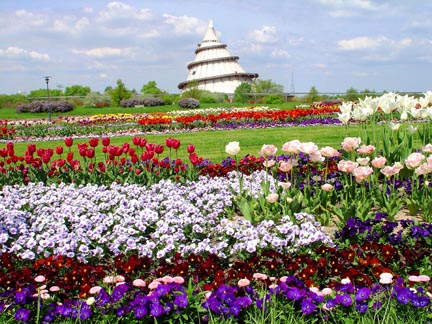
(left to right) Science demonstration at Millennium Tower; Millennium Tower

To explore the green of Magdeburg, visitors also want to investigate Elbauenpark. The park, which covers an area of 222 acres and was awarded the title of Germany’s second most attractive park in 2005, is home to many attractions that visitors can explore.

Since being created, the unique park has gained its place as one of Magdeburg’s most important landmarks. It is home to the Millennium Tower (the world’s tallest wooden construction of its kind), Lake Stage, Butterfly House and a number of playgrounds, sports areas, pieces of art, themed gardens and other attractions.

The park is home to a wide range of activities and facilities for sports fans, including golf, skating, rock climbing, hiking, biking, a high-rope park and even a toboggan run.

TOWN HALL OF MAGDEBURG
The Town Hall of Magdeburg dates to the 12th and 13th century, with the oldest remains in the vaults which form part of today’s Ratskeller restaurant. Pelt dressers, tanners and dealers in hides and skins met here in the long hall to trade and stock their goods. After the turmoil of the 30 Years War, a two-story sandstone town hall building was erected in Dutch Renaissance style including Italian Renaissance architecture, and in the 19th century it underwent a number of changes and extensions.

In January 1945, the Town Hall was completely destroyed during an air raid, but reconstruction work on it began in 1965, and it was rebuilt and restored according to its original blueprints. The hall features bronze doors designed by Heinrich Apel and carved with historical figures and stories from the city’s past as well as features an impressive bell carillon with four octaves. The carillon is played on market days and also for concerts.

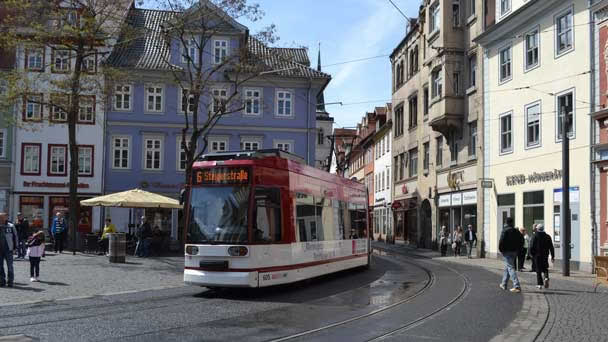
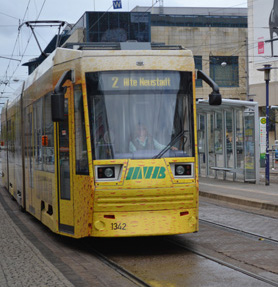
(left to right) Colorful street of buildings on Otto-Richter-Strasse; Magdeburg Town Hall with Statue of Otto I (912 – 973), Magdeburg, Germany. Otto I, or Otto the Great, was the founder of the Holy Roman Empire, reigning as German king from 936 until his death in 973.; Tram system in Magdeburg

NUMEROUS ART VENUES
Today Magdeburg features numerous museums, art galleries, theaters and performing venues including the AMO, a multifunctional complex for shows, concerts and conferences. There is also the Stadthalle Magdeburg, the city’s civic hall. The hall was constructed in the style of the Neues Bauen modern architecture movement in 1927 for use as a showplace on the occasion of the German Theatre Exhibition. It has hosted a wide range of events such as classical concerts, theater performances, musicals, revues, ballets, galas, sports shows and rock and pop concerts.

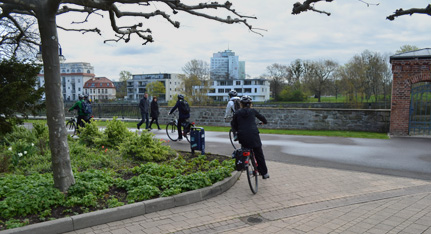
Magdeburg features miles of bike pathsthis one is near the Elbe River.

MAGDEBURG ZOO
Magdeburg Zoo is located at the heart of Vogelgesang Park, a natural and garden landscape that covers 47 acres. The zoo features 835 animals representing 176 different species. The man-made savannah landscape in the zoo covers an area of 215,000 square feet; the Savannah Viewing Point enables visitors to enjoy a panoramic view over the Africa area and the Water Bird Pond.

Magdeburg was the site of the 2016 German Travel Mart, attended by 1,500 participants from all over the world. Editor/Publisher Don Heimburger was on hand and filed this report about the green city of Magdeburg.