The Bernese love laid-back, hour-long shopping trips – and will do so in any weather. Thanks to the longest weather-protected stretch of shopping promenade in Europe, this is in fact quite feasible. The “Lauben,” as the Bernese call their arcades, are admirably suited for a stroll in the historic city center.
It is in the Bernese Old Town in particular where the unique historical ambiance combines shopping with a journey through time into the past. The Kramgasse forms the centerpiece of the Bern Old Town. This alley was once Bern’s busiest trade route for marketers and shopkeepers who loudly advertised and sold their goods here, and swapped the latest news. Almost 4 miles of arcades form a distinctive feature of the Old Town. The history of this arcade passage reaches back to the earliest city development (1191), and even then served to accommodate market stalls and businesses. Traders could thus trade and earn their living in any weather.
The Bernese also demonstrated their practical sense in putting their basements to good use. They built vaulted cellars under every house in order to be able to store their goods. Nowadays, entirely different treasures are hidden in these cellars. Descend the steep stone steps, and find yourself in a different world. The underground reveals trendy and traditional bars, clubs, theatres, cellar cinemas and special fashion shops.
Explore the Christmas Markets with this easy river and rail adventure.
By Marilyn Heimburger Photos by Don Heimburger
As the weather turns colder and stores begin playing Christmas music to heighten anxiety about getting everything done before Christmas, I yearn to spend the Advent season once again in Germany’s beautiful Christkindlmarkts.
Not long ago, a friend also expressed her longing to visit the famous Christkindlmarkts in Germany and Austria during Advent, but didn’t know where to begin. Which ones should she see? How do you find accommodations in each town, and arrange transportation from market to market? The planning seemed too daunting, and she just never got started.
European Traveler discovered the perfect plan to make that dream come true: last Advent we took a nine-day Christmas market tour by river and rail that was easy and convenient. We experienced more than a dozen Christmas markets along the Danube River in Germany and Austria, with guided tours in towns along the way.
VIKING AEGIR The river portion of our “Advent along the Danube” trip was on the Viking Aegir, a 1-½-year-old Viking River Cruise ship which sailed from Budapest to Nuremberg. One of the best perks of a river cruise is that you unpack only once for the week. Meals are provided for you, and the ship delivers you from market to market, with local tour guides waiting when you dock, and activities onboard while you leisurely cruise from market to market. What could be easier?
On board the Viking Aegir, passengers relax in comfort with a beautiful view of Germany and Austria through panoramic floor to ceiling windows.
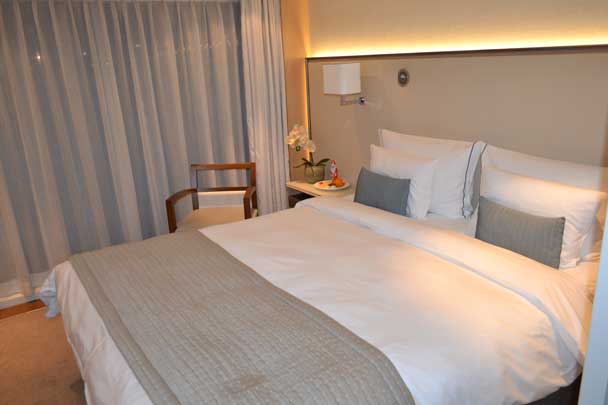
Although the cruise began in Budapest the day before, we chose to fly to Vienna and board the ship there. We moved into our spacious stateroom, complete with private bathroom with shower, drawers and closet for clothing, queen-sized bed, mini-fridge, TV and sliding glass doors on the balcony, offering a non-stop view along the Danube as Austria and Germany glided by.
Comfortable cabins await the passengers aboard the Viking Aegir cruise ship.
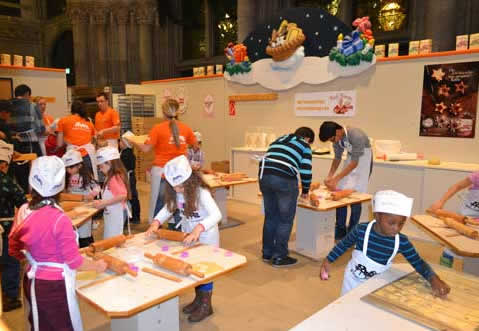
VIENNA’S MAGIC OF ADVENT Since the boat dock is some distance from the city center, Viking provides bus transportation to and from Vienna’s largest Christmas market, which glitters in the shadow of Vienna’s City Hall. Named “Wiener Adventzauber,” or “Vienna’s Magic of Advent,” it features hundreds of vendors in wooden huts offering local pastry, sausage and hot drink specialties, gifts, decorations, candles and accessories. There are pony rides, story reading on the Celestial Stage, appearances by the Viennese Christkind, and even arts and crafts and baking stations inside the Rathaus so children can make their own gifts and Christmas goodies.
Located inside Vienna’s Rathaus is a baking workshop, where children can make their own cookies.
Within walking distance of the Rathaus market are several other Christmas markets, smaller but with their own local focus and definitely worth a visit. Markets in other parts of Vienna are on Maria-Theresien-Platz, in the Old AKH, on Freyung, the Am Hof Advent Market, at Belvedere Palace, on Karlslatz, on Spittelberg, at Stephansplatz, on Riesenradplatz, and at the Schönbrunn Palace. To see all of them would take an extra day or two! We saved some of our market visits for after the cruise, when we returned to Vienna by rail for our flight back home.
Vienna has several smaller Christmas markets each with their own style and specialties, and each worth a visit.
The local food experiences aren’t limited to the Christmas markets. Upon our chilly return to the ship, we were met with Lebkuchen and hot mulled wine, and Vienna’s famous Sachertorte for dessert after the onboard dinner.
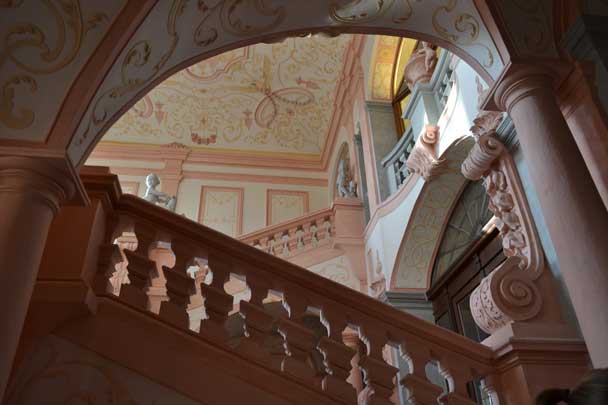
900-YEAR-OLD MELK ABBEY The small Christmas market at Melk, Austria, our next port of call, is only open on weekends, and unfortunately not during our visit. But we enjoyed a guided tour of the beautiful 900-year-old baroque Melk Abbey, and bought the famous local apricot liqueur.
A “Taste of Austria” luncheon aboard the Viking Aegir featured plenty of sausage and a Lederhosen-clad accordion player.
Leisurely travel on the Danube with its many locks means plenty of time for relaxing. To add to our Advent experience during that time, local culture is brought onboard: “A Taste of Austria” lunch included music by a Lederhosen-clad accordion player. A strudel-making demonstration showed that a tea towel was the trick to rolling the paper-thin dough around the apple/raisin/rum filling. As we neared the Bavarian town of Passau, a traditional Black Forest cake was the featured dessert after dinner.
(left to right) The Simon family bakers demonstrate the art of making gingerbread in Passau.; A beautiful Advent wreath is easy to make, as demonstrated in Passau.
ADVENT TRADITIONS IN PASSAU Our stop in Passau began a complete day of Advent tradition, all within easy walking distance from the boat dock. We learned the history and art of making Advent wreaths and the famous Simon family gingerbread, and were treated to a midday Advent organ concert at Passau’s St. Stephen’s Cathedral on the world’s largest cathedral organ. The main Passau Christmas market boasts a Bavarian flair with crafts and regional specialties, sausages, Glühwein and gingerbread.
Back on board our Viking ship we enjoyed tea time with plum cake, apple cake and other regional dessert specialties.
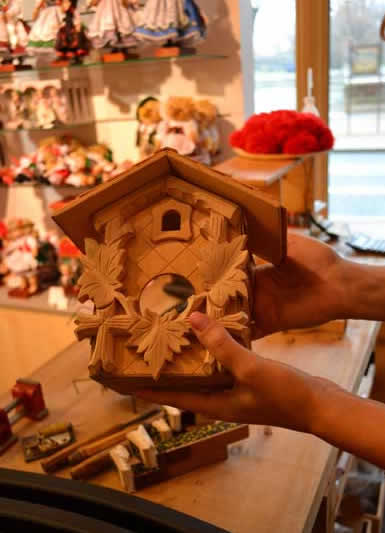
HISTORIC REGENSBURG The next day’s stop in Regensburg included a town tour with visits to the Hutkönig, a world famous hatmaker; a cuckoo clock-making demonstration; and the oldest sausage kitchen in Germany, which has been serving sausages for 900 years, since catering to the workers who built the adjacent Stone Bridge.
(left to right) A cuckoo clock-making demonstration was a tour option in Regensburg.; Regensburg’s famous Hutkönig had very special hats to offer.
ROMANTIC MARKET AT THE PALACE OF THURN AND TAXIS Regensburg’s main Christmas market spreads out near the cathedral, but another Regensburg highlight is the Romantic Christmas Market set in the courtyard and surrounding park of the Palace of Thurn and Taxis. Here the pathways are lit by torches, lanterns and lighted ropes wrapped around wooden fences, and there are hay bales for seating and open fires for warming stations. The bough-covered wooden stalls offer unique products obviously chosen for their quality and beauty. Although there is a fee of 6 -7 Euros to enter this private market, it was one of our favorites, and well worth the price.
The beautiful Romantic Christmas Market is on the grounds of the Palace of Thurn and Taxis in Regensburg.
After a full day in Regensburg, the local Advent experience continued on board as we were greeted with hot Glühwein and heart- and star-shaped Lebkuchen.
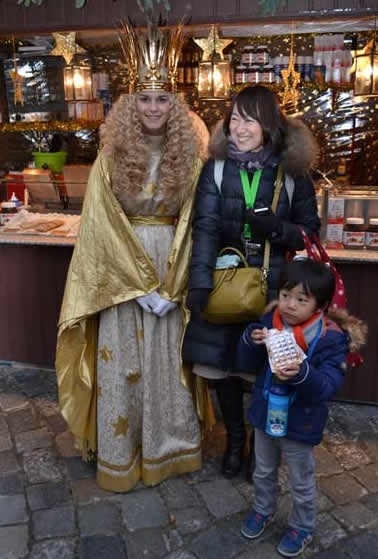
Red- and white-striped awnings decorate this Lebkuchen stall at Nuremberg’s historic Christkindlmarkt. The Christkind stands high on the balcony of the church on the left to open the market.
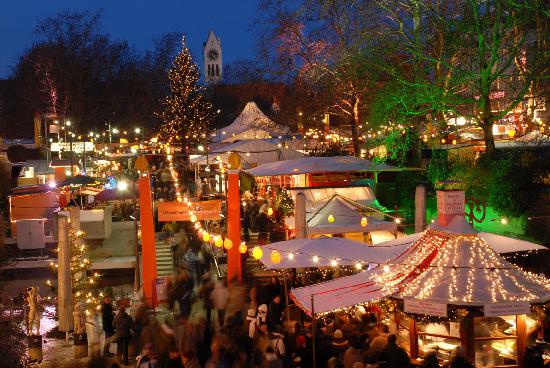
NUREMBERG’S CENTURIES-OLD CHRISTKINDLMARKT Our ship’s last stop was at Nuremberg, which boasts a 400-year-old Christmas market tradition. Once again, Viking provided bus transportation to and from the Christkindlmarkt on the Hauptmarkt square, since the boat dock is some distance away. Nearly 200 wooden stalls decorated with red- and white-striped awnings invite visitors from all over the world – more than two million each year – to sample the traditional gingerbread, sweets, sausages, potato pancakes and Glühwein, to buy their ornaments, candles, toys and prune men.
(left to right) The Children’s Christmas market in Nuremberg has rides and booths with hands-on activities for children, and appearances by Nuremberg’s Christkind.; Nuremberg’s unique Handwerkerhof is located at the distinctive Königtor within the historic city walls.
A few steps away is a children’s Christkindlmarkt with colorful rides, booths with hands-on activities, hot punch and Nuremberg’s beloved Christkind.
Don’t miss the nearby “Sister City” Christmas market featuring wares from Nuremberg’s sister cities around the world, and yet another Christmas market setting in Nuremberg’s distinctive Handwerkerhof, located at the Königstor within the historic city wall.
Though the river cruise part of our trip was over, and it was difficult to leave the cocoon of comfort we experienced on the ship, we had more markets to visit on our way back to Vienna.
INTER CITY EXPRESS SPEED AND COMFORT With a first class Eurail pass in hand, we boarded the fast Inter City Express (ICE) train from Nuremberg to Vienna. The Eurail pass, which we had to purchase in the U.S., allowed us to hop on and off the train for more Christmas market visits enroute to Vienna. Sitting in a six-seat “quiet room” directly behind the engineer gave us a clear view of the tracks ahead, a rail buff’s dream. The track generally followed the Danube, busy with barge traffic, with snow-covered mountains in the distance and large balls of mistletoe visible in the bare trees along the route.
Through the panoramic windows we watched the snow-covered forests and villages speed by, looking like gingerbread creations sprinkled with powdered sugar. We saw firewood meticulously piled high in covered sheds in preparation for the long cold winter, and churchyard cemeteries somehow decked out with colorful plants: lavender, heather – where does all the winter floral color come from?
MORE CHRISTKINDLMARKTS AT LINZ Soon we arrived at Linz, the location of our next Christmas market experience. We left our luggage in lockers at the train station and bought a ticket for the Linz City Express which took us through the town’s main shopping area to the Christkindlmarkt near the river on the Hauptplatz.
Nestled between the town’s centuries-old Baroque townhouses, this market featured wares by artists and artisans, with traditional hot drinks, Bratwürstlein and pastries. At the nearby Goldmann’s Bakery we sampled the town’s famous Linzer Torte. Lights above the stalls are designed to look like river waves, and a specially-designed light display above the river depicts angels blowing bubbles through a straw.
(left and bottom right) Vendors at the Schönbrunn Christmas Market offer painted pewter decorations and beautifully detailed figures for Nativity scenes.; Hot Glühwein in generous mugs, and stick-to-the-ribs comfort food hit the spot at the Schönbrunn Palace Christmas Market
Another short City Express ride delivered us to the Christmas market at the Folksgarten, which featured rides for children, stalls offering warm hats, scarves, decorations, and more hot drinks, pastries and comfort food.
Retrieving our luggage, we completed our train journey to Vienna, where one more very special Christmas Market beckoned.
SCHÖNBRUNN PALACE CHRISTMAS MARKET Vienna’s famous Schönbrunn Palace hosts its own large and very beautiful Christmas market. Situated on the grounds in front of the UNESCO World Heritage site, this unique market still has plenty of room to wander through the juried product stalls. Six food stands are centrally located, as is a towering lighted tree and a magnificently carved nativity scene. The Schönbrunn Market celebrates its 21st year in 2014, and has grown in size and popularity each year. This market easily sets a new standard with its attention to detail in set-up and design.
For those wondering how to experience the Christmas markets in Germany and Austria in comfort and convenience, this trip by river and rail is the answer.
Photos courtesy Schwabinger Christmas Market and Thomas Gießner
In times of technical developments and mass produced goods, the Schwabing Christmas Market in Munich, Germany strives to lift the focus to the individuality of arts and crafts.
FLYING HIGH, YET DOWN TO EARTH This market has caught the imagination of its visitors for decades with a mix of artisans creating art and crafts. The magical atmosphere of the Christmas market with its many culinary delights give it an unmistakable flair.
In addition, visitors can also expect daily music shows, kids’ entertainment and various culinary delights—and all is free of charge.
MUNICH’S FINEST ARTISTS MARKET More than 100 artists from all over Germany create a place where one can relax and enjoy this unique atmosphere. The concept has been one of an artist’s market from the very beginning. An unmistakable flair can be found here with the high level of artistic talent and craftsmanship. This is further underlined by the quality of the daily cultural programming and fine foods, as well as concerts and various events.
IDEA WAS BORN In the early 1970’s a number of artists who exhibited during the summer on the “Art Mile” on Leopold Street in Munich began to show their work at the former Swiss House prior to Christmas. In 1975 the idea of an artist’s market, with stalls and events, was born. With the backing of the local council, the Schwabing Chistmas Market was founded. A jury is responsible for choosing the work shown, as well as finding new exhibitors. This ensures that all exhibited work comes from the studios and workshops of the artists.
With summer approaching, it’s a good time to plan to visit the annual food and vegetable markets that pop up in the United Kingdom. Here are four of them that you might like to put on your “shopping list.”
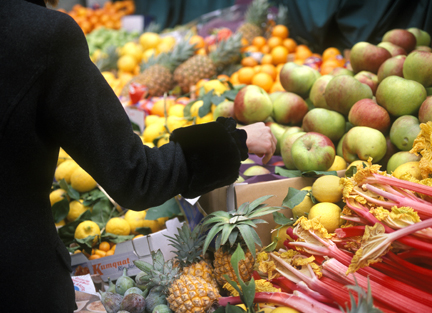
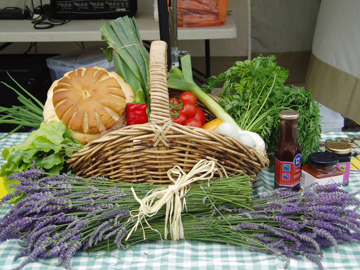
Selection of colorful fruit, Borough Market, London, EnglandPecorino Favoloso, Borough Market, London, England.The farmers’ market in Winchester, England has a great variety of produce, organic vegetables and fruit.
Vienna has a well deserved reputation as a capital of cakes, confections and coffeehouses. The Viennese can’t seem to get through the day without stopping for a mid-morning pick-me-up snack at their favorite coffeehouse and for mid-afternoon coffee-and-cakes at a neighborhood pastry shop. And who could resist buying a little box of handmade chocolates at one of the many tempting candy stores, to nibble on at home?
Winter is a great time to visit Vienna, when the city is decorated for the holidays and the colorful Christmas markets are in full swing. Even after the holidays, Vienna remains a festive city, with concerts, operas and other events to brighten up the gray winter days.
At this time of year, everyone needs more calories to cope with the cold weather. So let that be your excuse for sampling the many sweet treats that Vienna has to offer. Besides, what could be more romantic than sitting on a plush banquette under a sparkling chandelier in an elegant pasty shop, eating a rich torte and sipping hot coffee topped with whipped cream, while watching the snowflakes outside settle silently over the city?
KAFFEEHÄUSER & KONDITOREIEN Vienna’s coffeehouses (Kaffeehäuser) are an institution dating back to the 17th century. The city claims to have more than 800 of them, including 150 “classic” coffeehouses with their traditional wooden floors, dark wood paneling, little marble-top tables, racks of newspapers on the wall, and waiters dressed in black.
Cafe Central, one of Vienna’s most elegant coffeehouses.
Most of them serve more than 20 different kinds of coffee drinks, hot and cold. If you don’t know the differences among a Grosser Brauner, a Franziskaner, a Kapuziner and an Einspänner, then ask the waiter to explain the coffees listed on the menu. Each will be served with a small glass of cold water on the side. And for the price of just one drink you’ve bought the right to sit in that spot for as long as you want, lingering over a newspaper or magazine, or writing your own journal or poetry, just like the historic figures who frequented that same coffeehouse in the past. Coffeehouses also serve a limited selection of sweet cakes and pastries as well as light meals (and sometimes more substantial fare).
Vienna’s most famous old coffeehouses include the elegant Café Central (corner of Herrengasse and Strauchgasse); Café Bellaria (Bellaria Strasse 6); Mozart bei der Oper (Albertinaplatz 2); Café Diglas (Wollzeile 10); Café Hofburg in the Imperial Palace (Hofburg/Innerer Burghof); Café Dommayer (Dommayergasse 1); Café Sperl (Gumpendorfer Strasse 11); and Café Sacher (Philharmonikerstrasse 4).
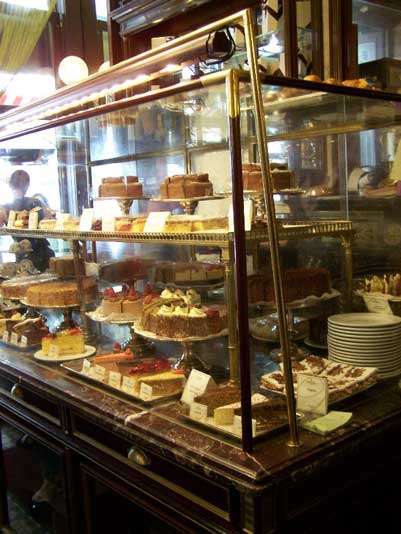
Vienna is equally famous for its pastry shops (Konditoreien), which are often packed with customers getting their mid-morning or mid-afternoon sugar fix. The 200-year-old Demel pastry shop (Kohlmarkt 14) attracts hordes of locals and tourists to its elegant showrooms and cafe. Demel’s high-quality cakes, pastries and confections are a temptation that can’t be resisted. After admiring the wares in the display cases downstairs, go upstairs to the chandeliered cafe to order your coffee and cake, stopping along the way to peer through the glass into the kitchens where the goodies are being made.
Cake counter at Demel’s pastry shop
Founded in 1847, A. Gerstner is another outstanding traditional Viennese Konditorei. Visit its original location at Kärntner Strasse 13-15 for a taste of Gerstner’s top-quality delights, perhaps dolled up with a dollop of Schlagobers (whipped cream). Both Demel and Gerstner have been official providers of sweets to the Hapsburg court in Austria, so you’ll eat like an emperor at either establishment.
(top) Making marzipan roses at Demel’s pastry and confection shop; (below) Stretching the dough for an apple strudel
Although there used to be a stronger distinction between coffeehouses and pastry shops in Vienna, that difference is now somewhat blurred. You can often get the same range of coffee drinks at a pastry shop as at a coffeehouse, and a good (but usually more limited) selection of pastries at a coffeehouse. Formerly Kaffeehäuser were mainly for men, whereas Konditoreien primarily served the ladies (and also sold prettily boxed pastries to take home). In our modern era these gender differences have almost faded away.
TORTE WARS Every visitor to Vienna wants to eat a slice of Sachertorte. Many pastry shops sell their own version of this rich chocolate cake, flavored with one or more layers of apricot jam and covered with a semi-sweet chocolate icing. But there are only two places that can claim to make the true Sachertorte: Hotel Sacher and Demel.
Pastry cook Franz Sacher invented this cake in 1832, and much later the recipe was further developed by one of Sacher’s sons while working at Demel’s bakery. In the 20th century a legal battle developed between the Hotel Sacher and Demel over who had the right to call this popular cake “The Original Sacher Torte.” After years of legal wrangling, the Hotel Sacher was given the right to attach a circular chocolate seal on top of its cakes and sell them as “The Original Sacher-Torte,” whereas Demel was allowed to attach a triangular seal on its cakes and call them “Eduard Sacher-Torte,” after the Sacher son who developed his recipe at Demel’s. (Now you’ll also see the cakes identified as “Demel’s Sachertorten.”) Each version is slightly different, so you’ll want to taste both of them, at their bakeries of origin, to decide which you like best!
(left) Marzipan confections cleverly colored and shaped to look like Austrian open-face sandwiches
HAVE A BALL If your sweet tooth is hungering for more, you can easily satisfy it at any of Vienna’s many candy shops, some of which make their own special confections. A number of them are concentrated around St. Stephen’s Cathedral in the heart of Vienna’s Altstadt. Look for Confiserie Heindl (Stephansplatz 11), which has 22 stores throughout Vienna; Manner (Stephansplatz 7); Metzger (also at Stephansplatz 7), which sells handmade confections, gingerbread and beeswax candles; and Lipizzaner (Stephansplatz 6), long known for its excellent chocolates, including some of the world’s first white chocolate candies.
Beyond St. Stephen’s, but still in the Altstadt, are Schokolade König (Freisingergasse 1), featuring handmade chocolates; City Confiserie (Bognergasse 5), with its extensive array of whimsical marzipan confections; Christian Rosenauer (Fleischmarkt 12), an old-fashioned Viennese candy store chock full of Mozartkugeln and other traditional sweets; and Leonidas (Fleischmarkt 9), which sells luxurious Belgian chocolates. Blühendes Konfect (Schmalzhofgasse 19) specializes in confections made from, and decorated with, flowers; and Xocolat (Strauchgasse 1) is a mecca for chocolate connoisseurs.
Wherever you go in Vienna, you can’t get away from those Austrian confections called Mozartkugeln. Invented in Salzburg in 1890, they’ve now taken all of Austria by storm. The original Mozart balls have a round center of sweetened green pistachio paste surrounded by a layer of hazelnut nougat, dipped in dark chocolate to coat the outside. Like all Mozartkugeln, they’re about the size of a small walnut. Other candy companies make their own versions, too, each a slightly different variation of the original confection. Mirabell-brand Mozart balls are the most widely marketed, in their distinct red-and-gold packages. You can’t leave Vienna without tasting this typical Austrian sweet.
MEHLSPEISEN Finally, any discussion of Viennese sweets should include mention of Mehlspeisen, those “flour foods” so beloved by the Austrians. This category of dishes made with flour includes Palatschinken, thin panckakes spread with jam, folded into quarters, and garnished with chocolate sauce and whipped cream; Kaiserschmarrn, a large buttery and sugary, raisin-studded pancake that looks like it has been hit by an earthquake; sweet Knödel, fruit-or jam-filled round dumplings garnished with confectioners’ sugar; Nockerln, big light-and-airy egg-white dumplings, sometimes served with berry sauce; and Strudel, layers of flaky pastry surrounding a filling of sweetened fruit, berries, or soft cheese. These are often listed in the dessert sections of restaurant menus, although they might be found under their own menu category, Mehlspeisen, reflecting the time when these dishes were also eaten as a main course, especially during fasting periods when meat products were prohibited.
Shelves of Mozart Kugeln at a Viennese candy store
► For more information about places to eat in Vienna (including restaurants, cafes, coffeehouses, pastry shops, and candy stores), get the 67-page booklet titled “Shopping, Wining & Dining” from the Vienna tourist office, WienTourismus (Albertinaplatz/Maysedergasse, www.vienna.info/en).















 European Traveler