Spain Is Hot

Let’s go, amigos!

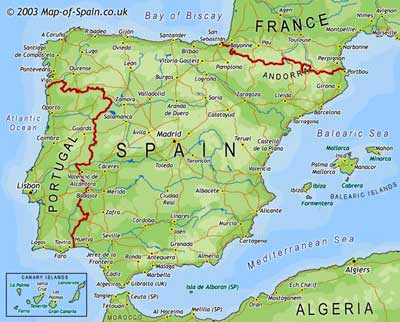
Map of Spain by Tourizm Maps © 2006

By Barbara Gibbs Ostmann
Photos by the author

Costa Blanca … Costa Daurada … the mere words conjure up images of warmth, sand and sunshine, just the antidote to chilly North American winter weather. Now is the time to head to the Mediterranean coast of Spain, where the weather is already warm. Going in the spring or fall offers great weather along with fewer tourists and lower, shoulder-season prices.

Spain is hot, hot, hot right now — from cuisine to fashion. Let’s go, amigos!

MAGICAL MADRID

Most flights from the United States fly into Madrid, and then connect to coastal cities such as Valencia or Barcelona. (Fly Iberian Airlines to get yourself into the Spanish state of mind.) Allow a few days for a Madrid sojourn before heading to the coast. The capital city is beautiful, packed with museums, great restaurants and many things to see and do.

The Gran Hotel Canarias Madrid makes a great home base. It is right in the center of town, across from the recently expanded Prado Museum and next to the Thyssen Museum.

Dining is a great pastime in Madrid, and Plaza Mayor is a good place to start. The area around the plaza is loaded with restaurants, such as Casa Botin, famous for its Castilian specialties and its listing in the Guinness Book of Records as the oldest restaurant in the world (circa 1725). Plaza Santa Ana, a short walk from the hotel and many museums, is home to lively tapas bars and wine bars. Near the Royal Palace, try the Café de Oriente. At the Thyssen Museum, dine in the terrace garden of the museum restaurant. For a simple and fun meal, check out the Museo del Jamon (Ham Museum), a chain of deli-cafes where you can see hanging hams, have a glass of sherry and a plate of sliced ham.
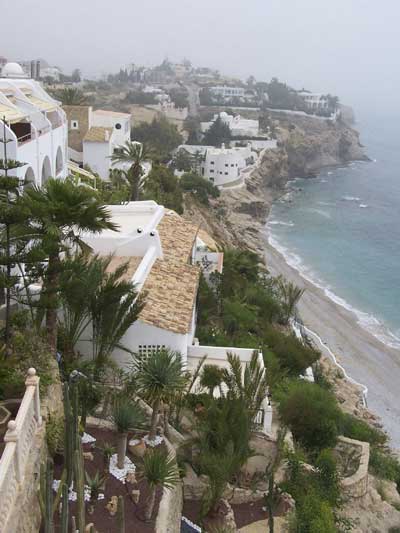
Hotel El Montiboli is perched on the Costa Blanca on the Mediterranean coast.
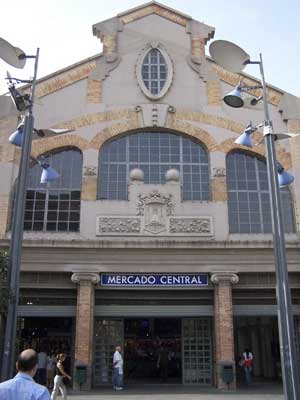
The central market of Alicante is in the heart of the city.

THE COSTA BLANCA

Tearing yourself away from Madrid, hop a plane or train and head to Alicante to begin your coastal voyage, then work your way northward along the coast to Barcelona, with as many stops along the way as your schedule will allow (or start in Barcelona and head south). Travel by rental car, plane or train, according to your preference and budget.

Alicante is on the Costa Blanca, or White Coast, and its beaches are spectacular. But there’s much more to do than lie on the sand and soak up the rays. Whether you take a guided city tour or wander on your own, don’t miss the imposing Santa Barbara Castle, which towers 500 feet above the city center, with panoramic views of the city below and the Mediterranean Sea. Early risers will enjoy the traditional covered market, the Mercado Centrale, bustling with vendors. Enjoy dinner at La Taberna del Gourmet or Nou Manolin.

A good base for exploring this area is the Hotel Hospes Amerigo, a beautifully renovated convent in the heart of Alicante. While the exterior is historic, the interior is ultra modern and comfortable.

Nearby towns include Elche and Villajoyosa, each worth a visit. In Elche, a majestic date palm grove with 600,000 trees, planted by the Phoenicians and later cultivated by the Moors, will take your breath away. Palm fronds from these trees are used for Palm Sunday celebrations throughout Spain. The grove itself is a UNESCO World Heritage Site. Take time to visit the Basilica of Santa Maria, the Huerto del Cura Botanic Gardens and the Archaeological Museum. Enjoy lunch (paella, anyone?) at Els Capellans Restaurant in the peaceful and beautiful surroundings of Hotel Huerto del Cura.

The picturesque fishing port of Villajoyosa is a major center of Spain’s chocolate production. A must stop is the Valor Chocolate Factory and the Chocolate Museum. You’ll want to stock up on Valor chocolate for gifts for the folks back home. For a scenic lunch stop, try the luxurious Hotel El Montiboli, perched on a cliff overlooking the Mediterranean. The dining room is wrapped in windows, with a view as divine as the food.

Elaborate chocolate sculpture at the Valor Chocolate Museum.
The likeness of the Lady of Elche is found all over town, from floral representations to fountains to sculptures.

VIVACIOUS VALENCIA

Next stop: Valencia, one of the most exciting cities in Europe, with its cosmopolitan mixture of old and new, tradition and trendiness, sophistication and casualness. The Hotel Astoria Palace, in the heart of the Old Quarter, is a great place to call home in Valencia.

Begin your visit with a walking tour of the historic Old Quarter, with the Central Market, fascinating La Lonja Silk Exchange, unique Lace Market, Plaza Redonda and the beautiful St. Mary’s cathedral with its legendary Holy Chalice, believed to be the chalice used by Jesus Christ at the Last Supper.

For a complete change of pace, head to the ultra-modern City of Arts and Sciences, a museum where the building and grounds are as spectacular as what is inside. Other good choices include the Fine Arts Museum, Valencian Institute of Modern Art or the National Ceramics Museum.

Be sure to visit the bustling, revitalized port area, home of the 32nd America’s Cup competition in 2007, and future home of the 33rd America’s Cup in 2009. There will be a pre-regatta in July 2008.

If you like being next to the water, you might opt to stay at the new and beautiful Hotel Las Arenas, with its lush gardens and stunning pavilions overlooking the sea. Indulge in its luxurious spa, or dine in the elegant Restaurante Sorolla.
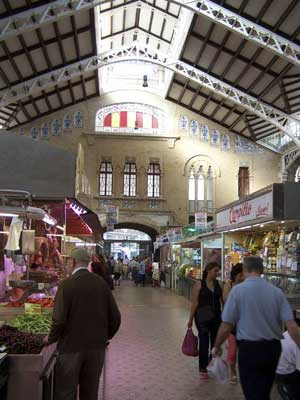
(left to right) The central market at Valencia is always bustling.; The National Ceramics Museum in Valencia has a remarkable exterior.; The ultra-modern City of Arts and Sciences is a must-see in Valencia.


For food to fuel your sightseeing, consider a stop for fideua, a paella made with noodles instead of rice, at Restaurante Submarino in the Oceanografico, or sample tapas at one of the many restaurants in the Old Quarter.

Be sure to try horchata, the artisanal beverage for which Valencia is known. A great place to get the real thing is in the suburb of Alboraya, where the chufa (tiger nut), the key ingredient in horchata, grows. The Horchateria Daniel serves a delicious horchata with the traditional accompaniment of freshly baked pastries.

For a charming outing and an authentic heartland paella, head out of town to the Albufhera, where you can take a boat ride through the shallow freshwater lagoon, a natural park known for many species of birds and fish, and visit a barraca, a traditional fisherman’s hut near the rice paddies and orange groves. La Matandeta is a rural farmhouse restaurant where the paella is cooked over firewood in a huge pan.
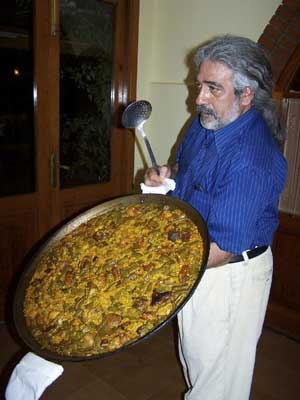
Paella is cooked in a huge pan over a wood fire at La Matandeta restaurant in the Albufhera area.
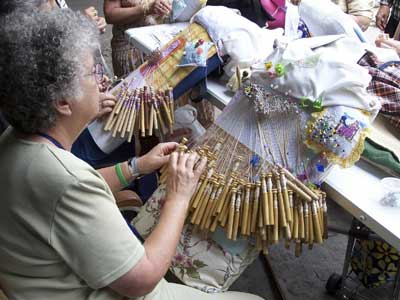
Local women make lace in the time-honored fashion in the center of the round plaza that houses Valencia’s Lace Market.

FROM HISTORIC CASTLE TO MODERN SPA

For a historic stop on your route north, make a slight detour to the medieval town of Tortosa and spend the night in the charming Castillo de la Zuda Parador, a 10th-century castle. Be sure to get there in time to wander the streets of this picturesque village and explore the castle itself. For dinner, sample regional specialties in the parador’s restaurant.

(clockwise) The convent garden is an oasis of peace within the bustling city of Tarragona.; Exquisite Roman mosaics are preserved in museums in Tarragona.; The Le Meridien Ra Beach Hotel and Spa in El Vendrell must be seen and experienced to be believed.

After a long day at sea, fishermen still have work to do, mending their nets. These are at the port of Tarragona.


Heading on to the Costa Daurada (Golden Coast), stop in the town of El Vendrell and spend a night –- or two or three -– at the ultra-modern and ultra-luxe Le Meridien Ra Beach Hotel and Spa. Splurge for spa treatments, such as the chocolate massage. Enjoy the beach, or play in one of the pools. Be sure to dine at least once in the hotel’s La Vinya del Penedes restaurant.

ROMAN ECHOES IN TARRAGONA

The next stop on your northward route is Tarragona, an ancient Roman city with layer upon layer of ruins, designated a World Heritage Site by UNESCO. Be sure to take a guided tour of the old town so you can understand the many layers of history upon which Tarragona is built. Each spring the town celebrates its heritage with Tarraco Viva, a Roman festival and games.

Visit Tarragona’s port and see the fishing boats arrive in the late afternoon. Watch the fisherman as they auction their fish and mend their nets. For a traditional mariner’s menu, dine in the seaside Restaurante La Puda and sample Tarragona’s famous Romesco sauce. Or, savor authentic tapas at Restaurante La Nau, tucked away on Calle La Nau in the old town.

BEAUTIFUL BARCELONA

The final stop (or the first, if you travel in the opposite direction), is Barcelona, the jewel of Catalonia. It would take another entire article to do justice to the wonders of Barcelona and its environs. Check with the local tourist office for maps and current events, then head out to see the sites. The celebrated architectural marvels of Antoni Gaudi are a must, and you’ll see them in many places throughout the city. Be sure to climb the steep towers of the iconic Sagrada Familia, or temple of the Sacred Family, for an up close and personal look at this architectural wonder.

While wandering along La Rambla through the heart of the city, duck into La Boqueria market, the largest in all of Spain. After whetting your appetite in the market, you might want to sign up for a cooking class at the Hofmann Escuela de Hosteleria (Hofmann Hospitality School) to learn how to cook Catalan specialties.

The Hotel Catalonia Berna is a great location for the hub of your explorations, within walking distance of many sites and close to the subway for longer trips.

A side trip to the Black Madonna Shrine of Montserrat, perched impossibly upon the steep mountains outside of Barcelona, is a must.

For more information about Spain, contact the Tourist Office of Spain in New York (212-265-8822); Miami (305-358-1992); Chicago (312-642-1992) or Los Angeles (323-658-7188) or go to www.spain.info.
Falling for Casares

Ancient baths in a dramatic location

By Susan MacCallum-Whitcomb
Photos courtesy Costa Del Sol Tourism

Sometimes it helps to follow your nose.

For days we’d heard rumors about ancient baths located just below Casares, in southeastern Spain. But reliable information was hard to come by. The tourist brochures made only passing reference to them, and even the directions that we finally did get were vague to say the least: head down the mountain and through the quarry, turn onto the foot path, then walk toward the water. Precisely how far we should go and which of the half-hidden paths we should take remained a mystery, though.

So on we plodded in Andalusia’s autumnal sunshine dodging killer cacti and recalcitrant donkeys, until we smelt it — the sulfurous pool that first brought the area a measure of fame more than 2,000 years before.

According to legend, Julius Caesar stumbled upon this same spot in 61 BC, when he was merely a provincial administrator with a nasty skin condition, and was so impressed by the pool’s medicinal properties that he became a frequent visitor. The Roman-built structure that encloses it (known as Baños de la Hedionda) is a simple dome with a sheltering wall around the perimeter. Rising about eight feet above ground level, it is broken only by two low arches through which you enter directly into the water by way of either a rough wooden ladder or a stone ramp. Taking the plunge can be unnerving. Darkness makes the depth of the pool difficult to determine, and two subterranean vaults add to the sense of foreboding.

WATER IS DIVINE

Caesar, however, was absolutely right: the water is divine and warm enough for swimming well into the fall. For him, its healing power seemed miraculous. For us, on the other hand, the real miracle was that the baños—despite their proximity to the Costa del Sol, one of Europe’s most congested tourist strips—have no signs, lines or admission fees. In short, they’ve yet to be invaded by the hordes of vacationers who have overrun the Mediterranean coast from Malaga to Algeciras. The same can also be said of Casares, the pueblo blanco or “white village” reputedly named for Caesar that overlooks the baths. And it, too, can seem rather daunting at first.

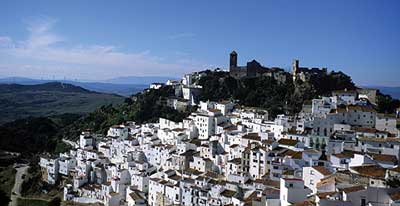
In part that’s because of its dramatic location: set 1,425 feet up in the Sierra Bermeja Mountains, Casares’ sugar-cube buildings perch precariously on twin plateaus and tumble into the deep crevice between. But it is also because of the quiet. You see, the village is a study in serenity, which is unsettling for those who’ve come to equate holidays with site-filled itineraries and Amazing Race-style activities.

The truth is that, save for the late afternoon (when children take to the soccer field) or dusk (when adults tread the cobbled pedestrian-only streets on their nightly paseo) sounds here are as muted as the almond blossoms that enliven the landscape, which is precisely why Casares is a perfect place to rediscover the lost art of lounging.
The first step, literally, is to stroll over to Plaza España where you can browse shops bordering the square and watch locals play pétanque beside a centuries-old fountain. Afterwards, you might putter about in Casares’ small ethno-history museum or pay homage to Blas Infante, the “Father of Andalusian Nationalism,” at his restored birthplace.

SATISFY YOUR HUNGER
Next, having satisfied your curiosity, you can concentrate on satisfying your hunger. It’s a pleasant prospect considering Casareño eateries dish up simple fare prepared with Andalusian flare. Specialties include morcilla de chivo sausages and artisanal goat cheese accompanied by dense brown bread. Hearty soups are harvest-time favorites, and game (most notably rabbit rolled in wild herbs) is popular in season.

If you’d like to enjoy these with a side order of scenery, the best bet for dining is Bodeguita de en Medio, which has a rooftop terrace offering views of the ruins that stand guard over the village. The very presence of these, of course, proves life in Casares hasn’t always been quite so peaceful. Its strategic position made it a popular hideout for bandoleros in the 19th century. Before that it was favored stop for armed forces, from the earliest Iberians through to the French who attempted a takeover during the Napoleonic Wars. Those who succeeded left an indelible mark that earned Casares recognition as a National Historic-Artistic Site in 1978, and their legacy is nowhere more apparent than at this isolated spot.

Fortified by the Romans, it was further developed by Moors who gained control of the region in 711. By the 13th century, they’d erected a castle on the seemingly impregnable promontory. Within a few hundred years, Queen Isabella’s Christian soldiers had put an end to Arab domination, and the Encarnación church was built atop it. Now that, too, is an empty shell, and the evocatively decaying structure reaches heavenward with a different purpose: aerials have been attached to it to improve television reception! Contemporary life has brought other changes as well. The climb to the ruins admittedly remains steep. The sweeping views – up to the mountains, down to the sea and across to the northernmost reaches of Africa – are as magnificent as ever.

ROCK OF GIBRALTAR
But while the ancients could only gaze out and imagine these distant locales, today’s visitors can easily reach them. Estepona, the closest of the Mediterranean resort towns, is just 25 minutes east by car, and a morning’s drive west through the clouds will take you to Ronda, the stunning gorge-straddling city that has been dubbed the “Birthplace of Bullfighting.” The iconic Rock of Gibraltar, situated an hour south, promises Barbary Apes plus a quick taste of the British Empire. Even Tangier — Morocco’s infamous, undeniably exotic port city — is accessible to early risers, thanks to the packaged daytrips sold all along the seaboard.

Closer to home, Paraje Natural de Sierra Crestellina now beckons ramblers, and diehard duffers are welcome to hit a few balls at a new area golf course. Remember, though, the true beauty of this place is that you don’t have to break a sweat to enjoy it. When you allow yourself to fully surrender to Casares’ laconic spell, simply sitting on a deck chair can provide ample entertainment. It’s easy enough, after all, to idle away hours watching farmers tend the olive and cork groves below, or marveling at the belled goats that graze at impossible heights on the rocky outcroppings above. Once you’ve had your fill of that, you can always soak up the atmosphere in Baños de la Hedionda. Trust me, the water’s fine…

The Fine Print: If relaxing is your primary goal, choosing where to stay is as important as deciding where to go. So while you can bed down in a basic room Hotel Casares for about €60 a night, renting a vacation home is a more restful, and budget-friendly, alternative. We booked ours through Just Casares, a local company which lists traditional white-washed townhouses starting at €300 per week in autumn. Those off-season rates kick in September 1, even though the village hosts two favorite ferias (or fairs) during that month: one honoring La Virgen del Rosario, the other El Cristo. These run respectively the first Saturday in September and over a long weekend in mid-September to coincide with the end of the summer harvest.

European Easter Breads

A Mix of Symbolism and Satisfying Taste

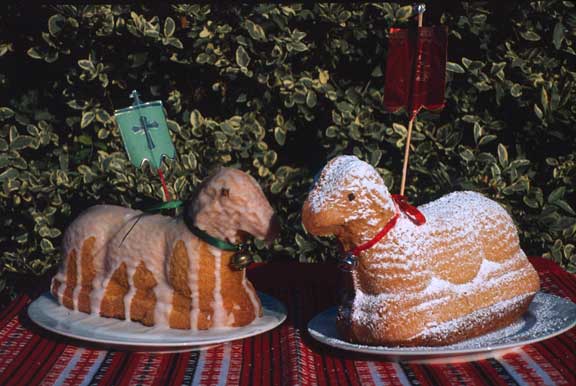
Lamb-shaped cakes and breads for Easter are made in the Alsace region of France, as well as in Germany, Austria and Eastern Europe. Photo by Sharon Hudgins


by Sharon Hudgins

When the Easter season approaches, European kitchens are filled with the yeasty aromas of freshly baked breads, as cooks all over the Continent prepare the special loaves and buns traditionally associated with this important religious holiday.

In the past, devout Christians observed a strict fast during Lent, the six or seven weeks before Easter, when they abstained from eating animal products of any kind: red meat, poultry, milk, butter, lard, cheese and eggs.

In some parts of Europe, even sugar, honey, olive oil, and certain kinds of fish were on the list of forbidden foods. When Easter finally arrived, people celebrated with a huge meal featuring dishes made from all the ingredients that had been prohibited during Lent. Even though few people follow such strict fasts today, the tradition of feasting on special foods at Easter is still an important part of many European cultures.

Rich, yeast-raised breads full of milk, butter and eggs are an essential element of the Easter meal in most European countries. Often the breads are made in symbolic shapes and elaborately decorated with sugar icing, candied fruits or colored eggs. Homemade or bakery bought, these breads represent a continuity of traditions from centuries past, including much earlier, pre-Christian times.

Different countries, regions and towns of Europe have their own characteristic breads baked especially for Easter. In some places, these special breads are taken to church to be blessed at the Easter midnight mass or the Easter Sunday morning service, before proudly being displayed on the festive dinner table at home. And in Russia and many Eastern European countries, the table also has a little three-dimensional lamb modeled out of butter, for spreading on the bread after it is cut.

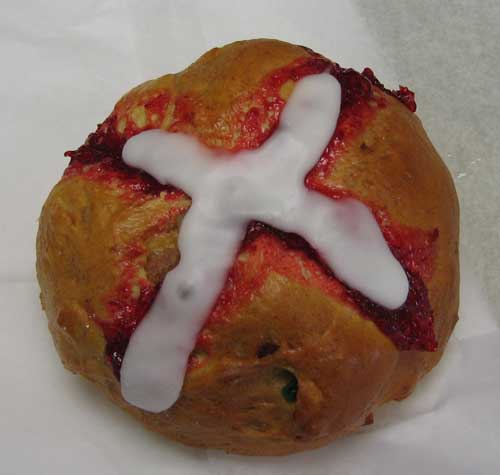
Hot cross buns are an Easter favorite.
Breads of all kinds are offered at Easter-time; these were baked by Michael Mikusch at his Austrian bakery.

GERMANY AND CENTRAL EUROPE

Bakers in Germanic communities make Easter breads in a variety of shapes, secular and religious. Breads shaped like rabbits, lambs, baby chicks and fish are symbols of springtime, fertility and birth. Braided loaves—long and straight, round or wreath-shaped—are made with three strands of dough representing the Holy Trinity of Father, Son and Holy Spirit. Germans and Austrians make several versions of Osterzopf (Easter braid), Osterkranz (Easter wreath or crown), and Striezel (stacked braided bread), as well as Osternester (Easter nests) or Eier im Nest (Easter-egg nest) with white or colored hard-boiled eggs surrounded by the dough. The circular braided Osterkranz is also symbolic of Christ’s crown of thorns, and the red-dyed eggs decorating many Easter breads are said to represent Christ’s blood and resurrection—although the egg’s significance as a symbol of rebirth and regeneration actually dates further back in time to the pre-Christian era.

Other special Germanic Easter breads include the Osterfladen—a flat, rectangular bread with a sweet filling of apples, raisins and almonds—and several varieties of Osterbrot (Easter bread) flavored with raisins, currants, candied orange peel, grated lemon zest, anise and cardamom. The Osterkarpfen (Easter carp) is a bread shaped like a fish, glazed with white icing, and studded with sliced almonds to represent fish scales. Germans also make Osterkorbe breads formed like Easter baskets and rabbit-shaped Osterhasen breads, all of them holding real or candy eggs. And the Eiermännle (Little Egg Man) is a flat bread shaped like a boy or man, with an unshelled hard-boiled Easter egg baked in the center of his body or inside a basket that he carries on his back.

Lamb-shaped cakes and breads can be found at Easter-time from Alsace to Austria, from Germany to the Czech Republic, Poland, Slovakia and Hungary. Baked in three dimensional metal or pottery molds, these represent Christ as the sacrificed Lamb of God, although their origin can probably be traced to earlier, pre-Christian rites in which baked dough effigies of sacrificial animals were substituted for live animals. Lamb breads are made from the same kind of sweet, yeast-raised doughs used for Alsatian Kugelhopf, Austrian Gugelhupf,and Polish baba (or babka). The cake versions are made from a simple white cake batter, although both chocolate and marble (mixed chocolate and white) lamb cakes sometimes show up in the flocks of Easter lambs sitting in bakery windows at this time of year.

The simplest lamb breads and cakes are merely dusted with a coating of confectioners’ sugar or drizzled with a light glaze of sugar icing. More elaborate cakes are covered with fluffy white frosting, sometimes garnished with shredded coconut, or spread with chocolate icing decorated with white icing swirls. The eyes are made from raisins, whole cloves, or coffee beans, and a small silk ribbon, often with a tiny bell attached, is tied around the lamb’s neck. Many of these lambs also hold a colored foil banner bearing the emblem of a lamb or a cross—recalling similar banners carried by Christian crusaders to the Holy Land a thousand years ago.

When you’re in Europe around Easter, look for the special Easter breads in local bakeries. You’ll likely be tempted by all the good pastries as well.
This shop offers Austrian breads and pastries which are as good as they look.

ITALY

Italy offers a rich variety of regional Easter breads, including Genoa’s pane dolce (sweet bread) full of raisins, candied fruit peel and pine nuts; Umbria’s cylindrical, cheese-flavored crescia; Venice’s large fugassa di Pasqua buns; and Cesenatico’s ring-shaped ciambelle, seasoned with anise and lemon peel. In Sicily, the edible centerpiece of the Easter meal is a large yeast bread shaped like a crown, with colored hard-boiled eggs embedded in the top. In some parts of Italy an old custom is still followed when Easter breads are made: the shell of the first egg put into the dough is cracked on the head of a young boy—supposedly to keep bad luck at bay.

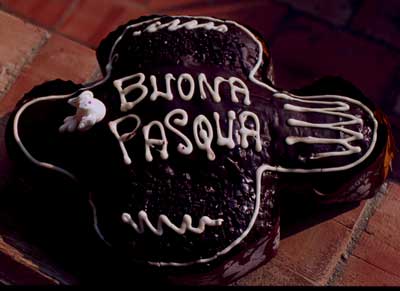
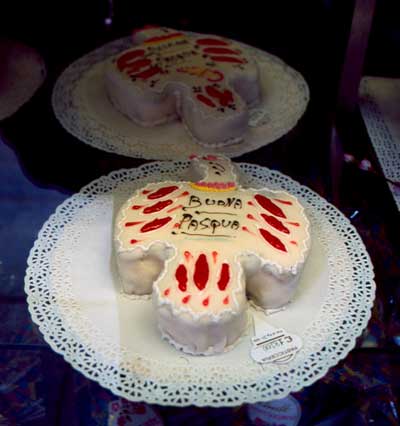
The Easter bread most popular throughout all of Italy is a specialty originally from Lombardy—the columba di Pasqua (or columba pasquale), a sweet yeast bread full of candied orange peel, raisins, and almonds, made in the shape of a dove. Some of the fancier columbe have pockets of orange- or champagne-flavored pastry cream inside. Others are made with swirls of light and dark (chocolate-flavored) dough, like marble cakes. The plainest ones are garnished with only a simple sugar glaze, but the more elegant columbe are elaborately decorated with almond paste, white or pastel icing, chocolate, nuts or sugar-paste flowers.

(bottom left and right) Italian Easter dove cakes (columbe di Pascua) are a symbol of springtime, the Holy Spirit, and peace.; Italian cheese-flavored crescia loaves for Easter, at a bakery in Umbria

GREECE

Maundy Thursday, three days before Easter, is the time when Greeks bake their holiday breads. Known as tsoureki or lambropsomo, these sweet, eggy breads are traditionally flavored with mahlepi, an unusual spice made from the finely-ground seeds of a type of cherry. Other Greek bakers add mastikha, pulverized crystals of sap from mastic shrubs that grow on the island of Chios. Cinnamon, nutmeg, cardamom and allspice can also go into the dough, as well as orange and lemon peel.

Greek Easter bread is made in different shapes from one region to another: a long braid, a braided wreath, a round loaf with bread-dough decorations on top in the form of leaves, flowers or a Byzantine cross. Each shape has its own symbolism. The three strands of braided dough represent the Holy Trinity. Wreaths and rings not only recall Christ’s crown of thorns but are also pre-Christian fertility symbols. Round shapes represent the life-giving sun, rebirth and resurrection. And no Greek Easter bread would be complete without one or more red-colored eggs—customarily dyed on Maundy Thursday—pressed into the top before baking.

SPAIN

The Spanish corona de Pascua (Easter crown) is another bread whose shape and symbolism is similar to Easter breads in many Mediterranean countries. Made from a sweet yeast-raised dough, the corona de Pascua is flavored with raisins, almonds, candied fruit peel, lemon and olive oil. Three strands of dough are first braided together, then formed into a ring. Whole, hard-boiled eggs are nestled into the top of the braid, usually one egg for each member of the family. Some people leave the eggshells white; others dye them red or a variety of spring colors.

Another Spanish Easter bread known as monja (nun) probably got its name from the nuns who traditionally baked breads, pastries and confections to sell from behind their convent walls. This orange-flavored bread—much like ones also found in Greece, Macedonia and Bulgaria—is round in shape, with a cross made of bread dough on top and four red-dyed eggs embedded at each point of the cross.

In the Castile region of Spain, Easter is celebrated with a large round loaf of bread in which shelled hard-boiled eggs, diced bacon,and chunks of Spanish sausages were imbedded in the dough before baking. And at Easter-time in some parts of Spain, godparents give their godchildren tortas de aceite, small savory buns made from yeast dough seasoned with orange, anise, and olive oil, with a single hard-boiled egg nestled in the center.

RUSSIA AND UKRAINE

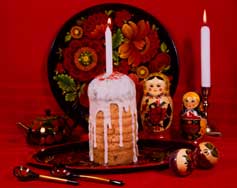
Since Easter is a springtime celebration of new life, it’s not surprising that many traditional Easter breads are made in the form of ancient fertility symbols. The most graphic of these are the tall, cylindrical breads with a puffy dome on top, whose phallic symbolism is unmistakable. Festive breads of this shape are made in both France and Italy, but the most famous is Russia’s kulich, a saffron-scented yeast bread flavored with raisins, almonds and candied fruit peel. The domes are frosted with white icing that dribbles down the sides in a further reinforcement of the fertility image. The kulichi can also be decorated with colored sugar sprinkles or candied fruits, and a long thin red candle is usually stuck into the top of the dome. On Easter, Russian Orthodox churches are often filled with these special breads, their candles lighted, awaiting blessing by the priest.

Velikodnia babka is the Ukrainian version of this tall, yeasty Easter bread, with raisins, almonds and candied peel kneaded into the dough. Another traditional Ukrainian Easter bread is velikodnia paska, made from a rich yeast dough containing plenty of butter, sugar, and eggs, and shaped into large rounds. The tops are fancily decorated with ornaments made out of dough, usually with a cross as the center motif surrounded by elaborate swirls, small birds, leaves,or flowers. Perekladnets is a special, colorful Easter treat, a kind of coffee-cake loaf made with lemon-scented yeast dough and three different layers of filling: chopped dried peaches or apricots with candied fruits; chopped figs, dates and walnuts; and chopped almonds with candied cherries.

Russian kulich, a tall cylindrical Easter bread often baked in a coffee can.

GREAT BRITAIN

Hot-cross buns are the most typical Easter bread in Great Britain. Baked on Good Friday, these round, slightly sweet buns often have chopped fruit peel and currants, raisins or sultanas in the dough. A cross is cut into the top of each bun before baking, or a strip of dough is used to make the form of a cross on top, to keep away evil on this sad day of remembering Christ’s crucifixion.

In some parts of Britain, a hot-cross bun is hung up in the house to keep away bad luck (fire, theft, illness) until Good Friday of the following year. Buns are also hung in the barns to protect the grain from rodents. As in the rest of Europe, these British hot-cross buns are an example of the powerful symbolism of breads baked for the Easter season.

Chowing Down in Catalonia

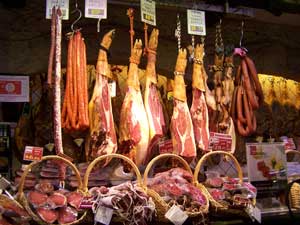
Spanish hams and sausages at Barcelona’s La Boqueria food market

By Sharon Hudgins
Photos by the author

Catalonia has long been one of my favorite gastronomic regions in Spain, years before star chefs such as Ferran Adrià, Santi Santamaria and Carme Ruscalleda catapulted it to fame on the international stage.

During two recent trips there, I ate at my favorite old restaurants, dined at new ones, and visited wineries and food producers throughout the area. And I was pleased to confirm that Catalonia is in no danger of losing its reputation for fine food, from traditional to modern, from home cooking to haute cuisine.

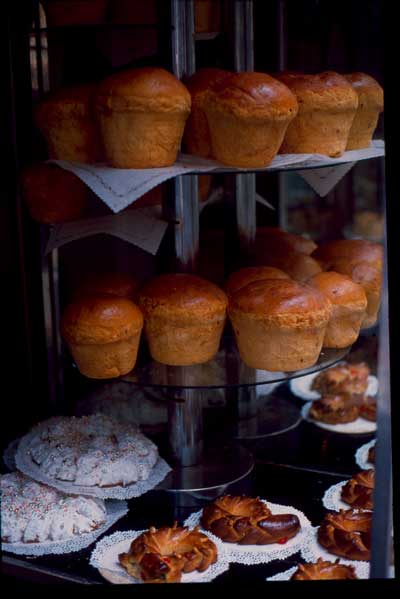
Tempting sweets at La Colmena pastry shop in Barcelona.

BEGIN IN BARCELONA
Barcelona, the capital of Catalunya (as it’s called in the Catalan language), is a prime destination for connoisseurs of good food. You could easily spend a couple of weeks eating your way around the city and still barely scratch the surface of its culinary possibilities.

Foodies flock to the colorful Mercat de Sant Josep (also known as La Boqueria), Barcelona’s best known big covered market, with its tantalizing displays of edibles from freshly caught Mediterranean fish to aged mountain cheeses, from exotic tropical fruits to pigs’ private parts. Grazers stroll from one tapas bar to another along the busy boulevards and the casual waterfront, drinking a glass of wine or beer and nibbling on tasty tidbits at each stop. Anyone’s sweet tooth will soon be satisfied at the city’s elegant pastry and confection shops, including Caelum which features pastries made in the many monasteries and convents around Spain. And don’t miss a visit to the Chocolate Museum, followed by a cup of thick hot chocolate at the bar in the museum’s shop.

But Barcelona is just the beginning of a memorable culinary experience in Catalonia. To understand the roots of Catalan cuisine, you need to spend time in the countryside, slowly savoring the sights, sounds and smells of a land that produces some of the best wines and food products in Spain.

Turbot with eggplant slices at El Rincon de Diego restaurant in Cambrils.

WINE COUNTRY
Catalonia is famous for its wines, including sparkling white and rosé cavas. Drive south from Barcelona into the picturesque Penedès wine country, the largest of Catalonia’s wine districts and one of the oldest wine-making regions in Europe. Although best known for its cava wines, processed in the same manner as French Champagnes, Penedès also produces many other fine wines, especially whites.

To learn about the history of wine-making in Catalonia, start at the Wine Museum in Vilafranca del Penedès. Then visit two of the largest producers of cava, Cordoníu and Freixenet, both located in Sant Sadurní d’Anoia. After seeing how those big commercial wineries operate, you’ll learn even more on a personal guided tour around one of the smaller, family-run wineries, such as J. Miquel Jané in Font Rubí, which provides very informative vineyard tours, cellar tours, and wine tastings, in English, and Pagès Entrena in Sant Jaume Sesoliveres, which also offers wine seminars and other activities such as horseback riding and bicycle excursions.

The rugged district of Priorat is known for its outstanding wines, particularly reds. Visit the new Wine Museum in Falset, the capital of this wine region, then drive to the little town of Gratallops, on a hill high above the Siurana River, to taste some of the excellent wines produced at the Buil & Giné winery there.

Not far inland from the popular coastal cities of Cambrils and Tarragona, the sparsely populated, mountainous Priorat region is a place of medieval villages, old monasteries and dramatic landscapes. Although off the beaten tourist path, it’s well known for its high-quality olive oils as well as its wines. Take the winding road up to the little village of Siurana, perched on a cliff with vertiginous views over the olive orchards and distant valleys below. Then enjoy a good meal accompanied by local wines at the little Restaurant els Tallers, in the small (six-room) Hotel la Siuranella.

Finally, finish up your tour of this part of the Catalan wine country by heading north a few miles into the Conca de Barberà wine district to see the Wine Museum in L’Espluga de Francolí. Housed in a landmark Modernist-style building constructed in 1913, it features three floors of exhibits on the history of grape growing and wine making in this area.

MÓN SANT BENET
For a completely different culinary experience, spend a weekend at Món Sant Benet, a complex of old and new buildings set amid the quiet countryside of Bages, a rural region just northwest of Barcelona, near the town of Manresa. Check into the ultramodern Hotel Món and enjoy a stroll through the nearby gardens before dining at either the Restaurant Món or Restaurant L’Angle (one Michelin star) within the hotel. Another restaurant, La Fonda, offers moderately priced lunches and snacks in the Factory building nearby on the complex’s grounds. The Factory also has an interesting shop selling local wines, food products and handicrafts.

Make a reservation to take a one-hour tour of the Alicia Foundation, a unique scientific and gastronomic research center established by Ferran Adrià at Món Sant Benet. You’ll visit the cutting-edge research laboratories and participate in an instructive workshop that focuses on the relationship between all of our senses and the foods we eat.

A highlight of the Món Sant Benet experience is a tour of the 10th century monastery there. The impressive multi-media tour cleverly uses video projections, 3-D holographic images and surround sound to tell the dramatic story of the monastery’s history. A separate, equally fascinating multi-media tour through the adjacent villa of the Modernist artist Ramon Casas gives an intimate glimpse into the daily life of the family who lived in the opulent villa during their summer holidays in the early 1900s. The combined tours through the monastery and villa take a total of two hours, leaving you plenty of time to relax in the soothing atmosphere of Món Sant Benet.

Wherever you choose to travel in Catalonia, from bustling Barcelona to tranquil Món Sant Benet, from the sunny seacoast to the high mountains of the Priorat, you’re never far from a fine meal with excellent wines. As the Catalans say when you begin to eat, “Bon profit!” (may you eat and drink well!).

Bread basket at El Rincon de Diego restaurant in Cambrils.
Handpainted Spanish ceramic coffee service at the Ramon Casas villa at Mon Sant Benet.

Where to eat:


Wineries to visit:


Wine Museums:

Flavors of Christmas in Spain

Photos courtesy Spain Tourist Office

Christmas delights the palate in Spain. You will have no shortage of opportunities to give way to temptation as you experience Spanish gastronomy during the festive Christmas season.

Dinner on Christmas Eve and New Year’s Eve, lunch on Christmas Day and New Year’s Day, along with January 6, Feast of the Epiphany, are the most essential dates. However, throughout the month of December, bars, restaurants and hotels are decked out for the season. Their tables are decorated with candles, bows and Christmas motifs, and they offer special menus and delicious dishes.

HEAVENLY TABLES
Christmas meals are usually copious. They tend to start with a selection of starters and appetizers, either hot or cold. Then comes several courses and dessert. You can try a bit of everything: shellfish, fish, meat, roasted meat, soups, Iberian cured meats—all prepared in an especially delicious way. Some of the most popular foods include turkey, lamb, red cabbage, sea bream, oysters, elvers and ham. As the dishes are served, you will see how hard it is to resist. And to accompany them are good Spanish wines, both white and red. At the end of the meal, good wishes are toasted with a glass of cava sparkling wine or cider.

SWEETS
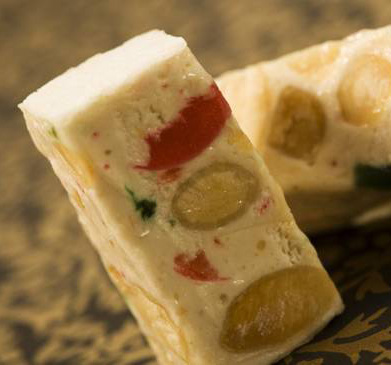
Sweets deserve a mention of their own, filling the table with color when it is time for dessert. Made with almonds, honey, sugar, chocolate and fruit, among other ingredients, they are a real treat for those with a sweet tooth. There is a wide array, and each region of Spain has its own typical recipes. However, the real star at Christmas is “turrón,” with a flavor admired around the world.

There are many different types of turrón, but you should try the Jijona variety—soft and sweet—and the Alicante type, which is hard and crunchy. Other traditional desserts are marzipan, polvorones (a crumbly shortbread) and mantecados (made with almonds and lard). Finally, on January 6, Day of the Three Kings (Epiphany), children are excited to receive their presents, while grownups get to savour a Roscón de Reyes (seasonal cake) with a cup of hot chocolate.

For more info, go to Spain Tourism