By Don Heimburger
Photos by the author or as noted
ON BOARD THE PREMICON QUEEN, MELK, AUSTRIA—What comes to mind when someone talks about the most beautiful waterways in Europe?
There is the Rhine, the Elbe, the Mosel, Main and others, of course, but the Danube seems to conjure up visions of romance, adventure and even intrigue.
The 1,771-mile-long Danube, originating in the Black Forest and flowing through 10 countries to the Black Sea, is Europe’s second longest river (Russia’s Volga is the longest). A third of the river flows through mountains, and the remainder through hills and plains.
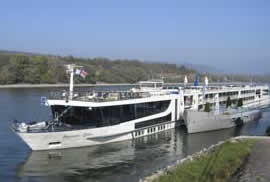
So here I am, a passenger on the Premicon Queen, a floating five-star hotel, which caters to travelers who appreciate the finer comforts of life and who can afford the time to enjoy them. It’s said to have more room per passenger than any other river cruise ship, at 484 square feet per passenger.

BUDAPEST IS ORIGINATING POINT
Operated by the popular Cologne-based KD Cruise Company, the five-day trip starts in Budapest and ends in Regensburg, Germany, a distance of 452 miles. And in those miles, as well as in the total miles of this majestic river, I think of all the cultures, towns, traditions and people this river binds together. This thought continues to hold wonder for me throughout the cruise, as we float from country to country and city to city.
Seeing these things all come together on the river—on a luxury ship—is a satisfying way to relax, with plenty of time to think, dream and melt your stress away.
Billed as the world’s most modern twin-propeller cruiser, the 800 KW Premicon Queen features two mini suites, 30 junior suites, 16 deluxe suites and four queen suites. The rooms face the water so travelers enjoy the river from the comfort of their own suite. The crew speaks both German and English.
Deluxe suites, with 237 square feet of space, feature an upscale interior, marble bathroom with shower and panorama doors which when opened, turn the suite into a loggia. Queen suites have a separate living and sleeping area, marble bathrooms with shower and tub and French balconies as well as a walk-on balcony with two seats. Even a butler is assigned to your cabin for any extra help you may need.
Rooms feature individual temperature control, television (with a channel showing a view from the front of the ship), telephone and wireless internet access. Bathrooms had both 110 and 220 volt outlets. Room service was also available.
OCTOBER TRIP
A couple of days devoted to touring Budapest are in order if you’ve never been to this city of under two million people. A city tour by a Cityrama bus (www.cityrama.hu), with a German/English-speaking guide, is a must if you aren’t familiar with the city. Purchase of a Budapest Card is also a good idea if you want to scout out the city on your own. It offers free services or discounts to more than 100 attractions from museums, baths and restaurants as well as public transportation.
Be sure to see the Westminster-style Parliament building, the Chain Bridge (especially at night), Heroes Square, the Palace of Art, the Transport Museum (Europe’s oldest), maybe the zoo, and take the funicular to Castle Hill. For fun visit the Great Market Hall, Statue Park and perhaps enjoy a nice relaxing stroll through Margaret (Margitsziget) Park, located on an island and reachable by tram. While in Budapest, visit the famous Szechenyi Baths in the City Park and eat at the upscale Gundel Restaurant nearby.
The Premicon Queen has arrangements with Hilton to provide lodging at the point of departure as well as the end point on cruises so passengers can spend extra time visiting these cities before and after their cruise.
My October cruise avoided the large tour groups that typically crowd Europe’s rivers and land excursions, so there was not a crush of visitors to deal with. But some of the nicer, warmer weather was gone as well. It’s a tradeoff sometimes.
After a day and a half of visiting the sights of Budapest, it was time to find my ship. Approaching the dock area near Budapest’s Parliament Building where it was waiting, two eager young men greeted me and carried my luggage to my room—no back strain there. After a tour of the room by one of the crew, I’m off to explore this 442-foot by 37-foot wide boat. I’m surprised it’s just a bit over 5 feet deep, but later on the trip I note some areas of low water on the river and understand why this is necessary.
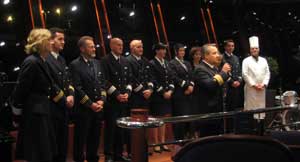
The captain, Stamen Dimitrov, who has been piloting ships for 19 years, will tell you the 106-passenger Premicon Queen can travel at nearly 14 miles an hour and has space for a crew of 60. Cruise Director Doris Moser, Hotel Manager Thomas Boge and Restaurant Manager Oliver Schulz, are on board to oversee virtually your every whim. When you figure the passenger count to the crew, you can see that it’s a win-win situation for the passengers, especially if you like attention.

SUNDECK GREAT GETAWAY
When the weather is warm, and there’s no precipitation, the 10,764-square feet of space on the top sundeck is the place to be. With comfortable lounge chairs, a tai chi area, shuffleboard, chessboard and putting green—as well as waiters ready to take your drink order—passengers have a number of distractions. In colder weather, you can use one of the large blankets supplied by the ship to stay warm.
When departing Budapest at 10 p.m., I wasn’t really sure we were leaving the dock since the ship’s motors were so quiet. After devouring the chocolates on my pillow placed there earlier in the evening by the maid, and after a comfortable night’s sleep in my room trimmed in rich dark wood paneling, I was ready for breakfast, served at the rear of the ship. With glass on all sides and rear of the restaurant, passengers are able to enjoy a wide-screen view of the river at the stern.

If you enjoy variety in your meals, the Premicon Queen will likely satisfy you. Breakfast consisted of a number of different juices, jams, breads, meats (ham, salami, veal liver pate, bacon, sausage), cereals, egg selections, as well as hot drinks, milk (3.5%, 1.5% or .03%), vita drinks such as green and yellow tea, and cheeses (Emmentaler, Tilsiter, Gouda, Edamer or Buttercheese, Brie and others).
In addition, oatmeal, fish, fresh fruits or dried fruits, danish pastries and more await you, and that’s just at breakfast. Did I mention the champagne? Early birds could start their day in the Steamship Salon with a limited breakfast menu until the ship’s main restaurant opened at 7:30 a.m.
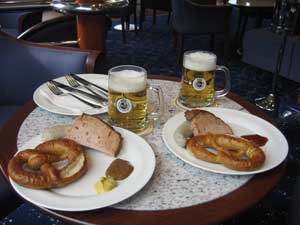
One evening for dinner guests were offered appetizers of beef tartar with dark bread and pickles or queen’s salad, or warm potato quiche. That was followed by a pure carrot ginger bisque soup with sevilla orange segments, and a main course of seared plaice fillet on lemon pesto, pancetta and rice souffle, or oven-roasted tenderloin of veal with truffle essence and a baked potato. Dessert was either tiramisu, green tea sherbert, seasonal fruit salad or a selection of cheeses. Oh yes, there was also a vegetarian dish.
Executive Chef Rainer Buss was always busy in the kitchen with his crew preparing new entrees, and Oliver Schulz the restaurant manager was eager to please, inquiring about the food, making sure passengers were well attended to, and sending the wine steward over to help guests make a wine selection.
Wine selections were sometimes a bit hard to make just because of the wide selection. My notes indicate that at one evening meal, passengers could select from two types of Hungarian bottled wines and four types of open wines, two from Germany and two from Austria. Descriptions of the wines and their origins was printed in the menus.
LOCAL CUISINE FEATURED
As the Queen floated down the Rhine between Hungary, Austria and Germany, the meals were often especially chosen to coincide with foods from that area. As an example, near Passau the evening meal selection included beef roulade with gravy, red cabbage and potatoes. A Bavarian crème with blueberry compote, a most delicious combination, celebrated the end of the meal.
As you can guess, meals were served with elegance and flair, and the portions were plentiful. More than once I was glad the ship was as large as it was so I could take an after-dinner stroll. But then came the “midnight snack,” usually served around 10:30 p.m., in case you were still hungry. This usually featured finger sandwiches, fruits, desserts and other tempting treats too good—and presented too elegantly—to pass up. Coffee and tea time was also a daily ritual between 3:30 p.m. and 4:30 p.m. in the ship’s Theatron, as was a cocktail hour at 6:30 p.m. every evening. Dinner began at 7 p.m.
The ship’s library was small but had an interesting selection of books on history, travel and novels, as well as some board games. Guests can walk to the clubroom where fine cigars and premium whiskeys are available, or relax in the contemporary steamship lounge.
ADDITIONAL FEATURES, ENTERTAINMENT
With wellness a big item these days in Europe, you can go below deck to the wellness area which includes a glass-encased saunarium, shower temple, a large whirlpool and a variety of cardio exercise machines. On-board staff can assist passengers with advice, acupressure, massages and even Kneipp treatments. A color and face consultation for women was also offered by the salon attendee.
Of course, complete make-up, hair styling and well-being sessions were available with an appointment during the cruise. This section of the ship on the lower deck was attractively decorated and inviting.
After dinner, passengers were treated to the on-board Bulgarian orchestra Rococo, featuring Bulgarian singer Rumy Key, a popular radio and television star. The orchestra also performed at dinner in the restaurant one evening. Also, slide presentations were given by Cruise Director Moser in the lounge, detailing the history of towns the ship was about to visit. These were informative sessions where guests could glean a lot of valuable information shortly before the ship docked in port—I know I learned a lot of information that helped me plan my historical treks through the towns. City maps were also provided for passengers.
The Queen also offers a number of off-ship land tour packages at the various ports where time allowed. Thus at Vienna, where we docked at 8:30 a.m., passengers had until about 10:45 p.m. The ship offered a shuttle service to the city center (Albertinaplatz) for those who needed a ride only. Individual tours were also available designed especially for passengers, such as private tastings with famous winemakers and helicopter excursions. All tours were arranged in small groups with a personal travel guide and minivans.
In Bratislava, passengers were offered a tour of the traffic museum, and they were taken there by an old-timer red bus. Another tour offered—which looked like a lot of fun—was entitled “Cooking at the Flowers Restaurant,” a unique, high-class Mediterranean-style restaurant with a glass roof, located in the historic Erdody Palace building. At Melk, Austria, a three-hour tour about wine growing and the wine culture of the region was available. All land excursions were extra fare, but you can also go on your own.
HIGHLIGHTS ALONG THE RIVER
Along-the-river highlights of this cruise include the Basilica of Esztergom, largest Catholic cathedral in Hungary, the tallest building in Hungary and the 18th largest church in the world. In Bratislava, where we had about 11 hours to explore, we were directed to the Old Town which is adjacent to the Danube. St. Martin’s Cathedral where Maria Theresa was crowned in 1740, is a must-see, as is St. Michael’s Gate, the last remaining portion of the historic city wall; Main Square, the bustling center of the city, Old Town Hall, and Bratislava Castle, the city’s most prominent landmark.
In Vienna, where the ship docked for 16 hours, passengers could spend a whole day and a good part of the evening in town. Highlights of this city are the Opera House, Hofburg Palace area, Schonbrunn Palace, St. Stephen’s Cathedral, Albertina Museum, Belvedere Palace, Lipizzaner Museum, the Secession Museum, the outdoor market called Naschmarkt, Liechtenstein Museum, the Sacher Cafe located in the Sacher Hotel, Vienna’s colorful main square called Stephansplatz, the Kohlmarkt (Vienna’s elegant shopping street), and right outside the city by tram, Grinzing, where “new wine” is offered at numerous little taverns and cafes.
Further down the Danube, Durnstein, a small village on top of “bird hill,” contains ruins of the Castle Durnstein. Here in 1192-1193 Richard the Lionheart was held prisoner after the Third Crusade. You can snap some fantastic photos of this intriguing small village from the ship’s sundeck on a clear day. In the Wachau area of Austria, Riesling and green Veltliner grape vineyards line the surrounding hills. The leaves of the vines, turning yellow from the fall season, presented an eye-catching picture.
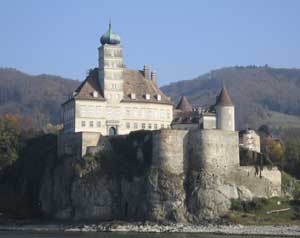
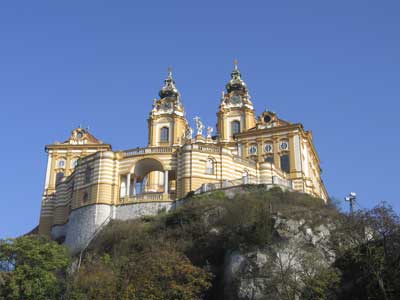
At Melk, the ship docked for five hours, enough time to make the trek through the small town of Melk and up to the Benedictine abbey which sits majestically on a cliff at the river bend. An important spiritual and cultural center for more than 1,000 years, Melk’s baroque abbey was first the home to the Babenberg family and since 1089 has been a monastery. This enormous structure, built between 1702 and 1736, is now on the UNESCO World Cultural Heritage list. Individual and group tours of the abbey are available.
PASSAU NEXT STOP
Passau was the ship’s next stop, and it’s defined by water. Three rivers—the Danube, Inn and Ilz—converge there, making it very picturesque. The Old Town is squeezed between the river banks in a storybook setting. The huge St. Stephen’s Cathedral houses the largest church organ in the world, with 234 stops and 18,000 pipes. Had our ship arrived a bit earlier, a free organ concert would have been on our agenda. Time didn’t permit a visit, but on the opposite side of the Danube was the Vesta Niederhaus, a medieval fortress which at one time formed the outermost defensive wall of the city.
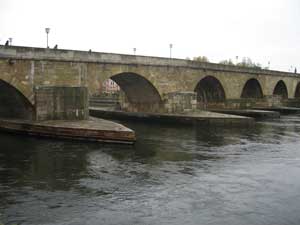
Our last city and stop on the cruise was Regensburg, Germany, originally founded as a military camp by the Romans. It’s an ideal town to explore by foot; 1,300 buildings are listed as being of historical interest, and a good view of the skyline is from the 12th century Stone Bridge which crosses the Danube by means of 15 arches; at one time it was the only fortified crossing of the Danube over its entire length. The streets curve and meander throughout the city center, and it takes some time to acquaint yourself with the old historic district, but it’s an interesting challenge to visit the merchant quarter, the Domnstadt area next to the ecclesiastical buildings, and the other parts of the Old Town. There’s also no problem finding a good hotel here if you wish to explore the city further: the Bayerwald, Furstenhof, Park-Cafe, Lindner Hotel Kaiserhof and Goldene Sonne are several that can make your stay a pleasant one.
With my Premicon Queen trip at an end, I said goodbye to the crew who had made my stay on board a memorable one. It was a river trip to far-off destinations where I had never before been. “Life is a long, wonderful journey,” says the Premicon’s Managing Director Klaus Hildebrand. “To travel is to live, to come to know the unknown,” he says.
That is what this cruise trip was all about for me, discovering people, places and the unknown. It was a fun adventure, and I’m a better educated traveler because of it.
IF YOU GO…
Cruising on a river ship is a relaxing way to visit cities and towns; virtually everything is done for you including meals and entertainment—and you don’t have to make your bed in the morning. It can get chilly on a ship, however, so always pack warm clothing. The evening meal is the time when passengers dress up, so a sport jacket and tie are in order for men, and more formal attire for women.
While there are usually no medical personnel on board, the ship is always in contact with the local authorities and can be at a dock within a few minutes. If you take medication, make sure you have enough of what you’ll need for the trip.
It’s not hard to find gifts along the way to take back home, so take an extra bag that can be folded into your main suitcase which you can then bring back with you.
Traveling with friends on a cruise makes sense. You’ll always have someone to dine with, and they can accompany you on the extra land tours.
Cruises are available for 2,3,5,6,7 and 10 nights on the Rhine, Danube and Main, as well as Christmas Journey and New Year’s Eve cruises.
For reservations contact www.premiconqueen.com, or in Germany call +49-221-2088-500 or e-mail: pearl@k-d.com.





 European Traveler