European Easter Breads

A Mix of Symbolism and Satisfying Taste
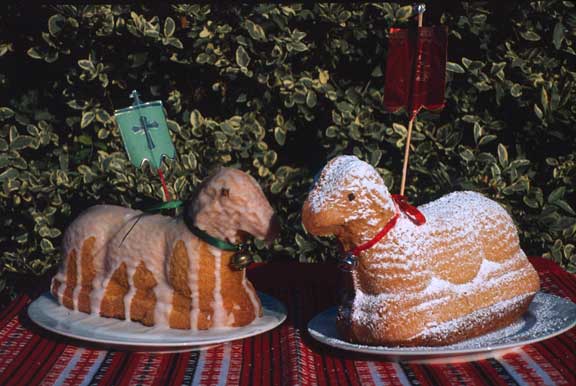
Lamb-shaped cakes and breads for Easter are made in the Alsace region of France, as well as in Germany, Austria and Eastern Europe. Photo by Sharon Hudgins


by Sharon Hudgins

When the Easter season approaches, European kitchens are filled with the yeasty aromas of freshly baked breads, as cooks all over the Continent prepare the special loaves and buns traditionally associated with this important religious holiday.

In the past, devout Christians observed a strict fast during Lent, the six or seven weeks before Easter, when they abstained from eating animal products of any kind: red meat, poultry, milk, butter, lard, cheese and eggs.

In some parts of Europe, even sugar, honey, olive oil, and certain kinds of fish were on the list of forbidden foods. When Easter finally arrived, people celebrated with a huge meal featuring dishes made from all the ingredients that had been prohibited during Lent. Even though few people follow such strict fasts today, the tradition of feasting on special foods at Easter is still an important part of many European cultures.

Rich, yeast-raised breads full of milk, butter and eggs are an essential element of the Easter meal in most European countries. Often the breads are made in symbolic shapes and elaborately decorated with sugar icing, candied fruits or colored eggs. Homemade or bakery bought, these breads represent a continuity of traditions from centuries past, including much earlier, pre-Christian times.

Different countries, regions and towns of Europe have their own characteristic breads baked especially for Easter. In some places, these special breads are taken to church to be blessed at the Easter midnight mass or the Easter Sunday morning service, before proudly being displayed on the festive dinner table at home. And in Russia and many Eastern European countries, the table also has a little three-dimensional lamb modeled out of butter, for spreading on the bread after it is cut.
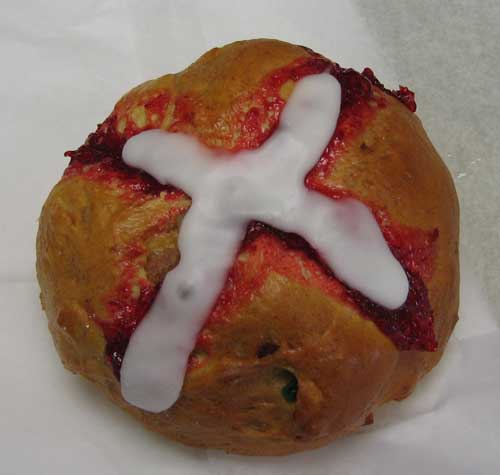
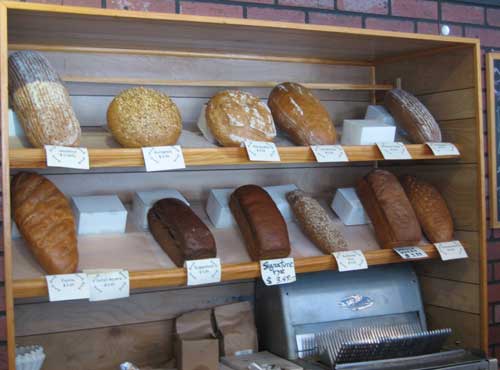
Hot cross buns are an Easter favorite.
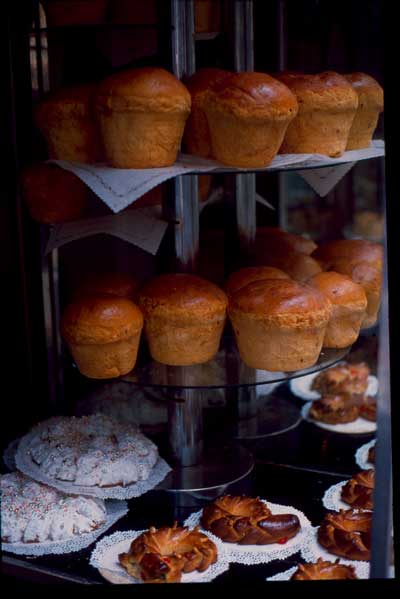
Breads of all kinds are offered at Easter-time; these were baked by Michael Mikusch at his Austrian bakery.

GERMANY AND CENTRAL EUROPE

Bakers in Germanic communities make Easter breads in a variety of shapes, secular and religious. Breads shaped like rabbits, lambs, baby chicks and fish are symbols of springtime, fertility and birth. Braided loaves—long and straight, round or wreath-shaped—are made with three strands of dough representing the Holy Trinity of Father, Son and Holy Spirit. Germans and Austrians make several versions of Osterzopf (Easter braid), Osterkranz (Easter wreath or crown), and Striezel (stacked braided bread), as well as Osternester (Easter nests) or Eier im Nest (Easter-egg nest) with white or colored hard-boiled eggs surrounded by the dough. The circular braided Osterkranz is also symbolic of Christ’s crown of thorns, and the red-dyed eggs decorating many Easter breads are said to represent Christ’s blood and resurrection—although the egg’s significance as a symbol of rebirth and regeneration actually dates further back in time to the pre-Christian era.

Other special Germanic Easter breads include the Osterfladen—a flat, rectangular bread with a sweet filling of apples, raisins and almonds—and several varieties of Osterbrot (Easter bread) flavored with raisins, currants, candied orange peel, grated lemon zest, anise and cardamom. The Osterkarpfen (Easter carp) is a bread shaped like a fish, glazed with white icing, and studded with sliced almonds to represent fish scales. Germans also make Osterkorbe breads formed like Easter baskets and rabbit-shaped Osterhasen breads, all of them holding real or candy eggs. And the Eiermännle (Little Egg Man) is a flat bread shaped like a boy or man, with an unshelled hard-boiled Easter egg baked in the center of his body or inside a basket that he carries on his back.

Lamb-shaped cakes and breads can be found at Easter-time from Alsace to Austria, from Germany to the Czech Republic, Poland, Slovakia and Hungary. Baked in three dimensional metal or pottery molds, these represent Christ as the sacrificed Lamb of God, although their origin can probably be traced to earlier, pre-Christian rites in which baked dough effigies of sacrificial animals were substituted for live animals. Lamb breads are made from the same kind of sweet, yeast-raised doughs used for Alsatian Kugelhopf, Austrian Gugelhupf,and Polish baba (or babka). The cake versions are made from a simple white cake batter, although both chocolate and marble (mixed chocolate and white) lamb cakes sometimes show up in the flocks of Easter lambs sitting in bakery windows at this time of year.

The simplest lamb breads and cakes are merely dusted with a coating of confectioners’ sugar or drizzled with a light glaze of sugar icing. More elaborate cakes are covered with fluffy white frosting, sometimes garnished with shredded coconut, or spread with chocolate icing decorated with white icing swirls. The eyes are made from raisins, whole cloves, or coffee beans, and a small silk ribbon, often with a tiny bell attached, is tied around the lamb’s neck. Many of these lambs also hold a colored foil banner bearing the emblem of a lamb or a cross—recalling similar banners carried by Christian crusaders to the Holy Land a thousand years ago.
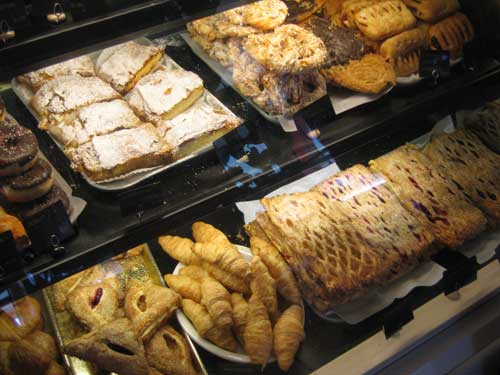
When you’re in Europe around Easter, look for the special Easter breads in local bakeries. You’ll likely be tempted by all the good pastries as well.
This shop offers Austrian breads and pastries which are as good as they look.

ITALY

Italy offers a rich variety of regional Easter breads, including Genoa’s pane dolce (sweet bread) full of raisins, candied fruit peel and pine nuts; Umbria’s cylindrical, cheese-flavored crescia; Venice’s large fugassa di Pasqua buns; and Cesenatico’s ring-shaped ciambelle, seasoned with anise and lemon peel. In Sicily, the edible centerpiece of the Easter meal is a large yeast bread shaped like a crown, with colored hard-boiled eggs embedded in the top. In some parts of Italy an old custom is still followed when Easter breads are made: the shell of the first egg put into the dough is cracked on the head of a young boy—supposedly to keep bad luck at bay.

The Easter bread most popular throughout all of Italy is a specialty originally from Lombardy—the columba di Pasqua (or columba pasquale), a sweet yeast bread full of candied orange peel, raisins, and almonds, made in the shape of a dove. Some of the fancier columbe have pockets of orange- or champagne-flavored pastry cream inside. Others are made with swirls of light and dark (chocolate-flavored) dough, like marble cakes. The plainest ones are garnished with only a simple sugar glaze, but the more elegant columbe are elaborately decorated with almond paste, white or pastel icing, chocolate, nuts or sugar-paste flowers.
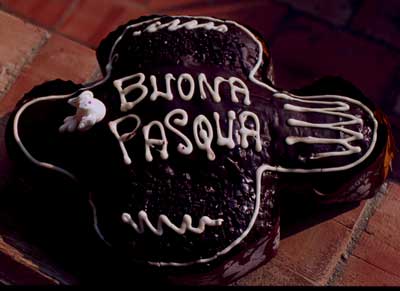
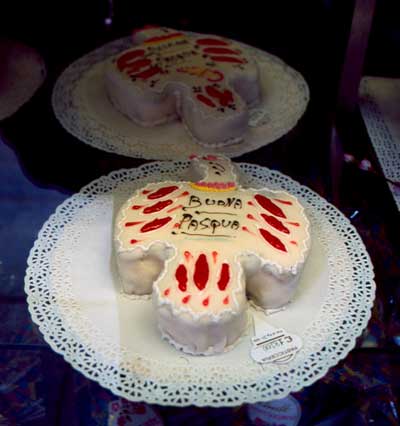
(bottom left and right) Italian Easter dove cakes (columbe di Pascua) are a symbol of springtime, the Holy Spirit, and peace.; Italian cheese-flavored crescia loaves for Easter, at a bakery in Umbria

GREECE

Maundy Thursday, three days before Easter, is the time when Greeks bake their holiday breads. Known as tsoureki or lambropsomo, these sweet, eggy breads are traditionally flavored with mahlepi, an unusual spice made from the finely-ground seeds of a type of cherry. Other Greek bakers add mastikha, pulverized crystals of sap from mastic shrubs that grow on the island of Chios. Cinnamon, nutmeg, cardamom and allspice can also go into the dough, as well as orange and lemon peel.

Greek Easter bread is made in different shapes from one region to another: a long braid, a braided wreath, a round loaf with bread-dough decorations on top in the form of leaves, flowers or a Byzantine cross. Each shape has its own symbolism. The three strands of braided dough represent the Holy Trinity. Wreaths and rings not only recall Christ’s crown of thorns but are also pre-Christian fertility symbols. Round shapes represent the life-giving sun, rebirth and resurrection. And no Greek Easter bread would be complete without one or more red-colored eggs—customarily dyed on Maundy Thursday—pressed into the top before baking.

SPAIN

The Spanish corona de Pascua (Easter crown) is another bread whose shape and symbolism is similar to Easter breads in many Mediterranean countries. Made from a sweet yeast-raised dough, the corona de Pascua is flavored with raisins, almonds, candied fruit peel, lemon and olive oil. Three strands of dough are first braided together, then formed into a ring. Whole, hard-boiled eggs are nestled into the top of the braid, usually one egg for each member of the family. Some people leave the eggshells white; others dye them red or a variety of spring colors.

Another Spanish Easter bread known as monja (nun) probably got its name from the nuns who traditionally baked breads, pastries and confections to sell from behind their convent walls. This orange-flavored bread—much like ones also found in Greece, Macedonia and Bulgaria—is round in shape, with a cross made of bread dough on top and four red-dyed eggs embedded at each point of the cross.

In the Castile region of Spain, Easter is celebrated with a large round loaf of bread in which shelled hard-boiled eggs, diced bacon,and chunks of Spanish sausages were imbedded in the dough before baking. And at Easter-time in some parts of Spain, godparents give their godchildren tortas de aceite, small savory buns made from yeast dough seasoned with orange, anise, and olive oil, with a single hard-boiled egg nestled in the center.

RUSSIA AND UKRAINE

Since Easter is a springtime celebration of new life, it’s not surprising that many traditional Easter breads are made in the form of ancient fertility symbols. The most graphic of these are the tall, cylindrical breads with a puffy dome on top, whose phallic symbolism is unmistakable. Festive breads of this shape are made in both France and Italy, but the most famous is Russia’s kulich, a saffron-scented yeast bread flavored with raisins, almonds and candied fruit peel. The domes are frosted with white icing that dribbles down the sides in a further reinforcement of the fertility image. The kulichi can also be decorated with colored sugar sprinkles or candied fruits, and a long thin red candle is usually stuck into the top of the dome. On Easter, Russian Orthodox churches are often filled with these special breads, their candles lighted, awaiting blessing by the priest.

Velikodnia babka is the Ukrainian version of this tall, yeasty Easter bread, with raisins, almonds and candied peel kneaded into the dough. Another traditional Ukrainian Easter bread is velikodnia paska, made from a rich yeast dough containing plenty of butter, sugar, and eggs, and shaped into large rounds. The tops are fancily decorated with ornaments made out of dough, usually with a cross as the center motif surrounded by elaborate swirls, small birds, leaves,or flowers. Perekladnets is a special, colorful Easter treat, a kind of coffee-cake loaf made with lemon-scented yeast dough and three different layers of filling: chopped dried peaches or apricots with candied fruits; chopped figs, dates and walnuts; and chopped almonds with candied cherries.
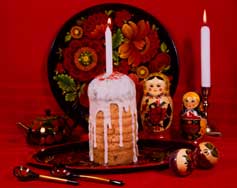
Russian kulich, a tall cylindrical Easter bread often baked in a coffee can.

GREAT BRITAIN

Hot-cross buns are the most typical Easter bread in Great Britain. Baked on Good Friday, these round, slightly sweet buns often have chopped fruit peel and currants, raisins or sultanas in the dough. A cross is cut into the top of each bun before baking, or a strip of dough is used to make the form of a cross on top, to keep away evil on this sad day of remembering Christ’s crucifixion.

In some parts of Britain, a hot-cross bun is hung up in the house to keep away bad luck (fire, theft, illness) until Good Friday of the following year. Buns are also hung in the barns to protect the grain from rodents. As in the rest of Europe, these British hot-cross buns are an example of the powerful symbolism of breads baked for the Easter season.

Europe’s Fascinating Food Markets

By Sharon Hudgins
Photos by the author

Sweet juicy plums. Pungent goat cheeses. Briny black olives. Homemade pâtés studded with pistachios. Paper-thin slices of farmhouse cured ham. Multi-grain buns and rosemary-scented flatbreads. Chestnut honey and walnut tartes.

Are you hungry yet?

On my first trip to Europe many years ago, I became hooked on shopping for food at the colorful local markets. Not the sterile supermarkets or gargantuan hypermarkets of today, which, except for the package labels in different languages, could be anywhere in the developed world. The markets that captured my imagination—and still keep drawing me back—are the ones where fresh foods are sold by individual vendors hawking their wares from wooden stalls, customized vans, folding tables, or even blankets spread on the ground.

I go. I see. I buy. I eat.

TYPES OF MARKETS
These food markets can be entirely outdoors, in the open air; or inside a cavernous covered market building; or in a combination of settings, with an indoor market surrounded by an open-air market that varies with the season. They can be permanent markets, operating year round at the same location, usually with the same vendors; or temporary events occurring only on specific days, once or twice a week, in a public square or country field, with local vendors as well as those who travel from one market to the next to sell their goods.

Some are truly farmers’ markets, where all the fruits, vegetables, meats and cheeses were grown, raised or processed by the people selling them. Others are outlets run by middlemen selling foods from a variety of suppliers, from small-time farmers to larger commercial companies. And some are a mixture of both.

London, Paris, Vienna, Madrid, Rome, and other major cities have many of these food markets located in neighborhoods throughout each metropolis. Smaller towns might have only one central market, whereas in a village there might be an open-air market only once a week, usually on Saturday. Check with the tourist office for the locations, dates and opening/closing times.

LOCAL SPECIALTIES, GLOBAL CHOICES
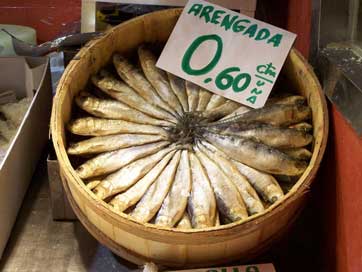
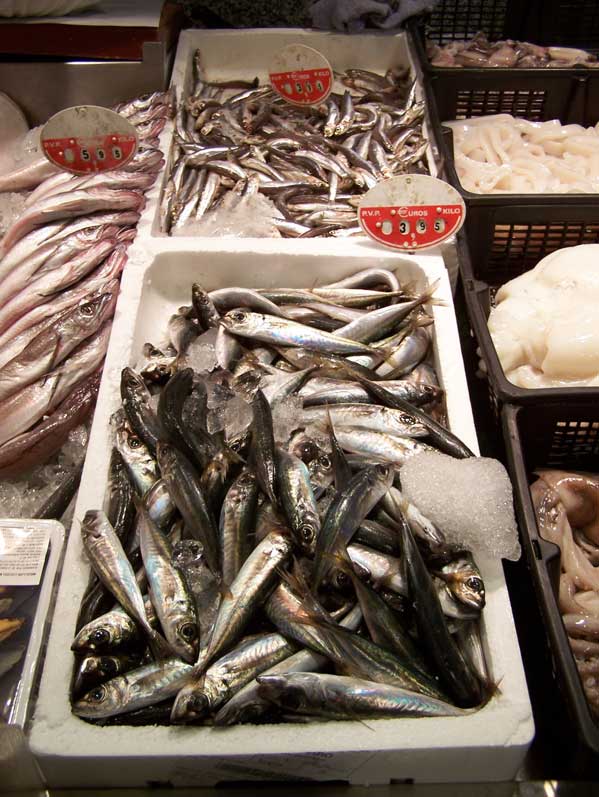
At these markets you can see, smell and taste authentic local and regional specialties, some of them found nowhere else. In different regions of France, I’ve bought farmhouse cheeses made just down the road and jams preserved by the woman selling them. In Sicily and Greece, I’ve wandered through markets stocked with fish caught that morning in the nearby seas. At German markets I’ve left with my shopping bags filled with potatoes and apples grown in the surrounding fields, and with big loaves of rye bread still warm from the wood-fired oven in which they were baked.

A visit to a large metropolitan market can also be a lesson in globalization. In addition to local Catalan and regional Spanish food products, Barcelona’s big Boqueria covered market also sells hot sauces from the USA, moles from Mexico, and guavas from South America. At Munich’s central Viktualienmarkt, you’ll find not only Bavarian meats and cheeses but also chermimoyas from North Africa, hot chiles from Southeast Asia, and exotic tropical fruits from the Philippines.

Each season brings its own specialties to European markets: strawberries, cherries and asparagus in spring and early summer; raspberries and blueberries later in the summer; mushrooms, apples and pears in the autumn; and oranges, nuts, and root vegetables in winter. Of course markets have more fresh produce during harvest time from spring through early autumn. And on any day you’ll always find the best selection early in the morning, just after the market opens.

LOOK, DON’T TOUCH
European markets are a great place to buy food for a picnic in your hotel room or in a park on a pretty day. Some even have a section with tables and chairs for public use, and German markets often include a beer garden on the premises, where you can bring your own food.

Tips: Always carry a shopping bag for your purchases. When you stop at a stand to buy fresh fruits or vegetables for your meal, don’t poke around in the produce and pick your own selection. At most markets, customers are expected to tell the vendor what they want, and the vendor chooses the best pieces, based on their ripeness and good condition, then weighs out the amount requested.

Don’t let your lack of the local language deter you from shopping in Europe’s food markets. Just point to the particular food you want and write the amount on a slip of paper: 100 grams (about one-fourth of a pound), 500 grams (close to a pound), 1 kilo (a bit over two pounds). Better yet, learn some basic numbers in that foreign language and let the product labels in the market teach you the names of the foods you want to eat. Soon you’ll be shopping like a European yourself.

LINKS TO FAVORITE FOOD MARKETS IN EUROPE
London Farmer’s Markets
Paris Food Markets
Rome Markets
Barcelona Food Markets
Madrid Markets
Berlin Markets
Munich Fresh Food Market
Hamburg Fish Market
Amsterdam’s Food and Antique Markets Guide
Guide to Seasonal Produce Markets of Brussels
Vienna Food and Farmer’s Markets
Guide to Vienna Food Markets
Budapest Markets
Athens Food and Flea Markets
Athens Farmer’s Markets

Have a Very Good Trip…by Train

So, you want to show your wife or your date a very good time.

And you want to do it between Venice and Paris.

That can be arranged.

What is called the World’s Most Romantic Celebration consists of a train trip on the Orient-Express between Venice and Paris.

Here are the details. The trip is eight days and seven nights from $24,750: three nights in Venice; one night on the Venice Simplon-Orient-Express and three nights in Paris.

Departure dates, which are Sundays and Wednesdays, in 2008 are: March 30; April 6, 13, 20, 27; May 11, 14, 25;June 8, 11, 22, 29; July 20, 27; August 3, 10, 17, 24; September 10, 21, 24, 28; and October 12, 15.

The itinerary consists of:

Day 1 – Venice
Arrive in the romantic city of Venice and transfer by private water taxi boat to the Hotel Cipriani. A deluxe suite is reserved for three nights in the city of canals. 

Overnight in Venice.


Day 2 – Venice
A personally tailored guided tour of the city in the morning. In the afternoon, the private launch of Romilly, Lady McAlpine collects you from the hotel and takes you to her home for a visit and refreshments. 

Breakfast included. Overnight in Venice.

Day 3 – Venice
Explore the delights of La Serenissima before a final romantic evening, including a ride on a gondola before dinner, at one of Venice’s most exclusive restaurants. 

Breakfast and dinner included. Overnight in Venice.


Day 4 – On the Venice Simplon-Orient-Express
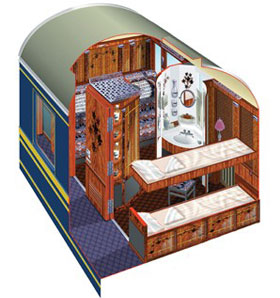
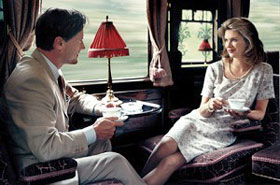
The train’s hostess completes check-in formalities for your journey on the Venice Simplon-Orient-Express train before your private transfer to the station. Board the train (cabin suite) for the overnight journey to Paris, enjoying superb cuisine and sparkling champagne. 

Breakfast, lunch and dinner included. Overnight on board.


Day 6 – Paris
After breakfast, a private car and driver takes you to the French countryside en route to Reims, capital of the Champagne region, where you have a private tasting before lunch at the two-star Michelin restaurant of Chateau Les Crayères, accompanied by fine wines and Prestige Champagne. After lunch, return to Paris. Breakfast and lunch included. Overnight in Paris.

Day 7 – Paris 
Time for final sightseeing or shopping in the boutiques and designer stores. In the evening a private car transfers you to Quai de Grenelle, where you board a luxurious private yacht. The vessel’s teak deck and sleek interiors allow you to relish the cozy atmosphere of a 1960s boat. Enjoy a glass of champagne as you cruise along the river Seine, before a romantic candlelit dinner served either on the outdoor deck or the inside cabin. A shower of roses completes the cruise before returning for a final night in Paris. Breakfast and dinner included. Overnight in Paris.

Day 8 – Paris
Your journey comes to an end. Breakfast included.  All aboard!

IF YOU GO…
Log onto www.orient-express.com for more details about the trip. Or, call (in the USA) 401-351-7518 or e-mail to: oesales.providence@orient-express.com. From France, call +33 1 55 62 18 00; from Germany, call +41 44 770 1407; from the Netherlands, call +31 35 6955111; and from the U.K., call +44 20 7805 5060

Learning the ‘Art of Travel’ on the Orient Express

A luxurious learning experience complete with a guide from London’s National Gallery

The Orient Express is launching a series of special vacation packages called “The Art of Travel,” including tours to Venice, Paris and within England. Travelers will learn about the lives of artists such as Canaletto, Bellini, Titian, Veronese, Monet, Rubens, Turner and Constable while seeing the places that inspired their work and visiting the places that house their work today, accompanied by an expert from London’s National Gallery.

All tours include at least one night at London’s Goring Hotel and begin at The National Gallery, where a specialist will give a guided introduction to selected masterpieces before the journey begins. Trips include:

THE VENICE OF CANALETTO: This seven-day tour will give travelers the opportunity to view Venice through Canaletto’s eyes. Travel from London aboard the Venice Simplon-Orient-Express through France, the snow-capped Alps and northern Italy. While in Venice, guests stay at the Hotel Cipriani and trace the footsteps of Canaletto, who is forever associated with magnificent Venetian views. Trips are limited to 20 people and depart on April 9, October 8 and October 22, 2011. 

VENETIAN PAINTERS: This is a six-day tour that introduces the traveler to the great Venetian masters, from Giovanni Bellini and Titian to Veronese. Starting in London with a tour and dinner at the National Gallery, travelers will fly to Venice, where they will step back into the Italian Renaissance and explore great sights such as the Doge’s Palace, the Accademia and Ca’ Rezzonica with an expert from the National Gallery. The journey ends with a return to London on the Venice Simplon-Orient-Express. The trip is limited to 20 people and departs on April 30, 2011.

IMPRESSIONS OF PARIS: Also offered will be a series of five-day tours focusing on French Impressionism, where travelers will trace Claude Monet’s long, dynamic life and will learn about the birth of a new artistic movement, when painters first began painting in the open air to capture the effects of light. From London, guests board the Venice Simplon-Orient-Express and can marvel that two of the restored carriages aboard the Art Deco train were already carrying passengers when Monet was producing his last masterpieces. Departures are April 9, May 7, June 25, July 27, August 24, September 24 and October 22, 2011. 

BRITISH PULLMAN: These tours combine the thrill of a steam-hauled luxury train, complemented by gourmet dining — brunch on the outbound journey and a three-course supper on the return — with delightful scenery and include visits to Bath’s finest art collections.

  • Collectors and Collecting: This trip is timed to coincide with the reopening of the Holburne Museum in May 2011 following a major restoration.  After a guided tour of the museum, there will be a tour of “Beckford’s Bath,” including the eccentric William Beckford’s house and the grounds leading up to Beckford’s Tower. The trip will depart on June 28, 2011.
  • Thomas Gainsborough: This journey focuses on landscape paintings by notable British and European artists including Rubens, Turner and Constable. Highlights include the new exhibition “Gainsborough’s Landscapes: Themes and Variation,” at the Holburne Museum and a walking tour of artists’ Bath.  This tour will depart on October 11, 2011.

For more information on “The Art of Travel,” visit www.orient-express.com/nationalgallery.

‘Ciao Down’ in Emilia-Romagna, Italy’s Gastronomic Capital

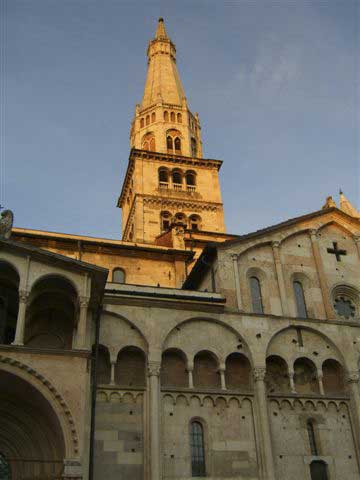
The bell tower of Modena’s cathedral

By Kristi Nelson Cohen
Photos by the author

One of things travelers enjoy the most is, well, eating.  We chow down breakfast, lunch and dinner without blinking an eye, when we wouldn’t dream of eating this much at home.  But as they say, “When in Rome.” You should definitely dine as they do, with a great glass of wine.  Each region of Italy offers its specialties, but Emilia-Romagna, located in the heartland of central Italy, could easily be considered this country’s gastronomic capital.
 
Located just over an hour north of Florence and about two hours southwest of Venice is the region’s capital, a major metropolitan city called Bologna. Bologna is easily reached as a transportation hub on the Italian rail or on Highway A1 from Florence.  Less than an hour northwest of Bologna are the smaller communities of Modena and Parma, which are also accessible by rail or car. The busy A1 highway links Bologna to Milan via Modena and Parma. 
 
The larger-than-life opera singer Luciano Pavarotti was from Modena. Pavarotti’s large stature and his appetite for life, friendliness and generosity exemplify the people of this region.  Those who watched his funeral on television in late 2007 got a glimpse of Modena’s historic Romanesque duomo.  This 11th century cathedral, its piazza and bell tower are all listed by UNESCO as a world heritage site.  But we’re here to talk about food!
 
Pigs still outnumber people here, which is why the Parma ham or prosciutto di parma is a dietary staple. Many of Italy’s prosciutto, salami and other pork products are cured in towns scattered over this region. Another well-known food staple is Parmesan cheese, and we’re not talking about the stuff that comes in a green can. The real deal is called Parmigiano-Reggiano. And don’t forget about the famed balsamic vinegar which originated in Modena, called Aceto Balsamico Tradizionale.  Here a visitor will learn about the painstaking process of making this aged, black gold. Tradizionale Balsamico is very expensive — a small bottle can cost $100-$400 — but each thick drop carries sweet and complex flavors used to enhance a variety of foods.

Lambrusco grapevines near Modena

 
ACETO BALSAMICO TRADIZIONALE DI MODENA

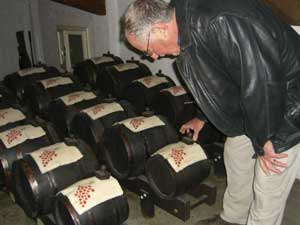
The balsamic vinegar found in the grocery stores, or even in the specialty gourmet stores in the U.S., is great on salads, but has merely a slight resemblance to the real thing. Tradizionale vinegar is made with the Trebbiano white grape. The juice is cooked, reduced and fermented in a series of specifically made wooden casks for no less than 12 years.  Each year, the vinegar evaporates from the wooden casks and is then moved to a graduated smaller cask.  At the end of 12 years, what started as six gallons of fermenting grape juice will only produce one quart of finished tradizionale vinegar. 
 
The vinegar production must pass strict government standards and be approved by the Balsamic Vinegar Consortium which monitors the quality and production amounts. There is only a handful of small producers, and while prices may seem high, this syrupy concoction takes years to create.  While visiting the area it is possible to schedule a production tour and tasting. High end restaurants offer menu selections where the Aceto Balsamico Tradizionale is sprinkled sparingly over grilled meats, strawberries, tortelloni, Parmigiano Reggiano cheese or even over ice cream. This sweet, aged, deep brown nectar can even be drunk as an after-dinner liqueur.
 

Balsamic vinegar casks


SAY “CHEESE” — PARMIGIANO–REGGIANO

West of Modena is Reggio Emilia, the birthplace of the renowned Parmigiano-Reggiano cheese. This cheese is not only grated onto pasta, but is often served by itself in chunks as an appetizer or even for dessert, when it might be drizzled with honey or the famed balsamic vinegar.
 
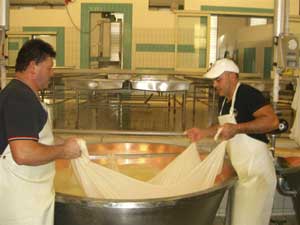
Cheese production tours are available with advance scheduling. There you can watch cheese makers stirring the milky brew in large copper cauldrons, then cutting through the curds and later forming soft pillows of cheese. The soft cheese is pressed into a wheel form with the pre-formatted stamp which says “Parmigiano Reggiano” and allowed to cool.  The soft wheel is then cured in saltwater brine for two weeks. The cheese wheel is then placed on wooden shelves and allowed to age from 2-5 years. 
 
Visitors can easily buy this cheese from any market in the area or even at the airport on departure day.  Be sure to check the hardened rind area to see the perforated stamp of authenticity.  If the cheese is sealed in a vacuum package, it is perfectly acceptable to carry home as a delicious reminder of a vacation in Italy.    

(left to right) Wheels of Parmigiano-Reggiano undergo the aging process; Master cheese makers with pillows of soft cheese

 
FAST CARS, RAGING BULLS AND RED RACING FEVER

If great food and world heritage sights aren’t enough to entice a visit to the area, perhaps the thrill of seeing another part of Italy’s claim to fame will  Italian design is world famous, but none more coveted than Italian specialty sports cars. The Modena area is home to Ferrari, Maserati, Ducati, Lamborghini and Pagani. 
 
Tours at the Ferrari factory, located 12 miles south of Modena in Maranello, are not available, but the Galleria Ferrari Museum has a great exhibition of engines, vintage cars, memorabilia and a reconstruction of Ferrari founder Enzo Ferrari’s personal study. There’s also the official Formula One shop, the Ferrari restaurant and places where visitors can view the Ferrari test track through the fence, giving an ample cure for “red racing fever.”

The Lamborghini Factory Museum located at Via Modena 12 in Sant’Agata is under the same roof as the “raging bull” factory.  There visitors enjoy a wide array of vintage automobiles, historic photos and rare prototype models. With an advance appointment, factory tours are also available, and this museum isn’t nearly as crowded as Ferrari, which gives visitors a chance to stroll the displays at leisure. Guided tours in English are available with advance request. 
 
There is so much to see for the sports car enthusiast that it might be best to set up guided full-service tours with museum and factory admission organized in advance by a professional guide service. Le Volpi Ciccione is one such operator. They can even customize a tour that includes your own Ferrari to drive for a few days, as long as your budget will allow.
 
Our food and motor tour included a cooking class at the Ferrari Village restaurant. The Ferrari Village’s red exteriors were a good match for the passion of the restaurant’s culinary team, which graciously opened their kitchen so our group could learn to make gnocco fritto (a light deep-fried dough which was served piping hot with thin slices of prosciutto) and the filled pasta called tortelloni (larger) or tortellini (traditional smaller-shaped filled pasta). Following the cooking instructions, our group enjoyed a luncheon fit for kings and, yes, we sampled our own creations, although some students were better at shaping the tortelloni than others.

With great food, historic sights, friendly people and the classy Italian sports cars, this area of Italy is not to be missed!
 
CONTACT INFORMATION TO HELP YOU FIND YOUR WAY THROUGH EMILIA-ROMAGNA
 
Le Volpi Ciccione srl – Tour Operator/Travel Agency in Modena
Le Volpi provides customized tours and area lodging with emphasis on food, wine, motorcars, historic sights and much more.  English speaking guides and group tours available. 

Vicolo del cane 7, 41100 Modena, Italy
Phone:  011-39-059-218 722
For customized tour itineraries for both individuals and groups, contact Giusy@levolpiciccione.it
 
Museo Lamborghini
Via Modena 12, 40019 Sant’Agata Bolognese, Italy
Phone:  011- 39-051-681 7611
Open Monday through Friday excluding holidays
E-mail:  museo@lamborghini.com or for factory tours factorytour@lamborghini.com
 
Galleria Ferrari
Via Dino Ferrari, 43-41053 Maranello, Italy
Phone:  011-053-694-32 04
Open every day excluding Dec. 25 & Jan. 1
E-mail: (for group requests) galleria@ferrari.it
 
Balsamic Vinegar Consortium
Corso Cavour 60, Modena 41100
Phone:  011-059 23 6981
 
Parmigiano-Reggiano Consortium
Via Kennedy 18, Reggio-Emilia
Phone:  011-052 23 077 41

About the writer
Kristi Nelson Cohen, also known as the “Train Dame,” has a long history with marketing and tourism promotions. Cohen’s love of history and trains, in addition to her hospitality and marketing background, led to a position as Vice President of Marketing for the Durango & Silverton Narrow Gauge Railroad where she worked full time until 2004.

Cohen remains active as an affiliate for American Heritage Railways and Rail Events Inc. where she has assisted with marketing efforts for The Great Smoky Mountains Railroad, Thomas the Tank Engine, Little Engine That Could Rail Tour and Polar Express Rides. She was also one of the organizers of the National Narrow Gauge Convention held in Durango in August 2006. She now owns and operates an international tour company called Bella Italia Trips, leading guided tours to Italy.