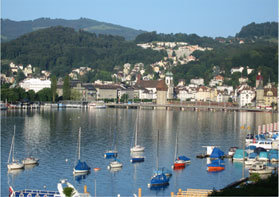
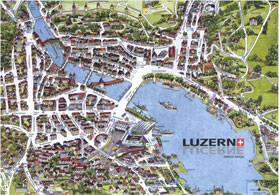
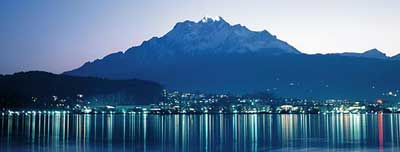
Lucerne, Switzerland is a great city for pedestrians. A walk around Lucerne, a city of only 57,500 people, is invigorating and beautiful, with the majestic Alps at your doorstep.
Founded as a small fishing village on Lake Lucerne (Vierwaldstattersee) the city (at 1,430 feet), is the focal point of the region, and the most populous city in central Switzerland.
The city is called “the essence of Switzerland” and the “Festival City” with numerous events such as the World Band Festival, Mozart Festival and the Lucerne Festival. There are numerous bridges in the city, with the Chapel Bridge the most famous, built circa 1300 as part of the city’s fortifications.
The Musegg Wall with its nine towers was built in 1400 after the Battle of Sempach and today it is considered the longest and best preserved rampart walls in Switzerland.
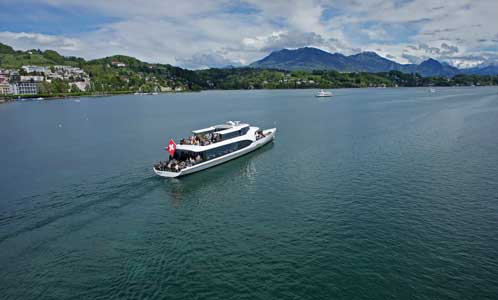
A ride on the many beautiful lake steamers is a must to enjoy the surrounding countryside. Boats leave right from a dock downtown across from the train station (Bahnhof). While in Lucerne, walk through or stay at the 101-year-old historic Palace Hotel and ask for a lakeside room.
While you are in Lucerne, stop by the Swiss Transport Museum (www.verkehrshaus.ch) and look at all the restored trains, planes, and other forms of transportation. If you have a full day each, also see Mt. Rigi (www.rigi.ch) and Mt. Pilatus (www.pilatus.ch), two spectacular mountains each obtainable by hiking or cog railway. You can take boats, trains or drive to the base of each mountain.
For more information on Lucerne, go to www.luzern.ch.
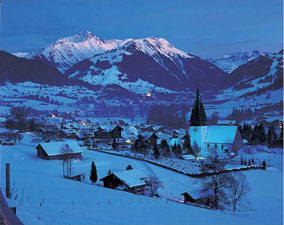
Consists of 44 square miles of hiking trails complete with breathtaking views of the Alps
Photos courtesy Lucerne Tourism
A walking trip around Lake Lucerne in central Switzerland provides impressive views of the Alps, as well as the surrounding hills and the lake.
Trekkers can pass through alpine meadows, steep cliffs and placid mountain lakes. While there, hikers can also enjoy the magnificent flora and fauna. Mountain inns are an invitation to fortify yourself, while mountain rails ensure that the strenuous uphill and downhill sections become excessive.
(LUCERNE) NIEDERRICKENBACH VILLAGE – EMMETTEN 5:30 (HOURS) TO (SEELISBERG) Leave Lucerne by train and enter Niederrickenbach by cable car. In the village, there are shops selling alpine herb trees gathered by women from the monastery. The tour continues further along the sycamore woods on a well-known game observation trail along the edges of the hills of Schwalmis and Oberbauen to Niderbauen. EF Valley ride using the cable car to Emmeten, then by post bus to Seelisberg.
SEELISBERG TO FLÜELEN 5:05 The Road of Switzerland, opened in 1991 in commemoration of the 700th anniversary of the Swiss Federation. It winds around the deep Urnersee — sometimes high above it, then again directly on its shores, at times along steps hewn into the cliff side, then again on broad, comfortable tracks, past numerous inns and swimming locations, and with frequent, splendid views of the lake and the surrounding hills.
FLÜELEN TO BRUNNEN 5:55 Between Flüelen and Sisikon the trek passes over a path on the shores, such as at the Riviera, past Tellskapelle and Tellsplatte. The climb from Sisikon onwards is rough, but there is an exciting adventure pool in Morschach for recuperating.
BRUNNEN/URMIBERG – RIGI KALTBAD 4:10 Hikers can travel by cable car to Urmiberg. The Rigi is a trekker’s paradise. The path from Urmiberg via Scheidegg to Kaltbad is also a trek that can only be described using superlatives. Unmatched views, which can cover up to four lakes at a time, are guaranteed. The panoramic view of the hills stretches from Säntis to the Bernese Alps.
RIGI KALTBAD – RIGI KULM – KÜSSNACHT 4:30 Rigi Kaltbad is nicknamed the Queen of the Mountains, and at its highest point extends more than 5,900 feet. It is no wonder then that, on a fine day, thousands of people eager to enjoy the sun make an excursion to this mountain. An unforgettable experience! Descent to Seebodenalp and Küssnacht. EF Seebodenalp – Küssnacht by cable car.
KÜSSNACHT – LUCERNE 5:30 The round trip around Lake Lucerne ends with a splendid finishing stretch across the Dietschiberg. The view of the sea is magnificent, and it is enjoyed by the golfers playing here above Lucerne. After a short descent, the path leads back to the heart of Lucerne, along the lakeside promenade. Brittany Petrillo
Liechtenstein is a small country with a big appetite for good food.
Wedged in between Austria and Switzerland, this country of only 62 square miles is bisected south to north by the Rhine River, with majestic mountains rising steeply on both sides of the lush Rhine Valley. Corn, cabbages, beets, onions and asparagus grow on the fertile Rhine plain. Wild game such as deer, boar, pheasant and grouse roam the forests and meadows on the mountainsides, and silvery trout swim in the cold Alpine streams.
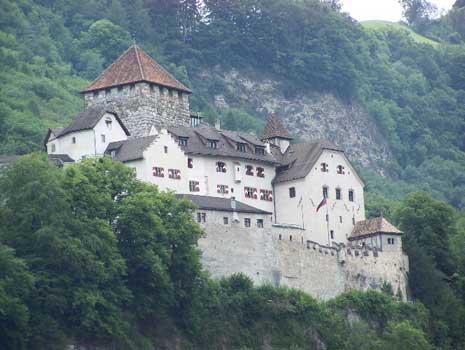
Perched high on one of the mountains, the medieval castle of the princely family of Liechtenstein towers over Vaduz, the capital city (population 5,500). Liechtenstein is officially a principality, where the Prince still rules as a hereditary monarch in conjunction with a democratically elected parliament. The Prince also owns the Hofkellerei (Princely Wine Cellars) in Vaduz, where you can taste his excellent wines. Afterward, walk along an educational wine trail in his local vineyard, where detailed signs describe the 50 different grape varieties growing there. More than 100 other vintners throughout the country also produce red and white wines of their own.
ALPINE FUSION FOOD The cooking of Liechtenstein is a creative combination of German, Austrian, Swiss, Italian and French culinary influences, producing a kind of local “Alpine fusion” cuisine. Soups are especially popular, from hearty meat-and-vegetable stews (split pea and sausage, smoked pork and sauerkraut) to elegant foamy white-wine soups served in stemmed glasses. Asparagus is a favorite vegetable, and the primary meats are beef, pork, and mountain trout.
Dumplings and potatoes are the main starches of traditional Liechtensteiner cooking, which includes shredded potato pancakes like Swiss Rösti and a variety of dumplings made from wheat flour, cornmeal or potatoes. Cheese is an important ingredient in the cuisine, from rich Alpine hard and semi-soft cheeses to Sauerkas, a kind of lightly aged fresh cheese made from soured milk. Desserts are as rich as you’d expect in a country situated between Austria and Switzerland. And wine has an important place on the table, befitting a country that prides itself in its small, but high quality, wine industry.
There’s a big difference between farmhouse fare in an Alpine climate and the fine cooking of Liechtenstein’s shrines of haute cuisine, several of which have garnered Michelin stars and high Gault Millau ratings. In the rustic restaurants you’ll find the stick-to-your ribs dishes like breaded pork cutlets, fried chicken, roast pork and Käsknöpfle, a large portion of little egg dumplings (like German-Schwabian Spätzle) tossed with a copious amount of cheese and garnished with plenty of crisply fried onions. Known as Liechtenstein’s “national dish,” Käsknöpfle is usually served with a separate portion of applesauce or a green salad, to counter the richness of the cheese.
FINE DINING Only 36,000 people live in this wealthy little enclave in the heart of Europe, where banking and financial services produce a GDP per capita that puts Liechtenstein in the top tier of the world’s richest countries. Such wealth supports a number of fine restaurants, rated among the best places to dine in Europe. These high-end restaurants tend to focus on lighter fare, artistically arranged on fancy plates—the kind of cuisine that combines respect for the country’s culinary traditions, an emphasis on local, seasonal ingredients and the imaginative use of modern kitchen techniques.
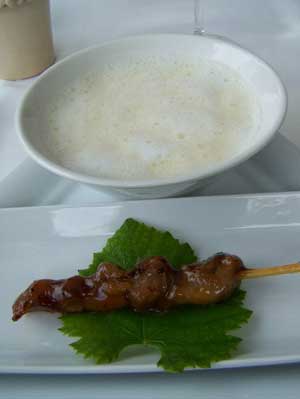
Highly acclaimed by many restaurant guides, chef Rolf Berger’s Restaurant Torkel serves haute cuisine in a beautiful setting. Located in a historic medieval building that was once a wine press, on the grounds of the royal vineyards in Vaduz, Restaurant Torkel is known not only for the quality of its cooking and its delightful ambience, but also for its excellent wine cellar. Choices on a recent daily menu in the summer included a delicious white wine soup with small yakitori dumplings on a skewer, Swiss prime beef filet in Port wine sauce, grilled sea bass in foamy smoked trout sauce, fresh berry parfait garnished with more berries and a good selection of cheeses. In nice weather, the perfect place to dine is on the pleasant stone-paved terrace overlooking the lush vineyards and the dramatic mountains beyond.
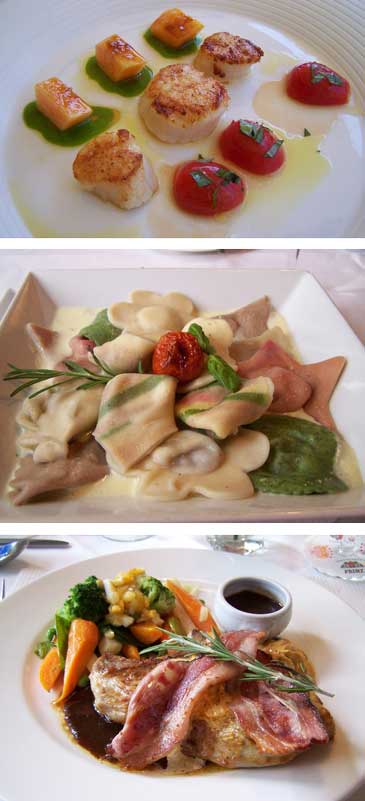
Another outstanding restaurant in Vaduz, the Marée at the Park Hotel Sonnenhof has won one Michelin star, two Gault Millau toques, and numerous other accolades. This is the place for fine dining in luxurious surroundings, from the elegantly furnished dining rooms to the large covered terrace facing the mountains and surrounded by gardens. The menu changes seasonally, four times a year, and features both traditional and modern dishes, all prepared with a light touch and plated artistically. Selections at a recent summer lunch included an appetizer of roasted scallops with melon, tomatoes, and fresh basil, followed by a main dish of crispy glazed breast of pork with fresh chanterelle mushrooms and cherries. Notable desserts were the colorful artist’s palette of house-made sorbets, and the basil sorbet with fresh strawberries and elderberry foam.
TRADITIONAL INNS For very good food at reasonable prices, the Landgasthof Mühle is the place to go. Located on the site of an old mill on the edge of Vaduz, this lovely little inn offers an interesting menu that matches the quality of the restaurant’s décor. Try the creamy Vaduz wine soup or the excellent house-made terrine with a large salad, followed by multicolored ravioli with foamy herb sauce, and elderberry sabayon garnished with fresh berries for dessert. Highly recommended for the quality of the food, large portions and friendly staff.
Long a favorite of locals and tourists alike, the Wirtschaft zum Löwen in Schellenberg is a traditional old inn located in a wood-shingled farmhouse with red geraniums blooming in the window boxes. Dine in one of the cozy, wood-paneled dining rooms or on the pleasant terrace with a spectacular view across the border to Austria. House specialties include the head cheese with onion rings and mustard sauce, and classic Käsknöpfle, those cheese-drenched dumplings with applesauce and green salad. Large portions of good traditional food served in a nice setting.
MOUNTAIN HIGHS Located in the Vögeli Alpenhotel in Malbun, a ski resort 5,000 feet above sea level, the Restaurant Alpenhotel is a cozy, rustic, pine-paneled restaurant—just the place where you want to retreat after a long day of hiking in the Alps or skiing down the mountainsides. The food is good here, and the portions are huge, apparently to satisfy those hungry hikers and skiers. The extensive menu seems to have something for every taste, including hearty meat dishes, a variety of big Rösti potato pancakes with garnishes, several pastas and cheese fondue. Warm up with garlic cream soup or creamy pumpkin soup with Styrian pumpkin seed oil, then chow down on the house-made game bratwurst with onion sauce, or deer Schnitzel with mushroom sauce. Be sure to save room for the traditional desserts (crêpes with chocolate sauce and whipped cream, battered-and-fried apple slices with vanilla sauce) or a big slice of the excellent cakes.
The Hotel-Restaurant Galina in Malbun is run by another member of the Vögeli family who owns the nearby Alpenhof hotel and restaurant there. At the Galina, the talented Norman Vögeli wears several hats: the hotel’s manager and falcon master (he stages an interesting falcon show several times a week), as well as the restaurant’s chef and pastry-maker (he supplies the delicious creamy cakes, fresh daily, for the Alpenhof Restaurant down the road). The food is very good here, including several large salads garnished with meats and cheeses, hearty soups, vegetarian main dishes, pizzas, cheese fondue and chef Vögeli’s tempting cakes for dessert.
And finally, down the mountain road from Malbun, stop off at the Cafe-Konditorei Gulfina in Triesenberg, for its luscious cakes and pastries, open-face sandwiches, and good variety of breads, all made fresh daily. Sip a cup of hot coffee and indulge in a slice of rich Engadiner Nusstorte—a regional pastry specialty, filled with caramel and walnuts—while sitting outside on the terrace that hangs precipitously over the mountainside, with a spectacular view of the valley below.
By Barbara Gibbs Ostmann All photos courtesy Switzerland Tourist Board
Switzerland is celebrating 150 years of Alpinism this year, and there’s no better way to celebrate than by going for a long mountain hike.
Aristocratic English adventurers were on to a good thing back in 1857 when they reached the summit of the Finsteraarhorn and later, upon their return to London, founded The Alpine Club, the first mountaineering association in the world.
By 1863, English climbers had ascended more than 50 Swiss peaks, firmly launching Switzerland as the playground of Europe and the center of mountain tourism. Today’s hikers can choose from more than 40,000 miles of well-marked paths throughout the country.
NEED COMFORTABLE BOOTS Touring Switzerland by foot is a lot different than touring it by train or car, and worth all the sweat and effort. The key to a successful hiking trip is a pair of well-broken-in hiking boots — it is not the time to try out a new pair.
Having lived in Switzerland for two years as a graduate student, and visiting it many times, I had my doubts about going on an organized hiking tour. But hiking in a group proved to be a great way to visit Switzerland, providing moral support and camaraderie. Although we had prepared for the trip by hiking at home, we all benefited from the well-planned itinerary that began with easy walks and built up to the steeper climbs, preparing us physically for the more difficult parts of the hike.
My group of hiking companions, ranging in age from 13 to 67, set off in high spirits from Les Avants, above Montreux on Lake Geneva in the French-speaking part of Switzerland, and arrived 10 days later, foot weary but fulfilled, in M̹rren in the heart of the Bernese Oberland in German-speaking Switzerland.
STARTED EASY The adventure began with an easy hike through the forest up to the Col de Jaman (Jaman Pass), above Lac Leman (Lake Geneva). We spent the first night on the trail in a matratzenlager or dormitory — a large room filled with side-by-side mattresses. It was a good introduction to what to expect in the final stages of our hike when we would be in the mountains for three days, carrying all our food and clothing. For most of the trip, we carried a day pack and a sack lunch each day, while our suitcases were transported by bus to the next village and hotel where we would spent the night.
It was early to bed because it was early to rise. At a little more than 11 miles, the next day’s walk was the longest of the trip, and much of it was on paved roads— hard on the feet and legs. However, the scenery along the Lac de L’Hongrin was beautiful and the weather was sunny and warm. The day’s hike ended in L’Etivaz, a small village in the French part of Switzerland.
DAY THREE The third day’s walk was more typical of those to come. We started with a steep climb out of the valley and up to the windy Col de Jable (Jable Pass), where we huddled behind a rock fence to eat lunch. Upon crossing the Col de Jable, we left the French Canton of Vaud and entered the German Canton of Bern. Descending, we arrived in the glitzy resort town of Gstaad. There was time to shop, but in our hiking gear, we didn’t look the part of fashionable Gstaad jet-setters.
In the morning, we hiked through drizzling rain to the bus stop and took the postal bus from Gstaad to the village of Lauenen, where we set out on the day’s hike. As we trudged over the Tr̹tlisberg Pass, the rain grew heavier and the temperature dropped. At the top of the pass, it was sleeting, and we were wet, cold and miserable. No stop for a picnic lunch at the top of this pass! In fact, no stop for lunch at all. All we wanted was to get to the next town, Lenk, and get warm and dry.
We did hole up briefly on the porch of an unoccupied chalet where we nibbled chocolate bars, changed from wet to dry clothes (if you were lucky enough to have any dry ones in your pack) and generally fortified ourselves for the remaining descent. We finally arrived at our small hotel in Lenk, where we rushed to get into hot baths midpoint of hike the hotel quickly ran out of hot water.
The next day, the midpoint of the hike and a free day, dawned sunny and bright. Many of us took the ski lift up to Leiterli from where we could see across the valley to the pass we had crossed the day before in the rain. We could pick out the chalet where we stopped, the place where we got lost and had to climb on our hands and knees on the slippery scree to get back up to the path, and where we had turned off to take a shortcut to town. It looked better in the sunshine than it had in the rain the day before!
Sunday, it was back to the trail. We started with a short bus ride to the hamlet of B̹elberg, from which we hiked to the Hahnenmoos Pass. It was drizzling, but nothing like the rainy day we’d had before. As we descended, the rain stopped, and we arrived in the lovely town of Adelboden with time to visit the shops.
The journey from Les Avants to Adelboden had been an introduction to the days to come. From Adelboden on, the mountains were higher and more rugged, and much of the trail was above the timberline.
The next day’s 9-mile hike began with a long, hard climb up to the Bunderchrinde Pass — more than 3,500 feet over slippery shale rock — then on to Kandersteg. As I sweated, puffed and panted, I wondered if I could actually make it. But when I reached the pass at 7,500 feet, it was more than worth the effort.
In my notebook I wrote, with words inadequate to describe the satisfaction of being there: What a thrill. The view is worth the whole hike. We are above the clouds, and in the clouds, as they move and change position. The north face of the Eiger just popped out of the clouds — thrilling! Eiger and Munch
Later, both the Eiger and the M̦nch were stunning as they poked through the clouds. Sighting the Eiger that day was the first of many such glimpses as we continued toward it and ended up directly across from it at our final destination of M̹rren. We were now at the heart of the hike — three days in the mountains with everything on our backs, hiking from Kandersteg to M̹rren, across the Bernese Oberland into the shadow of the Jungfrau, the magnificent mountain and glacier above Interlaken.
Luck was with us, and we had great weather for the three days, and even the next day in M̹rren, when we visited the Jungfraujoch in bright sunlight.
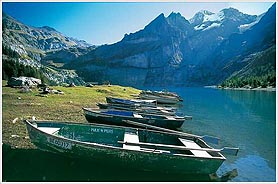
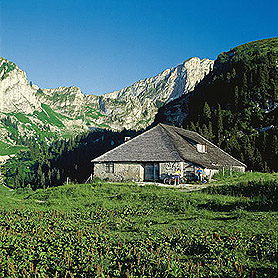
Leaving Kandersteg and its comforts, we started with a chairlift up to the Oeschinnensee, a spectacular Alpine lake with blue waters in an incredibly beautiful setting. From the lake, it’s a climb of more than 3,600 feet to the Hoht̹rli Pass, where we spent the night in an Alpine hut on the Bl̹misalp, next to a glacier. The hut, perched precariously on the top of the pass, is a popular spot for summer hikers and mountain climbers. In the winter, it is covered completely by snow. The accommodations at the hut consisted of a large room filled with mattresses, where we all piled in and slept like logs.
COLORFUL, AWESOME SUNSET One of the thrills that day was watching the colorful sunset, as the sun sank into the clouds, framed by the mountain peaks. From the pass, we could pick out the Eiger, now bigger and closer than its first sighting yesterday, as well as the Schilthorn with its restaurant perched on top, the scene of the James Bond movie, “In Her Majesty’s Secret Service.”
We began the morning’s descent by clinging to a steel cable pegged into the mountain wall as we slipped and slid on loose scree. The descent of 4,000 feet before reaching Alpine pastures seemed interminable. We just kept walking-and walking-and walking and going down and down and down.
We finally reached the valley floor where a glacial river flowed, icy cold and steel gray in color. We peeled off as much clothing as we could and still be decent and cooled off in the stream. Then it was on to a nearby chalet for cold beer and our sack lunches.
In the afternoon, we hiked along a wide path with wildflowers and bright sun. It was a delightful walk, leading us to our accommodations for the night: a cow and goat barn at Unter D̹rrenberg.
A ‘LOFTY’ SLEEP We climbed a ladder from the stables to the loft. (You quickly learn to hold the sides of the ladder, not the rungs, unless you want a handful of cow manure!) In the loft, there were side-by-side mattresses, as in the dormitories. Only here, the air was scented with ammonia from the goats and cows below. It was primitive, but one of the trip’s highlights for me, but not for some of my fellow hikers. It was probably a good thing that the next night we would find ourselves in a comfortable hotel once again.
The next day was the last day of the hike, and we hated to see it end. The morning’s climb was the most difficult of the entire trip — or maybe I was just getting tired. I thought I’d never make it across all that slippery scree and obtain the summit. But once again, upon arriving at the pass, the Sefinenfurke, the views were so spectacular and the feeling of accomplishment so great that I immediately forgot the ordeal of arriving there.
MAKE IT LAST We dawdled over lunch at the pass; everyone wanted to make the day last as long as possible. A snooze in the sun, a scramble to a nearby peak for photos, and soon it was time to descend. We crossed from the shale into Alpine pastures into forest and down into M̹rren, a picturesque village perched on the side of the mountain, facing the Jungfrau, M̦nch and Eiger across the valley.
The snow-covered mountains radiated sunlight as we descended, alpenstocks (walking sticks) in hand. After watching the Eiger grow larger and larger for several days, suddenly there it was, bigger than life and bathed in bright sunlight.
The feelings of the group could be summed up in the words we saw carved in German on an ancient chalet in the village of Kandersteg:
“He who drinks of the high mountain light, shall know no unhappiness on earth.”
For hiking tips and itineraries specific to Switzerland, visit www.myswitzerland.com and click on “hiking.”
The most important item for a hiking trip is a good pair of boots that fit you well and are thoroughly broken in. Other things to include in your pack are: moleskin, Band-Aids, Swiss Army knife, water bottle, sunscreen, Ace bandages, medicated powder, poncho, wool or fleece sweater or jacket, flashlight, binoculars, compass, hat, sunglasses, resealable plastic bags for keeping articles dry. Be sure to dress in layers — the weather in the mountains can change swiftly.
ABOUT THE WRITER Barbara Gibbs Ostmann is an award-winning journalist with 30 years of writing and editing experience in newspapers, magazines, cookbooks and newsletters. She was food writer for the New York Times Regional Newspaper Group from 1993-2005 and food editor of the St. Louis Post-Dispatch from 1975-1990. She joined the faculty of the University of Missouri-Columbia as an assistant professor and the coordinator of the Agricultural Journalism program from 1991-1993.
Barbara has co-edited 12 cookbooks and is co-author of “The Recipe Writer’s Handbook,” a style manual, and was copyedited or contributed to 17 other books. She writes about travel, food and wine for regional and national magazines, and copyedits manuscripts for several publishing houses.
Barbara is treasurer of The Culinary Trust, the philanthropic arm of the International Association of Culinary Professionals (IACP). She is also on the Board of Directors of the Midwest Travel Writers Association and the Missouri Association of Publications. She has traveled extensively in Europe, Asia, Australia, Africa, North America and South America.
Approximately 200,000 spectators are expected to visit Lucerne, Switzerland for the 27th Swiss Yodeling Festival from June 26 to 29. More than 11,000 yodelers, flag throwers and alphorn players will participate in a number of contests along the shore of Lake Lucerne. A festival parade winds through the Haldenstrasse and across Lucerne’s “Seebrücke.”
PROGRAM EVENTS
Thursday, 26 June 2008
Two national finals: 13th Swiss Young Talents’ Yodeling Competition and the 15th Swiss Young Musicians’ Competition
Friday, 27 June 2008
Competitive events for yodeling, alphorn blowing and flag throwing
Festival happenings in the yodelers’ pubs and at yodelers’ stands
Saturday, 28 June 2008
Competitive events for yodeling, alphorn blowing and flag throwing
Festival happenings in the yodelers’ pubs and at yodellers’ stands
Sunday, 29 June 2008
Ceremonial presentation of the flag
Reception of festival veterans, ceremonial church service and official festival ceremony
Festival parade
Festival happenings in the yodelers’ pubs and at yodelers’ stands




 European Traveler