By Phyllis Schweikle Photos courtesy the Italian Government Tourist Board NA
It is said that 65% of the world’s art treasures are in Italy, and 50% of those are in Florence. Five of us wanted to stay there for a full month, so hotels were too costly, and any pensione were too “rustic” (I’m finished with group sharing of bathrooms).
I made a list of our basic needs: old Florence neighborhood, quiet, four bedrooms, three baths, a well-stocked kitchen for my chef husband, air conditioning and a washing machine.
Then I entered “apartment rentals Florence Italy” in my computer search engine. Pages appeared with links to user-friendly websites for every size apartment, location and price, often with neighborhood maps. Historic Florence is not large, but if your interests lie near San Marco, then San Spirito may not be the neighborhood for you, unless you really like to walk a lot.
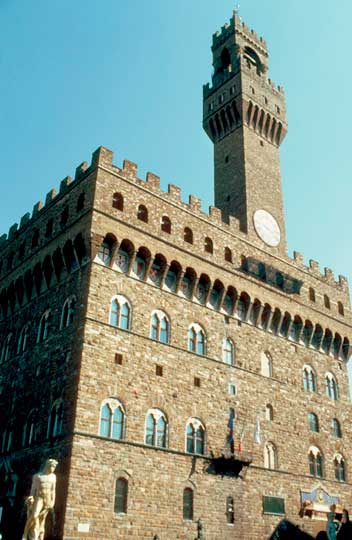
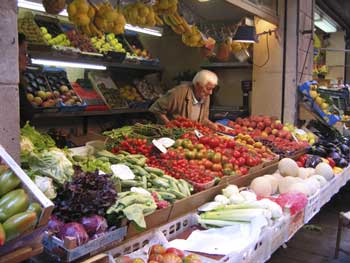
That year we found a wonderful apartment on via del Corno, behind the Palazzo Vecchio. While affordability motivated us to rent, we came away with so much more from our experience that today renting is our favorite option wherever we plan a stay of six days or more. Rent and you become what the Italians call famigliari — “familiars,” recognized and greeted by the fruit and vegetable guy, the baker, the butcher. You become absorbed into the fabric of your temporary neighborhood. Today at Ristorante Buzzino, where we often regrouped that first year, we embrace and are embraced, welcomed home on annual visits.
In major tourist areas, most Italians speak English, so if language is not your gift, you will be fine (always carry a light weight dictionary). But think about it… you are moving into a neighborhood, so why not learn some basic pronunciation rules and a few simple phrases? You will be amazed at the response to your effort. Check out the website “CyberItalian” and see if this interactive language learning tool appeals to you (for a $25/year membership you have so much to gain and comparatively nothing to lose).
We have learned a few things from renting six different apartments (five in Florence, ranging in size from studio to four bedrooms, and a two bedroom in Rome). Here are a few thoughts to consider:
1) Rates depend on a number of factors, but Italians are pragmatic, so don’t be afraid to negotiate respectfully if you plan to rent for three weeks or more. Owners are willing to reduce rates rather than leave a unit vacant.
2) Study the photos of every room. In my experience searching for six different apartments, online photos are reliable. So that ‘fish-eye‘ picture you see really does reveal the struggle to showcase a small space (which may be fine for you). If you find an interesting description with a photo of the terrace, request photos of all the rooms. There may be nothing wrong, but I’m just saying…
3) Italians are used to living in much less space per person than Americans. An apartment listing for 3 to 4 persons may have one bedroom for two, and a full size sofa bed in the living room, and/or a daybed in your bedroom to accommodate someone. If that’s okay with you, then go for it.
4) “T” stands for “Terra” which means Ground Floor. In Italy, the 1st Floor (Primo Piano) is one flight up, so unless you are young or athletic, you may want to eliminate any apartment without an elevator which is above the 2nd floor . Remember you will be carrying suitcases filled with necessities on arrival, and treasures when you leave, daily groceries, that famous bottled effervescent water, and your tired self up those steps at least once a day.
Our second apartment was a penthouse with a terrace and wonderful views. It belonged to an artist whose lovely artworks and subtle personal touches made us feel instantly at home. I was entranced by the interior photos, and though the description said ‘4th floor walk-up’, we were in very good shape. After all, I had walked all 60 miles of the Breast Cancer 3-Day that year. A few steps weren’t going to be a deal-breaker! Unfortunately, Tony and I both caught the flu at a language school we were attending. Every day for three weeks, two in health and one in illness, at least once a day, I’d find myself sitting on that 65th stair, surrounded by books, or groceries, and that water, staring exhaustedly up at the final 70th step with its terrace gate like a pilgrim outside the pearly gates.
5) Arrival can be a bit overwhelming, but ask how to use the washing machine and the oven (your dictionary should have a conversion table for weights and temperatures). Most important: be sure to ask where your electric box is. In one apartment we lost power repeatedly until the owner explained we needed to turn off the water heater in the bathroom before heating the oven. Italian electric flow is not like ours. Your daughter cannot dry her hair while you wash clothes, and your husband watches the news in air conditioning. In Italy, the circuits will blow. Ask where the switchbox is located. Then, when it happens, you can turn the power back on and choose where to reduce your draw. Trust me.
7) I assume there are clothes driers at the lavanderia (laundromat), but I have never seen one in an apartment or home. An Italian drier is the sun and breeze, and rain is an extra rinse cycle. In city apartments without terraces, you will find a drying rack in a closet along with clothespins, but be sure to check outside your windows…another clothes line could be there. You will also find an ironing board and iron. Italians iron everything. Washers do not hold a large number of articles, and take a long time to cycle. I would not recommend washing jeans within 48 hours of departure unless you plan to wear them damp.
Anais Nin wrote “Life shrinks or expands in proportion to one’s courage.” May your adventures be joyous, your courage rewarded, your view expanded.
I expect other countries feel it’s just not fair…Switzerland has all the luck: snow-covered mountains, hundreds of deep blue lakes, small, quaint mountain towns with intriguing steepled churches, chalet-type houses decorated with cow bells and colorful hanging baskets of flowers, tempting chocolates and cheeses, and of course a variety of delicious wines and beers.
Another important Swiss fact: over the years, the Swiss have poured billions of dollars into their train and transportation systems. Today, there are 3,100 miles of track including 620 miles of mountain railway lines operated by 43 companies. A total of 98% of the Swiss people have access to public transportation within less than about half a mile of their home.
“The Swiss transportation system is concise and precise — there is no guessing when or where the next train or bus will show up. It’s well thought out, and usually with great accommodation to everyone. And it works — efficiently.” Don Heimburger
So should you take a vacation–or even a business trip–to Switzerland, you will likely find a virtually seamless ribbon of buses, trains, trams, gondolas or ships to get you where you’re going. Even at the very tops of mountains, the Swiss have built funiculars or gondolas to scale the heights, and have then built restaurants and/or hotels at the top so you can enjoy the views longer while you’re sipping a glass of wine.
RAILFANS APPRECIATE SWISS RAILS
The average American railfan would appreciate to be treated this royally, riding the Swiss Railway system trains to nearly any worthwhile destination, then jump on a boat or whatever to take you the rest of the distance. In fact, often there is an alternative transportation system, as we’ll see.
Before you go, however, you’ll want to obtain the correct tickets in the United States for traveling by train abroad, and that means either the Eurail Pass or the Swiss Pass.
The Eurail pass is available through www.raileurope.com or call 888-382-7245 in the US or 800-361-7245 in Canada. If you’re traveling to Switzerland and planning to spend several days or longer there, and plan to visit several bigger cities, you’ll probably want to obtain a Swiss Pass from Eurail. It gives you free admission to more than 400 museums and exhibits in Switzerland and gives double the discount (50%) on rail and cable car rides to places like the Schilthorn, Jungfrau, Pilatus and Rigi. With the Swiss Pass, you receive access to rail, city transport systems, buses, lake steamers and mountaintop excursion rides.
While many people in Switzerland and northern Italy speak English, it would be a good idea to know a few words and phrases in German, one of the four official languages of Switzerland. Two publishers have easy-to-use books and audio CD’s that I recommend. Bilingual Books, 1719 West Nickerson St., Seattle, WA 98119 publishes a 132-page 8 1/2 x 11″ softbound book titled German in 10 Minutes a Day that helps you learn the language faster, and there’s a 60-minute CD German language lab and 64-page phrase book from Penton Overseas, 1958 Kellogg Ave., Carlsbad, CA 92008 that is great. In tandem, these tools were beneficial.
On a spring tour of Switzerland and northern Italy, there are numerous places to see and things to do by rail and by not-too-stenuous walking.
BERN, SWISS CAPITAL
Bern, the capital of Switzerland, with a population of only 130,000, was founded in 1911 for strategic reasons, the old historic part surrounded by the River Aare. The city, noted for its red-tiled roofs (appreciated more when overlooking the city from the Rosengarten {Rose Gardens} high on an adjunct hill), and perhaps even more while dining at the lovely Restaurant Rosengarten, became a university town in 1834 and then in 1848, the Federal capital. Bern is Europe’s most flower-decorated city and features one of the the longest covered shopping promenades (nearly four miles) in Europe. Another interesting thing to note about Bern is one-third of its area consists of public parks and woods.
In the Old Town of Bern, Switzerland, this famous old clock tower chimes on a regular basis.
Bern museums: a good part of your free time in the city might be devoted to visiting the many museums, such as the Zentrum Paul Klee which features Paul Klee’s designs (4,000 works alone), but other exhibitions, music, theatre and dance as well. The Museum of Fine Arts, the Historical Museum of Bern with its unique Albert Einstein exhibit (until October 15–Einstein was an employee of the Swiss Patent Office in Bern in 1905), the Natural History Museum and the Museum of Communications which held an exhibit of the 100 Years of Yellow Postbuses in Switzerland in 2006, are also very worthwhile.
Other Bern attractions include the colorful trams that run throughout the city, the Munster Cathedral, the beautiful Zygloggeturm Clock Tower, the Bear Pits and free guided tours of Parliament. Multilingual city guides are recommended at the local tourism office at Laupenstrasse 20 (berninfo.com). The bahnhof is conveniently located at the Bahnhof Platz, and within easy walking distance of the Old Town. More Bern info is at www.berninfo.com.
The main market square in spring is filled with fruit and vegetable stands and concessionaires offering numerous handmade and commercial products, as well as food, pastries and drinks. If your hotel is near the center of the Bundes Platz where this market takes place, be aware that the surrounding noise can be disturbing as it bounces off the buildings.
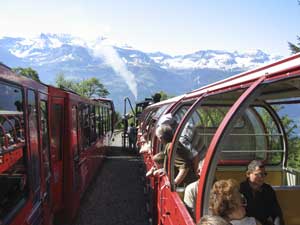
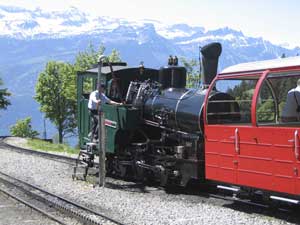
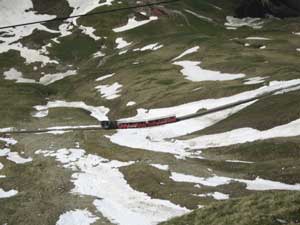
(left to right) Passenger trains on the Brienz steam route.; Brienz steam loads water.
Eating tips: try Schwellenmatteli Restaurant at Dalmaziquai 11 near the Aare River falls, adjunct to the Kirchenfeld Bridge. The restaurant features great rigitoni and delicious red wine. A quick Apfelstrudel presented with style at Schmiedstube (address: am Schmiedenplatz 5) near the Kornhaus will perk you up on a hot afternoon.
From Bern, hop a Swiss train on the Loetschberg Line to Bologna to discover what northern Italy has to offer. Trains run like clockwork in Switzerland (excuse the pun), and you hardly need to check a train schedule ahead of time–something is always coming to take you where you want to go, usually no more than an hour between trains.
BRIENZ BAHN
For a completely different aspect of travel, the Brienz Rothorn Bahn in the small town of Brienz, Switzerland on Lake Lucerne is a choice spot. In 1892 the Brienz Bahn (railway) was opened to ascend the top of 7,710-foot-high Brienzer Rothorn.
From mid-May to the end of October, this oil-fired steam train travels 4.72 miles to the top where visitors can enjoy refreshments and meals or an overnight stay at Hotel Rothorn Kulm.
A 360 degree view is possible from the top, as you watch steamers ascend. The line owns and operates three generations of steam locomotives as well as several diesels. The first steamers are from 1891-1892, while the second set were constructed in 1933-1936, and the last set in 1991-1996.
Large glass windows offer wide views of the ascent and descent, and the 70-member staff is friendly; you can even purchase stock in the company!
It looks like a toy, but it’s just far away.
LOETSCHBERG LINE
The Loetschberg line train usually pulls out exactly on time from Bern, and firtst class car windows are big — 4 x 3 1/2 feet. A stop comes at Spiez on the Thunersee, and the line breaks there to head towards Brig and the Simplon Pass, then into Italy at Domodossola and onto Milano, where a change of trains is required.
As you travel by train, you’ll notice the concrete ties, the banked curves, the mile-after-mile of concrete infrastructure, and the steel girder overhead wire system. America could never afford this outpouring of funds.
The train travels fast through this land, and the Swiss Alps loom large off the left side of the train. If you check out the passenger car toilets, you’ll see hand dryers instead of towels. You’ll also notice how the lst class seats are wide, high and have two positions. At Brig you’ll notice the Glacier Express yard facilities that service trains going to Zermatt. At Brig an announcement will tell you a customs search is coming, so have your passports ready.
At Domodossola, Swiss and Italian flags alternately wave in the breeze on the station platform. At Stresa, with enchanting Lake Maggiore in the background, you spot island villas that appear Hollywood-like in size and stateliness, and you wonder who lives in these red-tiled-roof mansions.
The Milano station is a favorite. It’s busy, bustling and big. The large signboard in the terminal area next to the tracks is where passengers await arrival track information, and it’s a fun place to sit on your luggage and watch the world go by. Little shops lining the station walls sell Italian lattes or cappuccinos if you need an adrenalin boost.
The green and white Italian Eurostar is a high quality, high speed train that connects main cities in Italy. A seat reservation is required, and the trains are roomy and comfortable with large windows so you can view the many vineyards and monasteries. In Italy, it’s helpful to know that binario means track and biglietto means ticket.
WELL PRESERVED BOLOGNA
Bologna, judged the most beautiful Italian city as a whole, was a seat of great learning. After Venice, it has the best preserved historic center in Europe. The central part of the city consists of a complex of streets, towers, buildings and monasteries all linked by arcades (nearly 20 miles of them).
Walking through the city center, you will find a number of the city’s ring towers still standing (but perhaps leaning), ancient aqueducts still intact, centuries-old red brick floors, historic bridges and statues. The clay, selenite and sandstone are local materials from which many structures were built.
You’ll also note that streets fan out from the center of the city, the easiest route to the surrounding farmlands where citizens returned after selling their produce in the city market.
Bologna’s main piazza attraction — since 1200 — is the Piazza Maggiore, which features a Neptune Fountain built during the years of the Counter-Reformation, the work of a Palermitan architect and a Flemish sculptor. The inside of the St. Petronic Basilica in Maggiore Square, commissioned in 1390, is the church of the local patron saint, and exceptionally large. It was hoped it would be built bigger than St. Peter’s in Rome, but that idea was blocked.
The local university (Archiginnasio) has taken up space in many of the central buildings around the piazza. During the 9th through 12th centuries, Bologna and Paris were the first cities to offer examples of intellectual pursuits; in fact, by the mid-12th century, Bologna was seen as a law center throughout Europe.
If you enjoy modern hotels, the UNA Hotel at Via Pietramellara 41 in Bologna is a thoroughly new hotel representing the latest in style and design. It is comfortable and features many amenities, and it’s located directly across from the train station.
Retracing your steps northbound on the Italian Eurostar to Milano, if you want to leave in the morning, you can take the 8:52 a.m. train. The Eurostar features low lighting and individual seat lamps like on airplanes. The seats, wider than on a plane, are covered in light and dark gray fabric, and offer more legroom than on a plane. You’ll change trains again in Milano and head for Lugano.
Our beautiful wooden boat on Lake Lugano
LUGANO BY THE LAKE Back in Switzerland, Lugano is a picturesque village surrounded by tree-covered mountains and Lake Lugano (The Lake That Steals Your Heart). Lugano is situated in Ticino, the southernmost corner of Switzerland where the climate is exceptionally mild, and where palm trees and cactus thrive.
The Lugano waterfront is one long tree-lined promenade, with plenty of hotels set back from the shore, and mountains that rise precipitously from the lake. It’s a relaxing spot to recover from train-riding in Switzerland, and a couple of days here will set your mind straight for weeks to come. Its beautiful serenity, combined with quiet tradition, contrasts with the hustle-bustle of everyday life in America.
For a scenic boat tour, contact Societa’ Navigazione Del Lago Di Lugano that can take you to a number of locations on the lake, from cogwheel railways to funiculars to the Swiss Customs Museum (has been open since 1949 and offers attractive exhibits in a former customs officers barracks).
Lugano is blessed with many museums, both large and small, to keep you occupied including the Cantonal Art Museum, Municipal Fine Art Museum, the Modern Art Museum and the Galleria Gottardo (owned by the Bank of Gottardo). The Gottardo exhibit highlights the archaeological findings from Poggio Civitate (near Siena, Italy) which was controlled by Etruscan aristocrats, who wore zany pointed, broad-brimmed hats. Other museums include the Villa Saroli, the Cantonal Natural History Museum and the Wilhelm Schmid Museum. Many more museums are also in surrounding towns.
The Swiss Miniatur in Lugano is a permanent “little village” that opened in 1959 that “synthesizes, symbolizes and summarizes Switzerland “– in 1:25 scale. The exhibit consists of 120 models of houses, castles and cathedrals, mountains, lakes and towns, and 11,480 feet of scale track that can accommodate 18 trains, funiculars, rack railways and cable cars! A modeler would have to put this display on his agenda; kids and spouses would enjoy it as well.
To cap off a day of exploration in Lugano, take the funicular up to the top of 3,000-foot-high Monte San Salvatore (the last downhill train leaves at 11 p.m. in the summer) for a mediterranean supper at Le Ristorante Vetta. Overlooking Lugano, this outpost high above the city can be a memorable experience. While you’re there, look for the Daphne Odorosa, a rare plant with delicate pink flowers, found only on the mountain’s slopes.
Good local guides can be tricky to find, but Romeo Bozzini, Ra Cara 16, CH-6926 Montagnola, Switzerland (Fax 41 91 994 36 40) should not only give you excellent history details of the Lugano area, he is saavy about local foods, customs and people. He has a good sense of humor, as well.
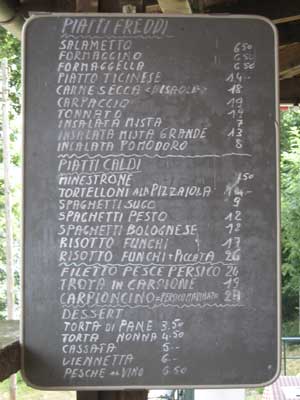
One of the experiences you’ll want to try in Lugano is eating at a grotto. Grotto means cave, but today dining at a grotto means dining outside with twinkly white lights strung in the trees. Grotto Figini, located up the side of a steep slope in Gentilino, will fill your plate with delicious local Ticino foods such as hot minestrone, risotto with fresh mushrooms and onions, sliced local meats, small round cheeses and good, dry red wines (the area is home to elegant Merlots) poured from an earthenware pitcher known as a boccalino.
More Lugano information can be obtained from www.ticino.ch.
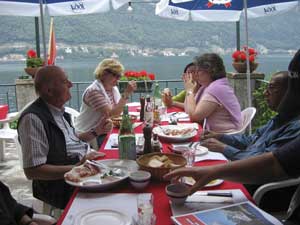
(left to right) Eating next to the water on Lake Lugano; A quiet restaurant reached by boat on Lake Lugano serves these specials.
CENTOVALLI RAILWAY From Lugano station, you can catch an SBB train to a fascinating, unspoiled region that begins at Locarno, Switzerland and ends in Domodossola, Italy. The Centovalli Railway is a 32-mile electric line that passes through numerous valleys as it snakes its way over high trestles and through tunnels (there are 83 bridges and viaducts on the line), over streams, past chesnut forests, vineyards and villages clinging to the sides of mountains. After Camedo the train crosses into Italy, and border guards may board the train at that point.
The countryside offers a lot to be explored, and you’d want to plan in advance if you want to stay overnight at any of the charming towns located on line. There are monuments, churches, paintings, embroidery, old streets, stucco work, old frescos, engraved glass, grottos, 500-year-old stoned roof houses and more to see tucked back into the hills and villages here. Go to www.lagomaggioreexpress.com and www.centovalli.ch for more information on these trains and the area.
This remote, beautiful region is accessible via numerous modern two-car wide-window Centovalli trains that leave from a tunnel station at Locarno. Soon the train encounters steep grades, as much as 6%, as it heads for Santa Maria Maggiore, the highest point on the line at 2,624 feet and approximately two-thirds of the way to Domodossola.
Three trainsets were built in 1959 and one in 1993, with scattered vestiges of older equipment on various sidings and yards. In all, the railway is very modern, well-kept, and it employs 95 people. It’s a railfan’s delight because of its scenery and because it’s a bit hard to “discover” unless you know it runs there.
There are special Lago Maggiore Express packages with both rail and boat transportation available, with featured locations such as the Borromeo Islands, Cannero castles and the resorts of Stresa and Ascona.
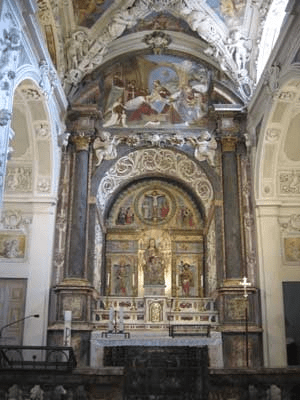
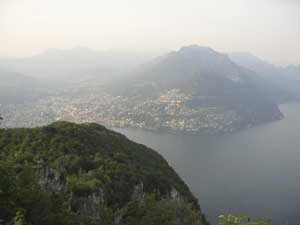
A tiny but richly-adorned church near LuganoView from the top of Mt. Salvatore at Lugano
WILLIAM TELL EXPRESS Leaving Lugano, you can board the popular northbound William Tell Express that combines rail and ship travel over the famous Gotthard Pass, the watershed between the Mediterranean and the North Sea. Be sure to ask for the small all-color 6 x 8″ William Tell Express guidebook when you make your reservations with Rail Europe back home. It gives a map and pictures of what you’ll be seeing on the route.
You’ll board a first-class Panoramic Car, which means you’ll be riding high with huge six-feet-wide windows (with sunshades) for excellent views. The seats are comfy and large, with two-abreast seating on one side of the car and one seat on the other side with wide aisles. Be forwarned, however, to board the train quickly when it arrives at the station. To maintain its schedule, it waits for no one!
Besides the mountains and waterfalls en route, you’ll see granite quarries, vineyards, small villages, churches and meadowlands. The Gotthard route sees 270 trains on peak days, with 50 international expresses and 100 merchandise freights on average. The Gotthard Tunnel itself is nine miles long, and it opened in 1881.
At Gurtnellen the first of three loop tunnels appears. At Wassen, look out the window at the quaint little church below you — you will pass it three times! Then at Wattinger spiral tunnel you are at the same height as the church, and at the Leggistein tunnel, you are lower than the church. Don’t miss this three spiral tunnel show — it’s worth noting.
Morning view from our room in the magnificent Palace Hotel, Lucerne
At Fluelen, the train station is a few steps from the paddle steamer boat ramp, and your luggage can be off-loaded to the boat using the Swiss railway’s Fast Baggage service which takes care of your luggage so you don’t have to load and unload it yourself.Check in your luggage at the station from which you depart.
On a clear day, the view from Fluelen towards Lake Lucerne as you await the Vier Waldstattersee steam paddle boat is as good as it gets: snow-covered Alps loom in the distance, contrasted by lush green hillsides filled with sheep, cows and farms.
A lake cruise between Fluelen and Lucerne is something one should experience at least once in a lifetime: it’s relaxing and dignified. Definitely a stress reliever.
The Lake Lucerne Navigation Company is Switzerland’s largest steam and motor ship operator with five paddle steamers and 15 motorized ships, transporting 2.3 million passengers each year. Since 1835 the ships have been plying the beautiful blue waters of Lake Lucerne, and recently the firm took over its food services on board the boats. The firm even owns its own shipyards.
In 2006 the steamboat Schiller, considered to be the most well designed steamer in the country, celebrated its 100th birthday. A portion of the ship is considered a national monument!
Watch for the Burgenstock Bahnen as you pass or stop at Burgenstock. It’s a funicular that takes visitors to the Burgenstock Resort high on the top of Hammetschwand.
LUCERNE ON THE RIVER REUSS Lucerne, located on the shores of Lake Lucerne and only 36 miles from Zurich, is a captivating medieval city steeped in history and surrounded by the Swiss Alps. As they say, you can arrive as a stranger and leave as a friend. Lucerne has a population of only 60,000 people, and the boat dock and Bahnhof are located across from one another to make transfers very easy.
The Old Town, straddling narrow waters of the River Reuss, is a particularly beckoning section, with quaint shops and restaurants that draw you up the cobblestone streets. Be sure to visit the Kapellbrucke (Chapel Bridge), the oldest wooden bridge in Europe built in the early 14th century. But there are many other treasures to investigate as well.
The late-Renaissance style Altes Rathaus was built between 1599 and 1606, and the Hofkirche, with an 80-rank organ and one of Switzerland’s finest, was built in 750.
The Swiss Transport Museum, at Lidostrasse 5, is the most comprehensive of its kind in Europe, and a railfan could easily spend the entire day there. A very extensive HO gauge Marklin train layout shows in miniature the Gotthard Tunnel track arrangements. There is a large selection of prototype locomotives and cars contained in 26,000 square feet of space, including 3,200 feet of track on which the cars and locos sit.
Swiss Transport Museum’s “Crocodile”
Special exhibits include the Limmat, a replica of the first Swiss steam locomotive; the Rigi No.7, the first European rack railway engine: the C 5/6 (the largest Swiss locomotive); and the legendary Be 6/8 Crocodile. There are numerous electric locos, SBB’s Red and Blue Arrows, and the Landi-Loco which was the most powerful Swiss locomotive. There’s even a cutaway view of an 0-6-0 to show how a steam locomotive operates.
An overhead walkway traverses the entire railway exhibit, making it easier to find the main attractions. There are also glassed-in exhibits of scale models to view. and special smaller exhibits such as one showing how the Langweis railway viaduct was constructed.
Other historical attractions of Lucerne include the Spreuerbrucke, an all-wood covered bridge dating from 1408, the Weinmarket, now a popular fountain square where passion plays were once conducted in the 15th to 17th centuries, and the Lion Monument (Lowendenkmal) called by Mark Twain “the most mournful and moving piece of stone in the world.”
You’ll want time to visit the local chocolate shops, and perhaps purchase a watch or Swiss Army knife in one of the stores. You’ll not have a problem locating this merchandise in town! Also take time to sit at an outside café for coffee and pastry (kuchen). It’s something Americans just don’t do enough.
For model railroad fans, stop in at Modellbahn Boutique at Frankenstrasse 5, next to the railway station.
A visit to the city landmark Palace Hotel (Haldenstrasse10), which celebrated its 100th birthday in 2006, is like visiting, well, a palace. The original owner of the hotel also built the Burgenstock funicular, as well as the Stanserhorn and San Salvatore funiculars, and the tramway system in Genoa, Italy. Franz-Josef Bucher wanted to build the most beautiful hotel in Switzerland, and spent 3.3 million francs to accomplish his dream in 1906. The current hotel has retained its old world charm but is respectful of what the 21st century traveler wants: attention to detail, more room — the hotel has reduced its rooms from 168 to 136 — and a good bit of pampering.
Two close-by Lucerne attractions that are easy to get to and worth your time are Mt. Pilatus and Mt. Rigi.
MT. PILATUS Mt. Pilatus (Mountain of Dragons), near Lucerne, is home to the world’s steepest cogwheel railway. At a maximum gradient of 48% over its nearly three miles of 31.5″ trackage, the line ends at 7,000-foot-high Pilatus Kulm, where two hotels, seven restaurants and hiking trails await the traveler. Opened in 1889 using steam, the line was electrified in 1937. Two of the former Pilatus steam locomotives are now in museums: #9 is at the Museum of Transport in Lucerne and #10 is at the Deutsches Museum in Munich.
Today, bright red 40-person cars travel the route from May to November at 6-8 miles an hour ascending in 30 minutes to the top through several climate zones. On the way up or down, you’re likely to witness trains passing at one of the unique “passing turnouts” on the line.
You can spend an entire day on Pilatus and its surroundings. Once on top, you can hike down, or take an aerial cable and panorama gondola down the back side. If you stop off part way down (at 4,640 feet), your kids can enjoy Switzerland’s largest rope park where they can swing and sway on all manner of ropes and bridges. The Pilatus Railway is adding more fun-related activities to the mountain rail experience, and last year 268,000 visitors rode to the top.
For a refreshing toboggan run, stop at Frakigaudi (www.rodelbahn.ch), the longest toboggan run in Switzerland at 4,428 feet. It’s located at Frakmuntegg, a cable car station stop between the top of Pilatus and the town of Kriens.
MT. RIGI Mt. Rigi (Queen of the Mountains), also located on Lake Lucerne but in the opposite direction from Mt. Pilatus, is 6,000 feet high, and the Vitznau-Rigi Railway ascends to the top. As the oldest cogwheel railway in Europe (1871), the line has enjoyed 135 years of service. In 2005, it carried 562,320 passengers to the top. The line was electrified in 1937, but today steam still operates on the line on special occasions.
The Rigi operates two steam engines built in 1923 and 1925, two 1873 carriages and a 1899 carriage, and the oldest self-propelled cogwheel train in the world from 1911. Much of this older equipment is reserved for special occasions.
Trains leave frequently for the mountaintop from the Vitznau station. As the line angles up the side of the Rigi slope, Lake Lucerne quickly falls away in the distance as the train continuously gains height. At the top, you can hike on the marked paths, take advantage of the restaurants and hotels, or just watch the clouds drift by.
Luzia Weber is a hostess on the luxurious Belle Epoque, an 1873 salon car.
From the top on a clear day, you can see 13 lakes and Germany and France. A total of 400 Swiss inhabit the mountain, but I bet there are more cows on the Rigi hillsides than that. To vary your route back to Lucerne, you can catch a cable car at Rigi Kaltbad that descends to Weggis where you can board a boat for Lucerne.
HOMEWARD BOUND Leaving Lucerne, you can take SBB trains that go directly to the Zurich airport located 7 miles north of downtown Zurich. That way you can skip having to change trains at the main train station in Zurich.
This Swiss-Italian journey would appeal to both railfans and their spouses. There are enough train adventures to more than satisfy the fan, and enough of life’s other historical attractions, dining and shopping experiences to please everyone. If you go, enjoy the trip, and be prepared to become a bit emotional when it’s time to leave. If you do, it means you had a great time!
By Carol Price Spurling Photos by the author and courtesy Belfast Welcome Center
The first time I visited the Emerald Isle more than 20 years ago I steered clear of troubled Belfast. But I’m older and wiser now, and Belfast, too, has grown up, transformed from a self-absorbed, divided town into an extroverted and welcoming world-class city.
Belfast offers Victorian charm in every quarter and has retained the best of what Ireland is famous for: warm hospitality, atmospheric historic and cultural sites, and easy access to the lush unspoiled countryside. In Belfast, they’re glad to see you, not just your wallet, and what a difference that makes.
BELFAST HIGHLIGHTS West Belfast’s Shankill and Falls neighborhoods saw most of the “Troubles” that erupted in the early 1970s. The Peace Walls that separate them are still standing, but visitors are welcomed on both sides and the practice of customers being searched before entering a store or office was retired years ago. For those interested in an insider’s view of Belfast’s political divide, Coiste Political Tours (www.coiste.ie/p_tours.htm) offers guided tours by Republican ex-political prisoners. Or, take a taxi tour to see wall murals and other relics from the bad old days (West Belfast Taxi Association, www.wbta.net).
The center of Belfast, Donegall Square, features Belfast City Hall (www.belfastcity.gov.uk), an embellished stone edifice built in 1888 as a monument to Belfast’s bright future.
All metro buses lead to the bustling square, also home to literary gem Linen Hall Library (www.linenhall.com). In this old linen warehouse, transformed into a library in 1788, visitors can access the cozy library’s unique archives such as the Northern Ireland Political Collection and the C.S. Lewis Collection. Enjoy the library’s tranquil wood-paneled ambiance and a view of City Hall by taking a tea break in the upstairs café.
A horse-drawn carriage strolls past the Ulster Transport Museum
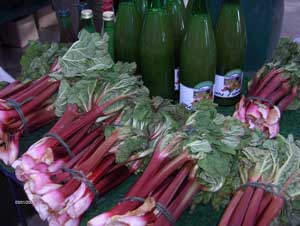
On Fridays and Saturdays the oldest Victorian-era covered market in Ireland, St. George’s, fills up with local shoppers intent on finding a bargain or tracking down the best fresh food in the region (www.belfastcity.gov.uk/markets). The Saturday market is devoted to food. You won’t go away hungry, with 250 stands offering everything from oysters to Irish cheeses to seaweed tapenade to tapas to sausages in curry sauce. Look for locally made “Belfast in a box” chocolates that celebrate Belfast landmarks, accompanied by an illustrated booklet (www.citycentres.com).
Everyone knows where the Titanic met her end but did you know she was born in Belfast? The city’s proud shipbuilding heritage is still obvious with the huge yellow cranes in the Harland and Wolff shipyard –- nicknamed Samson and Goliath — towering over Queen’s Island and the Titanic Quarter on the city’s eastern edge.
(left) Sampling seaweed at St. George’s Market
Belfast celebrates its past with the Titanic Made in Belfast Festival every March (www.belfastcity.gov.uk/titanicfestival), when free bus tours of Queen’s Island are offered by the city on Saturdays and Sundays.
My personal favorite from the tour: the inside of the design room at Harland and Wolff’s offices, where draftsmen labored under a cathedral-like arched ceiling to draw the ship’s plans.
Shores of the River Lagan
DO YOU NEED A CAR? Although Ireland and Northern Ireland aren’t famous for their extensive rail networks, between trains, buses, and taxis you can get anywhere you need to go in the greater Belfast area and environs without having to rent a car –- or drive on the left. Coach tours and trains also run directly north to Portrush, with convenient connections to Giant’s Causeway, Dunluce Castle, and Bushmills Distillery. Along the northern and southern shores of Belfast Lough, rail service is frequent and affordable, so getting to top attractions just outside Belfast, like Carrickfergus Castle (www.ehsni.gov.uk/carrick.shtml) or the must-see Ulster Folk and Transport Museum (www.uftm.org.uk/) is easy peasy. Day return tickets are offered at 1/3 off the standard rate if you leave after the morning rush hour, and families can get special ticket deals too (www.translink.co.uk).
But to see some of Northern Ireland’s diverse natural beauty and historic architecture (Environment and Heritage Service, www.ehsni.gov.uk/other-index/places.htm), a car will be very helpful. Most recommended is to make a day of driving north along County Antrim’s Causeway Coastal Route, where the craggy cliffs and wild sea spray on one side is balanced by charming villages and green pastures dotted with tranquil sheep on the other. Giant’s Causeway — a stunning outcropping of columnar basalt — can be busy during the tourist season but has been kept remarkably uncommercialized. Visit in the early morning or late afternoon for the best light at this geological wonderland (www.causewaycoastandglens.com).
Another lovely drive is west through the Fermanagh Lakelands, home of Belleek pottery, and National Trust gem Castle Coole (www.fermanaghlakelands.com).
WHERE TO EAT AND DRINK Celebrity chefs Paul and Jeanne Rankin have put Belfast on the culinary map with Cayenne Restaurant (www.rankingroup.co.uk) and Roscoff Brasserie. Up and down the Golden Mile on Dublin Road, foodies will be spoiled for choices of great pubs, cafés, bistros and restaurants.
Chef Michael Deane runs Northern Ireland’s only Michelin-starred eatery at Deane’s Restaurant (www.michaeldeane.co.uk); his newest venture is the contemporary bar and grill Deanes at Queens, located in the Queen’s University Common Rooms.
Coffee addicts never fear, Belfast baristas know what they’re doing. You can’t go wrong visiting any one of the seven Clement’s coffee shops, where coffee drinking is practically a spiritual pursuit, and the creamy hot chocolates are served in a large bowl.
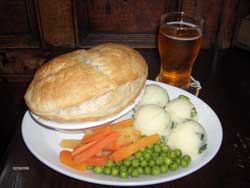
(left to right) Dining at one of Chef Michael Deane’s Belfast restaurants; Steak and Guinness pie is an Irish specialty
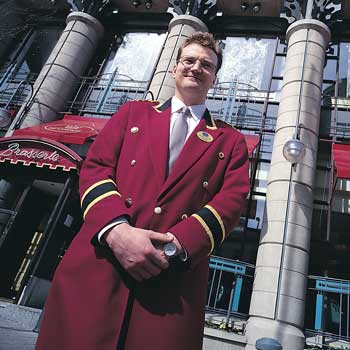
WHERE TO STAY In downtown Belfast itself, a famous landmark is the 4-star Europa Hotel (www.hastingshotels.com) conveniently located just in front of Great Victoria Street rail station and the Europa Buscentre. Head concierge Martin Mulholland will make sure you get everything you need, even if you’re not as famous as some guests who’ve stayed there, like Bill Clinton, Julia Roberts and Elton John.
For a more secluded getaway try the 5-star Culloden Hotel in Holywood, overlooking Belfast Lough (www.hastingshotels.com), or The Old Inn in picture-perfect Crawfordsburn (www.theoldinn.com), both within easy reach of the city.
For less expansive budgets there are dozens of guestshouses, B&Bs, self-catering holiday apartments, hostels, and budget hotels both in Belfast and in neighboring communities. Some are chic, some charming; choose according to your mood.
The Premier Inn hotel (www.premierinn.com) boasts a great central location and is spanking new to boot. The Ash-Rowan Town House (tel. 9066 1758) offers a choice of nine gourmet breakfasts, with a side of historic significance: the Ash-Rowan was once the home of Titanic designer Thomas Andrews.
If you get out into the Fermanagh Lakelands and wish you could stay, check out Belle Isle Castle (www.belleisle-estate.com), outside Enniskillen near Lisbellaw. The old stables and coach house have been transformed into comfortable holiday rentals, with a variety of outdoor activities available, as well as day-long cooking classes taught by Irish chef Liz Moore. You can even rent the castle for a group stay, or a small wedding.
WHEN YOU GO If you’re planning a trip to Belfast and Northern Ireland, be sure to visit the Belfast Welcome Centre website, www.gotobelfast.com. Like the office itself located at 47 Donegall Place in the city center, it is user-friendly, multi-lingual, and comprehensive. Be sure to pick up copies of their excellent themed city guides.
The Northern Ireland Tourist Board website is www.discovernorthernireland.com. Another free publication to pick up: Belfast In Your Pocket (www.inyourpocket.com). Published every couple of months, it always has the most up-to-date happenings, complete with maps of the city.
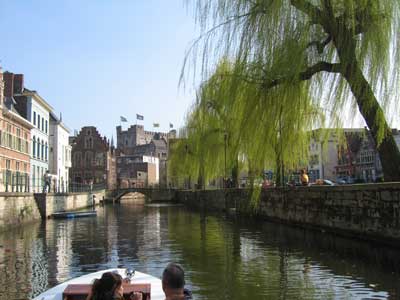
From the year 1000 to about 1500, Ghent, Belgium, was said to be one of the most important cities in Europe. It was larger than London, and only Paris was larger in size.
The city was ruled by rich merchant families, from whence came its great wealth. Today, Ghent is still a town rich in history, color and great food and beer. It also helps visitors that as many as 120 new location signposts have been installed to guide tourists to the most important spots in town.
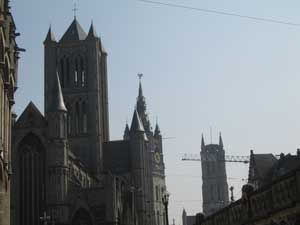
(left) The three towers of Ghent
Walking near the city center, you’re bound to discover features of the city that will amuse or interest you. Stolling along a street not far from Ghent’s impressive Castle of the Counts, I run across a small shop sign that reads, “The Fallen Angels.” The shop is devoted to old things. I like old things.
I hesitate to go in, perhaps not wanting to become one of those things the proprietor’s shingle suggests, but the more I study the front window, the more I determine it’s not only safe to walk in, but intriguing. Intriguing because of all the things that owner Isabelle Steel has gathered over the last 30 years or so for her re-sale shop.
“I started collecting things when I was 16 years old,” she explains. “My father was a painter,” she says, in helping to decipher how she came to appreciate colorful images.
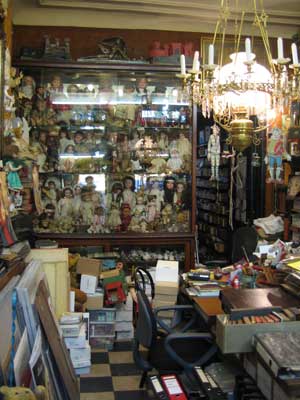
PACKED WITH IMAGERY Her very small, quaint shop is packed with imagery in the old kitchen tins, the religious paintings, the thousands of postcards, the picture albums from as early as 1886, the old manufacturer catalogs, and the posters, dolls, toys and trains that pack the place.
Two floors of “fallen angels” material line the walls, the drawers, the flat surfaces of the shop. There is no more room for additional fallen angels. Every cabinet, every inch on the wall has been crammed with attention-getting merchandise.
A sign on the second floor, which is like a small mezzanine and a few steps up from the main floor, reads, “Not more than 3 persons on second floor.” If it could even hold that. Isabelle’s website reads, “For those who require a little bit of nostalgia, this is the place to visit. Here you will find old postcards, devotion cards, old dolls, bears, old toys, tin cookie jars, etc…”
A talkative, friendly person, Isabelle makes customers feel at home in her store, chatting up her goods and keeping an ear to customer conversation that would lead her to a big “fallen angels” find in the future. “A number of my buying customers have something to sell, as well,” she says.
Isabelle and her daughter Ganesha have shops next to each other. Isabelle’s shop has been open for 23 years, and her daughter’s re-sale shop about five years.
Both shops are located in de Jan Breydelstraat nr. 29-31, next to the Castle of the Counts and the Korenmarkt. The Design Museum of Ghent is also located on the same street. For more information, go to www.the-fallen-angels.com.
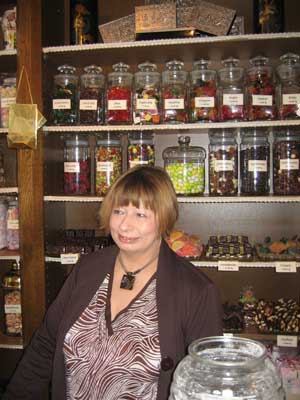
BELGIAN HARD CANDY ANYONE? There’s more to Belgian confectionery than chocolate—delicious though it is. For traditional Flemish candy, visit Temmerman (Kraanlei 79)–about eight generations of family members have been making this hard candy. Most popular item is the “cuberdon,” or raspberry nose (red nose filled with sugar), but the tiny shop is stuffed with more than 600 other varieties of sweet stuff. Other goodies include wippers (butter caramel with vanilla sugar), mokken (biscuit with anise) and katrienspekken (hard candy treated with baked sugar).
Another speciality shop is Tierenteyn-Verlent (Groentenmarkt 3, www.tierenteyn-verlent.be), which sells natural mustard made to a centuries-old recipe, and therein lies a tale: The first great evolution in making mustard took place in the region of Dijon where a farmer tried to crush the mustard seeds with a stone. This didn’t work because there was too much oil in the seeds that prevented the machine from working. He poured a bucket of water on the seeds and found out that mustard seeds had to be wet instead of dry to crush them.
This information was brought to Ghent by a soldier of Napoleon’s army who was discussing the mustard principle with an inhabitant of Ghent, Petrus Tierenteyn, who overheard this and decided to start making mustard himself. But instead of yellow seeds used in France, he used dark ones, like in most Germanic countries.
The shop was opened in 1790, and the first products they sold were herbs and groceries. In 1842 Petrus installed a steam-powered machine to give power to the mustard mill. From that time, the shop has been owned by the same family.
BUTCHER’S HALL In Ghent’s medieval Groot Vleeshuis Butcher’s Hall (Groentenmarkt 7) next to the River Leie, large wooden beams on the interior of the roof show the strength of the building, and from these beams hang Ghent’s special Ganda hams…they look good enough to eat, and you can sample their ham and other specialties in this old hall. There is no fee to walk in, and the building is wheelchair accessible. The Butcher’s Hall is open Tuesday through Sunday from 10 a.m. to 6 p.m. The hall contains a restaurant called the Promotiecentrum voor Oost-Vlaamse Streekproducten where you can sample East Flemish dishes.
If you’re at Butcher’s Hall, you’re also at the heart of this city of 250,000, and during warm weather, many of the thousands of local university students gather around the Graslei and Korenlei, the old trading harbor, which is now filled with tour boats. In many scenes of Europe, this view along the river, showing many of the old trading houses of the free boatmen and the grain harvesters, is a classic. Another good viewing area of this scene is from St. Michael’s Bridge.
MORE TO SEE Other top views of Ghent include the Castle of the Counts, an imposing fortress built in 1180. The Gravensteen (the Dutch name for the Castle of the Counts) was built by the counts of Flanders who had castles built in the principal cities of their rule. Because they had to maintain law and order, they moved continuously from city to city and thus had a castle in cities where they wanted to stay for a while. The castle in Ghent is the only one that survived the centuries more or less intact.
The Gravensteen was constructed by Fillips of Alsasse, who was the count of Flanders between 1157 and 1191. He took part in one of the crusades and died during the siege of Akko in the Holy Land. The opening in the form of a cross, above the main entrance gate, proves that he had taken part in a crusade when the castle was built. Next to the castle lies the Veerleplein (Veerle Square), the place where public executions took place.
Another attraction is St. Bavo’s Cathedral in the historic center, the oldest parish church. Astonishingly, it features 22 altars, and the rococo pulpit is a combination of beautiful marble and oak. At the Old Belfry, a dragon scans the horizon, and is perhaps one of the most impressive belfry towers in Flanders. Together with the St. Nicholas tower and the cathedral tower, it dominates the medieval center of the city. The architects were Jan van Aelst and Filips van Beergine. The tower was completed in 1338, when the bells were rung for King Edward II. At the top corners of the towers stone soldiers keep watch (they are copies and only one original is preserved elsewhere).
THE TOWN HALL The Town Hall at Botermarkt 1 features a rather flamboyant style of Gothic architecture on one side, and a more reserved Renaissance style on the other side. Inside, the same form holds true, with many different styles from different years.
Other attractions in Ghent include the Castle of Gerald the Devil, a 13th century fortress which has been used as a knight’s house, an arsenal, a monastery, a school and a bishop’s seminary. In 1623 it was even a house for the mentally ill.
And if you have a bit more time, visit the House of Alijn, a former house of worship, the Carmelite Friary (which has been restored) and Church, and the Augustine Monastery, founded in 1296.
A new brewery just opened in Ghent as well, with European Traveler a guest on opening night, along with Ghent Mayor Daniel Termont. The Gruut Brewery at Grote Huidevettershoek 10, offers tastes of their delicious beer at the bar within the brewery confines. Mayor Termont is justifiably proud of finding space for the new establishment in his growing city. www.gruut.be
Where to stay while in Ghent? I stayed at the very convenient Marriott Hotel at Korenlei 10, right in the heart of the historic center and next to the river. It’s next to all the attractions. The hotel features 138 rooms and 12 suites. The glass dome with the large bar-lounge Poppi serves as a cozy meeting place. The hotel’s restaurant is the Korenhuis. www.marriottghent.com info@marriottghent.com
Ghent is a city of surprises. Only Ghent residents may know about the “graffiti street,” but that’s another surprise in this city you won’t want to miss.
This Mediterranean country, 58 miles south of Sicily, has everything but a high profile
By Susan MacCallum-Whitcomb
Samuel Taylor Coleridge… Lord Byron… Sir Walter Scott…they all found inspiration in Malta’s legendary landscapes. It was Winston Churchill, however, who summed the place up best when he dubbed it “the tiny rock of history and romance.”
This three-island archipelago, covering only 122 square miles, certainly is tiny. Moreover, it reputedly has the world’s greatest concentration of historic sites. The romance quotient is remarkably high, too; though for centuries, most who came here couldn’t have cared less.
St. John’s Cathedral, Valletta Courtesy of Malta Tourism Authority/www.visitmalta.com
Malta’s strategic location was a far bigger attraction. Positioned midway between North Africa and the European mainland, it lured empire-builders from the ancient Phoenicians and Romans through to the imperial Brits, who prized Malta so much that they stayed for more than 150 years before pulling out in 1964. In their absence, moviemakers -– including those responsible for Gladiator and Troy -– moved in, drawn by a wealth of heritage sites, a camera-ready coastline and a reliably sunny climate.
Of course, the same attributes that make Malta an ideal filming locale make it an ideal vacation destination as well. As an added bonus, Malta, unlike her more popular neighbors, has an English-speaking population (it’s one of the legacies of Britain’s colonial rule), which means you can roam at will without ever having to worry about language barriers, if you speak English.
KNIGHT FEVER
The logical starting point is the capital, Valletta. The fact that this small harbor city rates as a UNESCO World Heritage site is thanks to the crusading Knights of St. John. After being forced out of the Holy Land by “heathen hordes,” members of the elite order were offered these islands as a new home base in return for one Maltese falcon per year. Happily, the token rent left enough in their coffers to fund a building spree that lasted from 1530 to 1798.
The results are visible in the Grand Master’s Palace, the opulent Manoel Theatre, Fort St. Elmo (a star-shaped citadel that was still fending off naval attacks in the 1940s), and the over-the-top auberges the knights called home. Even more evocative is their crowning achievement, St. John’s Co-Cathedral: a baroque extravaganza filled with such an abundance of gilt work, frescos, mosaics and paintings (among them Caravaggio’s massive “Beheading of St. John”) that it’s hard to find a bare surface.
Because of the density of sites within Valletta, it is not uncommon to see tourists charging brusquely down Republic Street –- from the city gate right to the sea –- frenetically ticking off sites in their guide book. But relaxing also has tangible rewards here. For instance, centuries of foreign occupation have made Malta a culinary crossroad. So you can get a combined course in history and anthropology by merely sitting down to dine!
Interested in eating your way through the entire curriculum? Try breakfasting on Arab-inspired pastries at Caffe Cordina, Valletta’s landmark coffeehouse on Piazza Regina, then ciao-ing down at La Cave, a 16th-century wine cellar converted into an Italian-style lunch spot. Later, take a break for traditional English tea at Hotel Phoenicia’s Palm Court Lounge; and for dinner pull up a chair at Barracuda, a suburban seafood restaurant housed in a 17th- century mansion.
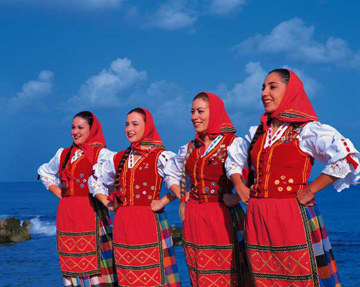
Traditional Maltese costumes Courtesy of Malta Tourism Authority/www.visitmalta.com
THE FEMININE MYSTIQUE
While the Knights of St. John were Malta’s best known architects, they weren’t the first. That distinction goes to a Neolithic cult that spent more than a millennium building a mystery. Archeological evidence proves that they began work on a series of megalithic temples about 3800 B.C. It also shows that their efforts were dedicated to the Great Mother: a goddess rendered in clay as a voluptuous woman known simply as the “Fat Lady.”
The rest remains an enigma because, inexplicably, the Fat Lady began to sing… By 2000 B.C. those who worshiped her had disappeared. As a result, we’ll likely never understand how a people who hadn’t discovered either metal tools or the wheel managed to construct sophisticated structures, complete with archways and corbelled ceilings, on such a colossal scale. Nonetheless, we may appreciate the fruits of their labors, each of which has its own claim to fame.
On the country’s “big island” (itself named Malta), visitors marvel at the Tarxien Temples, the most richly-decorated of the megaliths; or the twin temples of Hagar Qim and Mnajdra, which are notable for their seaside location. The Hal-Saflieni Hypogeum, conversely, wins top marks for ingenuity: carved from solid rock with antler picks and stone axes, the site extends 36 feet below a suburban street near Valletta. The grand prize, though, goes to the Ggantija Temples on Gozo, a 30-minute ferry ride away.
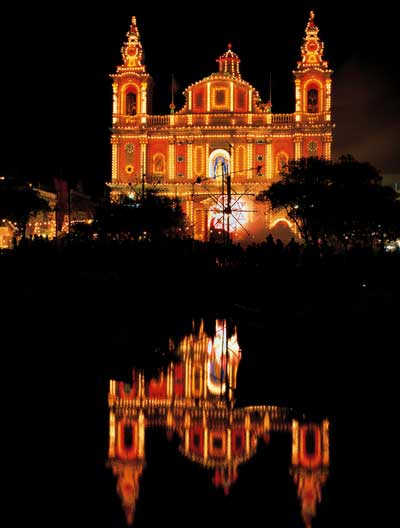
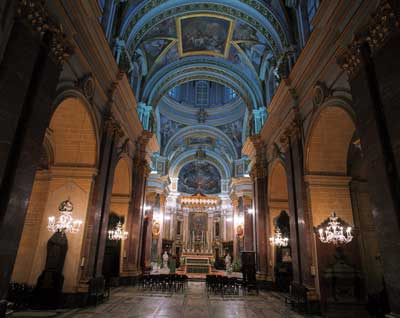
(left to right) Msida Church; Mdina Cathedral Courtesy of Malta Tourism Authority/www.visitmalta.com
Predating Stonehenge and the Egyptian pyramids by 1,000 years, they qualify as the oldest freestanding structures on earth. Such antiquity is difficult to grasp (quite frankly, the centuries-old graffiti is sufficient to dazzle most people). Factor in the sheer size of the stones used in construction – some of which stand 20 feet high and weigh 50 tons – and it is almost possible to believe that the Ggantija Temples were, as their name implies, built by a giantess.
MOTHER NATURE’S HANDIWORK
As if the mother lode of archeological sites wasn’t enough, Malta has a slew of natural attractions as well. The coastline is justifiably famous for geological oddities like the Azure Window, a towering stone arch encrusted with fossils. A lot of ink is also spent extolling Maltese beaches, particularly one on Rambla Bay where the mythological sorceress Calypso is said to have seduced Odysseus. But, truth be told, most are more like limestone shelves than sandy strands. So they seldom measure up to U.S standards.
The sunbather’s loss, however, is the diver’s gain because the rough terrain extends well beneath the waterline, creating seductive grottoes, dramatic drop-offs, and bizarre rock formations that beg to be explored. Conditions are optimal, too. The Mediterranean is clear here, with visibility up to 130 feet. Water temperatures rarely drop below 55° in winter, allowing for year-round diving. Plus there are dozens of outfitters happy to supply you with equipment or take you out on an organized dive.
Non-divers can get a glimpse of what lies beneath by signing on for a glass-keeled boat cruise around St. Paul’s Bay, the spot where the apostle was shipwrecked in 60 A.D. Meanwhile, those content to be on the water rather than under it can rent whatever they need at local sports centers. Since all three Maltese islands have them (even Comino, which has no resident population!) getting hold of a kayak, windsurfer or sailing craft is never a problem.
In this part of the world, though, the ultimate boating experience is also the oldest: namely crossing Valletta’s glorious Grand Harbour on a luzzu. These small, vividly-colored vessels have been plying local waters since the Phoenicians’ time and their prows are still painted with the god Osiris’ watchful eyes. Nowadays the luzzu serves as Malta’s unofficial national symbol. And nothing could be more appropriate in a tiny, waterbound land where myth and history remain inextricably bound.
WHERE TO STAY
Tourist zones around Sliema and St. Julian’s are crammed with upscale hotels. Hilton, Westin, Radisson: all the big names are represented. But for the optimal combination of amenities and location, it’s hard to beat Valletta’s Hotel Phoenicia. Although it is poised right at the city gates and has all the accoutrements of a grand hotel (think marble floors, plush upholstery and impeccable service), bargain hunters can snag double rooms there for as little as 90€ a night off season. Those who fantasize about lounging around a Mediterranean villa may prefer to book a vacation rental though Gozo Great Escapes. Heritage properties with private pools start at 595€ per week, so you can enjoy the high life without paying a high price.


















 European Traveler