For the millions of RMS Titanic lovers around the world, April 15 is a very significant date. On that day it will be exactly 100 years since the tragic sinking of the ship that changed so many lives and sparked one of the most captivating stories in human history.
On March 31 the world’s largest Titanic visitor attraction, Titanic Belfast, will officially open its doors, thrusting the ship’s physical and spiritual home firmly into the global spotlight.
The striking $152 million piece of modern architecture stands majestically at the head of the very slipways where the Titanic first glided into the waters of Belfast Lough.
Inside, nine walk-and-ride-through exhibition galleries equipped with the latest 3D, CGI and video technology uncover the true Belfast story of the Titanic, from its conception and construction in the Harland & Wolff Shipyard to its famous maiden voyage and subsequent place in history.
A host of experiences are offered—a thrilling ride through the shipyard with the Titanic under construction, or an exploration of the sumptuous luxury and superb craftsmanship of its interiors.
You can be drawn deep into the stories of the passengers, crew and the heroes of the day or re-live the drama of its tragic end and visit its resting place in the North Atlantic in a unique Ocean Exploration Center with live links to contemporary undersea exploration.
Set deep in the countryside, surrounded by forests and vineyards, Tripsdrill opened in 1929—Germany’s first theme park.
About an hour’s drive southeast of Heidelberg, the park revels in nostalgia, reflecting the Swabian region’s tradition and history. Tripsdrill is set on 190 acres, with 100 one-of-a-kind attractions, including the 100-foot-high “Mammoth” wooden roller coaster. Activities include water sports for the whole family, action rides for thrill seekers and interactive play for children.
In 2012, the Village Street will be enlarged. The new timbered house is typical of Southwest Germany, and its three floors will be devoted to a variety of games for older and also younger children. The year 2012 also marks the 60th birthday of the federal state of Southwest Germany (Baden-Württemberg), and Tripsdrill is joining in the fun with a series of special events to celebrate all aspects of Swabian culture.
The neighboring Wildparadies Tripsdrill (wildlife park) is devoted to wild animals native to Europe. Celebrating its 40th birthday in 2012 with plenty of wildlife action and excursions, this park also has a new feature: overnight stays. Visitors can stay in a shepherds’ wagon or a comfortable treehouse deep in the forest.
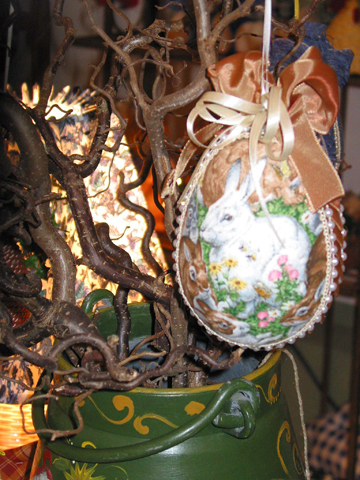
Easter celebrations are among the oldest, most traditional and unique celebrations in Germany. A myriad of differing regional traditions, Easter markets and special celebrations start weeks before the four-day Easter weekend from April 5 to April 9. Many of the American Easter traditions, including egg decorating, Easter trees, Easter egg games and, of course, the chocolate Easter bunny, were brought to America by German immigrants.
In preparation for Easter, towns decorate their fountains and trees with eggs and wind crepe paper around the branches. On the Easter Eve, bonfires are lit celebrating the new and getting rid of the old. Easter markets throughout the country exhibit Easter eggs and spring-themed local arts and crafts in surroundings from historic cities and castles to landscape parks. The markets last either a few weeks or a weekend and are a favorite leisure time activity for locals and tourists alike.
Easter decorations
EASTER MARKETS Being one of the oldest Easter markets in Germany, the Haeferles Market in Nuremberg in Franconia is the first major event of the spring season. With over 80 stalls in the middle of the historic city center, this market offers everything around the Easter holidays, from hand-painted eggs to wooden decorations (March 23 – April 9). Further to the north in the charming town of medieval Wolfenbuettel, about two hours from Frankfurt, the Easter market takes place in a royal surrounding. In the courtyard of the 18th century residence castle of the Guelphs in the city center, over 60 artists and craftsman from the region display their works on the weekend before Easter (March 31 – April 1). Then, on Easter Saturday a huge rabbit emerges from an enormous nest and distributes candy to the children.
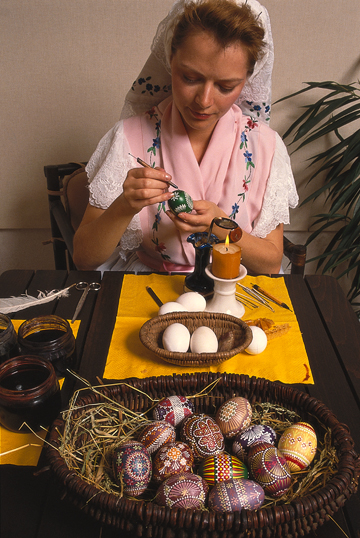
Lady in Sorbian costume handcrafts traditional Easter egg painting using wax-resist techniques.
EASTER DUCK RACE The festivities are closely followed by a duck race where the ducks are thrown into the river and race to the other side. One of the largest Easter Egg Fairs in Germany takes place in the beautiful landscape park Luisenpark in Mannheim from March 31 to April 4. The International Easter Egg Market at Mannheim’s Baumhainhalle hosts over 40 artists from Germany, Russia, France, Switzerland and Hungary.
St. Wendel fountain decorated for Easter
KREUZTRITT WALK PARADE A very special Easter culture exists in eastern Germany near the border with Poland. The Sorbs, a Slavic minority that has lived for generations in this area called Lusatia, celebrate Easter with a parade called the “Kreuztritt” (Cross Walk) on Easter Sunday. The men of the village dressed in traditional costumes of black jackets and top hats, ride horses in a circle from town to town announcing the resurrection of Christ. The Sorbs also are masters in the art of Easter egg painting. Sorbian artists from all over the region exhibit their skills during the Lenten season. The Egg Rolling and colorful Easter Market on Easter Sunday are wonderful highlights during the Easter weekend, April 7 and 8.
Dining in the Dordogne most certainly brings opportunities to pair wine with the other specialties of the area: foie gras, strawberries, walnuts and truffles.
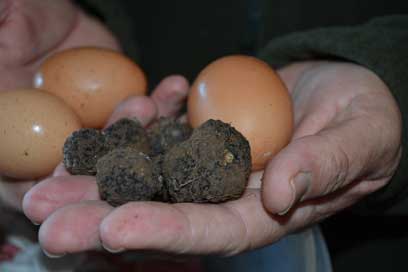
In fact, the Perigord is known for producing the very best black truffle, an aromatic fungus resembling a small black potato. To experience this local treasure, I spent a delightful morning at Truffiere de Pechalifour, the truffle farm of Edouard Aynaud, learning the art of truffle hunting.
Truffle farmer Edouard Aynaud
After meeting the high-energy Edouard, we entered a glass-doored, yellow stone building, where Edouard snaps open the lid of a large plastic bowl holding several black truffles, and thrusts it in my face. “Smell this,” he says in French, insisting that once you have this scent in your head, you’ll never forget it.
Edouard’s truffle-sniffing border collie
The valuable black truffle, sometimes called the Black Diamond, can command 1,000 Euros per kilogram, since the demand is always greater than the supply. Our host holds up a kiwi-sized truffle and we play “how much is this truffle worth?” My husband wins with his guess of 10 Euros, when the small scale records the truffle’s weight as 10 grams.
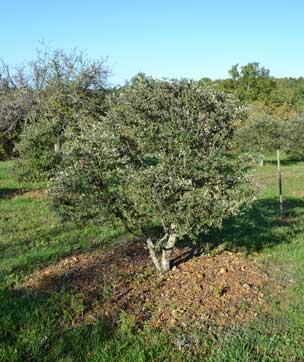
Now the lesson begins: truffles grow at the base of oak and hazelnut trees. The spores of the truffle form a web of mycorrhizal filaments that permeate both the soil and the roots of the trees. These filaments help the trees obtain nutrients from the soil, and in turn, the trees provide the truffle with needed sugars. Once this network spreads, there is a telltale brown circular area around the base of the tree called a “burn.” In the wild, this symbiotic relationship occurs with luck.
Here on the 10-acre Pechalifour farm, Edouard’s father planted his first trees in 1968. Today new tree seedlings with truffle spores grafted onto their roots are planted in the hopes of increasing the truffle crop. Edouard holds up a 2-foot-tall oak seedling to illustrate, and tells us that you must plant it and pray, and maybe in several years (3? 6? 10?) the telltale “burn” will appear. He explains that sadly, not many young people are getting into this business because it requires so much patience and optimism.
Edouard, however, personifies optimism and joy, explaining his craft in rapid-fire French (admirably translated by our local guide) and punctuated with animated facial expressions and gestures worthy of Marcel Marceau.
Once the “burn” is identified, there are three methods to locate the truffles beneath it:
With a pig. Grinning, Edouard holds up a Cracker-Jack-toy-sized pink plastic pig to illustrate. Furthermore, he continues, it must be a female pig. Why? Because the truffle scent mimics that of a male pig sex hormone.
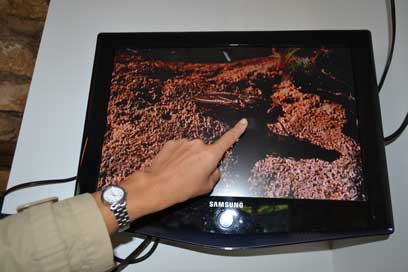
With a stick. Now he whacks a slender willow stick several times across the length of the table. Tapping a stick around the area of the “burn” disturbs a little brown fly that likes to lay its eggs on a ripe truffle, so that its larvae can feed on the nutrients. A short video illustrates that the fly’s brown color renders it invisible at rest. But once disturbed, the fly will rise up and then return to the location of the truffle, which must be harvested before the egg-laying, larva-eating process begins.
With a dog. The dogs must be trained while they are very young to recognize and search for the truffle scent. For that, Edouard uses the plastic film containers used before the age of digital photography. He pokes holes into the container and fills it with cotton that has been moistened with truffle oil. Then for one week he plays fetch with his canine student, rolling the container a little distance away, and rewarding the pup with treats and love when the prize is returned. The next week he hides the container in corners or behind something, and again rewards its return with treats and praise. The third week he buries the container outside under a little bit of soil and waits three days so that it no longer carries his human scent, but only the scent of the truffle, before sending the dog to find it. At the end of three weeks, with lots of praise and treats, the dog is trained.
Suddenly we are aware of a yellow labrador and a young black and white border collie snuffling around our feet, obviously eager to get to work. Edouard grabs a basket, some dog treats and a digging tool, and assuring us that he did not hide truffles ahead of time for us to find, we begin our spirited trek though the trees.
Pointing out brown fly in “burn” area where truffle lie
Walking slightly ahead of us, Edouard sees the telltale “burn” around the base of a tree, and gives his dog the command. Within seconds, the dog sniffs and puts his paw on a spot. Edouard scoops up a handful of the moist soil and sniffs it, crowing gleefully when he detects the scent of the hidden truffle. He pushes into my hands the special two-sided truffle-digging tool: pointed pick at one end, flat scraping blade at the other, and tells me to dig — but gently! We’re not digging up potatoes!
Tree with signs of a truffle underneath
Soon my delicate poking isn’t fast enough for him and he rakes his fingers through the mud until he isolates the prize. After pointing to exactly where I should look, he lets me make the final discovery. Voila! There it is — and it’s tennis-ball HUGE! But, alas, it is spoiled inside because of the recent unfavorable weather. Edouard rewards his dog with a treat and a cuddle, and then crushes the truffle with his fingers and reburies it on the spot, so its spores can sprout again.
The best months for harvesting ripe truffles in the Perigord is December, January and February, and then only if the weather conditions have been favorable — too much rain and they grow too fast and don’t ripen at the right time. All in all, it’s a business that needs luck — and lots of dog treats. www.truffe-perigord.com
PULTENEY BRIDGE WEIR The stunning weir beneath Bath’s Georgian Pulteney Bridge plays the part of the River Seine in the film version of Les Misérables. Pay Bath a visit and see it for yourself (but don’t jump in, like they do in the film!)
St. John’s Church
ST. JOHN’S CHURCH London’s St John’s Church in Smith Square was used in Atonement for the wedding scene. It’s a fine example of English baroque architecture and is a venue for concerts and recitals.
TEMPLE CHURCH Built by the Knights Templar in the 12th century, this historic church exudes mystery. It has a circular nave based on the Church of the Holy Sepulchre in Jerusalem and was used as a location in The Da Vinci Code.
Inverness
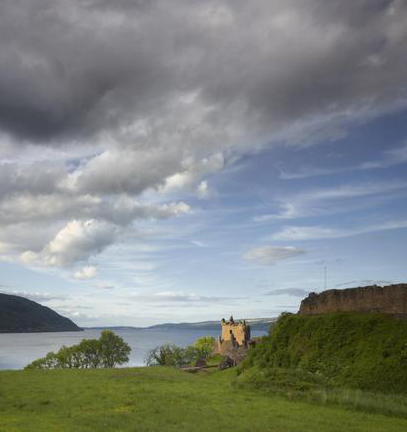
INVERNESS Inverness is a gateway to the Highlands and so makes a great base for exploring the surrounding countryside, historic battlefields and beautiful lochs. The Highland capital is friendly, welcoming, full of history and compact enough for wandering around by foot. Scenes for the TV drama Outlander were shot in and around the city.
MOMO Probably London’s most famous Moroccan restaurant, Momo is a glamourous spot to enjoy fine North African dishes. You might also recognize it as one of the locations in the UK film Bridget Jones’s Diary.
Rye
RYE One of East-Sussex’s most popular locations, Rye is a half-timbered medieval town full of unique shops and plenty of atmosphere. A great place to get a taste of traditional English life and to enjoy a good pub lunch or fish and chips overlooking the town quay.
OLD WARDOUR CASTLE Built in the 14th century as a luxury house, Old Wardour Castle slowly became a fashionably romantic ruin. It’s a beautiful place to spend a day, and you might even recognize it as one of the locations used in Robin Hood: Prince of Thieves.
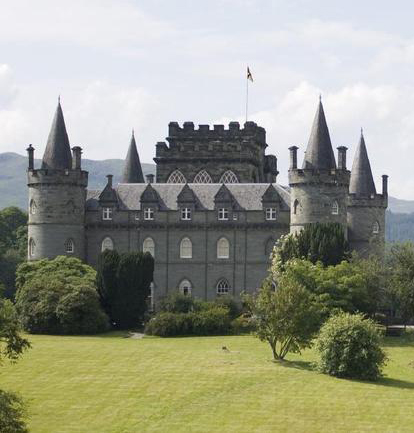
Inveraray Castle
INVERARAY CASTLE This magnificent stately home on the shores of Loch Fyne boasts tremendous views across the Scottish countryside. You might recognize its fairy-tale turrets from the Christmas 2012 episode of Downton Abbey when the Crawleys holiday in Scotland.
BROMPTON CEMETERY One of Britain’s Royal Parks is also a historic cemetery. Expect an atmospheric array of spectacular tombs and more than a few famous names. Look for Brompton in a suitably Gothic scene from the 2009 film Sherlock Holmes.
MI6 (THE SECRET INTELLIGENCE SERVICE) The HQ of MI6 (the Secret Intelligence Service) is off limits to visitors but you can get a great view of this imposing structure from the river. Take a speedboat tour with Thames RIB for fascinating anecdotes about Ian Fleming, the British Secret Service, and of course, James Bond himself.