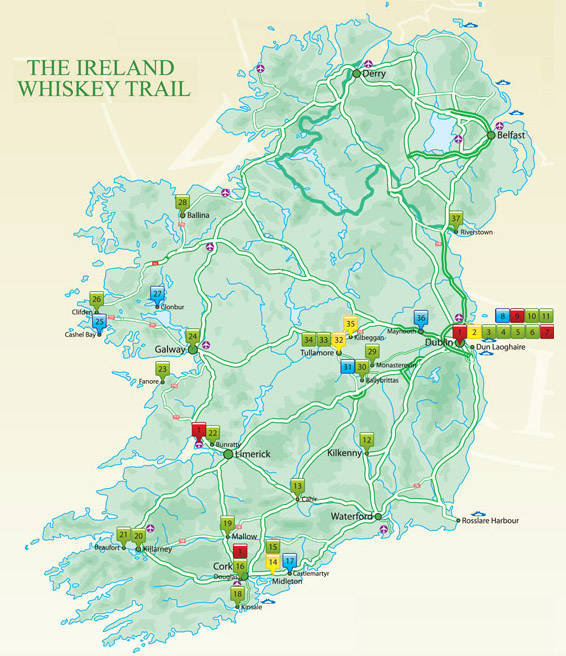
History, heritage and “a drop in your hand” of the finest whiskey in the world combine in one of the Emerald Isle’s newest visitor attractions, the Ireland Whiskey Trail.
IRISH WHISKEY TOURING GUIDE Heidi Donelon has created a touring guide for whiskey lovers to Irish pubs, hotels, whiskey shops and distilleries throughout Ireland. The trail features nearly 40 different places, ranging from the famous old Jameson Distillery in Dublin, to less well known whiskey emporiums such as Fairhill House Hotel in Connemara, which boasts a stock of more than 170 different whiskies.
Donelon says: “The trail is a great way for people to experience the story and magic of Irish whiskey, while discovering the heart of Ireland through the Irish characters they will inevitably meet in the pubs and bars across the island. It is a great touring guide for whiskey lovers, but also for anyone who wants to find that perfect Irish pub during their trip, whether they are whiskey drinkers or not. Some of these pubs are the last links to old and forgotten distilleries. These are not just great whiskey pubs, but also some of the very best traditional Irish pubs in the country.”
IN addition to the in-depth tour guide, the Ireland Whiskey Trail gives information about the history of Irish whiskey, insight into the difference between brands, Irish Coffee and whiskey recipes and details of whiskey tasting events. The Irish are credited with inventing whiskey, called uisce beatha in Gaelic, which translates as “water of life.” For 1,500 years whiskey has warmed the hearts of the Irish and their guests, and today it is a worldwide success with sales of brands such as Jameson, Bushmills, Tullamore Dew and Kilbeggan increasing at an unparalleled rate.
View of new wing at the German Emigration Center (on right).
The Emigration Center at Bremerhaven, Germany, just added a new wing to the museum. Until now visitors ended their journey back in time through the staged and reconstructed rooms at the Ellis Island Receiving Station in New York; the journey now continues.
The new room “Office of the New World” is dedicated to the question: what did immigrants and the countries of immigration know about one another? Against the backdrop of a train station as a place of transit, the new staged and reconstructed room “Grand Central Terminal” shows the history of German immigrants in the U.S.A.
The original plan.
The new bridge connects the history of emigration with the history of immigration.
HISTORY OF IMMIGRATION IN THE NEW EXTENSION On the first floor of the new building a mall with several commercial stores in the Federal Republic of Germany from 1973 has been reconstructed. Visitors trace the roots of immigrants: the shop windows display common, everyday objects together with the memorabilia of immigrant families, illustrating the stories of 15 immigration groups that came to Germany in the last 300 years. On the ground floor general information on immigration to Germany between 1685 and today can be found, as well as the family research area and the new “Roxy Cinema.” For more information, visit www.dah-bremerhaven.de/english.php
This holiday season, Royal Parks in London are celebrating with special events in places including Richmond Park, Greenwich Park, Kensington Gardens and Hyde Park.
Visitors to the parks can partake in the festivities by choosing their own real Christmas tree, wander through four of the Royal Parks following the Diana Princess of Wales Memorial Walk, visit the deer enclosure in Greenwich Park, or take a timeless winter horse carriage ride.
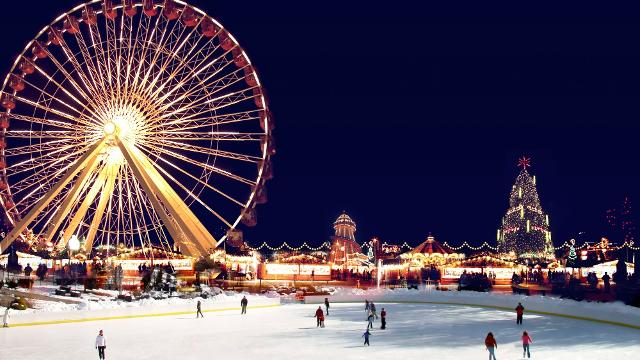
While in London, take in the Winter Wonderland Hyde Park, where you can hear live music, go ice skating and visit the Angels Christmas and Yuletide Markets.
View of the Aachen Cathedral from Katschhof Square
Photos courtesy German National Tourist Office
Cathedrals, monasteries, walled fortresses and abbeys are a distinct part of Germany’s culture and landscape. Every town, city and countryside has a beautiful church or abbey, including many masterpieces.
Aachen’s cathedral, the Church of St. Mary, was founded as Charlemagne’s chapel and is where 30 kings were crowned. The immensely beautiful Romanesque cathedral of Speyer, only one hour south of Frankfurt, became the burial place for the Salian emperors, and its size is on par with the Cologne Cathedral. The Cologne Cathedral is Germany’s most visited tourism site and was at one time the biggest building in the world. Its high Gothic style is pronounced and the Dom is home to sacred relics and precious artwork. In Hildesheim, 45 minutes outside of Hannover, St. Mary’s Cathedral and St. Michael’s Church are outstanding examples of Romanesque architecture.
Sculpture inside Aachen Cathedral
AACHEN CATHEDRAL The Church of St. Mary, originally built as the chapel of Charlemagne’s imperial palace in Aachen in 786 AD, was part of the emperor’s dream of creating a “new Rome.” With this building he laid the foundations of one of the most important architectural monuments in Europe. The cathedral’s appearance reflects more than 1,000 years of history. Charlemagne’s palatine chapel forms the core of the cathedral. The single-nave chancel was consecrated on the 600th anniversary of his death and the bold architecture of the “glass house” is as impressive today as it was then.
During the 600 years from 936 to 1531, 30 German kings were crowned in Aachen Cathedral. Today, the cathedral has lost nothing of the splendor of centuries past. The first ensemble of historical and architectural importance in Germany to be inscribed on the UNESCO World Heritage list in 1978, this is a building of outstanding significance.
SPEYER CATHEDRAL The magnificent Romanesque imperial cathedral in Speyer is the town’s best-known and most prominent landmark. Built by emperors, the cathedral was a symbol of their power and served as their final resting place. Construction began around 1030 under the Salian Emperor Conrad II and the church was consecrated in 1061. Speyer’s imperial cathedral, laid out in the form of a Latin cross, is one of Germany’s largest and most important Romanesque buildings. The Salian emperors chose it to be their burial site.
Its huge triple-naved vaulted basilica is the central element of a design that greatly influenced Romanesque architecture in the 11th and 12th centuries. The hallmarks of the cathedral are the balanced distribution of its dimensions to the east and the west and the symmetrical layout of the structure, consisting of a nave and transept with four towers on the corners.
COLOGNE CATHEDRAL Building first began in 1248 on what eventually became one of the finest ecclesiastical edifices in the world, and the epitome of high-Gothic cathedral architecture in its purest possible form. The scale of Cologne Cathedral is evident from its two mighty towers. Completed in 1880, they dominate both the city and the surrounding region. At the time of its completion in the 19th century, the cathedral was the biggest building in the world.
The design of the west side was truly groundbreaking. It has the largest exterior surface of any church in the world, said to be around 23,000 square feet, and is flanked by two huge towers, each rising to a height of 515 feet. The cathedral houses a wealth of important art treasures, including colorful stained glass windows that bathe the church interior in a mysterious light; the Ottonian Gero Cross (around 980 AD), the oldest large-scale sculpture in the western world; the shrine housing the relics of the Three Kings (1190-1225), an outstanding example of Rhenish goldwork; the altar of the patron saints of Cologne by Stefan Lochner (around 1450), a masterpiece of the Cologne school.
Cologne Cathedral by the RhineCologne Cathedral detailHildesheim Cathedral interior
ST. MARY’S CATHEDRAL AND ST. MICHAEL’S CHURCH IN HILDESHEIM St. Mary’s Cathedral and St. Michael’s Church are outstanding examples of early-Romanesque architecture. Both World Heritage churches exemplify the skill of Bishop Bernward (993 to 1022) and contain exceptional artworks.
The main attraction in St. Michael’s Church is the painted 13th century wooden ceiling depicting the Tree of Jesse. Germany’s only flat church ceiling, it is a fascinating example of monumental Romanesque painting. The spectacular cathedral treasure, Column of Christ and Bernward doors are characteristic of the Bernwardian period. The cathedral is being renovated for the anniversary of the diocese in 2015 and is closed until August 2014. Many of its treasures, including the huge bronze castings, can instead be seen at different places around Hildesheim until 2014.
The Column of Christ featuring scenes from the Old and New Testaments is on loan to St. Michael’s Church. The pair of two 16-ft. Bernward doors were cast in one piece—an achievement never mastered before—and are currently displayed at the Roemer and Pelizaeus Museum in Hildesheim.
The Silk Exchange in Valencia, Spain is an exceptional example of a secular building in late Gothic style, which dramatically illustrates the power and wealth of one of the great Mediterranean mercantile cities. It is aesthetically unique because of its fine Gothic architecture combined with Renaissance decoration from the 15th century.
The majority of the Silk Exchange was built between 1482 and 1492 under master mason Pere Compte. The work was completed by a pupil of his after his death, which explains the presence of Renaissance elements.
Its similarity with old medieval castles is based on the fierce, fortress-like appearance of its stone walls. It comprises four parts: the Tower, the Sea Consulate Room, the Orange-tree Patio and the Room of Columns. The site covers more than 6,562 square feet indoors and out.
It is a typical representation of the commercial and financial past of the city of Valencia, and has been used for the same purpose for five centuries. Its original function was as a trading exchange for oil. It developed into the main maritime trading center and the silk exchange. At the present time it is still a major trading exchange, now dealing primarily in agricultural products.