By Kristi Nelson Cohen
Photos by the author
One of things travelers enjoy the most is, well, eating. We chow down breakfast, lunch and dinner without blinking an eye, when we wouldn’t dream of eating this much at home. But as they say, “When in Rome.” You should definitely dine as they do, with a great glass of wine. Each region of Italy offers its specialties, but Emilia-Romagna, located in the heartland of central Italy, could easily be considered this country’s gastronomic capital.
Located just over an hour north of Florence and about two hours southwest of Venice is the region’s capital, a major metropolitan city called Bologna. Bologna is easily reached as a transportation hub on the Italian rail or on Highway A1 from Florence. Less than an hour northwest of Bologna are the smaller communities of Modena and Parma, which are also accessible by rail or car. The busy A1 highway links Bologna to Milan via Modena and Parma.
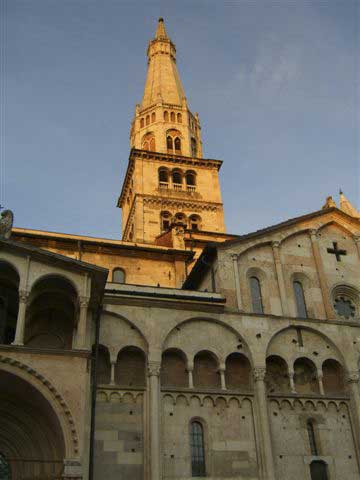
The larger-than-life opera singer Luciano Pavarotti was from Modena. Pavarotti’s large stature and his appetite for life, friendliness and generosity exemplify the people of this region. Those who watched his funeral on television in late 2007 got a glimpse of Modena’s historic Romanesque duomo. This 11th century cathedral, its piazza and bell tower are all listed by UNESCO as a world heritage site. But we’re here to talk about food!
Pigs still outnumber people here, which is why the Parma ham or prosciutto di parma is a dietary staple. Many of Italy’s prosciutto, salami and other pork products are cured in towns scattered over this region. Another well-known food staple is Parmesan cheese, and we’re not talking about the stuff that comes in a green can. The real deal is called Parmigiano-Reggiano. And don’t forget about the famed balsamic vinegar which originated in Modena, called Aceto Balsamico Tradizionale. Here a visitor will learn about the painstaking process of making this aged, black gold. Tradizionale Balsamico is very expensive — a small bottle can cost $100-$400 — but each thick drop carries sweet and complex flavors used to enhance a variety of foods.

ACETO BALSAMICO TRADIZIONALE DI MODENA
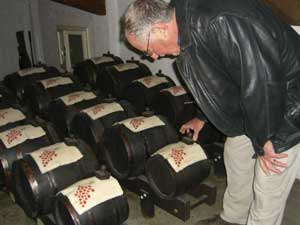
The balsamic vinegar found in the grocery stores, or even in the specialty gourmet stores in the U.S., is great on salads, but has merely a slight resemblance to the real thing. Tradizionale vinegar is made with the Trebbiano white grape. The juice is cooked, reduced and fermented in a series of specifically made wooden casks for no less than 12 years. Each year, the vinegar evaporates from the wooden casks and is then moved to a graduated smaller cask. At the end of 12 years, what started as six gallons of fermenting grape juice will only produce one quart of finished tradizionale vinegar.
The vinegar production must pass strict government standards and be approved by the Balsamic Vinegar Consortium which monitors the quality and production amounts. There is only a handful of small producers, and while prices may seem high, this syrupy concoction takes years to create. While visiting the area it is possible to schedule a production tour and tasting. High end restaurants offer menu selections where the Aceto Balsamico Tradizionale is sprinkled sparingly over grilled meats, strawberries, tortelloni, Parmigiano Reggiano cheese or even over ice cream. This sweet, aged, deep brown nectar can even be drunk as an after-dinner liqueur.
SAY “CHEESE” — PARMIGIANO–REGGIANO
West of Modena is Reggio Emilia, the birthplace of the renowned Parmigiano-Reggiano cheese. This cheese is not only grated onto pasta, but is often served by itself in chunks as an appetizer or even for dessert, when it might be drizzled with honey or the famed balsamic vinegar.
Cheese production tours are available with advance scheduling. There you can watch cheese makers stirring the milky brew in large copper cauldrons, then cutting through the curds and later forming soft pillows of cheese. The soft cheese is pressed into a wheel form with the pre-formatted stamp which says “Parmigiano Reggiano” and allowed to cool. The soft wheel is then cured in saltwater brine for two weeks. The cheese wheel is then placed on wooden shelves and allowed to age from 2-5 years.
Visitors can easily buy this cheese from any market in the area or even at the airport on departure day. Be sure to check the hardened rind area to see the perforated stamp of authenticity. If the cheese is sealed in a vacuum package, it is perfectly acceptable to carry home as a delicious reminder of a vacation in Italy.

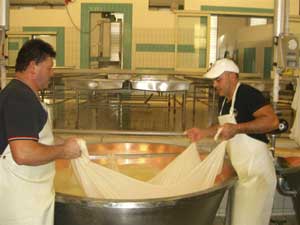
(left to right) Wheels of Parmigiano-Reggiano undergo the aging process; Master cheese makers with pillows of soft cheese
FAST CARS, RAGING BULLS AND RED RACING FEVER
If great food and world heritage sights aren’t enough to entice a visit to the area, perhaps the thrill of seeing another part of Italy’s claim to fame will Italian design is world famous, but none more coveted than Italian specialty sports cars. The Modena area is home to Ferrari, Maserati, Ducati, Lamborghini and Pagani.
Tours at the Ferrari factory, located 12 miles south of Modena in Maranello, are not available, but the Galleria Ferrari Museum has a great exhibition of engines, vintage cars, memorabilia and a reconstruction of Ferrari founder Enzo Ferrari’s personal study. There’s also the official Formula One shop, the Ferrari restaurant and places where visitors can view the Ferrari test track through the fence, giving an ample cure for “red racing fever.”
The Lamborghini Factory Museum located at Via Modena 12 in Sant’Agata is under the same roof as the “raging bull” factory. There visitors enjoy a wide array of vintage automobiles, historic photos and rare prototype models. With an advance appointment, factory tours are also available, and this museum isn’t nearly as crowded as Ferrari, which gives visitors a chance to stroll the displays at leisure. Guided tours in English are available with advance request.
There is so much to see for the sports car enthusiast that it might be best to set up guided full-service tours with museum and factory admission organized in advance by a professional guide service. Le Volpi Ciccione is one such operator. They can even customize a tour that includes your own Ferrari to drive for a few days, as long as your budget will allow.
Our food and motor tour included a cooking class at the Ferrari Village restaurant. The Ferrari Village’s red exteriors were a good match for the passion of the restaurant’s culinary team, which graciously opened their kitchen so our group could learn to make gnocco fritto (a light deep-fried dough which was served piping hot with thin slices of prosciutto) and the filled pasta called tortelloni (larger) or tortellini (traditional smaller-shaped filled pasta). Following the cooking instructions, our group enjoyed a luncheon fit for kings and, yes, we sampled our own creations, although some students were better at shaping the tortelloni than others.
With great food, historic sights, friendly people and the classy Italian sports cars, this area of Italy is not to be missed!
CONTACT INFORMATION TO HELP YOU FIND YOUR WAY THROUGH EMILIA-ROMAGNA
Le Volpi Ciccione srl – Tour Operator/Travel Agency in Modena
Le Volpi provides customized tours and area lodging with emphasis on food, wine, motorcars, historic sights and much more. English speaking guides and group tours available.
Vicolo del cane 7, 41100 Modena, Italy
Phone: 011-39-059-218 722
For customized tour itineraries for both individuals and groups, contact Giusy@levolpiciccione.it
Museo Lamborghini
Via Modena 12, 40019 Sant’Agata Bolognese, Italy
Phone: 011- 39-051-681 7611
Open Monday through Friday excluding holidays
E-mail: museo@lamborghini.com or for factory tours factorytour@lamborghini.com
Galleria Ferrari
Via Dino Ferrari, 43-41053 Maranello, Italy
Phone: 011-053-694-32 04
Open every day excluding Dec. 25 & Jan. 1
E-mail: (for group requests) galleria@ferrari.it
Balsamic Vinegar Consortium
Corso Cavour 60, Modena 41100
Phone: 011-059 23 6981
Parmigiano-Reggiano Consortium
Via Kennedy 18, Reggio-Emilia
Phone: 011-052 23 077 41

About the writer
Kristi Nelson Cohen, also known as the “Train Dame,” has a long history with marketing and tourism promotions. Cohen’s love of history and trains, in addition to her hospitality and marketing background, led to a position as Vice President of Marketing for the Durango & Silverton Narrow Gauge Railroad where she worked full time until 2004.
Cohen remains active as an affiliate for American Heritage Railways and Rail Events Inc. where she has assisted with marketing efforts for The Great Smoky Mountains Railroad, Thomas the Tank Engine, Little Engine That Could Rail Tour and Polar Express Rides. She was also one of the organizers of the National Narrow Gauge Convention held in Durango in August 2006. She now owns and operates an international tour company called Bella Italia Trips, leading guided tours to Italy.






 European Traveler