Germany’s Black Forest: Home of the Famous Wooden Cuckoo Clock

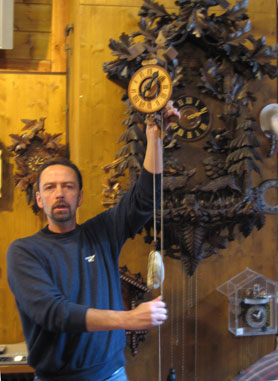
Jack, the cuckoo clock demonstrator in the Black Forest, explains the history and manufacturing process at the Familia Drubba’s Hofgut Sternen in Breitnau, Germany.

By Marilyn Heimburger
Photos by the author

One of my early childhood memories is watching my aunt change the time on her cuckoo clock so I could hear the cuckoo sound over and over again.

My grandfather, who emigrated from Germany at the age of 22, bought the clock during his only visit back to his homeland, after World War II. Since my fascination with the clock has continued into adulthood, I was happy to learn more about them during a trip to Familia Drubba’s Hofgut Sternen. Breitnau, in Germany’s Black Forest, which was a stopover destination included in a Rhine River Viking Cruise I took recently.

GREETED BY CUCKOO AND MUSIC

If you pull into the Hofgut Sternen parking lot at the top of the hour, you’ll be greeted by the cuckoo, music, and dancing characters of one of the largest cuckoo clocks in Germany. The two-story-high clock is built into the side of the shop.

Inside the building, Jack, the cuckoo clock demonstrator, briefly explains the history and manufacturing process of Germany’s most popular souvenir. A primitive form of the cuckoo clock dates back to the mid-1600’s and used stones as weights (the original “rock around the clock,” according to Jack.) It had no minute hand, only one hand to tell the hour. Shield clocks, with a flat face board painted with colorful flowers and scenes, were made around 1720, with the first cuckoo appearing in one around 1760. The station house clock, with a peaked roof and hand-carved leaves and animals, appeared around 1860.

The cuckoo sound was chosen for the clock because it was an easy sound to imitate. Two different sized bellows send puffs of air into two wooden pipes, to produce the two-pitched cuckoo sound.

At least two pinecone-shaped weights hang on chains beneath the clock: one to operate the cuckoo and one for the cog-driven timing mechanism. If the clock has a third weight, it has been fitted with a music box, which plays after the call of the cuckoo. The clocks are “wound” by pulling the chains to raise the weights to their highest position. Clocks with large pinecone weights are wound once a week; clocks with small pinecones are wound every day. While my aunt had to still the oak leaf pendulum every night to stop the clock and quiet the cuckoo, many clocks now have a switch that turns off the cuckoo and music, but allows the clock to keep running.

The Linden Tree wood is used in the clocks because it is easy to carve and features very little grain.

CLOCKS FROM LINDEN TREE WOOD

Most cuckoo clocks are made of wood from the Linden tree, because it is easy to carve and has hardly any grain. Since the wood is so moist, it has to dry for two years before it can be used. To make the frame board for the front of the station house clock, a stencil is placed against the flat board, and the basic outline is lightly spray-painted. This design is cut using a scroll saw or jig saw. Nothing else is done by machine. The rest of the frame board is hand-carved, a process that can take six to eight weeks for a large clock. Vines, oak leaves, birds, rabbits and stags are the traditional decorations on station house clocks.

Character clocks add humor to timekeeping. One clock at Hofgut Sternen features a man shoveling a dumpling into his mouth with each sounding of the hour. The “mother-in-law clock” has a woman bopping a lazy son-in-law on his head at the top of the hour, to encourage him to get to work.

An interesting observation: during all of the years I’ve looked at cuckoo clocks, I had never noticed that the Roman numeral used for the number four on the clock face is IIII, and not IV. Two theories sem to be most popular explaniations for this. In ancient Roman times, “IV” was an abbreviation for the Roman god, Jupiter. IIII was therefore used out of respect so that Roman public sundials or clocks didn’t have “1 2 3 GOD 5” on them. Later clock markers continued to use this alternative Roman numeral system on their timepieces. The other theory is simply one of symmetry on the clock face. The number eight, or “VIII” on the clock dial, is the heaviest number, consisting of four characters. Using IV (only two characters) for the number 4 on the opposite side of the clock face, would ruin the symmetry. Therefore the four-character “IIII” is preferred.

I am now the proud owner of my aunt’s cuckoo clock. The carved oak leaf decorations show evience of being dropped and re-glued by my uncle. But the cuckoo still works, and now enchants my grandchildren just as it did for me.

In the Black Forest, these men and women, in typical colorful garb from the region, are tour guides who know the towns, mountains and legends of this famous area.

IF YOU WANT MORE INFORMATION…

These retailers sell German-made cuckoo clocks on the web. We have listed them as a convenience to European Traveler readers, but we have no specific recommendations who to buy them from: www.clockway.comwww.german-cuckoos.comwww.BlackForestGifts.com and www.designedintime.com.

European Christmas Markets Celebrate the Season

Advent is the season in Europe when thousands of communities–large and small–set up Christmas trees, colorful lights and craft stalls in their central market square. For decades, Europeans have been getting together at these unique Christmas markets to share conversation, to enjoy a glass of hot mulled wine, or to find just the right specialty gift for a family member or friend.

European Traveler offers a quick glance at some of these fascinating markets, which normally last until Christmas Eve.

Belgium

Every town in French-speaking Wallonia hosts its own Christmas Market. The central square of Liège and the neighbouring Place du Marché stage one of Belgium’s largest Christmas Markets, attracting more than 1 million visitors with 190 wooden chalets full of tempting goodies, sweets and original hand crafted products and presents. If you’re in Brussels between November 27 and January 3, enjoy the Brussels Winter Wonderland featuring a Christmas Market with many stalls, a giant illuminated ferris wheel, street activities and a large skating rink. 


Switzerland

In Lucerne, a number of Christmas events take place, including the Christ Child Market at Railcity, the train station, between November 28 – December 21. Around 50 festively-decorated market stalls bring a  Christmas atmosphere feel to the station.

Every year between December 3-20 Lucerne’s Christmas Market takes place at the Franziskanerplatz. There are a large variety of stands with Christmas decorations, sweets, food and beverages.  The Christmas Tree Market usually starts one week before Christmas along the Schweizerhofquai. Then between December 17-20, 20 stands from 20 countries  present typical Christmas items from their homelands. There is always a stage featuring Christmas productions from all over the world. For more information, go to www.luzern.com/en/welcome.cfm?

Germany

Thuringia is primarily famous for its festive Christmas markets and especially the large selection of glass Christmas tree decorations. The Lauscha Ball Market (always held during two weekends in Advent) has the largest selection, but these traditional decorations are also available at other Thuringian Christmas markets.

In Frankfurt you are invited to the large, time-honored Christmas market where you can become acquainted with the market’s many culinary specialities and its traditions. You can join tour guides in ascending to the rooftop gallery of St. Nicholas Church, from where you’ll be able to enjoy a wonderful panoramic view of the entire market and the Frankfurt skyline. Next, join young and old for a nostalgic ride on a vintage carousel. Warm yourself with a hot cup of mulled wine at the end of the tour and take in the wonderful view of the market’s beautifully illuminated Christmas tree. The 1 1/2 hour tours include a carousel ride, hot mulled wine and special marzipan candy. Tours are available in English and German from the first day in Advent until Christmas.

Thanks to the Tourist Boards of Germany, Belgium, Austria and Switzerland for the photos in the report.

Christmas Markets in Luther Country

Erfurt Christmas Market

In Germany’s Luther Country, Advent means Christmas markets. The crisp winter air is filled with the smell of ginger and nutmeg, signaling the arrival of Stollen, a special Christmas cake, and Glühwein, mulled wine. Cobbled streets and squares, lined with half-timbered medieval houses, provide the backdrop for dozens of wooden stalls, selling wooden toys and Christmas decorations, handcrafted gifts and seasonal foods, such as Zimtsterne (cinnamon stars) and Lebkuchen (soft, spiced cookies).

Brass bands play and choirs sing carols, often written by Martin Luther himself. In fact, many Christmas traditions were supposedly instigated by the Protestant reformer 500 years ago. Legend insists one dark and starry night, Luther was touched by the beauty of the pine trees. On returning home, he cut down a tree, took it into his house and decorated it with candles. As well as the Christmas tree, Luther is credited with the idea of Christkind, the Christ child bringing presents. (Kris Kringle is still familiar in many U.S. homes). Concerned that Saint Nicholas, who delvered his gifts on December 6, was too popular, Luther came up with an alternative to “Santa Claus”: a golden angel, with wings and a crown.

Here are just some of Luther Country’s most authentic Christmas markets.

(clockwise) Christmas Stollen; Lebkuchen; Zimtsterne

ERFURT
November 27 – December 22
Although Erfurt’s 162nd Christmas Market spreads throughout the old town, the focus is on the Domplatz, the vast Cathedral Square. The 200 market booths sell everything from Thuringian bratwurst (Germany’s favorite grilled sausage) and Christmas cookies to handmade toys or traditional, handmade Christmas decorations. Children love the giant Ferris wheel,

the 90-foot-tall Christmas tree covered in candles, and the 40-foot-high wooden pyramid. Most of all, they love the nativity scene, set in a fairytale forest, complete with near life-sized, hand-carved figures. Gardeners should not miss the floral Christmas exhibition in the underground vaults of the cathedral.

Lutherstadt Wittenburg Christmas Market

LUTHERSTADT WITTENBERG
November 28 – December 23
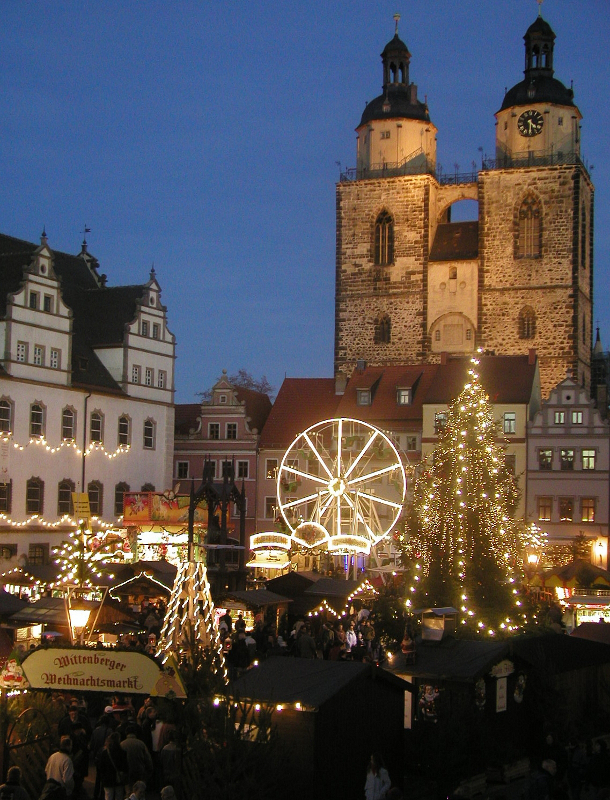
In the market square, a statue of Luther looks out across the Christmas market, with its stalls decorated with pine boughs, lights and Christmas ornaments. In the air is the scent of mulled wine and roasted almonds. Across the square is the Marienskirche (St. Mary’s Church), where Luther preached. Special are the town’s Adventshöfe, medieval courtyards, where local artists and craftsmen sell their wares. In the Cranach Courtyard, named for Luther’s great friend and painter Lucas Cranach, the weekend of December 8 and 9 features weavers and knitters, wood carvers and basket makers.

QUEDLINBURG
November 30 – December 23
With more than 1,300 half-timbered houses, Quedlinburg is one of Europe’s most romantic cities. And during the Christmas Market, strolling along the cobbled streets is like walking through history. One unique event is the “Advent in den Höfen” (December 1-2, 8-9, 15-16), when some 20 private courtyards open to sell special Christmas gifts, often handmade. Another highlight is the world’s largest Advent calendar! At 4:30 p.m. every afternoon for 24 days, children look out for the star that marks the house where the next scene in the Advent calendar will appear. When the door opens, fairytale characters appear and dance, sing or play for spectators.

WERNIGERODE
November 30 – December 22
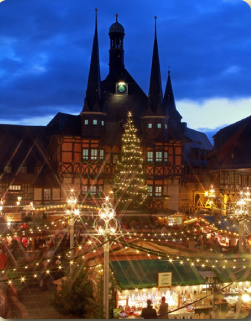
Dominated by its 12th-century castle, Wernigerode’s annual Christmas market has a fairy story backdrop: a 15th-century town hall, half-timbered houses and a 35-foot-tall Christmas tree. The stalls serve traditional food and drink, hand-made toys and ornaments for the home; evenings are filled with concerts of seasonal music. From December 15 to January 8, 2013, the Castle hosts its own special Winter Market. Children meet a fairy at 3 p.m. and receive presents from St. Nikolaus (Santa Claus) at 4 p.m. They also love to ride the Christmas train in a historic carriage, pulled by a steam engine through the snow-covered countryside.

Wernigerode Christmas Market

LAUSCHA
December 1-2 and 8-9
Each Christmas, this small town in a steep, wooded valley in the Thuringian Forest, plays a vital role in every American home. This is where the first glass Christmas tree ornaments were created in 1847. In 1880, F. W. Woolworth, the five-and-dime store pioneer, brought a batch of these glass balls to his store in Pennsylvania, and the rest is history. The tradition continues in Germany’s glassblowing capital, where you can watch artisans creating works of art at Lauscha’s Museum of Glass Art. At Lauscha’s annual Christmas “Kugelmarkt,” or glass bauble market, you can buy these handmade decorations in all shapes and colors.

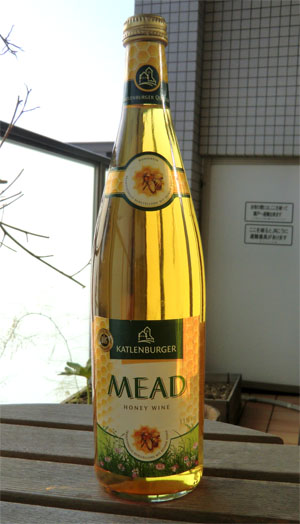
Mead honey wine

WARTBURG CASTLE, EISENACH
December 1-2, 8-9, 15-16
Wartburg Castle is where Martin Luther, the Protestant reformer, changed history when he translated the New Testament into German. And this UNESCO World Heritage Site just outside Eisenach is still a massively impressive fortress. At Christmas, however, a historic Christmas Market transforms the castle, with artists and street performers, craftsmen and knights. Meet candle makers and barrel makers, rope makers and lantern makers, minstrels and puppeteers. With cheerful booths and medieval decorations, this is a like a trip back in time. And the medieval food is delicious, from roast apples and honey to mead.

Raise a Glass to Ireland’s New Whiskey Trail

Photos courtesy Ireland Tourist Office

History, heritage and “a drop in your hand” of the finest whiskey in the world combine in one of the Emerald Isle’s newest visitor attractions, the Ireland Whiskey Trail.

IRISH WHISKEY TOURING GUIDE
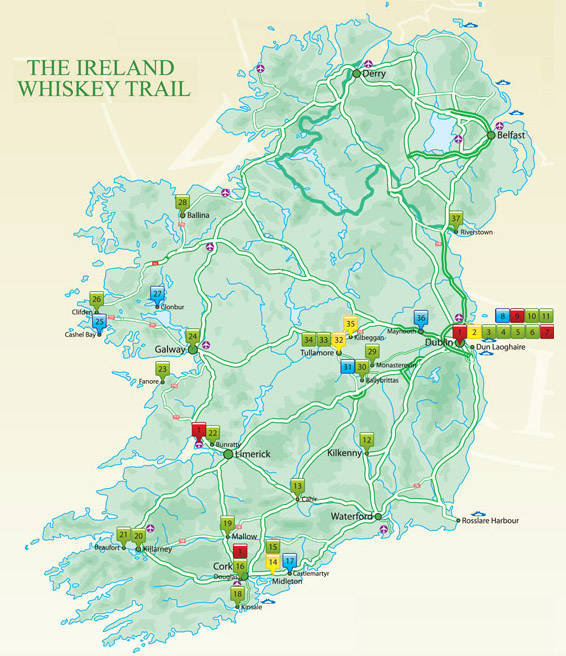
Heidi Donelon has created a touring guide for whiskey lovers to Irish pubs, hotels, whiskey shops and distilleries throughout Ireland. The trail features nearly 40 different places, ranging from the famous old Jameson Distillery in Dublin, to less well known whiskey emporiums such as Fairhill House Hotel in Connemara, which boasts a stock of more than 170 different whiskies.

Donelon says: “The trail is a great way for people to experience the story and magic of Irish whiskey, while discovering the heart of Ireland through the Irish characters they will inevitably meet in the pubs and bars across the island. It is a great touring guide for whiskey lovers, but also for anyone who wants to find that perfect Irish pub during their trip, whether they are whiskey drinkers or not. Some of these pubs are the last links to old and forgotten distilleries. These are not just great whiskey pubs, but also some of the very best traditional Irish pubs in the country.”

IN addition to the in-depth tour guide, the Ireland Whiskey Trail gives information about the history of Irish whiskey, insight into the difference between brands, Irish Coffee and whiskey recipes and details of whiskey tasting events. The Irish are credited with inventing whiskey, called uisce beatha in Gaelic, which translates as “water of life.” For 1,500 years whiskey has warmed the hearts of the Irish and their guests, and today it is a worldwide success with sales of brands such as Jameson, Bushmills, Tullamore Dew and Kilbeggan increasing at an unparalleled rate.

For more info, go to www.discoverireland.com or www.irelandwhiskeytrail.com

Switzerland’s Transport Museum

Kaitlyn and Kellen get “sized up” by this big Swiss Air DC-3.

Photos by Amy Luetgert

Wow! Cool! That’s what visitors, and especially children, say after a few minutes in this 21,500-sq-foot museum in Lucerne, located right on Lake Lucerne.

With as many as 850,000 visitors a year, the museum is Switzerland’s most popular attraction of its type.

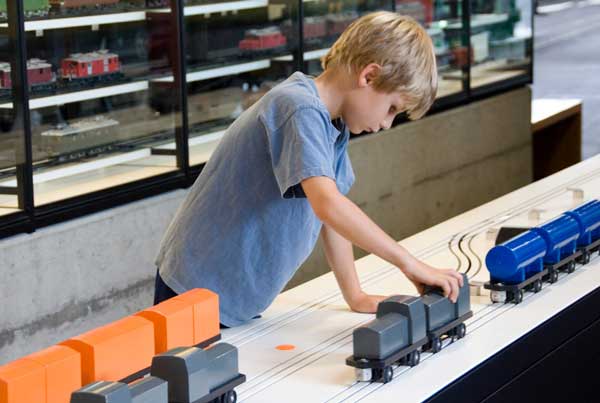
From space capsules to trains (big ones, as well as miniature ones that run through the grounds), to airplanes and helicopters and automobiles, from the latest media technologies and interactive hands-on exhibits to a cycle park, the Swiss Transport Museum displays more than 3,000 objects, plenty to keep two kids busy for a while.

Kaitlyn Luetgert, 9, and her brother Kellen, 6, from the Chicagoland area, spent an afternoon at the Museum with their parents, and their mother Amy Luetgert filed this photo report of their experiences.

The Luetgert kids “sign on” as airline pilots and flight attendants.
Kellen says, “I could spend a whole day here!”
“No problem, let’s walk under this steam engine,” urges Kellen.
With a facade like this, anything is possible inside the Museum.

For more info, go to Swiss Transport Museum