Munich’s Colorful 2007 Christmas Markets

By Marilyn Heimburger
Photos by Marilyn and Don Heimburger

What better way to discover the magic of Christmas than to experience the sights, sounds and smells of Germany’s famous colorful Christmas markets!

Not only do these markets offer beautifully-crafted products and traditional food, they are also filled with a sense of excitement, community and anticipation during the season of Advent.

Children’s eyes sparkle as they gaze at the colorful lighted displays, and friends meet to share a drink and celebrate the season.

European Traveler’s first stop on a Weihnachtsmarkt tour was Munich’s historic market in Marienplatz. Possibly dating from the 14th century, the market was first called a “Nicholas Market” during the 17th century. Since 1972 the Christkindlmarkt, as it is now called, has been held in the central square of Marienplatz, near the famous Glockenspiel in the town hall.
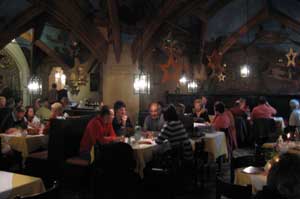
Market-goers can relax at the Ratskeller located in the basement of Munich’s Rathaus.


100-FOOT-TREE SPARKLES

A nearly 100-foot- tall Christmas tree, sparkling with thousands of tiny white lights, towers over the more than 140 stalls that fill the square and meander down Kaufingerstrasse toward the famous two-towered Frauenkirche.

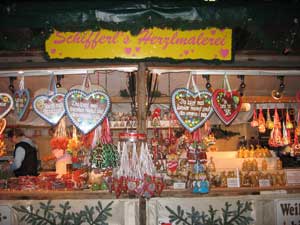
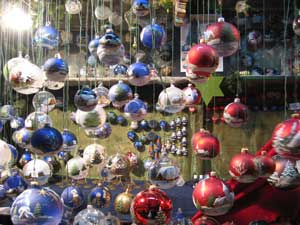
Hungry? Try the grilled sausages and sauerkraut, or potato pancakes with a glass of the delicious local beer. Or warm up with a cup of Gluhwein (hot spiced wine) and take home a souvenir Christmas Market mug. Buy a gingerbread heart that declares your love or friendship in icing, or a package of traditional Nuremberg Lebkuchen. The aroma of roasted almonds, served in paper cones, is everywhere. Handmade Christmas decorations of straw, pewter and wood, hand carved from the Oberammergau, South Tyrol and the Erzgebirge areas of Germany, carry forward Christmas traditions of centuries passed.

Candles, pottery and toys are among the offerings of other merchants, all of whom brave the chilly weather to be a part of this festive annual event that is open from the Friday before the first Sunday in Advent until Christmas Eve.

SPECIAL CHRISTKINDL STAMP

On the way to the additional booths located in the town hall’s inner courtyard is a special Christmas Post Office which will postmark your mail “Christkindl” and send it anywhere in the world.

Unique to Munich’s Christmas markets since the middle of the 18th century is the Kripperlmarkt, Germany’s largest manger market. Located a short walk away from Marienplatz on the Rindermarkt, this specialty market offers animals, figures, stalls, lanterns, sheds, trees – anything for a large or small Nativity scene. Food and beverages are available at this market from the hut at the base of a colorful, two-story-high, rotating candle pyramid.

Both the Christkindlmarkt on Marienplatz and the Kripperlmarkt on the Rindermarkt are open Monday through Friday from 10:00 a.m. to 8:30 p.m., on Saturday from 9:00 a.m. to 8:30 p.m. and on Sunday from 10:00 a.m. to 7:30 p.m. A 10-minute walk from Marienplatz to Brinner Strasse at Wittelsbacher Platz brings you to the Mittelaltermarkt. This unique market is designed to transport you to the Middle Ages, where knights and ladies-in-waiting stroll among wooden stalls, which are lighted by flaming torches and candlelight.

Vendors dress in period costumes, and hot mulled wine is served in clay vessels. Pastry, waffles, crepes, fur accessories, jewelry, candles, ceramics, and knight and princess costumes for children, are among the products available at this relatively new but increasingly popular market.

THE DALLMAYR STORE

On the way back to Marienplatz, stop and visit Dallmayr, Germany’s most famous deli . It has been located on Dienerstrasse between Marienplatz and Odeonplatz. since the late 17th century, but the current building was constructed in 1950, after the previous one was burned to the ground during World War II. Known for its brand name coffee, the delicatessen offers luxury foods that include confectioneries, tea, honey, jelly, chocolate, meat, sausage, chicken, fish, caviar, pasta, bread, fruits, vegetables, wine, tobacco, and even an indoor fountain stocked with live crayfish. There is also a high-end restaurant with seating for 120.

Another interesting and tasty stop is Rischart Bakery, located right off Marienplatz. During the Christmas market season, this outdoor, cobble-stoned café is transformed, with the help of a windowed white tent, into a heated, carpeted, indoor café, complete with a white, fabric-swagged, star-lit ceiling. Children are invited to assemble cookies for baking at a workstation, while adults enjoy coffee and a pastry.

DEUTSCHES MUSEUM OFFERS A LOT

Is it too rainy to visit the Christmas markets? Spend some time at the Deutsches Museum until the weather clears. Founded in 1903, the museum shows the development of science and technology from early time to the present day. It is one of the largest museums in the world, with exhibits on marine navigation, mining and man’s first attempts at flight to space travel and rocket science.

Beautifully detailed models show railroad and bridge construction. The museum’s collection of musical instruments is one of the most important of its kind anywhere in the world. Tours and demonstrations are scheduled daily in many departments. Find more information at www.deutsches-museum.de.

If the magic of Christmas at the markets isn’t enough, end your day at the Munich Opera House enjoying a performance of Mozart’s “Magic Flute.” This production is a holiday favorite for families, who dress in their finest for the event. During the intermission, have a glass of wine and light dinner or snack at the lower level food service area. A behind-the-scenes tour of the Bavarian State Opera house reveals the immense area available to facilitate movement and storage of scenery for the many productions. With seating for 2,101, it is the largest opera house in Germany. First built between 1811 and 1818, it was rebuilt after being destroyed by fire in 1823, and again after being bombed during World War II. The current neoclassic building was finished in 1963.

With the popularity of Munich’s Christmas Markets, accommodations may be difficult to find near Marienplatz. For comfortable lodging, try the Hotel Pullman Munch, which is just a short U-Bahn ride away from Marienplatz, the Christmas markets, and the Opera House. It is located at Theodor-Dombart-Strasse 4, 80805 Munich Phone: +49 89 360990.
Oberammergau’s Passion Play and RUHR.2010 lead the way

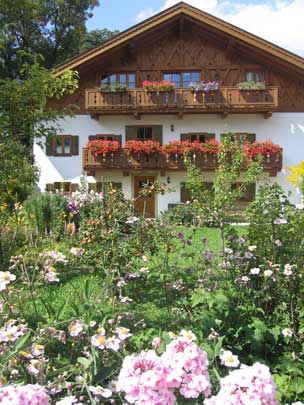
Colorful Oberammergau is home of the Passion Play in 2010.

Photos by Don Heimburger

With anniversaries and unique events all year long, 2010 is shaping up to be a year of variety and diversity in Germany.

From modern to traditional, the festivals and anniversaries offer something for every taste: the RUHR.2010 European Capital of Culture, the decennial Passion Play performance, Robert Schumann’s 200th birthday, the 300th anniversary of the renown Meissen Porcelain, the 175th birthday of the German Railway and last but not least, the 200th year of the world’s most famous beer festival, the Oktoberfest in Munich.

Essen and the Ruhr Region in western Germany will be voted the “European Cultural Capital 2010.” For the first time in this European competition the cultural capital is not an individual city, but a whole region with Essen as the standard bearer. 

The Ruhr region is Germany’s highest populated area and especially exciting for its post-industrial transformation. Discover this region on the move with its cutting edge museums and art installations within the existing walls of former coal mines and factories. The exciting project RUHR.2010 celebrates those changes with fascinating exhibitions, events and workshops starting in January.  www.ruhr2010.de 

For the 41st time, the Bavarian village of Oberammergau will celebrate the Passion Play in 2010. This event has taken place every 20 years since its first enactment in 1633. More than 2,000 Oberammergauers, actors, singers, instrumentalists and stage technicians, bring to life the last days of Christ in approximately six hours of playing time. More than 500,000 visitors from all over the world and tens of thousands of Americans will be part of this unique religious event from May 15 to October 3. www.passionsspiele2010.de 

Only one year after Mendelssohn, Leipzig celebrates another one of its famous citizens: the 200th birthday of Robert Schumann. Many concerts will be dedicated to his works, featuring solo concertos, symphonies, piano works and song-cycles. 

Without Schumann, 20th century music would be quite different. The fusion of radical subjectivity and mastery of form, and his characteristic modernity and individuality, has inspired and influenced many composers who came after him. A highlight of the Schumann Year is the anniversary concert in the Leipziger Gewandhaus on June 3 and 4, but also Baden-Baden, Bonn, Bremen, Dresden, Duesseldorf, Frankfurt, Heidelberg, Stuttgart and Zwickau will celebrate the composer with special concerts and exhibitions.  www.schumann-portal.de (German only) 

Oberammergau Mayor Arno Nunn

The history of European porcelain began with the discovery of hard porcelain and the subsequent founding of the Meissen porcelain workshop in 1710 near Dresden. In 2010 the Meissen porcelain workshop will celebrate the third centenary of its founding. Visitors can tour the factory and the museums as well as participate in workshops. 

The anniversary will be celebrated with several world class porcelain exhibitions in Meissen and Dresden. In the Meissen workshop the yearlong project “All Nations are Welcome” shows outstanding pieces of Meissen Porcelain that reflect the influence of different cultures and epochs during the workshop’s 300-year history. 

Within the walls of Albrechtsburg Castle in Meissen, where the first European porcelain workshop was founded in 1710, a special exhibition takes you deep into the beginnings of the Meissen porcelain (May 8 – October 31). Another highlight will be the exhibition in the Japanese Palais in Dresden, showing famous works from the first 100 years of the Meissen workshop (May – August). http://friedrich.meissen.com 

The world’s most famous beer festival, the Oktoberfest in Munich, celebrates its 200th anniversary from September to October 2010. It took place the first time in 1810 as a festival honoring the marriage of Crown Prince Ludwig (later King Ludwig I) and Princess Therese of Saxe-Hildburghausen. The festival grounds Theresienwiesen were named after her. The Oktoberfest, or “Wiesn” as it is called in Bavaria, started out as a horse race. A parade was added in the following years, and at the end of the 19th century, local brewers opened their beer tents. Today it is an enormous festival, attracting millions of visitors from all over the world every year with Bavarian music, food and, of course, beer.  www.oktoberfest.de 

In Nuremberg, 175 years ago, the first German train, the steam-driven “Adler” (eagle) started off towards the neighboring city of Fuerth. To celebrate this milestone in Germany’s history, the city will host several events throughout 2010: During the “Blue Night” (May 15th), artists will stage spectacular projections and actions to kick off the Railway Year, the past will be brought to life again with major locomotive and vehicle parades planned by German Rail and a comprehensive jubilee exhibition in the Deutsche Bahn Museum will focus on 175 years of railway history (dates to be determined). www.nuernberg.de 

European Christmas Markets Celebrate the Season

Advent is the season in Europe when thousands of communities–large and small–set up Christmas trees, colorful lights and craft stalls in their central market square. For decades, Europeans have been getting together at these unique Christmas markets to share conversation, to enjoy a glass of hot mulled wine, or to find just the right specialty gift for a family member or friend.

European Traveler offers a quick glance at some of these fascinating markets, which normally last until Christmas Eve.

Belgium

Every town in French-speaking Wallonia hosts its own Christmas Market. The central square of Liège and the neighbouring Place du Marché stage one of Belgium’s largest Christmas Markets, attracting more than 1 million visitors with 190 wooden chalets full of tempting goodies, sweets and original hand crafted products and presents. If you’re in Brussels between November 27 and January 3, enjoy the Brussels Winter Wonderland featuring a Christmas Market with many stalls, a giant illuminated ferris wheel, street activities and a large skating rink. 


Switzerland

In Lucerne, a number of Christmas events take place, including the Christ Child Market at Railcity, the train station, between November 28 – December 21. Around 50 festively-decorated market stalls bring a  Christmas atmosphere feel to the station.

Every year between December 3-20 Lucerne’s Christmas Market takes place at the Franziskanerplatz. There are a large variety of stands with Christmas decorations, sweets, food and beverages.  The Christmas Tree Market usually starts one week before Christmas along the Schweizerhofquai. Then between December 17-20, 20 stands from 20 countries  present typical Christmas items from their homelands. There is always a stage featuring Christmas productions from all over the world. For more information, go to www.luzern.com/en/welcome.cfm?

Germany

Thuringia is primarily famous for its festive Christmas markets and especially the large selection of glass Christmas tree decorations. The Lauscha Ball Market (always held during two weekends in Advent) has the largest selection, but these traditional decorations are also available at other Thuringian Christmas markets.

In Frankfurt you are invited to the large, time-honored Christmas market where you can become acquainted with the market’s many culinary specialities and its traditions. You can join tour guides in ascending to the rooftop gallery of St. Nicholas Church, from where you’ll be able to enjoy a wonderful panoramic view of the entire market and the Frankfurt skyline. Next, join young and old for a nostalgic ride on a vintage carousel. Warm yourself with a hot cup of mulled wine at the end of the tour and take in the wonderful view of the market’s beautifully illuminated Christmas tree. The 1 1/2 hour tours include a carousel ride, hot mulled wine and special marzipan candy. Tours are available in English and German from the first day in Advent until Christmas.

Thanks to the Tourist Boards of Germany, Belgium, Austria and Switzerland for the photos in the report.

The Maritime Museum in Malta

When in Malta, a visit to the Malta Maritime Museum is worthwhile.

The museum is located at the Vittoriosa waterfront. During the presence of the Knights of Malta on the island, the site was used as the arsenal where the Order’s galley fleet was maintained.

During the time of the British presence in Malta, the site was developed as the naval bakery, built between 1842 and 1845 by British architect and engineer William Scamp. The naval bakery supplied the Royal Navy’s Mediterranean fleet stationed in Malta with its daily requirements of bread and biscuits. The “Bakery,” as it was and still is affectionately known, remained part of the Royal Naval establishment up to the closure of the British base in March of 1979.

The museum illustrates Malta’s maritime history from prehistory to the present day; the ancient shipping section includes Roman lead anchors and amphoras. The section dedicated to the Order of St. John includes an important collection of authentic period models, some originally pertaining to the Congre-gazione delle Galere, and to the Order’s nautical school.

The French interlude (1798-1800) is represented by two large French republican guns, a prisoner-of-war wooden model of the French second-rater Bucentaur, documents, edged period weapons, and a host of water colors, engravings and lithographs.

The British period (1800-1979) is particularly well represented. The hall is divided into various sections illustrating the role of the Royal Navy in Malta.

Maltese traditional boat models, such as the Latin-rigged Gozo boat, the Ferilla and the Kajjik, tools and paintings constitute the basis of a small hall dedicated to boat building in Malta.

For more information, visit www.heritagemalta.org/museums/maritime/maritimecoll.html

Have a Very Good Trip…by Train

So, you want to show your wife or your date a very good time.

And you want to do it between Venice and Paris.

That can be arranged.

What is called the World’s Most Romantic Celebration consists of a train trip on the Orient-Express between Venice and Paris.

Here are the details. The trip is eight days and seven nights from $24,750: three nights in Venice; one night on the Venice Simplon-Orient-Express and three nights in Paris.

Departure dates, which are Sundays and Wednesdays, in 2008 are: March 30; April 6, 13, 20, 27; May 11, 14, 25;June 8, 11, 22, 29; July 20, 27; August 3, 10, 17, 24; September 10, 21, 24, 28; and October 12, 15.

The itinerary consists of:

Day 1 – Venice
Arrive in the romantic city of Venice and transfer by private water taxi boat to the Hotel Cipriani. A deluxe suite is reserved for three nights in the city of canals. 

Overnight in Venice.


Day 2 – Venice
A personally tailored guided tour of the city in the morning. In the afternoon, the private launch of Romilly, Lady McAlpine collects you from the hotel and takes you to her home for a visit and refreshments. 

Breakfast included. Overnight in Venice.

Day 3 – Venice
Explore the delights of La Serenissima before a final romantic evening, including a ride on a gondola before dinner, at one of Venice’s most exclusive restaurants. 

Breakfast and dinner included. Overnight in Venice.


Day 4 – On the Venice Simplon-Orient-Express
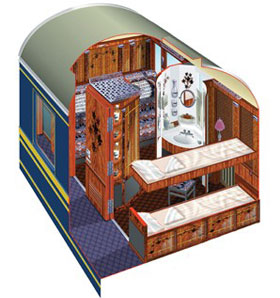
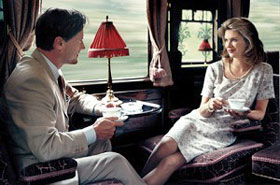
The train’s hostess completes check-in formalities for your journey on the Venice Simplon-Orient-Express train before your private transfer to the station. Board the train (cabin suite) for the overnight journey to Paris, enjoying superb cuisine and sparkling champagne. 

Breakfast, lunch and dinner included. Overnight on board.


Day 6 – Paris
After breakfast, a private car and driver takes you to the French countryside en route to Reims, capital of the Champagne region, where you have a private tasting before lunch at the two-star Michelin restaurant of Chateau Les Crayères, accompanied by fine wines and Prestige Champagne. After lunch, return to Paris. Breakfast and lunch included. Overnight in Paris.

Day 7 – Paris 
Time for final sightseeing or shopping in the boutiques and designer stores. In the evening a private car transfers you to Quai de Grenelle, where you board a luxurious private yacht. The vessel’s teak deck and sleek interiors allow you to relish the cozy atmosphere of a 1960s boat. Enjoy a glass of champagne as you cruise along the river Seine, before a romantic candlelit dinner served either on the outdoor deck or the inside cabin. A shower of roses completes the cruise before returning for a final night in Paris. Breakfast and dinner included. Overnight in Paris.

Day 8 – Paris
Your journey comes to an end. Breakfast included.  All aboard!

IF YOU GO…
Log onto www.orient-express.com for more details about the trip. Or, call (in the USA) 401-351-7518 or e-mail to: oesales.providence@orient-express.com. From France, call +33 1 55 62 18 00; from Germany, call +41 44 770 1407; from the Netherlands, call +31 35 6955111; and from the U.K., call +44 20 7805 5060