Photos Courtesy Austrian Tourist Office and Tourism Salzburg
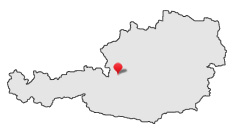
High above Salzach Valley near Salzburg and built with an unyielding stone facade, the 900-year-old Hohenwerfen Fortress has undergone centuries of development to become one of the oldest and best-preserved castles in Europe.
Tour the interior of this historic structure, visit the impressive falconry displays at Austria’s first Falconry Museum or enjoy concerts, theater performances and heritage evenings throughout the year.
Hohenwerfen Fortress
Isolated high above the Salzachtal Valley near Salzburg, Hohenwerfen fortress has a history of protecting archbishops and archdukes from enemies, as well as keeping prisoners locked up behind the impenetrable castle’s walls. These days, the stronghold’s doors are wide open to visitors to explore the history of this “Castle of Adventure.”
GREETINGS FROM THE MIDDLE AGES A guided tour takes you through the venerable fortress’ chapel, kitchens, battlements and bell tower. Check out weapons from throughout the ages on display in the armory and arsenal, and inspect the residential rooms of former castle governors.
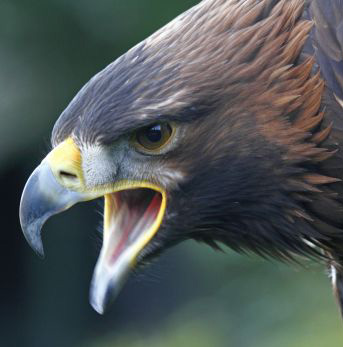
THE HIGH ART OF FALCONRY Every year, a wide variety of special events including concerts, theater performances, and folk heritage evenings take place at Hohenwerfen. Many consider the highlight of this lineup to be the daily demonstrations of falconry put on by the Provincial Falconer. To learn more about the history and skill of falconry, visit Austria’s first falconry museum along the Bird-of-Prey Path.
By Danielle Pruger Photos courtesy of Castilla-León Regional Tourist Board
Castile-Léon Spain is highlighted in red.
Castile-Léon, an interior region of Spain, is known for its castles (Castile means “land of castles” in Spanish) and provides a look at ancient and medieval forms of architecture. Throughout the Middle Ages, Castile-Léon served as a frontier between Christians and Muslims from the 9th century to the 11th century, which created the initial motivation for building fortresses and castles. Later, the struggle between the various noble families and the royal family from the 12th century to the 15th century made it necessary to build new fortifications. The following six castles, open to the public, can be found in Castile-Léon.
AMPUDIA CASTLE The municipality of Ampudia is home to a 15th century castle which stands in the center of the village. This castle is well preserved and has been restored. Its sturdy enclosure is protected by four towers, and it has all of the traditional elements of medieval castles: battlements, ramparts, barbicans and a moat. Although it is privately owned, it is open to visitors, and its interior is home to a museum of art and antiquity.
PEÑAFIEL CASTLE The medieval castle in Peñafiel was built in the 11th century and stands on a rocky spur. The castle was rebuilt around the 14th and 15th centuries and has a peculiar shape because the outline of the walled enclosure conforms to the elongated silhouette of the ridge. This unusual shape has made it one of Spain’s most famous images; from a distance the castle resembles a boat run aground in the midst of a sea of pastures and wheat fields. This castle is also home to the Provincial Wine Museum.
ALCÁZAR FORTRESS The city of Segovia contains the Alcázar fortress, another one of Spain’s most emblematic images. This imposing Gothic building was built between the 14th and 15th centuries and was later transformed by Philip II in the 16th century into the Herrerrian style seen today. It was the residence of the Castilian and Spanish monarchs for two centuries; its location is on a gorge above the Eresma and Clamores rivers. The location, along with the appearance of the castle, is similar to the castles in fairytales, which evoke the images of princesses, knights, witches and dragons.
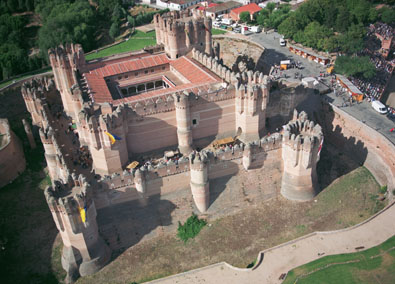
COCA CASTLE The Coca Castle, located in the municipality of Coca, is completely different from other castles; it was built in the Mudejar style of the 15th century using typical red brick. It has three walled enclosures, a moat with a drawbridge, a bailey (courtyard) and a splendid keep. The village of Coca is the descendant of the Celtic-Iberian city of Cauca, which was conquered by the Romans in 151 B.C.
LA MOTA CASTLE La Mota Castle, also designed in the Mudejar style, is located in the town of Medina del Campo. It was built in the 15th century using concrete and red brick and has four enclosures protected by enormous walls, as well as a monumental keep. It was in the 15th century that Medina del Campo reached its maximum splendor: its fairs were the most important in all of Europe, and it is where bills, instead of coins, were first used as currency. This is also the place where Queen Isabella I of Castile, known as Isabella “la Católica,” died.
Zamora Castle
ZAMORA CASTLE The city of Zamora, located beside the Duero River, has a medieval castle that was built in the 12th century. This castle was restored in 2009, and the castle is surrounded by three walled enclosures dating from the same period, which encircle the historic center of town.
Lismore Castle is a unique destination ideal for family holidays, a special gathering of friends or even a romantic wedding. The layout of the castle means it can feel intimate with 8-12 guests yet spacious with up to 27 and there is room for many more in the Banqueting Hall for larger events. A dedicated staff is on hand to offer help on every aspect of your stay.
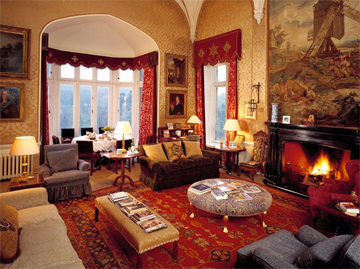
Originally built in 1185 by King John, Lismore Castle was owned in turn by Sir Walter Raleigh and Richard Boyle, First Earl of Cork, before passing to the Fourth Duke of Devonshire in 1753. The castle, located in the southern county of West Waterford, is designed in Gothic style and contains some of the finest examples of domestic Pugin furniture still in private hands. The gardens, laid out over eight acres within the 17th Century outer defensive walls, are believed to be the oldest in Ireland and retain much of their original Jacobean form. In recent years, the castle has been extensively restored and upgraded by successive Dukes but the historic charm remains intact. In addition, the West Wing has been renovated as a contemporary art gallery.
Continually cultivated gardens
FINE FOOD Fine food is the highlight of any guest’s stay; everything is made from scratch in the castle kitchens. Seasonal food is a must for Lismore Castle chefs, and the ever-expanding kitchen gardens offer a plentiful supply of home grown produce to provide accompaniments to locally sourced seafood, fish and meat.
Afternoon tea in the drawing room19th Century decor adorns the Dining Room
From hikes and hot air balloon rides in and over the nearby Knockmealdown Mountains to beachcombing and rock-pooling with botanists on White Bay Strand, to sea kayaking and surfing in Ardmore Bay, to cycle tours along the river and leisurely strolls along Lady Louisa’ Walk, Lismore and the surrounding area is paradise for lovers of the outdoors. Take part in the Sean Kelly Cycle Tour and pedal the hills and valleys where Ireland’s greatest cyclist’s bike once flashed over the cobbles or enjoy a day out at the Tramore Races Festival.
The Blackwater fishing season, an example of one of many festivals in the area, runs from February 1st to September 30th. Enjoy casual casting on a charming stretch of river beneath the castle walls or test your skills and on famed stretches nearby. The Kilkenny Arts Festival (renowned multi-arts festival) and Spraoi, a free urban festival in Waterford city are also within easy reach of Lismore.
Lismore Castle offers packages which include multi-night accommodation with breakfast, afternoon tea and dinner; private airport transfers and more.
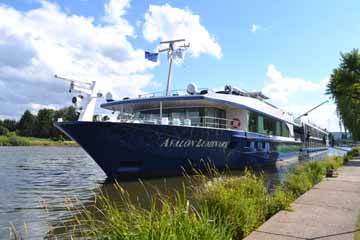
Are you are looking for a vacation that combines relaxation, a bit of history, romantic castles, charming medieval villages, and excellent cuisine? This week-long river cruise on the Moselle, Rhine and Main rivers in Germany, offered by Avalon Waterways, may be the perfect choice for you.
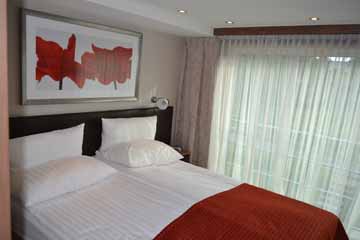
The MS Avalon Luminary, our ship for this cruise, was just recently added to Avalon’s fleet. Its 69 staterooms and suites are designed for efficiency, with plenty of space to stow personal items and luggage. Each room had a small bathroom with shower, comfortable memory foam mattress, a desk, lamp, mirror, fresh flowers, mini bar, and a safe for valuables. A television provided satellite programming and broadcast the view from a camera at the front of the ship. Floor-to-ceiling windows open to a private balcony in most rooms. It’s a luxury of river cruising to just unpack once and let the ship transport you with ease to each destination.
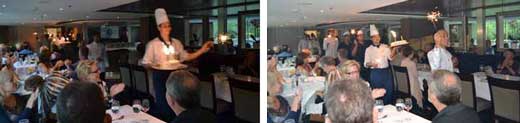
Another luxury on a cruise such as this is the excellent cuisine. The sumptuous breakfast buffet included breads, pastries and cereals, fruits, eggs, potatoes, sausages and bacon, and made-to-order entrees. The full lunch buffet served each day in the main dining room offered soups, salads, choice of main course and desserts. A lighter lunch option was also available in the lounge one deck above. Five-course dinners included an appetizer, choice of soups, salad, choice of meat, fish or vegetarian main course, and several dessert options. The well-trained staff served red, rose, or white wine or beer upon request.
BOARD IN LUXEMBOURG Boarding the Luminary in Remich, Luxembourg, we were welcomed by cruise director Jean Loup Domart. Entertaining, energetic, and extremely organized, Jean excelled at keeping everything running smoothly.
Although we set sail while dinner was being served, we missed none of the excitement, since the dining room was designed for maximum viewing, with panoramic windows on both sides. A sense of intimacy was provided with fresh orchids in lighted open rectangles dividing the large space without interrupting with the view. The lounge on the level directly above the dining room was also designed for watching Germany glide by in the most comfortable of settings.
Our first stop was Trier, Germany, which boasts amazingly intact structures from the Roman Empire, including imperial baths, an amphitheater, and Constantine’s reception hall, which now serves as a protestant church. Did you ever wonder why Roman ruins always seem to be discovered 6 feet underground? We learned from our local guide that after Roman towns were abandoned, local residents built homes by taking usable stones from the old Roman buildings. Over the course of 600 years, this practice left a 6-foot-deep base of rubble, upon which the medieval towns were built. Trier’s Porta Nigra (black gate) is black from wood fire smoke from Roman times, and was left standing because it was a site that attracted pilgrims, who brought money to the church.
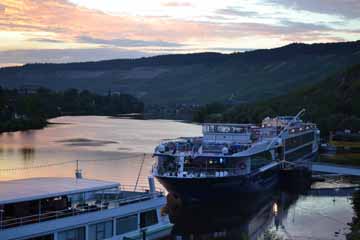
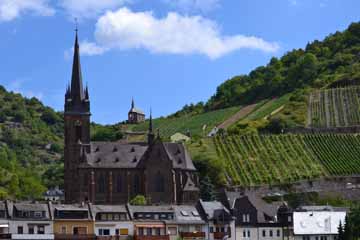
As our trip continued down the Moselle, we passed vineyard after vineyard and peaceful patchwork slopes, dotted with small villages and church steeples. The southern facing slopes provide the perfect environment for catching warm sunlight needed to grow grapes for Germany’s famous Riesling wines. And the ship’s outdoor decks were perfect for relaxing with a cup of coffee or listening to birds along the shore as the ship glided quietly along.
BERNKASTEL-KUES WEINFEST Our late afternoon arrival in Bernkastel-Kues allowed just enough time to explore the Old Town around the quaint market square. This town hosts the biggest Weinfest on the Moselle in September. One vineyard overlooking the town is the source of their “Doktor” wine. Legend has it that drinking some of the wine from this vineyard cured an archbishop of an ailment, so the wine became known as the “Doktor.”
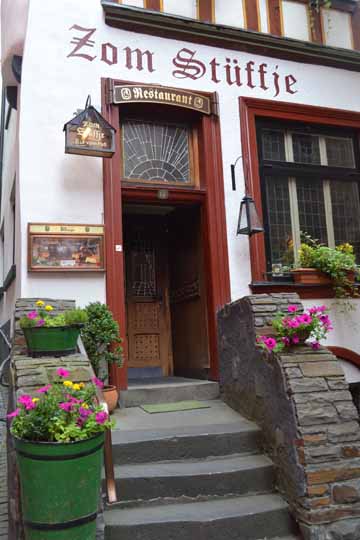
Half-timbered buildings in Bernkastel
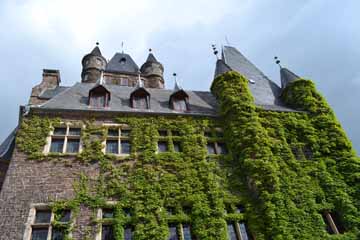
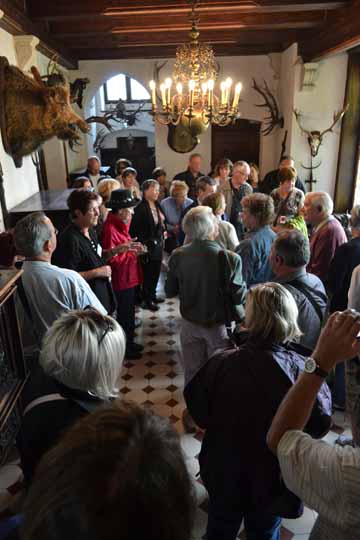
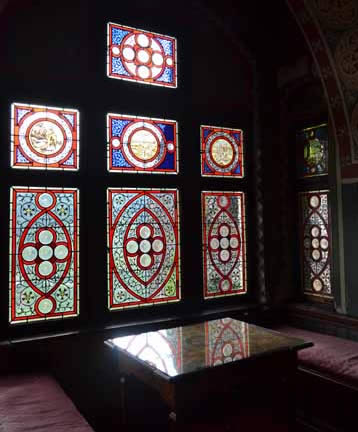
The next day brought us to the wine town of Cochem and a tour of Reichsburg Castle. The interior of the castle highlights not only only medieval artifacts, but Renaissance and Baroque furnishings selected by the 19th century restorers. The tour was informative and the view from the castle — spectacular.
Passengers tour the castle
The Moselle joins the Rhine at Koblenz, an important center of trade during the Middle Ages. An imposing statue of Kaiser Wilhelm I mounted on a horse dominates the Deutches Eck (German Corner) where the two rivers meet. We arrived just before dinner, with enough time for a short walk into the square to see the many shops and restaurants. The fortress Ehrenbreitstein stands on the opposite bank of the river and provides a beautiful panoramic view of the area.
To begin our cruise down the Rhine Gorge (some say the most beautiful part of the Rhine) first thing in the morning, we docked overnight at Koblenz, and were entertained on board after dinner by a small ensemble of classical musicians.
THE MIDDLE RHINE The next morning was filled with the history, legends and romance of the Middle Rhine. Cruise Director Jean Loup provided informative narration as the ship glided along, with passengers enjoying the view while relaxing on the sundeck. We learned that during the Middle Ages the Rhine River Gorge posed many hazards for travelers, and provided many opportunities for powerful kings to levy tolls for safe passage. They built castles and fortresses in the 12th and 13th centuries along the banks to collect tolls, make money, and enlarge territories.
Reichsburg Castle
The castles were usually built high on hills, close to a spring, and often on a curve with a view of the river. Stones for the castles were lifted with wheels and ropes, and the building projects provided work and security for locals, whose lifespan at the time was only about 40 years. Most castles were built with limestone, which was easier to work with than granite. Later palaces were built with marble, as techniques improved. To attack a fortress, enemies could try to break down a wall or door with a battering ram on wheels with a roof as protection from arrows shot from the castle. Or a catapult could throw fire over the castle walls. Castles residents used beehives, hot tar or hot water to fend off attackers. Some fortresses housed armies of 600.
In the town of Boppard we saw Sterrenberg and Liebenstein, known as the castles of the enemy brothers, and heard the legend: Two brothers both fell in love with their adopted sister. She wanted none of this, and entered a monastery in town to live as a nun. The brothers fought and finally built two castles next to each other with a wall in between.
The 430-foot-high Lorelei rock is located where the river narrows, creating treacherous currents dangerous to ships. The famous legend of the beautiful maiden who sat on the rock luring sailors to their destruction with her singing is commemorated with a bronze statue.
The town of Oberwesel, below Schoenburg Castle, still has many fortification walls and towers still standing. When the river water is low, travelers can see the “rocks of the seven virgins.” Legend has it that a lord with seven sons wanted to arrange marriages for them. The seven chosen virgins didn’t want to marry, and threw themselves into the Rhine, where, because they were so hardhearted, they turned to stone.
Pfalz Castle (whose gold lion was to symbolize strength and power) was built in the 16-17th century as a customs tollhouse on a little island in the middle of the river. Gutenfels Fortress was built on the bank opposite Oberwesel to protect the tollhouse.
Sooneck Castle, a toll-enforcing castle from the 11th century, also housed pirates. It is one of the oldest along the Rhine and is restored as a cafe.
In an attempt to preserve the beauty and tranquility of the shoreline, many of the houses along the shore are painted in soft pastels, often pale yellow, a color made popular by Maria Theresa. Train tunnel entrances on this stretch of the river are built to look like castles, in order to blend in with the style of the area.
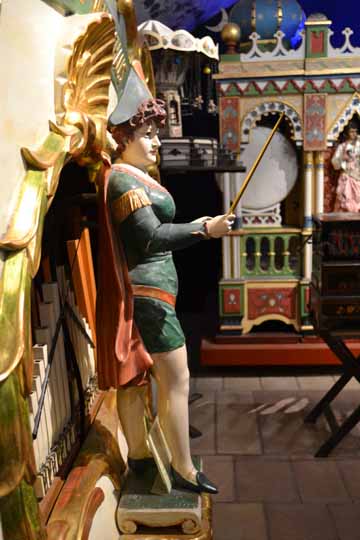
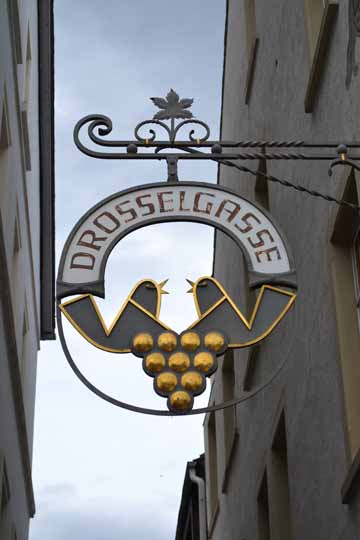
(left to right) Siegfried’s Mechanical Musical Instrument Museum; Drosselgasse, a lively street in Rudesheim.
DROSSELGASSE A FAVORITE Our last stop on the Rhine River was in Rudesheim, where we enjoyed a guided tour of the Museum of Mechanical Musical Instruments (some imitating entire orchestras in one huge contraption!), and a local winery. Be sure to take time to explore the exciting main street, the Drosselgasse, with its many restaurants and shops.
Navigating the Main River is a slow process because of the many locks needed to raise or lower the ship along the route. So our ever resourceful cruise director kept passengers busy on board with an entertaining German lesson, and a cookie-baking demonstration by an “almost nun” from Miltenberg, our next port of call on the Main.
Miltenberg
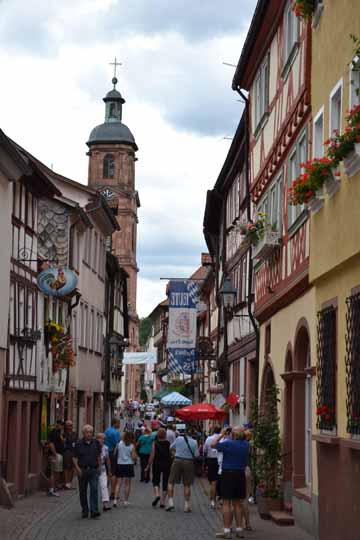
Miltenberg was built against a hill at a curve in the river, a perfect place to collect tolls for the archbishop of Mainz. Many half-timbered houses are still preserved because the people here were too poor to tear them down and rebuild. If a floor sagged and sank, it was filled with sand and covered with another floor. In some recently renovated buildings, 30 centimeters of sand/wood layers were discovered beneath the floor. The original red “paint” on the houses was a mixture containing, among other things, oxblood and cattle dung, which provided the desired red color and also killed worms that might live in the wood. A unique naturally cool icehouse is located in the hill at the rear of the town.
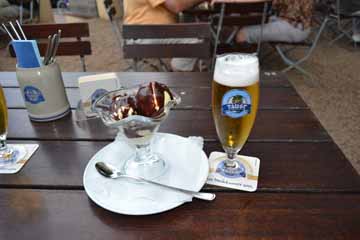
Cold beer and ice cream
While the ship slowly navigated through more locks, passengers rode by bus to Wurzburg, and met the ship when it finally docked after our tour. Wurzburg is the site of the Prince Bishop’s Residenz, which is one of the finest examples of a baroque palace, and also a UNESCO World Heritage Site. It was built to rival Versailles in France and the Schoenbrunn in Vienna. The unique mirrored room features the difficult technique of reverse painting. The famous ceiling fresco by Tiepolo miraculously survived bombing, and the original marble floor is still in the main reception hall. The “marble” pillars are actually a stone core with a ground marble coating so that colors could be controlled, a technique that was more expensive than using solid marble.
Wurzburg
WURZBURG AND X-RAYS Wurzburg was also the home of Professor William Conrad Rundkin, winner of the Nobel Prize for the discovery of X-rays. Residents in Wurzburg are not x-rayed; they are “Rundkined.”
Bamberg
The terrain along the river from Wurzburg to Bamberg changes and becomes flatter, with fewer vineyards, more trees and shrubs, and more locks. This quiet time was perfect for relaxing with a book from the ship’s library, located in the small lounge at the rear of the ship. There passengers found English language books of all genres, games, and the most wonderful coffee machine which dispensed espresso drinks that rivaled any coffee shop. Iced tea, shortbread cookies and other snacks were available 24/7. The ship also had an exercise room with a treadmill, two types of exercycles and flat screen TV, and a small beauty salon.
Cruise ship surprises
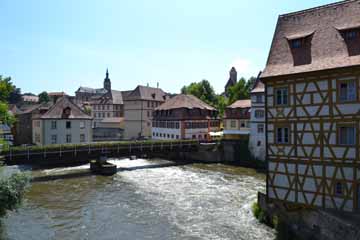
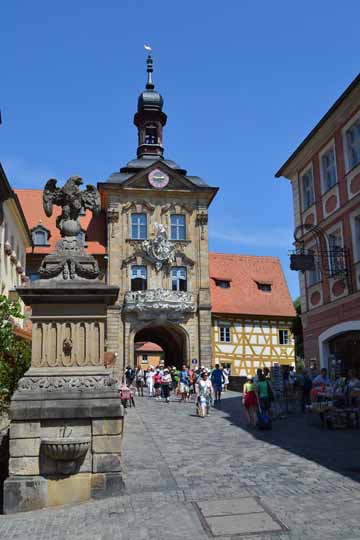
Busses again transported us to meet local tour guides in Bamberg, another UNESCO World Heritage Site. There we learned the local history of the cathedral, the Old Town Hall, which straddles the River Regnitz, had an opportunity to taste the local specialty, “Rauchbier” (smoked beer), and had time for browsing in the main pedestrian shopping area.
Our cruise ended the next morning upon arrival in Nuremberg, from which some passengers continued by bus to Prague, and others to charming Rothenburg ob der Tauber.
IF YOU GO.. Avalon Waterways, which has been in business for 80 years, has a number of different river cruises available in Europe. Their river cruise ships are small compared to ocean liners, which makes the service and trip more personal. They also have Europe’s youngest fleet of ships, with their fleet averaging just two years old, compared to seven years for other cruise companies.
There are full floor to ceiling sliding glass doors in 85% of the deluxe staterooms on Avalon’s fleet. Also, the Luminary had lots of space in the central passenger areas such as the dining room, lounge and library.
The Luminary offered five categories of rooms including Royal Deck suites; Royal Deck Category P; Sapphire Deck Forward, Category A; Sapphire Deck Aft, Category B; and Indigo Deck, Category E.
And grand castles, happy sheep and catchy music aplenty
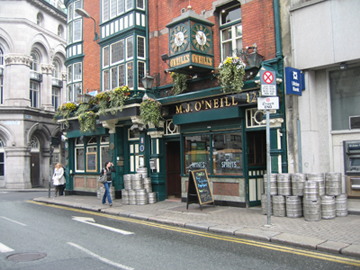
Pub in Temple Bar, Dublin
By Don Heimburger Photos by the author
The Emerald Isle is inviting to first-time European visitors for several good reasons.
Because you’re not traveling to continental Europe, the flight time is from 1-1 ½ hours less from the United States. It’s 3,614 miles between Chicago and Dublin, or 3,187 miles between New York and Dublin. From Chicago to Dusseldorf on the mainland it’s 4,217 miles.
The time zone in Ireland is an hour closer to U.S. time zones.
You needn’t speak a foreign language.
These are a few reasons you may want to place Ireland at the top of your “must visit” list, but there are many other incentives, as well. As many as 40 million Americans claim to have Irish blood―that’s 10 times more than the population of Ireland itself.
How do most visitors get there? You could take a cruise ship across the Atlantic, but most people are in a hurry and fly, and that means American, U.S. Airways, Delta, Continental or Aer Lingus (which sometimes has some really low fares, especially in early spring).
DUBLIN’S ATTRACTIONS Since you’re probably flying into Dublin, where most visitors begin their adventure, you’ll want to spend at least a day there. In fact, I’d recommend two or three days, because there is a lot to discover. Think of St. Stephen’s Green as a center point for your activities. This lush, quiet Victorian garden is located in the main part of the city, yet it is a refuge from the hustle and bustle, and you can always come back to it for solace and relaxation. With ponds, picnicking, wildlife and a playground for kids, it makes an ideal meeting point as well. In the summer, lunch time concerts are given here.
Fanning out from the Green are the National Museum of Archaeology and the National Museum of Natural History. At the first museum, you’ll be transported back to 7,000 B.C. You’ll see examples of Celtic and Medieval art such as the famous Ardagh Chalice, the Tar Brooch and the Derrynaflan Hoard, another old historic chalice. Ireland’s foremost treasure, the Ardagh Chalice, is considered the jewel in the crown of all exhibits there. The beautifully proportioned chalice is the finest example of eighth century metalwork ever to have been found. Standing six inches high, it is made of silver, bronze and gold; the design and decoration indicates technical proficiency of the highest order.
Heading down Nassau Street, you come to Trinity College, the oldest university in Ireland and situated on 40 acres in the heart of the city. Besides strolling the sidewalks around here where you’ll feel like a college student again, you’ll want to see the Book of Kells, a 9th century Gospel manuscript created by Celtic monks. Its lavishly decorated pages in Latin of the four Gospels is a masterpiece of calligraphy and represents the ultimate in Insular illumination. It is definitely worth the trip to see, as is the Long Room of books (215 feet long), which contains more than 200,000 of Trinity’s most ancient volumes. Interestingly, in 1860 the roof of the building was raised higher to accommodate more books. The Long Room is an impressive site, with 14 marble busts commissioned by sculptor Peter Scheemakers lining both sides of the gallery.
TEMPLE BAR AWAITS YOU On the other side of Trinity and bordered by the River Liffey, is the Temple Bar section of the city, where nightlife is abundant. Bar after bar is crowded into the narrow cobblestone streets here, and more than 50 contemporary art and cultural galleries and studios in this section of the city make up a part of what is called “Dublin’s Cultural Quarter.” On weekends, open markets are held in Meeting House Square nearby as well.
On Grafton Street, the main shopping area, you’ll find Molly Malone’s statue where you can have your picture taken to send back to friends and relatives. Molly was a legendary figure, celebrated in the song Cockles and Mussels, a Dublin anthem. Molly Malone is one of the more famous people from Dublin’s past, but whether she really existed is not known.
She’s certainly one of the strangest icons ever officially commemorated by a city government. The statue, erected in 1987, depicts a woman in 17th century dress that shows abundant cleavage. Molly allegedly sold fish by day and sold her body by night. Though she lived in the 1600’s, the song Cockles and Mussels about her does not appear in any historic record before the 1880’s. The familiar lyric goes:
In Dublin’s fair city where the girls are so pretty I first set my eyes on sweet Molly Malone As she wheeled her wheelbarrow Through streets broad and narrow Crying, “Cockles and mussels, alive alive oh!”
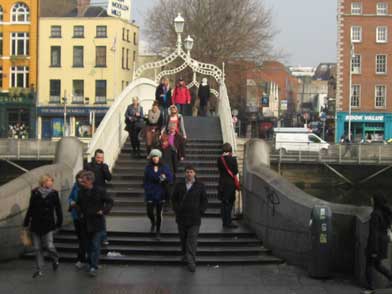
CITY BREWS Ha’Penny Bridge is Dublin’s oldest pedestrian bridge. Erected in 1816, a toll of half a penny was levied on all users of the bridge until 1919. You’ll also want to see the Guinness Storehouse when visiting and take a tour, and then enjoy a fresh glass of Guinness in the Gravity Bar afterward. Cost is €13.50. The Storehouse is located in a section of town called the Liberties, which lay outside the city walls in earlier times.
In the Smithfield Village area, across the Liffey, is the Old 1780 Jameson Distillery, once considered one of the largest and finest distilleries in the world. You will discover the time-honored secret of how three simple ingredients―water, barley and yeast―combine to make whiskey. And you can end your tour with whiskey tasting in the Jameson Bar. The distillery tour is open seven days a week, and if you’re really into it, you can request a tutored whiskey tasting.
FAMOUS DUBLIN WRITERS The Dublin Writer’s Museum, which opened in 1991 and is located in an 18th century mansion, offers visitors a fascinating view of famous Irish writers such as Oscar Wilde, James Joyce, Jonathan Swift and George Bernard Shaw. It’s a small but interesting museum that tells the background of these famous people.James Joyce, the author of Ulysses, has his own museum in Joyce Tower at No. 35 North Great George’s Street. The house was built in 1784 for Valentine Brown, the Earl of Kenmare, and is decorated with plasterwork by Michael Stapleton. Restored in the 1980s, the house opened as the James Joyce Center in 1996, and is run by members of Joyce’s sister’s family.
St. Patrick’s Cathedral on Patrick Street is an important Dublin landmark, with writer and satirist Jonathan Swift its Dean between 1713-1747. In 1742, the first performance of Handel’s Messiah was performed here by the combined choirs of St. Patrick’s and Christ Church, just a block away. (Christ Church is the oldest building in Dublin, dating from c. 1030. Inside are rare artifacts, examples of early gold and silverware, and historic manuscripts.)
CAD E’ AN SCE’AL? (WHAT’S GOING ON?) Many other sights are waiting for the European traveler as well in this city of about 1.5 million. You’ll find the natives very friendly and accommodating. Getting around Old Town Dublin is easy: walking is your best bet.
Maps are available that detail the highlights of the city; the Dublin tourism office is located just past Grafton Street on Suffolk Street where you can pick up free information leaflets and get personal advice on things to do, places to visit and to eat. The tourist office staff speaks seven languages, including English, French, German, Irish, Italian, Polish and Spanish. There are also sightseeing tour buses that will take you around the city. For more information, go to visitdublin.com. Also, the Dublin tram system, called LUAS, is a state-of-the-art light rail system operating on a Green and a Red line. If you stay close to the Old Town, however, the tram won’t be needed. The Green Line starts at St. Stephen’s Green, and a downtown Red Line stop is at Abbey Street.
The Dublin Pass is a cost-saving card will allows you access to more than 30 of Dublin’s top attractions and more. Go to dublinpass.ie for information.
For those who want a five-star hotel experience, the Shelbourne, a Renaissance hotel, is conveniently located on St. Stephen’s Green, and lives up to its reputation. It’s located just a few steps from Dublin’s sights and shops. Founded in 1824, the Irish constitution was drafted here; the hotel retains its original charm and is an oasis in the midst of the city’s clamor. The hotel features a total of 265 rooms, including seven for the physically challenged.
SOUTH COAST ATTRACTIONS There are many areas of Ireland that appeal to visitors. But with Dublin as a starting point, let’s drop down the southeast coast to do more exploring.
If you’re driving, you’ll want to use N11, a major highway that runs along the coast to Wexford. Roads in Ireland are fairly narrow, so be aware of this: it can be a daunting experience. This is where a trained bus driver on a group tour comes in handy.
Glendalough, which translates into “the valley of the two lakes,” is about 90 minutes south of Dublin, and is a totally captivating spot. It contains ruins from a 6th century monastery, some of which remains today.
The short history of Glenalough is thus: St. Kevin was a descendent of one of the ruling families of Leinster. As a young boy he went to live at Glendalough, and founded a monastery there which continued to expand for 600 years, but was destroyed in 1398. In its prime, the land included churches, monastic cells and workshops, guesthouses, a health center, farm buildings and homes. Most of the buildings that survive date from the 10th through 12th centuries. The most famous is the pencil thin round tower which is 112 feet high with a base 52 feet in circumference. A cathedral, stone churches and decorated crosses also survive. Take your camera along, as Glenalough is excellent for snapping unique pictures, especially if it’s a bit foggy. A modern visitor’s center features an informative movie about the ruins and its history, and wandering paths in the surrounding valley offer more exploration.
POWERSCOURT HOUSE AND GARDENS Situated in the picturesque mountains of Wicklow, Powerscourt is a large mansion once owned by powerful families such as the O’Tooles and the FitzGeralds, Earls of Kildare. In 1603, Powerscourt Castle and the surrounding lands were granted to Richard Wingfield, who was Marshal of Ireland (a royal officeholder). His descendants remained there for more than 350 years.
Later the castle was remodeled, creating a magnificent mansion around the shell of the former castle. Large formal gardens, a fish pond, cascading waterfalls, grottoes and terraces all form a striking approach to the mansion. The story is told that Daniel Robertson, a garden architect and a leading proponent of Italianate garden design, suffered from gout and directed his operations from a wheelbarrow, fortified by a bottle of good sherry. When the sherry was depleted, Robertson’s work ceased for the day!
Near the imposing castle is the five-star Ritz-Carlton, overlooking the wooded slopes of Sugar Loaf Mountain. Blending into the countryside, this 200-room, seven-story hotel is ritzy, with a warm Georgian-inspired interior. Afternoon tea, evening cocktails in the Sugar Loaf Lounge, the Gordon Ramsey signature restaurant and a complete Irish pub combine to make a stay here memorable. The hotel’s spa is also available to guests, which is on two floors and boasts a 65-foot long Swarovski crystal-lit swimming pool. There’s also a 36-hole championship golf course as part of the hotel complex.
DUNBRODY SHIP PROJECT In 2011 the JFK Trust launched its replica of a 19th century three-masted sailing ship, the Dunbrody, that brought immigrants to America. This ship is on display in New Ross harbor; an audio-visual experience, guided tours and a convincing performance of costumed actors brings to life the long, difficult journeys made in the 19th century on this ship. A new visitor’s museum will be ready this year as well.
For a night’s rest in this area, check out the Dunbrody Country Hotel and Spa in Arthurstown. It’s a 1830s Georgian manor amid 300 acres of tranquil parklands, not far from Waterford. This four-star hotel, owned by hospitable Catherine and Kevin Dundon, offers 22 rooms. Master chef Kevin Dundon also has a cooking school here and designs one- and two-day cooking courses―there’s even a week-long master class. You’ll feel rejuvenated after a few days in this setting. www.dunbrodyhouse.com
Dunbrody Cookery School’s Edward Hayden
If you want to get up close and personal to the water and the Irish shoreline, here’s your chance. Hook Head Lighthouse in New Ross has been a guiding light for ships for more than 800 years. There’s a visitor’s center offering guided tours of the 13th century tower, a gift shop, cafe, art classes and picnic areas.
Glass blowers and artisans at the Waterford Crystal factory
At Waterford, a stop at the Waterford Crystal factory is a must. Since 1783, the company that George and William Penrose founded has been making stunning glass pieces with a distinctive, silvery white brilliance, which Waterford Crystal’s artists enhance with deeply-cut ornamentation. It’s said that in all of Ireland, no hands have been more patient, more meticulous, or more blessed with the elusive powers of art, than the hands of Waterford Crystal’s craftsmen. Drinkware, serving accessories and decorative crystal from the Waterford factory is still the customary gift for royalty and heads of state. It’s not inexpensive, but a factory tour will show you the secret of why this glass has been so highly prized for all these years.
LISMORE CASTLE GARDENS Heading to Lismore, you can visit the beautiful Lismore Castle gardens and gallery. In the Burlington family for more than 400 years, this fairytale castle, originated in 1185, has seen many changes since. Because the Burlington family stills resides there (Lord and Lady Burlington), only the gardens and gallery are open for touring. The gardens are set on seven acres and provide spectacular views of the castle and the surrounding countryside. You might even see Lord or Lady Burlington on the grounds!
When you’re looking for a place to land for the night, you might try this hotel located next to the sea. The Cliff House has been described as a five-star cascading luxury hotel sewn into Ireland’s coastline, overlooking the small village of Ardmore. Thrown in for good measure is the House Restaurant (one Michelin star), serving both Irish and international cuisine This 39-bedroom jewel is tops for either a holiday (as the Irish call it), or it’s perfect as a hideaway to recoup. www.thecliffhousehotel.com
Kilkenny Castle
At Kilkenny Castle in Kilkenny, you can take a guided tour of this 12th century structure, originally built for William Marshall, the Earl of Pembroke. With many additions and changes over the centuries, this dark gray castle comprises many architectural styles, seen in the various ornate rooms. You’ll see the Drawing Room, Withdrawing Room (reserved for ladies after dinner), the Picture Galley Wing with a hammer-beam roof structure, the Library with silk damask curtains and the elegant Dining Room, among other rooms. Surprisingly, the Marquess of Ormonde sold the sprawling castle to the people of Kilkenny for the sum of €50 in 1967.
Afterward, stroll over to Kyteler’s Inn in downtown Kilkenny, and have lunch or supper in this fun, quaint restaurant, established in 1324. Look for the story of the original owner, Dame Alice le Kyteler, on the first floor.
FLYING BACK TO DUBLIN On the way out of Ireland, reserve a room on the last evening at the four-star Barberstown Castle, a short 30-minute drive from the Dublin airport. Situated on 20 acres of flower gardens, this Irish country house has flourished for eight centuries, opening as a hotel in 1971. Its Victorian and Elizabethan extensions have been melded with the original castle battlement of 1288. Since then, Barbertown Castle has had 37 owners, one of them Eric Clapton. The 59-room hotel is now owned by Kenneth Healy, who lives on the property and who purchased it from Clapton (the names of all 37 owners are painted on the exterior doors of the rooms―Clapton’s room is #61).
We’ve just covered Dublin and the south coast of Ireland. There’s more―much more―to see on the the Emerald Isle, but that will have to wait until another time.
CEAD MILE FAILTE (A HUNDRED THOUSAND WELCOMES) Ireland is welcoming and a friendly place, with old-world charm and more castles than you’d believe possible. The Guinness isn’t too bad, either.




















 European Traveler