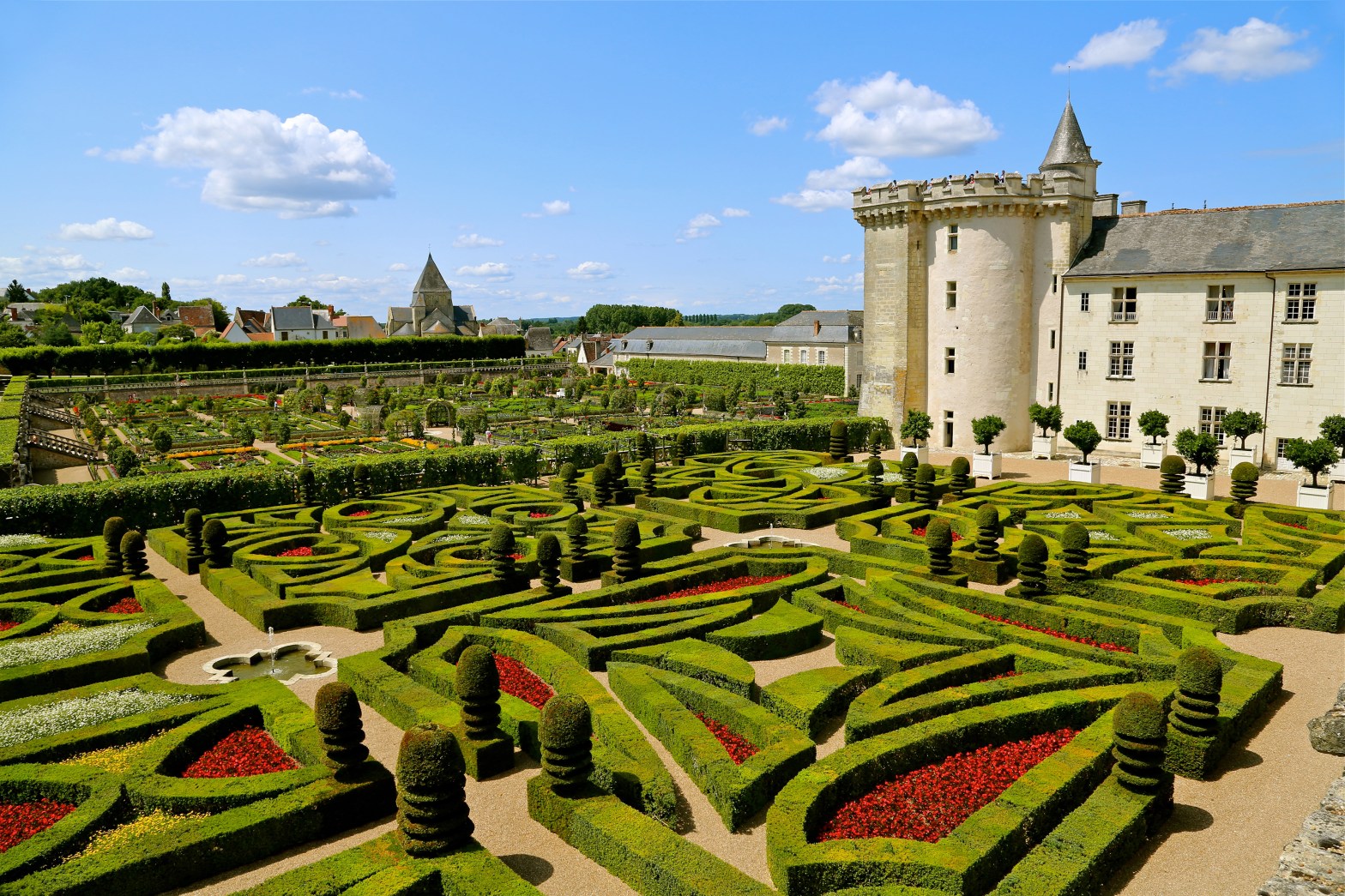
Exploring Germany: Culture, Cuisine, and History on Viking Cruises

Even a 45-minute lecture can prepare you for the sights and scenes of Germany

Story and photos by Sharon Hudgins

Cruise Lecture Teaches History, Culture
If you watch Masterpiece and other programs on public television in America, you’re probably familiar with the phrase, “Viking. Proud sponsor of…”—accompanied by images from Viking’s “longboat” cruises on the Rhine, Mosel, and Danube rivers in Europe. Other times you see wanderlust-invoking scenes from Viking’s ocean-going fleet, which sails the Atlantic and Pacific oceans, the Baltic and Mediterranean seas, and beyond, encircling the globe. And occasionally you’ll see the two new Viking polar-class expedition ships, the “Octantis” and “Polaris,” that sail to Antarctica in the Southern Hemisphere and the Great Lakes in the Northern Hemisphere.

Since 2017 I’ve had the pleasure of being a guest speaker on Viking Ocean Cruises in Europe, giving lectures on historical, cultural, and culinary topics aboard ships sailing from Viking’s home port in Bergen, Norway, to most of the countries bordering on the Baltic Sea.

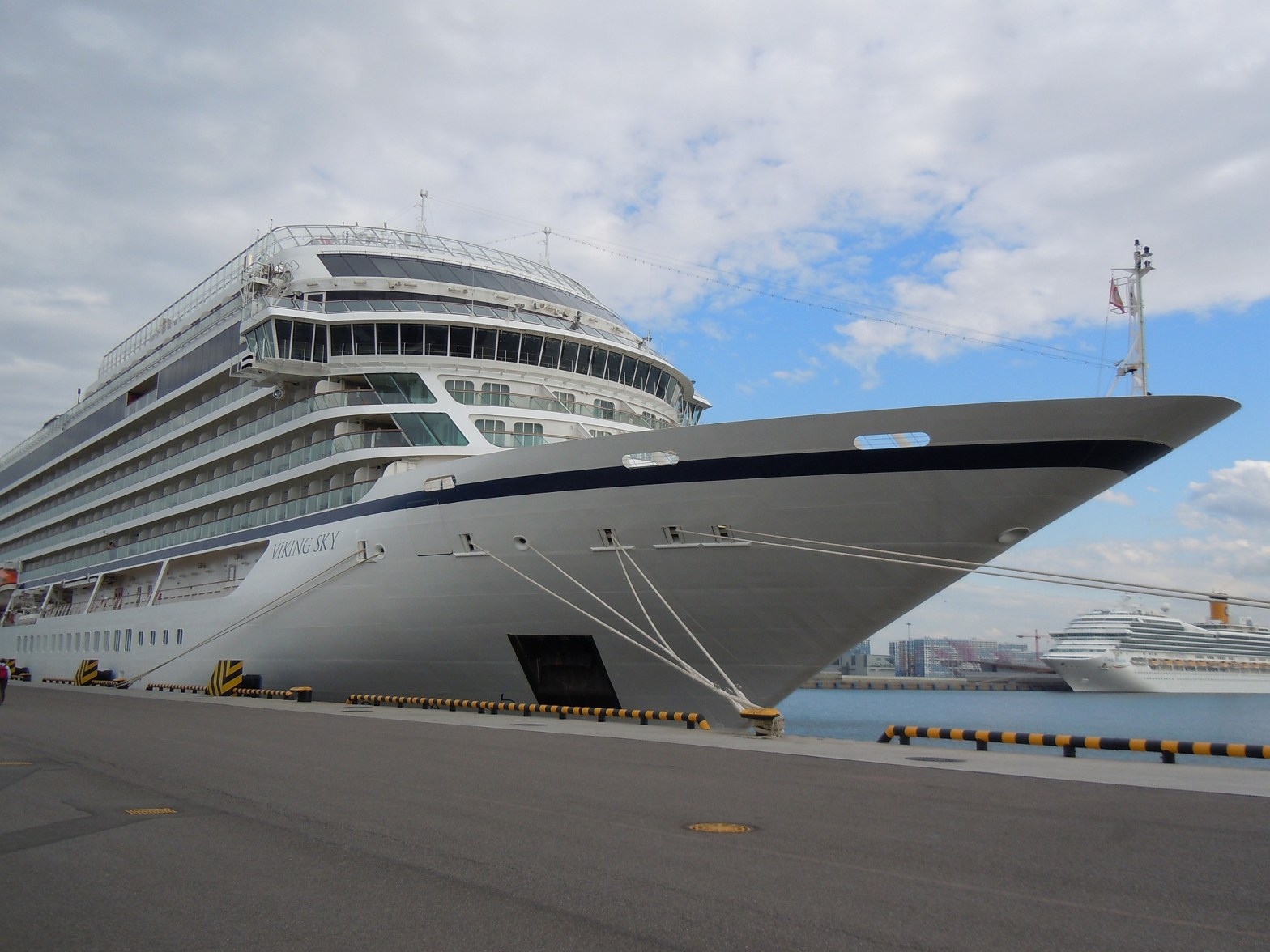
The Viking Sea ship docked at a Baltic port.

The “Viking Sea” ship docked at a Baltic port.

That itinerary follows the routes of the Hanseatic League, the medieval trading confederation that linked the countries of England, northern Europe, and Russia, and also the routes of the earlier, historical Vikings, who plied the waters of the Baltic, too.

Viking prides itself on focusing on the history and cultures of every country on its itineraries. So the cruise director on each ship schedules lectures about those destinations one or two days before the ship arrives in a port, to prepare passengers for the sights, sounds, and tastes of each new country they visit.

While the cruise ship guests are away during the day on shore excursions to a variety of places in those countries, the ship’s staff refills the vessel’s fuel tanks, cleans the guest rooms and public spaces, restocks food supplies, and prepares meals for hungry passengers when they come back on board. The singers, dancers, and musicians also use that time to rehearse their next shows on stage.

Cultural Stereotypes and Truths
So what does that have to do with Germany? Many cruise lines sailing in the Baltic dock at the busy German port of Warnemünde. I’ve lost count of how many times I’ve been to Warnemünde and the surrounding area, as a guest speaker on Viking, National Geographic-Lindblad, and Oceania cruises, as well as on press trips for journalists gathering new material for articles to write. But only on Viking cruises have I had the opportunity to present a 45-minute illustrated lecture about that entire country of Germany, a nation I often think of as “my second home.”

I begin with a short introduction telling how long I lived in Germany (15 years) and what I was doing there (teaching for the University of Maryland’s education programs at U.S. military bases, writing for the Stars and Stripes newspaper). I also mention that for 28 years I was a writer for German Life magazine in America, too. Then I launch into my lecture: “Germany: Land of Laptops and Lederhosen.”

A lecture on “all-of-Germany” in 45 minutes? How is that possible? Not easy without being superficial, I assure you. And that’s exactly how I begin my lecture, showing pictures of the stereotypes that many people have about Germany: Men in Lederhosen. Women wearing Dirndls. Oompah bands and choral groups clothed in traditional Trachten, too. Half-timbered houses and fairy-tale castles. Foaming mugs of beer. Strings of sausages. Pretzels!

Then I point out that stereotypes often contain a grain of truth. But they’re only one part of a many-faceted story (or country), factors that exist side-by-side with all of them being true simultaneously.

Modern Germany – Regions and Festivals
So I segue easily into modern Germany: High-speed highways. High-speed trains. High-tech industries. High fashion. Avant-garde art and architecture. Michelin-starred restaurants and Turkish döner kebab stands. And all those oh-so-wonderful German breads and pastries!

There’s no way anyone could condense centuries of German history into such a lecture. So I focus on Germany today, starting with Berlin and the country’s government (with a nod to the rise and fall of the Berlin Wall), and an overview of Germany’s population, literacy rate, national health insurance program, religions, and economy. The rest of my presentation is about the characteristics of its four main regions, from North to South, East to West, including those regions’ differing landscapes, architecture, industries, and cuisines. Then I conclude with—what else?—Oktoberfest! That world-renowned German beer festival brings me full circle back to the beginning of my lecture: The coexistence of stereotypes and deeper, often contrasting, realities in Germany today, a land of computers and cowbells indeed.

Viking Ships and Excursions
Viking’s ocean vessels carry 960 guests, plus a large, well-trained crew. While in port, most of the passengers head off on shore excursions, and even some of the ship’s employees have a few hours of shore leave, too. When the ship is docked in Warnemünde, Viking offers half-day and full-day excursions to several locations in northern Germany: the Hanseatic cities of Rostok, Lübeck, and Wismar; a classic 19th-century spa town reached by steam train; the magnificent castle in Schwerin; the grim concentration camp at Sachsenhausen.

But the most popular destination is Berlin—six hours round-trip by special train, plus six hours of touring various parts of the city and its historical sites, by chartered buses and on foot with knowledgeable guides, or just exploring Berlin on your own. One excursion even includes lunch at the Reichstag, along with a special tour of that iconic building so important in Germany’s history.

Clockwise from left: The German Reichstag in Berlin, as seen from the Spree River.
The modernistic Marie-Elizabeth-Lueders-Haus government building near the Reichstag in Berlin.
The facades of many Berlin buildings are best viewed from a boat ride on the Spree River.

On my first Baltic cruise with Viking, the only time available for my Germany lecture was at 9 p.m. on the night before we docked at Warnemünde. Since half the 960 guests on that ship had signed up for the 12-hour shore excursions to Berlin the next day—and since they all had to get up at 5 a.m. to board the train at 6 that morning—I expected only a few people to attend my lecture that night. After all, passengers could always watch a video of it on television in their own cabins, any time later during the cruise. So I was surprised when half the ship showed up for that introduction-to-Germany lecture, filling the lecture hall.

The next evening we all returned from Berlin, tired but happy, after a full day of riding the rails through the German countryside, visiting one of the world’s great capital cities, and learning so much about Berlin’s special place in history. But another treat awaited us back in Warnemünde. A red carpet led from the cruise ship terminal across the pier to the ship’s gangway. Lined up along the sides were the ship’s officers and staff, from the captain to the cabin cleaners. At the terminal each guest was handed a glass of sparkling wine, which we all tried to balance in one hand while dancing along the red carpet to lively music, with many of the crew joining in, as we made our way back to the ship.

Top: One of the modernistic fountains in Rostock, a shore excursion destination on Viking Baltic cruises.
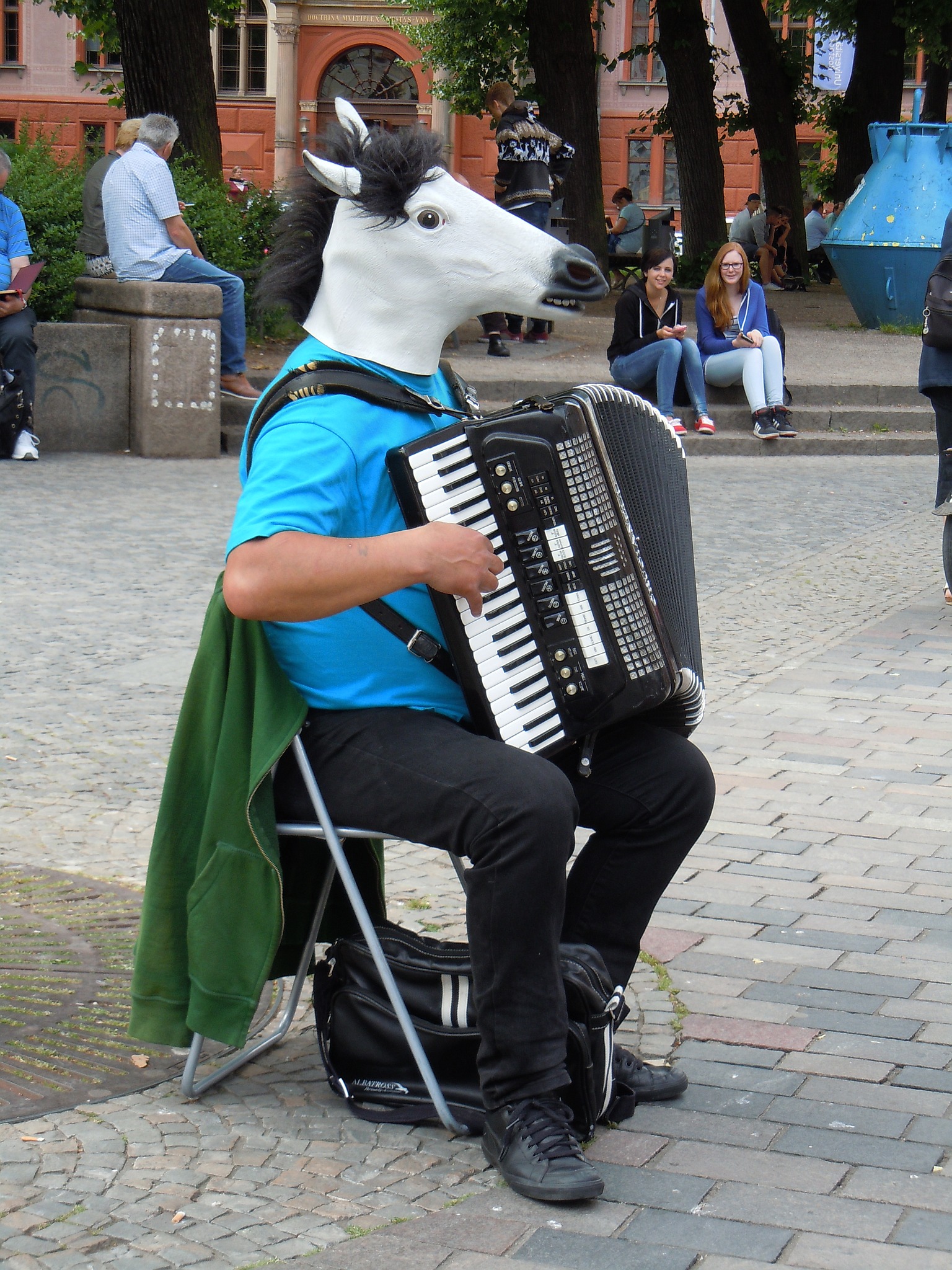
Lower left: Street musician in Rostock, one of the cities on shore excursions from Viking ships docked at Warnemünde, Germany, on Baltic cruises.
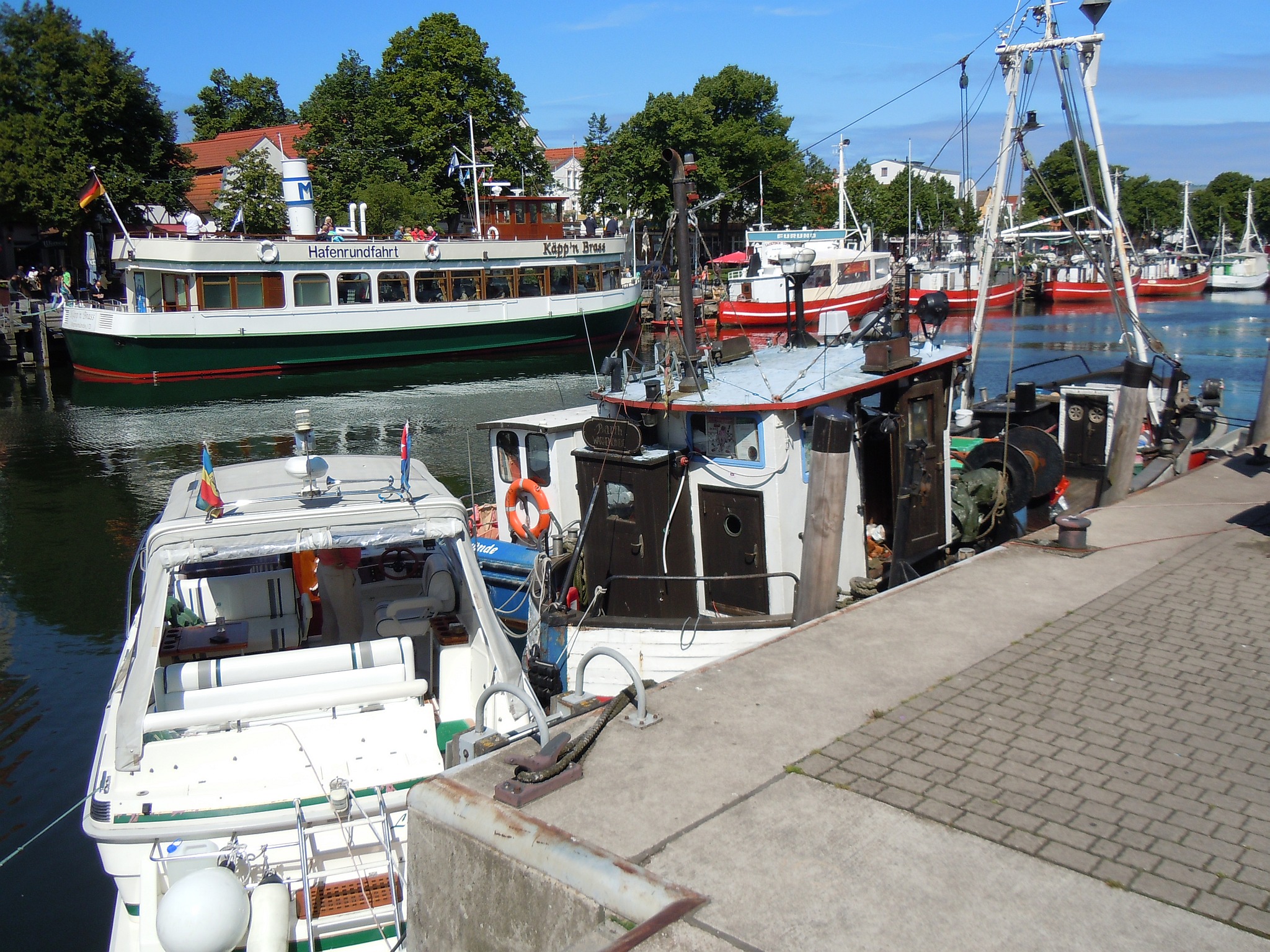
Middle and lower right: The colorful Alter Strom inner harbor at Warnemünde is always filled with small fishing boats and sightseeing boats.

German Culinary Delights on Deck
Dinners on board that evening featured traditional German specialties, from Sauerbraten to Schnitzel, Black Forest Cherry Cake to Bavarian Cream. And of course plenty of German beers and wines, too! As we sailed away from Warnemünde, the only regret for me was leaving a country where I have such deep roots. But we still had five other Baltic countries to visit on that cruise, so who was I to complain about new adventures awaiting the next day? And there was always the prospect of another cruise, or even a different kind of job, bringing me back to Germany in the future.

One of the greatest rewards of working on tours in Germany has been introducing other people to such a fascinating country. Nothing compares with the feeling I get when a member of our tour group comes up to me and says, “Thank you for your lecture about Germany. Because of you, I saw the country with different eyes when we were there.”

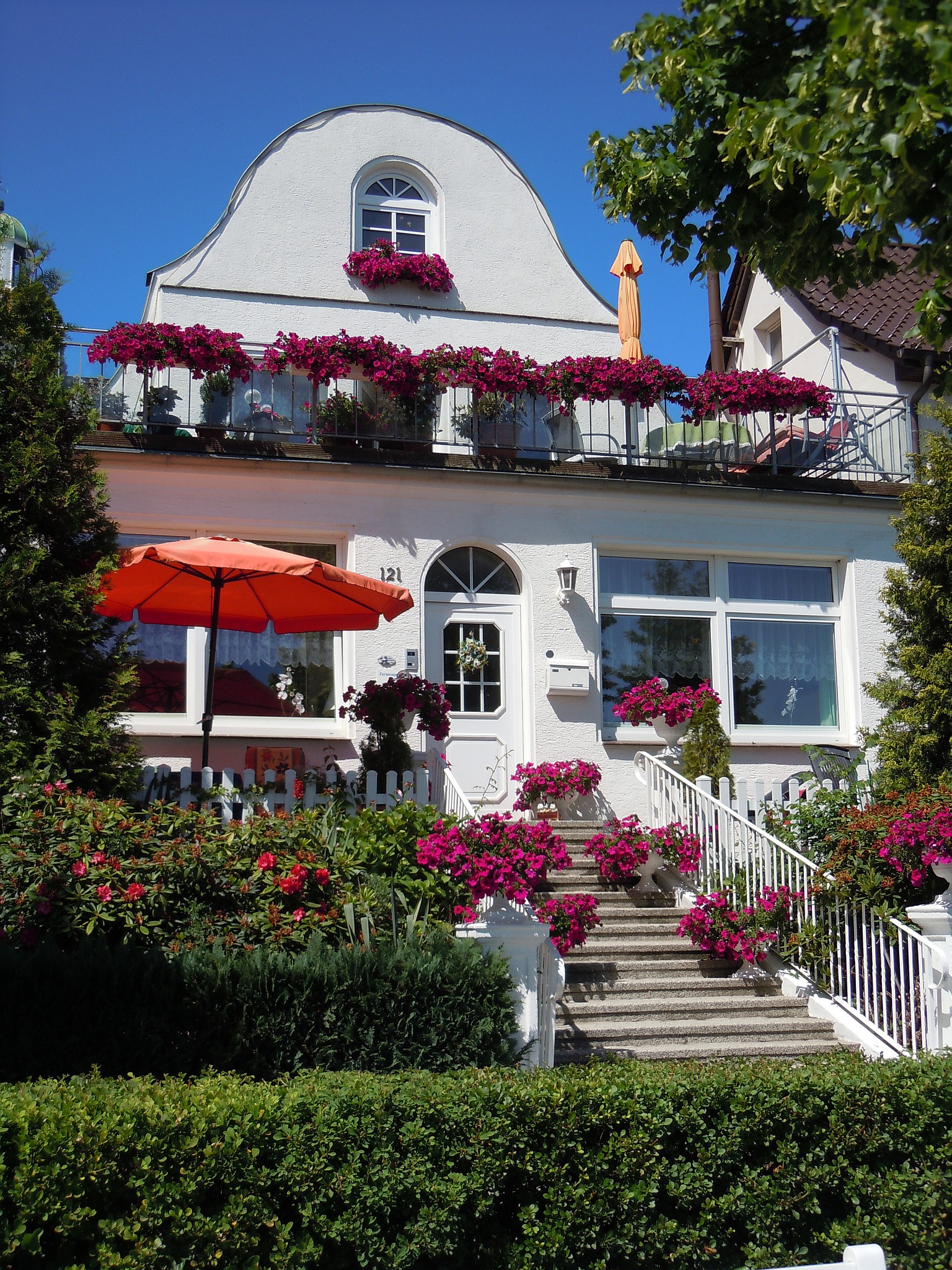
Left: One of the many pretty villas overlooking the waterfront at Warnemünde.
Right: Sand sculpture at the cruise ship dock in Warnemünde.


Sharon Hudgins is a professional writer and a lecturer on educational tours to Europe, Alaska, and North Asia. See more at www.sharonhudgins.com

Visit Viking Cruises to explore cruise destinations and itineraries.


🔍 Search the site to discover more European Traveler feature stories. 🌍

FOLLOW US:

Biting Into Basel

Wedged between Germany and France, this northern Swiss city abounds with traditional restaurants offering classic fare and Old World flair

By Randy Mink

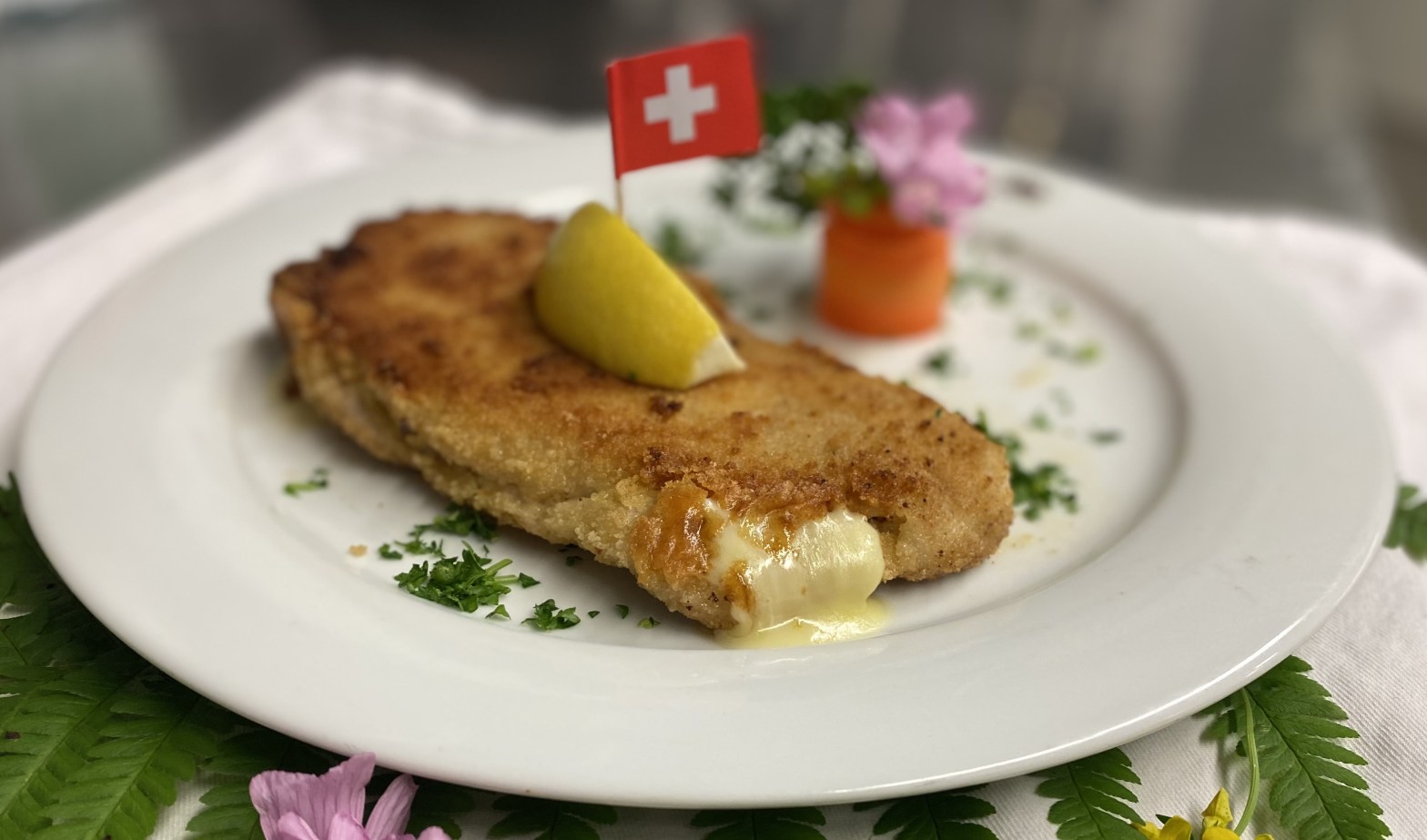
Served piping-hot and oozing with cheesy goodness, the veal cordon bleu at Zum Gifthüttli restaurant is something to savor, even drool over. Lunch in the wood-paneled dining room remains the warmest memory of my visit to Basel, the third-largest city in Switzerland.

After disembarking there from my week-long Rhine River cruise, I was most looking forward to exploring the medieval Old Town with its museums, churches, riverside promenades and specialty shops lining atmospheric alleyways paved with cobblestones. What turned out to be just as inviting, though, were the traditional, pub-style restaurants scattered about the historic core.

Cordon bleu is the house specialty at Zum Gifthüttli. We ordered the Classique, a juicy, golden-breaded schnitzel filled with ham and melted cheese, taking advantage of the Tagesteller (“daily plate”), a deal for 36.50 Swiss francs (about $43) that included french fries, pumpkin soup and dessert.

Gifthüttli, a traditional restaurant in Basel’s atmospheric Old Town, offers dining in the main-floor Bierstube, the upstairs Weinstube and at outdoor tables ideal for people-watching. (Randy Mink Photo)

Zum Gifthüttli’s menu lists cordon bleu variations, like the one with ham, cheese, asparagus, cherry tomatoes and Hollandaise sauce. Another consists of chorizo, mozzarella and herbs. The Florentiner has ham, cheese, spinach and a fried egg on top, while the Schweizer features two Swiss delicacies—Bündner air-dried ham and scrapings of raclette cheese. Opting for pork cordon bleu, instead of veal, can shave a bit off your bill, but any meal in Switzerland will cost much more than at home.

Guests at Gifthüttli can dine in the main-floor Bierstube, upstairs in the white-tablecloth Weinstube or, in warm weather, at outdoor tables offering the bonus of people-watching in Old Town’s pedestrian zone.

The white-tablecloth Weinstube at Gifthüttli offers a refined atmosphere. (Photo credit: Basel Tourism)


Fans of cordon bleu and antique charm also gravitate to Old Town eateries like Zum Braunen Mutz and Restaurant Löwenzorn. The latter offers tables in its historic rooms and in the idyllic courtyard garden, where blankets, furs and electric heaters keep patrons toasty in cooler weather. Löwenzorn favorites include the wienerschnitzel and traditional Swiss fondue.

Löwenzorn, a traditional restaurant in Basel’s Old Town, offers seating in historic rooms and in the courtyard garden. (Photo credit: Basel Tourism)


Restaurant Kunsthalle, a sophisticated but friendly Old World restaurant in the same building as the Kunsthalle Basel contemporary art museum, every winter opens its Fondue Stübli, a cozy fondue chalet next to the landmark Tinguely Fountain. Additional city-center spots for fondue (and other Swiss classics) are Walliserkanne and Safran Zunft.

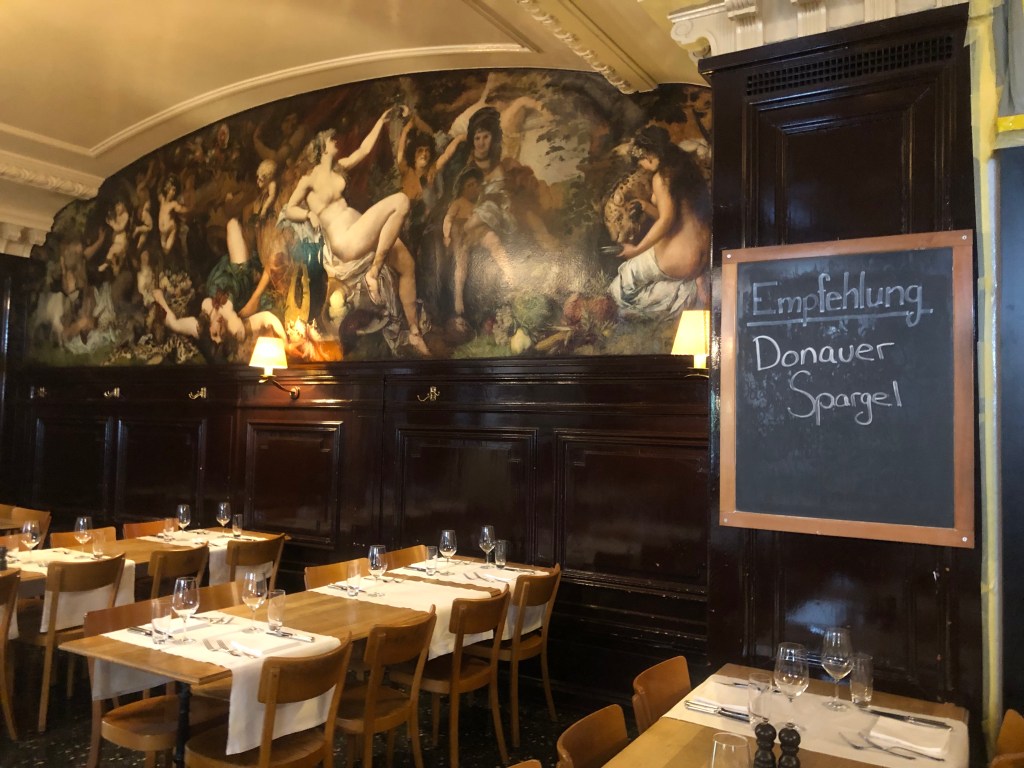
Patrons at Basel’s Restaurant Kunsthalle enjoy an Old World atmosphere in the vaulted Schluuch room. (Randy Mink Photo)


On our springtime visit to Restaurant Kunsthalle, we had a lunch of pasta amidst dark wood and classical cherub murals in the cozy, vaulted Schluuch room. The more formal “white” room overlooks the chestnut tree-shaded patio, one of Basel’s prime spots for alfresco dining. The Kunsthalle’s menu reveals typical Swiss fare, including Zürcher Geschnetzeltes (veal strips in a sauce of white wine, cream and mushrooms) with rösti, the ubiquitous Swiss version of hash browns offered at most restaurants that serve french fries.

No discussion of traditional dining spots is complete without a mention of Gasthof zum Goldenen Sternen, Basel’s oldest restaurant. Though it’s been at its current riverside location for only 50-some years, it date backs to 1412. In the 1970s the ancient building was dismantled and rebuilt stone by stone along with the original ceiling paintings and all the wood paneling. Highlighting the menu are highly regarded fish dishes—I had the lightly fried salmon filet with linguine. It also offers lamb shank, steaks and wienerschnitzel, among other entrees. The restaurant looks out on the Rhine River, and there’s outdoor seating under trees on the riverfront promenade.

Gasthof zum Goldenen Sternen, Basel’s oldest restaurant, enjoys a setting on the Rhine River. There is seating under trees on the riverfront promenade. (Photo credit: Basel Tourism)


The Goldenen Sternen (“Golden Star”) is located in the picturesque St. Alban quarter, a quiet neighborhood noted for its patrician townhouses, half-timbered buildings, narrow streets and a stream that powers the waterwheel at the Basel Paper Mill. Now a fascinating museum about the history of paper making and printing, the medieval mill, just steps from the Rhine and not far from Old Town, was one of many in St. Alban that made Basel a book publishing center for centuries.

Though skeptical about how interesting a paper museum could be, we found it eye-opening. Especially fun was watching demonstrations of how a pulpy goop is transformed into paper. We had a chance to make our own sheet as a souvenir. And we were surprised to learn that until the 19th century paper was made almost entirely from old rags and ropes that were sorted, cleaned, cut into strips and left to decay in a rag cellar’s rotting vats. There are even exhibits on the evolution of toilet paper, which was considered a luxury product when first introduced in the late 1800s.

Visitors learn about the history of paper and witness the paper-making process at the Basel Paper Mill, a museum housed in a medieval paper mill. (Randy Mink Photo)


Claiming nearly 40 museums, Basel has a museum for every interest, showcasing subjects ranging from cartoons and musical instruments to city history and Jewish culture. Most visited are its two leading art museums.

Kunstmuseum Basel, whose three-building complex holds the world’s oldest municipally owned public art collection, presents seven centuries of European art and boasts the world’s largest collection of paintings by the Holbein family. On the outskirts of Basel, Fondation Beyeler, comprising a main building designed by noted architect Renzo Piano, houses some 400 masterpieces of modern and contemporary art, including pieces by Picasso, Monet, Matisse and Cezanne.

Kunstmuseum Basel holds an impressive collection of paintings by Hans Holbein. (Photo credit: Basel Tourism)


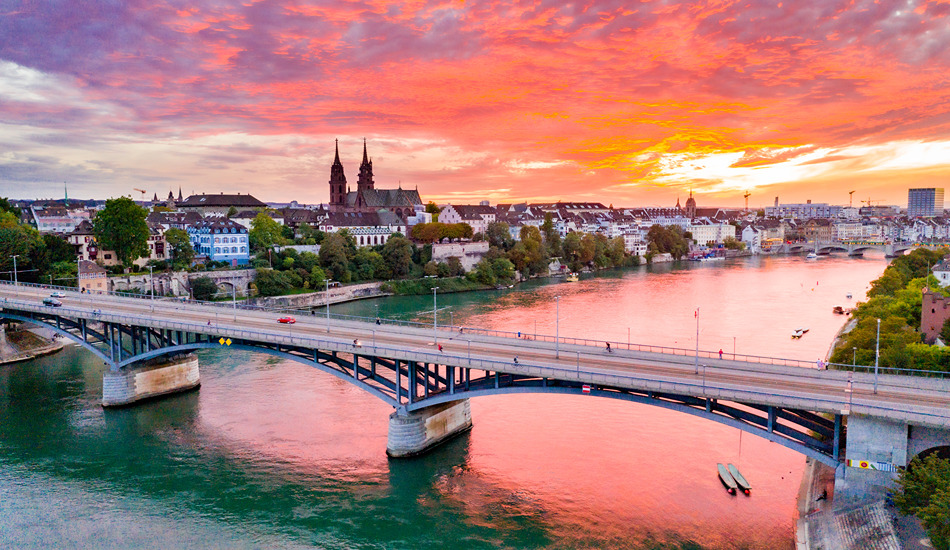
The Basel Historical Museum, with exhibition halls under the vaulted ceilings of a former 13th century church, focuses on the intersection of the cultures of Switzerland, France and Germany. (From Basel, Germany and France are just a hike or bike ride away. Visible on the horizon are the Vosges Mountains of France and Germany’s Black Forest.)

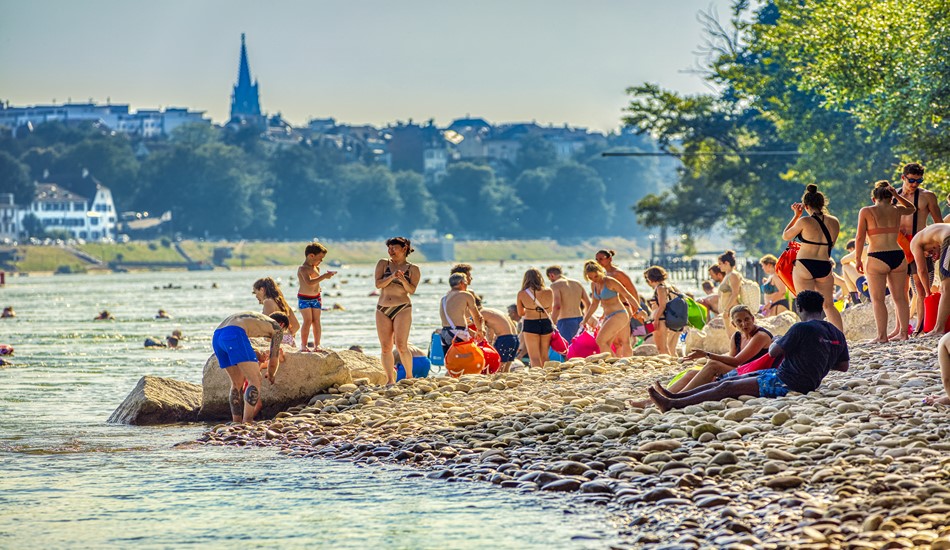
In the summer you’ll see people sunning on the riverbanks and swimming or floating in the river. Basel Tourism offices and retail stores sell something called a Wickelfisch, a brightly colored, fish-shaped waterproof bag for keeping your clothes dry as you whoosh down the river past city landmarks. It’s not to be used as a flotation device.

Frolicking in the Rhine River is a popular pastime with tourists and locals alike. (Photo credit: Basel Tourism)


Sightseeing cruises provide another way of experiencing the Rhine. Or you can take one of the small passenger ferries that shuttle back and forth between the larger southern part of the city (Grossbasel, or Greater Basel) to the northern side (Kleinbasel, or Little Basel) at four crossing points. Attached to a cable that spans the river, the non-motorized boats are guided deftly by expert ferry operators.

We took the five-minute ride from St. Alban to the opposite bank, then walked along the riverside path for 11 minutes before reaching the Museum Tinguely, a showplace for monumental mechanical sculptures created by world-renowned artist Jean Tinguely (1925-1991), who grew up and studied in Basel. Buttons allow visitors to activate some of the playful, mischievous and wacky creations, causing them to rattle, shake and whirl.

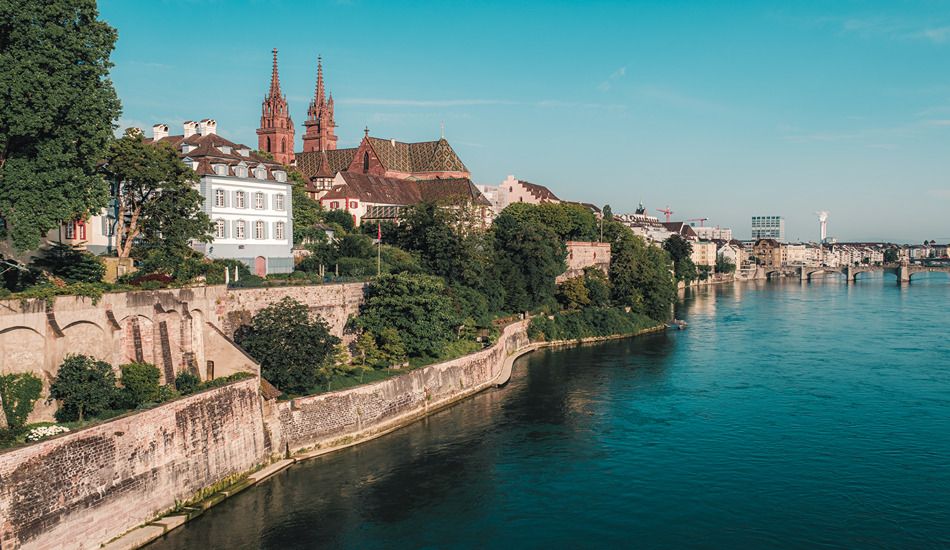
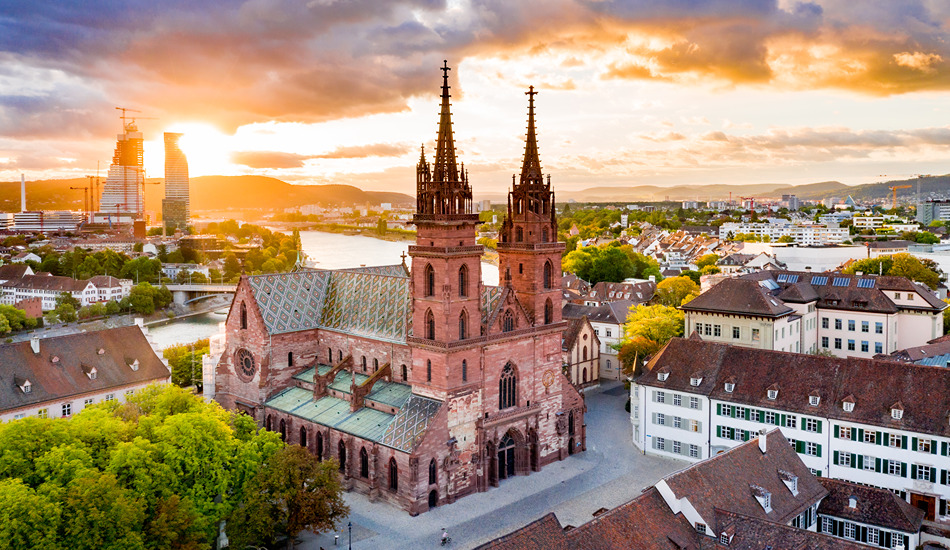
Sweeping views of the Rhine can be enjoyed from the tree-shaded terrace of Basel Cathedral. Sporting impressive twin towers, it is the city’s most prominent landmark. Built mainly in the 12th and 13th centuries, the Romanesque-Gothic church contains the tomb of the Dutch humanist Erasmus (1466-1536), who lived in Basel. Ambitious types can climb the towers’ narrow staircases (about 250 steps).

The twin spires of Basel Cathedral dominate the skyline of Basel, which lies on the Rhine River in northern Switzerland. (Photo credit: Basel Tourism)

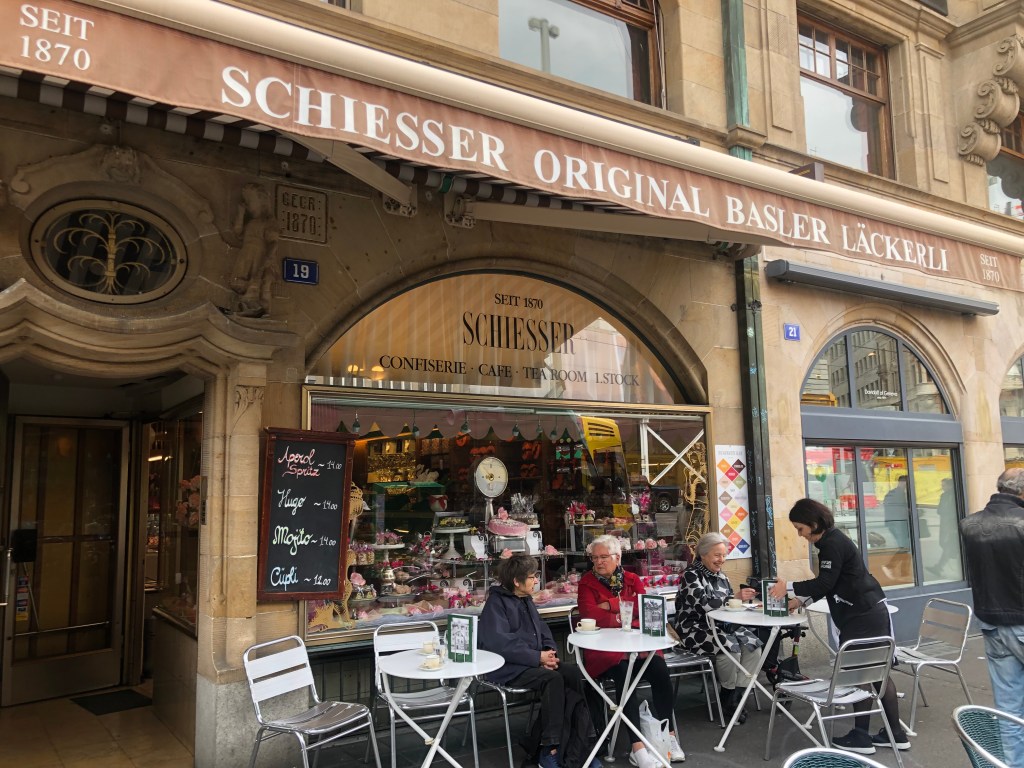
One of the best places to take a break from sightseeing is Confiserie Schiesser, a cafe/tea room/confectionery with an on-site chocolate factory and bakery. Founded in 1870 and now in its fifth generation of family ownership, Schiesser faces Old Town’s vivid red Rathaus (Town Hall) and market square. A tantalizing array of chocolates, cookies and pastries tempts the sweet tooth. Distinctive to Basel are the Basler Läckerli, a ginger cookie made with honey, spices, almonds, and candied orange and lemon peel.

Confiserie Schiesser, a cafe/tea room/confectionery founded in 1870, is famous for its chocolates, cookies and pastries. (Randy Mink Photo)


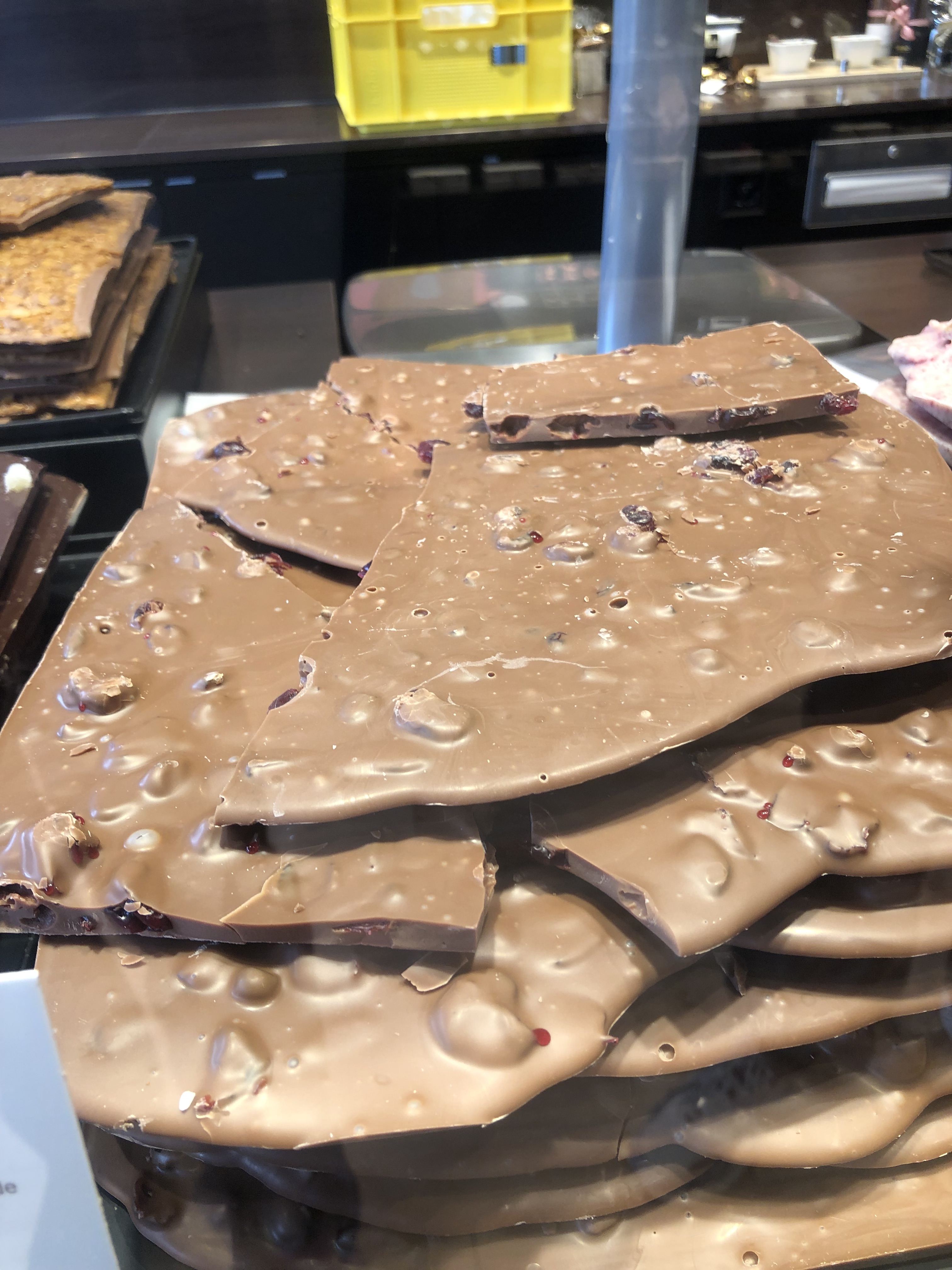
A few doors down from Confiserie Schiesser, high-end Läderach chocolatier sells slabs of melt-in-your-mouth chocolate called Frisch Schoggi. Sold by the gram, the uneven pieces are studded with everything from hazelnuts and almonds to cranberries and cornflakes.

Visitors in Basel’s Old Town can indulge their sweet tooth at Läderach, a high-end Swiss chocolatier. (Randy Mink Photo)


Indulging in Basel’s tasty treats is the epitome of Swiss bliss.

For more information, visit the Basel Tourism website, www.basel.com.

Cruising Through the Heart of Europe

In comfort and style aboard the Scenic Opal

By Randy Mink

I can’t think of a more relaxing way of seeing Europe than cruising in luxury along its great rivers. Unlike a multi-country bus tour or train journey, you unpack just once, as your ship is home sweet home for the week. And as these sleek white vessels often dock in the center of town, the tourist highlights lie just steps from the gangway.

My most recent magic-carpet ride to adventure was “Charming Castles & Vineyards of the Rhine and Moselle,” a seven-night trip filled with shore excursions in southwestern Germany, northeastern France and the Grand Duchy of Luxembourg. Delivering us to these enchanting places was the 163-passenger Scenic Opal, one of 12 ships in the Europe fleet of Scenic, an Australian-owned cruise line geared to English-speaking guests.

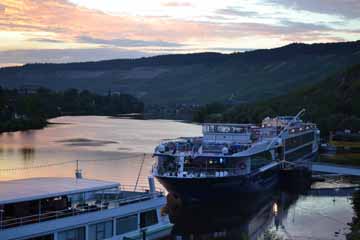
The 163-passenger Scenic Opal, shown here on the Moselle River in Bernkastel, Germany, is one of Scenic’s 12 luxury river ships in Europe. (Randy Mink Photo)

The Scenic Difference

At first glance, most river ships in Europe seem to offer a similar product, but Scenic stands out in two ways. First, guests have a little more elbow room, as the vessels offer a higher-than-usual passenger-to-space ratio. Whereas many ships of the same size take on 180 or more passengers, Scenic’s four-deck floating hotels carry 163 guests maximum. (Our sailing counted 129 passengers, including 53 Americans, 27 Canadians, 37 British, nine Australians and a smattering of other nationalities.) The Scenic Opal and sister ships Scenic Amber and Scenic Jasper were built in 2015/2016 and refurbished in 2019.

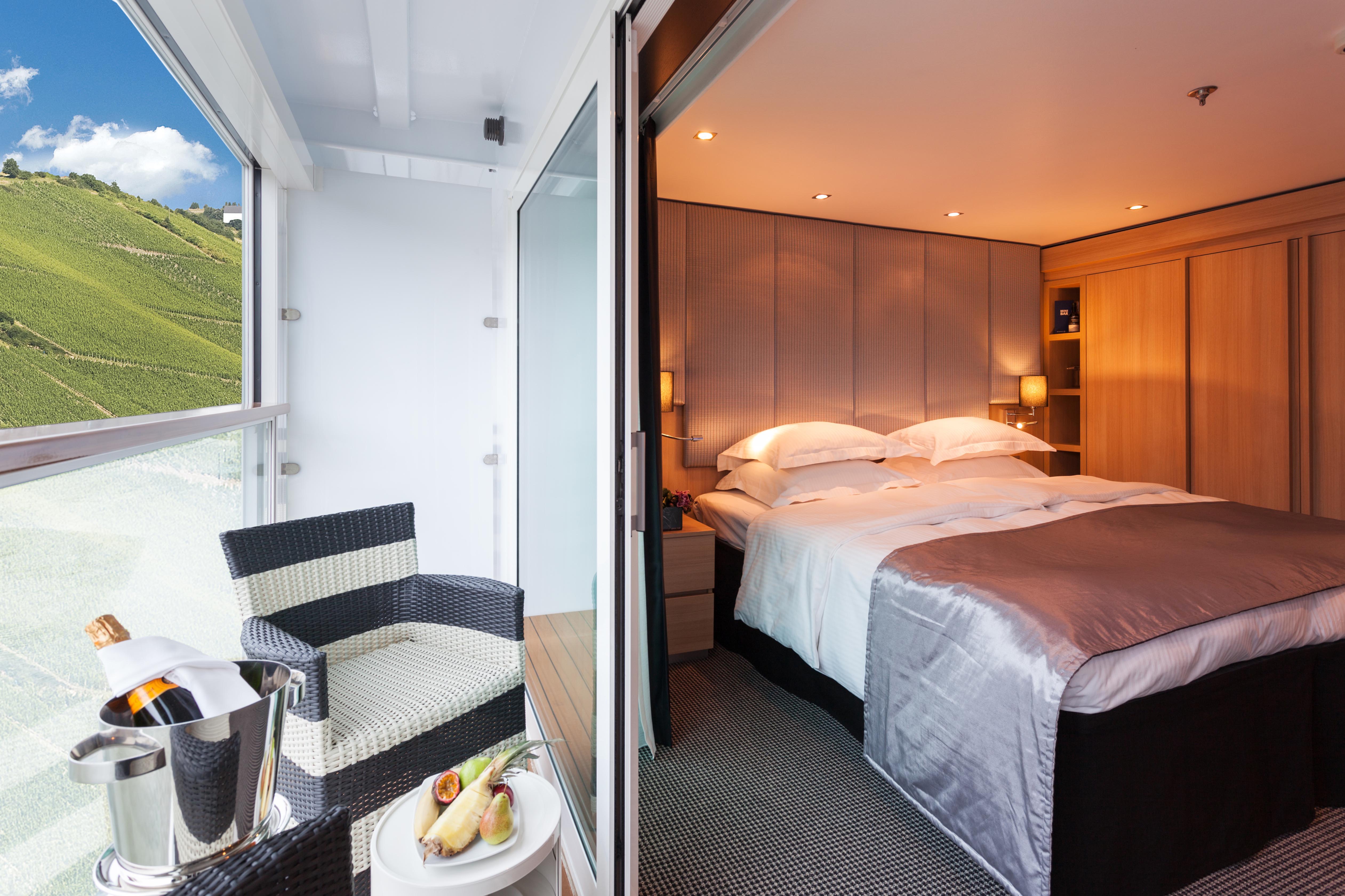
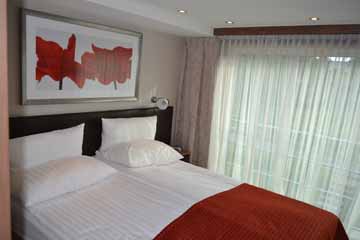
Floor-to-ceiling windows in both public areas and most staterooms, moreover, give the feeling of added space. All cabins on the Sapphire and Diamond (second and third) decks feature a full-length, enclosed balcony with two padded wicker chairs, a table and a wide horizontal window that glides up or down at the push of a button. A curtain and a glass door can be used to close off the bedroom from the peaceful nook, called a Scenic Sun Lounge. For this sense of extra space, Scenic ships are marketed as “Space-Ships” (not because they’re futuristic-looking). Smaller staterooms on the less-populated lower deck, the Jewel Deck, have a large picture window but no balcony.

The other chief takeaway about Scenic is the all-inclusive price. You never have to take out your wallet and won’t even be asked for a credit card at check-in. The cruise fare includes not only gratuities, airport and hotel transfers, laundry service once per cruise, shore excursions and multiple dining options but also unlimited complimentary beverages (soda, beer, wine, cocktails, spirits) all day, not just with meals. You don’t even need to worry about using your room’s mini-bar—just help yourself to free drinks and snacks when the mood strikes. Treats in my cabin included Pringles chips and a favorite of mine—Manner cocoa-flavored hazelnut-creme wafers from Vienna. The refrigerator, replenished daily, was stocked with everything from Coke, beer and juices to German wines and miniature bottles of rum, gin and whiskey.

Left: Most cabins on the Scenic Opal have an enclosed balcony, or Sun Lounge, with a window that glides up and down at the push of a button. (Photo credit: Gillies & Zaiser)
Right: The Junior Balcony Suite offers a little more space than standard staterooms on the Scenic Opal. (Photo credit: Gillies & Zaiser)

Food, Glorious Food

In the Crystal Dining Room, I always tried to get a window table so as to look out on the sloping vineyards and fairy-tale towns flanking the Rhine and Moselle rivers. The daily breakfast buffet featured a million different items—well, at least 100 anyway—and even offered chilled Champagne. There were bagels and artisan breads, yogurts and fruits of all kinds, and hot-off-the-griddle pancakes or waffles, not to mention made-to-order omelets. The Brits and Australians appreciated the baked beans, porridge, English bacon, and grilled tomatoes and mushrooms. One morning we had bread-and-butter pudding.

The breakfast buffet also offered cheeses, cold cuts and smoked fish (herring, rollmops, halibut, salmon). What’s more, we could order from a menu that featured lamb chops, French toast and perfectly done, oh-so-decadent eggs Benedict.

Lunch also was a smorgasbord. I really enjoyed the German buffet, a special meal that put an exclamation point on our morning transit through the castle-studded Rhine Gorge and got us in a jolly mood for the tourist-thronged wine town of Rüdesheim. The spread included three types of sausage—bratwurst, Käsekrainer (cheese-filled) and Weisswurst (white veal sausage)—and three mustards. There were sauerkraut, parsley potatoes and both bread and potato dumplings. Cheesy spaetzle, freshly tossed, was served hot from the pan. I didn’t have room for the fried chicken (Backhendl), pan-seared river trout in almond butter or even a morsel of the pork knuckle.

Recorded oom-pah band music lent a Munich beer hall vibe as I washed down traditional German foods with a tall glass of Erdinger Weissbier, a classic wheat brew. Dessert was Dampfnudel, a pillowy steamed dumpling filled with blueberries. Other lunch buffets usually featured at least one food representative of the region we were traveling through.

On King Charles III’s coronation day, the River Cafe, an area of the Opal Lounge that offers a daily lunch buffet, we had fish ’n’ chips while watching the ceremony on big-screen TVs. The lounge’s coffee and tea stations had scones with jam and clotted cream, another British touch.

The River Cafe, open during the day for sandwiches, salads, ice cream and pastries, is transformed each evening into Portobellos, a five-course Italian dining experience for which each guest receives a printed invitation once during the week. Table La Rive, a sophisticated chef’s table offered once a cruise to Diamond Deck and Junior Suite guests, stars innovative fare with wine matching in a small-group setting in the dining room.

Every night, the restaurant’s a la carte dinner menu gave us appetizer, main course and dessert choices. If we didn’t want one of the three entree selections, we could order a salmon steak, sirloin steak or chicken breast.

Rather eat in privacy on your balcony? An extensive room service menu is available from 6 a.m. to midnight.

On any cruise, I tend to overeat (don’t we all?), so every day I hit the walking track on the expansive Sun Deck, a breezy area with tables, chairs, loungers and a vitality pool. Happily for me, the track was lighted after dark. I recall one night making my rounds as floodlit Reichsburg Castle loomed beyond the storybook Moselle River town of Cochem, Germany, a magical moment indeed.

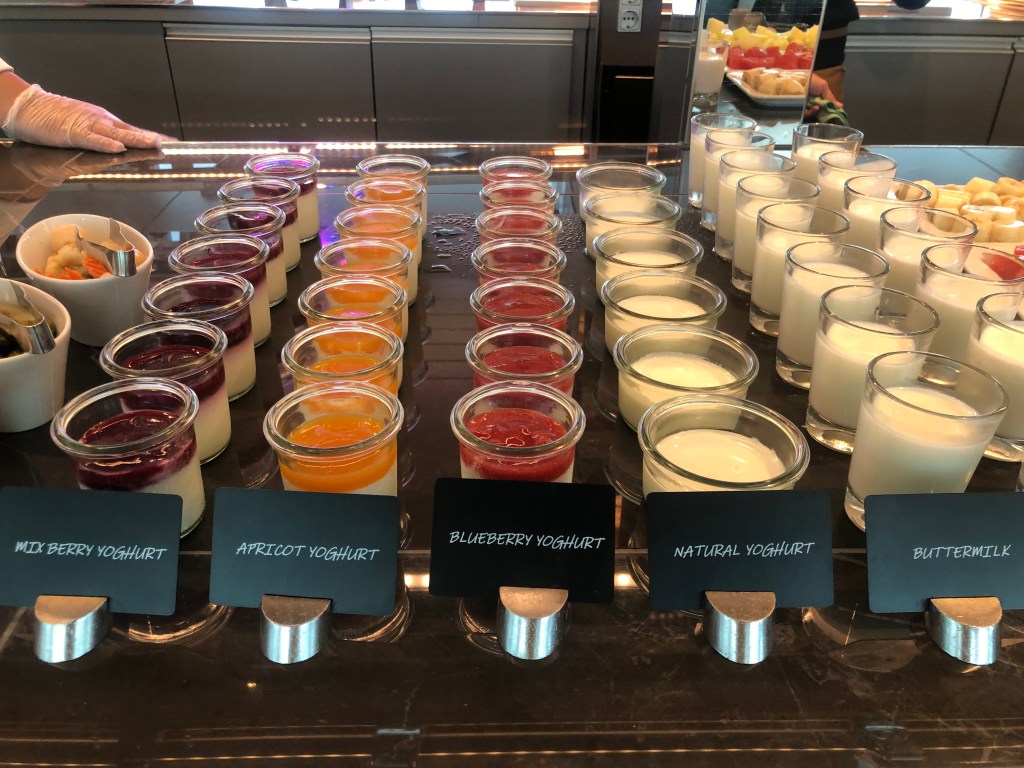
Left to right: The Scenic Opal’s daily breakfast buffet offers choices galore, including many varieties of yogurt. (Randy Mink Photo)
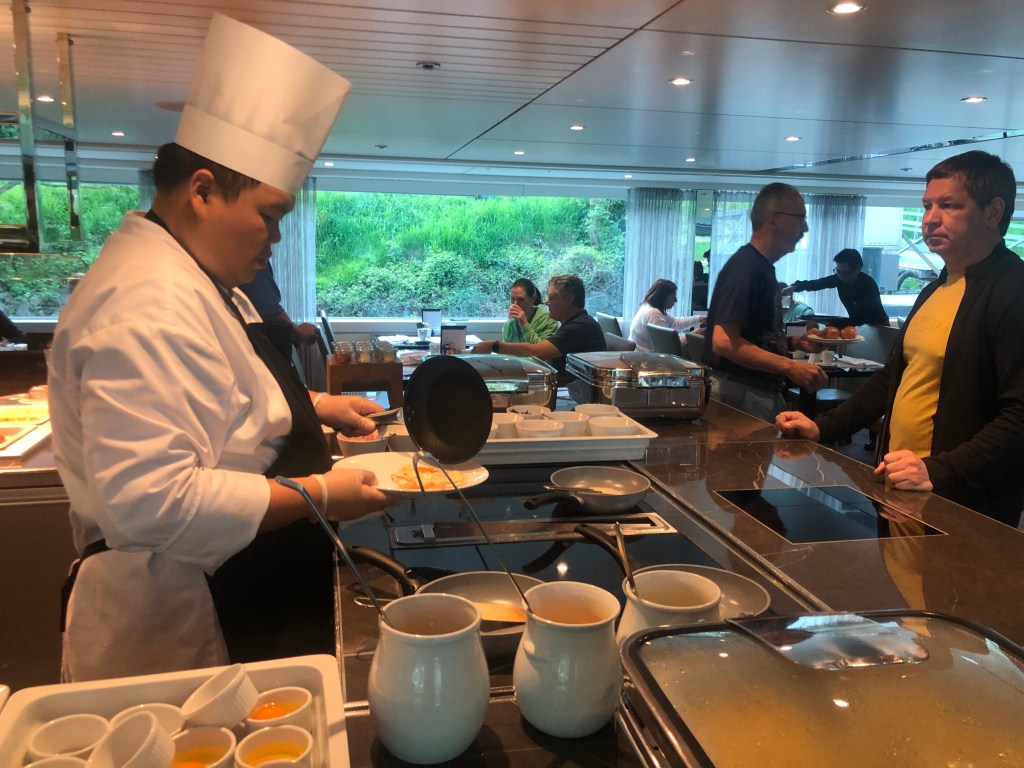
An omelet station is part of the Crystal Dining Room’s breakfast buffet. (Randy Mink Photo)
Alcoholic drinks in the Opal Lounge and dining room are included in the cruise fare. (Photo credit: Gillies & Zaiser)
The River Cafe is the place for a wide variety of tempting small bites throughout the day. (Photo credit: Gillies & Zaiser)

A Superlative Staff

Every evening we all gathered in the spacious lounge with cruise director Alex Thurein, who briefed us on the next day’s schedule. An affable German who was born in Wiesbaden and currently lives in Salzburg, Austria, he set the upbeat tone of the cruise. From Day 1 we knew we could go to Alex for travel advice or any problem. (On a personal note, I will be forever grateful to him for helping me contact credit card companies after a pickpocket incident during a shore excursion in Colmar, France.)

One morning Alex gave a brilliant presentation on “Germany and the Germans: A Brief Overview of 1,200 Years of Central European History.” Another day his topic was Europe’s rivers, canals and lock systems.

The Scenic Opal’s crew, 53 in all, represented 14 nationalities, from Thai and Indonesian to Serbian and Polish. Our captain was Hungarian. The women staffing the reception desk always had smiles and couldn’t wait to assist or answer a question.

Also smoothing the way was the stateroom’s TV, an encyclopedia of information and entertainment options. We could watch television shows (I mostly caught the live BBC newscasts), choose from a wide selection of movies and music, view the daily schedule and lounge presentations, and bone up on the ports of call. A keyboard even let us use the screen as a computer.

With high-tech gadgetry, an all-inclusive approach and plenty of space to unwind, Scenic has thought of everything to ensure a worry-free journey on the rivers of Europe.

1: Champagne is served at the first-night welcome reception onboard the Scenic Opal. (Photo credit: Gillies & Zaiser)
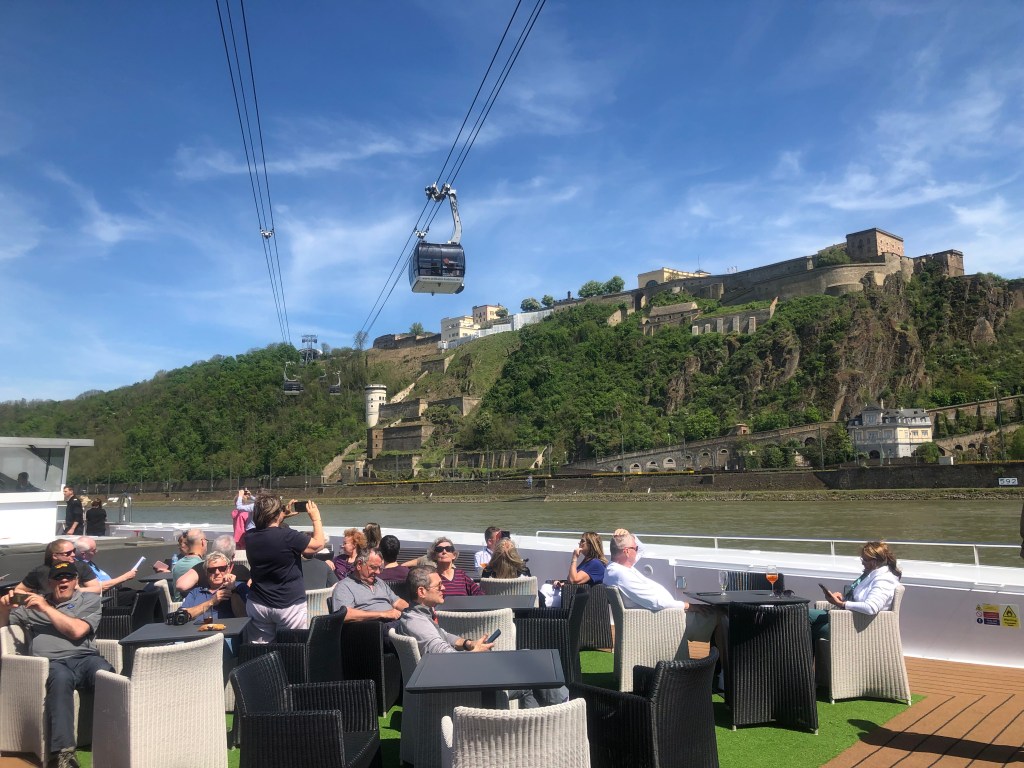
2: In the Rhine River city of Koblenz, passengers relax on the Sun Deck of the Scenic Opal as cable cars to Ehrenbreitstein Fortress pass overhead. (Randy Mink Photo)
3: The Scenic Opal’s reception desk is located just off the Opal Lounge. (Photo credit: Gillies & Zaiser)
4: A passing parade of hilltop castles enchants passengers on the Scenic Opal. (Photo credit: Scenic)

Cruising Through Central Germany

By Marilyn Heimburger
Photos by Don Heimburger

Are you are looking for a vacation that combines relaxation, a bit of history, romantic castles, charming medieval villages, and excellent cuisine? This week-long river cruise on the Moselle, Rhine and Main rivers in Germany, offered by Avalon Waterways, may be the perfect choice for you.

The MS Avalon Luminary, our ship for this cruise, was just recently added to Avalon’s fleet. Its 69 staterooms and suites are designed for efficiency, with plenty of space to stow personal items and luggage. Each room had a small bathroom with shower, comfortable memory foam mattress, a desk, lamp, mirror, fresh flowers, mini bar, and a safe for valuables. A television provided satellite programming and broadcast the view from a camera at the front of the ship. Floor-to-ceiling windows open to a private balcony in most rooms. It’s a luxury of river cruising to just unpack once and let the ship transport you with ease to each destination.

Another luxury on a cruise such as this is the excellent cuisine. The sumptuous breakfast buffet included breads, pastries and cereals, fruits, eggs, potatoes, sausages and bacon, and made-to-order entrees. The full lunch buffet served each day in the main dining room offered soups, salads, choice of main course and desserts. A lighter lunch option was also available in the lounge one deck above. Five-course dinners included an appetizer, choice of soups, salad, choice of meat, fish or vegetarian main course, and several dessert options. The well-trained staff served red, rose, or white wine or beer upon request.

BOARD IN LUXEMBOURG
Boarding the Luminary in Remich, Luxembourg, we were welcomed by cruise director Jean Loup Domart. Entertaining, energetic, and extremely organized, Jean excelled at keeping everything running smoothly.

Although we set sail while dinner was being served, we missed none of the excitement, since the dining room was designed for maximum viewing, with panoramic windows on both sides. A sense of intimacy was provided with fresh orchids in lighted open rectangles dividing the large space without interrupting with the view. The lounge on the level directly above the dining room was also designed for watching Germany glide by in the most comfortable of settings.

Our first stop was Trier, Germany, which boasts amazingly intact structures from the Roman Empire, including imperial baths, an amphitheater, and Constantine’s reception hall, which now serves as a protestant church. Did you ever wonder why Roman ruins always seem to be discovered 6 feet underground? We learned from our local guide that after Roman towns were abandoned, local residents built homes by taking usable stones from the old Roman buildings. Over the course of 600 years, this practice left a 6-foot-deep base of rubble, upon which the medieval towns were built. Trier’s Porta Nigra (black gate) is black from wood fire smoke from Roman times, and was left standing because it was a site that attracted pilgrims, who brought money to the church.

As our trip continued down the Moselle, we passed vineyard after vineyard and peaceful patchwork slopes, dotted with small villages and church steeples. The southern facing slopes provide the perfect environment for catching warm sunlight needed to grow grapes for Germany’s famous Riesling wines. And the ship’s outdoor decks were perfect for relaxing with a cup of coffee or listening to birds along the shore as the ship glided quietly along.

BERNKASTEL-KUES WEINFEST
Our late afternoon arrival in Bernkastel-Kues allowed just enough time to explore the Old Town around the quaint market square. This town hosts the biggest Weinfest on the Moselle in September. One vineyard overlooking the town is the source of their “Doktor” wine. Legend has it that drinking some of the wine from this vineyard cured an archbishop of an ailment, so the wine became known as the “Doktor.”


Half-timbered buildings in Bernkastel

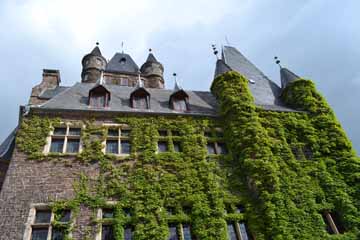
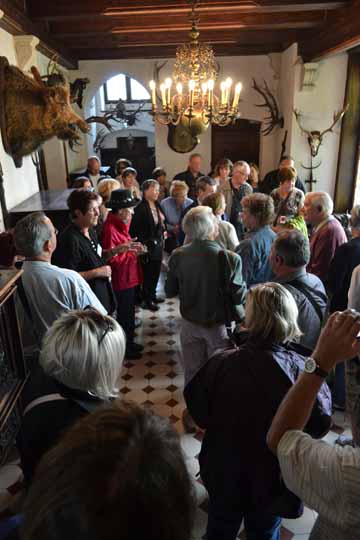
The next day brought us to the wine town of Cochem and a tour of Reichsburg Castle. The interior of the castle highlights not only only medieval artifacts, but Renaissance and Baroque furnishings selected by the 19th century restorers. The tour was informative and the view from the castle — spectacular.

 Passengers tour the castle

The Moselle joins the Rhine at Koblenz, an important center of trade during the Middle Ages. An imposing statue of Kaiser Wilhelm I mounted on a horse dominates the Deutches Eck (German Corner) where the two rivers meet. We arrived just before dinner, with enough time for a short walk into the square to see the many shops and restaurants. The fortress Ehrenbreitstein stands on the opposite bank of the river and provides a beautiful panoramic view of the area.

To begin our cruise down the Rhine Gorge (some say the most beautiful part of the Rhine) first thing in the morning, we docked overnight at Koblenz, and were entertained on board after dinner by a small ensemble of classical musicians.

THE MIDDLE RHINE
The next morning was filled with the history, legends and romance of the Middle Rhine. Cruise Director Jean Loup provided informative narration as the ship glided along, with passengers enjoying the view while relaxing on the sundeck. We learned that during the Middle Ages the Rhine River Gorge posed many hazards for travelers, and provided many opportunities for powerful kings to levy tolls for safe passage. They built castles and fortresses in the 12th and 13th centuries along the banks to collect tolls, make money, and enlarge territories.

Reichsburg Castle

The castles were usually built high on hills, close to a spring, and often on a curve with a view of the river. Stones for the castles were lifted with wheels and ropes, and the building projects provided work and security for locals, whose lifespan at the time was only about 40 years. Most castles were built with limestone, which was easier to work with than granite. Later palaces were built with marble, as techniques improved. To attack a fortress, enemies could try to break down a wall or door with a battering ram on wheels with a roof as protection from arrows shot from the castle. Or a catapult could throw fire over the castle walls. Castles residents used beehives, hot tar or hot water to fend off attackers. Some fortresses housed armies of 600.

In the town of Boppard we saw Sterrenberg and Liebenstein, known as the castles of the enemy brothers, and heard the legend: Two brothers both fell in love with their adopted sister. She wanted none of this, and entered a monastery in town to live as a nun. The brothers fought and finally built two castles next to each other with a wall in between.

The 430-foot-high Lorelei rock is located where the river narrows, creating treacherous currents dangerous to ships. The famous legend of the beautiful maiden who sat on the rock luring sailors to their destruction with her singing is commemorated with a bronze statue.

The town of Oberwesel, below Schoenburg Castle, still has many fortification walls and towers still standing. When the river water is low, travelers can see the “rocks of the seven virgins.” Legend has it that a lord with seven sons wanted to arrange marriages for them. The seven chosen virgins didn’t want to marry, and threw themselves into the Rhine, where, because they were so hardhearted, they turned to stone.

Pfalz Castle (whose gold lion was to symbolize strength and power) was built in the 16-17th century as a customs tollhouse on a little island in the middle of the river. Gutenfels Fortress was built on the bank opposite Oberwesel to protect the tollhouse.

Sooneck Castle, a toll-enforcing castle from the 11th century, also housed pirates. It is one of the oldest along the Rhine and is restored as a cafe.

In an attempt to preserve the beauty and tranquility of the shoreline, many of the houses along the shore are painted in soft pastels, often pale yellow, a color made popular by Maria Theresa. Train tunnel entrances on this stretch of the river are built to look like castles, in order to blend in with the style of the area.

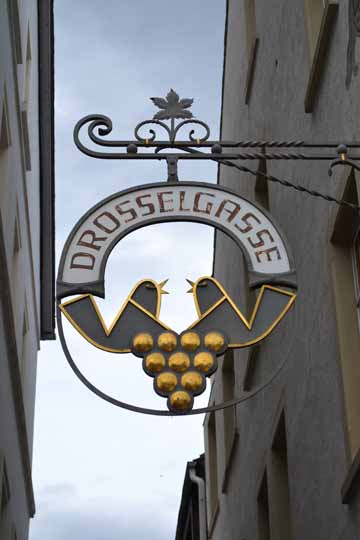
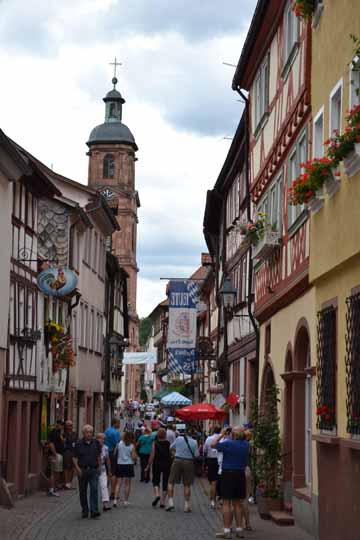
(left to right) Siegfried’s Mechanical Musical Instrument Museum; Drosselgasse, a lively street in Rudesheim.

DROSSELGASSE A FAVORITE
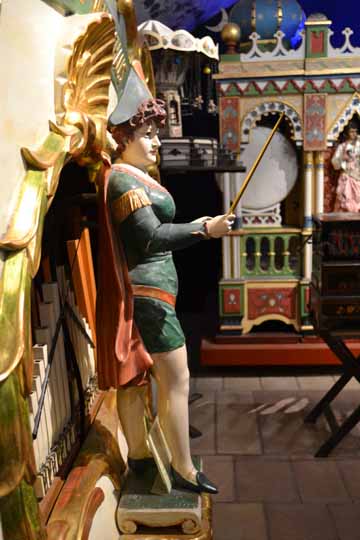
Our last stop on the Rhine River was in Rudesheim, where we enjoyed a guided tour of the Museum of Mechanical Musical Instruments (some imitating entire orchestras in one huge contraption!), and a local winery. Be sure to take time to explore the exciting main street, the Drosselgasse, with its many restaurants and shops.

Navigating the Main River is a slow process because of the many locks needed to raise or lower the ship along the route. So our ever resourceful cruise director kept passengers busy on board with an entertaining German lesson, and a cookie-baking demonstration by an “almost nun” from Miltenberg, our next port of call on the Main.

Miltenberg

Miltenberg was built against a hill at a curve in the river, a perfect place to collect tolls for the archbishop of Mainz. Many half-timbered houses are still preserved because the people here were too poor to tear them down and rebuild. If a floor sagged and sank, it was filled with sand and covered with another floor. In some recently renovated buildings, 30 centimeters of sand/wood layers were discovered beneath the floor. The original red “paint” on the houses was a mixture containing, among other things, oxblood and cattle dung, which provided the desired red color and also killed worms that might live in the wood. A unique naturally cool icehouse is located in the hill at the rear of the town.

Cold beer and ice cream

While the ship slowly navigated through more locks, passengers rode by bus to Wurzburg, and met the ship when it finally docked after our tour. Wurzburg is the site of the Prince Bishop’s Residenz, which is one of the finest examples of a baroque palace, and also a UNESCO World Heritage Site. It was built to rival Versailles in France and the Schoenbrunn in Vienna. The unique mirrored room features the difficult technique of reverse painting. The famous ceiling fresco by Tiepolo miraculously survived bombing, and the original marble floor is still in the main reception hall. The “marble” pillars are actually a stone core with a ground marble coating so that colors could be controlled, a technique that was more expensive than using solid marble.

Wurzburg

WURZBURG AND X-RAYS
Wurzburg was also the home of Professor William Conrad Rundkin, winner of the Nobel Prize for the discovery of X-rays. Residents in Wurzburg are not x-rayed; they are “Rundkined.”

Bamberg

The terrain along the river from Wurzburg to Bamberg changes and becomes flatter, with fewer vineyards, more trees and shrubs, and more locks. This quiet time was perfect for relaxing with a book from the ship’s library, located in the small lounge at the rear of the ship. There passengers found English language books of all genres, games, and the most wonderful coffee machine which dispensed espresso drinks that rivaled any coffee shop. Iced tea, shortbread cookies and other snacks were available 24/7. The ship also had an exercise room with a treadmill, two types of exercycles and flat screen TV, and a small beauty salon.

Cruise ship surprises

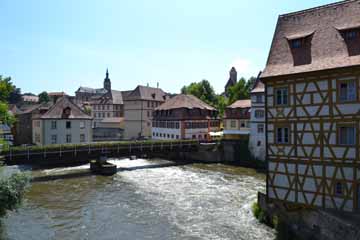
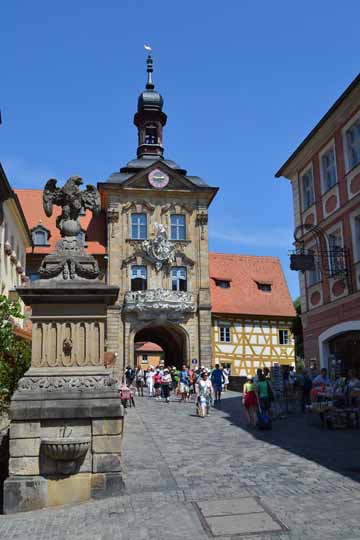
Busses again transported us to meet local tour guides in Bamberg, another UNESCO World Heritage Site. There we learned the local history of the cathedral, the Old Town Hall, which straddles the River Regnitz, had an opportunity to taste the local specialty, “Rauchbier” (smoked beer), and had time for browsing in the main pedestrian shopping area.

Our cruise ended the next morning upon arrival in Nuremberg, from which some passengers continued by bus to Prague, and others to charming Rothenburg ob der Tauber.

IF YOU GO..
Avalon Waterways, which has been in business for 80 years, has a number of different river cruises available in Europe. Their river cruise ships are small compared to ocean liners, which makes the service and trip more personal. They also have Europe’s youngest fleet of ships, with their fleet averaging just two years old, compared to seven years for other cruise companies.

There are full floor to ceiling sliding glass doors in 85% of the deluxe staterooms on Avalon’s fleet. Also, the Luminary had lots of space in the central passenger areas such as the dining room, lounge and library.

The Luminary offered five categories of rooms including Royal Deck suites; Royal Deck Category P; Sapphire Deck Forward, Category A; Sapphire Deck Aft, Category B; and Indigo Deck, Category E.

For more information, go to www.avalonwaterways.com or call 877-797-8791.

Castles, Christmas Markets and Cruising

By Marilyn Heimburger
Photos by Don Heimburger

Taking a river cruise is always a good idea. A river cruise that includes both historic castles and colorful Christmas Markets along Germany’s Rhine River is the best idea ever. So on Thanksgiving Day I happily ignored Black Friday and escaped the pre-Christmas shopping frenzy of the USA to spend a week on the AmaKristina, cruising from Amsterdam to Basel, Switzerland. Romantic castles and Christmas Markets along the Rhine River ushered in the Christmas spirit for me this year.

The newest AMA ship, the AmaKristina

The AmaKristina is essentially a floating luxury hotel for 158 guests. Our roomy cabin had a queen-sized bed, private bathroom with shower and double sink, desk, large format Apple screen and keyboard for internet, TV, or movies. Built in 2017, the ship’s hallways and guest suites were filled with Gustav Klimt art prints, and seasonally decorated with lights, Christmas trees, wreaths, garlands, and gingerbread houses. We boarded in Amsterdam, unpacked, and had our first dinner on board. Open seating at each meal encourages mingling of guests.

AMSTERDAM ATTRACTIONS
Fortified with a sumptuous on-board breakfast buffet, including an omelet station and daily vitamin “shot,” we departed the ship for an informative canal cruise, a panoramic city bus tour of Amsterdam with an up-close look at a local working windmill, and free time for exploring. Although there were no Christmas markets in Amsterdam, there were plenty of opportunities for shopping near the central train station, and street entertainment in Dam Square: a saxophone player, giant bubble maker, dancing dinosaurs, and impromptu yoga. Just be sure to watch out for the numerous killer bicycles that demand the right-of-way.

The AmaKristina set sail from Amsterdam in the afternoon, and I had time to explore the ship’s main lounge and bar, massage and hair salon, fitness room, gift shop, and even a heated pool and giant chess set on the sun deck. A cruise overview presented by our cruise director, plus Christmas tree decorating and an evening classical music performance by the three talented string players known as “La Strada” kept passengers entertained. The cruise ships cleverly bring nightly entertainment on and off the ship when stopped at the locks on the river.

Onboard entertainment by La Strada

COLORFUL COLOGNE
After cruising all morning, we docked in Cologne, Germany, where shuttle buses brought us to our first Christmas Market in Cathedral Square. Although the earliest Christmas Markets in Germany date from the late Middle Ages, the one in the shadow of Cologne’s impressive Cathedral is a relative newcomer, opening in 1995. Under a dazzling canopy of thousands of tiny lights, 150 vendor huts with bright red awnings and brilliant multi-faceted stars displayed handicrafts, comfort foods, gifts of all types, decorations, wooden toys and much more.

Canopy of Christmas lights in Cologne’s Cathedral Square

Cologne Cathedral Square market

HOME OF THE ELVES
A few blocks away in the Altstadt and Heumarkt was an older and much larger Christmas Market called the “Heimat der Heinzel” or Home of the Elves. These were little creatures from a Cologne legend who used to do all the housework until they were annoyed by an inquisitive housewife, and disappeared. I loved this market. Aisles were arranged by theme, and the large wooden huts had Old World, wood-carved details, thick green garlands and costumed vendors. Little “Heinzelmännchen” rode in gondolas above an expansive ice rink. Each souvenir mug of Glühwein (the traditional hot mulled wine so popular at the Christmas Markets) had a different elf pictured on one side, and his particular work specialty described in verse on the other. Cologne boasted three additional smaller markets, but time was too short to visit all of them on this trip.

Home of the Elves’ Market in Cologne

CASTLE DAY ON THE RIVER
The morning cruise from Cologne to the next stop in Rüdesheim passed through the UNESCO World Heritage Rhine Gorge. What a treat to sit in the ship’s expansive lounge with panoramic windows, coffee in hand, gazing at vineyard- covered slopes, picturesque villages, historic castles, and the famous Lorelei Rock, with commentary by the cruise director. This romantic part of the trip alone is a highlight of any Rhine River cruise.

RÜDESHEIM’S CHRISTMAS MARKET OF THE NATIONS
After a gourmet lunch of traditional German specialties, we docked in Rüdesheim, where the “Christmas Market of the Nations” wound up and down the narrow streets of this wine town of about 7,000 citizens. Vendors from France sold mushrooms, lavender and cheese, Tunesia vendors brought wares made of olive wood, smoked salmon came from Norway, furs came from Finland and even the United States was represented with a local vendor offering homemade cookies, Dr. Pepper, Fanta, marshmallows, and Hershey’s chocolate. Christmas choir music piped throughout the market added to the festive atmosphere as shoppers strolled past inviting vendor stalls and village shops. A new discovery at this market was hot mulled Glühbier from Belgium.

(clockwise) Hot lunch in Rüdesheim; Fur from Finland at Rüdesheim’s Christmas Market of the Nations; “Hallo” from the gnomes in Rüdesheim; Placing a phone call to the Christkind in Speyer

Throughout the ship’s seven-day cruise, each day’s program offered passengers quiet, regular and active excursions. Rüdesheim excursions offered by the AMAKristina included wine tasting, a hike, bike or gondola tour through the vineyards. A late night, fun option was experiencing Rüdesheimer coffee – coffee set on fire with Asbach brandy and sugar, topped with whipped cream and chocolate flakes – at Eiscafe Engel on Rüdesheim’s famous Drosselgasse.

Rüdesheimer coffee
Atmospheric narrow Rüdesheim street

THE IMPERIAL CITY OF SPEYER
By noon the next day we docked in Mannheim and could choose a bus excursion to Heidelberg or to Speyer. Having visited Heidelberg several times already, we chose to see the 2,000-year-old Imperial city of Speyer. Here the Christmas Market extended down Maximilianstrasse from the UNESCO World Heritage Speyer Cathedral, the largest Romanesque cathedral in the world. Though smaller than the Cologne Christmas Markets, Speyer’s market had all the requisite comfort foods: Glühwein, grilled sausages, roasted almonds, and even waffles, potato soup and dumplings. Vendors offered wood handicrafts, colorful candles, jewelry, scarves, kitchen gadgets and unique cookie cutters. Especially for children were an ice rink, kiddie car rides and a telephone booth with direct access to the Christkind in Heaven!

Back onboard the AmaKristina we had a tea time treat of traditional Spekulatius cookies and Stollen, while we set sail for our next stop: Strasbourg and Le Petite Alsace in France.

INVITING STRASBOURG AND LE PETITE ALSACE
As with each stop on our route, AmaWaterways provided an energetic and knowledgable guide for a walking tour of the area on the way to the Christmas Markets. This morning we learned about the Alsace region, which changed hands between France and Germany four times in 75 years. The name “Alsace” derives from a German phrase meaning “seated on the Ill.” While our guide led us along the Ill River, past the beautiful half-timbered houses lining both sides, she explained that this charming area was historically the least desirable place to live. It had been the site of fortifications and a prison, the home of executioners and the location of the tanning trade, with its smelly byproducts. Today it is a photographic highlight of any trip.

CHRISTMAS MARKETS WITH A FRENCH TWIST
Christmas Markets first appeared in Strasbourg in 1570, making this German/French town the location of one of the oldest markets in Europe. Although much was similar to the Christmas Markets we saw in Germany, here the food vendors offered toasted baguettes topped with cheese as the warm comfort food, instead of the ubiquitous wursts in the German markets.

The traditional market was near the cathedral, with some vendor huts topped with storks, that famously nest in Strasbourg’s Parc de l’Orangerie. More than 300 vendor chalets filled the historic city center. Entertaining metal sculptures depicting different professions caught my eye, as did the detailed, intricately carved figures for nativity sets. A market area featuring Strasbourg’s service organizations surrounded a towering decorated Christmas tree and grassy area which was perfect for family photos. A small market in Gutenberg Square annually invites vendors from other countries: this year it welcomed Iceland.

Try some gingerbread in Gengenbach

GENGENBACH’S GIGANTIC ADVENT CALENDAR
We were back on the German side of the Rhine River by late afternoon, and on a shuttle bus from the AmaKristina to the beautiful village of Gengenbach. A guided tour down Engelgasse led to the Christmas Market which stretched down the main street from the town hall square.

Gengenbach Town Hall Advent Calendar

Gengenbach boasts the world’s largest Advent calendar in its neo-classical town hall, where each night one of its 24 windows is opened to reveal a picture by a famous artist. This year’s calendar featured paintings by Andy Warhol. We arrived just in time for the first night’s opening ceremony: a narrated short skit performed by children from the town. After browsing through the market’s matching vendor huts, with hot Glühwein in a mug depicting the town hall Advent calendar, we returned to the ship to be delightfully entertained by a French cabaret singer and her accordion accompanist.

LAST FULL DAY ONBOARD
Shuttle busses from the AmaKristina were the order of the day with options to Riquewihr, France, or to Freiburg and Breisach, Germany. Deciding to aim for German-speaking vendors, we took the second option, and explored the market in the heart of Freiburg’s beautiful old quarter. Traditional craft products, including glass blowing and colorful wooden toys were offered beneath the green and white lights that trimmed the roofs of the more than 130 vendor huts.

Time was too short to see all of the ceramics, candles, hand puppets, amber jewelry and Christmas decorations, but we enjoyed a quick wurst and Glühwein lunch before leaving for Breisach. Unfortunately this town’s tiny Christmas Market was not yet open for business, so after strolling down the pedestrian-only shopping zone, we walked back to the boat dock, to sail to Basel and enjoy the captain’s farewell dinner and our final evening on board.

Early the next morning, with our luggage packed with Christmas Market treasures, we left for home filled with Christmas spirit and with wonderful memories from this romantic river cruise of Christmas Markets and Castles on the Rhine.

TIPS AND FINAL NOTES
An AmaWaterways river cruise makes visiting so many sites along the Rhine extremely easy. You unpack only once in a roomy cabin. Meals are well-planned, complete and delicious, with perfect portions and special dietary options. Wine and beer are included with lunch and dinner. The fabulous coffee bar is open all the time. Special surprises delight passengers as well, such as serving a location’s specialty treats during afternoon tea time, recognizing St. Nicholas Tag by putting treats in passengers’ shoes left outside cabin doors, and providing hot towels and beverages upon re-boarding after cold excursions. The company will cheerfully arrange for your transfers to and from the cruise ship.

The cruise director is the key to having a wonderful time on any cruise, and this AmaWaterways trip had a great one. David Rosell was organized, energetic, accommodating and entertaining.

Most Christmas Markets are open from the beginning of Advent through Christmas, although some larger markets stay open longer, and some smaller ones have limited open hours. Bring euros – most small vendors don’t accept credit cards.

Pack warm layers of clothes, boots and umbrellas. The weather can be chilly and damp during November and December.

AmaWaterways provides a post-cruise option, if you want to extend your trip. This Christmas Market/Rhine River castle cruise offered an excursion to Lucerne and Zurich after disembarkation in Basel. For more AmaWaterways information and schedules, go to: www.amawaterways.com.

If you go: The Mövenpick Hotel Central in Amsterdam is a great place to stay before you board. This new, 4-star hotel is located within walking distance of the train station, the city center and the cruise ship loading docks. A sumptuous breakfast buffet is included with the room, and a knowledgable concierge team can help you plan your free time in Amsterdam before the cruise. For more information go to: www.movenpick.com/en/europe/netherlands/amsterdam.