InterCity Hotels: In the Center of the Action

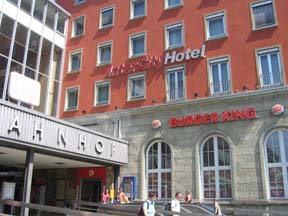
InterCity Hotel in downtown Munich

By Don Heimburger
Photos by the author

My business takes me to European cities several times a year, and I usually end up spending a lot of time in the “old town” or historic part of a city or town. It’s typically my favorite place to spend time, looking at the market squares, visiting hotels and restaurants, asking questions about town festivals and events, or visiting a museum or other local attraction.

When I’m done at the end of a day, I want to stay close to the center of town, because really I’m not done with my work. There’s always more to see and do in the evening, and that means generally after a late afternoon break, I’m back again, interviewing, taking pictures or attending some function. And again it’s usually near the center of town.

CENTER OF TOWN CLOSE TO TRAIN STATION
In Europe, the center of town means it’s in close proximity to the train station, because the railroads are and were instrumental in growing cities.

One company that likes to locate its hotels near the train stations is Steigenberger’s InterCity Hotel group, a chain of 31 facilities in Germany and one in Austria. Their own literature says, “If you are seeking a centrally located, functionally equipped and comfortable domicile, InterCityHotels are your perfect choice.”

In a recent business deal, the Egyptian tourism corporation Travco Group became a majority stockholder in the Steigenberger Hotel Group. “Particular focus will be given to international expansion of the brands Steigenberger Hotels and Resorts and InterCityHotel,” says Hamed El Chiaty, founder and owner of the Travco Group.

On a recent trip to Munich and Freiburg, I booked rooms at the InterCity Hotel in both cities. From the Munich train station, where I arrived from the airport, I only had a few steps before I saw the familiar InterCity sign at one end of the train station.

FEATURES OF HOTEL
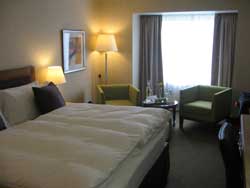
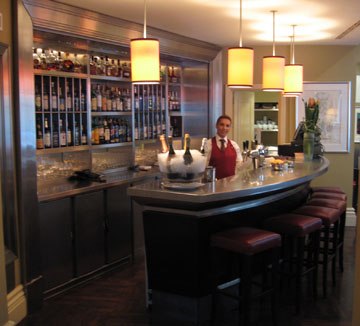
The five-story hotel has 198 rooms and suites, floors for non-smoking, with all rooms sound-proofed and air-conditioned. The soundproofing was a good idea, as next to a train station, it can be fairly noisy at times. Rooms feature a bathroom with shower, toilet, hair dryer, cable television and a writing desk. There was a WiFi connection in the room. The hotel featured two elevators and a restaurant (Fleming’s Brasserie & Wine Bar), where the morning’s complimentary breakfast was served.

I was happy to have room air conditioning when I was there, as it hit 95 degrees in the afternoon in Munich, a rarity for this city so close to the Alps.

A convenient part of any InterCity booking is a complimentary card that allows guests to use local public transportation free of charge. So if you want to go to the Marienplatz, as an example, which I did several times, I just presented my card at the train station when needed, and I enjoyed free transportation. The city center is less than a mile away.

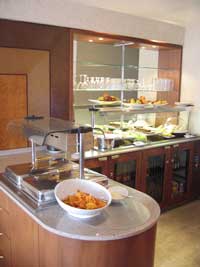
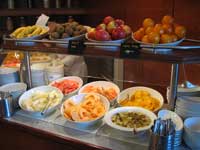
Intercity hotels are mid-range in price, clean and walkable to the inner city. In the morning, a buffet-style breakfast was served with scrambled and hard-boiled eggs, sausage (white Munchener sausages), several types of yogurt, two types of juice, hard rolls, whole grain breads, crossiants and pastries, bacon, large pretzels, a variety of soft and hard cheeses, six types of cereals and a variety of cold cut meats.

There was also dried fruits, fresh fruits such as watermelon, pineapple, and a bowl of mixed apples for guests. I was ready to start my day!

The lobby downstairs was sparse but featured comfortable chairs and couches for guests, as well as a few tables.

THE FREIBURG INTERCITY
Later on, I took the train to Freiburg near the Black Forest, where again a stay at the InterCity there kept me close to the train station and was only a few blocks from downtown. The hotel, in fact, is just a few steps from the entrance to the train station.

This multi-level hotel features 152 guestrooms, had non-smoking rooms, cable television, direct dial telephones, a modem/fax link, a writing desk and a mini-bar. There was no air conditioning, so with the hot weather, keeping the window open was a necessity; I was told the typical summer high temperature doesn’t require air, and it’s not available in most Freiburg hotels.

The room had a shower, toilet, hairdryer, and a restaurant and a bar downstairs. The hotel staff was pleasant and I noticed they was able to answer visitors questions about the train schedules and the city. Again the room was clean and had the basics. The hotel even had rooms for the disabled if needed.

In all, a stay at a InterCityHotel affords travelers a convenient location for a mid-range price, with breakfast included.

MORE HOTELS TO OPEN
More InterCity Hotels are scheduled to open with the merger of the Travco Group. Steigenberger’s Chief Executive Officer André Witschi says that the company will continue to invest in improving the quality of their hotels, and international expansion will help them to increase brand awareness for Steigenberger Hotels and Resorts and InterCityHotels.

In 2010 and 2011 InterCityHotels will open five new locations in Germany: at the Berlin-Brandenburg Airport and in Bonn, Darmstadt, Mannheim and Ingolstadt.

For more information, go to:
www.intercityhotel.com
www.muenchen.intercityhotel.de
www.freiburg.intercityhotel.de

Contact the hotels by e-mail: info@muenchen.intercityhotel.de
info@freiburg.intercityhotel.de

If you are arriving by train:
www.raileurope.com
Paris Avec Famille

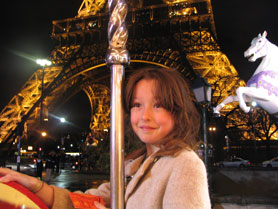
Sophie at the Eiffel Tower

By Susan MacCallum-Whitcomb
Photo by the author

Ahh, Paree! For most of us, the City of Light is synonymous with culture, cuisine and romance.

When you visit, you’re supposed to spend your time in world-class museums and Michelin-starred restaurants. You’re supposed to take intimate strolls by the River Seine. You’re not supposed to take your children. Right? Wrong.

In fact, Paris is extremely kid-friendly. Part of the reason is that the locals-–who tend to take their own enfants everywhere-–are so welcoming. But it is also because Paris itself seems reassuringly familiar to children.

Some discover the French capital as toddlers courtesy of Ludwig Bemelman’s Madeline books; other make vicarious visits with Eloise, the Aristocats, the Rugrats, even the ubiquitous Olsen Twins. Hence its big-ticket attractions already have a built-in appeal. Take Notre Dame Cathedral: 800-year old churches don’t normally top a child’s itinerary. But, as the setting for Disney’s Hunchback movies, this one is an exception to the rule. Since it is literally the center of the city–the place from which all distances are measured-–it also makes a fitting starting point for your family’s monumental adventure.

CAVERNOUS INTERIOR
After spinning around the cavernous interior and “reading” the stories in the stained-glass windows, older kids can drop a few euros to descend into the pre-Roman Crypte Archeologique or climb the towers for a close-up look at Quasimodo’s home turf.

Younger ones, meantime, may prefer to plop on a bench in adjacent Viviani Square. Thanks to the uncluttered view of Notre Dame it offers, they can amuse themselves by playing “spot the gargoyle” (one looks suspiciously like Disney’s Laverne) and feeding the world’s most gregarious pigeons.

Compared to the cathedral, the Eiffel Tower is a relative newcomer. Yet it’s a certifiable icon, and you’ll likely feel compelled to scale it. Of course, every other tourist in town will too. So to avoid the worst crowds, try arriving early on a weekday and taking the elevator straight to the third level. Tickets are steep (11.50€ /6.30€ for ages 3-11); but on a clear morning the vista is priceless. Alternately, bring the kids after dark to see the tower lit up like a super-sized Christmas tree. For the full effect, arrive on the hour (dust to 2 a.m. in summer) when 20,000 individual bulbs sparkle in a 10-minute display.

ARC DE TRIOMPHE
For those who’d rather look at the Eiffel Tower than be on it, the Arc de Triomphe is another option. Napoleon’s tribute to his troops might not seem like a natural choice for families: after all, it’s perched on the site where Paris’ 12 main avenues converge and is surrounded by an obscenely-busy traffic circle. Nevertheless, children routinely give it the “Coolest Tall Thing” award. That’s because it’s wide open at the top. Unlike the Eiffel Tower (which is enveloped in mesh) there is nothing creepy or cage-like to impede their view-–and the sight of Paris, laid out like a star below–is impossible to beat.

Once you’ve soaked it all in, it’s time to hit the city’s famed museums-–some of which are aimed squarely at families. One such venue is the Science and Industry Museum. Its interactive “Cité des Enfants” is undeniably inviting: five – to 12 year-olds, for instance, can program robots while younger siblings play Bob the Builder at a mini construction site. However, the rules can be off-putting. Registration is required, limited numbers of guests are admitted and visits are restricted to 90 minute sessions. Kids are also streamed by age. So depending on your family structure, the trip can be a logistical nightmare.

Luckily, though, there’s no need to stick to the kiddy category when it comes to Parisian museums. Musée Rodin is a case in point. The esteemed sculptor’s estate in the seventh arrondissement is an ideal place to introduce youngsters to fine art. Sure its walls hide orderly flowerbeds, ornamental pools and a grand 18th-century mansion. But don’t let the formality fool you. In the garden, kids are free to play among famous statues; and inside visitors as young as four can sign up for regularly-scheduled activities (including tours complete with games and drawing sessions) that are priced between €4.50 and €6. 

KID PLEASERS
Musée d’Orsay, on the Left Bank, and the Pompidou Centre’s t&L=2″ Musée National d’Art Moderne, on the Right, are kid-pleasers as well. The former has a dazzling Impressionist and Post-Impressionist collection (think works by Monet, Renoir, Van Gogh and Cézanne), while the latter focuses on Modern masters like Picasso and Matisse. Both have intriguing architecture, plus bright bold canvases that appeal to kids. But the fabled Louvre, with its exhaustive-–and exhausting!-–supply of religious and historical paintings will seem pretty staid by comparison.

If seeing Mona Lisa’s smile is high on your personal to-do list, consider taking turns with   another adult. When one of you dips in, the family can relax just outside on the expansive lawns of Jardin du Tuileries. It’s easy to while away hours there bouncing on tres chic trampolines, sailing toy bateaus, riding carousel horses or graduating to real ponies (à la carte activities that cost a couple of euros each). Many of the same simple pleasures can be enjoyed across the Seine in Jardin du Luxembourg: a sixth arrondissement park which also happens to house the city’s best-loved marionette theater.

JARDINS ARE BACKYARDS

The beauty of both spots is that they’re not merely tourist attractions. In a city of apartment dwellers, these jardins serve as a backyard for countless families. So lingering in them qualifies as an authentic cultural experience, especially on weekends or Wednesday afternoons when local children are out of school. If your offspring have a smattering of French they can strike up a conversation with their Parisian peers. If not, don’t worry: they’ll quickly learn that the language of child’s play is universal.

For playtime on a grander scale, you can take the gang 20 miles north to Parc Astérix (35€/ 25€ for ages 3-11). Inspired by France’s favorite cartoon hero, it features dozens of amusements ranging from a classic wooden roller coaster to an ultra-modern corkscrew model. Twenty miles east of the city, meanwhile, is Disneyland-Paris: a 2,225-acre resort that proves it really is “a small world after all.” Said to be Europe’s #1 tourist attraction, it consists of two parks-–a Magic Kingdom and Walt Disney Studios-–with one-day passes to each costing  46€  (38€ for ages 3-11). 

FUN ANYWAY
Since these resemble their U.S. counterparts and recreate many popular rides (“Dumbo’s Flight” and “Rock’n’Roller Coaster” among them), Disneyland-Paris is often dismissed as an unnecessary Americanism. Who, naysayers may ask, needs a kingdom built around a faux castle when the countryside is full of the genuine article? For that matter, who needs a movie park dedicated to a foreign director when Jean-Luc Godard and François Truffaut are native sons? Well, nobody does. But they’re fun anyway. Besides, a dose of Disney is a great antidote for kids suffering a temporary case of culture shock.

The truth is that no matter how well prepared you are, your children will feel slightly disoriented at times. Moreover, touring with them will always be an added responsibility. Yet there are upsides. Kids, literally and figuratively, look at things from a different angle. Hence being with them will reveal sites and scenes that are typically hidden from vacationers. All you have to do is slow down and savor the experience. Remember, parents don’t get bonus points for ticking off every attraction listed in their guidebook. The real reward comes from building a store of family memories that you all can share. ET

Take a Pass: Admission charges add up fast, so a  Paris Museum Pass is just the ticket for pennywise parents. Priced from €30 for a two-day version, it gives adults unlimited entry to more than 60 museums and monuments – including all of those mentioned above except for the Eiffel Tower. Children don’t need one because so many of the attractions are already free for guests under 18 (that’s a big plus when your traveling companions have short attention spans!). Better still, the whole family benefits since the pass also allows all of you to jump those lengthly lines.

ABOUT THE WRITER
Living up to her turn-of-the-millennium resolution, freelancer Susan MacCallum-Whitcomb jettisoned her professorial robes and traded teaching for full-time travel writing. In the years since, she has spent an inordinate amount of time doing research in Europe — much of it with her family in tow!  The results can be read in Fodor’s guidebooks (she’s contributed to six thus far) as well as Fodor’s online newsletter, and a host of Canadian magazines and newspapers. When not jaunting around the continent, Susan enjoys taking it easy in her sublime home base: Halifax, Nova Scotia.

InterContinental Hotel Prague

Restful haven in a bustling capital

By Don Heimburger
Photos by the author

The InterContinental Hotel in Prague sits on the banks of the Vltava River in the city’s Jewish Quarter.

This is important because it offers a great view of the city and the Prague Castle and the river’s activities, but it also is convenient to the historical center, as well as transportation. The high-end shopping area called Parizska Street is a few steps outside the door.

I didn’t realize all this when I first spotted the hotel, but soon I realized that location sometimes can be everything. But for his hotel, it goes beyond that. It’s a luxury accommodation on the inside, as well as being centrally located.

OFFERS 372 ROOMS
The hotel offers 372 rooms and suites and another important feature, especially for the business traveler—the Club InterContinental (concierge service, a library, free internet access, copy machine, newspapers and refreshments).

The hotel’s rooms feature goose-down duvets, blackout curtains, Italian marble bathrooms, mini-bar, in-room safe, color television with 47 channels, telephone, voice mail, coffee machine, iron and ironing board and individually-controlled air conditioning.

I found plush towels in my room, fluffy pillows, chocolates at turn down time, bright, cheerful rooms with two comfy chairs and 3.4 ounce bottles of shampoo, lotion, conditioner and shower gel. The bathroom had two hand towels, two face towels and two shower towels. There was plenty of closet space, a storage cabinet and nice plush carpeting. The flat screen television was of the newest model, and the swimming pool was nice.

BREAKFAST: GOOD VARIETY
Breakfast, an important meal for business and leisure travelers alike, featured a large variety of meats and sausages, cheeses, cereals, potatoes, hot plates such as waffles or scrambled or fried eggs made to order, breads and rolls, juices, coffee and tea, and fruit, as well as whole fruit. The breakfast was delicious and there was plenty of it. The wait staff was pleasant and efficient.

The hotel’s staff is multilingual–good when you can’t understand the local language.

The Zlata Praha Restaurant in the hotel serves a wide variety of dishes, including Czech and international cuisine. A Sunday brunch is also offered between 11 a.m. and 3 p.m. A second restaurant on the first floor, the Primator, offers excellent views of the river. Duke’s Bar & Cafe offers a pleasant setting for a quiet drink or two, with live entertainment on Friday and Saturday evenings.

A Health club and spa are part of the hotel offerings, with whirlpool, saunas and solariums, as well as five treatment rooms.

To make a reservation, go to www.intercontinental.com/prague or www.icprague.com. The five-star InterContinental hotel is located at Curieovych 43/5, Prague 1, 110 00, Czech Republic. E-mail is prague@ihg.com.

Hotel Amigo Is a Friendly Place

By Don Heimburger
Photos by the author or as noted

“I am delighted to introduce the Hotel Amigo, which we restored to its rightful status as the best luxury hotel in Brussels,” said Rocco Forte when the hotel’s renovation was completed in 2002. Forte, owner of the Rocco Forte chain of 14 hotels (some currently under development), which are located in European capitals and in Marrakech, has assembled a group of upper-scale hotels that are designed to provide all the usual  higher class amenities and then some.  

Located at Rue de l’Amigo 1-3, only a block from the famous Grand Place, considered the center of Brussels and noted as likely the most beautiful square in Europe, the five-star Amigo is ideally situated near the key historical sites, shopping areas, restaurants and entertainment.

The doormen in their black top hats signal a welcome to the hotel; the lobby is small, but neat and classy with a dark-paneled reception counter and polite clerks. 

The air-conditioned room was bright, very clean, with a small suite adjoining the bedroom and bathroom. Comfort was key. There was a modern feel to the room which featured furniture and pictures from the Blaton collection and influences from Brussels’ history. The bright bathroom featured a red mosaic vanity top and excellent toiletries.

The room contained Brussels linens, red silk curtains with embroidered velvet details and Flemish chairs and desks. The bed was firm and comfortable. The room was quiet and provided a cozy getaway from busy shopping or touristy activities. I did not try the restaurant for dinner, or the bar, being there only one evening.

A BIT OF HISTORY

The hotel has a bit of history. The original structure on the lot was built before 1522 by a wealthy merchant family and later purchased by the city council and turned into a prison. In 1957 the Hotel Amigo was built by the Blaton family on the occasion of the Universal Exhibition of 1958. During the Rocco Forte renovation in 2000, it underwent a re-styling by Olga Polizzi, the hotel’s director of design. Canvases from artists such as Courtens, Dansaert and Wagemans, together with Flemish wall tapestries from the 18th century, give the hotel a pleasingly modern but still historic flavor.

The morning breakfast included all the necessary eggs, breads, meats and cheeses, juices, coffee, and fruits to satisfy many diverse tastes. The wait staff was pleasant and helpful.

Then hotel was won many awards, including being rated one of the top 100 hotels in the world by the Institutional Investor in 2007. Forbes Traveler rates it one of the top 400 hotels in the world.

European Traveler rates it extremely high as well. We liked virtually everything about it. 

The lowdown:

• Member of the Leading Hotels of the World
• 174 rooms, including 18 suites and the Blaton Suite (on the top floor with large terrace for excellent views of Brussels)
• In-room telephones, voice messaging, internet connection, cable TV, marble bathroom, minibar, safe, trouser press
• Ristorante Bocconi, with bar in the lobby
• Ballroom for up to 200 guests
• Fitness center
• Transfers from the airport (at a charge)
• 24-hour room service which “arrives on time” (the hotel guarantees this)
• In 2007, room rates for a classic room single were 590e; 720e for an executive room single
• General Manager: Ivan Artolli, since 2002 (fluent in French and English)
• Reservations: amigo@roccofortehotels.com

Munich’s Colorful 2007 Christmas Markets

By Marilyn Heimburger
Photos by Marilyn and Don Heimburger

What better way to discover the magic of Christmas than to experience the sights, sounds and smells of Germany’s famous colorful Christmas markets!

Not only do these markets offer beautifully-crafted products and traditional food, they are also filled with a sense of excitement, community and anticipation during the season of Advent.

Children’s eyes sparkle as they gaze at the colorful lighted displays, and friends meet to share a drink and celebrate the season.

European Traveler’s first stop on a Weihnachtsmarkt tour was Munich’s historic market in Marienplatz. Possibly dating from the 14th century, the market was first called a “Nicholas Market” during the 17th century. Since 1972 the Christkindlmarkt, as it is now called, has been held in the central square of Marienplatz, near the famous Glockenspiel in the town hall.

Market-goers can relax at the Ratskeller located in the basement of Munich’s Rathaus.


100-FOOT-TREE SPARKLES

A nearly 100-foot- tall Christmas tree, sparkling with thousands of tiny white lights, towers over the more than 140 stalls that fill the square and meander down Kaufingerstrasse toward the famous two-towered Frauenkirche.

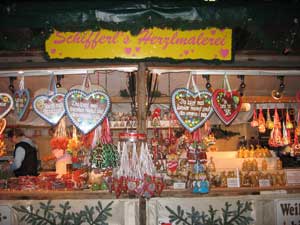
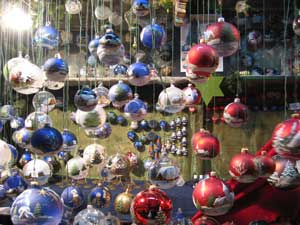
Hungry? Try the grilled sausages and sauerkraut, or potato pancakes with a glass of the delicious local beer. Or warm up with a cup of Gluhwein (hot spiced wine) and take home a souvenir Christmas Market mug. Buy a gingerbread heart that declares your love or friendship in icing, or a package of traditional Nuremberg Lebkuchen. The aroma of roasted almonds, served in paper cones, is everywhere. Handmade Christmas decorations of straw, pewter and wood, hand carved from the Oberammergau, South Tyrol and the Erzgebirge areas of Germany, carry forward Christmas traditions of centuries passed.

Candles, pottery and toys are among the offerings of other merchants, all of whom brave the chilly weather to be a part of this festive annual event that is open from the Friday before the first Sunday in Advent until Christmas Eve.

SPECIAL CHRISTKINDL STAMP

On the way to the additional booths located in the town hall’s inner courtyard is a special Christmas Post Office which will postmark your mail “Christkindl” and send it anywhere in the world.

Unique to Munich’s Christmas markets since the middle of the 18th century is the Kripperlmarkt, Germany’s largest manger market. Located a short walk away from Marienplatz on the Rindermarkt, this specialty market offers animals, figures, stalls, lanterns, sheds, trees – anything for a large or small Nativity scene. Food and beverages are available at this market from the hut at the base of a colorful, two-story-high, rotating candle pyramid.

Both the Christkindlmarkt on Marienplatz and the Kripperlmarkt on the Rindermarkt are open Monday through Friday from 10:00 a.m. to 8:30 p.m., on Saturday from 9:00 a.m. to 8:30 p.m. and on Sunday from 10:00 a.m. to 7:30 p.m. A 10-minute walk from Marienplatz to Brinner Strasse at Wittelsbacher Platz brings you to the Mittelaltermarkt. This unique market is designed to transport you to the Middle Ages, where knights and ladies-in-waiting stroll among wooden stalls, which are lighted by flaming torches and candlelight.

Vendors dress in period costumes, and hot mulled wine is served in clay vessels. Pastry, waffles, crepes, fur accessories, jewelry, candles, ceramics, and knight and princess costumes for children, are among the products available at this relatively new but increasingly popular market.

THE DALLMAYR STORE

On the way back to Marienplatz, stop and visit Dallmayr, Germany’s most famous deli . It has been located on Dienerstrasse between Marienplatz and Odeonplatz. since the late 17th century, but the current building was constructed in 1950, after the previous one was burned to the ground during World War II. Known for its brand name coffee, the delicatessen offers luxury foods that include confectioneries, tea, honey, jelly, chocolate, meat, sausage, chicken, fish, caviar, pasta, bread, fruits, vegetables, wine, tobacco, and even an indoor fountain stocked with live crayfish. There is also a high-end restaurant with seating for 120.

Another interesting and tasty stop is Rischart Bakery, located right off Marienplatz. During the Christmas market season, this outdoor, cobble-stoned café is transformed, with the help of a windowed white tent, into a heated, carpeted, indoor café, complete with a white, fabric-swagged, star-lit ceiling. Children are invited to assemble cookies for baking at a workstation, while adults enjoy coffee and a pastry.

DEUTSCHES MUSEUM OFFERS A LOT

Is it too rainy to visit the Christmas markets? Spend some time at the Deutsches Museum until the weather clears. Founded in 1903, the museum shows the development of science and technology from early time to the present day. It is one of the largest museums in the world, with exhibits on marine navigation, mining and man’s first attempts at flight to space travel and rocket science.

Beautifully detailed models show railroad and bridge construction. The museum’s collection of musical instruments is one of the most important of its kind anywhere in the world. Tours and demonstrations are scheduled daily in many departments. Find more information at www.deutsches-museum.de.

If the magic of Christmas at the markets isn’t enough, end your day at the Munich Opera House enjoying a performance of Mozart’s “Magic Flute.” This production is a holiday favorite for families, who dress in their finest for the event. During the intermission, have a glass of wine and light dinner or snack at the lower level food service area. A behind-the-scenes tour of the Bavarian State Opera house reveals the immense area available to facilitate movement and storage of scenery for the many productions. With seating for 2,101, it is the largest opera house in Germany. First built between 1811 and 1818, it was rebuilt after being destroyed by fire in 1823, and again after being bombed during World War II. The current neoclassic building was finished in 1963.

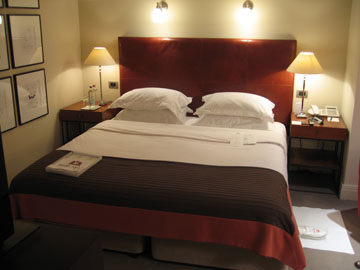
With the popularity of Munich’s Christmas Markets, accommodations may be difficult to find near Marienplatz. For comfortable lodging, try the Hotel Pullman Munch, which is just a short U-Bahn ride away from Marienplatz, the Christmas markets, and the Opera House. It is located at Theodor-Dombart-Strasse 4, 80805 Munich Phone: +49 89 360990.