Meissen Porcelain Celebrates 300 Years

Photos courtesy Germany Tourism

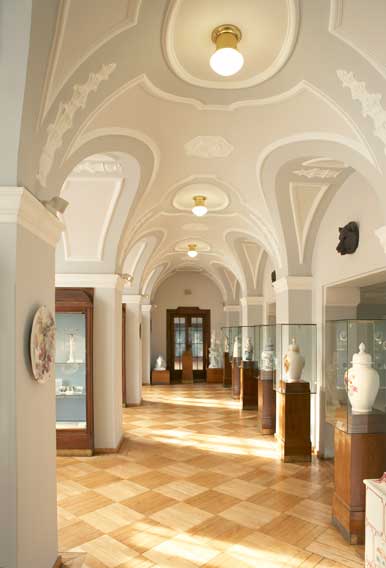
Founded in 1710, Meissen Porcelain is one of the world’s most successful luxury brands. It stands for the timeless connection between past and present, classic design and hand-made quality. This year Germany is celebrating the 300th anniversary of Meissen Porcelain with more than 40 special events and exhibitions.

Some of this year’s highlights included these exhibitions: Triumph of the Blue Swords at the Japanisches Palais in Dresden, focusing on the first 100 years of Meissen, showing masterpieces that are not usually displayed in public; All Nations are Welcome in the nearby town and modern factory of Meissen (January 23 – December 31); Philosopher’s Stone, a collection in the original workshop in Castle Albrechtsburg also in Meissen (May 8 – October 31); and The Fascination of Fragility with 500 pieces from Dresden’s state collection in the Ephraim Palace in Berlin.

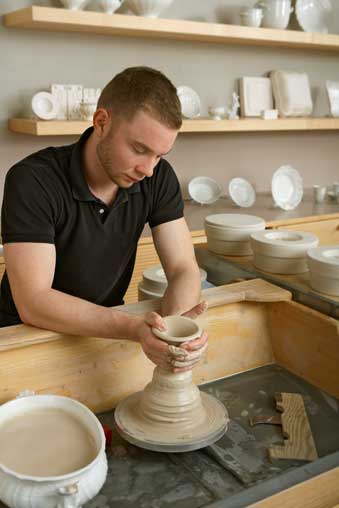
Porcelain in Meissen and Dresden is not only available to the public during this jubilee year. The Saxon nobelman Augustus the Strong’s permanent collection is housed in Dresden’s Zwinger Museum in the rooms beautifully restored by the New York designer Peter Marino. The modern production center, its connected museum in Meissen and the original factory in the Albrechtsburg, are only 45 minutes outside of Dresden and accessible by fast train to visitors throughout the year. You can dine on Meissen porcelain, participate in workshops, watch the production and, of course, buy the products.

Porcelain manufacturing and collection is a major attraction throughout Germany, with special routes, museums and production centers. Two porcelain routes link places of interest with the manufacturing of porcelain: Along the 340-mile-long route in the north-east of Bavaria visitors can discover famous factories, the European Industrial Museum of Porcelain, the Rosenthal Museum and the European Museum of Technical Ceramics.
www.porzellanstrasse.de

A second themed route in Thuringia features factories where porcelain is made and decorated and where visitors can visit factory outlets, demonstration workshops and several museums.
www.thueringerporzellanstrasse.de

Another highly acclaimed porcelain factory is based in Munich in the beautiful Nymphenburg Palace. For 260 years the Nymphenburg production center produced dinner services and figurines for the Bavarian kings. At the adjacent museum more than 1,000 pieces of Nymphenburg porcelain from different periods are exhibited. www.nymphenburg.com/us/nymphenburg

Sightsleeping in a Castle

Photo courtesy Heidelberg Marketing GmbH
Sightsleeping Hotels

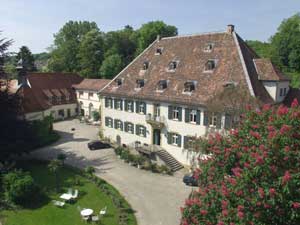
With “sightsleeping” hotels, the state of Bavaria offers tourists interesting ways to discover the land of King Ludwig with its many castles. “Sightsleeping” features 19 different hotels all over Bavaria, each unique, and a tourist attraction in and of itself.

Especially interesting are the seven castle hotels at Neuburg, Wernberg, Pommersfelde, Eggersberg, Rothenburg, Burgellern and Hopferau. Each offers a connection between history, culture, art and luxury. (www.bayern.by)


Live like a king, spend as a pauper

Castles, former hunting lodges and manor homes have been turned into bed and breakfast places and even youth hostels. All these castles are pleasant, historic and non expensive getaways, and definitely a good bargain.

Castles, monasteries and manor houses that have joined the Culture and Castles Association, a group of aristocratic families opening their properties to the public, stand out due to their remarkable authenticity, and they provide timeless accommodations for great value, starting at 60 Euro per night. Services range from bed and breakfasts, holiday apartments and wedding facilities, to dreamlike locations for meetings and special festivities. (www.culture-castles.de)

Along the Castle Road, which stretches more than 600 miles from Mannheim/Heidelberg to Prague, some of the more than 70 castles, palaces and castle ruins have been turned into hotels and offer comfortable and fairy-tale like accommodations. For centuries the buildings have survived the vicissitudes of history and stand as reminders of emperors, kings and princes, of poets and thinkers, robber knights and romantic tales of chivalry.

Youth hostels in castles are the essence of great value with a unique experience. Stahleck Castle (www.jugendherberge.de), in Bacharach near the river Rhine river, is Germany’s prime example of spending like a pauper but living like a king. This 11th century castle houses one of Germany’s top youth hostels with plenty of beds, a warm welcome and a medieval view. Prices for an overnight stay can be as low as 20 Euro. Other popular youth hostels can be found in the castles of Nuremberg above the city center: Altena near the Ruhr region, Ehrenbreitstein near Koblenz and Rothenfels in the Main valley.

Baden Wuerttemberg and its Castles

The state of Baden Wuerttemberg in the southwest of Germany is home to many of the country’s finest palaces and the birthplace of its most powerful dynasty: the Hohenzollern, who ruled Prussia and Germany for many centuries.

Castles in Baden Wuerttemberg cannot only be visited, but they also serve as hotels offering guests royal comfort and an unforgettable stay.

A luxury getaway is the Castle Hotel Buehlerhoehe. The five-star hotel, just outside of Baden-Baden, is at an altitude of 2,788 feet, overlooking the surrounding wineries. With luxury accommodations, gourmet restaurants and unique flair, this castle hotel is one of Baden Wuerttemberg’s shining stars and promises an unforgettable stay. (www.buehlerhoehe.de)

Along the castle road lie other unique hotels: A romantic stay in an authentic fortress can be found at Castle Guttenberg. Situated on a mountaintop overlooking the river Neckar, guests will not only sleep comfortable in this fortress from the 13th century, the castle has a rustic charm and invites guests to medieval feasts. (www.burg-guttenberg.de)

The Castle Hotel Liebenstein is a treat for all golfers with its own 27-hole golf course. The castle was built in the 12th century and is situated in close to the river Neckar. With 24 rooms, the hotel promises an intimate experience with personal service. (www.liebenstein.com)

Other castle hotels in Baden Wuerttemberg are Staufeneck, www.burg-staufeneck.de; Haigerloch, www.schloss-haigerloch.de; Hornberg, www.burg-hotel-hornberg.de; Heinsheim, www.schloss-heinsheim.de; and Reinach, www.schlossreinach.de.

From the castle hotels you can take trips to the impressive main castles of the Hohenzollern. The crown of the Prussian kings can be visited in Hohenzollern Castle, a majestic fortress overlooking its environment from the top of a mountain. Castle Sigmaringen, the Hohenzollern’s former seat on the Danube, is also a major landmark. The castle of the princes of Hohenzollern stands high above the Danube on a white Jurassic limestone spur. All the castles of the Hohenzollern can be discovered by following the scenic Hohenzollern route. The route of 143 miles takes you through the countryside and to many sights that once made up “Hohenzollern country.” The route starts from the Neckar Valley in the north and runs down almost as far as Lake Constance in the south, traversing the Swabian Alb. (www.germany-tourism.de)

Besides the castles of “Hohenzollern Country,” there are the impressive palaces of Heidelberg and Mannheim. Heidelberg Castle served as the residence of the Palatine Electors for over four centuries and today is a UNESCO World Heritage Site. The castle and its courtyard are famous for celebrations and cultural events, such as the castle festival in the summer (June 21 – August 23). (www.heidelberg-marketing.de)

Reopened last year, the Baroque castle of Mannheim is the pride of the region. Built in 1720 the castle has a long and turbulent history, being destroyed and rebuilt several times.(www.schloss-mannheim.de)

For more information on castles in the state of Baden-Wuerttemberg visit http://www.tourism-bw.com. An overview of all castles in Baden-Wuerttemberg is at www.schloesser-magazin.de.

Steigenberger Frankfurter Hof: Historic Lodgings in a Modern Metropolis

By Marilyn Heimburger
Photos by Don Heimburger

The name “Steigenberger” in the hotel business stands for hospitality at its best, and the Frankfurter Hof in Frankfurt, Germany doesn’t disappoint.  From the moment you walk through the stately pillars of the 136-year-old façade, across the courtyard with its outdoor dining tables covered with crisp white linens, into the elegant reception area, you sense the 5-star luxury.

From the doorbell in the hall to the “Tilevision” flat screen TV in the bathroom, the spacious rooms speak comfort. The beautifully appointed rooms boast a luxurious firm bed, large flat screen TVs, AC, high-speed internet access, a bathroom area with tub and double sink, and separate small rooms for the toilet and the shower. Bathrooms have hairdryers and outlets in both 110 and 220 volts that fit plugs for U.S. appliances without needing an adaptor.

Remarkable, considering the location of the hotel in the middle of Frankfurt’s business district, was the absolute absence of outside noise in the room, allowing for a good night’s sleep. 

The breakfast buffet is in the Hofgarten, one of the four restaurants at the Frankfurter Hof.  An order for coffee brings a small individual pot to the table.  Espressos are also available to order.  The buffet caters to all international tastes: from the German meat, cheese and Brotchen, to American bacon and eggs; from Asian specialties, to a full English breakfast; an omelet station, juices, cereals, grains, breads and pastries. Also open for lunch, the Hofgarten seating is available indoors or in the adjacent courtyard.

Other restaurants at the Frankfurter Hof include the Japanese IROHA, deemed among the best sushi restaurants in town; Oscar’s, a more casual bistro with its own terrace and bar; and the elegant gourmet Restaurant Francais, which has earned a Michelin star for the last three years.  

Another attraction in the hotel is the Autorenbar, or Author’s Bar, at which you can have a late continental breakfast, light lunch, or classic high tea.  With live piano music to entertain you in the evening, the room is especially popular during the annual Frankfurt International Book Fair, when it hosts receptions with visiting authors.

In the afternoons or evenings, smokers can relax in the Cigarrum lounge with a selection fine wines and chocolates. 

Opened in 1876, the Frankfurter Hof grandly offered 250 rooms, 20 banquet rooms, and dining for 800, with elevators and steam heating.  A few years later it boasted the first public phone and the first electric lighting in Frankfurt.  Its international popularity grew steadily until the Second World War. In 1940 Albert Steigenberger became the major stockholder of the hotel and took over its management. 

In March 1944 bomb attacks destroyed all but the façade of the hotel.  Rebuilding started four years later, and by 1961 the Frankfurter Hof was the largest hotel in the Federal Republic of Germany.  

While the Old World façade implies a sense of history, the deluxe hotel’s 280 rooms and 41 suites, 18 banquet rooms, four restaurants, bar and Wellness Club have been continuously restored and renovated, with the latest work on the second floor being completed just this past spring.  

It is ideally located in the center of Frankfurt’s business district, a short walk from the Frankfurt train station, the Main River, the shopping district, and the historic half-timbered building area around the town hall, called Roemer, where museums and restaurants abound.

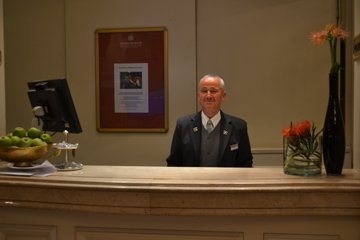
If the location and luxurious amenities aren’t enough to bring you to the Frankfurter Hof, come for its enthusiastic and knowledgeable concierge, Jurgen Carl.  With 50 years of experience at that post, Herr Carl rejected the idea of retirement to continue doing the job he loves.  With encouragement from his fans, he has even authored a book about his craft. He will greet you with a genuine smile, eager to answer your travel questions. 

Jurgen Carl, concierge

Since so many trips to Germany begin with a flight to Frankfurt, the Frankfurter Hof is an ideal place to pamper yourself with a good night’s rest, fortifying meals, and travel tips before you venture out on your European travels.

HOTEL INFO
Address: AM Kaiserplatz
60311 Frankfurt am Main
Germany
Phone +49 69 215-02
Fax +49 69 215-900
e-mail: frankfurter-hof@steigenberger.de
www.steigenberger.com/en/Frankfurt/

See the hotel’s photostream on Flickr: www.flickr.com/photos/steigenberger/sets/72157625885624181

Humble Onion Stars at Weimar Onion Market

A colorful autumn fair; a local market since 1653

Photos courtesy of German National Tourist Office

The humble onion is the star of the show at the Onion Market held in Weimar, Germany every October. These are no ordinary onions lumped together in crates or sacks; these are onions arranged together in the traditional way and decorated with dried flowers of yellow, white or lilac. They come in all sizes, too—from tiny ones to whopping big ones.

MARKET FOR BEASTS AND ONIONS
The market was first recorded in 1653 as a “market for beasts and onions” on what is today the Frauenplan, at a time when Weimar barely had a population of 5,000. There are many instances of the links between the German writer Goethe and the Market; he is said to have secured onion hearts to his desk, to have decorated his house with them, and to have praised the role of the onion in promoting good health.

In the 19th century, the market moved to today’s Schillerstrasse and developed into the major onion purchasing center for the whole of central Germany. Dealers came mainly from Heldrungen, 29 miles away, and that is still the case today.

In 1861 the market was extended to three days. In 1872 the city of Weimar passed an Onion Market Ordinance. Onions are offered as well as celery, radishes, garlic, leeks and marjoram, as well as other types of spices and vegetables. During the 20th century, world wars and inflation led to the decline of the market, and it was reduced to one day due to the limited produce available and high prices. It was not until the 1950s that the market began to pick up again, and by 1971 a record was set when 200,000 visitors attended.

ONION GARLAND
The sale of the famous market souvenir, the onion garland, has grown to 70,000 pieces, and onions and other vegetables, fruits, spices and handicrafts began to make their mark. In 1990 the Onion Market again became a three-day event. The market has also grown in size in the interim and now occupies the whole of the historic inner city. The number of visitors is now 350,000 annually.

For more info, contact the German National Tourist Office.

Frankfurt’s Liquid Gold

Photos Courtesy Frankfurt Tourist & Congress Board

Locals and tourists alike enjoy this beverage in rustic apple wine pubs all over the city. The “core” apple wine scene is in Old Sachsenhausen; numerous apple wine pubs line its streets where they serve customers their infamous “liquid gold.”

In the Middle Ages, beer and wine were the beverages of choice. As with many products today, apple wine came into being because of an unavoidable circumstance rather than an idea for a new product. In the middle of the 16th century, the Rhine-Main area went through a climatic change that negatively influenced wine production. Because of this, many vineyards transformed into fruit orchards, thus beginning apple wine production. During the Goethe era, taverns made the switch and became apple wine pubs. Today, apple wine remains a staple in Frankfurt and is growing in popularity.

It’s easy to spot a local apple wine pub: just look for the wreath hanging above the door. There’s even an old saying, “A wreath on the door means apple wine and more.” Traditionally, apple wine is served in a blue-gray stoneware jug called a Bembel. Other necessary glassware for apple wine drinking includes a ribbed glass called a Gerippte.

For an unforgettable Frankfurt experience, take a tour of old town in the “Apple Wine Express.” The Apple Wine Express is the city’s most popular streetcar and takes guests on a sightseeing tour around the city. For one hour, visitors can munch on pretzels, listen to music and sip apple wine while experiencing the city in a new way.

For more info, go to: www.frankfurt-tourismus.de