Exploring Germany: Culture, Cuisine, and History on Viking Cruises

Even a 45-minute lecture can prepare you for the sights and scenes of Germany

Story and photos by Sharon Hudgins

Cruise Lecture Teaches History, Culture
If you watch Masterpiece and other programs on public television in America, you’re probably familiar with the phrase, “Viking. Proud sponsor of…”—accompanied by images from Viking’s “longboat” cruises on the Rhine, Mosel, and Danube rivers in Europe. Other times you see wanderlust-invoking scenes from Viking’s ocean-going fleet, which sails the Atlantic and Pacific oceans, the Baltic and Mediterranean seas, and beyond, encircling the globe. And occasionally you’ll see the two new Viking polar-class expedition ships, the “Octantis” and “Polaris,” that sail to Antarctica in the Southern Hemisphere and the Great Lakes in the Northern Hemisphere.

Since 2017 I’ve had the pleasure of being a guest speaker on Viking Ocean Cruises in Europe, giving lectures on historical, cultural, and culinary topics aboard ships sailing from Viking’s home port in Bergen, Norway, to most of the countries bordering on the Baltic Sea.

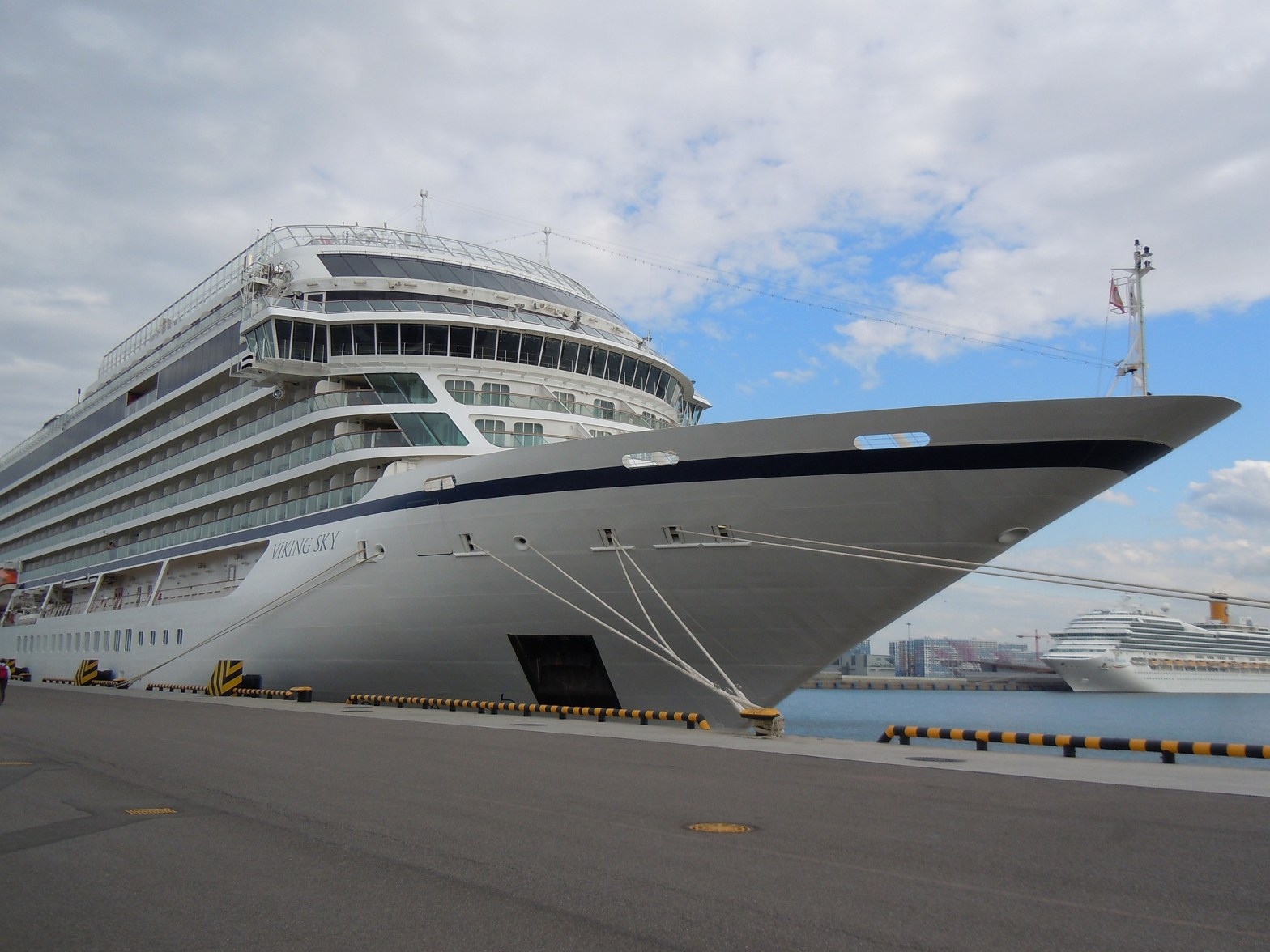
The Viking Sea ship docked at a Baltic port.

The “Viking Sea” ship docked at a Baltic port.

That itinerary follows the routes of the Hanseatic League, the medieval trading confederation that linked the countries of England, northern Europe, and Russia, and also the routes of the earlier, historical Vikings, who plied the waters of the Baltic, too.

Viking prides itself on focusing on the history and cultures of every country on its itineraries. So the cruise director on each ship schedules lectures about those destinations one or two days before the ship arrives in a port, to prepare passengers for the sights, sounds, and tastes of each new country they visit.

While the cruise ship guests are away during the day on shore excursions to a variety of places in those countries, the ship’s staff refills the vessel’s fuel tanks, cleans the guest rooms and public spaces, restocks food supplies, and prepares meals for hungry passengers when they come back on board. The singers, dancers, and musicians also use that time to rehearse their next shows on stage.

Cultural Stereotypes and Truths
So what does that have to do with Germany? Many cruise lines sailing in the Baltic dock at the busy German port of Warnemünde. I’ve lost count of how many times I’ve been to Warnemünde and the surrounding area, as a guest speaker on Viking, National Geographic-Lindblad, and Oceania cruises, as well as on press trips for journalists gathering new material for articles to write. But only on Viking cruises have I had the opportunity to present a 45-minute illustrated lecture about that entire country of Germany, a nation I often think of as “my second home.”

I begin with a short introduction telling how long I lived in Germany (15 years) and what I was doing there (teaching for the University of Maryland’s education programs at U.S. military bases, writing for the Stars and Stripes newspaper). I also mention that for 28 years I was a writer for German Life magazine in America, too. Then I launch into my lecture: “Germany: Land of Laptops and Lederhosen.”

A lecture on “all-of-Germany” in 45 minutes? How is that possible? Not easy without being superficial, I assure you. And that’s exactly how I begin my lecture, showing pictures of the stereotypes that many people have about Germany: Men in Lederhosen. Women wearing Dirndls. Oompah bands and choral groups clothed in traditional Trachten, too. Half-timbered houses and fairy-tale castles. Foaming mugs of beer. Strings of sausages. Pretzels!

Then I point out that stereotypes often contain a grain of truth. But they’re only one part of a many-faceted story (or country), factors that exist side-by-side with all of them being true simultaneously.

Modern Germany – Regions and Festivals
So I segue easily into modern Germany: High-speed highways. High-speed trains. High-tech industries. High fashion. Avant-garde art and architecture. Michelin-starred restaurants and Turkish döner kebab stands. And all those oh-so-wonderful German breads and pastries!

There’s no way anyone could condense centuries of German history into such a lecture. So I focus on Germany today, starting with Berlin and the country’s government (with a nod to the rise and fall of the Berlin Wall), and an overview of Germany’s population, literacy rate, national health insurance program, religions, and economy. The rest of my presentation is about the characteristics of its four main regions, from North to South, East to West, including those regions’ differing landscapes, architecture, industries, and cuisines. Then I conclude with—what else?—Oktoberfest! That world-renowned German beer festival brings me full circle back to the beginning of my lecture: The coexistence of stereotypes and deeper, often contrasting, realities in Germany today, a land of computers and cowbells indeed.

Viking Ships and Excursions
Viking’s ocean vessels carry 960 guests, plus a large, well-trained crew. While in port, most of the passengers head off on shore excursions, and even some of the ship’s employees have a few hours of shore leave, too. When the ship is docked in Warnemünde, Viking offers half-day and full-day excursions to several locations in northern Germany: the Hanseatic cities of Rostok, Lübeck, and Wismar; a classic 19th-century spa town reached by steam train; the magnificent castle in Schwerin; the grim concentration camp at Sachsenhausen.

But the most popular destination is Berlin—six hours round-trip by special train, plus six hours of touring various parts of the city and its historical sites, by chartered buses and on foot with knowledgeable guides, or just exploring Berlin on your own. One excursion even includes lunch at the Reichstag, along with a special tour of that iconic building so important in Germany’s history.

Clockwise from left: The German Reichstag in Berlin, as seen from the Spree River.
The modernistic Marie-Elizabeth-Lueders-Haus government building near the Reichstag in Berlin.
The facades of many Berlin buildings are best viewed from a boat ride on the Spree River.

On my first Baltic cruise with Viking, the only time available for my Germany lecture was at 9 p.m. on the night before we docked at Warnemünde. Since half the 960 guests on that ship had signed up for the 12-hour shore excursions to Berlin the next day—and since they all had to get up at 5 a.m. to board the train at 6 that morning—I expected only a few people to attend my lecture that night. After all, passengers could always watch a video of it on television in their own cabins, any time later during the cruise. So I was surprised when half the ship showed up for that introduction-to-Germany lecture, filling the lecture hall.

The next evening we all returned from Berlin, tired but happy, after a full day of riding the rails through the German countryside, visiting one of the world’s great capital cities, and learning so much about Berlin’s special place in history. But another treat awaited us back in Warnemünde. A red carpet led from the cruise ship terminal across the pier to the ship’s gangway. Lined up along the sides were the ship’s officers and staff, from the captain to the cabin cleaners. At the terminal each guest was handed a glass of sparkling wine, which we all tried to balance in one hand while dancing along the red carpet to lively music, with many of the crew joining in, as we made our way back to the ship.

Top: One of the modernistic fountains in Rostock, a shore excursion destination on Viking Baltic cruises.
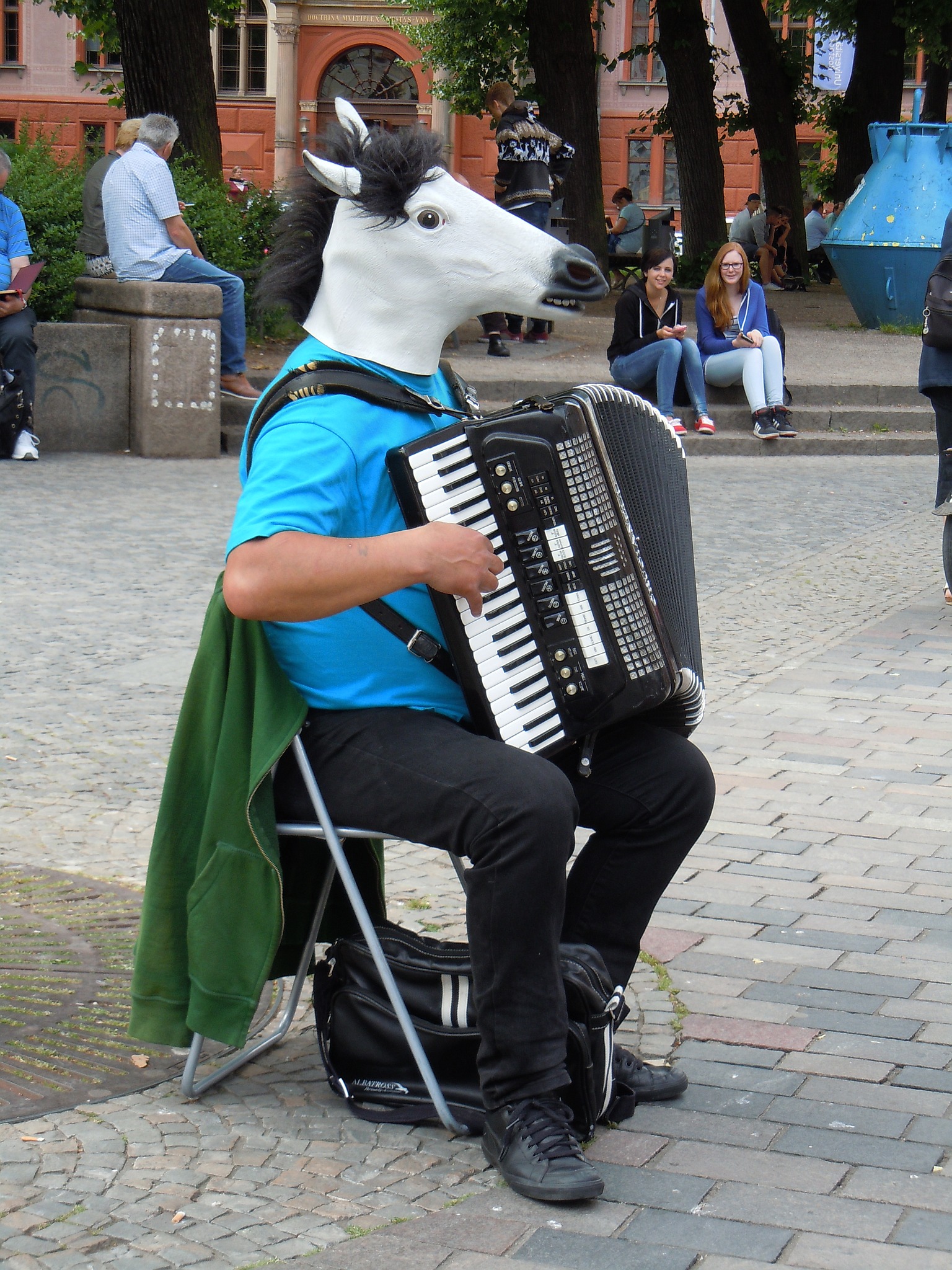
Lower left: Street musician in Rostock, one of the cities on shore excursions from Viking ships docked at Warnemünde, Germany, on Baltic cruises.
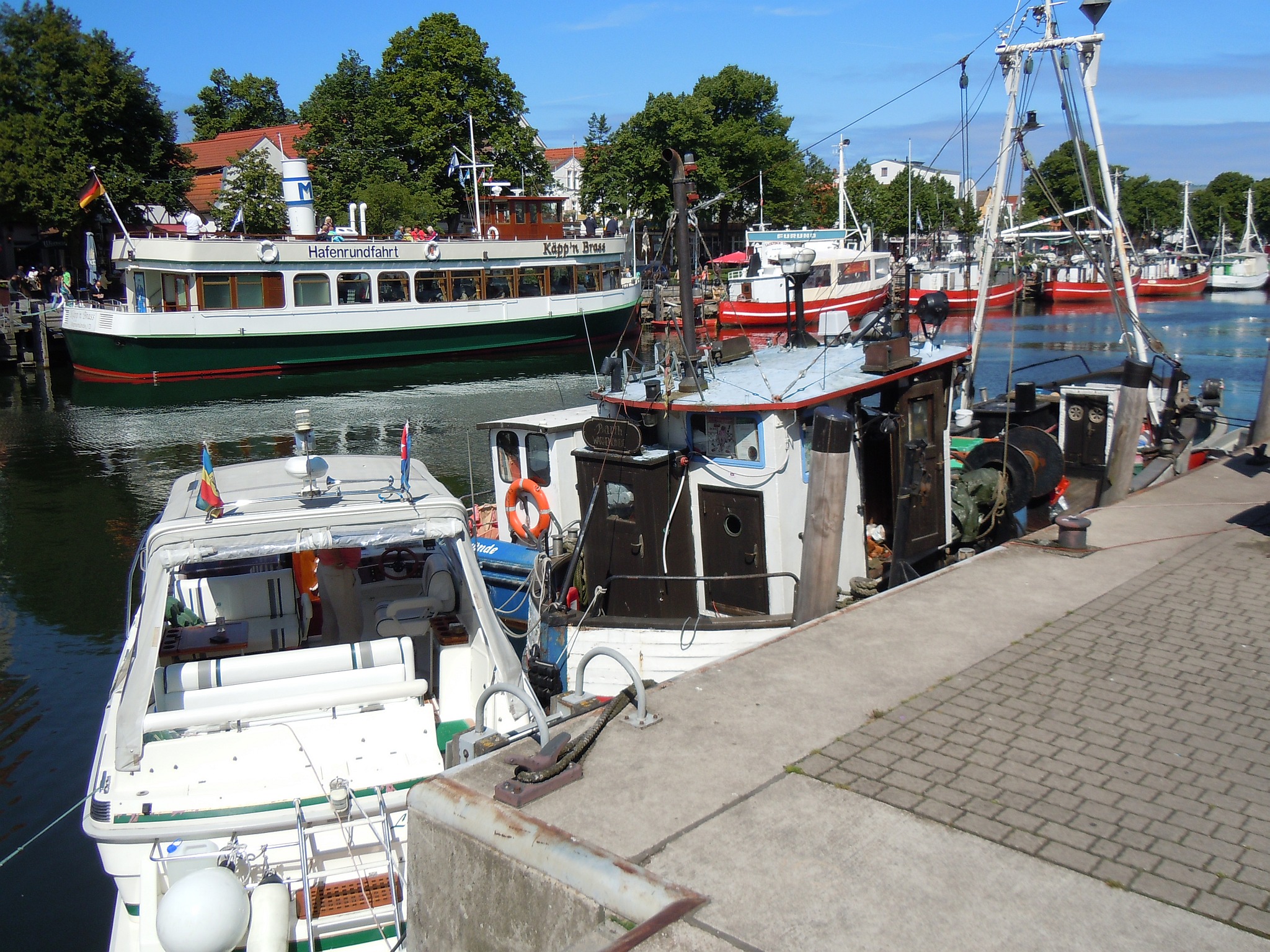
Middle and lower right: The colorful Alter Strom inner harbor at Warnemünde is always filled with small fishing boats and sightseeing boats.

German Culinary Delights on Deck
Dinners on board that evening featured traditional German specialties, from Sauerbraten to Schnitzel, Black Forest Cherry Cake to Bavarian Cream. And of course plenty of German beers and wines, too! As we sailed away from Warnemünde, the only regret for me was leaving a country where I have such deep roots. But we still had five other Baltic countries to visit on that cruise, so who was I to complain about new adventures awaiting the next day? And there was always the prospect of another cruise, or even a different kind of job, bringing me back to Germany in the future.

One of the greatest rewards of working on tours in Germany has been introducing other people to such a fascinating country. Nothing compares with the feeling I get when a member of our tour group comes up to me and says, “Thank you for your lecture about Germany. Because of you, I saw the country with different eyes when we were there.”

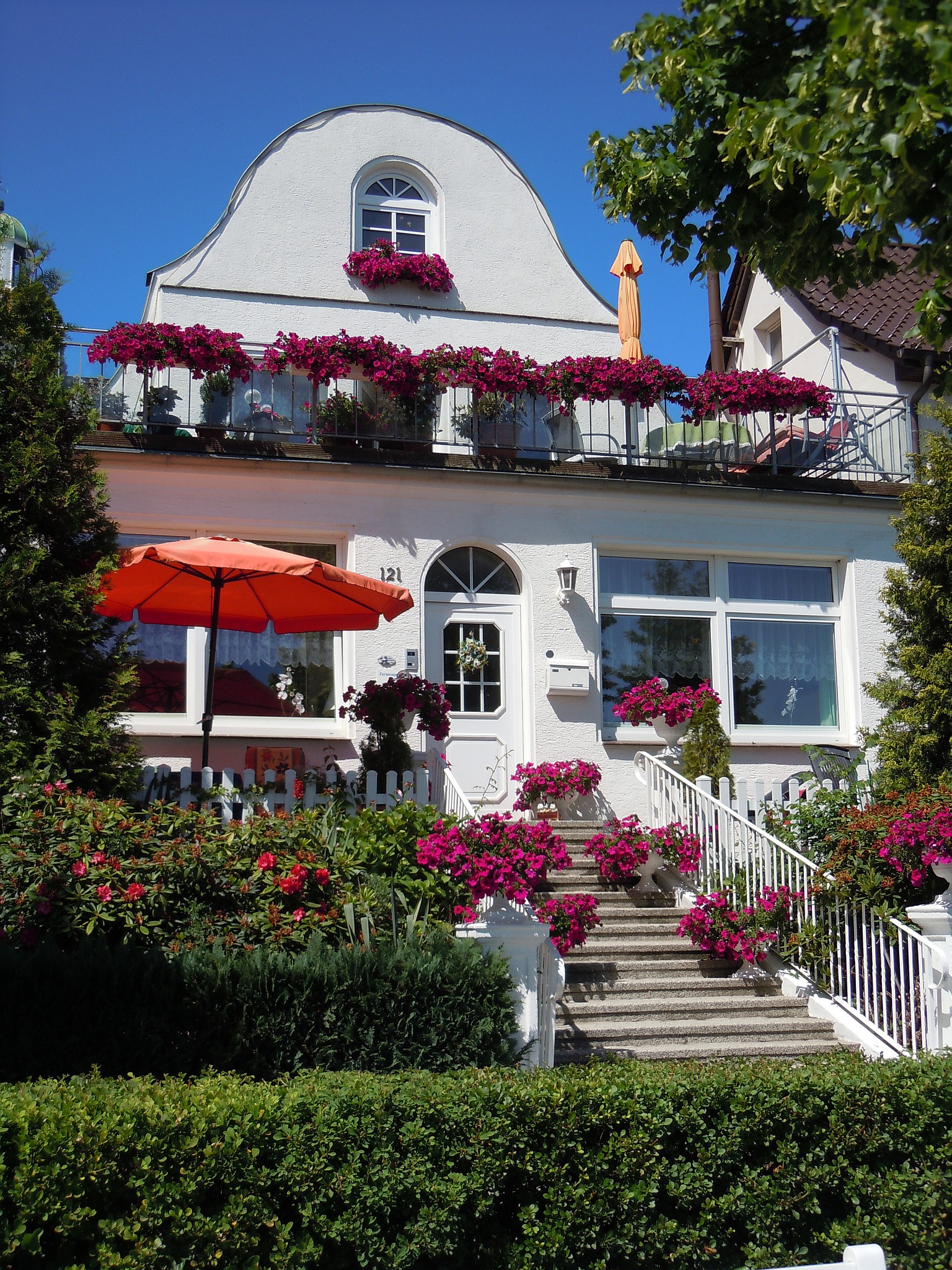
Left: One of the many pretty villas overlooking the waterfront at Warnemünde.
Right: Sand sculpture at the cruise ship dock in Warnemünde.


Sharon Hudgins is a professional writer and a lecturer on educational tours to Europe, Alaska, and North Asia. See more at www.sharonhudgins.com

Visit Viking Cruises to explore cruise destinations and itineraries.


🔍 Search the site to discover more European Traveler feature stories. 🌍

FOLLOW US:

Hitting the Heights in Cuenca

A medieval gem awaits travelers in the Castilla-La Mancha region of central Spain

Story and Photos by Randy Mink  

With ancient buildings stacked on a steep promontory at the meeting of two deep river gorges, Cuenca projects a dramatic profile, one different from any other city in Spain. Because it’s not on the traditional tour circuit, this somewhat isolated medieval gem, about two hours southeast of Madrid, is off the radar of most North American travelers, a fact that just adds to its beguiling appeal.

In Cuenca it’s all about the heights. Think vertical. Looking up or gazing down, you’ll find yourself constantly taking in the views. Traipsing around narrow meandering streets and passageways, you’ll encounter one vantage point after another that provides a fresh new slant on cliff-clinging houses high above the gorges. There’s a new vista at every turn.

Those afraid of heights get nervous crossing San Pablo footbridge, a wooden plank walkway that spans the Huécar River 200 feet below. But it’s a major attraction in itself, an Instagrammable spot for sure. If you’re staying at Parador de Cuenca, as our group was, the bridge is the most direct way of getting to the core of the enchanting Ciudad Alta, or Old City. We crossed it several times a day, often wondering how many people it could hold at one time.

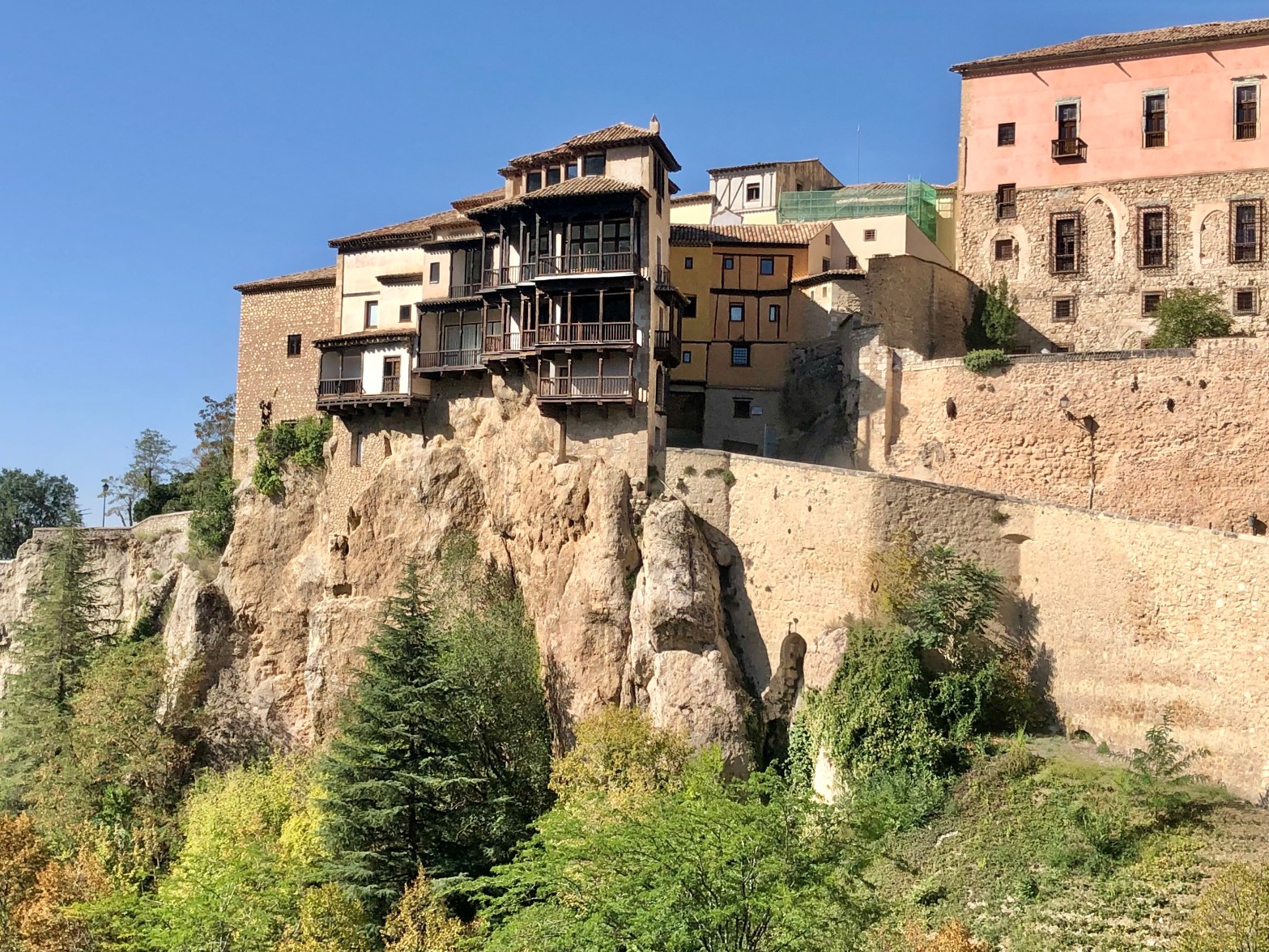
San Pablo footbridge and the Hanging Houses (left) dominate this view of Cuenca’s Old City.

From the bridge you have the best view of Cuenca’s most emblematic attraction—the Hanging Houses, or Casas Colgadas. The wooden balconies of this trio of 14th century dwellings jut out over a sheer cliff. Appearing to defy gravity, the buildings seem about to topple off their perch and into the abyss. You can actually stand on one of the cantilevered balconies if you visit the Museum of Spanish Abstract Art or gourmet restaurant Casas Colgadas Jesus Segura, both tenants of the Hanging Houses. Some art lovers prefer the Antonio Perez Foundation, a museum of modern art housed within a former Carmelite convent, another cliff-hugger.

The Antonio Perez Foundation is a modern art museum housed in a former convent.

In medieval times, why did many builders push to the precipice? The answer: real estate was scarce atop the escarpment and every square foot counted. Because land was at a premium, some houses were built eight to 12 stories high. Constructed of wood and adobe, these “skyscrapers,” many of them painted in bright colors today, were among the tallest buildings in Europe until the introduction of reinforced concrete in the 20th century. At its economic peak in the 15th century, the crowded old quarter had a population of 17,000. Now the number is 2,000.

Cuenca does not have a long checklist of must-see sights, which suits me just fine. I’m happy just wandering and getting lost in the medieval lanes, soaking up all the history that crosses my path—and taking picture after picture. The refreshing lack of tourists in Cuenca makes it even more delightful.

The narrow alleyways of Cuenca’s historic core invite discovery.

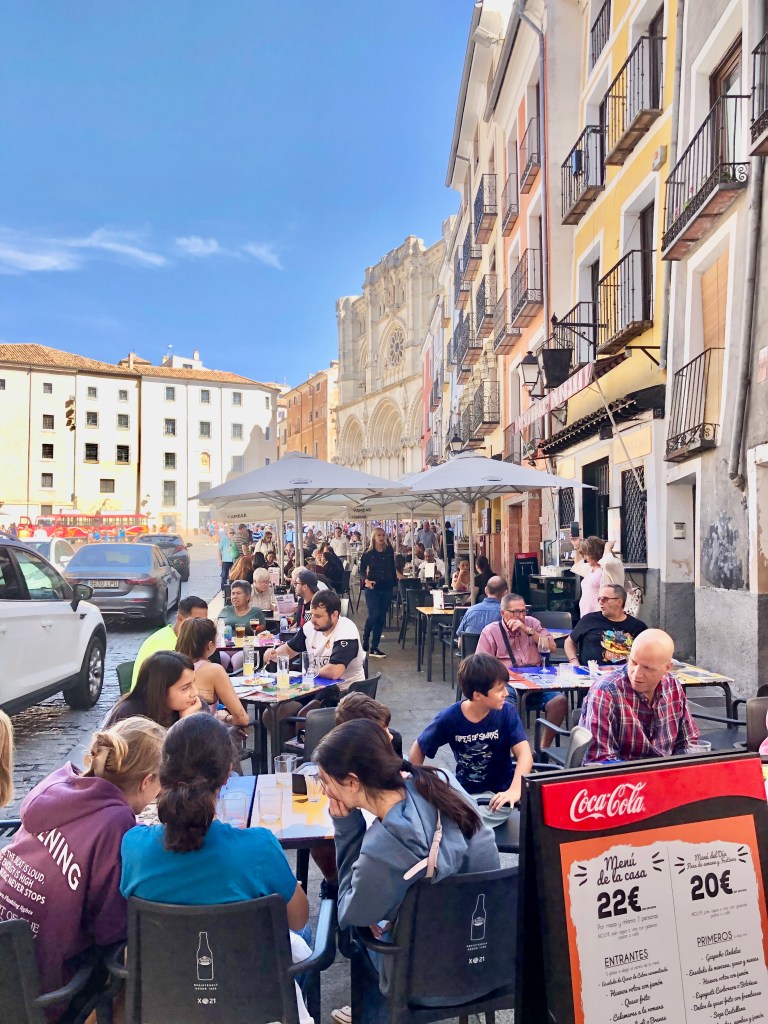
The heart of this UNESCO World Heritage city is the Plaza Mayor, which spreads in a linear fashion from the Cathedral of Cuenca, passing through the arch of the town hall. Outdoor cafes lend a lively air, and the red tram departs from the square for a tour of the Old City, an ideal option for those who want to avoid tackling the steep inclines on foot.

The Plaza Mayor, with its outdoor cafes, is the focal point for tourists in Cuenca’s historic core.

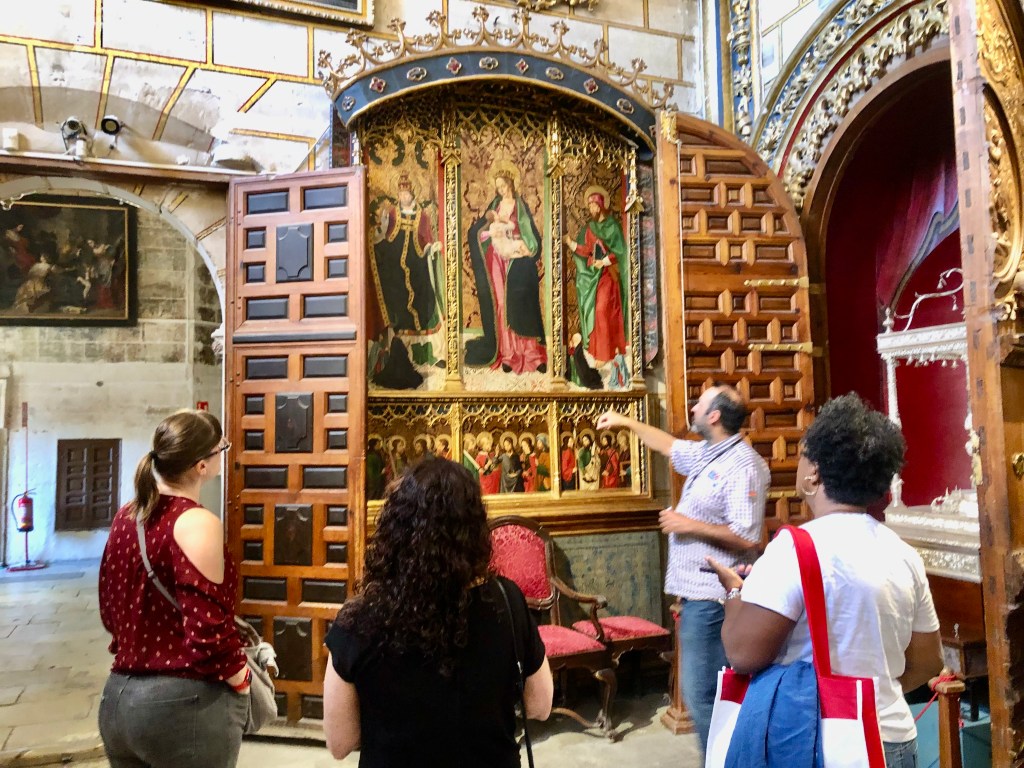
The Cathedral in Cuenca is a treasure house of art and architecture.

Sightseeing trams take tourists up and down the hilly lanes of Cuenca’s Old City.

While Spain has better known churches, the Cathedral of Nuestra Senora de Gracia is truly impressive and worth a look inside. Largely built between 1156 and 1256, it was the first Gothic church on the Iberian peninsula. Statuary, paintings, expanses of marble and lavishly adorned chapels reflected the city’s wealth in medieval days. The two pipe organs date from the 18th century. Our group heard their melodious sounds while seated in the ornately carved wooden choir stalls during an evening concert.

Rock climbers scale the cliffs just down the road from Parador de Cuenca, a monastery-turned-hotel.

If you haven’t had enough in the way of heights after taking in the panoramas from all angles and crossing the footbridge a number of times, consider a zipline ride or go rock climbing. On a short walk from Parador de Cuenca, I came upon harnessed men and women scaling vertical walls and people of all ages whooshing across the valley on a sturdy cable. And on two mornings I saw hot air balloons high in the sky. I wasn’t adventurous enough to pursue those options but wished I’d had time to hike the path that zigzags up to the giant mountaintop statue of Christ, Cerro del Socorro. The two-mile trail is marked by 14 Stations of the Cross. The statue is illuminated at night, as is the entire rock face of medieval Cuenca, a romantic vision that lingers long after your visit to this fascinating city off the beaten path.

Biting Into Basel

Wedged between Germany and France, this northern Swiss city abounds with traditional restaurants offering classic fare and Old World flair

By Randy Mink

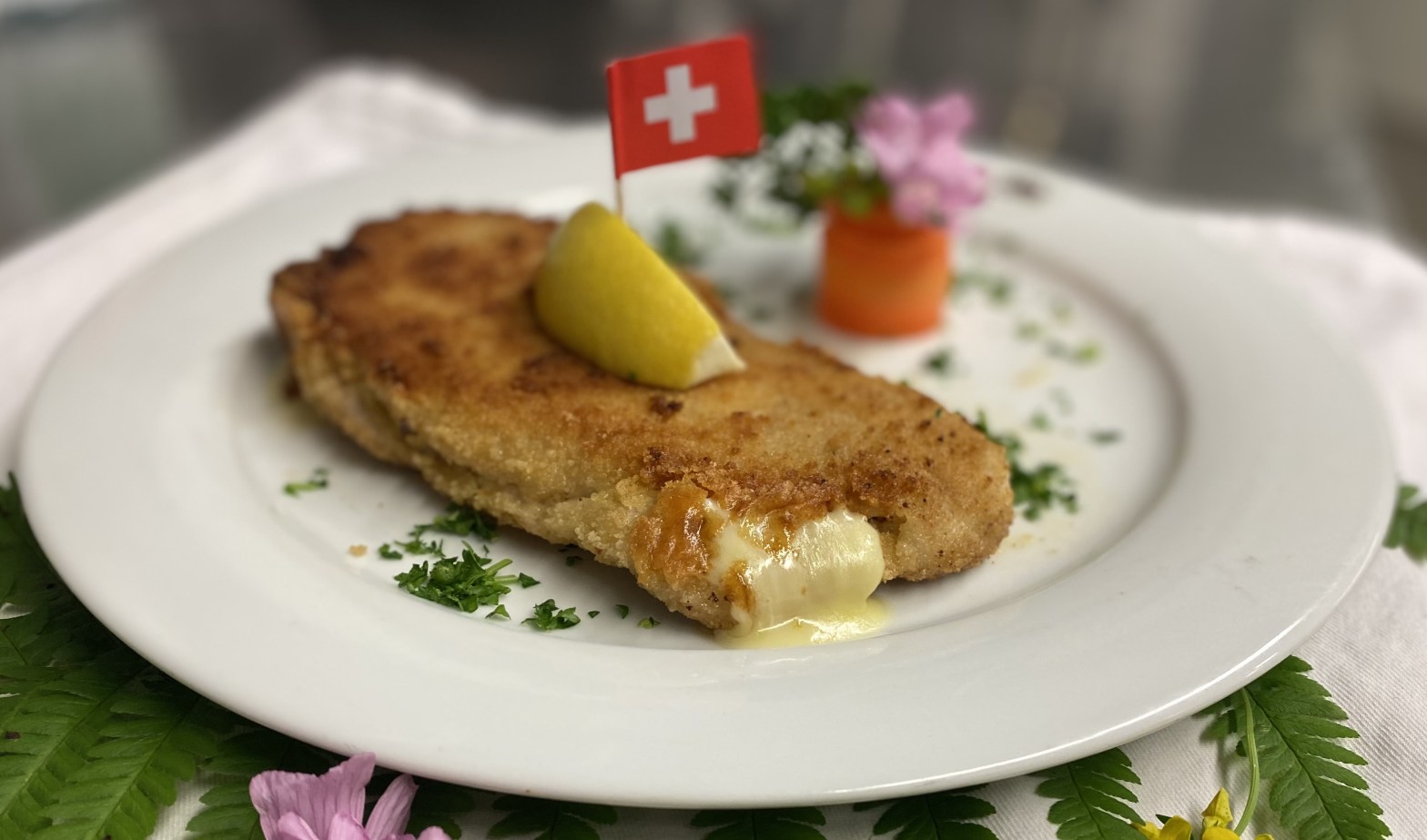
Served piping-hot and oozing with cheesy goodness, the veal cordon bleu at Zum Gifthüttli restaurant is something to savor, even drool over. Lunch in the wood-paneled dining room remains the warmest memory of my visit to Basel, the third-largest city in Switzerland.

After disembarking there from my week-long Rhine River cruise, I was most looking forward to exploring the medieval Old Town with its museums, churches, riverside promenades and specialty shops lining atmospheric alleyways paved with cobblestones. What turned out to be just as inviting, though, were the traditional, pub-style restaurants scattered about the historic core.

Cordon bleu is the house specialty at Zum Gifthüttli. We ordered the Classique, a juicy, golden-breaded schnitzel filled with ham and melted cheese, taking advantage of the Tagesteller (“daily plate”), a deal for 36.50 Swiss francs (about $43) that included french fries, pumpkin soup and dessert.

Gifthüttli, a traditional restaurant in Basel’s atmospheric Old Town, offers dining in the main-floor Bierstube, the upstairs Weinstube and at outdoor tables ideal for people-watching. (Randy Mink Photo)

Zum Gifthüttli’s menu lists cordon bleu variations, like the one with ham, cheese, asparagus, cherry tomatoes and Hollandaise sauce. Another consists of chorizo, mozzarella and herbs. The Florentiner has ham, cheese, spinach and a fried egg on top, while the Schweizer features two Swiss delicacies—Bündner air-dried ham and scrapings of raclette cheese. Opting for pork cordon bleu, instead of veal, can shave a bit off your bill, but any meal in Switzerland will cost much more than at home.

Guests at Gifthüttli can dine in the main-floor Bierstube, upstairs in the white-tablecloth Weinstube or, in warm weather, at outdoor tables offering the bonus of people-watching in Old Town’s pedestrian zone.

The white-tablecloth Weinstube at Gifthüttli offers a refined atmosphere. (Photo credit: Basel Tourism)


Fans of cordon bleu and antique charm also gravitate to Old Town eateries like Zum Braunen Mutz and Restaurant Löwenzorn. The latter offers tables in its historic rooms and in the idyllic courtyard garden, where blankets, furs and electric heaters keep patrons toasty in cooler weather. Löwenzorn favorites include the wienerschnitzel and traditional Swiss fondue.

Löwenzorn, a traditional restaurant in Basel’s Old Town, offers seating in historic rooms and in the courtyard garden. (Photo credit: Basel Tourism)


Restaurant Kunsthalle, a sophisticated but friendly Old World restaurant in the same building as the Kunsthalle Basel contemporary art museum, every winter opens its Fondue Stübli, a cozy fondue chalet next to the landmark Tinguely Fountain. Additional city-center spots for fondue (and other Swiss classics) are Walliserkanne and Safran Zunft.

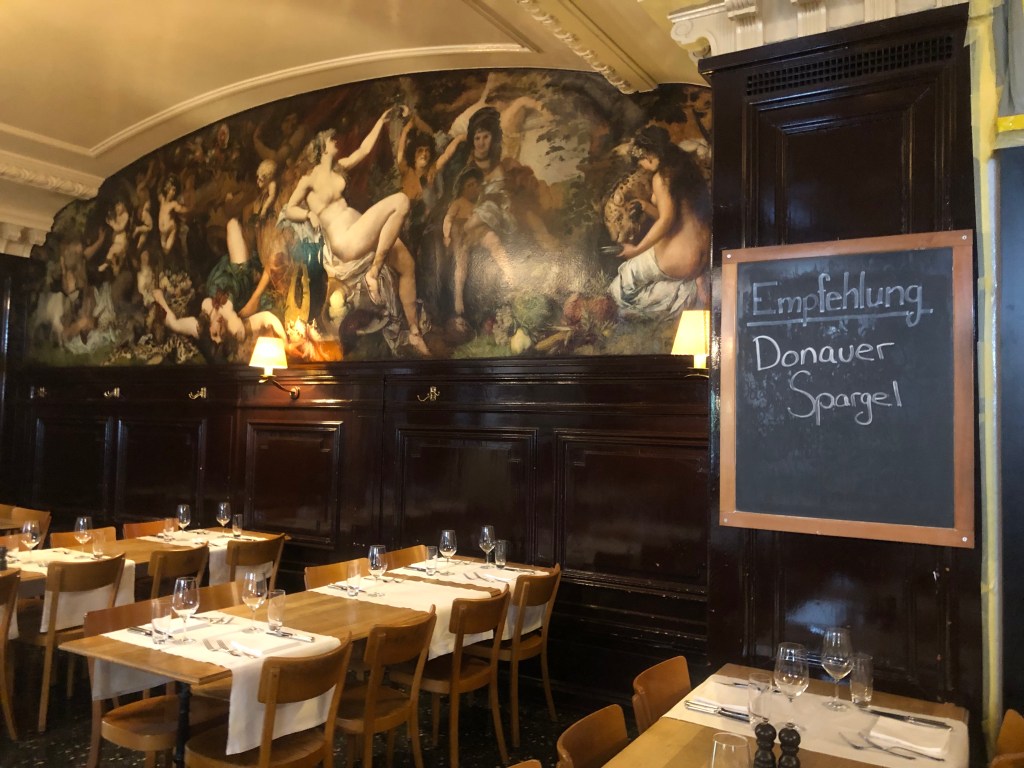
Patrons at Basel’s Restaurant Kunsthalle enjoy an Old World atmosphere in the vaulted Schluuch room. (Randy Mink Photo)


On our springtime visit to Restaurant Kunsthalle, we had a lunch of pasta amidst dark wood and classical cherub murals in the cozy, vaulted Schluuch room. The more formal “white” room overlooks the chestnut tree-shaded patio, one of Basel’s prime spots for alfresco dining. The Kunsthalle’s menu reveals typical Swiss fare, including Zürcher Geschnetzeltes (veal strips in a sauce of white wine, cream and mushrooms) with rösti, the ubiquitous Swiss version of hash browns offered at most restaurants that serve french fries.

No discussion of traditional dining spots is complete without a mention of Gasthof zum Goldenen Sternen, Basel’s oldest restaurant. Though it’s been at its current riverside location for only 50-some years, it date backs to 1412. In the 1970s the ancient building was dismantled and rebuilt stone by stone along with the original ceiling paintings and all the wood paneling. Highlighting the menu are highly regarded fish dishes—I had the lightly fried salmon filet with linguine. It also offers lamb shank, steaks and wienerschnitzel, among other entrees. The restaurant looks out on the Rhine River, and there’s outdoor seating under trees on the riverfront promenade.

Gasthof zum Goldenen Sternen, Basel’s oldest restaurant, enjoys a setting on the Rhine River. There is seating under trees on the riverfront promenade. (Photo credit: Basel Tourism)


The Goldenen Sternen (“Golden Star”) is located in the picturesque St. Alban quarter, a quiet neighborhood noted for its patrician townhouses, half-timbered buildings, narrow streets and a stream that powers the waterwheel at the Basel Paper Mill. Now a fascinating museum about the history of paper making and printing, the medieval mill, just steps from the Rhine and not far from Old Town, was one of many in St. Alban that made Basel a book publishing center for centuries.

Though skeptical about how interesting a paper museum could be, we found it eye-opening. Especially fun was watching demonstrations of how a pulpy goop is transformed into paper. We had a chance to make our own sheet as a souvenir. And we were surprised to learn that until the 19th century paper was made almost entirely from old rags and ropes that were sorted, cleaned, cut into strips and left to decay in a rag cellar’s rotting vats. There are even exhibits on the evolution of toilet paper, which was considered a luxury product when first introduced in the late 1800s.

Visitors learn about the history of paper and witness the paper-making process at the Basel Paper Mill, a museum housed in a medieval paper mill. (Randy Mink Photo)


Claiming nearly 40 museums, Basel has a museum for every interest, showcasing subjects ranging from cartoons and musical instruments to city history and Jewish culture. Most visited are its two leading art museums.

Kunstmuseum Basel, whose three-building complex holds the world’s oldest municipally owned public art collection, presents seven centuries of European art and boasts the world’s largest collection of paintings by the Holbein family. On the outskirts of Basel, Fondation Beyeler, comprising a main building designed by noted architect Renzo Piano, houses some 400 masterpieces of modern and contemporary art, including pieces by Picasso, Monet, Matisse and Cezanne.

Kunstmuseum Basel holds an impressive collection of paintings by Hans Holbein. (Photo credit: Basel Tourism)


The Basel Historical Museum, with exhibition halls under the vaulted ceilings of a former 13th century church, focuses on the intersection of the cultures of Switzerland, France and Germany. (From Basel, Germany and France are just a hike or bike ride away. Visible on the horizon are the Vosges Mountains of France and Germany’s Black Forest.)

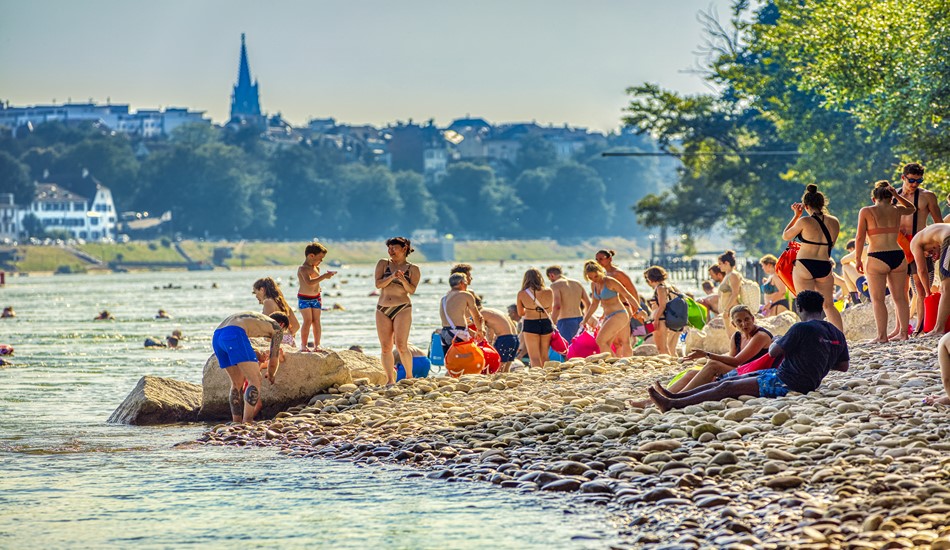
In the summer you’ll see people sunning on the riverbanks and swimming or floating in the river. Basel Tourism offices and retail stores sell something called a Wickelfisch, a brightly colored, fish-shaped waterproof bag for keeping your clothes dry as you whoosh down the river past city landmarks. It’s not to be used as a flotation device.

Frolicking in the Rhine River is a popular pastime with tourists and locals alike. (Photo credit: Basel Tourism)


Sightseeing cruises provide another way of experiencing the Rhine. Or you can take one of the small passenger ferries that shuttle back and forth between the larger southern part of the city (Grossbasel, or Greater Basel) to the northern side (Kleinbasel, or Little Basel) at four crossing points. Attached to a cable that spans the river, the non-motorized boats are guided deftly by expert ferry operators.

We took the five-minute ride from St. Alban to the opposite bank, then walked along the riverside path for 11 minutes before reaching the Museum Tinguely, a showplace for monumental mechanical sculptures created by world-renowned artist Jean Tinguely (1925-1991), who grew up and studied in Basel. Buttons allow visitors to activate some of the playful, mischievous and wacky creations, causing them to rattle, shake and whirl.

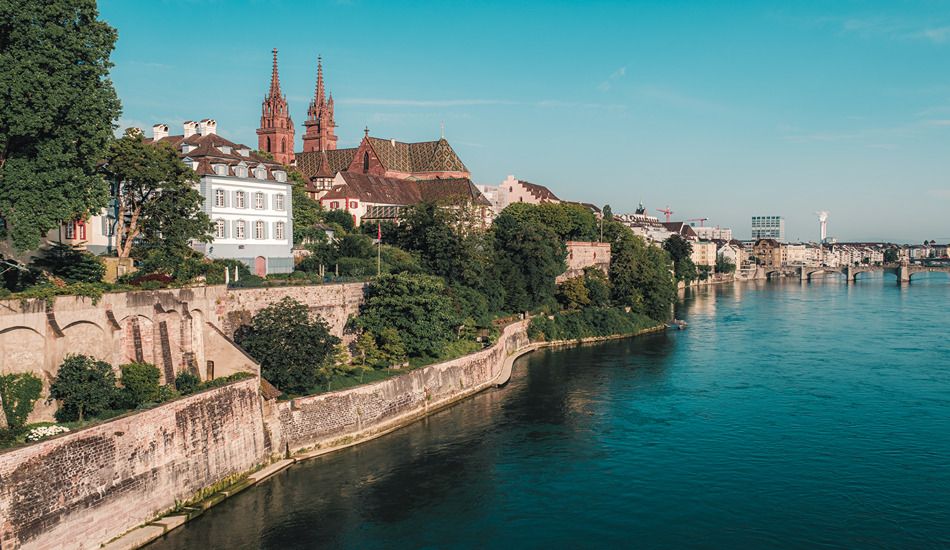
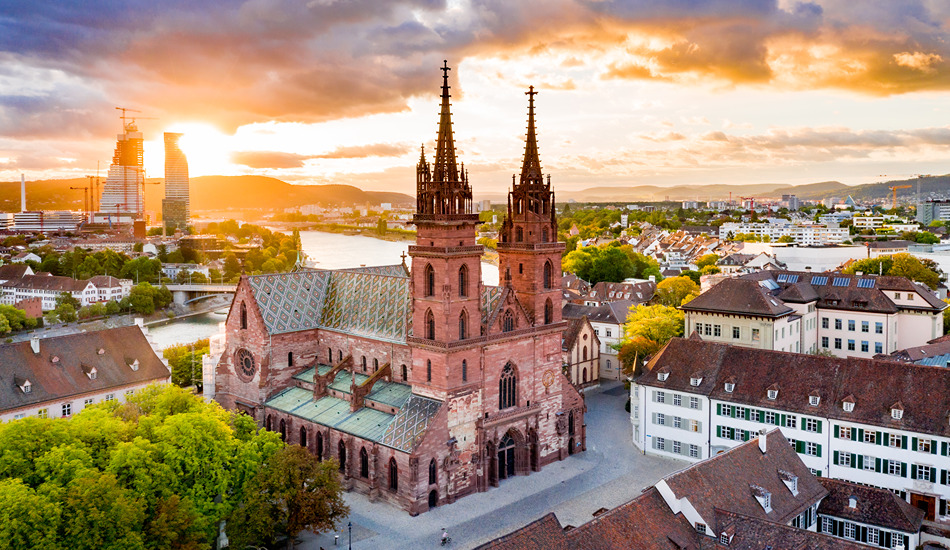
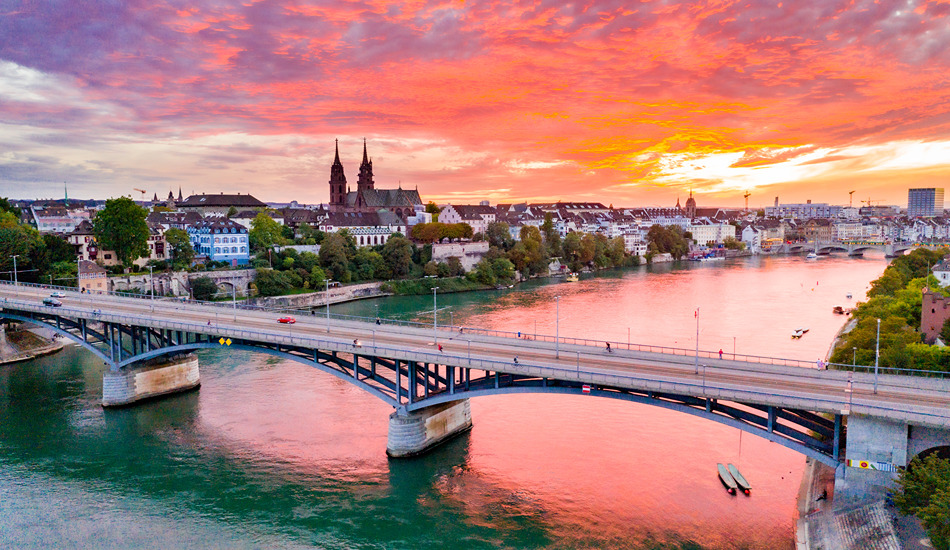
Sweeping views of the Rhine can be enjoyed from the tree-shaded terrace of Basel Cathedral. Sporting impressive twin towers, it is the city’s most prominent landmark. Built mainly in the 12th and 13th centuries, the Romanesque-Gothic church contains the tomb of the Dutch humanist Erasmus (1466-1536), who lived in Basel. Ambitious types can climb the towers’ narrow staircases (about 250 steps).

The twin spires of Basel Cathedral dominate the skyline of Basel, which lies on the Rhine River in northern Switzerland. (Photo credit: Basel Tourism)

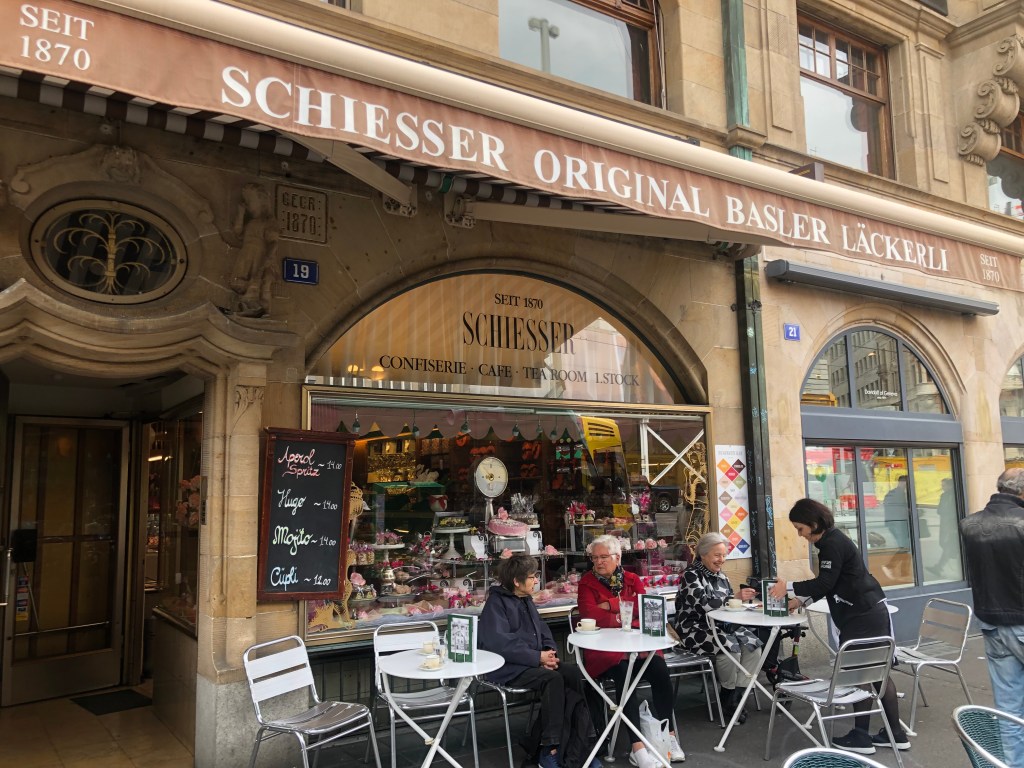
One of the best places to take a break from sightseeing is Confiserie Schiesser, a cafe/tea room/confectionery with an on-site chocolate factory and bakery. Founded in 1870 and now in its fifth generation of family ownership, Schiesser faces Old Town’s vivid red Rathaus (Town Hall) and market square. A tantalizing array of chocolates, cookies and pastries tempts the sweet tooth. Distinctive to Basel are the Basler Läckerli, a ginger cookie made with honey, spices, almonds, and candied orange and lemon peel.

Confiserie Schiesser, a cafe/tea room/confectionery founded in 1870, is famous for its chocolates, cookies and pastries. (Randy Mink Photo)


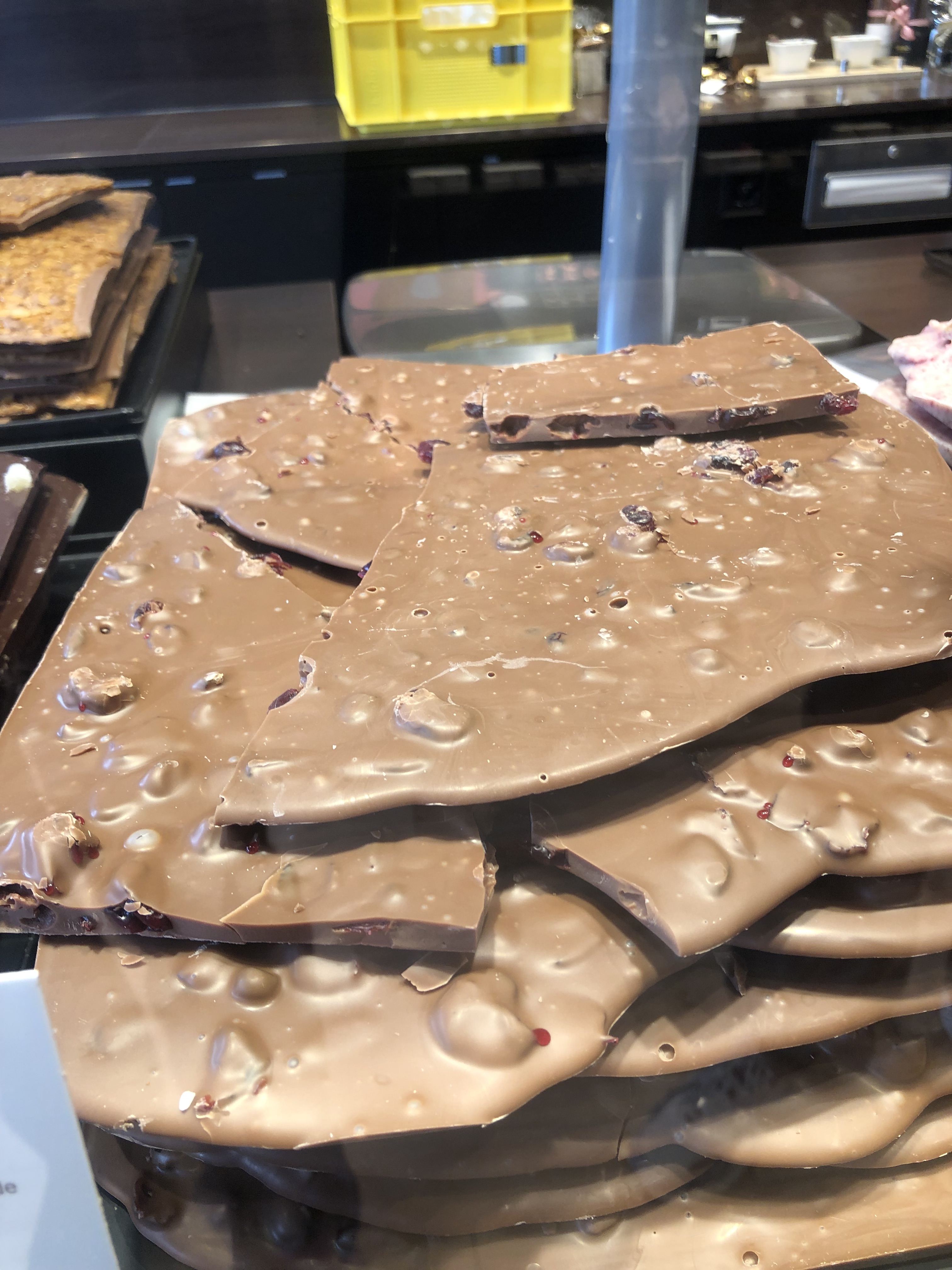
A few doors down from Confiserie Schiesser, high-end Läderach chocolatier sells slabs of melt-in-your-mouth chocolate called Frisch Schoggi. Sold by the gram, the uneven pieces are studded with everything from hazelnuts and almonds to cranberries and cornflakes.

Visitors in Basel’s Old Town can indulge their sweet tooth at Läderach, a high-end Swiss chocolatier. (Randy Mink Photo)


Indulging in Basel’s tasty treats is the epitome of Swiss bliss.

For more information, visit the Basel Tourism website, www.basel.com.

Castles, Christmas Markets and Cruising

By Marilyn Heimburger
Photos by Don Heimburger

Taking a river cruise is always a good idea. A river cruise that includes both historic castles and colorful Christmas Markets along Germany’s Rhine River is the best idea ever. So on Thanksgiving Day I happily ignored Black Friday and escaped the pre-Christmas shopping frenzy of the USA to spend a week on the AmaKristina, cruising from Amsterdam to Basel, Switzerland. Romantic castles and Christmas Markets along the Rhine River ushered in the Christmas spirit for me this year.

The newest AMA ship, the AmaKristina

The AmaKristina is essentially a floating luxury hotel for 158 guests. Our roomy cabin had a queen-sized bed, private bathroom with shower and double sink, desk, large format Apple screen and keyboard for internet, TV, or movies. Built in 2017, the ship’s hallways and guest suites were filled with Gustav Klimt art prints, and seasonally decorated with lights, Christmas trees, wreaths, garlands, and gingerbread houses. We boarded in Amsterdam, unpacked, and had our first dinner on board. Open seating at each meal encourages mingling of guests.

AMSTERDAM ATTRACTIONS
Fortified with a sumptuous on-board breakfast buffet, including an omelet station and daily vitamin “shot,” we departed the ship for an informative canal cruise, a panoramic city bus tour of Amsterdam with an up-close look at a local working windmill, and free time for exploring. Although there were no Christmas markets in Amsterdam, there were plenty of opportunities for shopping near the central train station, and street entertainment in Dam Square: a saxophone player, giant bubble maker, dancing dinosaurs, and impromptu yoga. Just be sure to watch out for the numerous killer bicycles that demand the right-of-way.

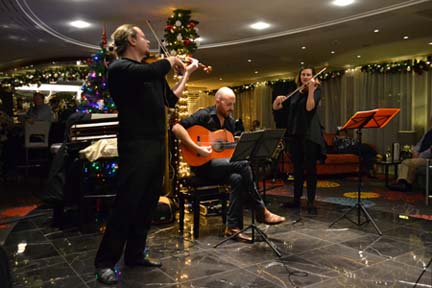
The AmaKristina set sail from Amsterdam in the afternoon, and I had time to explore the ship’s main lounge and bar, massage and hair salon, fitness room, gift shop, and even a heated pool and giant chess set on the sun deck. A cruise overview presented by our cruise director, plus Christmas tree decorating and an evening classical music performance by the three talented string players known as “La Strada” kept passengers entertained. The cruise ships cleverly bring nightly entertainment on and off the ship when stopped at the locks on the river.

Onboard entertainment by La Strada

COLORFUL COLOGNE
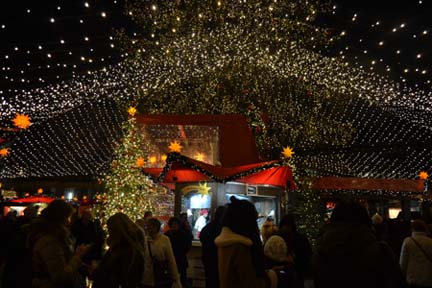
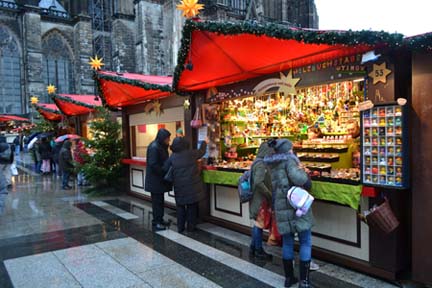
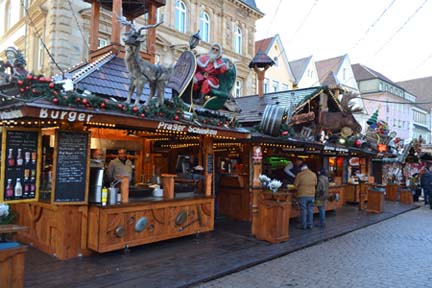
After cruising all morning, we docked in Cologne, Germany, where shuttle buses brought us to our first Christmas Market in Cathedral Square. Although the earliest Christmas Markets in Germany date from the late Middle Ages, the one in the shadow of Cologne’s impressive Cathedral is a relative newcomer, opening in 1995. Under a dazzling canopy of thousands of tiny lights, 150 vendor huts with bright red awnings and brilliant multi-faceted stars displayed handicrafts, comfort foods, gifts of all types, decorations, wooden toys and much more.

Canopy of Christmas lights in Cologne’s Cathedral Square

Cologne Cathedral Square market

HOME OF THE ELVES
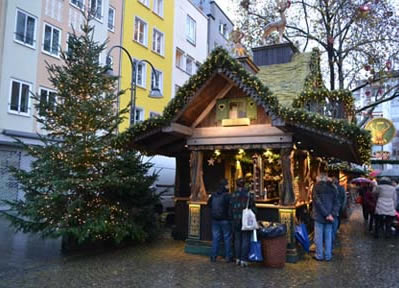
A few blocks away in the Altstadt and Heumarkt was an older and much larger Christmas Market called the “Heimat der Heinzel” or Home of the Elves. These were little creatures from a Cologne legend who used to do all the housework until they were annoyed by an inquisitive housewife, and disappeared. I loved this market. Aisles were arranged by theme, and the large wooden huts had Old World, wood-carved details, thick green garlands and costumed vendors. Little “Heinzelmännchen” rode in gondolas above an expansive ice rink. Each souvenir mug of Glühwein (the traditional hot mulled wine so popular at the Christmas Markets) had a different elf pictured on one side, and his particular work specialty described in verse on the other. Cologne boasted three additional smaller markets, but time was too short to visit all of them on this trip.

Home of the Elves’ Market in Cologne

CASTLE DAY ON THE RIVER
The morning cruise from Cologne to the next stop in Rüdesheim passed through the UNESCO World Heritage Rhine Gorge. What a treat to sit in the ship’s expansive lounge with panoramic windows, coffee in hand, gazing at vineyard- covered slopes, picturesque villages, historic castles, and the famous Lorelei Rock, with commentary by the cruise director. This romantic part of the trip alone is a highlight of any Rhine River cruise.

RÜDESHEIM’S CHRISTMAS MARKET OF THE NATIONS
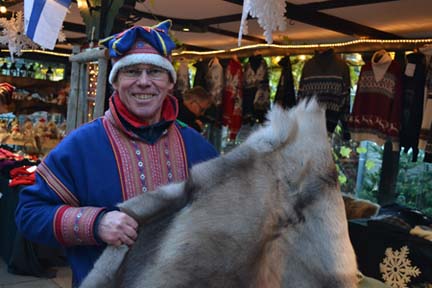
After a gourmet lunch of traditional German specialties, we docked in Rüdesheim, where the “Christmas Market of the Nations” wound up and down the narrow streets of this wine town of about 7,000 citizens. Vendors from France sold mushrooms, lavender and cheese, Tunesia vendors brought wares made of olive wood, smoked salmon came from Norway, furs came from Finland and even the United States was represented with a local vendor offering homemade cookies, Dr. Pepper, Fanta, marshmallows, and Hershey’s chocolate. Christmas choir music piped throughout the market added to the festive atmosphere as shoppers strolled past inviting vendor stalls and village shops. A new discovery at this market was hot mulled Glühbier from Belgium.

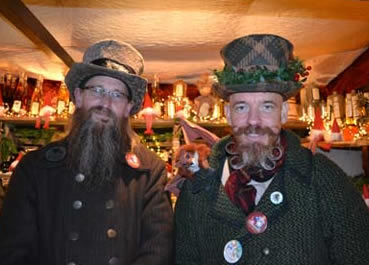
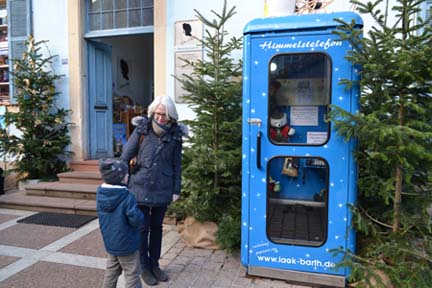
(clockwise) Hot lunch in Rüdesheim; Fur from Finland at Rüdesheim’s Christmas Market of the Nations; “Hallo” from the gnomes in Rüdesheim; Placing a phone call to the Christkind in Speyer

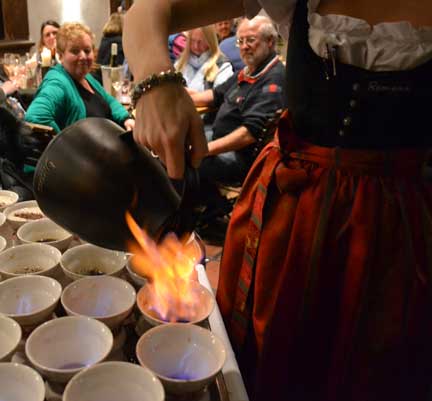
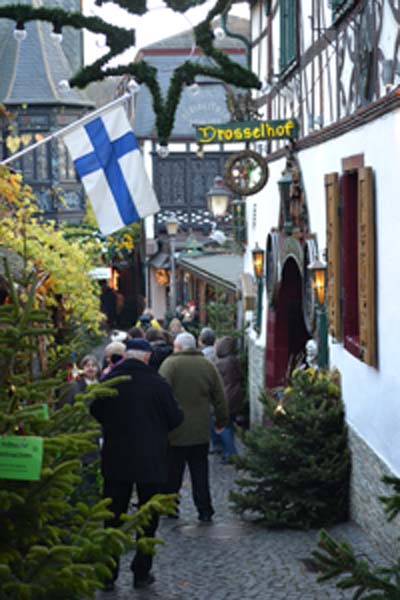
Throughout the ship’s seven-day cruise, each day’s program offered passengers quiet, regular and active excursions. Rüdesheim excursions offered by the AMAKristina included wine tasting, a hike, bike or gondola tour through the vineyards. A late night, fun option was experiencing Rüdesheimer coffee – coffee set on fire with Asbach brandy and sugar, topped with whipped cream and chocolate flakes – at Eiscafe Engel on Rüdesheim’s famous Drosselgasse.

Rüdesheimer coffee
Atmospheric narrow Rüdesheim street

THE IMPERIAL CITY OF SPEYER
By noon the next day we docked in Mannheim and could choose a bus excursion to Heidelberg or to Speyer. Having visited Heidelberg several times already, we chose to see the 2,000-year-old Imperial city of Speyer. Here the Christmas Market extended down Maximilianstrasse from the UNESCO World Heritage Speyer Cathedral, the largest Romanesque cathedral in the world. Though smaller than the Cologne Christmas Markets, Speyer’s market had all the requisite comfort foods: Glühwein, grilled sausages, roasted almonds, and even waffles, potato soup and dumplings. Vendors offered wood handicrafts, colorful candles, jewelry, scarves, kitchen gadgets and unique cookie cutters. Especially for children were an ice rink, kiddie car rides and a telephone booth with direct access to the Christkind in Heaven!

Back onboard the AmaKristina we had a tea time treat of traditional Spekulatius cookies and Stollen, while we set sail for our next stop: Strasbourg and Le Petite Alsace in France.

INVITING STRASBOURG AND LE PETITE ALSACE
As with each stop on our route, AmaWaterways provided an energetic and knowledgable guide for a walking tour of the area on the way to the Christmas Markets. This morning we learned about the Alsace region, which changed hands between France and Germany four times in 75 years. The name “Alsace” derives from a German phrase meaning “seated on the Ill.” While our guide led us along the Ill River, past the beautiful half-timbered houses lining both sides, she explained that this charming area was historically the least desirable place to live. It had been the site of fortifications and a prison, the home of executioners and the location of the tanning trade, with its smelly byproducts. Today it is a photographic highlight of any trip.

CHRISTMAS MARKETS WITH A FRENCH TWIST
Christmas Markets first appeared in Strasbourg in 1570, making this German/French town the location of one of the oldest markets in Europe. Although much was similar to the Christmas Markets we saw in Germany, here the food vendors offered toasted baguettes topped with cheese as the warm comfort food, instead of the ubiquitous wursts in the German markets.

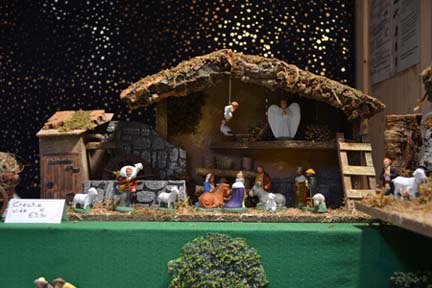
The traditional market was near the cathedral, with some vendor huts topped with storks, that famously nest in Strasbourg’s Parc de l’Orangerie. More than 300 vendor chalets filled the historic city center. Entertaining metal sculptures depicting different professions caught my eye, as did the detailed, intricately carved figures for nativity sets. A market area featuring Strasbourg’s service organizations surrounded a towering decorated Christmas tree and grassy area which was perfect for family photos. A small market in Gutenberg Square annually invites vendors from other countries: this year it welcomed Iceland.

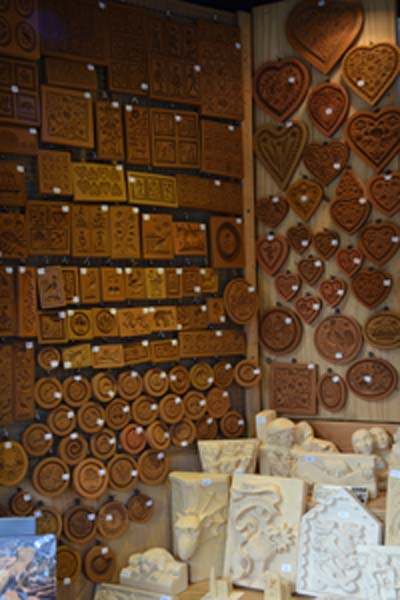
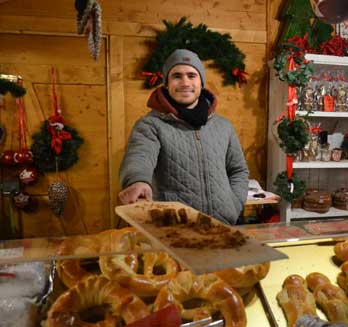
Try some gingerbread in Gengenbach

GENGENBACH’S GIGANTIC ADVENT CALENDAR
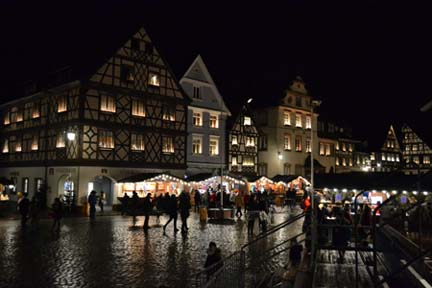
We were back on the German side of the Rhine River by late afternoon, and on a shuttle bus from the AmaKristina to the beautiful village of Gengenbach. A guided tour down Engelgasse led to the Christmas Market which stretched down the main street from the town hall square.

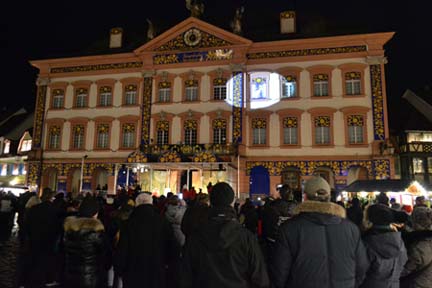
Gengenbach Town Hall Advent Calendar

Gengenbach boasts the world’s largest Advent calendar in its neo-classical town hall, where each night one of its 24 windows is opened to reveal a picture by a famous artist. This year’s calendar featured paintings by Andy Warhol. We arrived just in time for the first night’s opening ceremony: a narrated short skit performed by children from the town. After browsing through the market’s matching vendor huts, with hot Glühwein in a mug depicting the town hall Advent calendar, we returned to the ship to be delightfully entertained by a French cabaret singer and her accordion accompanist.

LAST FULL DAY ONBOARD
Shuttle busses from the AmaKristina were the order of the day with options to Riquewihr, France, or to Freiburg and Breisach, Germany. Deciding to aim for German-speaking vendors, we took the second option, and explored the market in the heart of Freiburg’s beautiful old quarter. Traditional craft products, including glass blowing and colorful wooden toys were offered beneath the green and white lights that trimmed the roofs of the more than 130 vendor huts.

Time was too short to see all of the ceramics, candles, hand puppets, amber jewelry and Christmas decorations, but we enjoyed a quick wurst and Glühwein lunch before leaving for Breisach. Unfortunately this town’s tiny Christmas Market was not yet open for business, so after strolling down the pedestrian-only shopping zone, we walked back to the boat dock, to sail to Basel and enjoy the captain’s farewell dinner and our final evening on board.

Early the next morning, with our luggage packed with Christmas Market treasures, we left for home filled with Christmas spirit and with wonderful memories from this romantic river cruise of Christmas Markets and Castles on the Rhine.

TIPS AND FINAL NOTES
An AmaWaterways river cruise makes visiting so many sites along the Rhine extremely easy. You unpack only once in a roomy cabin. Meals are well-planned, complete and delicious, with perfect portions and special dietary options. Wine and beer are included with lunch and dinner. The fabulous coffee bar is open all the time. Special surprises delight passengers as well, such as serving a location’s specialty treats during afternoon tea time, recognizing St. Nicholas Tag by putting treats in passengers’ shoes left outside cabin doors, and providing hot towels and beverages upon re-boarding after cold excursions. The company will cheerfully arrange for your transfers to and from the cruise ship.

The cruise director is the key to having a wonderful time on any cruise, and this AmaWaterways trip had a great one. David Rosell was organized, energetic, accommodating and entertaining.

Most Christmas Markets are open from the beginning of Advent through Christmas, although some larger markets stay open longer, and some smaller ones have limited open hours. Bring euros – most small vendors don’t accept credit cards.

Pack warm layers of clothes, boots and umbrellas. The weather can be chilly and damp during November and December.

AmaWaterways provides a post-cruise option, if you want to extend your trip. This Christmas Market/Rhine River castle cruise offered an excursion to Lucerne and Zurich after disembarkation in Basel. For more AmaWaterways information and schedules, go to: www.amawaterways.com.

If you go: The Mövenpick Hotel Central in Amsterdam is a great place to stay before you board. This new, 4-star hotel is located within walking distance of the train station, the city center and the cruise ship loading docks. A sumptuous breakfast buffet is included with the room, and a knowledgable concierge team can help you plan your free time in Amsterdam before the cruise. For more information go to: www.movenpick.com/en/europe/netherlands/amsterdam.

Enjoying the Riverbanks of Burgundy

By Danielle Pruger
Photos courtesy Burgundy Tourism

Auxerre, France

Burgundy, France offers more than 600 miles of waterways, making it a perfect destination for sailors of all experience levels. There are many ways to enjoy the rivers of Burgundy – sailing, sightseeing, waterskiing and bicycling along the river are just to name a few.

FUN AND RELAXATION BY THE WATER
Visitors can relax on a sightseeing boat for a guided tour along the waters of the Burgundy Canal. The Seille, a river flowing between the French departments Tournus and Louhans, also offers cruising opportunities. Hotel barges are also a relaxing way to enjoy the Burgundy Canal.

The city of Clamecy and the medieval village of Cravant on the Nivernais Canal are great small towns to visit and explore. The little town of Semur-en-Auxois is few miles away from Burgundy and includes sights such as the Tour de l’Orle d’Or or the Collegiate Church of Notre-Dame. Large cities also have a lot to offer: the Dijon marina is a lively area with the Péniche Cancale, a boat converted into a floating gourmet bistro and cabaret that hosts concerts, exhibitions, dance performances and theatre.

Burgundy, the birthplace of pinot noir and chardonnay, is home to world-class vineyards that produce some of the most prestigious wines in the world. Visitors can taste some of the best wines of Burgundy at the cellars of the vineyards of Auxerrois, Tonnerrois, Maranges or Santenay.

WATER SPORTS
Water sports enthusiasts can choose other activities including water-skiing, sailing and rowing. The developed areas invite swimming in leisure centers in Auxerre or Decize. The tranquility of the waterway can be enjoyed by fishing on the region’s canals or lakes or by big game fishing on the Saône while accompanied by a qualified instructor.

OUTDOOR ACTIVITIES ALONG THE BANKS
The towpaths along the canals and rivers, open to cyclists, are perfect for biking. These paths are also great for enjoying a walk along the waterfront.

The region is full of marked trails so there are plenty of routes to choose from. The Tour of Burgundy by bike runs along the canals of Nivernais and Burgundy, as well as the Canal du Centre. These paths take visitors through the region’s most beautiful landscapes – across vineyards, groves and forests and pass by historic monuments and charming residences.
Pardone des mariniers in Saint-Jean de Losne

A region criss-crossed by waterways, every year Burgundy celebrates water with various events. Music, demonstrations, tournaments and tastings punctuate the shorelines all summer long. There are many events to choose from, including the Pardon des mariniers in Saint-Jean de Losne, the Fête du Flottage in Clamecy or the Halles en eaux in Decize.

For more info, go to Burgundy Tourism