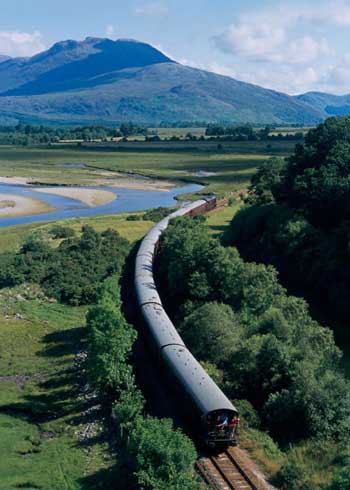
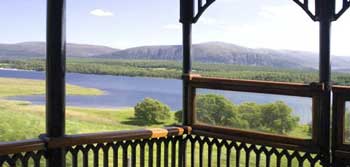
Travel to Scotland can hardly get more luxurious than aboard the Royal Scotsman, the private train that takes its passengers through some of the most spectacular scenery in the British Isles.
In June 2009, join respected British gardening writer Sue Chivers and photographer Patsy Floyd on a memorable journey around some of Scotland’s finest country homes and gardens.
The Royal Scotsman departs from Edinburgh on June 5, and meanders north across the Forth Railway Bridge to Montrose and Edzell Castle. From there the train heads up the east coast to Aberdeen and the whiskey region. Day two takes travelers west towards Inverness, capital of the Highlands, passing through Dingwall before continuing north to Invergordon, where passengers disembark for a visit to Foulis Castle.
The train heads south on Day Three to Carrbridge, where travelers disembark for a visit to Logie House. This estate is privately-owned by Mr & Mrs Alastair Laing, who will conduct a tour of their home and gardens and discuss how they run their estate.
On Day Four, passengers disembark the train at Boat of Garten and take a motorcoach to Rothiemurchus Estate. This estate has been owned by the Grant family for almost 450 years. Philippa and Johnnie Grant, the 17th Laird of Rothiemurchus, invite passengers into their hunting lodge.
The next day the train returns to Edinburgh’s Waverly Station through the former Kingdom of Fife. Price for this rail journey is $7210 and includes all table d’hôte meals and accommodation on board based on two people sharing a twin compartment or one person in a single. Follow this link for more information or to order tickets.
For the millions of RMS Titanic lovers around the world, April 15 is a very significant date. On that day it will be exactly 100 years since the tragic sinking of the ship that changed so many lives and sparked one of the most captivating stories in human history.
On March 31 the world’s largest Titanic visitor attraction, Titanic Belfast, will officially open its doors, thrusting the ship’s physical and spiritual home firmly into the global spotlight.
The striking $152 million piece of modern architecture stands majestically at the head of the very slipways where the Titanic first glided into the waters of Belfast Lough.
Inside, nine walk-and-ride-through exhibition galleries equipped with the latest 3D, CGI and video technology uncover the true Belfast story of the Titanic, from its conception and construction in the Harland & Wolff Shipyard to its famous maiden voyage and subsequent place in history.
A host of experiences are offered—a thrilling ride through the shipyard with the Titanic under construction, or an exploration of the sumptuous luxury and superb craftsmanship of its interiors.
You can be drawn deep into the stories of the passengers, crew and the heroes of the day or re-live the drama of its tragic end and visit its resting place in the North Atlantic in a unique Ocean Exploration Center with live links to contemporary undersea exploration.
New High-Speed Line makes Direct Train Travel between France, Germany and Switzerland faster and easier
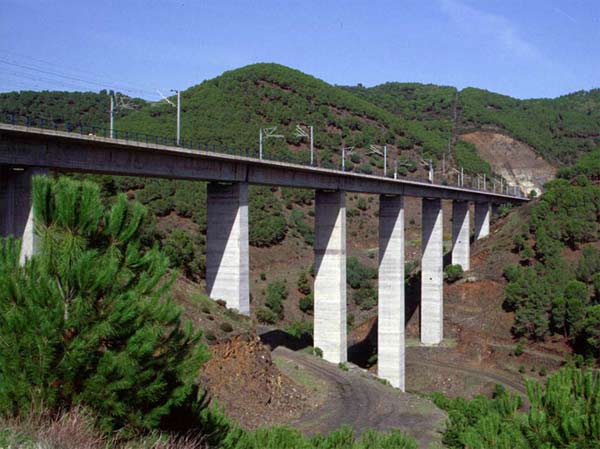
A total of 160 bridges and 12 viaducts have been built on the 264 miles of new track to be used by high-speed TGV trains which can travel at speeds up to 201 miles an hour.
For the first time, direct service is being offered within France on routes including Paris to Besancon, Belfort and Mulhouse.
TGV is French for Train à Grande Vitesse which means “high-speed train.”
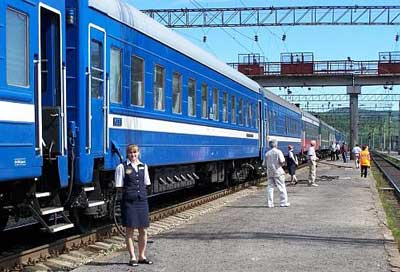
International high-speed TGV trains offer direct service between France, Switzerland and Germany on routes such as Paris/Lausanne, Paris/Bern, Paris/Zurich and Frankfurt/Marseille. Tickets for TGV trains, including this newest section of high-speed line, are available through RailEurope.com.
Avignon TGV station
“This newest section of high-speed line will make a big difference to the way travelers can travel within France and also between France, Germany and Switzerland in 2012,” said company President and CEO Frederic Langlois. “The Rhine-Rhone high-speed line will offer faster travel times, more frequent and direct trains, and the speed, ease and convenience of connecting between these countries makes for a better travel experience.”
This new high-speed line runs east-west, reducing travel times from the northeastern city of Strasbourg to Lyon to just 3 hours and 40 minutes. The number of trains on this route will also increase to six roundtrips per day.
Another line will run north-south from France into Germany allowing travelers from Marseille or Avignon in the south of France to go directly to Frankfurt without changing trains. It is estimated that 11 million riders will utilize the new Rhine-Rhone line.
From tea in a British buffet car, to luxury dining on the Trans-Siberian Express, eating on trains can be a true culinary adventure.
By Sharon Hudgins Photos by the author
I grew up riding trains across America just before the era of classic passenger service ended on the railroads and before Amtrak was a gleam in the government’s eye. Later I rode trains all over Europe from northern Scotland to central Italy, from the coast of France to the plains of Hungary. And in Russia I’ve logged nearly 40,000 miles on the legendary Trans-Siberian Railroad, crossing the continents of Europe and Asia between Moscow and Vladivostok several times.
That’s also a lot of dining on trains, snacking on railroad station platforms and eating at station buffets.
DINING ON BRITISH TRAINS I remember riding first class on British Rail across England and Scotland many years ago, when smartly uniformed stewards served tea in your private train compartment, first spreading a starched white cloth on the little table under the window, then pouring the hot brown brew from a silver-plated teapot into a porcelain cup (with milk added first or last depending on where you stand on that contentious issue). A small plate of sweet biscuits (cookies, in American English) always accompanied the tea. What a civilized way to spend a morning or afternoon, sipping tea, nibbling on biscuits, and watching the British countryside roll by outside the window.
Morning coffee and afternoon tea were included in the price of the ticket. But like many travelers on trains all over the world, I often chose to save money on meals by purchasing food from station vendors to eat on the train. Once in a while, however, I’d splurge on a meal in the dining car, luxuriating in the “white-tablecloth service” and the selection of foods that were so different from those I’d eaten on American trains.
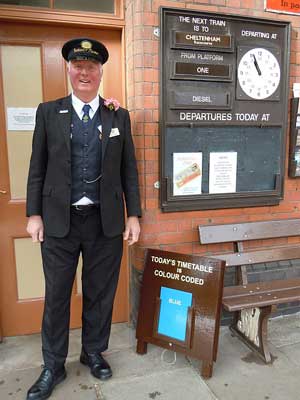
(left) Conductor on the Cheltenham Flyer, historic steam train of the Gloucestershire Warwickshire line of the British Great Western Railway.
Traditional English pork pie from the buffet aboard the Cheltenham Flyer
Alas, in 2011 contemporary trains in Britain did away with the last of their full-service dining cars, replacing them with airline-type meals served at the seats of first-class passengers and microwaved snacks sold in the buffet car for everyone else. But there’s hope for the future: In 2013 the First Great Western Railway re-introduced full-service “Pullman dining,” with fine wines and locally-sourced foods, on the UK’s only remaining regularly scheduled train with a real restaurant car. But, strangely, the dining services don’t operate on weekends or public holidays!
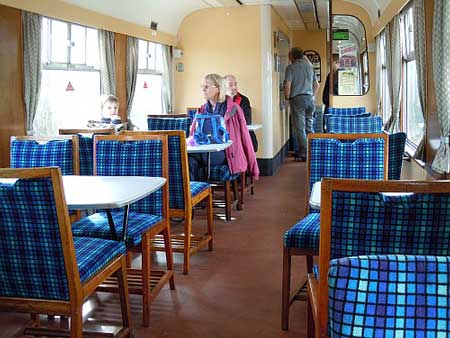
Restored 1950s-era buffet saloon car on the Cheltenham Flyer
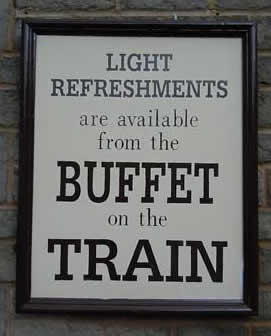
However, special tourist trains in Britain, including many historic trains, still provide a range of enjoyable culinary experiences. Recently I traveled through England’s lovely Cotswolds countryside on the historic Cheltenham Flyer, a 1930s-era steam train that chugs along the Gloucestershire Warwickshire branch of the Great Western Railway, which has been operating trains in western England since 1838. The train included a restored 1950s “buffet saloon car” whose menu offered Scotch eggs, pork pies, bacon rolls, homemade flapjacks and homemade cakes, along with a range of hot and cold drinks, alcoholic and non-. At certain times of the year, the historic trains running on these rails also offer special culinary tours, from Fish & Chips Specials to Ale & Steam Weekends (sampling 24 real English ales) to Luxury Pullman Style Dining Experiences with multi-course meals served on china plates, accompanied by wines poured into crystal glasses.
CONTINENTAL RAILROAD DINING The railroad dining experience on the European continent varies from country to country, type of train, and distance of travel. Some local trains have no dining facilities at all. Others have only a small snack bar or buffet, or vendors who come through the train with a cart stacked with packaged foods and canned drinks. Some have a full-service dining car, with a menu featuring multi-course meals and a selection of wines. If fine food and white-tablecloth dining are an important to you on a rail journey, then you need to seek out the trains that have a separate dining car and well rated menus.
For the ultimate in Old World luxury train travel (and dining), book a journey on the Venice-Simplon Orient Express, a modern revival of that classic train, which operates several tours of different lengths between London and Istanbul. The trains also feature three beautifully restored dining cars from the 1920s, with haute cuisine to match. Wear period dress to dinner, and you’ll feel like you’ve stepped back in time into an Agatha Christie novel.
Who could resist the special Swiss Chocolate Train that takes you on a day trip to a cheese-making factory, Gruyères Castle, and the Cailler-Nestlé Chocolate Factory in Broc for cheese and chocolate tastings at those stops? Travel in a vintage Pullman Belle Epoque-era train car or in a sleek, ultramodern panoramic car with large windows for viewing the Swiss Alps, the vineyards surrounding Montreux and the medieval town of Gruyères along the route. Bring along a shopping bag and leave your calorie counter behind.
Don’t overlook the foods to be found inside train stations, too. If you don’t want to spend big bucks to travel on a luxury train but you still like to eat well, you’ll find plenty of choices at many of Europe’s train stations, particularly those in the larger cities. I’ve been especially impressed with the train station buffets and take-out selections at major Swiss, German and French stations, as well as those in capital cities such as Budapest and Madrid. But for the ultimate in elegant, nostalgic, train-station dining, don’t miss the beautifully restored Le Train Bleu (The Blue Train) restaurant in Paris’s Gare de Lyon—a Belle Epoque-style restaurant with a pricey French menu and a gorgeous decor to match.
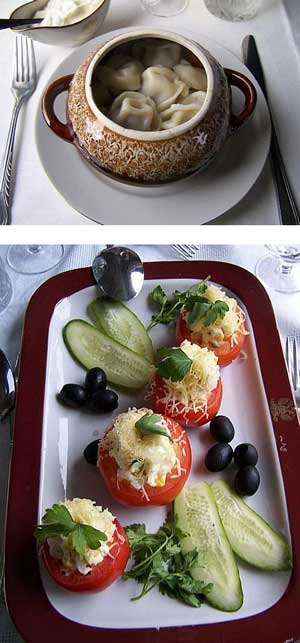
DINING ACROSS CONTINENTS Finally, for the travel adventure of a lifetime, board the British-owned, Russian-operated Golden Eagle Trans-Siberian Express whose route covers nearly 6,000 miles between Moscow and Vladivostok. Almost half that distance is on the European side of Russia, from Moscow to Kazan to the Ural Mountains. Each comfortable cabin on this luxury train has its own private bathroom. And three times a day, professional chefs in the a fully equipped kitchen car turn out freshly cooked meals featuring regional specialties, all served in an elegant dining car designed to evoke the Golden Age of train travel. During the 12-day journey across Europe and Asia, the menu is different at every meal except breakfast. On this longest train trip on earth, you’ll have plenty of time to enjoy the best of Russian cuisine and international wines while watching the fascinating changes of scenery outside the dining car windows.
So wherever you travel by train in Europe, enjoy the experience of dining on (and off) the diner. It’s a great way to taste a wide variety of regional foods and expand your culinary and geographic horizons at the same time.
Are you are looking for a vacation that combines relaxation, a bit of history, romantic castles, charming medieval villages, and excellent cuisine? This week-long river cruise on the Moselle, Rhine and Main rivers in Germany, offered by Avalon Waterways, may be the perfect choice for you.
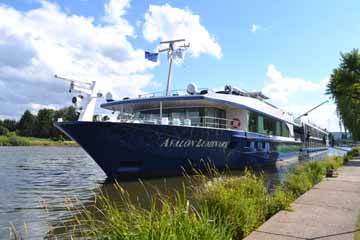
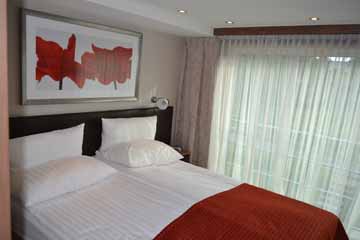
The MS Avalon Luminary, our ship for this cruise, was just recently added to Avalon’s fleet. Its 69 staterooms and suites are designed for efficiency, with plenty of space to stow personal items and luggage. Each room had a small bathroom with shower, comfortable memory foam mattress, a desk, lamp, mirror, fresh flowers, mini bar, and a safe for valuables. A television provided satellite programming and broadcast the view from a camera at the front of the ship. Floor-to-ceiling windows open to a private balcony in most rooms. It’s a luxury of river cruising to just unpack once and let the ship transport you with ease to each destination.
Another luxury on a cruise such as this is the excellent cuisine. The sumptuous breakfast buffet included breads, pastries and cereals, fruits, eggs, potatoes, sausages and bacon, and made-to-order entrees. The full lunch buffet served each day in the main dining room offered soups, salads, choice of main course and desserts. A lighter lunch option was also available in the lounge one deck above. Five-course dinners included an appetizer, choice of soups, salad, choice of meat, fish or vegetarian main course, and several dessert options. The well-trained staff served red, rose, or white wine or beer upon request.
BOARD IN LUXEMBOURG Boarding the Luminary in Remich, Luxembourg, we were welcomed by cruise director Jean Loup Domart. Entertaining, energetic, and extremely organized, Jean excelled at keeping everything running smoothly.
Although we set sail while dinner was being served, we missed none of the excitement, since the dining room was designed for maximum viewing, with panoramic windows on both sides. A sense of intimacy was provided with fresh orchids in lighted open rectangles dividing the large space without interrupting with the view. The lounge on the level directly above the dining room was also designed for watching Germany glide by in the most comfortable of settings.
Our first stop was Trier, Germany, which boasts amazingly intact structures from the Roman Empire, including imperial baths, an amphitheater, and Constantine’s reception hall, which now serves as a protestant church. Did you ever wonder why Roman ruins always seem to be discovered 6 feet underground? We learned from our local guide that after Roman towns were abandoned, local residents built homes by taking usable stones from the old Roman buildings. Over the course of 600 years, this practice left a 6-foot-deep base of rubble, upon which the medieval towns were built. Trier’s Porta Nigra (black gate) is black from wood fire smoke from Roman times, and was left standing because it was a site that attracted pilgrims, who brought money to the church.
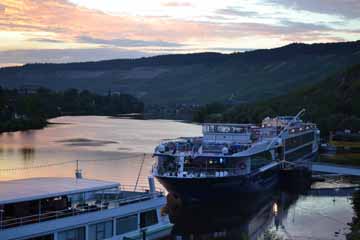
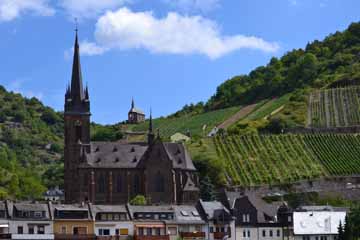
As our trip continued down the Moselle, we passed vineyard after vineyard and peaceful patchwork slopes, dotted with small villages and church steeples. The southern facing slopes provide the perfect environment for catching warm sunlight needed to grow grapes for Germany’s famous Riesling wines. And the ship’s outdoor decks were perfect for relaxing with a cup of coffee or listening to birds along the shore as the ship glided quietly along.
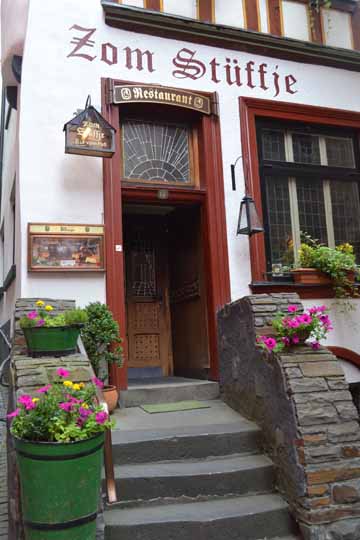
BERNKASTEL-KUES WEINFEST Our late afternoon arrival in Bernkastel-Kues allowed just enough time to explore the Old Town around the quaint market square. This town hosts the biggest Weinfest on the Moselle in September. One vineyard overlooking the town is the source of their “Doktor” wine. Legend has it that drinking some of the wine from this vineyard cured an archbishop of an ailment, so the wine became known as the “Doktor.”
Half-timbered buildings in Bernkastel
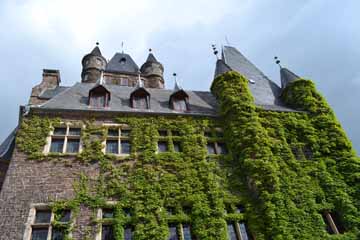
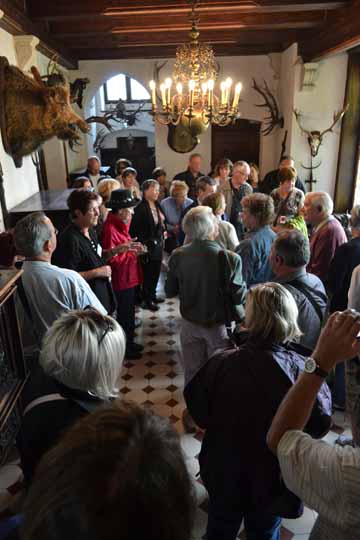
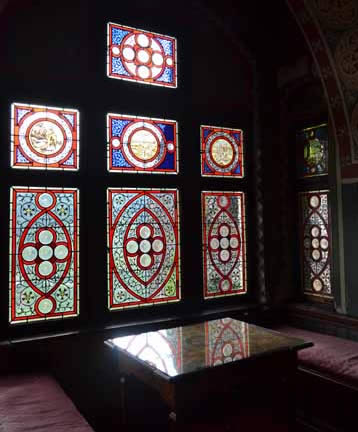
The next day brought us to the wine town of Cochem and a tour of Reichsburg Castle. The interior of the castle highlights not only only medieval artifacts, but Renaissance and Baroque furnishings selected by the 19th century restorers. The tour was informative and the view from the castle — spectacular.
Passengers tour the castle
The Moselle joins the Rhine at Koblenz, an important center of trade during the Middle Ages. An imposing statue of Kaiser Wilhelm I mounted on a horse dominates the Deutches Eck (German Corner) where the two rivers meet. We arrived just before dinner, with enough time for a short walk into the square to see the many shops and restaurants. The fortress Ehrenbreitstein stands on the opposite bank of the river and provides a beautiful panoramic view of the area.
To begin our cruise down the Rhine Gorge (some say the most beautiful part of the Rhine) first thing in the morning, we docked overnight at Koblenz, and were entertained on board after dinner by a small ensemble of classical musicians.
THE MIDDLE RHINE The next morning was filled with the history, legends and romance of the Middle Rhine. Cruise Director Jean Loup provided informative narration as the ship glided along, with passengers enjoying the view while relaxing on the sundeck. We learned that during the Middle Ages the Rhine River Gorge posed many hazards for travelers, and provided many opportunities for powerful kings to levy tolls for safe passage. They built castles and fortresses in the 12th and 13th centuries along the banks to collect tolls, make money, and enlarge territories.
Reichsburg Castle
The castles were usually built high on hills, close to a spring, and often on a curve with a view of the river. Stones for the castles were lifted with wheels and ropes, and the building projects provided work and security for locals, whose lifespan at the time was only about 40 years. Most castles were built with limestone, which was easier to work with than granite. Later palaces were built with marble, as techniques improved. To attack a fortress, enemies could try to break down a wall or door with a battering ram on wheels with a roof as protection from arrows shot from the castle. Or a catapult could throw fire over the castle walls. Castles residents used beehives, hot tar or hot water to fend off attackers. Some fortresses housed armies of 600.
In the town of Boppard we saw Sterrenberg and Liebenstein, known as the castles of the enemy brothers, and heard the legend: Two brothers both fell in love with their adopted sister. She wanted none of this, and entered a monastery in town to live as a nun. The brothers fought and finally built two castles next to each other with a wall in between.
The 430-foot-high Lorelei rock is located where the river narrows, creating treacherous currents dangerous to ships. The famous legend of the beautiful maiden who sat on the rock luring sailors to their destruction with her singing is commemorated with a bronze statue.
The town of Oberwesel, below Schoenburg Castle, still has many fortification walls and towers still standing. When the river water is low, travelers can see the “rocks of the seven virgins.” Legend has it that a lord with seven sons wanted to arrange marriages for them. The seven chosen virgins didn’t want to marry, and threw themselves into the Rhine, where, because they were so hardhearted, they turned to stone.
Pfalz Castle (whose gold lion was to symbolize strength and power) was built in the 16-17th century as a customs tollhouse on a little island in the middle of the river. Gutenfels Fortress was built on the bank opposite Oberwesel to protect the tollhouse.
Sooneck Castle, a toll-enforcing castle from the 11th century, also housed pirates. It is one of the oldest along the Rhine and is restored as a cafe.
In an attempt to preserve the beauty and tranquility of the shoreline, many of the houses along the shore are painted in soft pastels, often pale yellow, a color made popular by Maria Theresa. Train tunnel entrances on this stretch of the river are built to look like castles, in order to blend in with the style of the area.
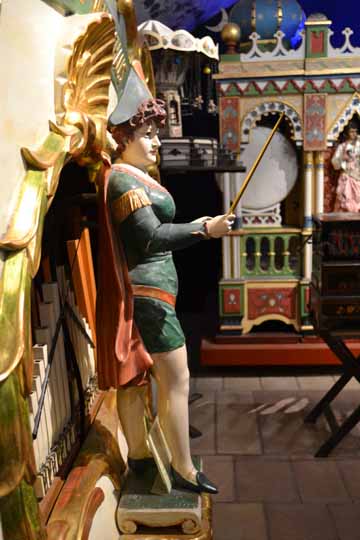
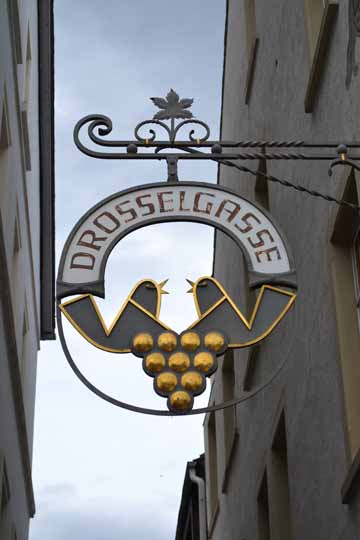
(left to right) Siegfried’s Mechanical Musical Instrument Museum; Drosselgasse, a lively street in Rudesheim.
DROSSELGASSE A FAVORITE Our last stop on the Rhine River was in Rudesheim, where we enjoyed a guided tour of the Museum of Mechanical Musical Instruments (some imitating entire orchestras in one huge contraption!), and a local winery. Be sure to take time to explore the exciting main street, the Drosselgasse, with its many restaurants and shops.
Navigating the Main River is a slow process because of the many locks needed to raise or lower the ship along the route. So our ever resourceful cruise director kept passengers busy on board with an entertaining German lesson, and a cookie-baking demonstration by an “almost nun” from Miltenberg, our next port of call on the Main.
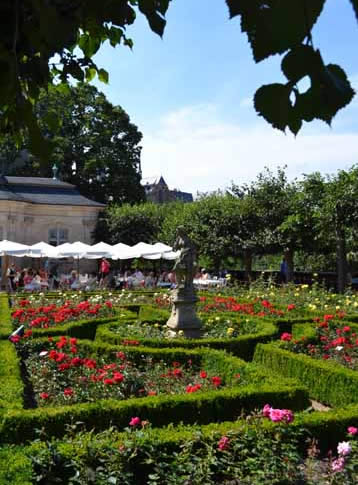
Miltenberg
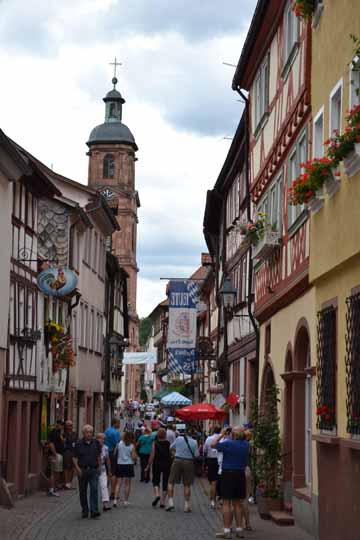
Miltenberg was built against a hill at a curve in the river, a perfect place to collect tolls for the archbishop of Mainz. Many half-timbered houses are still preserved because the people here were too poor to tear them down and rebuild. If a floor sagged and sank, it was filled with sand and covered with another floor. In some recently renovated buildings, 30 centimeters of sand/wood layers were discovered beneath the floor. The original red “paint” on the houses was a mixture containing, among other things, oxblood and cattle dung, which provided the desired red color and also killed worms that might live in the wood. A unique naturally cool icehouse is located in the hill at the rear of the town.
Cold beer and ice cream
While the ship slowly navigated through more locks, passengers rode by bus to Wurzburg, and met the ship when it finally docked after our tour. Wurzburg is the site of the Prince Bishop’s Residenz, which is one of the finest examples of a baroque palace, and also a UNESCO World Heritage Site. It was built to rival Versailles in France and the Schoenbrunn in Vienna. The unique mirrored room features the difficult technique of reverse painting. The famous ceiling fresco by Tiepolo miraculously survived bombing, and the original marble floor is still in the main reception hall. The “marble” pillars are actually a stone core with a ground marble coating so that colors could be controlled, a technique that was more expensive than using solid marble.
Wurzburg
WURZBURG AND X-RAYS Wurzburg was also the home of Professor William Conrad Rundkin, winner of the Nobel Prize for the discovery of X-rays. Residents in Wurzburg are not x-rayed; they are “Rundkined.”
Bamberg
The terrain along the river from Wurzburg to Bamberg changes and becomes flatter, with fewer vineyards, more trees and shrubs, and more locks. This quiet time was perfect for relaxing with a book from the ship’s library, located in the small lounge at the rear of the ship. There passengers found English language books of all genres, games, and the most wonderful coffee machine which dispensed espresso drinks that rivaled any coffee shop. Iced tea, shortbread cookies and other snacks were available 24/7. The ship also had an exercise room with a treadmill, two types of exercycles and flat screen TV, and a small beauty salon.
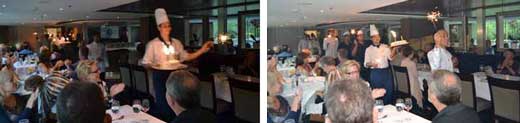
Cruise ship surprises
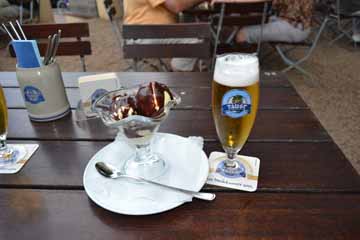
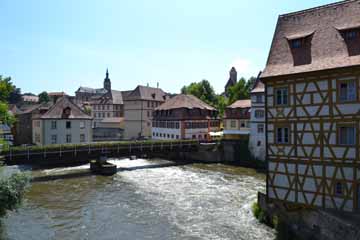
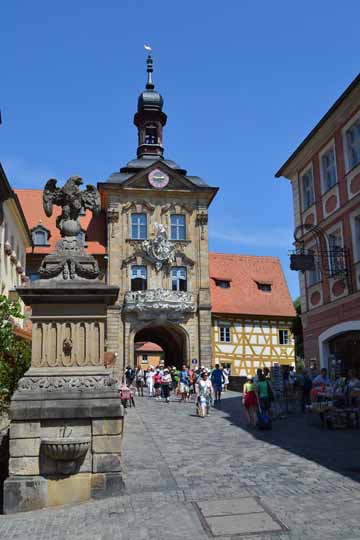
Busses again transported us to meet local tour guides in Bamberg, another UNESCO World Heritage Site. There we learned the local history of the cathedral, the Old Town Hall, which straddles the River Regnitz, had an opportunity to taste the local specialty, “Rauchbier” (smoked beer), and had time for browsing in the main pedestrian shopping area.
Our cruise ended the next morning upon arrival in Nuremberg, from which some passengers continued by bus to Prague, and others to charming Rothenburg ob der Tauber.
IF YOU GO.. Avalon Waterways, which has been in business for 80 years, has a number of different river cruises available in Europe. Their river cruise ships are small compared to ocean liners, which makes the service and trip more personal. They also have Europe’s youngest fleet of ships, with their fleet averaging just two years old, compared to seven years for other cruise companies.
There are full floor to ceiling sliding glass doors in 85% of the deluxe staterooms on Avalon’s fleet. Also, the Luminary had lots of space in the central passenger areas such as the dining room, lounge and library.
The Luminary offered five categories of rooms including Royal Deck suites; Royal Deck Category P; Sapphire Deck Forward, Category A; Sapphire Deck Aft, Category B; and Indigo Deck, Category E.



















 European Traveler