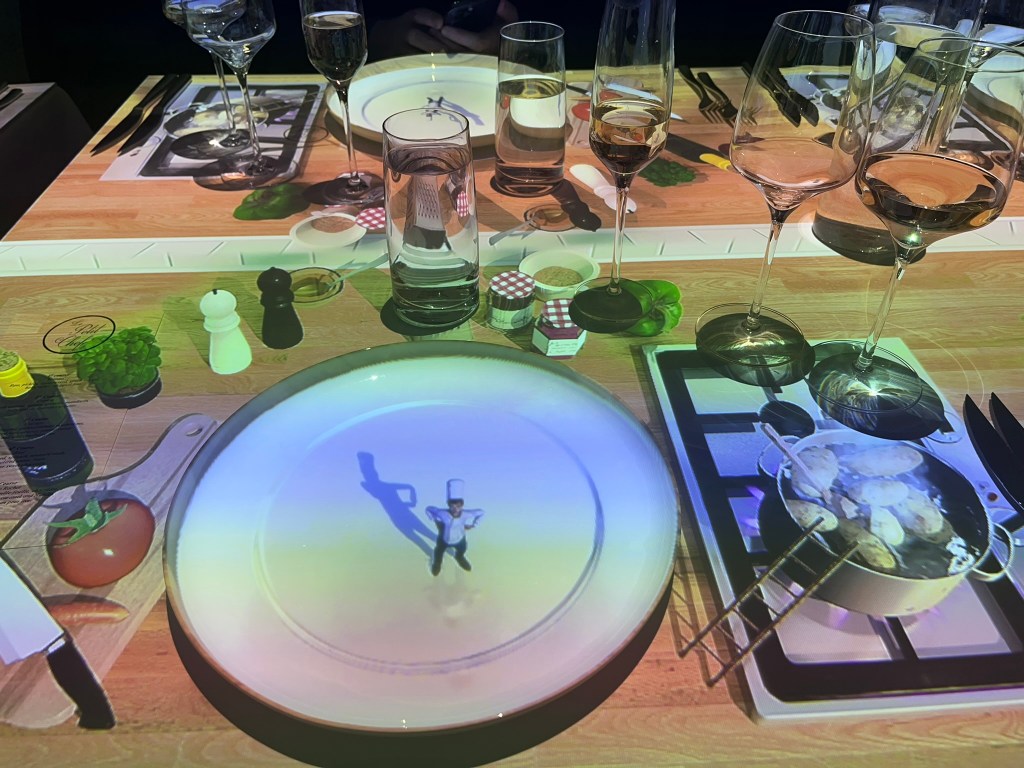
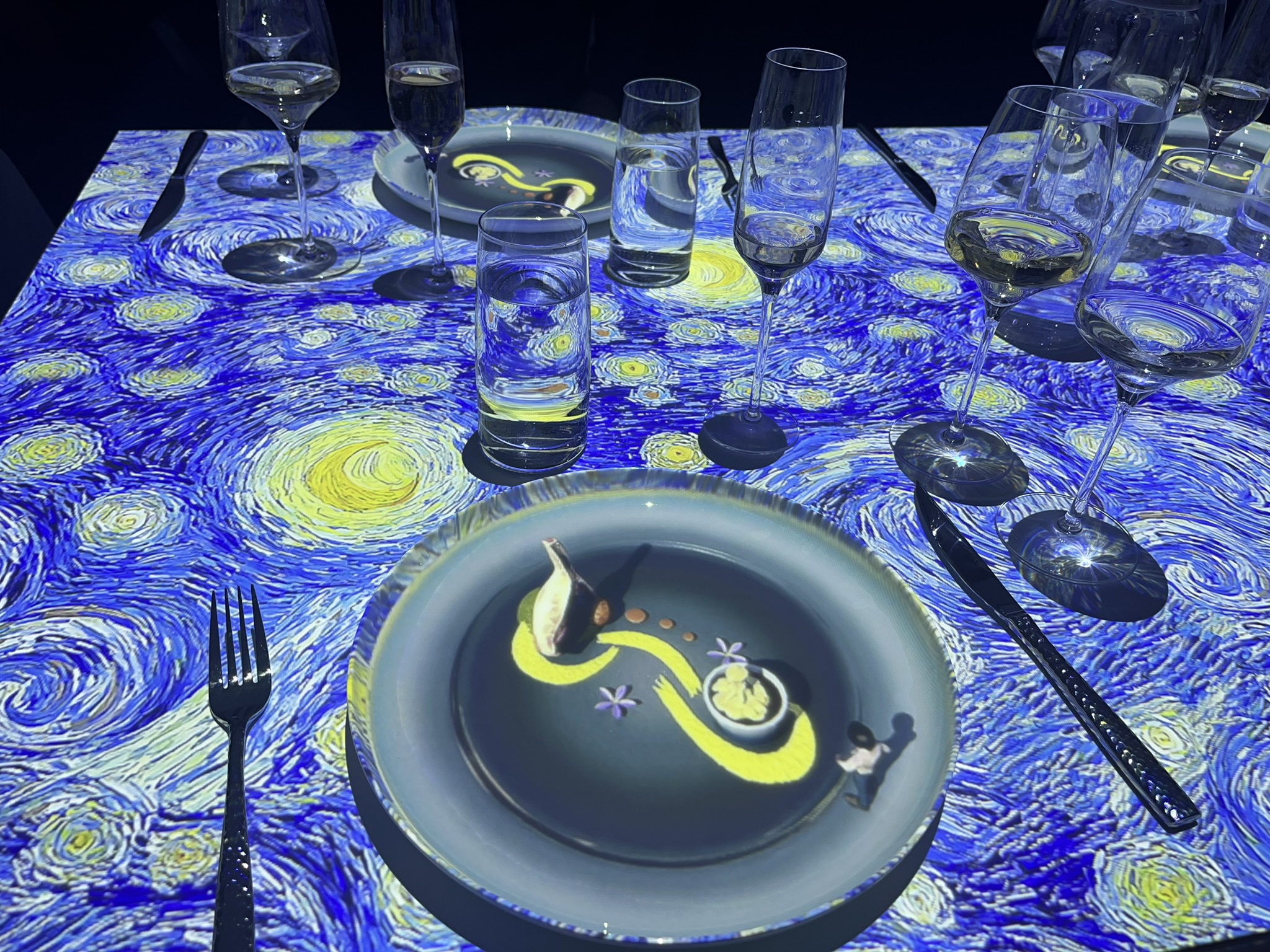
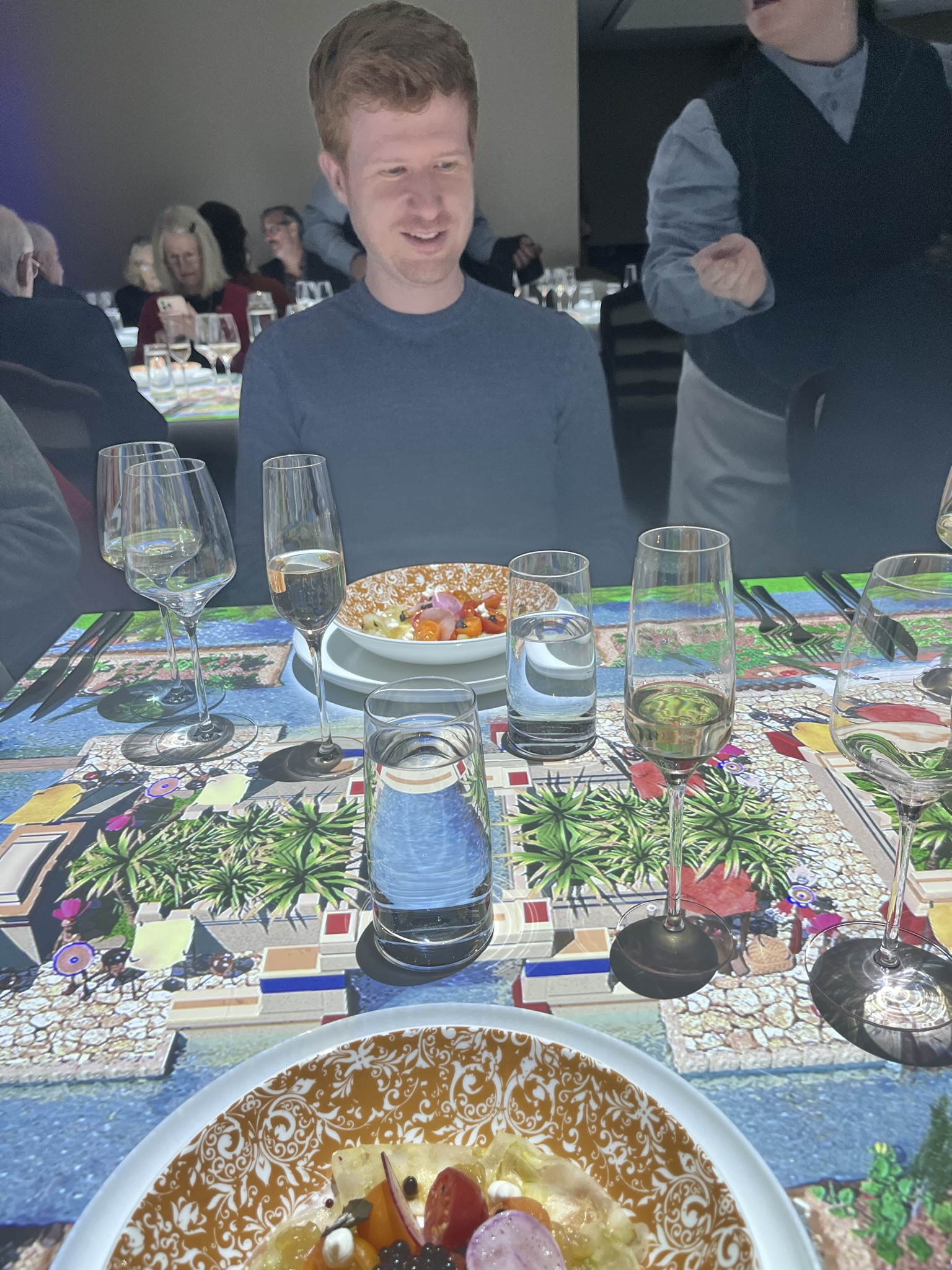
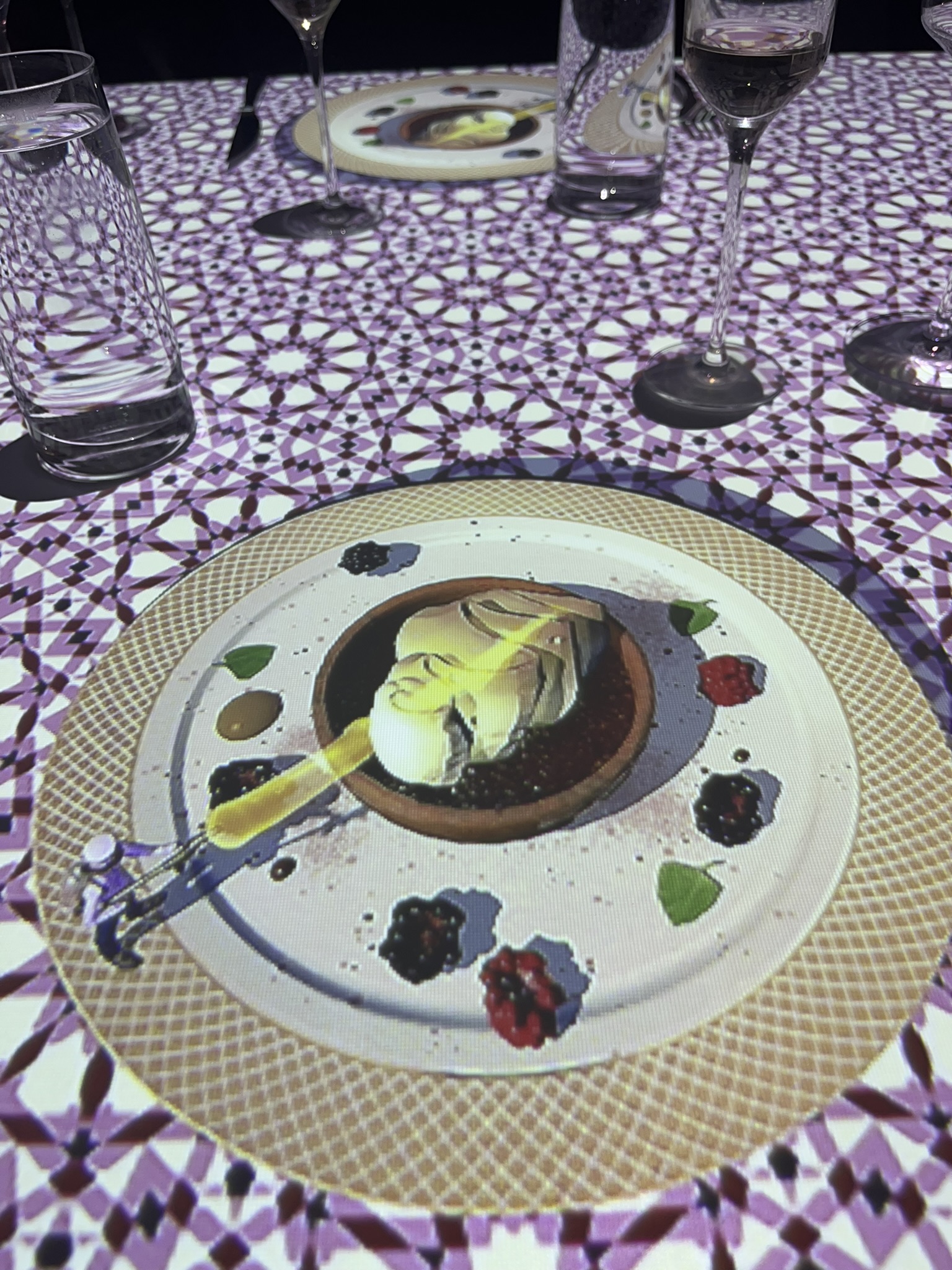
A simple white charger plate and smooth white table turn into a texture-rich artistic musical experience, culinary history lesson, and elaborate feast right before your eyes! Fairmont Chicago’s Le Petit Chef: An Immersive Dining Experience features a 2.5-inch animated French character created by artists at Skullmapping. Rising from the center of your plate via groundbreaking 3D projection mapping that requires no special eyeglasses or visors, Le Petit Chef illustrates through colorful storytelling the history of ingredients used in the meal, the joy of being a chef, and the art of creative plating inspired by famous painters. It’s a dining experience like no other, and Fairmont Chicago, in partnership with TableMation™, opened this exclusive gastronomical adventure to the public on January 19, 2023. The lobby level Cuvée Room at Fairmont Chicago houses this 90-minute themed dinner with curated wine pairings.
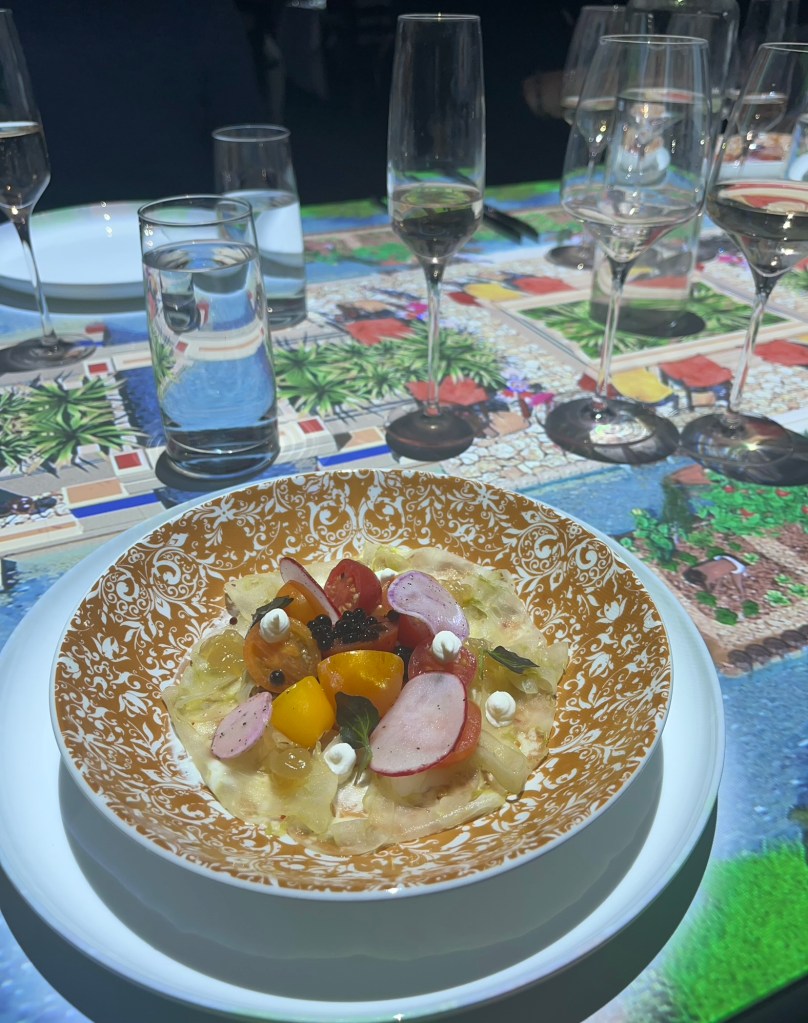
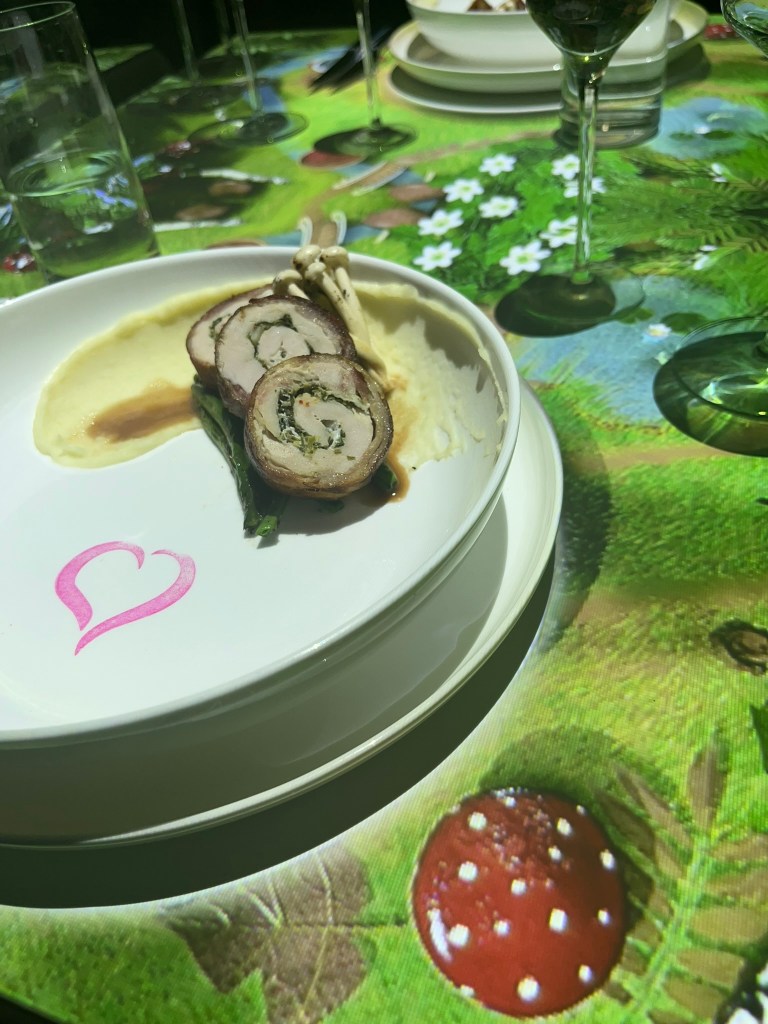
Projected from the ceiling down to the tables and plates, 3D scenes and designs bring the dining area to life, illustrating gardens, sculpted fountains, raging battles, as well as busy cooktops boiling potatoes and searing meat. Between humorous anecdotes, musical numbers featuring dancing vegetables, lessons about ingredient composition, and tips on flavor combinations, guests are served a beautifully prepared, delectable 5-course meal featuring the elements showcased.
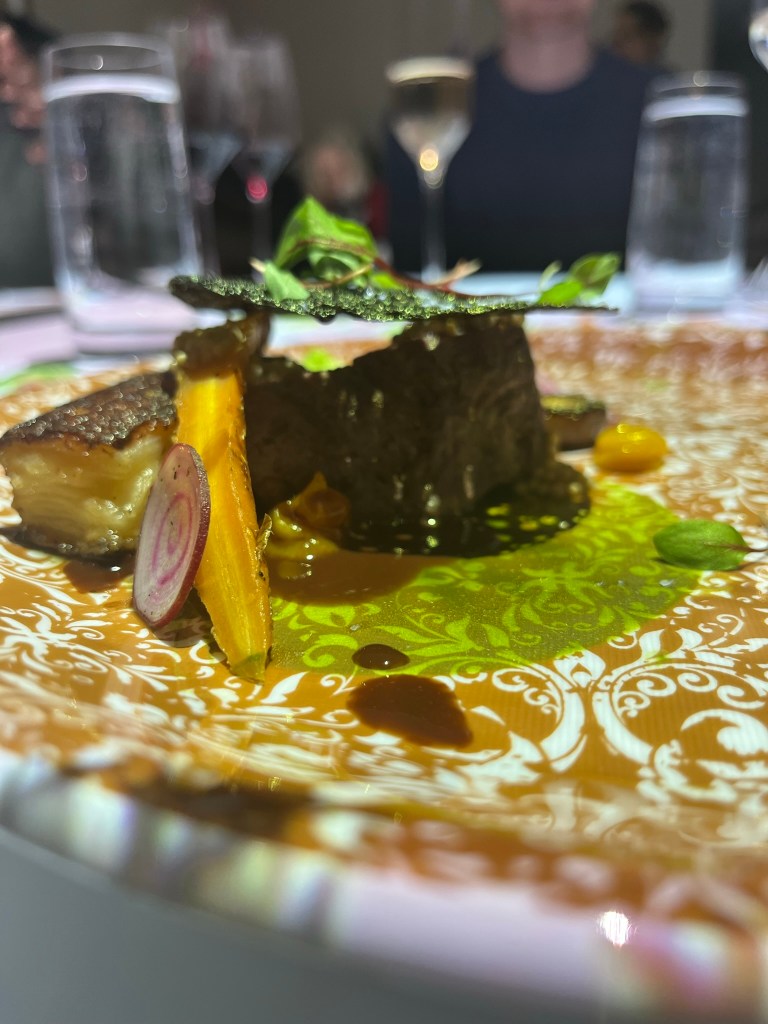
Each dish is rich with taste, texture, and color, but not heavy or saturated with creams and dressings. The delicious natural flavors of fresh produce and meat are perfectly seasoned to surprise and satisfy. Those with allergies or special dietary needs and preferences are graciously accommodated, making the menu safe for all who want to partake.
“I think all kinds of eaters will find something to enjoy in this experience,” said diner Marc Berry after his meal with Le Petit Chef. “Even non-foodies can enjoy each interesting yet accessible course, and the joy of the 3D segments accompanying them.”
Fairmont Chicago General Manager, Clay Spencer, said, “We are thrilled to bring this unique dining experience to our guests, the city of Chicago, and the larger Midwest region. … We’re delighted for diners to experience this culinary adventure through animation. It is a dinner like no other.”
Pricing per person begins at $155 (exclusive of tax and gratuities), with an optional French wine pairing of $42. The first seating starts at 6:00 p.m. and the second at 8:00 p.m. every Thursday through Saturday, through the end of 2023. For more information about Fairmont Chicago and to book your special dining experience at Le Petit Chef, please visitfairmontchicago.com.
For Valentine’s Day, treat your sweetheart to Le Petit Chef’s fun and fancy French meal, or consider these other Chicago area specials:
Love is in the air! Skydeck Chicago’s “Pie in the Sky” VIP Valentine’s Day Dinner offers a three-course meal that includes a delicious Giordano’s heart-shaped deep-dish pizza, salad, and dessert, served with a stunning view of the city. This 10 p.m. after-hours experience is intimate, with only seven tables per evening, maximum, and it takes place after Skydeck Chicago is closed to the public. Before ascending to the 103rd floor to step out on the glass-bottomed The Ledge, explore the ground-level museum and exhibits featuring Chicago’s diverse neighborhoods and architecture. A small-scale Bean (Cloud Gate), Second City stage setup, giant hot dog and deep-dish pizza, full-scale “L” train car, replica Chicago Picasso – there are photo opportunities galore! Book your Pie in the Sky tablehere for Valentine’s Day, February 14, 2023, or celebrate early by booking for Thursday, February 10, or Friday, February 11.
Photo courtesy of Skydeck Chicago
The “Love, Alma” package at stylish Hotel Zachary at Gallagher Way is a tribute to architect Zachary Taylor Davis’ true love and muse, Alma Davis. This romantic overnight includes a $50 food and beverage credit at The Bar, upgraded Wrigley Field ballpark view accommodations, and an extended 1 p.m. late checkout. Book your reservationhere.
Photo courtesy of Hotel Zachary
Spread the love on Friday, February 10, from 6:00 p.m. to 10:00 p.m. at Hotel Zachary’s The Bar “Galentine’s Day Social Hour,” where you can craft a custom flower bouquet, enjoy live R&B DJ entertainment, snack on light bites and desserts, savor wine or a build-your-own-spritz concoction, and observe the on-site creation of an original painting by an artist. This event is hosted by Chicago influencer @FoodiexFancy in partnership with Bombay. Guests in attendance are encouraged to sign cards to be donated to a local Chicago children’s hospital. Purchase your Galentine’s Day Social Hour passeshere.
Photo courtesy of Hotel Zachary
Museum of Illusions (MOI), in the heart of downtown Chicago, is a unique and interactive date spot to explore with your special someone. MOI offers a 2-for-1 Valentine’s Day ticket special for those wanting a mind-bending experience at a fraction of the cost. Reserve your February 14 ticketshere, and the discount will automatically apply at checkout on Adult tickets.
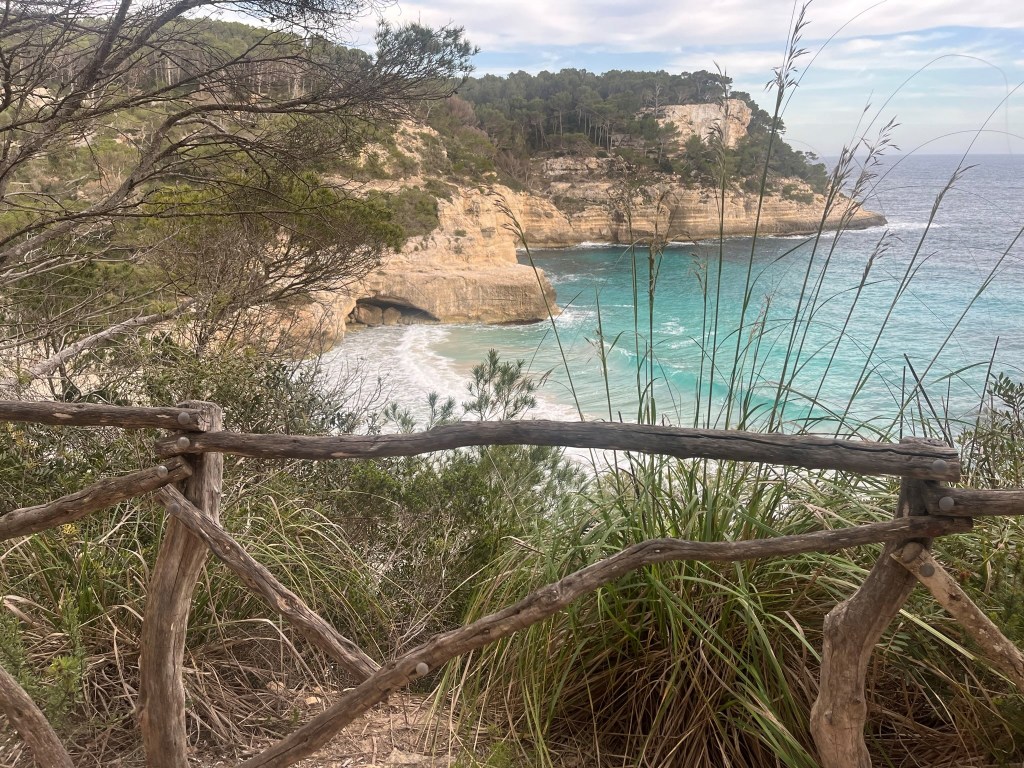
In the west Mediterranean Sea, the Balearic Islands’ Menorca makes the most of its natural resources. And for being only about 30 miles long and 10 miles wide, it has a lot! This haven of coves and turquoise water licking untouched white sand beaches has been a Biosphere Reserve since 1993, and due to its wide diversity of habitats and landscape it is UNESCO-designated as the headquarters for the World Network of Island and Coastal Biosphere Reserves for matters pertaining to sustainable development. Local farming practices focus on sustainability and preserving the island’s natural heritage. Using environmental resources found within the island’s ecosystem, resident farmers and artisans make a living from the offerings provided by landscape and livestock.
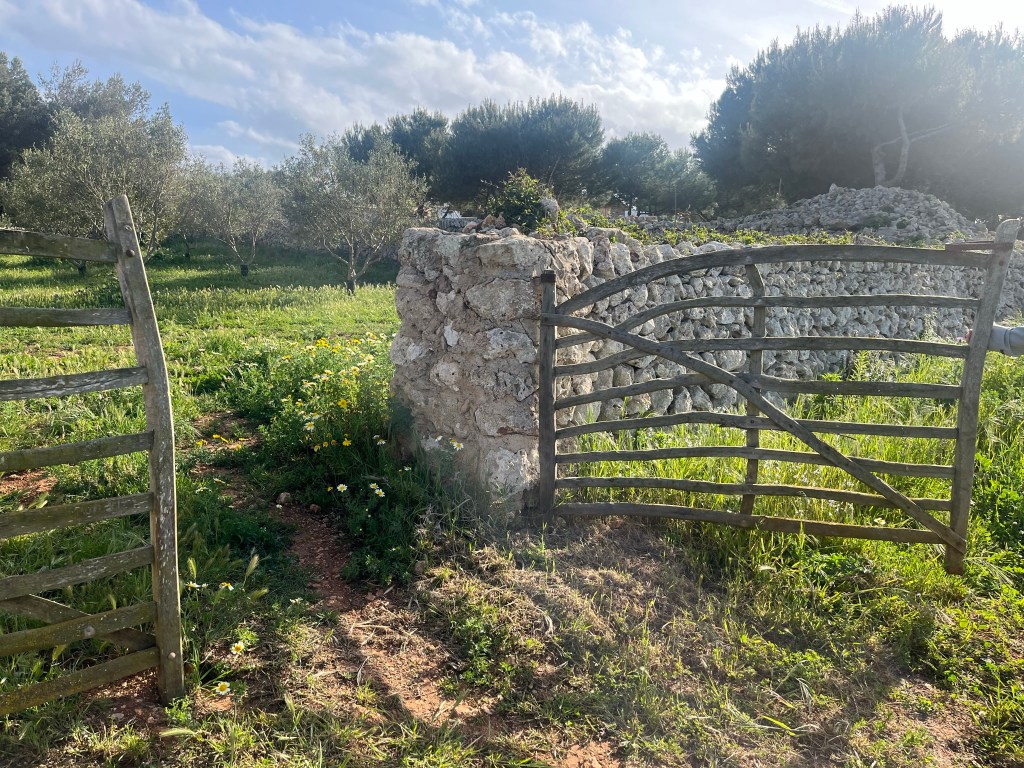
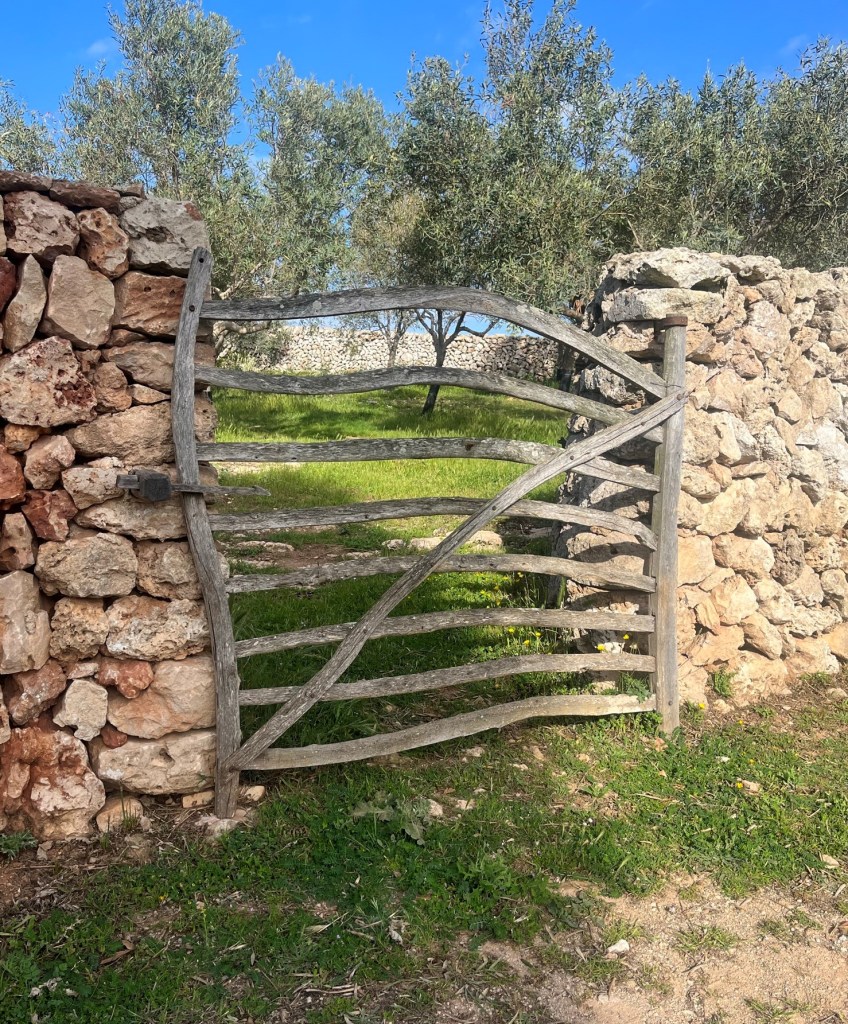
Across the island, wild olive tree wood is fashioned into fences to divide land and act as guard rails.
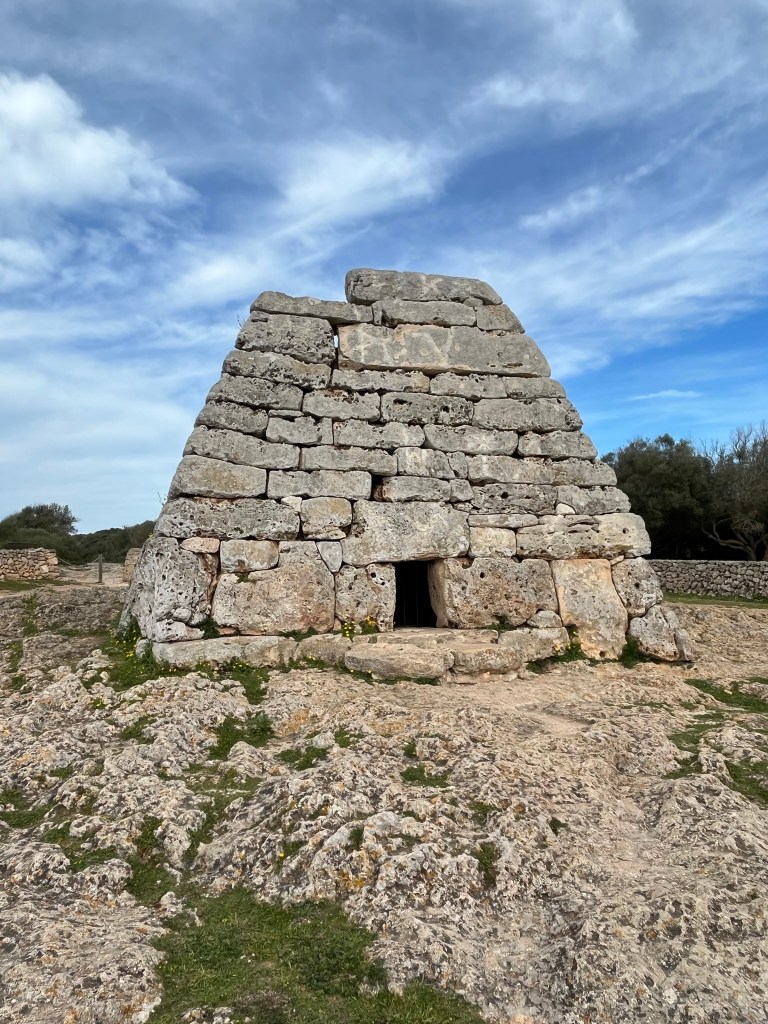
Menorca’s “mosaic landscape” of varying ecosystems consists of farmland, forests, and villages, with a bird’s-eye view revealing small plots of land divided by a network of dry-stone walls. Since ancient times, agrarians have gleaned rocks from the soil to build these mortar-less barriers that cover about 6,835 miles of the island (more than half the length of the Great Wall of China) and reduce erosion by blocking the wind from shifting soil to neighboring plots. Even the island’s prehistoric navetas (burial chambers) and talayots (shrines) were built by carefully selecting stones of varied size and shape, filling gaps with sand, and relying on gravity to secure them together.
(left) Unique to the island, Menorca’s navetas are pre-Talaiotic burial monuments shaped like an inverted boat and built using only large stone blocks. (middle) The island’s naturally rocky soil is gleaned to build stone walls that separate land plots. Wild olive trees with olives not suitable for harvesting are formed into farm gates using their distinctive, curvy wood. (right) Prevalent on Menorca are cement-free stacked-stone walls and sturdy gates crafted from wild olive trees.
Vineyards on Menorca are typically surrounded by these stone walls, a drainage situation that adequately waters the vines without leaving them overly damp. Local beverages created from the natural flora offerings of the land include the Vi de la Terra Illa de Menorca indication of quality wine, aromatic Menorcan gin (the oldest in Spain) produced using wine-based alcohol distilled with native herbs and juniper berries in old copper stills, and herb liquor digestifs.
The olive tree is another landscape prevalence, including the Spanish arbequina variety, which is used to produce a popular extra virgin olive oil with a mild, creamy flavor and slow kick. Oral history says the famous condiment mayonnaise heralds from Menorca, where the invading French Duke of Richelieu first tried the local sauce (a simple mixture of olive oil, egg, and salt) and brought it back to the French court, naming the recipe “mahonnaise” after the town Mahón. The oldest written source of Menorcan recipes is Art de la Cuina, a book by Fra Francesc Roger detailing the island’s cultural gastronomy in more than 200 18th century recipes, including a recipe for mayo using native olive oil. Not only are olives used for oil production, the strong wood from wild olive trees whose olives aren’t large enough to harvest is crafted into rustic, swing farm gates in a distinctive curvy design seen all across the island.
The oldest written source of Menorcan recipes is Art de la Cuina, a book by Fra Francesc Roger detailing the island’s cultural gastronomy in more than 200 18th century recipes, including a recipe for mayo using native olive oil.
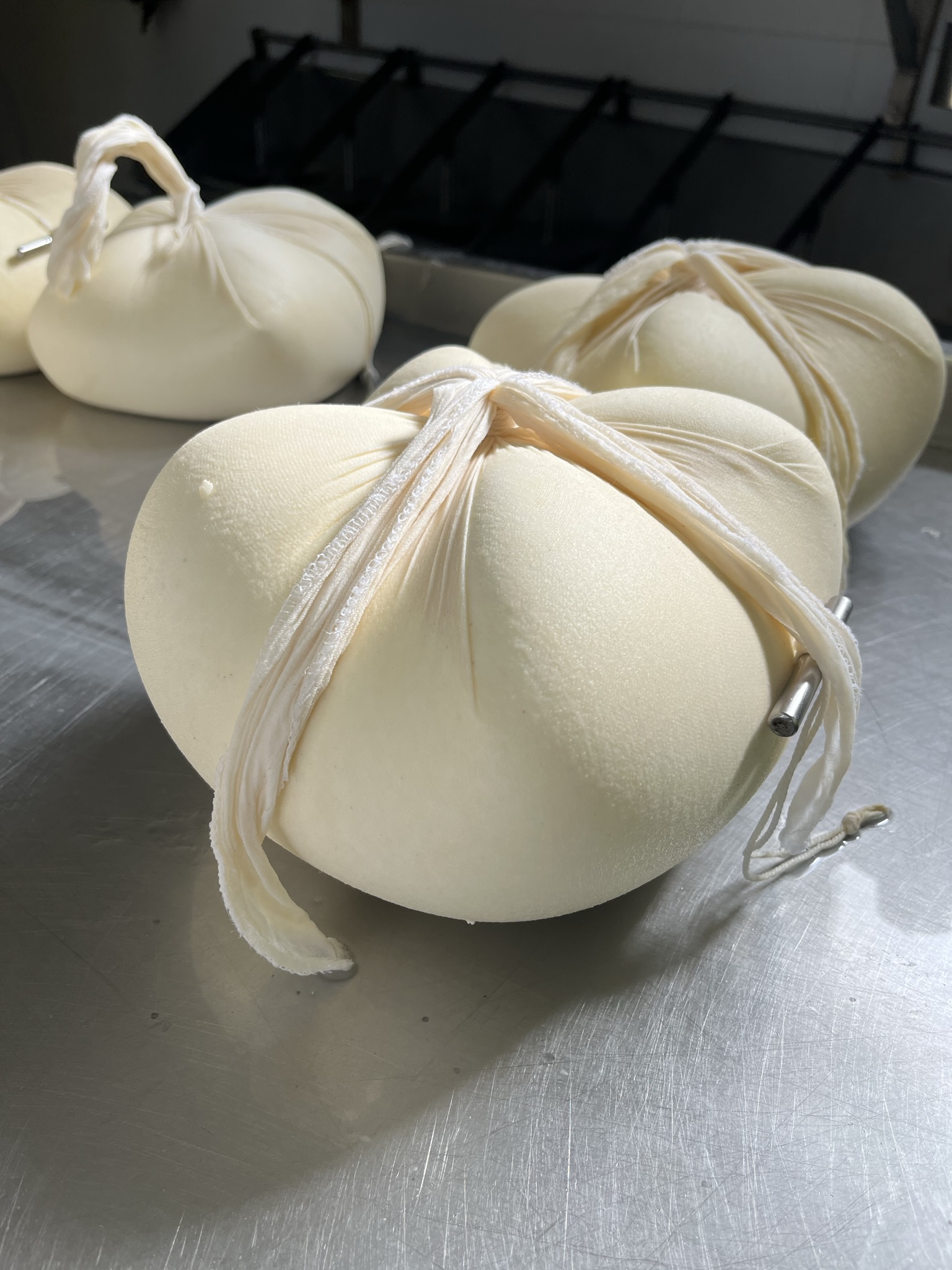
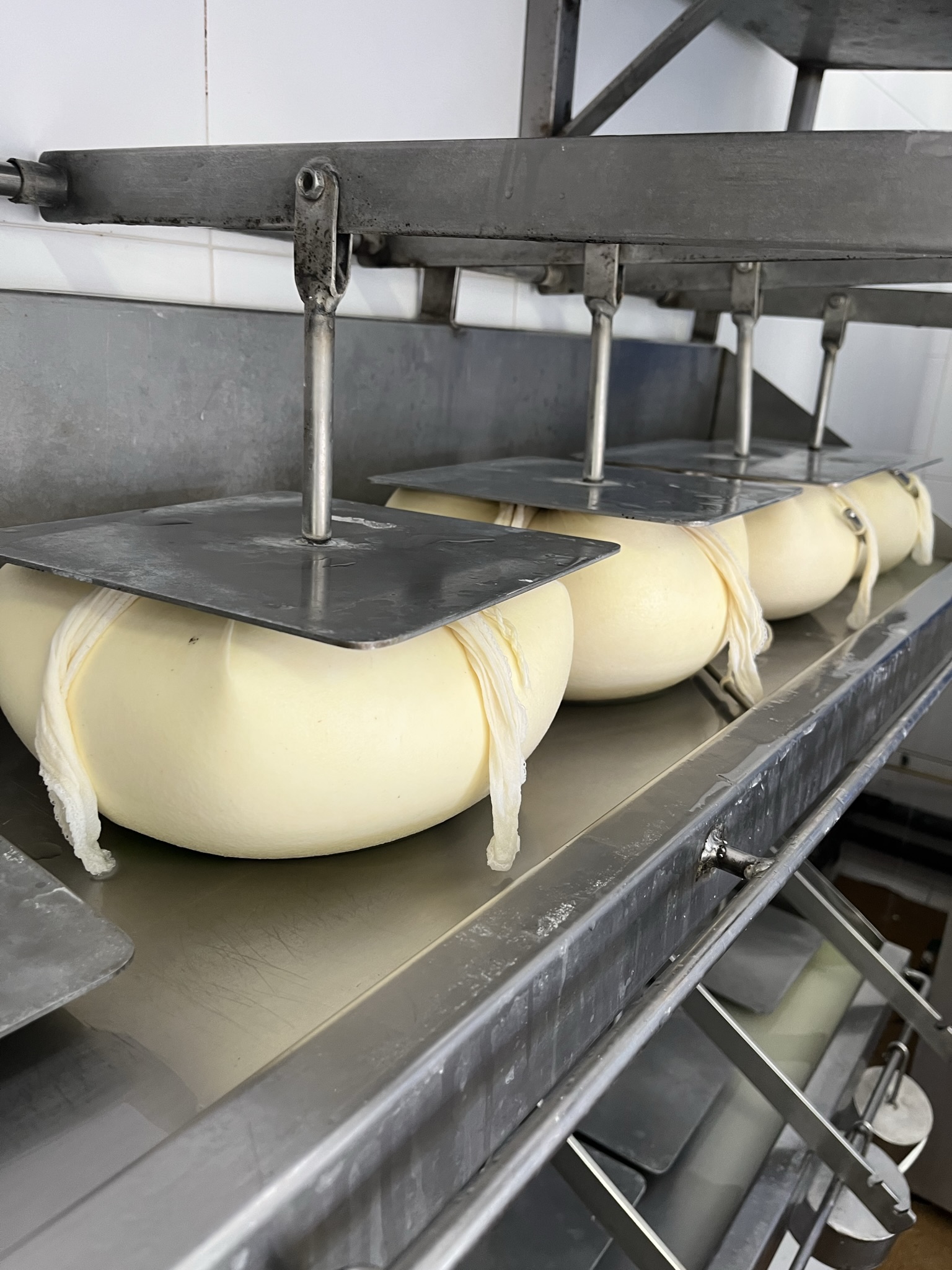
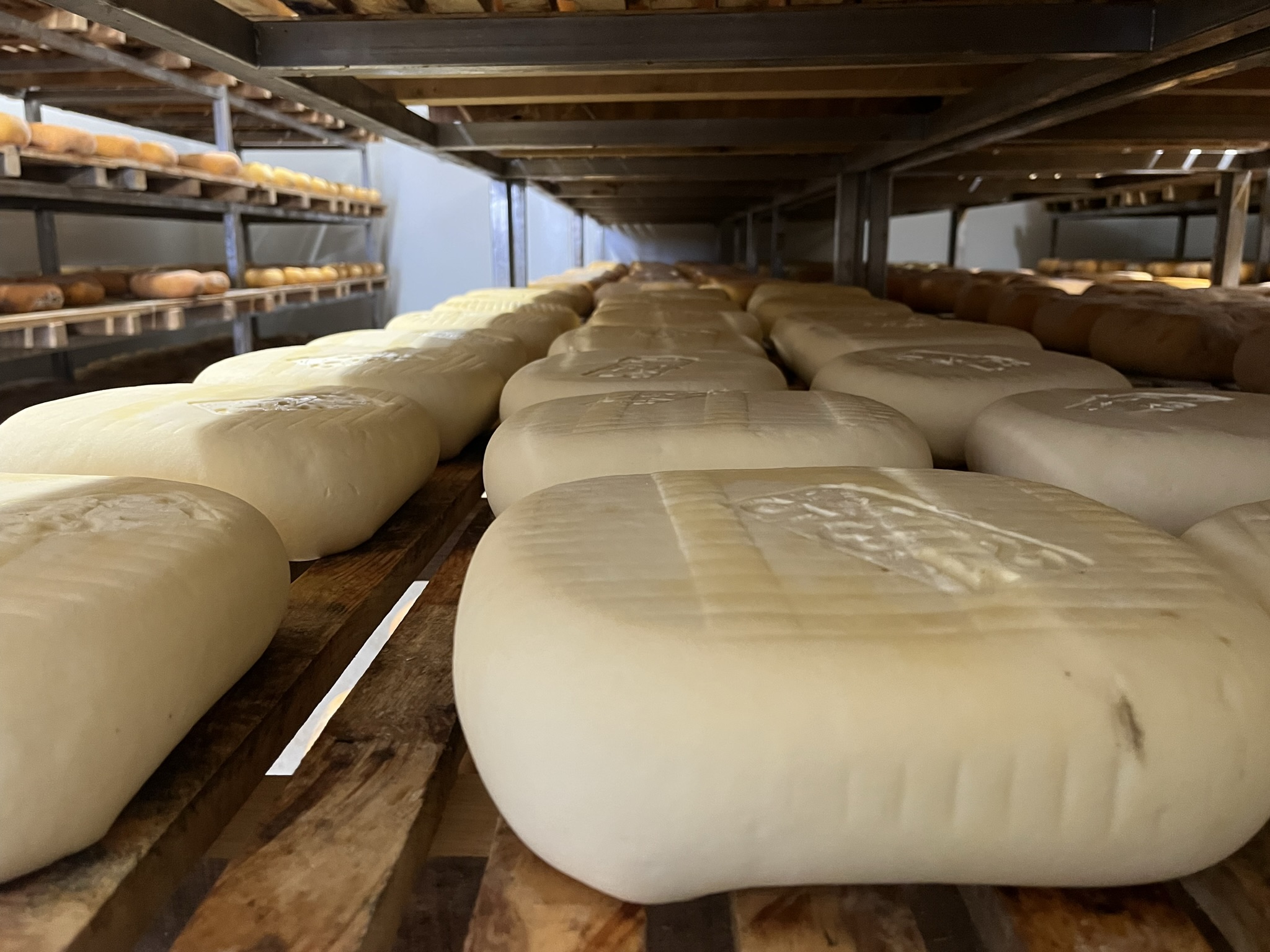
Using age-old methods, farmers use milk from Menorcan cows to produce rounded-edge square blocks of Mahón-Menorca Denomination of Origin cheese with a flavorful, oily dark rind (even Arabic documents from the year 1000 describe the tasty qualities of cow’s milk Menorcan cheese). Farms like Son Piris produce artisan cheese (made with raw milk and intended for immediate consumption) or the more industrialized and slightly sweeter pasteurized-milk cheeses. Martina Fedelich of Son Piris explained that it is difficult to imitate the Menorcan bacteria used in their cheese, as they are unique and isolated from other cheeses and even differ from those on neighboring island Mallorca. Easy to identify, Mahón-Menorca cheese’s unique shape comes from the cheesecloth used during the pressing process, and fabric lines from the cloth remain visible in the rind.
(clockwise from upper left) The unique shape of Mahón-Menorca cheese comes from the cheesecloth used during the pressing process, and fabric lines from the cloth remain visible in the rind; Son Piris cheeses are wrapped tightly in cheesecloth, which holds together the solid cheese curd while allowing for drainage of liquid whey; Wrapped cheeses are pressed to remove excess moisture; After their tightly wrapped cloths are removed, the cheese is set out to dry; Martina Fedelich of Son Piris serves the famous farm-to-table Mahón-Menorca Denomination of Origin cheese.
Agriculture is a key trade on Menorca; however, the most important manufacturing business on the island is shoe design and production—an industry dating back to the 18th century. Footwear made in Menorca is known for its high quality and meticulous craftsmanship. The most famous sandal shape, with a cowhide leather upper and sole, was first created to protect farmers’ feet while working the rocky soil. Nowadays, these avarcas (also called abarcas or menorquinas) are sold with heels and straps of all styles and colors, but use recycled tires as a hardy sole. Popularity and production have been increasing especially over the past few years, and they are worn by Menorcans and visitors alike.
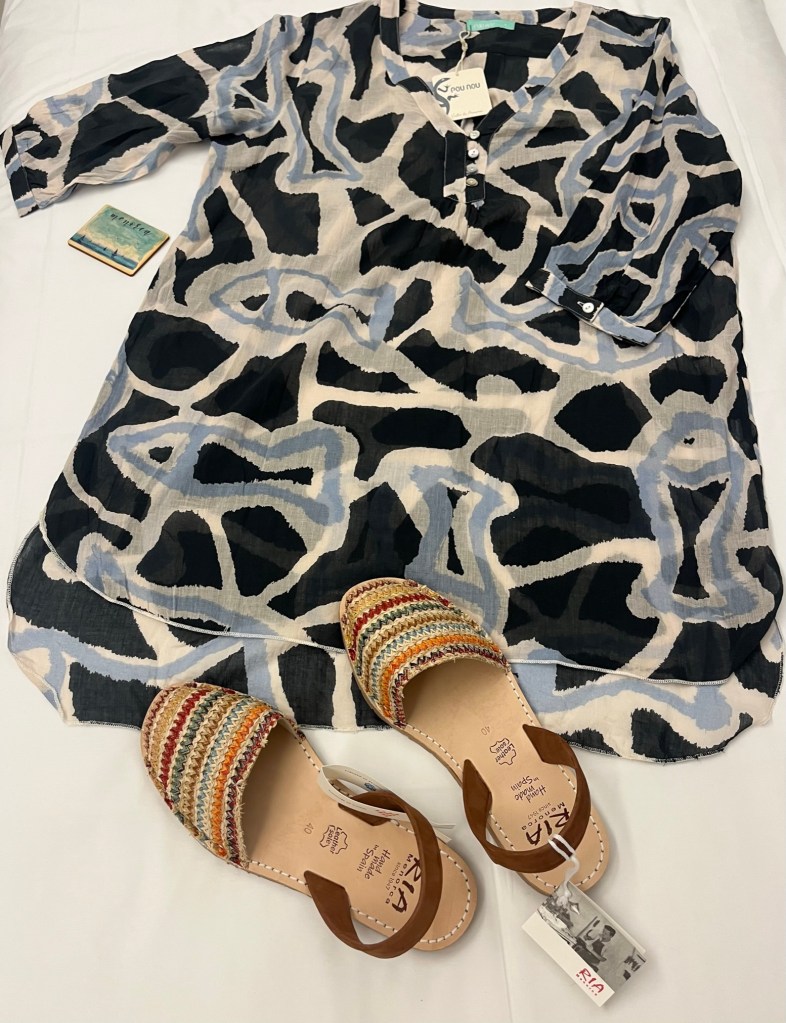
RIA brand avarcas fashioned from leather with a colorful woven upper are a stylish update to traditional peasant footwear. Pou Nou clothing motifs echo the sea life and landscape of the island, like this fish-print tunic in shades of blue.
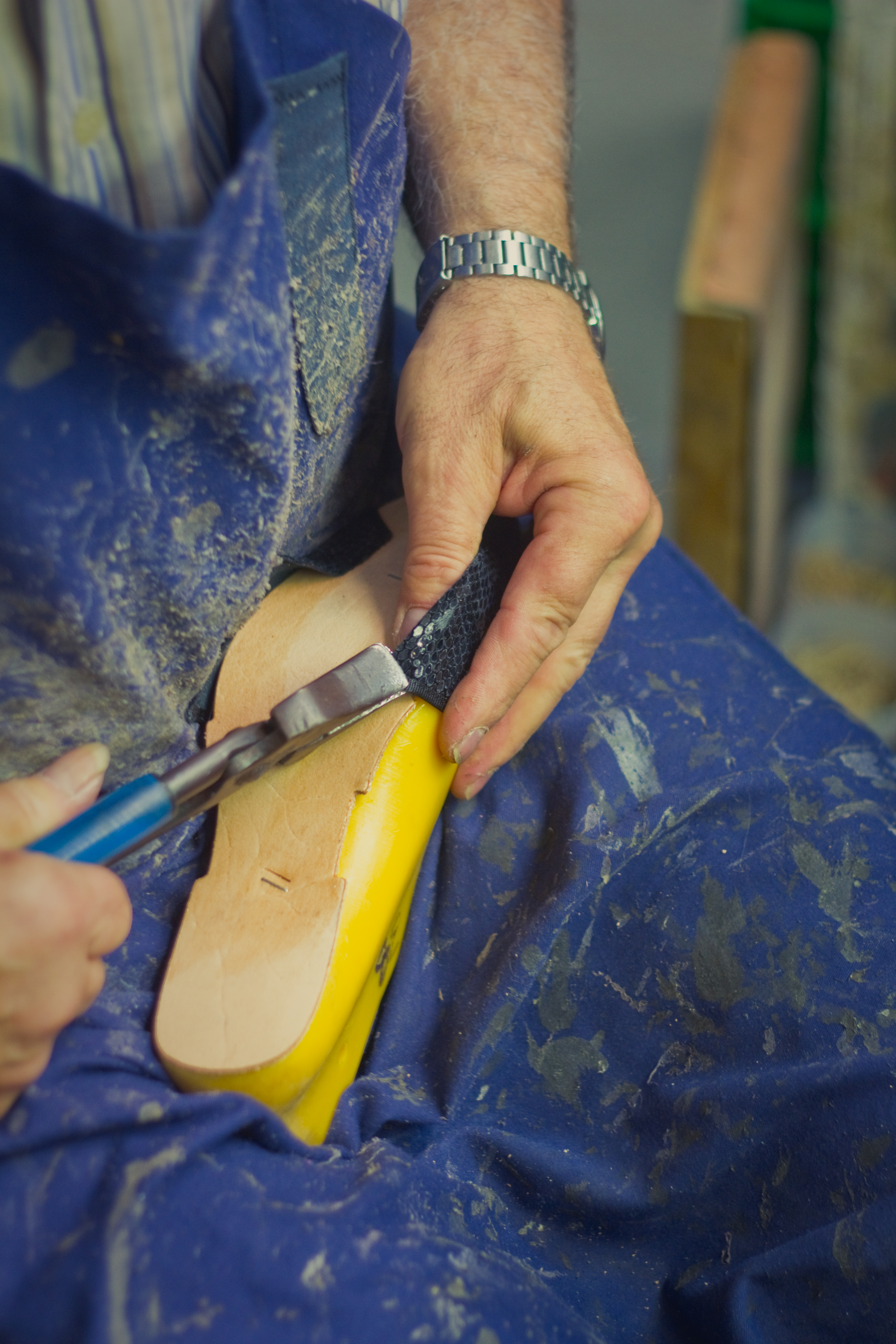
Avarca company MIBO proudly carries the Avarca de Menorca hallmark—another island-specific denomination of origin—which guarantees that their footwear is crafted locally and made with high-quality materials. Founded in 1998 by Miguel Pascual and Bosco Moll, MIBO designs and manufactures these iconic Menorcan sandals using traditional methodology combined with modern technology. Moll said, “The process to make a pair of avarcas from Menorca has about 25 operations, which all need the hands of craftsmen to be able to make them. We also use technology that helps the craftsmen, but it always requires expert hands. … The future of our product and our brand passes through the qualified training of our craftsmen-workers since there are no schools or training cycles that help this task.”
(left) A traditional style with modern updates, some MIBO avarcas feature trendy details like cut-outs, bows, and textured mosaic prints. (right) A MIBO artisan carefully guides a hallmark-stamped leather sole through machine stitching. Photos courtesy of MIBO.
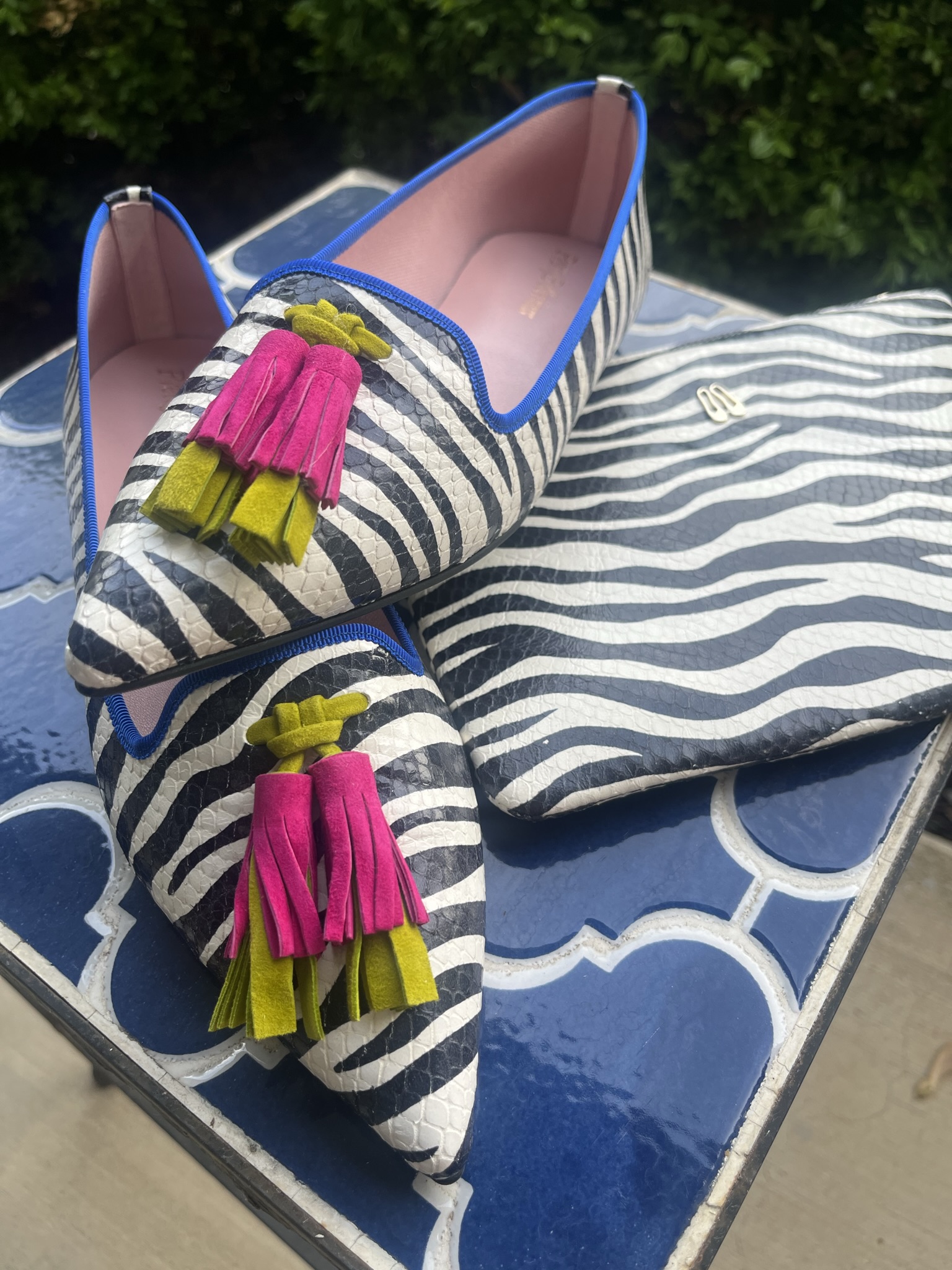
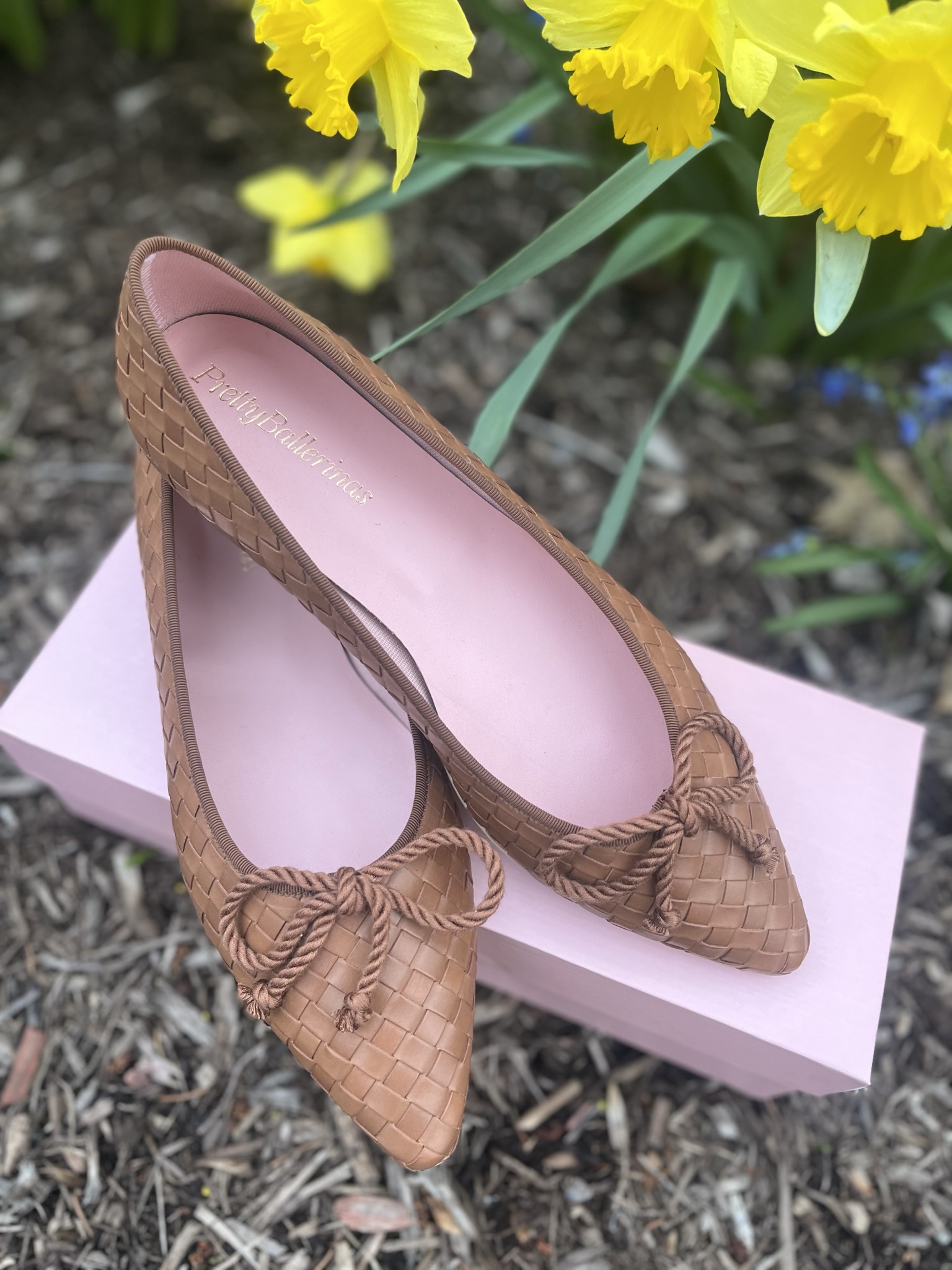
Another prestigious Menorcan shoe brand known internationally for its impeccable quality and innovative designs is Pretty Ballerinas, a unique line of leather flats produced by the Mascaró Group footwear company. These fashions have been famously worn by Kate Moss, Kate Middleton, the Queen of Spain, Elle Macpherson, Claudia Schiffer, and Angelina Jolie, among other celebrities. Fanny Cano, vivacious franchisee and owner of Pretty Ballerinas U.S. (the sole U.S. store, located in New York City), was born on Mallorca and has worked for the Mascaró brand since 1998. Fanny said:
“I love when through our very personal customer service we get to transmit to our customers the island’s vibes. They know they are wearing a unique piece crafted by hand on a small island in the Mediterranean. They feel the quality and the time invested in their pair of shoes. Explaining to the clients where and how the shoes are made—in a very artisanal and old-fashioned method—it really helps them to get tele-transported to the smell of the leather, the artisan hands sewing the shoes, mixed with the breeze of the sea and the taste of the food.”
Fanny Cano, Pretty Ballerinas franchisee and owner of the New York City store, poses before the iconic pink boxes and glamorous storefront that identify this high-quality brand of Menorca-made women’s leather flats. Easily identifiable by a pink lining and stamped ballerina slipper icon on the underside, Pretty Ballerinas flats and matching handbags exhibit a unique style and luxurious leather silhouette. Top-left and bottom-right photos courtesy of Fanny Cano.
Woodworking, earthenware, basket weaving, traditional llaüt wooden boat carpentry, and other crafts using fabrics, stone, and paper are sold in island shops and markets during the summer months. The quality of local, professional artisans’ work is acknowledged by the Artesanía de Menorca (Craft of Menorca) hallmark, and the Centre Artesanal de Menorca (Artisan Centre of Menorca) at the Es Mercadal fairground exhibits and sells many of these handmade products.
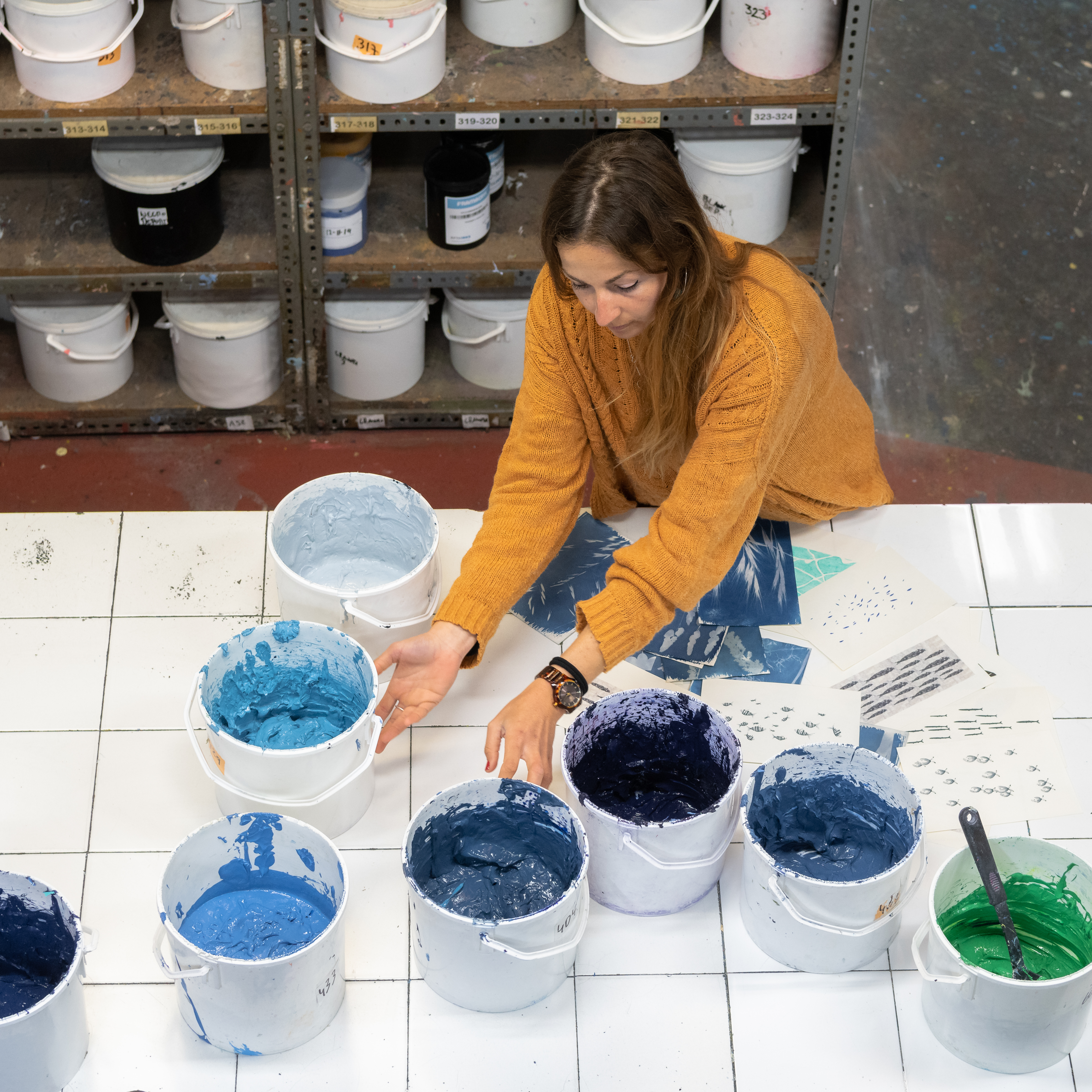
A Menorca-born leader in local artistry is Pou Nou clothing company, whose designers work closely with area artists to produce contemporary designs and stylish garments that reflect the colors and shapes of Mediterranean life. Drawing inspiration from the sea, sky, and island itself, Pou Nou creates hand-printed T-shirts and breezy, comfortable fashions for all ages using natural fibers like linen and cotton.
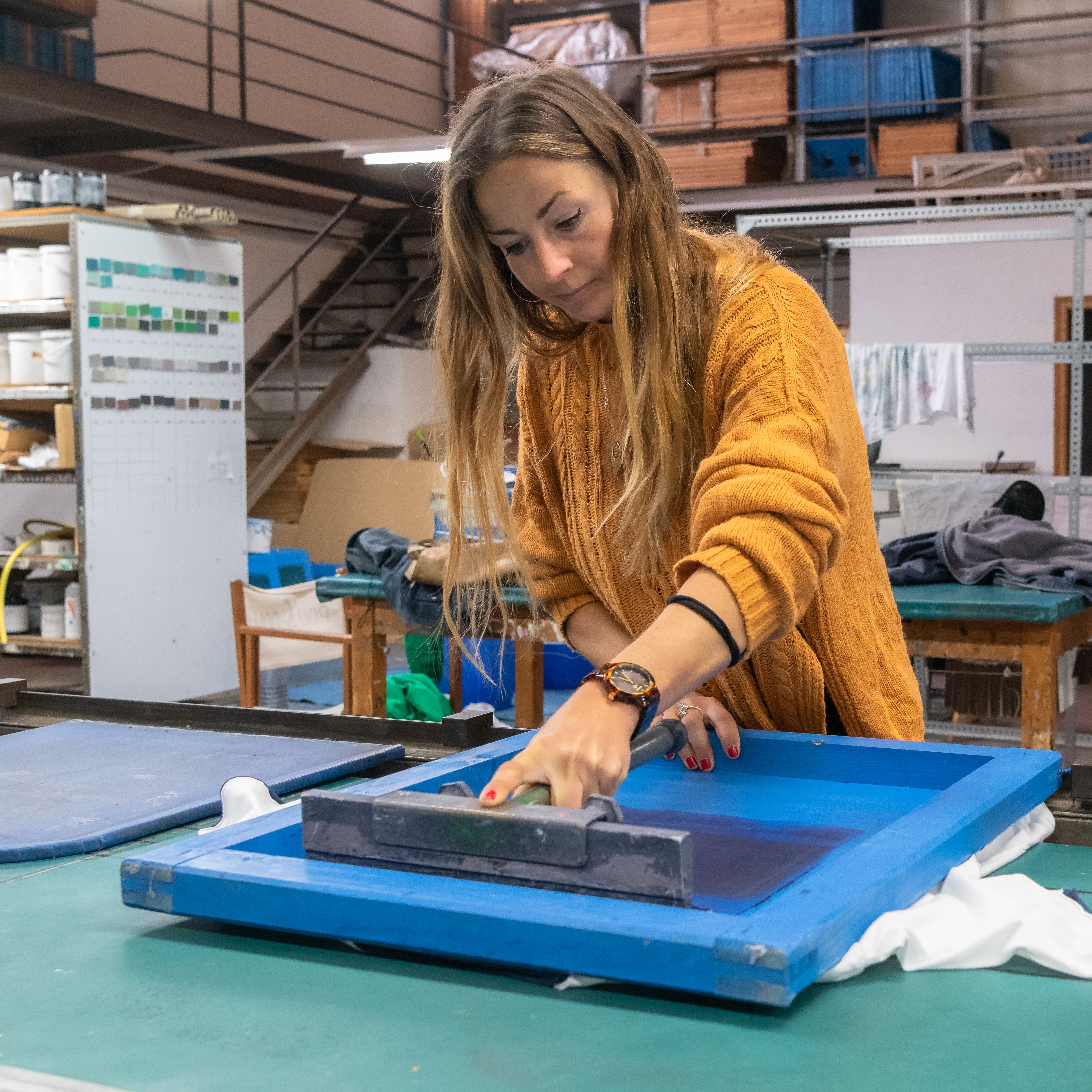
(clockwise from left) Pou Nou team members select nature-inspired artwork for clothing designs; Pou Nou colors and designs are inspired by Menorca’s flora and fauna, sea, and sky; Using a Mediterranean-inspired color palette, a Pou Nou team member tests a screen-print design. Photos courtesy of Pou Nou.
Collaboration with local artists results in Pou Nou’s unique island-wear designs.
Owner Joan Carrés said, “I am proud of having been in the business for 36 years, following my original idea of combining good quality garments with original artwork from local artists.” Pou Nou’s easy-to-wear styles and unique artist collaborations feature screen-printed sea creatures, flowers, geckos, insects, boats, bikes, palm leaves, and nautical themes. With Pou Nou only available for purchase in Spain and other European countries, U.S. travelers looking for this island-wear can reach the Balearic Islands by flying directly from New York/Newark (EWR) to Palma de Mallorca (PMI) through United Airlines’ new, seasonal direct flight offerings. Menorca has been like a hidden treasure for many years, largely reached only from mainland Spain, but these new direct flights from the United States allow easier access to Menorca-made specialty items and scenic views of iconic landscape features. The island’s varied ecosystems and natural offerings provide ample resources for a thriving artisan business, with agriculture, footwear, fashion, and handcraft industries using materials and inspiration offered by the beautiful land and sea.
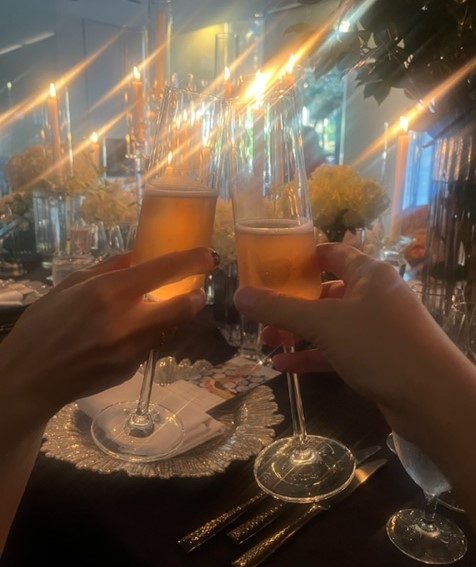
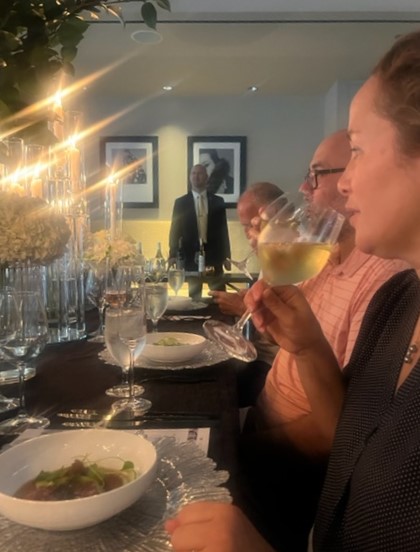
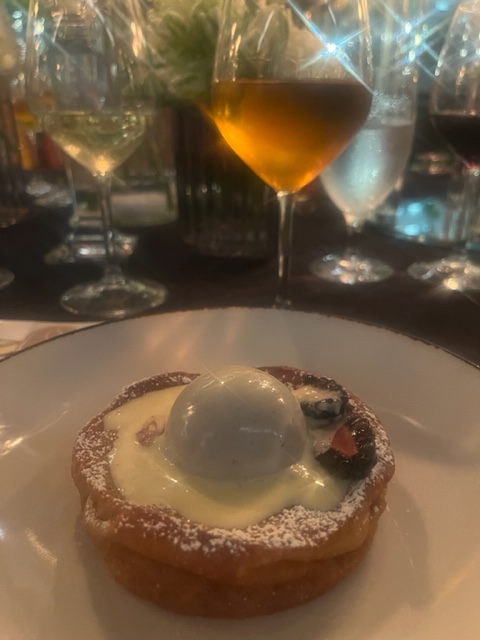
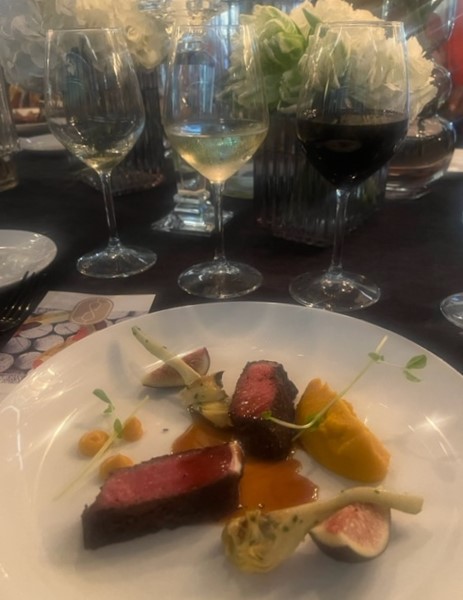
Dozens of blooming white flowers and shimmering candles in glass holders grace the center of a long dining table. Greeted with a glass of sparkling wine upon entry to the Cigale Room, Sofitel Chicago Wine Dinner guests seat themselves around the table and sip their bubbling beverages while reviewing the printed menu of culinary delights and drinks to come. The varied-height centerpieces create intimacy between clusters of conversing guests, allowing privacy within a group setting. Per French ideals, one simple joy of life is savoring food and wine that bring out the best in each other, and Sofitel Chicago is an expert in this pairing of dishes and drinks, offering fine dining experiences through its creatively curated Sofitel Wine Dinners. This series of seasonal dinners introduces guests to exquisitely prepared courses matched with wines and cocktails whose notes enhance flavors in the meal.
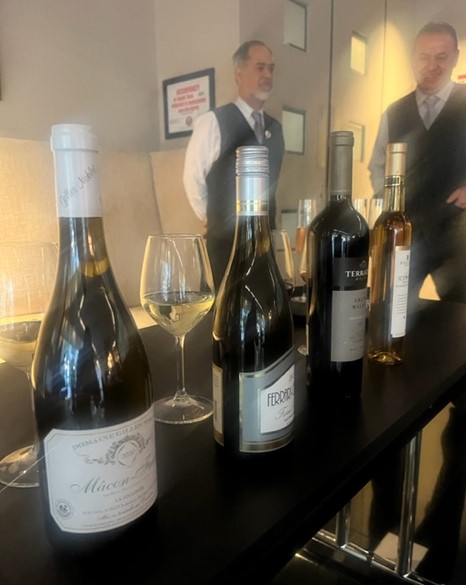
The September 2022 Sofitel Wine Days Dinner at Sofitel Chicago was prepared by Executive Chef Cliff Crawford, who crafts meals that embody Sofitel’s “Live the French Way” motto. He said, “I always strive to have a noticeable French influence in the menus. It can be ingredients used, such as cheeses or pâtes, or could be a modern take on French classics.” Per this ideal, the September dinner’s first course was a beautifully plated French-style tuna tartare alongside cucumber mousse and delicate cucumber curls, ponzu onion, and topped with a marquise-shaped scoop of paddlefish caviar. This flavorful delicacy was accompanied by a generous pour of golden Domaine Gilles Noblet Mâcon-Fuissé from vineyards in Mâconnais, Burgundy, France.
Sofitel Chicago began hosting these wine dinners in late 2021, and a gourmet dinner is scheduled for each of the remaining three months of 2022. The dining room’s exquisite décor changes based on the time of year, as does Chef Crawford’s menu planning. “It is really just about the season and the ingredients that are best at that time of year. It mostly revolves around produce. Wild mushrooms, for example, are one of my favorites. I love to have morels in the spring and black trumpets in the winter,” Crawford said.
The Fall Harvest Wine Dinner on October 7will feature wines from France, Italy, and the USA, alongside seasonal spreads. The November 11 Winter Whiskey Dinnerwill serve an exclusive Maker’s Mark bourbon mixed into cocktails, in lieu of wine. The December 9 Art de Noel Dinner will feature holiday décor and include festive cocktails to compliment the meal.
Regarding guests at these luxurious dinner experiences, Chef Crawford said, “I would like to see them leave with plans to return. I feel we are a bit of a ‘hidden gem’ here in downtown Chicago; we are a great location, but not everyone has heard of us. I want them to feel like they have found something special.” To purchase tickets for upcoming dinners at Sofitel Chicago, please visit https://www.sofitel-chicago.com/dining/wine-dinner-series/. To round out the evening, a convenient and comfortable overnight stay in the posh rooms above can be booked at https://www.sofitel-chicago.com/.
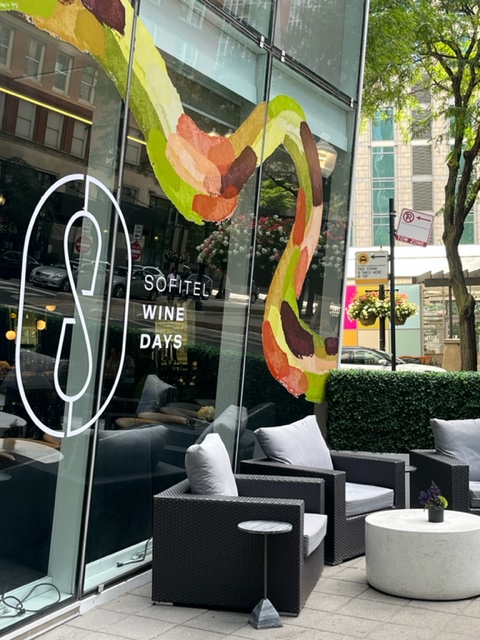
The 5-star Sofitel Chicago is part of a French luxury hotel chain that embodies “living the French way” by celebrating life through a sophisticated and unique approach to luxury accommodations and hospitality. Its stylish avant-garde exterior is a preview of the interior’s chic design and atmosphere. Le Bar, the glass-walled bar and lounge on the lobby level of the hotel, is a trendy place to unwind and socialize while indulging in savory appetizers, flatbreads, main dishes, and desserts, and sipping unique libations like the Banana Old Fashioned. A combination of Bacardi 8-year, Giffard Banane Liqueur, Angostura bitters, Angostura cocoa bitters, and Demerara syrup, with a dark cherry and an orange peel garnish, one patron described this drink as “a really interesting take on an old fashioned. Not too sweet, and very banana, which was fun!”
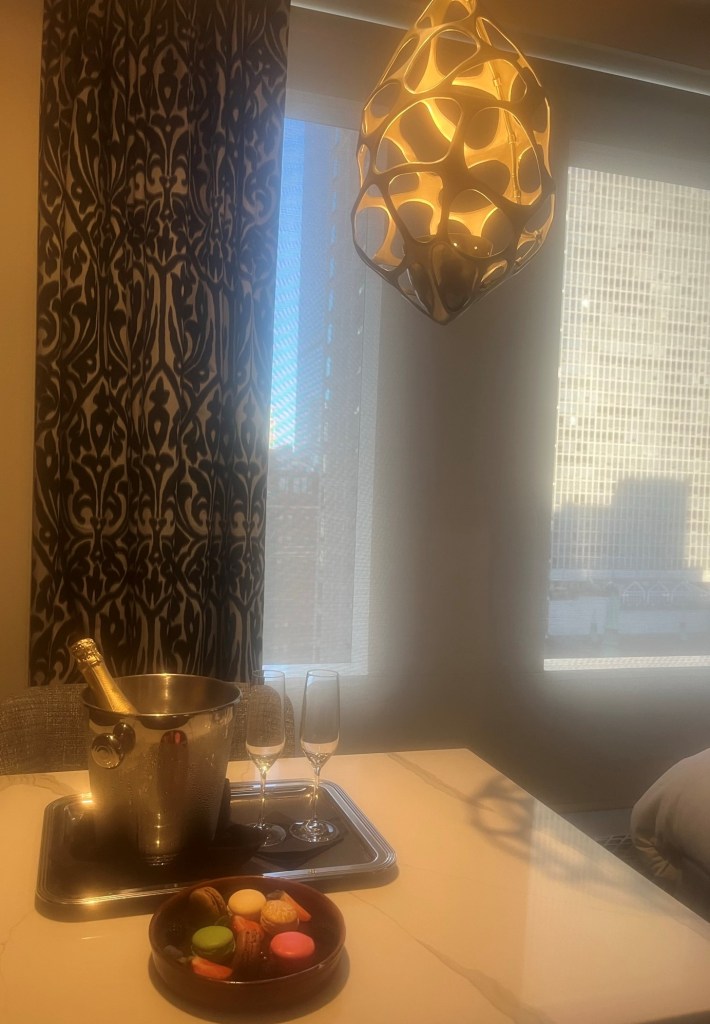
The higher floors of Sofitel Chicago offer a wide-windowed, stunning view of the bustling city below, while an easy flick of a switch lowers the blinds for privacy and comfort. In the European way, the fluffy bedding provides a warm nest in which to rest beneath a soft duvet with no need for a top sheet. Room bathrooms are supplied with bath and skin products by LANVIN Paris, a soft white robe, soaker tub, and rainfall shower. Luxurious and cozy, Sofitel Chicago provides home-away-from-home accommodations that pamper and allow for chic indulgence.
Further celebrate the art of living—l’art de vivre—and say oui to a nearby adventure that will bring the soirée to new heights. A mere five-minute walk from Sofitel Chicago, you can experience elevation to an even higher viewpoint of the city, at 360 CHICAGO, the top of the former John Hancock Center. The observation deck sits 94 floors high (1,030 feet above the Magnificent Mile) and is the home of Chicago’s highest thrill ride, TILT. To get to this height, you first stroll through an exhibition celebrating the history of Chicago and nine of its culture-rich neighborhoods. A quick 20-miles-per-hour elevator ride then lifts you to the glass-walled, 17,000-square-foot level that allows breathtaking 360-degree vistas of the city and lakefront. On a clear day, you can even see four states from this lookout deck!
An add-on to the observation deck entry is a ticket to experience TILT, where guests 42 inches and taller can spend 2-3 minutes safely angling forward over the cityscape and peering downward through the glass window. While excited participants tightly grasp handles to their right and left sides, the glass wall is set into action in a series of motion profiles, allowing people to feel the sensation of leaning out into the sky and over the skyscrapers. Energizing music builds as the windows tilt farther and farther out at each interval, causing some people to close their eyes, some to giggle nervously, and others to shriek in terror. At night, colorful lights outline each panel separating participants. In “Extreme” mode (an experience that requires a prerequisite signing of a safety waiver), a window can even slide open for guests to enjoy further thrills and feel the city breeze. Trying out the basic mode, with its increasing angles and exhilarating music, Megan Pletzer from Madison, Wis., said, “You think it’s done, and then it just keeps going!”
A general admission ticket to the observation deck includes entry to the brand new CloudBar, which officially opened on September 14, 2022. Owned and operated by Magnicity, a Paris-based company, 360 CHICAGO’s CloudBar is a novel, sky-high bar and lounge that magnifies the best of Chicago by featuring local food and beverage partnerships and décor by area artisans. Magnicity CEO, Alexia Vettier, said, “We want each Magnicity location to act as a true city ambassador for our guests—encouraging exploration of the vibrant neighborhoods within our cities and forging new adventures and experiences. We are thrilled to introduce our brand-new bar concept with CloudBar.”
Photos above courtesy of 360 CHICAGO.
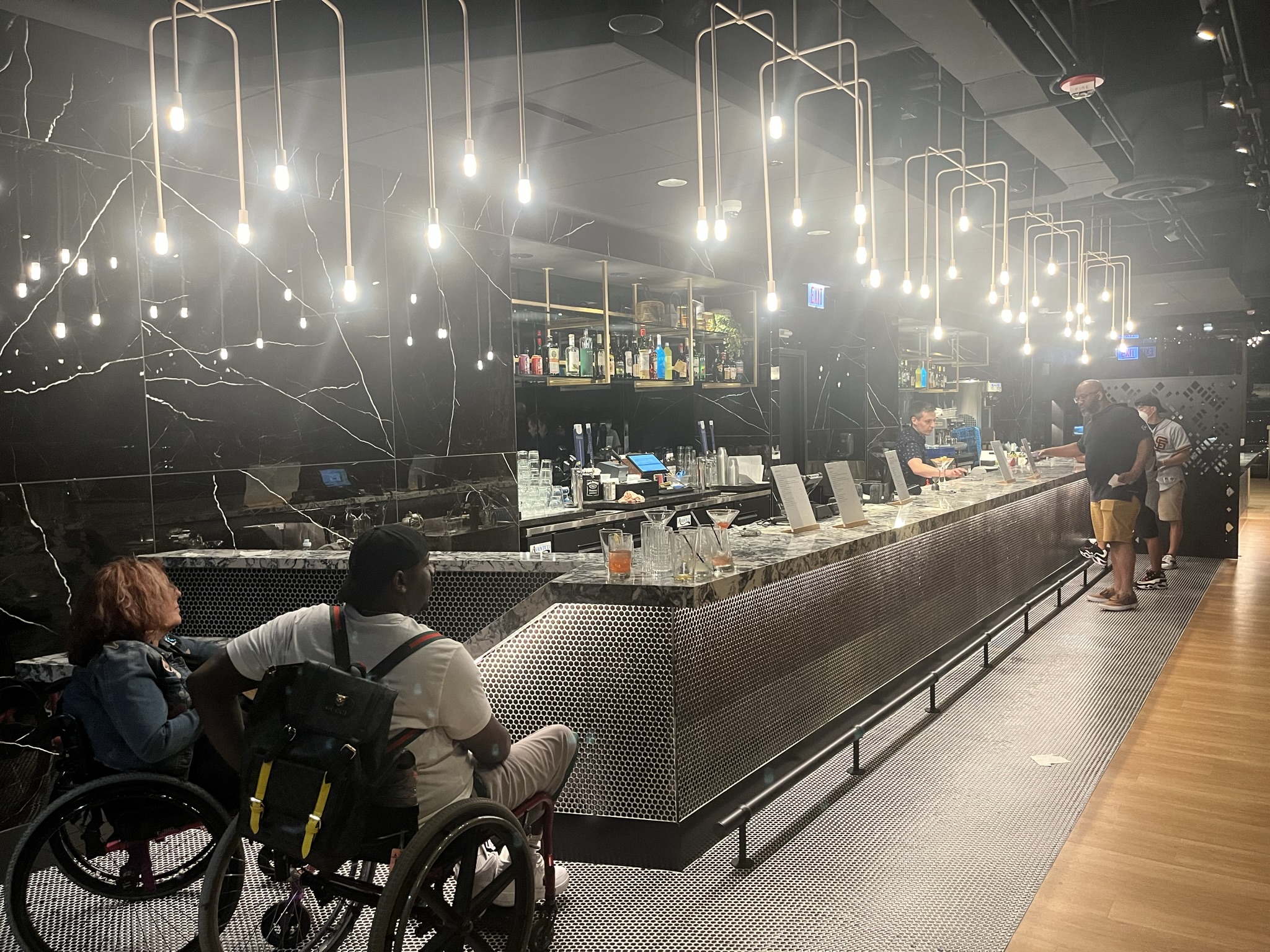
The Gettys Group Chicago design team fashioned the area to give people the feeling of “floating in the air.” Numerous reflective surfaces (including the ceiling, drink rails, and back wall) echo the spectacular sights visible through the floor-to-ceiling windows. Modern European lounge furniture and stylish lighting coupled with customized, original graphics by Chicago-based muralist Lauren Asta emphasize the blended cultures found in the city.
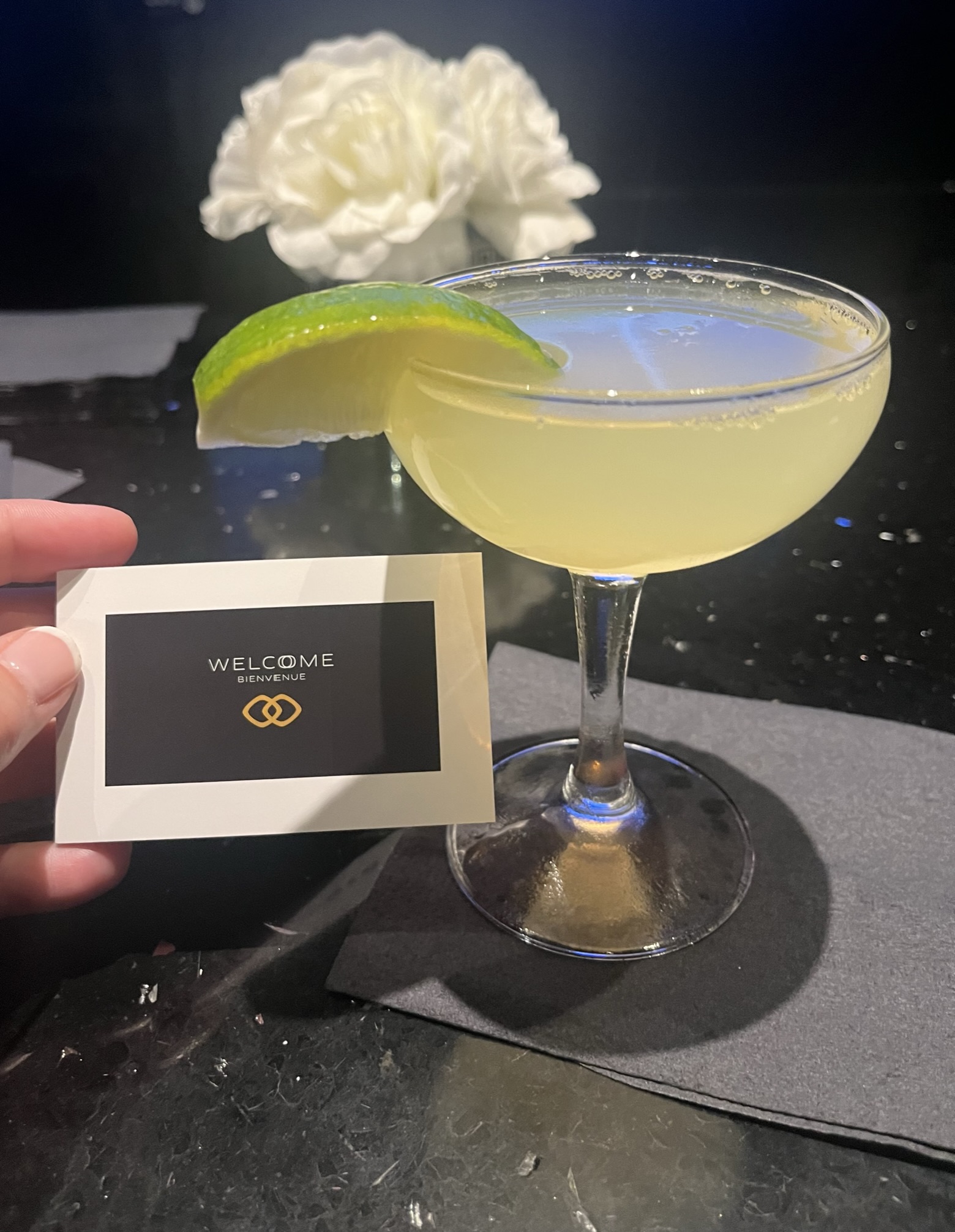
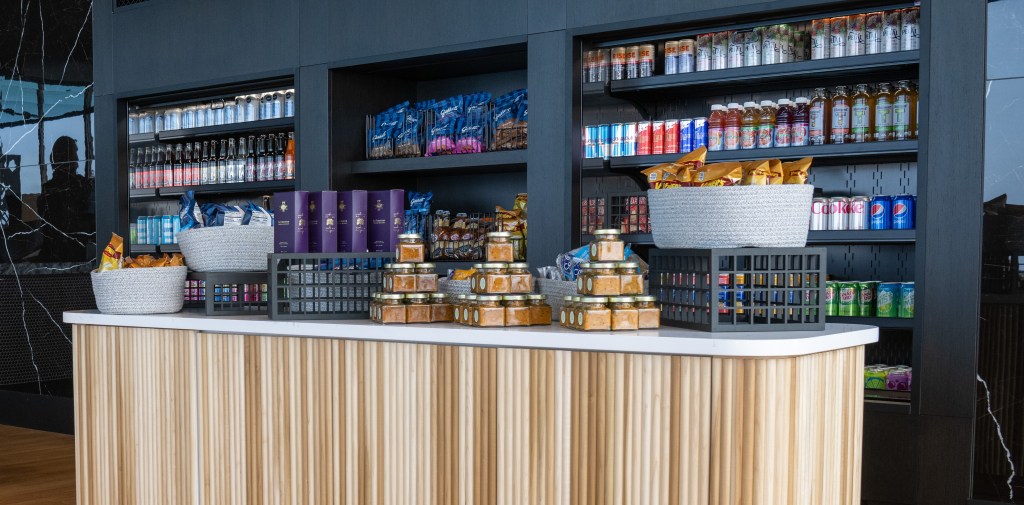
At this great height and surrounded by inspiring art and lights, you can also stimulate your sense of taste with snacks and sips from CloudBar’s offerings. The “Feeling Tilt-sy” cocktail carries on the “TILT” theme, served in a unique glass that leans to one side. Another colorful drink emits a haze of white mist from its lime-accessorized martini glass. Exclusively available at CloudBar is the Magnicity Pilsner, created by Moody Tongue brewery in partnership with 360 CHICAGO. Other true Chicago brands and products can be found at this exciting altitude, including wares from Garrett Popcorn, Vosges Haut-Chocolate, Carol’s Cookies, Kit Kat Lounge & Supper Club, and Kikwetu Coffee Company.
Photos above courtesy of 360 CHICAGO. Pictured at center above is artist Lauren Asta.
This space in the clouds is also available to be rented for private events, weddings, and parties. For information on event reservations, please visit 360chicagoevents.com. Relax at cloud level with besties and beverages, elevate your mood, and let the spectacular city views fill you with joie de vivre, the joy of living.
Straying off the beaten path in Castile-León, a region ripe for discovery
Story and Photos by Randy Mink
Does your town have a distinct look or personality? Something that really sets it apart from others?
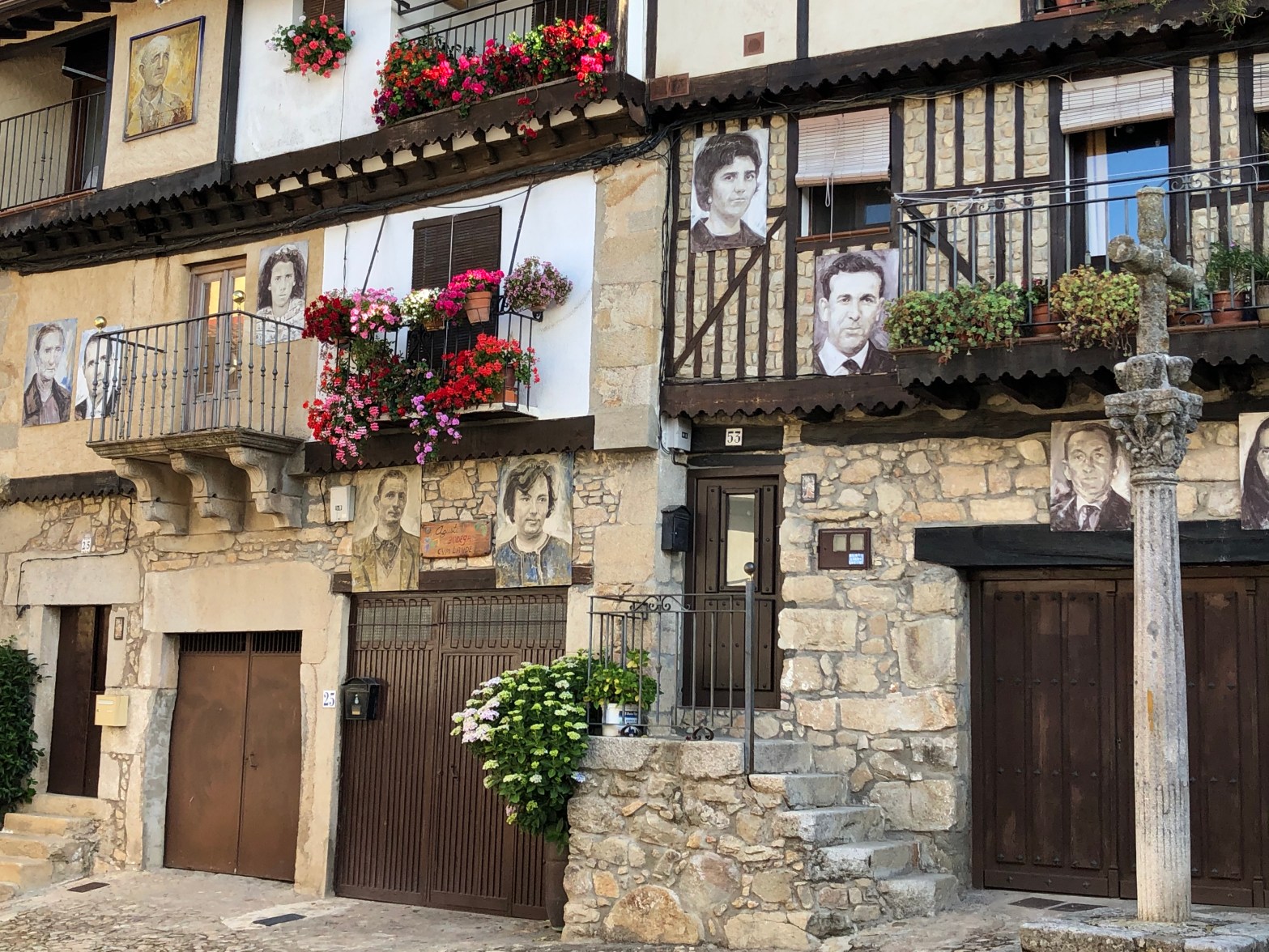
In western Spain, tiny Mogarraz (pop. 250) plasters its personality all over town, festooning houses with pictures of residents past and present. These portraits are large artworks that visitors can’t help noticing as they prowl the little plazas and narrow streets of this obscure town in the Sierra de Francia Mountains of southern Salamanca province.
Overlooked by most travel guidebooks, quirky Mogarraz was one of my favorite discoveries on a recent trip that included some under-the-radar places in Castile-León, one of Spain’s 17 autonomous regions. Our group concentrated on the region’s less-traveled western frontier, dropping in on remote rural areas, sampling three of its designated wine routes and venturing as far as the Portugal border.
This was my first trip overseas in three years, so I was more than revved up. Like a lot of Americans whose international travel plans were stifled by the pandemic, I had been itching to travel abroad. What a joy it was to be in Europe again! Each day was a revelation, a real adventure delving into art history, gastronomy, wine and everything that gets me psyched about Spain. Talk about pent-up wanderlust. The week-long trip provided a much-needed boost indeed.
Castile-León, situated west and north of Madrid, makes up about 20 percent of Spain’s total area but is only its sixth largest region in population (2½ million). Consisting of nine provinces, the vast chunk of real estate is slightly bigger than Portugal. Castile-León claims nine of Spain’s 34 wine routes and counts more than 400 wineries. It boasts three UNESCO World Heritage Sites—Salamanca (which our group visited), Segovia and Ávila.
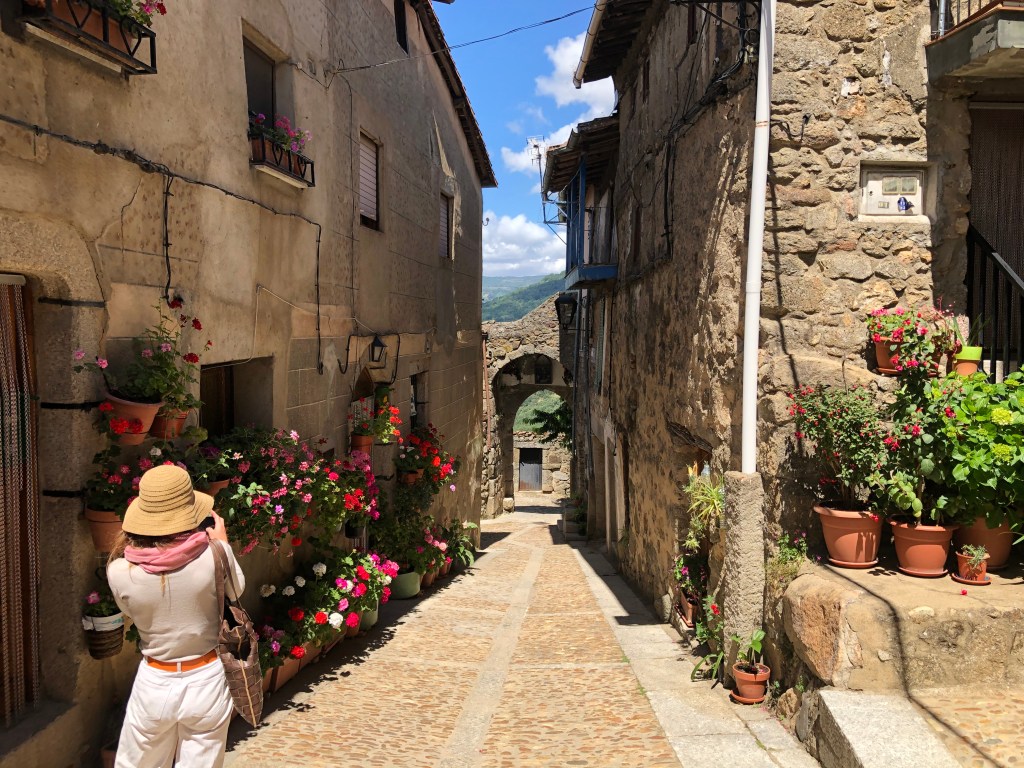
The quaint medieval village of Mogarraz, on the Sierra de Francia Wine Route, would be a delightful destination if just for the enchanting cobblestone lanes that snake past its stone and half-timbered houses, many with flower-filled balconies. But portraits of the people who live in these ancient buildings add a strange twist.
The novel art project began in the 1960s, when poverty in the area drove many residents to seek jobs in South America, for which they needed a photo ID card. These IDs inspired the idea of decorating houses with photographs of the adults who lived in them. In 2012, local artist Florencio Maíllo took over the project and today he paints each of the 300-some portraits, from wizened grandmothers to young men in military caps.
Mogarraz, a tiny village in the Sierra de Francia Mountains of Salamanca province, is known for the portraits of residents that adorn its houses. These sketches of townspeople give the streets a personality all their own.
Mogarraz and other towns in this mountainous region base their economies on tourism and winemaking. The delicate, dark-skinned rufete grape is special to the Sierra de Francia area in southern Salamanca province, where vines have been tended in terraces for centuries.
Our nest for the night, Hotel Spa Villa de Mogarraz, was right in the heart of the fairy-tale town and just steps from Bodega Vinos La Zorra. Under a tent canopy on La Zorra’s streetside patio, bistro patrons savor wines and tapas at tables fashioned from colorfully painted oil drums. We noshed on croquetas (croquettes), those addictive deep-fried balls of mushy goodness, and patatas meneás, mashed sweet potatoes flavored with garlic and paprika and topped with a pork rind.
Our group also went back in time in Miranda del Castañar, another gem on the Sierra de Francia Wine Route. With a guide we wandered the cobbled streets and took in forested panoramas from the 12th century walls of the pretty hilltop village. The medieval castle is now a brewery.
The medieval streets of Miranda del Castañar invite tourists to explore.
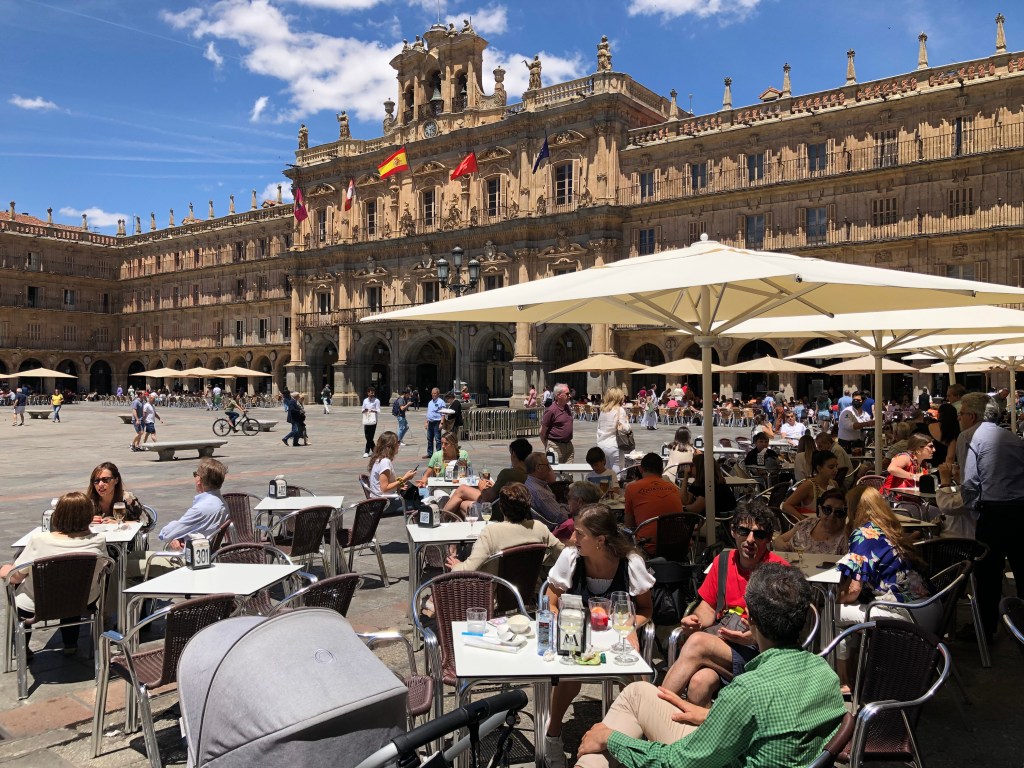
The city of Salamanca, unlike sleepy Mogarraz and Miranda del Castañar, is rather well known as a visitor destination, its historical core centering on the venerable buildings of Spain’s oldest university, founded in 1218. With a magnificent central plaza, lively pedestrian streets and youthful vibe, the manageable, medium-sized city of 150,000 residents offers just the right ingredients for a pleasant day or two of seeing the sights and soaking in the ambience. To me, it’s Spain in a nutshell.
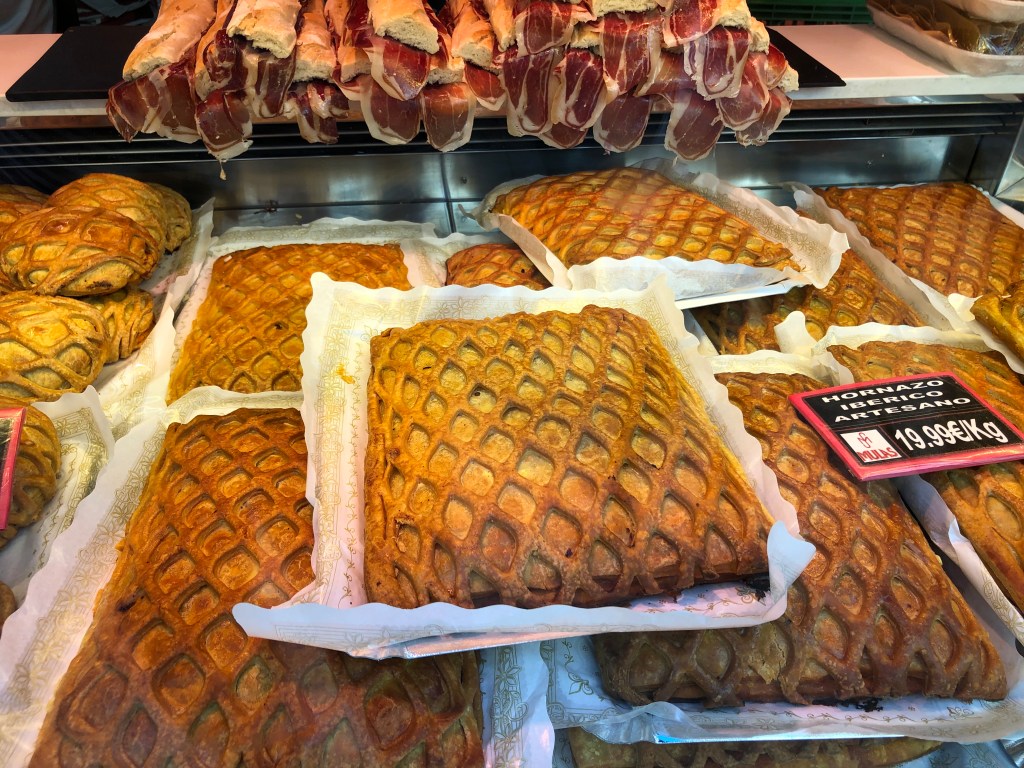
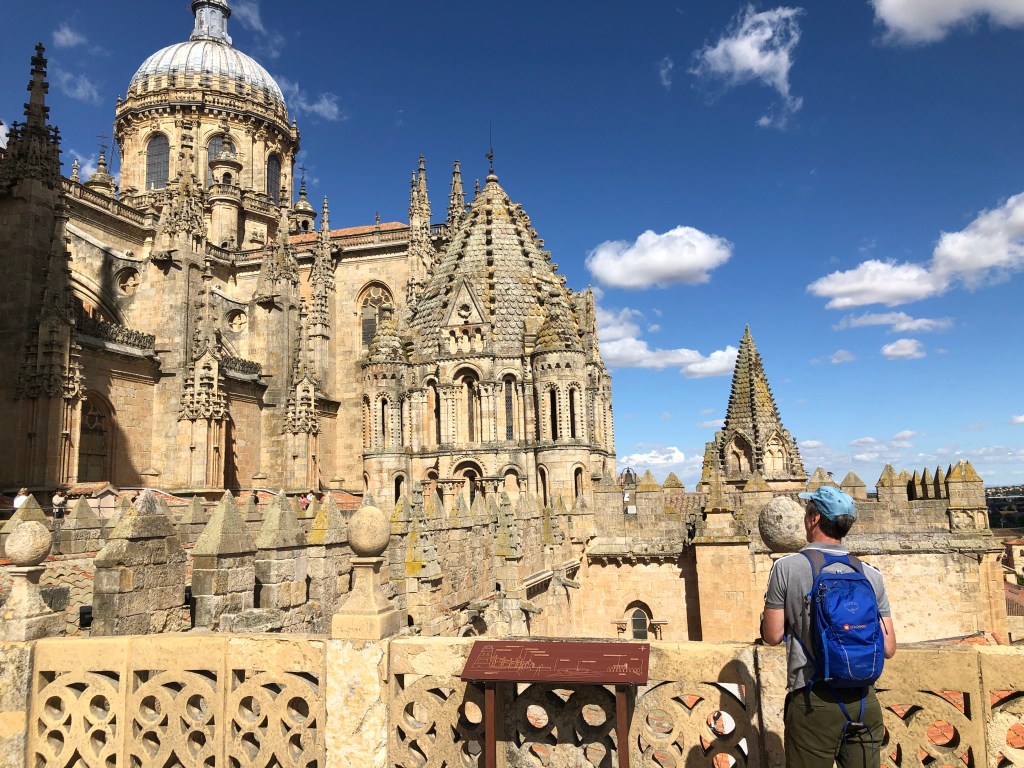
Clockwise from upper left: Relaxing and people-watching on Salamanca’s Plaza Major, one of Spain’s largest and most beautiful squares; The best views of Salamanca’s Old World skyline are from the banks of the River Tormes and its Roman bridge; The author enjoys a hornazo meat pie at a café on Salamanca’s Plaza Major; Hornazo, a meat pie with layers of pork chorizo, pork loin and ham wrapped in lattice-crusted yellow dough, is a specialty of Salamanca province; Exploring Salamanca’s Old and New Cathedrals.
In Salamanca’s Old Town, an open-air museum of radiant sandstone buildings, prime attractions lie within walking distance of each other. I recommend these five experiences:
Touring the Old and New Cathedrals. Built centuries apart, they are attached; you can’t visit the 13th century Romanesque church (Cathedral of Santa Maria) without going through the Cathedral of La Asunción de la Virgen, or New Cathedral, which isn’t new at all. It was built hundreds of years ago in the Gothic, Renaissance and Baroque styles.
Ascending the “Stairway to Heaven” on a 200-step climb up La Clerecía Church’s bell towers for bird’s-eye views of Old Town. The colossal Baroque building, now Pontificia University, began life in 1617 as a training school for Jesuit missionaries.
Walking across the River Tormes’ Roman-era bridge while admiring the classic Old World skyline
Touring the University of Salamanca, a popular place for American and other foreign students to study Spanish. Standing before the main building’s intricately sculpted sandstone façade, tourists try to find the “hidden” frog, said to be a symbol of good luck.
Relaxing over tapas at a café on postcard-perfect Plaza Mayor, one of the largest and most beautiful squares in Spain. Try hornazo, a meat pie with layers of pork chorizo, pork loin and ham wrapped in lattice-crusted yellow dough.
Zamora, a town of 60,000 north of Salamanca, is called the “Romanesque City.” Its 23 Romanesque churches, 10th century walls and Duero River bridge ruins provide a magical setting for communing with the past. The Cathedral of Zamora impresses with its Byzantine-style dome, richly carved choir and 15th century Flemish tapestries.
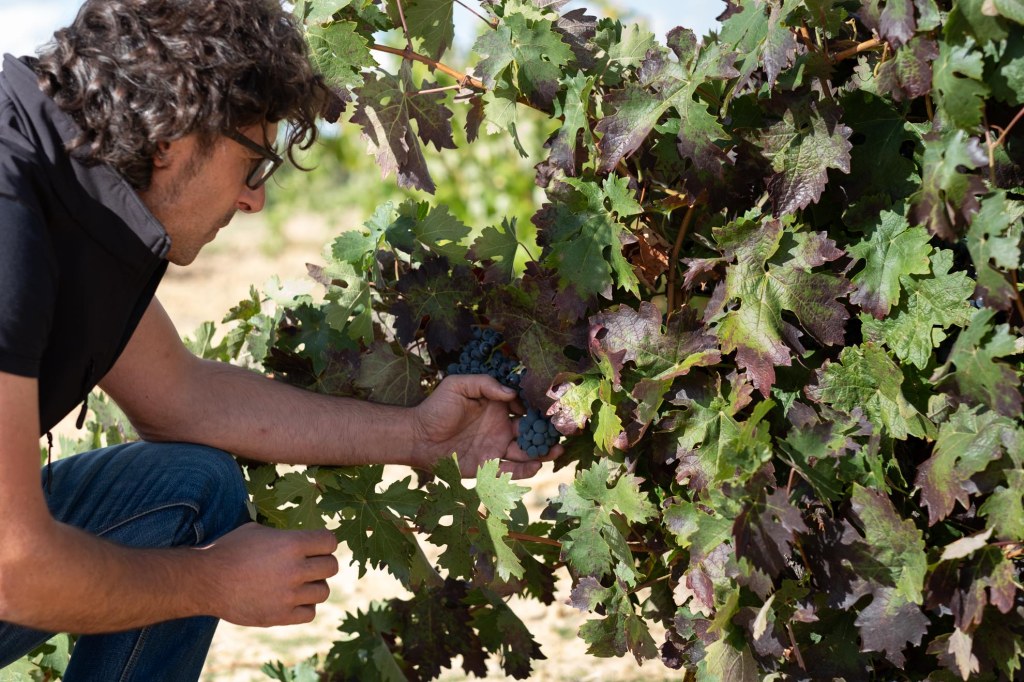
The Zamora Wine Route in Zamora and Salamanca provinces takes travelers through traditional rural landscapes of sheep pastures, hay fields, vineyards and unspoiled villages with stone houses and Romanesque churches. In Villanueva de Campeán, we did wine tastings in the barrel room and vineyards of Bodegas Viñas del Cenit, which makes Cenit Tradición, an unusual blend of red and white grapes (mostly tempranillo)—a light, refreshing wine with less alcohol. The vines have been mixed since the times of the Franciscan friars who tended them from their 15th century monastery, the ruins of which we saw in the distance. (Older locals remember when monks still inhabited the monastery.)
“They just wanted to make wine, with no worries whether it was red or white. It was just wine for them,” said Ana Belen Hernández, Cenit’s director of marketing. “Cenit Tradición is our commitment to carrying on the tradition and personality of the historic wines of this territory. It’s a wine with no recipe, a wine we think our ancestors would have made.”
Growing grapes for wine is an age-old tradition in the Castile-León region of western Spain.
Cenit’s 90-year-old vineyards are threaded by the Via de la Plata, or Silver Route, one of the 11 pilgrimage routes to the tomb of St. James in the Cathedral of Santiago de Compostela in Galicia; visitors may encounter pilgrims making the trek.
In the nearby village of Casaseca de Campeán, our group enjoyed an atmospheric wine country lunch at Café de Quintano. Deep underground, we feasted amid the rustic trappings of a vaulted, 200-year-old cellar. The hard-working servers must have made 20 trips each from the upstairs kitchen to our cozy “cave.” Besides wines, the group menu featured platters of cheeses and paper-thin slices of cured ham, chickpea soup, tuna steak in garlic sauce and Iberian pork steak with deep-fried vegetables. At dinner the previous night we had two regional specialties—roast suckling leg of lamb and Zamoran-style rice, a zesty dish with pork and paprika.
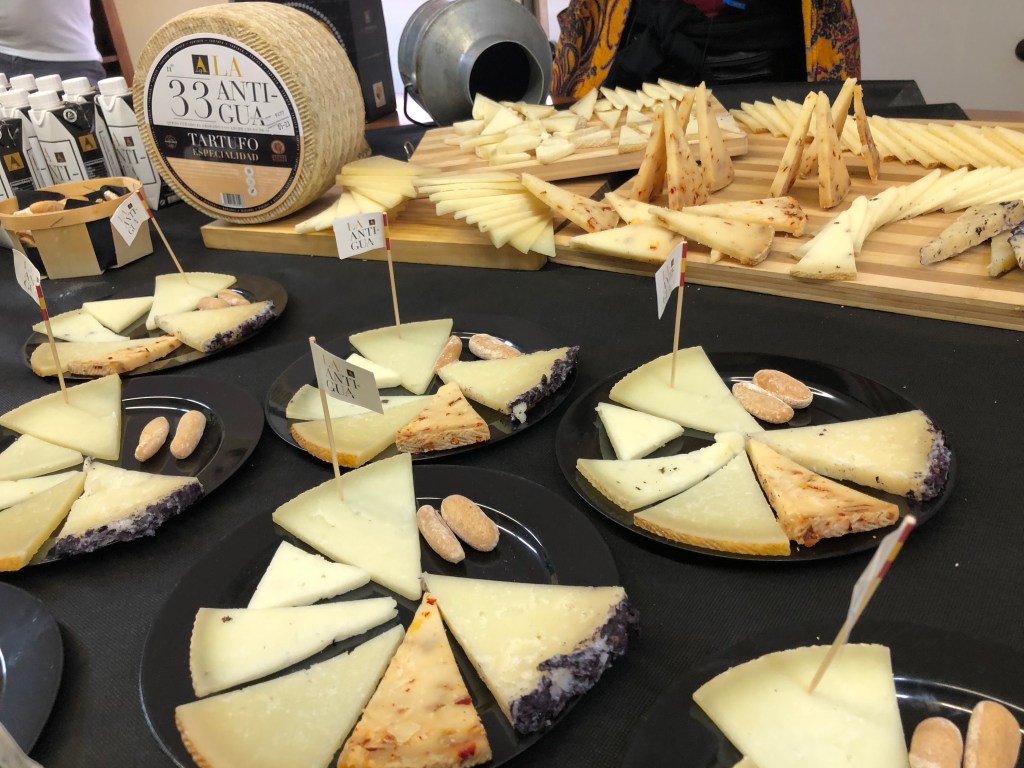
My best memory of the Zamora Wine Route was touring Quesería La Antigua, a high-tech dairy in Fuentesaúco. Donning a white plastic coat, hairnet and shoe covers, we followed guides who explained how sheep’s milk is turned into prize-winning cheeses. Afterward, we watched a video and sampled six varieties, including one with tempranillo grape skins in the rind, another flecked with paprika flakes. Under construction is a museum that will showcase La Antigua’s passion for making cheese.
Sampling the product is a highlight on tours of Quesaría La Antigua in Fuentesaúco, a dairy that makes sheep’s milk cheeses.
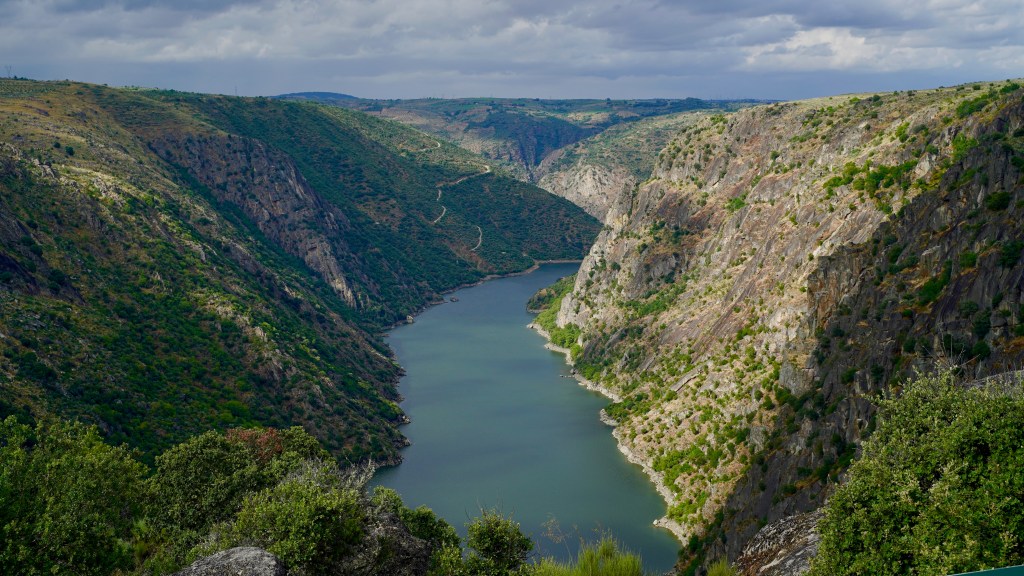
When our bus passed a shepherd tending his flock later that day, we got giddy and were granted a photo stop. We were en route to the far western stretches of Zamora and Salamanca provinces where the Douro River’s scenic canyonlands straddle the Spain-Portugal border. (“Douro” is the Portuguese spelling; it’s “Duero” in Spanish.) For Spaniards, this remote valley of granite cliffs and outcroppings is considered the “Wild West.”
Our introduction to the Arribes del Duero Wine Route, set against the backdrop of the valley’s Arribes del Duero nature park, involved vineyard and winery visits hosted by Bodega el Hato y el Garabato in tiny Formariz. Dinner and overnight were in the comfortable Posada Doña Urraca in Fermoselle, a quiet Spanish border town famous for its centuries-old network of wine caves (more than 1,000, so they say), a few of which have been opened for tourism. After our subterranean tour and wine tasting, we did more sampling at Bodega Frontio, a winery started by a young Danish entrepreneur who goes by the nicknames “Chus” and the “Crazy Dane.”
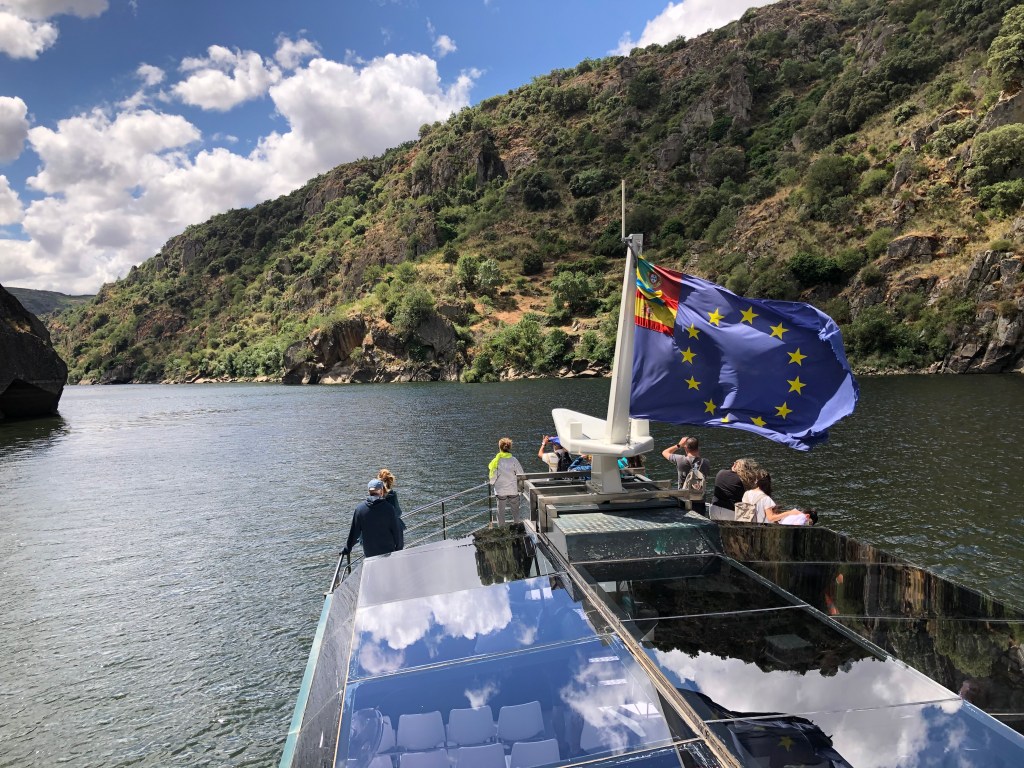
A brief foray into Portugal the next day took us to Miranda do Douro, where we boarded an excursion boat for an ecology cruise focusing on the geology, flora and fauna of the UNESCO Meseta Ibérica Biosphere Reserve. Our one-hour journey provided a chance to witness up-close the spectacular gorge topography we had viewed from a lookout point earlier that day.
Flying the flag of the European Union, this excursion boat offers a narrated environmental cruise spotlighting the geology, flora and fauna of the Douro River Valley, a land of scenic splendor on the Spain-Portugal border.
Exploring Fermoselle and other villages tucked away from the crowds, we often felt as if we had Castile-León to ourselves. On early morning strolls up and down the twisting, shadowy alleyways, sometimes the only sounds were chirping birds, crowing roosters and our own footsteps. It was good to be back in the Old Country, making new discoveries in corners of Spain off the beaten track.
From the first red wine produced along the Mosel River during Roman rule to the sweet Riesling for which the country is renowned, German wine is woven into the country’s culture and history.
Many member cities of the Historic Highlights of Germany are inviting travelers to experience this firsthand this fall with a series of wine-themed events, activities and offers.
In Mainz, more than 50 wine growers from throughout the region assemble during the first weekend in September for the annual Mainz Wine Market (photo at left). The event has craft stalls, rides, music and fireworks and, of course, dozens of wine stands. Wine-making goes back nearly 2,000 years in Trier, where several two-night packages feature special themes such as wine cultivation during Roman rule and a combination of World Heritage site visits and wine culture.
In Heidelberg, packages include the Heidelberg Wine and Chocolate Tasting with five wines from regional vineyards and five fine chocolates. Wine has long been central to life in Koblenz, located at the confluence of the Rhine and Mosel Rivers, where the “Wine Village” welcomes visitors to enjoy a glass of wine in the quiet setting of half-timbered houses.
Würzburg, situated on the Main River, is home to several wine estates, where visitors can enjoy tours and wine-tastings—including the Juliusspital, whose 400-year old, 800-foot long wine cellar makes it one of the oldest and largest German wineries.
Historic Highlights of Germany suggests two “Dream Routes” that focus on wine. Click on “Dream Routes” on our site at: www.historicgermany.com






































 European Traveler