B is for ‘Brusselicious’

By Don Heimburger
Photos by the author and courtesy Visitbelgium.com

What’s a 13-letter word that starts with a “B” and combines the capital city of Belgium with the concept of excellent food?

“Brusselicious” is the 2012 theme for Brussels’ Gourmet Year, and a fitting description of this city of 1.1 million that boasts no less than 19 Michelin stars among its dozens of top restaurants.

In 2006 Brussels was the capital of Fashion and Design, followed soon after in 2009 as the capital of the Comic Strip. Now it becomes the city of Culinary Delights, but locals and in-the-know visitors to this cosmopolitan city, with German, French and Flemish influences, enjoy their Brusselicious lunches and dinners every day of the year.

FRENCH FINESSE, GERMAN PORTIONS
The old saying is that the Belgians cook their food with the finesse of the French, but serve it in generous German-sized portions. Some specialties of Belgian cuisine include moules frites (mussels and fries), Waterzoo (fish or chicken stew), Stoemp potato (potatoes and vegetables mixed together), and Salade Liégeoise.

So what’s cooking in Brussels in 2012?

There’s a fairly long list, but it all begins with Brussels’ traditional menus, which start with fresh meats and produce, and are then honed with a top chef’s creativity and skill. In Brussels this is just the way they do it. After all, they have a reputation developed over the years, that they refined plate after plate.

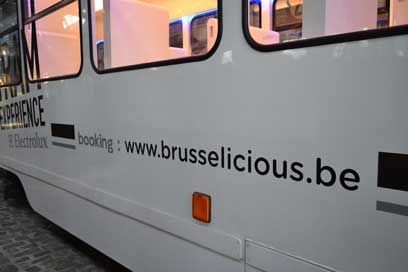
  • Brussels’ gastronomy will be on the move this year when a new designer tram will be introduced that will provide meals on board as guests roll around the city. Menus will be arranged by two-star chefs, and food will be served to 34 people on board the train during two-hour-long dinner parties. Departures start on Tuesdays and go through Sundays. This novel “meals on wheels” idea will appeal to the combination railfan and foodie.
  • As many as 35 giant artist’s reproductions will be introduced to the streets of Brussels during 2012 as well. Early in the year, artists were finalizing their creations in an old factory building called Carthago Delenda Est. Giant brussel sprouts, chocolate bars, mussels, pints of beer and giant cones of fries were masterfully being sawed, glued and screwed together to remind the city of its food heritage.
  • As many as eight themed dinners are being sponsored, from a Banquet des Miserables to mark 150 years of the finishing of Victor Hugo’s novel Les Miserables, to a Belgian Wine Growers Dinner, a Five Senses Dinner (sight, hearing, smell, taste, touch) and a Medieval Ommegang Banquet (Ommegang recreates a famous celebration of 1549 on the Grand Place in honor of Charles V and his son Philippe II).
  • The Bocuse D’Or Europe is the highly prestigious gastronomic competition held for 20 of the world’s top chefs this year in Brussels, who compete over a two-day period to claim top honors. The dozen best chefs then are entered into next year’s world finals in Lyon, France.
  • How about a Chocolate Week? With evening events, visits to chocolate workshops and a Chocolate’s Fair in town, what’s not to like?
  • A restaurant festival, publicized as the biggest gourmet event in Belgium, is coming to Brussels September 6-9. Imagine 100 restaurants and bars serving up their best dishes—with cooking on the spot—in a Brussels park.

TOP OF FOOD CHAIN
The 2012 culinary program doesn’t stop there, not for a city that loves to be at the top of the food chain. There’s a “Chipstands Festival” (you heard it correctly). So the city with some of the best frites (French fries) in the world will sponsor a competition and special events based on the fry. Would you like ketchup or mayo with that?

On a cooking platform 15 feet above the ground, Brussels’ star-studded top chefs will surprise and delight audiences with their “Dinner in the Sky” skills in the middle of the city. Also in August and September, the famed 650 tasty Belgian beers get their due during a weekend at the Grand’Place with tastings and more.

The city is also offering its own bottle of Brusselicious Beer, made by adding brown sugar to a bitter lambic. Lambic beer is produced by spontaneous fermentation: it is exposed to wild yeasts and bacteria that are said to be native to the Senne Valley, in which Brussels lies. It is this unusual process which gives the beer its distinctive flavor.

Other events are also planned, such as a Thai Food Festival, a Savoring Brussels Festival (dedicated to the flavors of fresh produce), and a Brussels Wine Weekend with open houses at some of the wine cellars and wine bars throughout the city.

Brussels’ ornate Town Hall

BUSINESS, BUT RELAXED
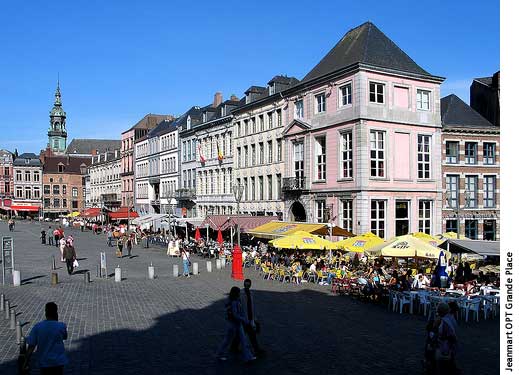
Brussels is, despite its European Parliament designation, a business center that appears to be relaxed at the same time. A tour of this multilingual city revolves around the Grand Place and its many gilded houses and the ornate town hall building (see it at night for a spectacular view).
Check out the Mont des Arts and its museums: the René Magritte Museum occupies the house in which the Belgian surrealist painter worked.  On the ground floor of the museum is the apartment where the painter lived and worked from 1930 to 1954;  exhibits of the artist are on two upper floors.

At the Belgian Comic Strip Center you can meet the comic strip character Tintin and his sidekicks, created by Belgian artist Georges Remi, who wrote under the pen name of Herge.

Walk to another part of the city and see the huge stone columns and a good view of the lower part of the city from the immense Palais de Justice, and visit the Atomium, with its gleaming spheres. It’s said to be “neither tower, nor pyramid, a little bit cubic, a little bit spherical, half-way between sculpture and architecture, a relic of the past with a determinedly futuristic look, museum and exhibition center; the Atomium is, at once, an object, a place, a space, a Utopia and the only symbol of its kind in the world which eludes any kind of classification.” The Atomium was the main pavilion and icon of the World’s Fair of Brussels in 1958.

If you’re in the market for shopping—or just window shopping—Brussels has it. Walk over to Avenue Louise and see its shopping arcade, or Boulevard de Waterloo, Rue de Namur or Avenue de la Toison d’Or for some upscale finds from classic to trendy.

Now back to Brusselicious food. One other very famous food delight is the Belgian waffle. I learned there are actually two types. One is the Belgian waffle, a light, fluffy waffle eaten with or without syrup and served at the more prestigious restaurants and hotels. Then there’s the thicker Liege waffle that is smaller, sweeter, heavier and more filling. You can find the heavier waffles served at stands everywhere in Brussels, usually with toppings such as whipped cream, strawberries, cherries, confectioner’s sugar, or chocolate spread.

If Belgium has a national cookie it is the Speculoos. Originally created for children to celebrate Saint Nicholas day on December 6, the treat is now widely popular and often found along with a cup of coffee in restaurants and bars as a side treat.

So add waffles and Speculoos to the large selection of foods that keep visitors going back to this vivacious gourmet city.

And to think, all this high cuisine started with the lowly Brussel sprout, from which the city gets its name. It just goes to show how inventive the Belgians are in the kitchen. They’ve taken the art of preparing and cooking food to new heights over the last few decades. Some would call that a Brusselicious endeavor. I’d say it was a call for dinner…in Brussels, of course.

For more information, go to www.visitbrussels.be or www.visitbelgium.com.

IF YOU GO…
Brussels has a number of interesting districts to visit.  The Brussels Card is valid for 72, 48 or 24 hours and allows you to visit 30 Brussels museums. It includes a public transport ticket and a full-color guidebook, as well as discounts at some tourist attractions and stores. Go to www.brusselscard.be.

The 2012 Michelin Guide shows the following Brussels restaurants have earned Michelin stars:

 2 STARS 
Sea Grill
Comme Chez Soi
Le Chalet de la Forêt (New addition)

1 STAR 
Alexandre
Jaloa (New addition)
La Truffe Noire
La Paix
Bruneau
San Daniele
Kamo
Senza Nome
Le Passage
Bon-Bon
Michel
Terborght
‘t Stoveke

The ‘Champs-Elysees’ of Burgundy Wines

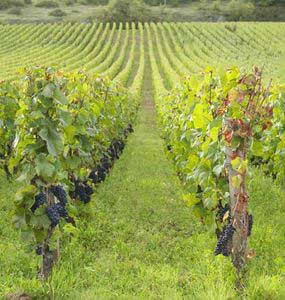
The wines of Burgundy are rich and varied, and are divided into regional appellations, village appellations, Premiers crus and Grands crus. The Appellation d’Origine Contrôlée (AOC) is your guarantee of the characteristics of the regional wines. Fall is a beautiful time to drive or bike through the wine routes.

The Côte de Nuits extends from the south of Dijon to Corgoloin and forms the northern section of the Grands Crus route. It is a prestigious hillside that is home to villages bearing the names of the greatest red wines in the world. Here you will find 24 of the 33 grands crus in Burgundy: Chambertin, Clos de Vougeot, Romanée-Conti and many more.

The Côte de Beaune follows on from the Côte de Nuits towards the south, from Ladoix-Serrigny to the hillside of the Maranges. This soil, blessed with the Chardonnay grape, is where the greatest dry white wines in the world are produced (Corton-Charlemagne and Montrachet, among others). Outside of the city of Beaune, which is the capital of Burgundy’s wine regions, the countryside becomes gentler as you approach Santenay and the département of Saône-et-Loire.

Burgundy hiker

ROUTE OF THE GRANDS VINS DE BOURGOGNE – THE ROUTE THROUGH NATURE
The route of the Grands Vins runs from Santenay to Saint-Gengoux-le-National, and is the extension of the route of the Grands Crus towards the south: more than 100 signposts connect around 40 towns via the vineyards of Maranges, the Couchois and the Côte Chalonnaise. This varied route combines villages with nature, and vineyards with wooded countryside, and is dotted with Romanesque churches and castles. You can discover it by car, but also along the water of the Canal du Centre, or by bike along the the many cycling routes.

ROUTE OF THE MÂCONNAIS-BEAUJOLAIS, THE SOUTHERN WINE-GROWING AREA
This route in the south of Saône-et-Loire is the extension of all the wine routes from Dijon. The eight circuits enable you to break away from the main route and explore the most southerly vineyards in Burgundy in greater depth. The main route itself crosses the Mâcon wine-growing region in a straight line and finishes at Romanèche-Thorins (Saône-et-Loire) on the hillsides of the Beaujolais region.

ROUTE OF THE VINEYARDS OF THE YONNE ALONGSIDE THE RIVERS
In the département of the Yonne, the vineyards have developed alongside rivers: the Jovinien and the Auxerrois in the Yonne Valley, the Chablisien in the Serein Valley, the Tonnerrois in the Armançon Valley, and the Vézelien in the Cure Valley. The wines of the Yonne are undergoing a renaissance and deserve to be discovered in all their diversity just as much as the highly famous Chablis.

ALONG THE LOIRE AROUND THE NIÈVRE
The vineyards of the Nièvre, which extend along the right bank of the Loire, belong not to Burgundy but to the Centre-Loire, and have long suffered from a certain lack of recognition. Now another wine route enables visitors to discover all their charms, from the hillsides of Pouilly-sur-Loire, where the famous Pouilly-Fumé is produced, to the Coteaux du Giennois overlooking Cosne-Cours-sur-Loire. This route also takes in Sancerre on the other side of the river in the Cher.

For more information on Burgundy, go to www.burgundy-tourism.com.

Rendez-vous in the Midi-Pyrénées for Wine, Food and Culture

Photographs compliments of Midi-Pyrénées Tourism Office

Visitors to the Midi-Pyrénées in France, also known as the Southwest, have the unique opportunity to savor some of the most unique food and wine in all of France while also soaking up the rich arts and culture scene of the region.

WINE
The Midi-Pyrénées is a verdant, hilly wine region—home to more than two dozen winemakers featuring some of the world’s greatest grape varieties and some that are grown nowhere else in the world.

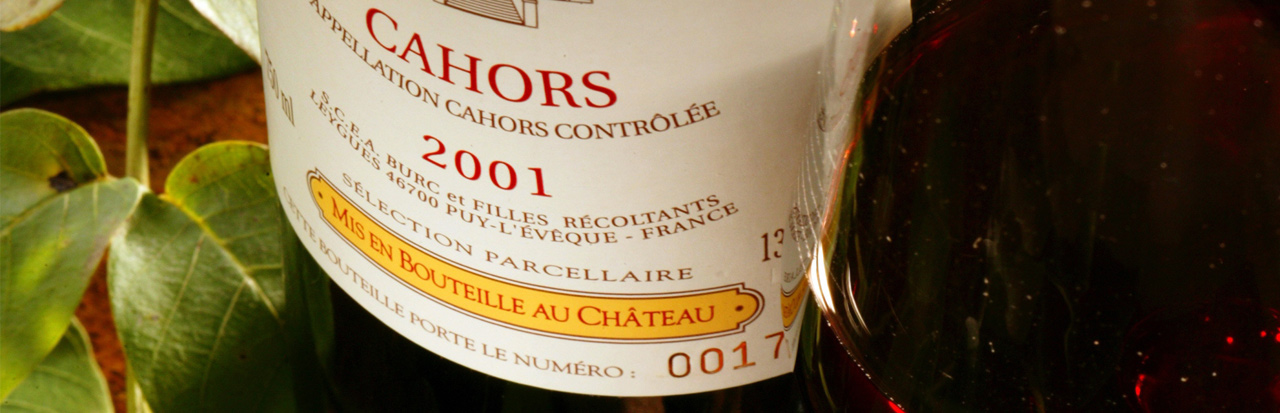
From the Malbec wines grown in the sun-drenched Cahors region to the Gaillac district, one of the oldest wine-growing areas in France, to the Madiran wines known for their inky color and tannic density, the wines of southwest France offer a wide array of flavors and are a true treasure trove for the dedicated wine connoisseur.

The region is also rich in spirits, most notably the distinctive brandy Armagnac, produced in Gascony. Tourists can explore the “Route de l’Armagnac” which winds through the vineyards and experience the different tastes and sensations of this brandy, known for its unique finesse and roundness.

FOOD
The Midi-Pyrénées is also renowned for its fine cuisine. It is home of the black truffle, which is found exclusively in the region around the village of Lalbenque.

The Midi-Pyrénées is also the capital of the iconic French specialty, foie gras. With subtle flavors of hazelnut and a creamy texture, this delicacy can be bought directly from the producer or at the special winter foie gras markets that are peppered throughout many small towns in the Gers district.

CULTURE
The Soulages Museum, in the town of Rodez, is dedicated to the work of acclaimed painter and Rodez native Pierre Soulages. Widely considered one of the great abstract artists, Soulages was inspired by the prehistoric and Romanesque art of the region. The museum houses 500 works donated by Pierre and Colette Soulages to Rodez, which is the world’s biggest collection, estimated to be worth close to $55 million.

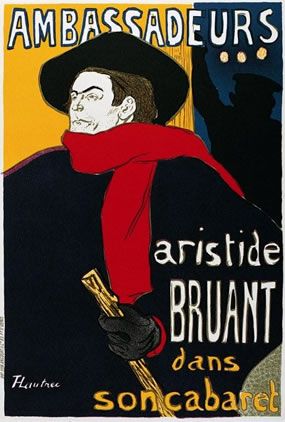
The Toulouse Lautrec Museum will celebrate the life of painter and lithographer Toulouse Lautrec, born in the city of Albi in 1864. The exhibit will run from October 25, 2014 to January 25, 2015.

FESTIVITIES
The Midi-Pyrénées also abounds with celebrations and performances, with more than 180 festivals and events taking place throughout the year.

The Medieval Festival of the Grand Falconer takes place in the village of Cordes-sur-Ciel on July 14—coinciding with Bastille Day, France’s national holiday. The annual festival offers a faithful recreation of medieval life in the Midi-Pyrénées, with fire-eaters, jugglers, falconers, troubadours, musicians, knights and villagers all garbed in medieval attire.

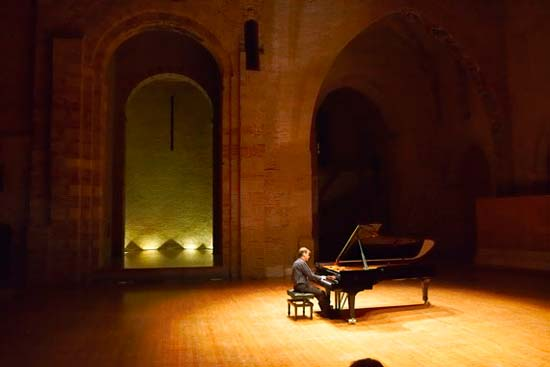
The Piano aux Jacobins, held in the region’s capital city Toulouse during the month of September, is the first festival in France entirely dedicated to piano performances. This year’s edition takes place September 2 to 29.

The small and quaint Gascon town of Marciac will transform into a jazz capital this summer from July 24 to August 13 with its legendary festival, Jazz in Marciac, which has welcomed international jazz icons.

ADVENTUROUS
The natural world comes alive in the Midi-Pyrénées with vast areas of untouched countryside and rugged mountains in its national parks. Cyclists come from all corners of the earth to follow the route of the Tour de France in the Pyrenees and climb the famed Col du Tourmalet.

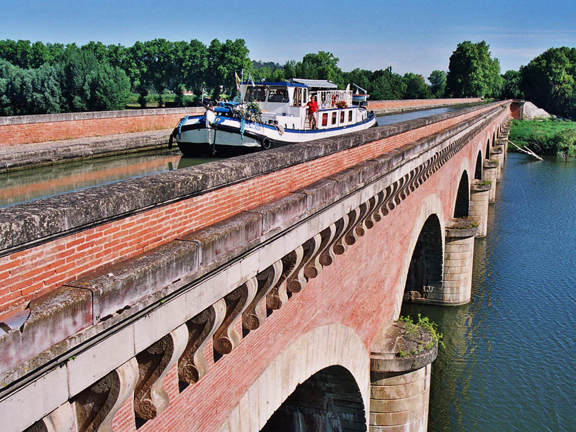
The Canal du Midi, a UNESCO World Heritage Site that runs from Bordeaux and the Atlantic coast to the Mediterranean sea, is ideal for bicycling enthusiasts looking for a relaxing ride and discovering this 150-mile engineering masterpiece.

SPIRITUAL
Travelers can embark on a spiritual retreat in the region at the sacred French Grotto of Lourdes, a world famous pilgrimage site. Every year, the cosmopolitan and convivial town receives 6 million travelers from 140 countries from every continent.

Walking the Way of St. James has changed little over the centuries, where pilgrims trek from all over Europe to the city of Santiago de Compostela in northwestern Spain. The route winds through many scenic villages born of the ancient pilgrimage, including Rocamadour, Conques and Moissac.

For more information on Midi-Pyrénées, go to: Midi-Pyrénées Tourism Office.

‘Ciao Down’ in Emilia-Romagna, Italy’s Gastronomic Capital

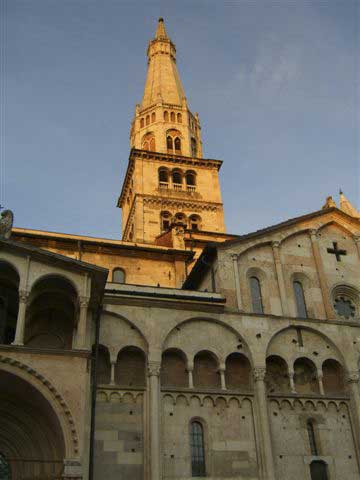
The bell tower of Modena’s cathedral

By Kristi Nelson Cohen
Photos by the author

One of things travelers enjoy the most is, well, eating.  We chow down breakfast, lunch and dinner without blinking an eye, when we wouldn’t dream of eating this much at home.  But as they say, “When in Rome.” You should definitely dine as they do, with a great glass of wine.  Each region of Italy offers its specialties, but Emilia-Romagna, located in the heartland of central Italy, could easily be considered this country’s gastronomic capital.
 
Located just over an hour north of Florence and about two hours southwest of Venice is the region’s capital, a major metropolitan city called Bologna. Bologna is easily reached as a transportation hub on the Italian rail or on Highway A1 from Florence.  Less than an hour northwest of Bologna are the smaller communities of Modena and Parma, which are also accessible by rail or car. The busy A1 highway links Bologna to Milan via Modena and Parma. 
 
The larger-than-life opera singer Luciano Pavarotti was from Modena. Pavarotti’s large stature and his appetite for life, friendliness and generosity exemplify the people of this region.  Those who watched his funeral on television in late 2007 got a glimpse of Modena’s historic Romanesque duomo.  This 11th century cathedral, its piazza and bell tower are all listed by UNESCO as a world heritage site.  But we’re here to talk about food!
 
Pigs still outnumber people here, which is why the Parma ham or prosciutto di parma is a dietary staple. Many of Italy’s prosciutto, salami and other pork products are cured in towns scattered over this region. Another well-known food staple is Parmesan cheese, and we’re not talking about the stuff that comes in a green can. The real deal is called Parmigiano-Reggiano. And don’t forget about the famed balsamic vinegar which originated in Modena, called Aceto Balsamico Tradizionale.  Here a visitor will learn about the painstaking process of making this aged, black gold. Tradizionale Balsamico is very expensive — a small bottle can cost $100-$400 — but each thick drop carries sweet and complex flavors used to enhance a variety of foods.

Lambrusco grapevines near Modena

 
ACETO BALSAMICO TRADIZIONALE DI MODENA

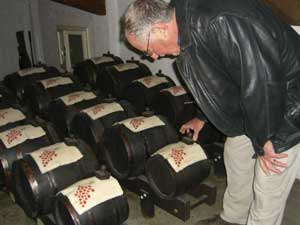
The balsamic vinegar found in the grocery stores, or even in the specialty gourmet stores in the U.S., is great on salads, but has merely a slight resemblance to the real thing. Tradizionale vinegar is made with the Trebbiano white grape. The juice is cooked, reduced and fermented in a series of specifically made wooden casks for no less than 12 years.  Each year, the vinegar evaporates from the wooden casks and is then moved to a graduated smaller cask.  At the end of 12 years, what started as six gallons of fermenting grape juice will only produce one quart of finished tradizionale vinegar. 
 
The vinegar production must pass strict government standards and be approved by the Balsamic Vinegar Consortium which monitors the quality and production amounts. There is only a handful of small producers, and while prices may seem high, this syrupy concoction takes years to create.  While visiting the area it is possible to schedule a production tour and tasting. High end restaurants offer menu selections where the Aceto Balsamico Tradizionale is sprinkled sparingly over grilled meats, strawberries, tortelloni, Parmigiano Reggiano cheese or even over ice cream. This sweet, aged, deep brown nectar can even be drunk as an after-dinner liqueur.
 

Balsamic vinegar casks


SAY “CHEESE” — PARMIGIANO–REGGIANO

West of Modena is Reggio Emilia, the birthplace of the renowned Parmigiano-Reggiano cheese. This cheese is not only grated onto pasta, but is often served by itself in chunks as an appetizer or even for dessert, when it might be drizzled with honey or the famed balsamic vinegar.
 
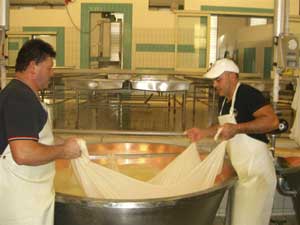
Cheese production tours are available with advance scheduling. There you can watch cheese makers stirring the milky brew in large copper cauldrons, then cutting through the curds and later forming soft pillows of cheese. The soft cheese is pressed into a wheel form with the pre-formatted stamp which says “Parmigiano Reggiano” and allowed to cool.  The soft wheel is then cured in saltwater brine for two weeks. The cheese wheel is then placed on wooden shelves and allowed to age from 2-5 years. 
 
Visitors can easily buy this cheese from any market in the area or even at the airport on departure day.  Be sure to check the hardened rind area to see the perforated stamp of authenticity.  If the cheese is sealed in a vacuum package, it is perfectly acceptable to carry home as a delicious reminder of a vacation in Italy.    

(left to right) Wheels of Parmigiano-Reggiano undergo the aging process; Master cheese makers with pillows of soft cheese

 
FAST CARS, RAGING BULLS AND RED RACING FEVER

If great food and world heritage sights aren’t enough to entice a visit to the area, perhaps the thrill of seeing another part of Italy’s claim to fame will  Italian design is world famous, but none more coveted than Italian specialty sports cars. The Modena area is home to Ferrari, Maserati, Ducati, Lamborghini and Pagani. 
 
Tours at the Ferrari factory, located 12 miles south of Modena in Maranello, are not available, but the Galleria Ferrari Museum has a great exhibition of engines, vintage cars, memorabilia and a reconstruction of Ferrari founder Enzo Ferrari’s personal study. There’s also the official Formula One shop, the Ferrari restaurant and places where visitors can view the Ferrari test track through the fence, giving an ample cure for “red racing fever.”

The Lamborghini Factory Museum located at Via Modena 12 in Sant’Agata is under the same roof as the “raging bull” factory.  There visitors enjoy a wide array of vintage automobiles, historic photos and rare prototype models. With an advance appointment, factory tours are also available, and this museum isn’t nearly as crowded as Ferrari, which gives visitors a chance to stroll the displays at leisure. Guided tours in English are available with advance request. 
 
There is so much to see for the sports car enthusiast that it might be best to set up guided full-service tours with museum and factory admission organized in advance by a professional guide service. Le Volpi Ciccione is one such operator. They can even customize a tour that includes your own Ferrari to drive for a few days, as long as your budget will allow.
 
Our food and motor tour included a cooking class at the Ferrari Village restaurant. The Ferrari Village’s red exteriors were a good match for the passion of the restaurant’s culinary team, which graciously opened their kitchen so our group could learn to make gnocco fritto (a light deep-fried dough which was served piping hot with thin slices of prosciutto) and the filled pasta called tortelloni (larger) or tortellini (traditional smaller-shaped filled pasta). Following the cooking instructions, our group enjoyed a luncheon fit for kings and, yes, we sampled our own creations, although some students were better at shaping the tortelloni than others.

With great food, historic sights, friendly people and the classy Italian sports cars, this area of Italy is not to be missed!
 
CONTACT INFORMATION TO HELP YOU FIND YOUR WAY THROUGH EMILIA-ROMAGNA
 
Le Volpi Ciccione srl – Tour Operator/Travel Agency in Modena
Le Volpi provides customized tours and area lodging with emphasis on food, wine, motorcars, historic sights and much more.  English speaking guides and group tours available. 

Vicolo del cane 7, 41100 Modena, Italy
Phone:  011-39-059-218 722
For customized tour itineraries for both individuals and groups, contact Giusy@levolpiciccione.it
 
Museo Lamborghini
Via Modena 12, 40019 Sant’Agata Bolognese, Italy
Phone:  011- 39-051-681 7611
Open Monday through Friday excluding holidays
E-mail:  museo@lamborghini.com or for factory tours factorytour@lamborghini.com
 
Galleria Ferrari
Via Dino Ferrari, 43-41053 Maranello, Italy
Phone:  011-053-694-32 04
Open every day excluding Dec. 25 & Jan. 1
E-mail: (for group requests) galleria@ferrari.it
 
Balsamic Vinegar Consortium
Corso Cavour 60, Modena 41100
Phone:  011-059 23 6981
 
Parmigiano-Reggiano Consortium
Via Kennedy 18, Reggio-Emilia
Phone:  011-052 23 077 41

About the writer
Kristi Nelson Cohen, also known as the “Train Dame,” has a long history with marketing and tourism promotions. Cohen’s love of history and trains, in addition to her hospitality and marketing background, led to a position as Vice President of Marketing for the Durango & Silverton Narrow Gauge Railroad where she worked full time until 2004.

Cohen remains active as an affiliate for American Heritage Railways and Rail Events Inc. where she has assisted with marketing efforts for The Great Smoky Mountains Railroad, Thomas the Tank Engine, Little Engine That Could Rail Tour and Polar Express Rides. She was also one of the organizers of the National Narrow Gauge Convention held in Durango in August 2006. She now owns and operates an international tour company called Bella Italia Trips, leading guided tours to Italy.

Frankfurt’s Liquid Gold

Photos Courtesy Frankfurt Tourist & Congress Board

Locals and tourists alike enjoy this beverage in rustic apple wine pubs all over the city. The “core” apple wine scene is in Old Sachsenhausen; numerous apple wine pubs line its streets where they serve customers their infamous “liquid gold.”

In the Middle Ages, beer and wine were the beverages of choice. As with many products today, apple wine came into being because of an unavoidable circumstance rather than an idea for a new product. In the middle of the 16th century, the Rhine-Main area went through a climatic change that negatively influenced wine production. Because of this, many vineyards transformed into fruit orchards, thus beginning apple wine production. During the Goethe era, taverns made the switch and became apple wine pubs. Today, apple wine remains a staple in Frankfurt and is growing in popularity.

It’s easy to spot a local apple wine pub: just look for the wreath hanging above the door. There’s even an old saying, “A wreath on the door means apple wine and more.” Traditionally, apple wine is served in a blue-gray stoneware jug called a Bembel. Other necessary glassware for apple wine drinking includes a ribbed glass called a Gerippte.

For an unforgettable Frankfurt experience, take a tour of old town in the “Apple Wine Express.” The Apple Wine Express is the city’s most popular streetcar and takes guests on a sightseeing tour around the city. For one hour, visitors can munch on pretzels, listen to music and sip apple wine while experiencing the city in a new way.

For more info, go to: www.frankfurt-tourismus.de