The ‘Champs-Elysees’ of Burgundy Wines

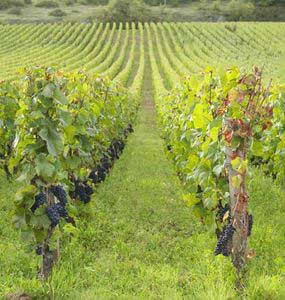
The wines of Burgundy are rich and varied, and are divided into regional appellations, village appellations, Premiers crus and Grands crus. The Appellation d’Origine Contrôlée (AOC) is your guarantee of the characteristics of the regional wines. Fall is a beautiful time to drive or bike through the wine routes.

The Côte de Nuits extends from the south of Dijon to Corgoloin and forms the northern section of the Grands Crus route. It is a prestigious hillside that is home to villages bearing the names of the greatest red wines in the world. Here you will find 24 of the 33 grands crus in Burgundy: Chambertin, Clos de Vougeot, Romanée-Conti and many more.

The Côte de Beaune follows on from the Côte de Nuits towards the south, from Ladoix-Serrigny to the hillside of the Maranges. This soil, blessed with the Chardonnay grape, is where the greatest dry white wines in the world are produced (Corton-Charlemagne and Montrachet, among others). Outside of the city of Beaune, which is the capital of Burgundy’s wine regions, the countryside becomes gentler as you approach Santenay and the département of Saône-et-Loire.

Burgundy hiker

ROUTE OF THE GRANDS VINS DE BOURGOGNE – THE ROUTE THROUGH NATURE
The route of the Grands Vins runs from Santenay to Saint-Gengoux-le-National, and is the extension of the route of the Grands Crus towards the south: more than 100 signposts connect around 40 towns via the vineyards of Maranges, the Couchois and the Côte Chalonnaise. This varied route combines villages with nature, and vineyards with wooded countryside, and is dotted with Romanesque churches and castles. You can discover it by car, but also along the water of the Canal du Centre, or by bike along the the many cycling routes.

ROUTE OF THE MÂCONNAIS-BEAUJOLAIS, THE SOUTHERN WINE-GROWING AREA
This route in the south of Saône-et-Loire is the extension of all the wine routes from Dijon. The eight circuits enable you to break away from the main route and explore the most southerly vineyards in Burgundy in greater depth. The main route itself crosses the Mâcon wine-growing region in a straight line and finishes at Romanèche-Thorins (Saône-et-Loire) on the hillsides of the Beaujolais region.

ROUTE OF THE VINEYARDS OF THE YONNE ALONGSIDE THE RIVERS
In the département of the Yonne, the vineyards have developed alongside rivers: the Jovinien and the Auxerrois in the Yonne Valley, the Chablisien in the Serein Valley, the Tonnerrois in the Armançon Valley, and the Vézelien in the Cure Valley. The wines of the Yonne are undergoing a renaissance and deserve to be discovered in all their diversity just as much as the highly famous Chablis.

ALONG THE LOIRE AROUND THE NIÈVRE
The vineyards of the Nièvre, which extend along the right bank of the Loire, belong not to Burgundy but to the Centre-Loire, and have long suffered from a certain lack of recognition. Now another wine route enables visitors to discover all their charms, from the hillsides of Pouilly-sur-Loire, where the famous Pouilly-Fumé is produced, to the Coteaux du Giennois overlooking Cosne-Cours-sur-Loire. This route also takes in Sancerre on the other side of the river in the Cher.

For more information on Burgundy, go to www.burgundy-tourism.com.

Christmas Markets in Luther Country

Erfurt Christmas Market

In Germany’s Luther Country, Advent means Christmas markets. The crisp winter air is filled with the smell of ginger and nutmeg, signaling the arrival of Stollen, a special Christmas cake, and Glühwein, mulled wine. Cobbled streets and squares, lined with half-timbered medieval houses, provide the backdrop for dozens of wooden stalls, selling wooden toys and Christmas decorations, handcrafted gifts and seasonal foods, such as Zimtsterne (cinnamon stars) and Lebkuchen (soft, spiced cookies).

Brass bands play and choirs sing carols, often written by Martin Luther himself. In fact, many Christmas traditions were supposedly instigated by the Protestant reformer 500 years ago. Legend insists one dark and starry night, Luther was touched by the beauty of the pine trees. On returning home, he cut down a tree, took it into his house and decorated it with candles. As well as the Christmas tree, Luther is credited with the idea of Christkind, the Christ child bringing presents. (Kris Kringle is still familiar in many U.S. homes). Concerned that Saint Nicholas, who delvered his gifts on December 6, was too popular, Luther came up with an alternative to “Santa Claus”: a golden angel, with wings and a crown.

Here are just some of Luther Country’s most authentic Christmas markets.

(clockwise) Christmas Stollen; Lebkuchen; Zimtsterne

ERFURT
November 27 – December 22
Although Erfurt’s 162nd Christmas Market spreads throughout the old town, the focus is on the Domplatz, the vast Cathedral Square. The 200 market booths sell everything from Thuringian bratwurst (Germany’s favorite grilled sausage) and Christmas cookies to handmade toys or traditional, handmade Christmas decorations. Children love the giant Ferris wheel,

the 90-foot-tall Christmas tree covered in candles, and the 40-foot-high wooden pyramid. Most of all, they love the nativity scene, set in a fairytale forest, complete with near life-sized, hand-carved figures. Gardeners should not miss the floral Christmas exhibition in the underground vaults of the cathedral.

Lutherstadt Wittenburg Christmas Market

LUTHERSTADT WITTENBERG
November 28 – December 23
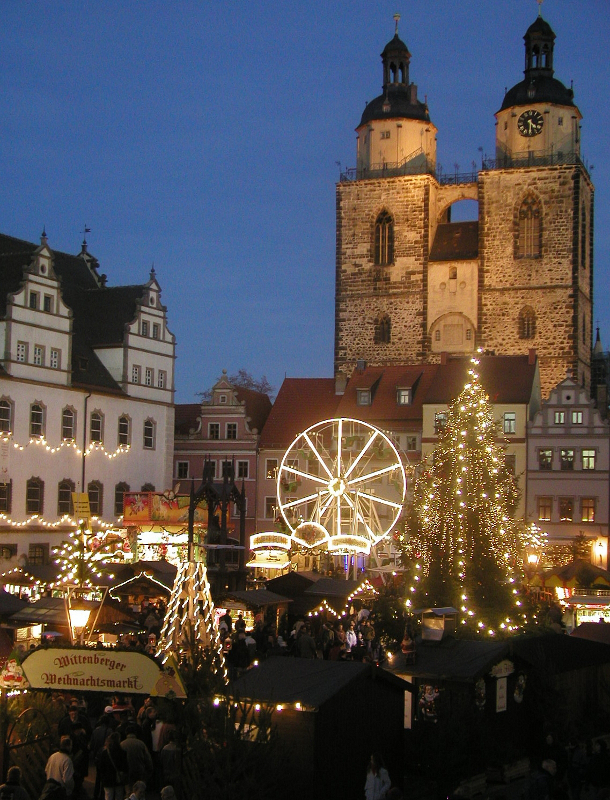
In the market square, a statue of Luther looks out across the Christmas market, with its stalls decorated with pine boughs, lights and Christmas ornaments. In the air is the scent of mulled wine and roasted almonds. Across the square is the Marienskirche (St. Mary’s Church), where Luther preached. Special are the town’s Adventshöfe, medieval courtyards, where local artists and craftsmen sell their wares. In the Cranach Courtyard, named for Luther’s great friend and painter Lucas Cranach, the weekend of December 8 and 9 features weavers and knitters, wood carvers and basket makers.

QUEDLINBURG
November 30 – December 23
With more than 1,300 half-timbered houses, Quedlinburg is one of Europe’s most romantic cities. And during the Christmas Market, strolling along the cobbled streets is like walking through history. One unique event is the “Advent in den Höfen” (December 1-2, 8-9, 15-16), when some 20 private courtyards open to sell special Christmas gifts, often handmade. Another highlight is the world’s largest Advent calendar! At 4:30 p.m. every afternoon for 24 days, children look out for the star that marks the house where the next scene in the Advent calendar will appear. When the door opens, fairytale characters appear and dance, sing or play for spectators.

WERNIGERODE
November 30 – December 22
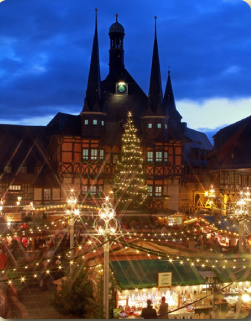
Dominated by its 12th-century castle, Wernigerode’s annual Christmas market has a fairy story backdrop: a 15th-century town hall, half-timbered houses and a 35-foot-tall Christmas tree. The stalls serve traditional food and drink, hand-made toys and ornaments for the home; evenings are filled with concerts of seasonal music. From December 15 to January 8, 2013, the Castle hosts its own special Winter Market. Children meet a fairy at 3 p.m. and receive presents from St. Nikolaus (Santa Claus) at 4 p.m. They also love to ride the Christmas train in a historic carriage, pulled by a steam engine through the snow-covered countryside.

Wernigerode Christmas Market

LAUSCHA
December 1-2 and 8-9
Each Christmas, this small town in a steep, wooded valley in the Thuringian Forest, plays a vital role in every American home. This is where the first glass Christmas tree ornaments were created in 1847. In 1880, F. W. Woolworth, the five-and-dime store pioneer, brought a batch of these glass balls to his store in Pennsylvania, and the rest is history. The tradition continues in Germany’s glassblowing capital, where you can watch artisans creating works of art at Lauscha’s Museum of Glass Art. At Lauscha’s annual Christmas “Kugelmarkt,” or glass bauble market, you can buy these handmade decorations in all shapes and colors.

Mead honey wine

WARTBURG CASTLE, EISENACH
December 1-2, 8-9, 15-16
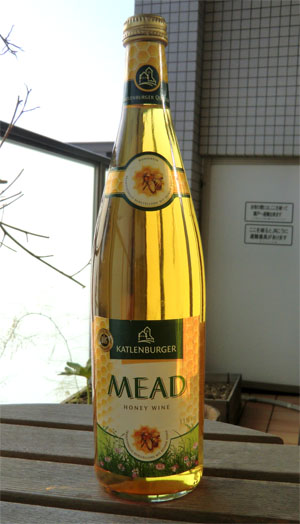
Wartburg Castle is where Martin Luther, the Protestant reformer, changed history when he translated the New Testament into German. And this UNESCO World Heritage Site just outside Eisenach is still a massively impressive fortress. At Christmas, however, a historic Christmas Market transforms the castle, with artists and street performers, craftsmen and knights. Meet candle makers and barrel makers, rope makers and lantern makers, minstrels and puppeteers. With cheerful booths and medieval decorations, this is a like a trip back in time. And the medieval food is delicious, from roast apples and honey to mead.

Zurich’s Hotel Schweizerhof

Convenient, high-class luxury

By Don Heimburger
Photos by Don Heimburger and courtesy Schweizerfhof Hotel

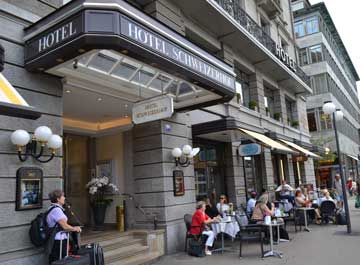
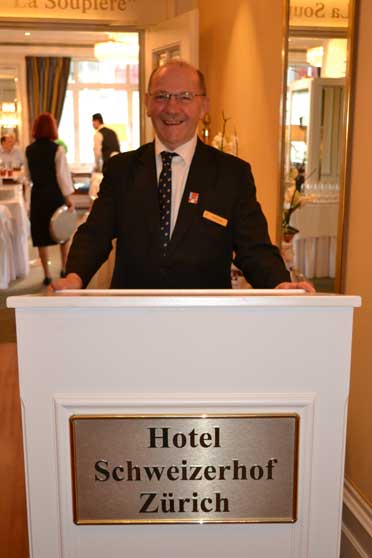
Especially if you’re traveling by train to Zurich, finding the famous five-star Schweizerhof Hotel isn’t hard. It’s right across the street from the ornate Neo-renaissance Hauptbahnhof, and a 12-minute ride from Zurich’s airport. A few steps out of the station, the hotel’s beckoning facade looms before you.

Not only is the Schweizerhof convenient, it’s highly rated. Trip Adviser, for example, shows it to be the third-rated hotel in Zurich, out of 124 hotels.

One Trip Advisor reviewer said, “I was very impressed with the outstanding service from all the staff, in particular the reception girls Carmen and Dominique, Michael (a porter) and Hans, who provided us with a private butler service and free champagne and chocolates! Okay, I did say we were on honeymoon, but it did not cut much ice anywhere else!”

He added, “This hotel is out to impress (you) and wants you to go back.”

CLOSE TO THE BAHNHOFSTRASSE
The six-story stone-front hotel is also only a few steps away from the famous Bahnhofstrasse, that mile-long elegant street dating from 1864 that’s a combination of Chicago’s Michigan Avenue, New York’s 5th Avenue and Los Angeles’s Rodeo Drive.

In good weather, locals gather early in the morning at the sidewalk cafe in front of the hotel to read their newspapers, talk about politics or the day’s happenings and order coffee and pastries.

With 114 rooms and suites, the Schweizerhof can provide an economy single room with a bath, a moderate single room with a shower or bath, or a standard-plus room, which affords a bit more space.

At a higher price, double rooms with a queen-size bed are offered, as are twin-bed rooms, corner rooms, a junior suite, and a premium deluxe suite. The rooms are decorated with Italian designer furniture, and bathrooms feature Italian granite.

The rooms are comfortable, with firm mattresses, plenty of lighting around the room, and the entire hotel is air conditioned. One great feature also is the triple-glazed windows: noise from the street below never was a problem when I was there.

The hotel offers high-speed internet service, flat screen televisions, beds are electrically adjustable and all rooms have a handy make-up and razor mirror. A mini-bar, hairdryers, trouser press, umbrella, safe, complimentary fruit plate, and pickup service from the railway station is also included.

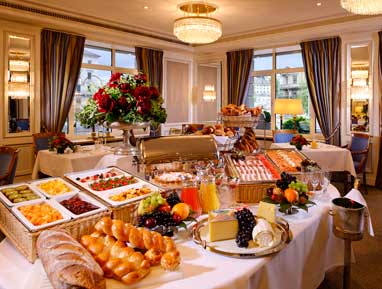
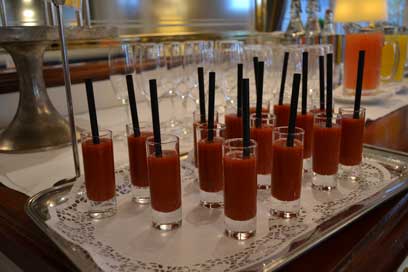
In the morning, guests can enjoy a complimentary champagne breakfast buffet which includes a personal pitcher of fresh squeezed orange juice, assorted juices,various breads, croissants, assorted jams and jellies, cold meats, fruits, yogurt, coffee to order, including expresso, and there is a menu card just for tea.

In addition, assorted cereals, crepes, Nutella, made-to-order eggs, including eggs benedict if desired, bacon and sausage are available. A special Japanese breakfast of miso soup, salmon, vegetables and fried potatoes is offered.

As an added touch of ambiance, little stools are available just to hold ladies’ handbags next to the table.

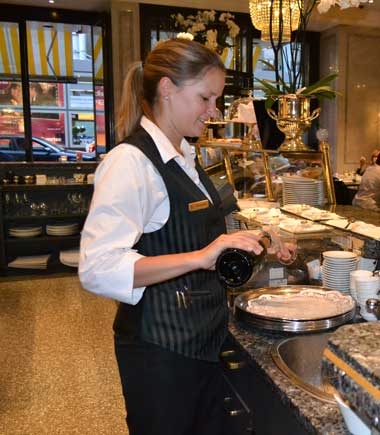
The staff is attentive to special requests and diets, and they make notes of special needs for the guest’s next stay. I was told that if I came back next year for breakfast, the staff would remember what my breakfast preferences were. Breakfast is served in a room on the mezzanine, with pleasant surroundings and a cheerful waitstaff.

While restaurants abound in Zurich, the hotel offers Restaurant La Soupiere, a traditional French-style restaurant serving seasonal, market-fresh cuisine and Swiss specialities. The Cafe Gourmet et sa Boutique du Caviar is a cozy, small cafe serving snacks, salads and caviar.

For meetings and business travelers, the hotel offers a number of meeting rooms and banquet facilities.

With style, this Zurich hotel serves a clientele that expects a little bit more, and they get it.

Jörg Rudolf von Rohr is the managing director of the hotel.

More more information, go to www.hotelschweizerhof.com.

Hotel Schweizerhof Zürich
Bahnhofplatz 7
8021 Zürich / Schweiz

Tel. +41 44 218 88 88
Fax +41 44 218 81 81

To learn more about Zurich, go to www.zuerich.com, or www.myswitzerland.com/en/zurich.html

Interlaken: A Winter Wonderland to Suit Every Taste

Interlaken, Switzerland

Photos courtesy Interlaken Tourism

Winter and spring in Interlaken has fun to offer at the foot of the Eiger, Mönch and Jungfrau mountains. While superb sledge runs attract snow enthusiasts to the mountains, the region between the lakes has a wealth of cultural highlights in store.

INTERLAKEN CLASSICS
The tradition-steeped concert series in the Interlaken Kursaal features the stars of tomorrow playing works by old masters. At Kleine Scheidegg, rock music greats share the stage with local music legends, and the many folklore clubs practice yodeling and alphorn sounds.

European Union Youth Orchestra

SLEDGING BY MOONLIGHT
In Saxeten, after an uphill walk to Alp Nessleren near Wilderswil, guests are rewarded for the effort with a 2 1/2-mile-long sledging session. Culinary well-being is guaranteed with a stop for mulled wine, followed by a tasty fondue in traditional rustic surroundings at the end of the sledge run.

Sledging for snow enthusiasts

YODELING
Swiss folklore clubs promote traditions yodeling and alphorn playing first hand. Yodeling choirs offer a unique blend of beautiful harmony and players create a powerful sound from a long wooden pipe, which echos through the valleys.

53RD INTERLAKEN CLASSICS
You can meet tomorrow’s classic stars at the 53rd Interlaken Classics Festival from March 24 – April 8. The festival has grown into a summit meeting for younger and already internationally-acclaimed musicians. The consistent staging of this podium for young artists is based on close cooperation with Europe’s best youth orchestras, namely the Gustav Mahler Youth Orchestra and the European Union Youth Orchestra.

SnowpenAir Concert on April 6 is the highest-altitude open-air concert. This breathtaking setting on snow at 1 1/4 miles above sea level attracts thousands of concert visitors who will enjoy top acts such as Roxette and OneRepublic, the founding father of Swiss dialect rock Hanery Amman and promising young talent MC Juli.

Schilthorn Summit near Interlaken, Switzerland offers panoramic views.

For more info, go to Interlaken Tourism

Raise a Glass to Ireland’s New Whiskey Trail

Photos courtesy Ireland Tourist Office

History, heritage and “a drop in your hand” of the finest whiskey in the world combine in one of the Emerald Isle’s newest visitor attractions, the Ireland Whiskey Trail.

IRISH WHISKEY TOURING GUIDE
Heidi Donelon has created a touring guide for whiskey lovers to Irish pubs, hotels, whiskey shops and distilleries throughout Ireland. The trail features nearly 40 different places, ranging from the famous old Jameson Distillery in Dublin, to less well known whiskey emporiums such as Fairhill House Hotel in Connemara, which boasts a stock of more than 170 different whiskies.

Donelon says: “The trail is a great way for people to experience the story and magic of Irish whiskey, while discovering the heart of Ireland through the Irish characters they will inevitably meet in the pubs and bars across the island. It is a great touring guide for whiskey lovers, but also for anyone who wants to find that perfect Irish pub during their trip, whether they are whiskey drinkers or not. Some of these pubs are the last links to old and forgotten distilleries. These are not just great whiskey pubs, but also some of the very best traditional Irish pubs in the country.”

IN addition to the in-depth tour guide, the Ireland Whiskey Trail gives information about the history of Irish whiskey, insight into the difference between brands, Irish Coffee and whiskey recipes and details of whiskey tasting events. The Irish are credited with inventing whiskey, called uisce beatha in Gaelic, which translates as “water of life.” For 1,500 years whiskey has warmed the hearts of the Irish and their guests, and today it is a worldwide success with sales of brands such as Jameson, Bushmills, Tullamore Dew and Kilbeggan increasing at an unparalleled rate.

For more info, go to www.discoverireland.com or www.irelandwhiskeytrail.com