Happy to See You in Belfast

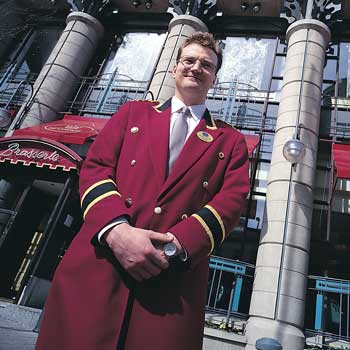
Bellhop at the Europa Hotel

By Carol Price Spurling
Photos by the author and courtesy Belfast Welcome Center

The first time I visited the Emerald Isle more than 20 years ago I steered clear of troubled Belfast. But I’m older and wiser now, and Belfast, too, has grown up, transformed from a self-absorbed, divided town into an extroverted and welcoming world-class city.

Belfast offers Victorian charm in every quarter and has retained the best of what Ireland is famous for: warm hospitality, atmospheric historic and cultural sites, and easy access to the lush unspoiled countryside. In Belfast, they’re glad to see you, not just your wallet, and what a difference that makes.

BELFAST HIGHLIGHTS
West Belfast’s Shankill and Falls neighborhoods saw most of the “Troubles” that erupted in the early 1970s. The Peace Walls that separate them are still standing, but visitors are welcomed on both sides and the practice of customers being searched before entering a store or office was retired years ago. For those interested in an insider’s view of Belfast’s political divide, Coiste Political Tours (www.coiste.ie/p_tours.htm) offers guided tours by Republican ex-political prisoners. Or, take a taxi tour to see wall murals and other relics from the bad old days (West Belfast Taxi Association, www.wbta.net).

The center of Belfast, Donegall Square, features Belfast City Hall (www.belfastcity.gov.uk), an embellished stone edifice built in 1888 as a monument to Belfast’s bright future.

All metro buses lead to the bustling square, also home to literary gem Linen Hall Library (www.linenhall.com). In this old linen warehouse, transformed into a library in 1788, visitors can access the cozy library’s unique archives such as the Northern Ireland Political Collection and the C.S. Lewis Collection. Enjoy the library’s tranquil wood-paneled ambiance and a view of City Hall by taking a tea break in the upstairs café.

A horse-drawn carriage strolls past the Ulster Transport Museum

On Fridays and Saturdays the oldest Victorian-era covered market in Ireland, St. George’s, fills up with local shoppers intent on finding a bargain or tracking down the best fresh food in the region (www.belfastcity.gov.uk/markets). The Saturday market is devoted to food. You won’t go away hungry, with 250 stands offering everything from oysters to Irish cheeses to seaweed tapenade to tapas to sausages in curry sauce. Look for locally made “Belfast in a box” chocolates that celebrate Belfast landmarks, accompanied by an illustrated booklet (www.citycentres.com).

Everyone knows where the Titanic met her end but did you know she was born in Belfast? The city’s proud shipbuilding heritage is still obvious with the huge yellow cranes in the Harland and Wolff shipyard –- nicknamed Samson and Goliath — towering over Queen’s Island and the Titanic Quarter on the city’s eastern edge.

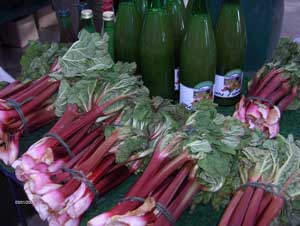
(left) Sampling seaweed at St. George’s Market


Belfast celebrates its past with the Titanic Made in Belfast Festival every March (www.belfastcity.gov.uk/titanicfestival), when free bus tours of Queen’s Island are offered by the city on Saturdays and Sundays.

My personal favorite from the tour: the inside of the design room at Harland and Wolff’s offices, where draftsmen labored under a cathedral-like arched ceiling to draw the ship’s plans.

Shores of the River Lagan

DO YOU NEED A CAR?
Although Ireland and Northern Ireland aren’t famous for their extensive rail networks, between trains, buses, and taxis you can get anywhere you need to go in the greater Belfast area and environs without having to rent a car –- or drive on the left. Coach tours and trains also run directly north to Portrush, with convenient connections to Giant’s Causeway, Dunluce Castle, and Bushmills Distillery. Along the northern and southern shores of Belfast Lough, rail service is frequent and affordable, so getting to top attractions just outside Belfast, like Carrickfergus Castle (www.ehsni.gov.uk/carrick.shtml) or the must-see Ulster Folk and Transport Museum (www.uftm.org.uk/) is easy peasy. Day return tickets are offered at 1/3 off the standard rate if you leave after the morning rush hour, and families can get special ticket deals too (www.translink.co.uk).

But to see some of Northern Ireland’s diverse natural beauty and historic architecture (Environment and Heritage Service, www.ehsni.gov.uk/other-index/places.htm), a car will be very helpful. Most recommended is to make a day of driving north along County Antrim’s Causeway Coastal Route, where the craggy cliffs and wild sea spray on one side is balanced by charming villages and green pastures dotted with tranquil sheep on the other. Giant’s Causeway — a stunning outcropping of columnar basalt — can be busy during the tourist season but has been kept remarkably uncommercialized. Visit in the early morning or late afternoon for the best light at this geological wonderland (www.causewaycoastandglens.com).

Another lovely drive is west through the Fermanagh Lakelands, home of Belleek pottery, and National Trust gem Castle Coole (www.fermanaghlakelands.com).

WHERE TO EAT AND DRINK
Celebrity chefs Paul and Jeanne Rankin have put Belfast on the culinary map with Cayenne Restaurant (www.rankingroup.co.uk) and Roscoff Brasserie. Up and down the Golden Mile on Dublin Road, foodies will be spoiled for choices of great pubs, cafés, bistros and restaurants.

Chef Michael Deane runs Northern Ireland’s only Michelin-starred eatery at Deane’s Restaurant (www.michaeldeane.co.uk); his newest venture is the contemporary bar and grill Deanes at Queens, located in the Queen’s University Common Rooms.

Coffee addicts never fear, Belfast baristas know what they’re doing. You can’t go wrong visiting any one of the seven Clement’s coffee shops, where coffee drinking is practically a spiritual pursuit, and the creamy hot chocolates are served in a large bowl.

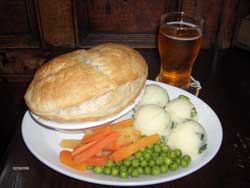
(left to right) Dining at one of Chef Michael Deane’s Belfast restaurants; Steak and Guinness pie is an Irish specialty

WHERE TO STAY
In downtown Belfast itself, a famous landmark is the 4-star Europa Hotel (www.hastingshotels.com) conveniently located just in front of Great Victoria Street rail station and the Europa Buscentre. Head concierge Martin Mulholland will make sure you get everything you need, even if you’re not as famous as some guests who’ve stayed there, like Bill Clinton, Julia Roberts and Elton John.

For a more secluded getaway try the 5-star Culloden Hotel in Holywood, overlooking Belfast Lough (www.hastingshotels.com), or The Old Inn in picture-perfect Crawfordsburn (www.theoldinn.com), both within easy reach of the city.

For less expansive budgets there are dozens of guestshouses, B&Bs, self-catering holiday apartments, hostels, and budget hotels both in Belfast and in neighboring communities. Some are chic, some charming; choose according to your mood.

The Premier Inn hotel (www.premierinn.com) boasts a great central location and is spanking new to boot. The Ash-Rowan Town House (tel. 9066 1758) offers a choice of nine gourmet breakfasts, with a side of historic significance: the Ash-Rowan was once the home of Titanic designer Thomas Andrews.

If you get out into the Fermanagh Lakelands and wish you could stay, check out Belle Isle Castle (www.belleisle-estate.com), outside Enniskillen near Lisbellaw. The old stables and coach house have been transformed into comfortable holiday rentals, with a variety of outdoor activities available, as well as day-long cooking classes taught by Irish chef Liz Moore. You can even rent the castle for a group stay, or a small wedding.

WHEN YOU GO
If you’re planning a trip to Belfast and Northern Ireland, be sure to visit the Belfast Welcome Centre website, www.gotobelfast.com. Like the office itself located at 47 Donegall Place in the city center, it is user-friendly, multi-lingual, and comprehensive. Be sure to pick up copies of their excellent themed city guides.

The Northern Ireland Tourist Board website is www.discovernorthernireland.com. Another free publication to pick up: Belfast In Your Pocket (www.inyourpocket.com). Published every couple of months, it always has the most up-to-date happenings, complete with maps of the city.

Beautiful Bratislava

Courtesy http://www.visit.bratislava.sk

By Leah Larkin
Photos by Don Heimburger (unless noted)

“I like the changes. The town looks much better now. It’s more comfortable,” says city guide Evo Cubrikova.

She was speaking about her hometown, Bratislava, the Slovak capital of 450,000 inhabitants that is spread out on two banks of Europe’s second longest river, the Danube.

Indeed, since Czechoslovakia overthrew communism in 1989 and Slovakia split from the Czech Republic in 1993, there have been major changes and improvements, not just in Bratislava, but throughout the country.

Yet, progress has been fastest in the capital where renovation, new construction and new wealth have made their mark. Most remnants of those gray, shabby communist days are long gone, replaced by freshly renovated historic buildings now painted in pretty pastels, swanky shops, trendy restaurants and bustling cafes.

Courtesy http://www.visit.bratislava.sk

LIVELY PLACE
It’s not Vienna, Prague or Budapest, but it’s a pleasant, lively place to visit. Many tourists in nearby Vienna (64 km/ 40 miles away) and Budapest (194 km/116 miles) make day trips by bus or boat to the city. The opposite is also true with Bratislava visitors heading to the Austrian and Hungarian capitals, also for day excursions.

“Bratislava is a great city break destination,” notes Alison White of the British tour agency Regent Holidays which sends many visitors to the city. “You can take the hydrofoil to Budapest or Vienna. Use it as a base to explore these cities that are more expensive.”

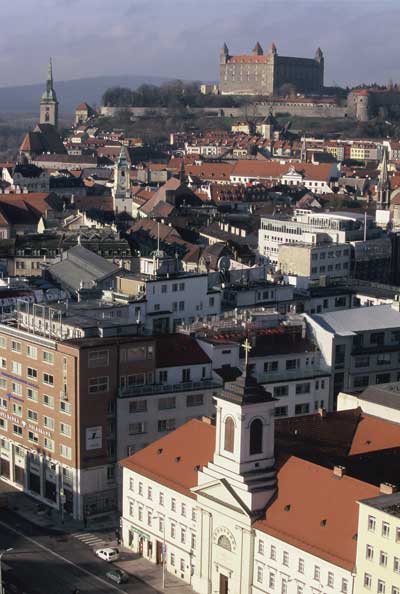
But don’t neglect Bratislava’s sights which are easy to explore on foot as the town is not that big. Towering over the city is its castle, a perfect place to begin a visit with magnificent views of the town and surroundings. Unfortunately the interior of the castle which houses the Slovak National Museum is closed for extensive renovation and will remain so for several years.

It’s still worth the trek. You can climb the outer walls and aim your camera for overall shots of the town. Across the river is Petrzalka, a suburb of bleak concrete highrises built in the communist era. One third of the city’s population live in these apartments, which are being restored. Because of their proximity to the inner city, they are now in demand, Cubrikova said.

The first written reference to the castle dates to 907, but the first inhabitants of the castle hill were Celts, then came the Slavs who built a fortress there. It was replaced by a palace of stone in the 10th century when Bratislava became part of the Hungarian kingdom. In the 15th century a Gothic castle was built, but all that changed in the 16th century when it was rebuilt in Renaissance style. Then along came Maria Theresa who had it converted into a rococo structure for her daughter.

MOST IMPORTANT TOWN
During Maria Theresa’s reign (1740-1780), Bratislava became the largest and most important town in the territory of present-day Slovakia and Hungary. The population exploded and many new palaces, monasteries, mansions and streets were built. But the glory began to fade when Maria Theresa’s son, Joseph II took over and the crown jewels were taken to Vienna in 1783 in an attempt to strengthen the union between Austria and Hungary.

The castle burned down in 1811 and remained a hulk of empty ruins until 1953 when renovation began, continuing until 1968. From far off, it looks like an upside down table -– four towers (legs) extending from the building, the table top.

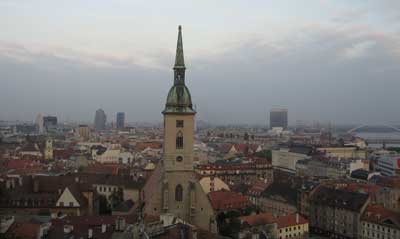
At the foot of the castle is the charming Old Town with labyrinthine streets and cobblestone squares. The prominent church at the edge of the Old Town, which was once part of the city’s walls, is St. Martin’s cathedral, a three-nave Gothic church dating to the beginning of the 14th century. Bratislava was the capital of the Kingdom of Hungary under the Habsburg monarchy from 1536 to 1783. Eleven Hungarian kings and eight royal wives were crowned in the cathedral.

Wandering through the narrow alleys of the Old Town behind the cathedral is reminiscent of Prague, with a Middle Ages ambience still in tact. You’ll undoubtedly come to Michael’s Gate, the only preserved gate of the medieval city fortifications. Its appearance changed through the centuries, but its 51-meter high tower still dominates.

Just down from the Gate is my favorite Bratislava discovery — Cokoládovna pod Michalon at Michalská 6, a chocolate café with what must be the world’s best hot chocolate — 44 different kinds, most with liqueurs. Dark, thick, sinfully delicious. I went for Indian hot chocolate, flavored with rum, cloves, cinnamon, orange peel and whipped cream –89 SKK (Slovak koruna).

Bratislava’s Old Town Hall took shape in the 15th century when several burgher houses were joined together. It, too, has been reconstructed throughout the centuries and now houses the city’s Municipal Museum. Under its tower is a unique and cozy cafe, Radnicka, which employs the disabled and is very popular. Crafts made by the disabled are also sold in the café.

CITY’S MAIN SQUARE
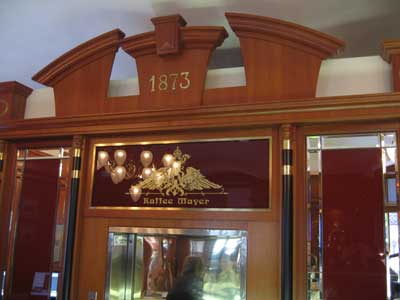
Walk through the passageway under the tower past the restaurant and enter the city’s main square, Hlavne Namestie, where architectural gems have been restored and now house embassies. There are also several cafes in the square including Maximilian’s, a pastry shop/café with a fountain flowing with liquid chocolate. Opposite is the Café Mayer, another noted café and pastry shop famous for “razky,” the city’s signature pastry, crescent shaped with a tiger pattern on the crust and a tasty filling of ground walnuts or poppy seeds.

Another attraction in this square is one of the town’s whimsical statues — a bronze of a Napoleonic soldier leaning over a bench. Tourists love to sit on the bench and pose next to the fellow, who was said to have been left behind by the French after they besieged the city in 1809.

More of these fun surprises are spread throughout the city, another favorite being a man peeping out of a manhole on the street. They say he’s looking up the ladies’ skirts.

On a more serious note is the Primatial Palace, an elegant, classical palace from the end of the 18th century which was the archbishop’s winter palace and now serves as the mayor’s office. Its lavishly-decorated rooms are used for official ceremonies. When none of these is taking place, you can visit and admire its Hall of Mirrors and series of six enormous, stunning English tapestries from the 17th century that illustrate the mythical legend of Hero and Leandros. According to Cubrikova, there are only three sets of tapestries in the world illustrating this legend, but only Bratislava’s set is complete.

The perfect place for a stroll is Hviezdoslavovo Namestie, a long mall-like boulevard with the Slovak National Theater on one end and a small square on the other end near the city’s famous New Bridge. Trees, fountains, a gazebo, cafes and restaurants, even the American Embassy, line the boulevard which is abuzz with people.

The restaurant of choice is the Slovenská Reštaurácia (www.slovrest.com), Hviezdoslavovo nám. 20, rich in old Slovak décor with a “Stroll Through Slovak Gastronomy” five-course menu for 790 SKK. From smoked trout, garlic soup with fried bread, goose liver in red wine sauce, a farmer’s platter and the finale, your choice of several types of homemade strudel, it’s a hearty feast. Get in the Slovak spirit and begin the meal with a shot of brandy. The restaurant serves many kinds, but silvovica (plum brandy) is the local staple. Slovakia makes excellent beer, the beverage of choice with this meal.

ONE-PYLON BRIDGE
After a meal like that, exercise is in order. Cross the bridge, a city symbol that was built in 1972 –- a futuristic suspension bridge with only one pylon. Ride the elevator to the top of the bridge tower where there is a viewing platform and the panorama “UFO” restaurant, so named because of its flying saucer shape. On the other side of the Danube is a lovely riverside park.

The UFO restaurant (www.u-f-o.sk/en/) is pricey with gourmet offerings — a six-course menu for 3,000 SKK. You can even have a tasting of Iranian caviar (6,800 SKK for 30 grams). I settled for a cappuccino, 70 SKK.

In the more affordable category, the Reštaurácia Monarch, Sedlárska 4, offers the Demänovská Valley Delicacy, a potato pancake filled with beef strips, tomatoes, green peppers, onions and mushrooms. Cost of the tasty concoction: 320 SKK. A large beer, 60 SKK.

Slovak crafts — wooden products, painted ceramics, cornhusk dolls — make the best souvenirs. Crystal is also a local favorite. I bought a pretty hand painted plate at Folk Art, Panská 2, for 450 SKK.

Recommended hotels in the city center include the four-star Hotel Devin (www.hoteldevin.sk) at Riecna 4; a new four-star boutique hotel, Marrols, (www.hotelmarrols.sk) at Tobrucká 4, and the reasonable and popular three-star Ibis Hotel (www.ibis-bratislava.sk), Zamocka 38.

For more information, check out visit.bratislava.sk/en/.

The People and Places of Bruges

By Don Heimburger
Photos by the author

From the look of the crowds on the streets, it appears everyone has fallen in love with Bruges. And I visited in early April when there were fewer people visiting.

But that’s about the only negative thing you might be able to say about such a beautifully-preserved medieval city. It’s truly a must-see on any tour of Flanders, and you could easily spend several days visiting its wonders.

If Disney could have laid claim to Bruges, he would have: it’s that charming.

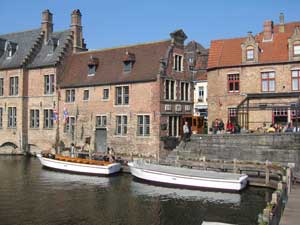
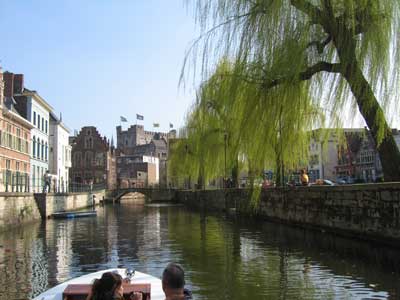
Bruges is easily walkable, but beware the cobblestone walks—make sure you have good walking shoes. Also, plenty of horse and buggies are for hire, or you can take a boat tour of the city or ride in a mini-bus.

UNESCO SITE
The whole of the city center is a historical landmark, designated by UNESCO as a World Heritage Site, and so it should be. It’s hard not to become enamored with Bruges, its twisting streets and alleyways, its network of canals, and its charm. It’s a complicated network of narrow passageways, brick buildings and waterways, but that’s what makes this city so fascinating. You’ll love it.

VISIT THE BEGUINAGE
In most cases, you’ll cross Minnewater Bridge to enter the Beguinage, founded in 1245. Now populated by nuns from the Order of Saint Benedict, you’ll see the beautiful courtyard garden, where yellow daffodils pop up in spring, the whitewashed house fronts that line the Beguinage, and the peaceful beauty of the area. A posted sign even asks visitors to be quiet and be beware of their surroundings.

THE BELFRY
In case of war—or fire, or anything—the belfry was where it was first noticed. The marketplace is still dominated by this high tower, and it looks out onto the bustling plaza where life comes together in Bruges. You can climb to the top of the belfry (it will cost you 366 steps), and get a good view of the town as well as the two statues in the square, one of Jan Breydel and one of Pieter de Conick, both heroes who resisted the French in 1302.

The Stadsschouwburg is the royal theater building dating from 1869 and is said to be Europe’s best preserved city theater. Behind the Gothic revival architecture is a palatial auditorium and an elegant foyer.

The Little Bear of Bruges, located in a niche in the Burghers Lodge at Poortersloge, a 15th century private club building, is an important city symbol. I tried finding it, to no avail, but perhaps you’ll have better luck. It’s worth a photograph.

Kempinski Dukes’ Palace, at Prinsenhof 8, now an excellent five-star luxury hotel, was a former 15th century Dukes of Burgundy castle, and features 93 rooms, including 22 palatial suites, of which six are historically listed. Each room contains original features from 1429, but they have been completely modernized with elegant furnishings and marble bathrooms, and the hotel offers the latest technology such as flat screen television and high speed internet. Even just a look from the outside at this hotel is impressive; it’s located at the end of a short street, and is easy to miss.

LAST REMAINING BREWERY
Bruges’ last remaining city brewery is De Halve Maan (The Half Moon), established in 1546; their specialty beer is called Brugse Zot, which refers to the nickname of the townspeople, conferred upon them by Maximilian of Austria. You can take a 45-minute tour of the brewery and museum; cost is 5.50 euros.

Churches are abundant and worthy of a look. There’s the Beguinage Church, the Episcopal Palace, the English Convent, Basilica of the Holy Blood, Church of the Holy Magdalena, the Military Chapel, Church of our Lady of the Pottery, and the Welcome Church of Our Lady (see the art collection inside including Michelangelo’s famous Madonna and Child, and the 15th and 16 century mausoleums of Mary of Burgundy and Charles the Bold). Saint James’ Church benefited from the Dukes of Burgundy and the many foreign merchants, and their gifts have left their glittering marks on the interior of this church. A guidebook, which you can pick up at the local tourism office in town or at the Bruges railway station, will sort out these churches and other points of interest for you. www.brugge.be/tourism

The Frietmuseum is all about the Belgian potato fry, located in the Saaihalle. Here you’ll learn all about the history of potatoes, and fries, and the condiments which are served with them. Kids will especially enjoy the fun things this museum offers, and you can even taste fries in the cellar of this medieval 14th century building.

WHAT ABOUT CHOCOLATE?
Belgian chocolates, and their history, are served up in good measure at the Chocolate Museum, a four-story compilation of everything chocolate. The museum explains chocolate started with the Mayans and Aztec civilizations in pre-Colombian Central America, and after adding sugar, was imported to Europe around 1500 AD. Chocolate as we know it became popular around 1800, and as they say, the rest is history. The museum is a must-see in Bruges at Wijnzakstraat 2.

To taste more fine Belgian chocolate, you’ll want to check out The Chocolate Line at Simon Stevinplein 19. Master chocolatier Dominique Persoone, one of the owners, is a dynamic chef with advanced ideas on the making and blending of chocolates and other flavors. Chef Persoone blends chocolate with such tastes as cigars, fried onions and passion fruit. His shop is one of only three chocolate shops listed in the Michelin Guide, and the shop’s customers include such top-notch restaurants as Comme Chez Soi, Oud Sluis and Hof van Cleve. He even has a new book out where he travels through Mexico in search of the origins of cocoa, visiting Maya settlements and discovering the secret of the first chocolate drink and today’s Pozol. If you happen to get to meet Dominique, you will enjoy his demeanor and his chocolates.
www.thechocolateline.be

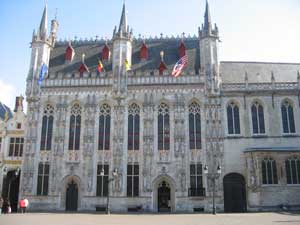
Bruges is also known for its many guild halls, which are scattered throughout the town. Bruges Town Hall, built between 1376 and 1420, is one of the oldest in the Low Countries. A ceremonial staircase leads from the entrance hall to the first floor, where visitors can view the Gothic Chamber. This former council chamber continues to play an important part in the life of the city. The wooden, polychrome ceiling is decorated with a profusion of late-medieval carvings. The murals illustrating Bruges’ past were added during the chamber’s restoration in the late 19th century.

Where to stay? There are dozens of hotels, youth hostels, apartments and bed and breakfasts to choose from. The Bruges Tourist Office can supply a booklet listing these.

Bruges is colorful, inviting and lively, and the food and beer there is some of the best in Europe. You couldn’t find a better combination of history, fun and food. For more information, go to www.visitflanders.us or www.brugge.be

Ghent: From Fallen Angels to Hard Candy to the Great Butcher’s Hall

By Don Heimburger
Photos by the author

From the year 1000 to about 1500, Ghent, Belgium, was said to be one of the most important cities in Europe. It was larger than London, and only Paris was larger in size.

The city was ruled by rich merchant families, from whence came its great wealth. Today, Ghent is still a town rich in history, color and great food and beer. It also helps visitors that as many as 120 new location signposts have been installed to guide tourists to the most important spots in town.

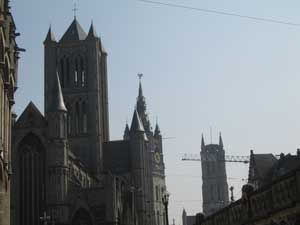
(left) The three towers of Ghent

Walking near the city center, you’re bound to discover features of the city that will amuse or interest you. Stolling along a street not far from Ghent’s impressive Castle of the Counts, I run across a small shop sign that reads, “The Fallen Angels.” The shop is devoted to old things. I like old things.


I hesitate to go in, perhaps not wanting to become one of those things the proprietor’s shingle suggests, but the more I study the front window, the more I determine it’s not only safe to walk in, but intriguing. Intriguing because of all the things that owner Isabelle Steel has gathered over the last 30 years or so for her re-sale shop.

“I started collecting things when I was 16 years old,” she explains. “My father was a painter,” she says, in helping to decipher how she came to appreciate colorful images.

PACKED WITH IMAGERY
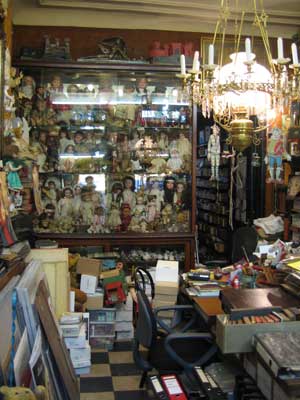
Her very small, quaint shop is packed with imagery in the old kitchen tins, the religious paintings, the thousands of postcards, the picture albums from as early as 1886, the old manufacturer catalogs, and the posters, dolls, toys and trains that pack the place.

Two floors of “fallen angels” material line the walls, the drawers, the flat surfaces of the shop. There is no more room for additional fallen angels. Every cabinet, every inch on the wall has been crammed with attention-getting merchandise.

A sign on the second floor, which is like a small mezzanine and a few steps up from the main floor, reads, “Not more than 3 persons on second floor.” If it could even hold that. Isabelle’s website reads, “For those who require a little bit of nostalgia, this is the place to visit. Here you will find old postcards, devotion cards, old dolls, bears, old toys, tin cookie jars, etc…”

A talkative, friendly person, Isabelle makes customers feel at home in her store, chatting up her goods and keeping an ear to customer conversation that would lead her to a big “fallen angels” find in the future. “A number of my buying customers have something to sell, as well,” she says.

Isabelle and her daughter Ganesha have shops next to each other. Isabelle’s shop has been open for 23 years, and her daughter’s re-sale shop about five years.

Both shops are located in de Jan Breydelstraat nr. 29-31, next to the Castle of the Counts and the Korenmarkt. The Design Museum of Ghent is also located on the same street. For more information, go to www.the-fallen-angels.com.

BELGIAN HARD CANDY ANYONE?
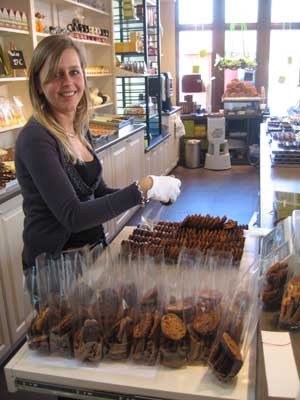
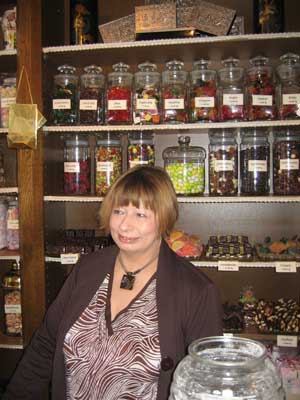
There’s more to Belgian confectionery than chocolate—delicious though it is. For traditional Flemish candy, visit Temmerman (Kraanlei 79)–about eight generations of family members have been making this hard candy. Most popular item is the “cuberdon,” or raspberry nose (red nose filled with sugar), but the tiny shop is stuffed with more than 600 other varieties of sweet stuff. Other goodies include wippers (butter caramel with vanilla sugar), mokken (biscuit with anise) and katrienspekken (hard candy treated with baked sugar).

Another speciality shop is Tierenteyn-Verlent (Groentenmarkt 3, www.tierenteyn-verlent.be), which sells natural mustard made to a centuries-old recipe, and therein lies a tale:  The first great evolution in making mustard took place in the region of Dijon where a farmer tried to crush the mustard seeds with a stone. This didn’t work because there was too much oil in the seeds that prevented the machine from working. He poured a bucket of water on the seeds and found out that mustard seeds had to be wet instead of dry to crush them.
 
This information was brought to Ghent by a soldier of Napoleon’s army who was discussing the mustard principle with an inhabitant of Ghent, Petrus Tierenteyn, who overheard this and decided to start making mustard himself. But instead of yellow seeds used in France, he used dark ones, like in most Germanic countries.
 
The shop was opened in 1790, and the first products they sold were herbs and groceries. In 1842 Petrus installed a steam-powered machine to give power to the mustard mill. From that time, the shop has been owned by the same family.
 

BUTCHER’S HALL
In Ghent’s medieval Groot Vleeshuis Butcher’s Hall (Groentenmarkt 7) next to the River Leie, large wooden beams on the interior of the roof show the strength of the building, and from these beams hang Ghent’s special Ganda hams…they look good enough to eat, and you can sample their ham and other specialties in this old hall. There is no fee to walk in, and the building is wheelchair accessible. The Butcher’s Hall is open Tuesday through Sunday from 10 a.m. to 6 p.m. The hall contains a restaurant called the Promotiecentrum voor Oost-Vlaamse Streekproducten where you can sample East Flemish dishes.

If you’re at Butcher’s Hall, you’re also at the heart of this city of 250,000, and during warm weather, many of the thousands of local university students gather around the Graslei and Korenlei, the old trading harbor, which is now filled with tour boats. In many scenes of Europe, this view along the river, showing many of the old trading houses of the free boatmen and the grain harvesters, is a classic. Another good viewing area of this scene is from St. Michael’s Bridge.

MORE TO SEE
Other top views of Ghent include the Castle of the Counts, an imposing fortress built in 1180. The Gravensteen (the Dutch name for the Castle of the Counts) was built by the counts of Flanders who had castles built in the principal cities of their rule. Because they had to maintain law and order, they moved continuously from city to city and thus had a castle in cities where they wanted to stay for a while. The castle in Ghent is the only one that survived the centuries more or less intact.

The Gravensteen was constructed by Fillips of Alsasse, who was the count of Flanders between 1157 and 1191. He took part in one of the crusades and died during the siege of Akko in the Holy Land. The opening in the form of a cross, above the main entrance gate, proves that he had taken part in a crusade when the castle was built. Next to the castle lies the Veerleplein (Veerle Square), the place where public executions took place.

Another attraction is St. Bavo’s Cathedral in the historic center, the oldest parish church. Astonishingly, it features 22 altars, and the rococo pulpit is a combination of beautiful marble and oak. At the Old Belfry, a dragon scans the horizon, and is perhaps one of the most impressive belfry towers in Flanders. Together with the St. Nicholas tower and the cathedral tower, it dominates the medieval center of the city. The architects were Jan van Aelst and Filips van Beergine. The tower was completed in 1338, when the bells were rung for King Edward II. At the top corners of the towers stone soldiers keep watch (they are copies and only one original is preserved elsewhere).

THE TOWN HALL
The Town Hall at Botermarkt 1 features a rather flamboyant style of Gothic architecture on one side, and a more reserved Renaissance style on the other side. Inside, the same form holds true, with many different styles from different years.

Other attractions in Ghent include the Castle of Gerald the Devil, a 13th century fortress which has been used as a knight’s house, an arsenal, a monastery, a school and a bishop’s seminary. In 1623 it was even a house for the mentally ill.

And if you have a bit more time, visit the House of Alijn, a former house of worship, the Carmelite Friary (which has been restored) and Church, and the Augustine Monastery, founded in 1296.

A new brewery just opened in Ghent as well, with European Traveler a guest on opening night, along with Ghent Mayor Daniel Termont. The Gruut Brewery at Grote Huidevettershoek 10, offers tastes of their delicious beer at the bar within the brewery confines. Mayor Termont is justifiably proud of finding space for the new establishment in his growing city.
www.gruut.be

Where to stay while in Ghent? I stayed at the very convenient Marriott Hotel at Korenlei 10, right in the heart of the historic center and next to the river. It’s next to all the attractions. The hotel features 138 rooms and 12 suites. The glass dome with the large bar-lounge Poppi serves as a cozy meeting place. The hotel’s restaurant is the Korenhuis.
www.marriottghent.com
info@marriottghent.com

Ghent is a city of surprises. Only Ghent residents may know about the “graffiti street,” but that’s another surprise in this city you won’t want to miss.

For more information, go to www.visitgent.be or www.visitflanders.us.

Spotlight on Lucerne

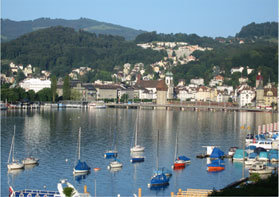
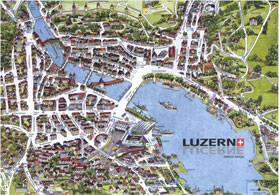
Lucerne, Switzerland is a great city for pedestrians. A walk around Lucerne, a city of only 57,500 people, is invigorating and beautiful, with the majestic Alps at your doorstep.

Founded as a small fishing village on Lake Lucerne (Vierwaldstattersee) the city (at 1,430 feet), is the focal point of the region, and the most populous city in central Switzerland.

The city is called “the essence of Switzerland” and the “Festival City” with numerous events such as the World Band Festival, Mozart Festival and the Lucerne Festival. There are numerous bridges in the city, with the Chapel Bridge the most famous, built  circa 1300 as part of the city’s fortifications.

The Musegg Wall with its nine towers was built in 1400 after the Battle of Sempach and today it is considered the longest and best preserved rampart walls in Switzerland.

A ride on the many beautiful lake steamers is a must to enjoy the surrounding countryside. Boats leave right from a dock downtown across from the train station (Bahnhof). While in Lucerne, walk through or stay at the 101-year-old historic Palace Hotel and ask for a lakeside room. 

While you are in Lucerne, stop by the Swiss Transport Museum (www.verkehrshaus.ch) and look at all the restored trains, planes, and other forms of transportation. If you have a full day each, also see Mt. Rigi (www.rigi.ch) and Mt. Pilatus (www.pilatus.ch), two spectacular mountains each obtainable by hiking or cog railway. You can take boats, trains or drive to the base of each mountain.

For more information on Lucerne, go to www.luzern.ch.