European Christmas Markets Celebrate the Season

Advent is the season in Europe when thousands of communities–large and small–set up Christmas trees, colorful lights and craft stalls in their central market square. For decades, Europeans have been getting together at these unique Christmas markets to share conversation, to enjoy a glass of hot mulled wine, or to find just the right specialty gift for a family member or friend.

European Traveler offers a quick glance at some of these fascinating markets, which normally last until Christmas Eve.

Belgium

Every town in French-speaking Wallonia hosts its own Christmas Market. The central square of Liège and the neighbouring Place du Marché stage one of Belgium’s largest Christmas Markets, attracting more than 1 million visitors with 190 wooden chalets full of tempting goodies, sweets and original hand crafted products and presents. If you’re in Brussels between November 27 and January 3, enjoy the Brussels Winter Wonderland featuring a Christmas Market with many stalls, a giant illuminated ferris wheel, street activities and a large skating rink. 


Switzerland

In Lucerne, a number of Christmas events take place, including the Christ Child Market at Railcity, the train station, between November 28 – December 21. Around 50 festively-decorated market stalls bring a  Christmas atmosphere feel to the station.

Every year between December 3-20 Lucerne’s Christmas Market takes place at the Franziskanerplatz. There are a large variety of stands with Christmas decorations, sweets, food and beverages.  The Christmas Tree Market usually starts one week before Christmas along the Schweizerhofquai. Then between December 17-20, 20 stands from 20 countries  present typical Christmas items from their homelands. There is always a stage featuring Christmas productions from all over the world. For more information, go to www.luzern.com/en/welcome.cfm?

Germany

Thuringia is primarily famous for its festive Christmas markets and especially the large selection of glass Christmas tree decorations. The Lauscha Ball Market (always held during two weekends in Advent) has the largest selection, but these traditional decorations are also available at other Thuringian Christmas markets.

In Frankfurt you are invited to the large, time-honored Christmas market where you can become acquainted with the market’s many culinary specialities and its traditions. You can join tour guides in ascending to the rooftop gallery of St. Nicholas Church, from where you’ll be able to enjoy a wonderful panoramic view of the entire market and the Frankfurt skyline. Next, join young and old for a nostalgic ride on a vintage carousel. Warm yourself with a hot cup of mulled wine at the end of the tour and take in the wonderful view of the market’s beautifully illuminated Christmas tree. The 1 1/2 hour tours include a carousel ride, hot mulled wine and special marzipan candy. Tours are available in English and German from the first day in Advent until Christmas.

Thanks to the Tourist Boards of Germany, Belgium, Austria and Switzerland for the photos in the report.
When in Austria, Look for Dirndls

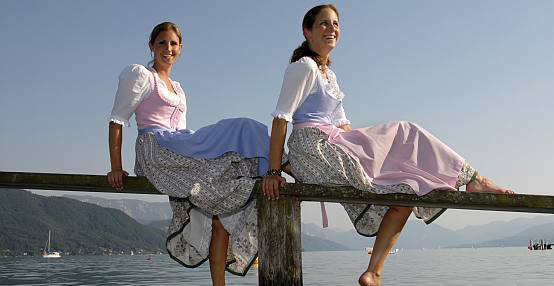
Photos courtesy Austrian Tourist Board

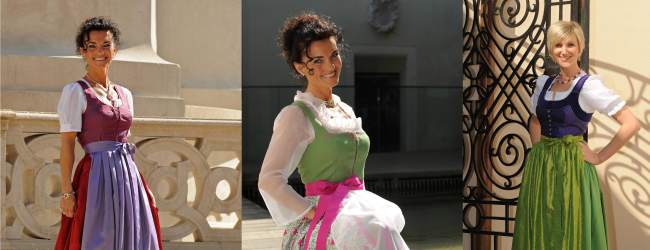
What is a Dirndl? If you have seen the movie “The Sound of Music,” you already know the basic elements that make up a Dirndl: skirt, bodice, apron and blouse. Simple, right? Far from it!

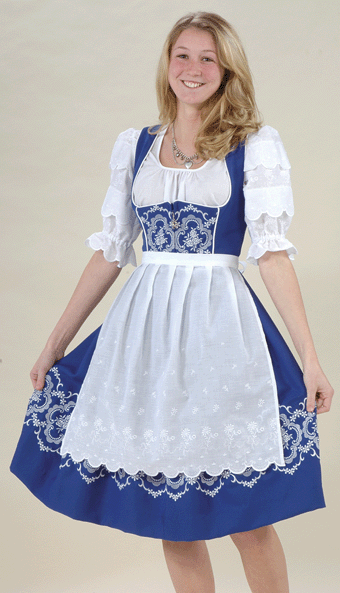
There is a veritable science to Dirndl cuts, fabric patterns, colors and embroidery.The main elements that make up a Dirndl are the wide skirt attached to a “Leiberl,” or fitted bodice, an apron (often with a hidden pocket) and a short Dirndl blouse.

The skirt usually starts at the waist or a little lower. You can choose between various lengths, depending on current fashion trends. The bodice used to be a separate item, but since the 1930s is sewn to the skirt. It comes in many different styles: with a high or low, round or square neckline, it is fastened with buttons, hooks, or ribbons.

An important element is the Dirndl blouse. It is generally very short (ends above the waist), with long, short or puffed sleeves. It can have many different necklines and is usually made of white cotton or linen. The Dirndl blouse accentuates the style of your Dirndl: Choose between delicately hand-embroidered pieces, blouses with extravagant ruffles and lace, or simple ones with straight sleeves.

Finally, there is the apron. Formerly worn to protect the dress underneath, it is now a purely decorative item. There are aprons for every-day wear and aprons for festive occasions which are usually of a more elegant fabric than the simple linen or cotton ones. Before you tie the knot—be sure to check on which side to place it—otherwise you might unwittingly send out the wrong message.

Different combinations of these elements make up the traditional Dirndl. There are different Dirndl styles for different occasions, even Dirndl styles that tell which region in Austria the wearer is from. With the recent “Dirndl Renaissance,” there are countless downright “unorthodox” styles that experiment with different fabrics, cross cultural references and punk elements.

If all these options seem daunting at first, remember: the most important thing is to have fun with the many different colors and patterns, and to choose a Dirndl that fits your personality.

FROM PEASANT GARB TO HIGH FASHION
The Dirndl has evolved from its humble origins centuries past as the work garb of peasants to a modern-day fashion superstar. With its feminine silhouette, its versatility and simple elegance, the Dirndl is a fashion “evergreen.” But where does it come from, and how did it get so popular?

Allegedly, the short Dirndl blouse we know today was originally a long shirt. Way back when, the shirt was actually one of the “basics” in the contemporary wardrobe of the rural population. Women wore a bodice, or even just a tightly wound cloth as an undergarment for warmth and support. Aprons were tied around the shirt to protect it from stains and dust. When people came home from the fields, the apron was simply switched to a different one for house work, or one for festive occasions.

Eventually, for reasons of practicality and perhaps vanity, the shirt was sometimes worn underneath the bodice and so the Dirndl was born. For a long time it was the garb of women in the countryside, and different styles developed for different regions.

Finally, in the middle of the 19th century, Emperor Franz Joseph and his court used to vacation in the Salzburg Lake district. The emperor took to wearing Lederhosen during his hunting exhibitions there, and a fashion trend was born. Suddenly, the Dirndl was all the rage and the Viennese aristocracy wore Dirndls and Lederhosen during their stay in the country.

Photo courtesy Ernst Licht German Imports

In the 1920s, the founders of the Salzburg Festival contributed to the popularity of the Dirndl by making it acceptable to wear during performances and society events. The Salzburger Dirndl manufacturer Lanz and the world-wide success of the operetta “Weisses Roessl” made the Dirndl an international hit.

Since then the Dirndl has conquered the international fashion world. In the last 10-15 years, the Dirndl and traditional costumes in general have experienced another huge surge in popularity, even outside of the regions in Austria where it has been an everyday item for generations.

WHERE TO BUY A DIRNDL?
With so many different styles to choose from, where do you start your own quest for the perfect Dirndl? Where to find authentic, traditional styles, and which Dirndl designers are known for fun and tasteful modern versions?

The best place to buy your Dirndl, of course, is at the “source.” The “real” Maria von Trapp used to mainly wear Dirndls and ordered new outfits with her favorite Dirndl tailor whenever she went back to her native Salzburg. Today, with Dirndls and Lederhosen in high demand, there are enough Dirndl manufacturers and stores to make your head spin.

For more info, go to www.austria.info/us

Hohenwerfen Fortress: A Well-Preserved Antique

Photos Courtesy Austrian Tourist Office and Tourism Salzburg

High above Salzach Valley near Salzburg and built with an unyielding stone facade, the 900-year-old Hohenwerfen Fortress has undergone centuries of development to become one of the oldest and best-preserved castles in Europe.

Tour the interior of this historic structure, visit the impressive falconry displays at Austria’s first Falconry Museum or enjoy concerts, theater performances and heritage evenings throughout the year.

Hohenwerfen Fortress

Isolated high above the Salzachtal Valley near Salzburg, Hohenwerfen fortress has a history of protecting archbishops and archdukes from enemies, as well as keeping prisoners locked up behind the impenetrable castle’s walls. These days, the stronghold’s doors are wide open to visitors to explore the history of this “Castle of Adventure.”

GREETINGS FROM THE MIDDLE AGES
A guided tour takes you through the venerable fortress’ chapel, kitchens, battlements and bell tower. Check out weapons from throughout the ages on display in the armory and arsenal, and inspect the residential rooms of former castle governors.

THE HIGH ART OF FALCONRY
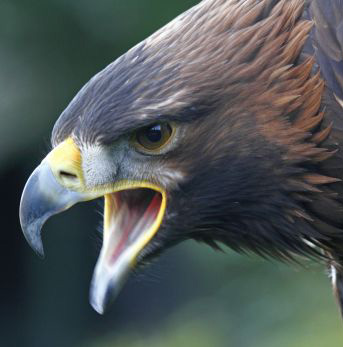
Every year, a wide variety of special events including concerts, theater performances, and folk heritage evenings take place at Hohenwerfen. Many consider the highlight of this lineup to be the daily demonstrations of falconry put on by the Provincial Falconer. To learn more about the history and skill of falconry, visit Austria’s first falconry museum along the Bird-of-Prey Path.

For more info, go to: www.austria.info

Austrian Ice Caves

Photos Courtesy Austrian Tourist Board

Austria is a magnificent country that offers plenty of tourist attractions. One popular attraction is located in Werfen, Austria which is home to “Eisriesenwelt,” German for “world of the ice giants.”

Eisriesenwelt was discovered in 1879 by a scientist named Anton Posselt and is located inside of the Tennengebirge section of the Alps. Prior to Posselt’s discovery in 1879, hunters and poachers knew of its existence, but had never entered the cave. Although Posselt only explored 1/8 of a mile inside the cave, he published a report of his discovery a year later. It wasn’t until 1921 that Eisriesenwelt saw a large increase in the number of visitors to the cave.

Lamps are distributed to visitors who explore these breathtaking caves for a 75 minute tour. Visitors experience Posselt Hall, which holds the Posselt Tower stalagmite; the Great Ice Embankment, a formation towering over 75 feet; and the Ice Organ, created by the stalactites in Hymir’s Castle. The ice formations are sometimes highlighted with magnesium lighting for an added effect.

The Eisriesenwelt caves are open from May 1 to October 26, and during peak season tours are held every six minutes.

For more info, go to: www.austria.info

Experience 24 Hours in Innsbruck

Innsbruck, Austria

Photos courtesy Innsbruck Tourism

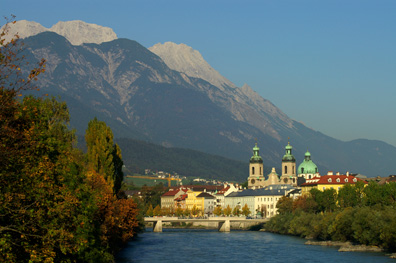
Innsbruck’s beautiful medieval Old Town, set against the backdrop of majestic peaks, is everything you picture a quintessential Alpine town to be. Yet its quaint appearance can be deceiving: a one-day tour will reveal a rich and varied side of Tirol’s capital underneath layers of ancient history and cherished tradition.

MORNING
Before you do anything else, purchase a 24-hour Innsbruck Card either at your hotel or at the Innsbruck Information Office in the Old Town. This grants you access to all museums, public transportation, one roundtrip on any of Innsbruck’s lifts and cable cars and guided tours. Armed with the card, you are now set to start your day with a tour of the historic city center. You’ll love the colorful medieval buildings, vaulted walkways and stuccoed facades.

Golden Roof

Innsbruck’s landmark, the Golden Roof, is famously covered with exactly 2,657 gilded tiles and overlooks the main square. In the 15th century, the Habsburg family ruled their empire from Innsbruck’s Hofburg Imperial Palace.

See the Imperial Apartments and exhibitions at the palace, then stop at the adjacent Hofkirche Court Church, where one of the most important cultural monuments in Tyrol is on display: 28 larger-than-life bronze figures surround the 16th century tomb of Emperor Maximilian I, representing his heroes of antiquity and his ancestors. The quaint alleys of the Old Town also house many small boutique stores offering handcrafted Tyrolean products that make for excellent souvenirs.

AFTERNOON
For lunch with a view, head past the Hofburg Imperial Palace to the Nordkettenbahnen Cable Cars. The funicular stations were designed by star-architect Zaha Hadid, and their sleek modern design contrasts beautifully with the surrounding landscape and historic architecture of the city.

Only 20 minutes later you’ll find yourself at 6,500 feet, near the top of the Nordkette Mountain range. Head to the restaurant at the Alpenlounge Seegrube and enjoy the breathtaking views over Innsbruck and the Austrian Alps. If you want to continue your mountain experience, head to the Innsbruck Alpine Zoo. Europe’s highest zoo features more than 2,000 animals including bears, wolves, eagles and many other species native to the region. To get there, simply take the Nordkettenbahnen back down the mountain and get off at the Alpenzoo Station. Otherwise, head straight back to the city in the early afternoon. It’s time to explore Innsbruck’s excellent shopping street, the Maria-Theresien-Strasse. Within view of the Golden Roof, the grand boulevard is located in a pedestrian area and—among many smaller shops and boutiques—houses two shopping centers: the ultra-modern Kaufhaus Tyrol designed by David Chipperfield and the Rathaus Galerien with boutique stores featuring well-known luxury brands. Don’t miss the Swarovski Flagship Store in the Old Town.

Maria Theresien

Another option for outdoor enthusiasts is to spend the afternoon taking part in Innsbruck’s fabulous summer hiking program. Visitors to Innsbruck and its 25 holiday villages can use the hiker’s bus with their Guest Card and explore the region with a free mountain guide. Even the equipment rental is free of charge with your Guest Card. Simply make a reservation through your hotel the day before.

EVENING
You don’t really know a destination until you have sampled its food. Tyrol is famous for its hearty fare, such as Tiroler Gröstl (meat, potatoes, and onions topped with a fried egg) and a large variety of sweet and savory dumplings. The famous Café Sacher, a traditional Viennese coffee house and restaurant, as well as the Ottoburg, the Weisses Rössl or the Goldener Adler in the Old Town all feature excellent authentic cuisine. After dinner, head to the newly-opened Adlers hotel, housed in one of the city’s tallest buildings and enjoy a cocktail on the rooftop terrace, ending the day with a stunning view of Innsbruck by night.

For more info, go to www.austria.info/us or www.innsbruck.info/en