Visitors to the Castilla-La Mancha region can absorb Spanish traditions at this strategically located monastery-turned-hotel
By Randy Mink
For soaking up the heritage and romance of Spain almost by osmosis, nothing beats staying overnight in one of the country’s government-owned paradors. Many of the parador network’s 90-plus hostelries occupy former castles, palaces, fortresses and other types of historic buildings. They’re a big hit with North Americans seeking out Old World flavor.
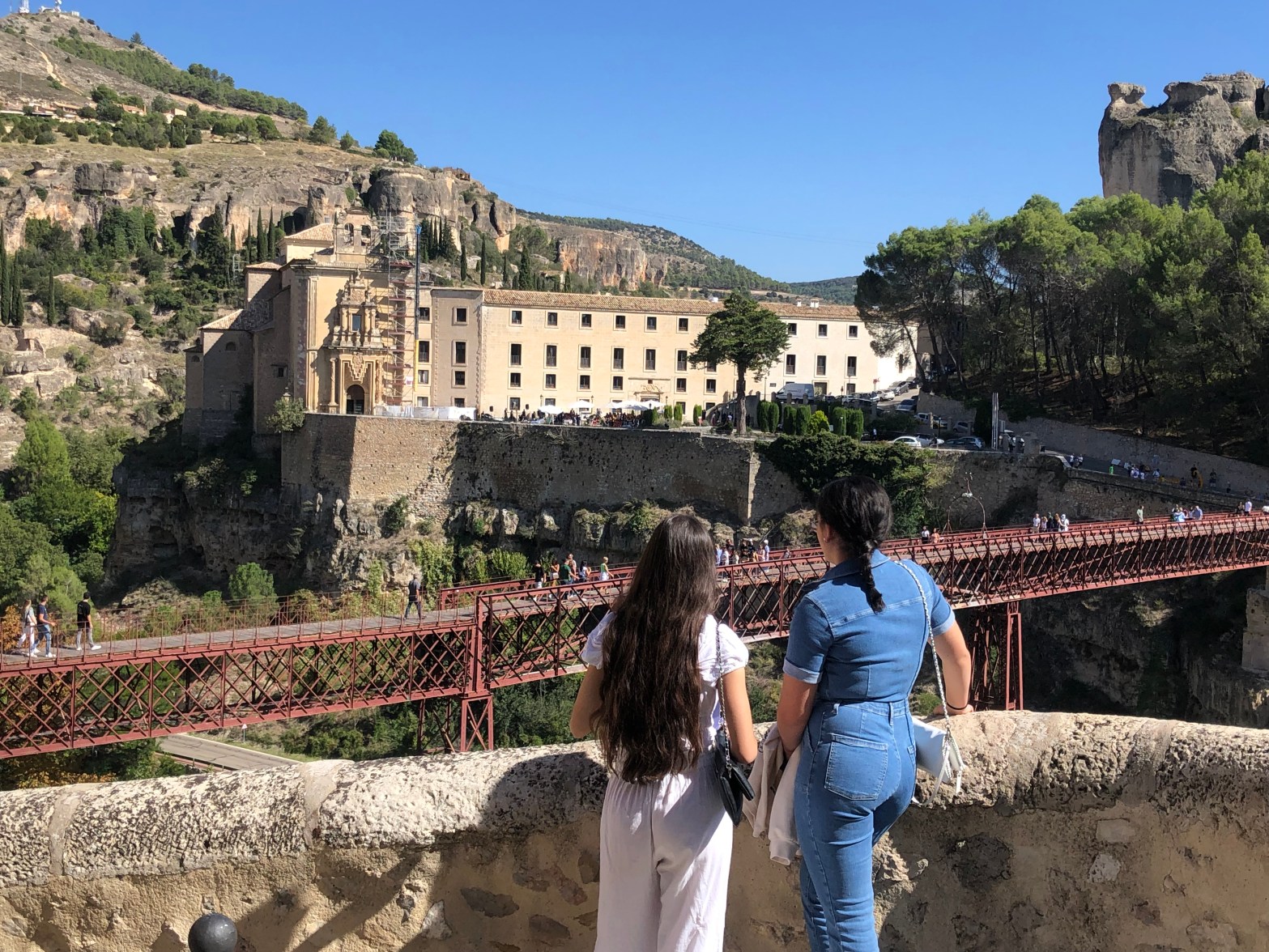
Both for its prime location and historical ambience, the 63-room Parador de Cuenca, once the monastery of San Pablo, makes an ideal home base in the enchanting city of Cuenca. Set on a rocky outcrop high above the Huécar River, the hotel affords postcard-perfect views of ancient buildings clinging to the cliffs across the gorge. And just steps from the entrance lies the city’s photogenic San Pablo Bridge, a gorge-spanning walkway that leads to the Ciudad Alta (Old City).
Parador de Cuenca overlooks the gorge-spanning San Pablo footbridge. (Randy Mink Photo)
A destination in itself, Parador de Cuenca was built in the 16th century by the Dominican order. The monastery, with a Gothic-style church, Renaissance cloister and Baroque facade, was converted into a university in the 1800s and later served as a hospital, secondary school and military headquarters.
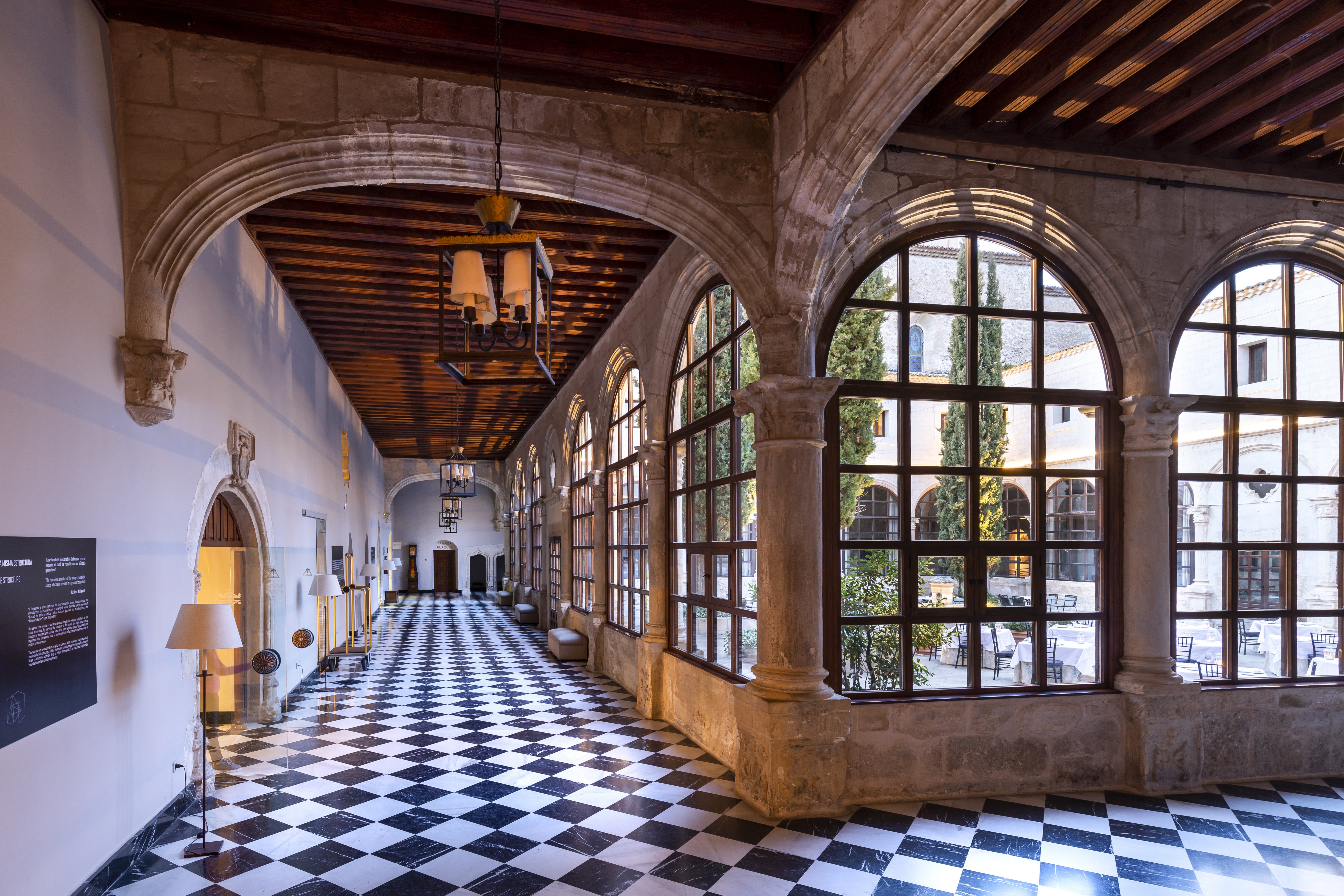
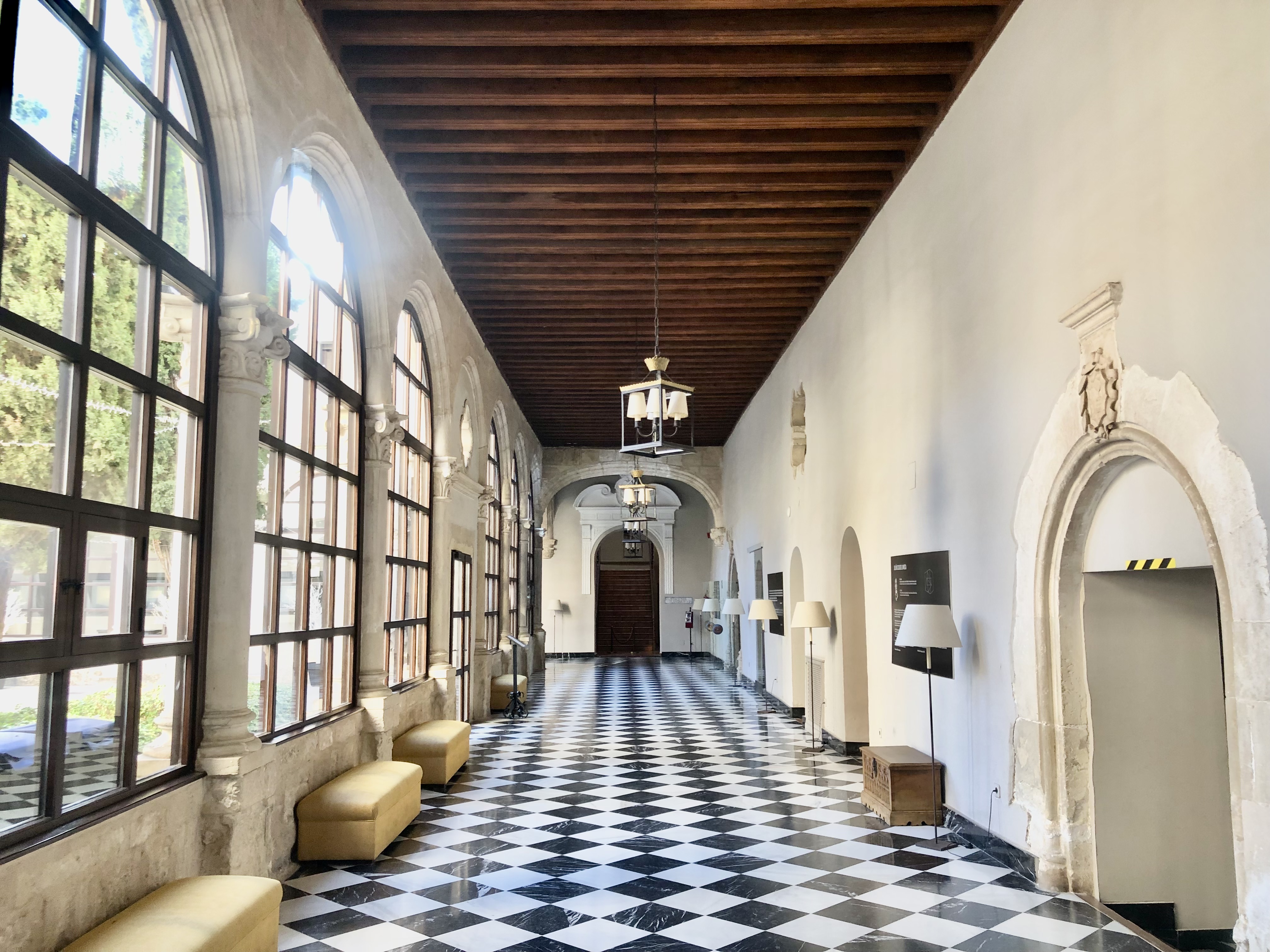
One of the hotel’s most striking features is the beautiful cloister that wraps around an open-air courtyard where you can enjoy a drink on a summer evening. The arcades, graced with semi-circular arches, beamed ceilings and black-and-white-tile floors, are accented here and there with antiques, including wooden chests and a grandfather clock. (On the Saturday of our visit, a wedding party had taken over the courtyard after a ceremony held under a tent in the plaza out front.)
The former monastery’s gracious cloister has been well preserved. (left, Paradores de Turismo de España; right, Randy Mink Photo)
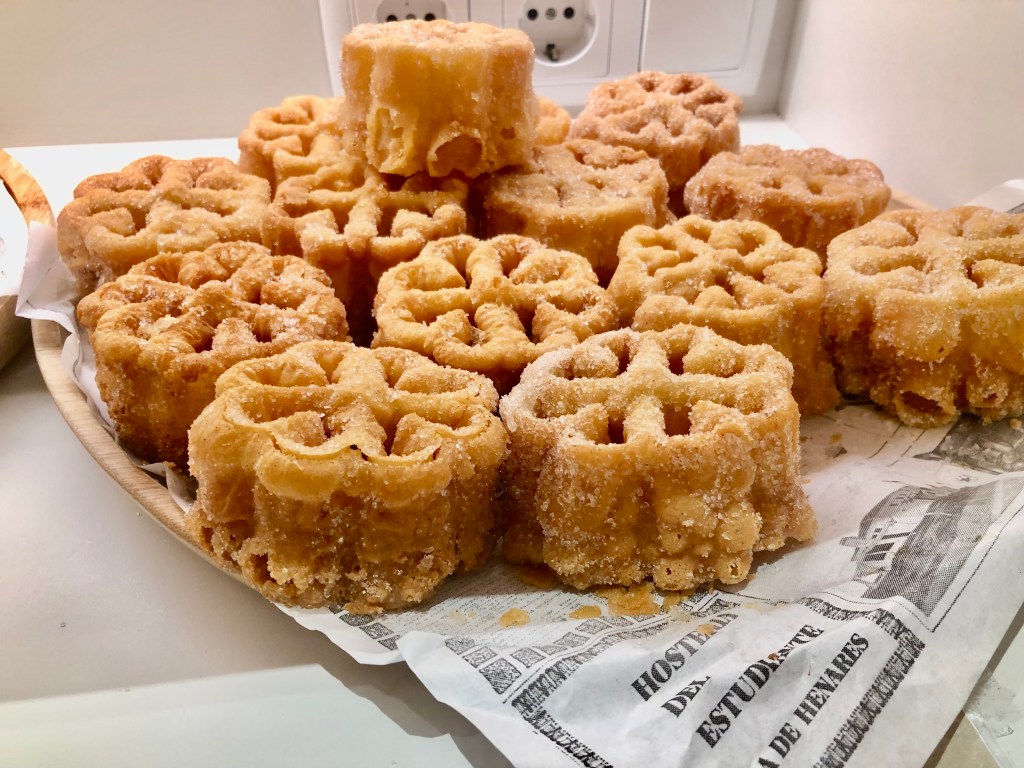
Also impressive is the coffered wooden ceiling of the parador’s restaurant. Once a chapel where monks prayed, the vaulted room is a heavenly place for breakfast. At the buffet we helped ourselves to fresh fruits, meats, cheeses, yogurt, artisan breads and all kinds of homemade pastries. A fan of baked goods, I filled up on mini brioches with chocolate chips, pretty pink-frosted strawberry chocolate donuts, shortbread cookies made by nuns from a local convent and Manchego flowers (or flores manchegas), a flaky, flower-shaped pastry of fried dough dusted with sugar and cinnamon.
Among the many pastries offered at the parador’s bountiful breakfast buffet are Manchego flowers, or flores manchegas. (Randy Mink Photo)
From the a la carte menu we could order piping-hot churros or eggs any style, but both days I went for migas, a humble dish that became a favorite of mine while traveling in Spain. A satisfying comfort food, migas combines fried crumbs from stale bread (soaked in water to get moist), olive oil, garlic, paprika (coloring it orange) and bits of chorizo. The crispy concoction is usually topped with a fried egg.
Paradors are known for purveying the best in Spanish gastronomy, and the restaurant’s dinner menu features many dishes with traditional recipes from central Spain’s Castilla-La Mancha region. Entrees include shoulder of suckling lamb, Manchego-style roasted lamb with rosemary sauce, and baked cod with Manchego ratatouille and saffron sauce.
The word “Manchego”—known to North Americans as the name of a prized, semi-hard sheep’s milk cheese—and its various forms refer broadly to the La Mancha region. A man from La Mancha would be a Manchegan (with a capital “M”) in English, or a manchego in Spanish.
To explain it further, Americans have only heard the adjective manchego in reference to the cheese, so often when they see the popular Spanish vegetable dish, pisto manchego, they assume it has to do with cheese, but it actually has no cheese at all; it just means it’s a Manchegan dish. The parador’s menu offers a selection of Manchego cheeses, or quesos manchegos.
Like the dining hall, the bar evokes the spirit of the old monastery. Just look up at the lovely religious ceiling frescoes framed by ornate plasterwork.
Summer guests can enjoy the parador’s swimming pool. Long ago, the parador’s dining room was the monastery’s chapel.(Randy Mink Photos)
Across the road are the tennis courts, outdoor swimming pool and party room. The main building has a fitness room.
The high-ceilinged guest rooms at Parador de Cuenca are tastefully appointed. My third-floor nest had a desk, TV, refrigerator and individual temperature controls. There were two floor lamps, two upholstered chairs and a coffee table. The red-tile floors and carved wooden doors lent a rustic look. Bathroom amenities included vanity and dental kits, make-up mirror and hairdryer. In both the bedroom and bathroom, windows let in fresh air and allowed me to hear crowing roosters at the farmstead across the river.
For information on the paradors of Spain, visit www.paradores.es.
Salamanca’s Old Town boasts one of the largest and most beautiful town squares in Spain. Its labyrinth of pedestrian streets is a stroller’s paradise.
Story and photos by Randy Mink
Two of my favorite things to do in Europe are: 1) communing with the past in historic city centers with rambling pedestrian zones and 2) watching the world go by while noshing away at an outdoor cafe. For me, life doesn’t get better than this.
In west-central Spain, the perfect place to pursue both passions is Salamanca, a medium-size city just 100 minutes away from Madrid by high-speed train.
Salamanca’s Plaza Mayor, one of the most magnificent town squares in Spain, is ringed with cafes serving up tapas, those delectable little bites craved by locals and tourists alike. Steps away, cobbled, car-free streets invite carefree wanderers to travel back centuries, as distant as the Middle Ages. Giving this outdoor museum a youthful vibe are students from around the world who attend the University of Salamanca, Spain’s oldest. It’s all there for a true European experience in this UNESCO World Heritage City.
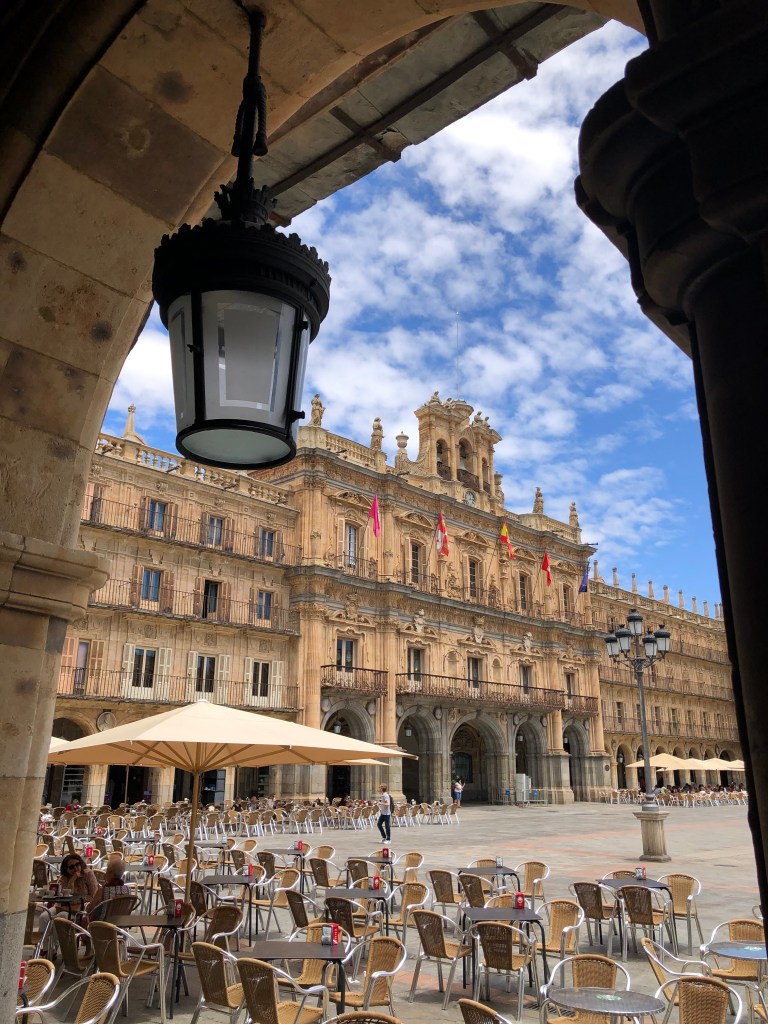
Salamanca’s Plaza Mayor is one of the largest and most beautiful central squares in Spain. The Baroque architecture dates from the 1700s.
Salamanca is not exactly on the way to other big destinations—you have to seek it out. That gives the city a feeling of being undiscovered.
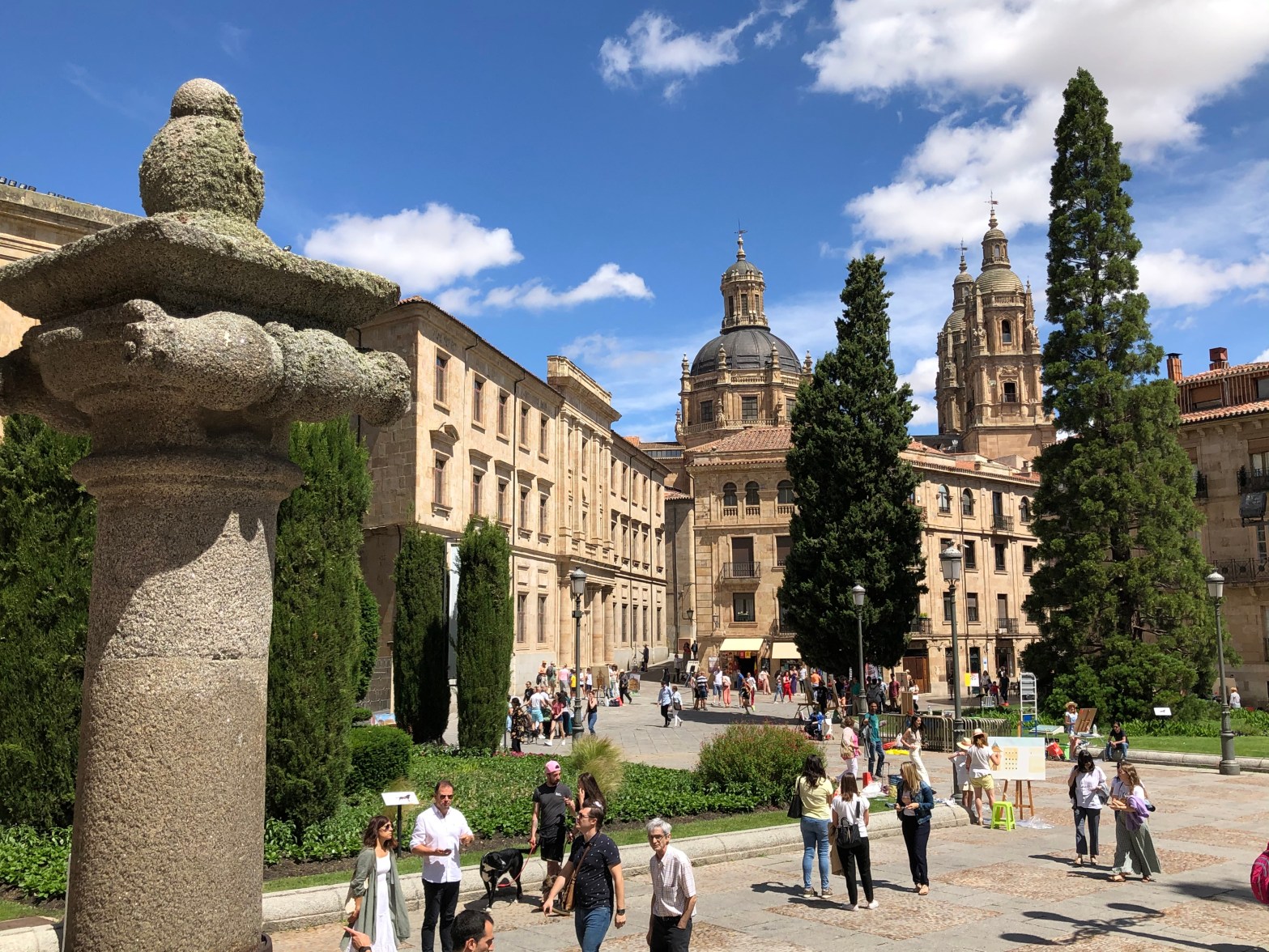
Tourist-friendly but not too crowded, the historic core is compact and manageable. The number of sights is not overwhelming, so there’s time to pause, reflect and loll about eating tapas on the Plaza or Calle Rua Mayor, the main pedestrian artery. Salamanca’s Old Town, to my mind, is Spain in a nutshell.
Salamanca’s Majestic Plaza Mayor
From your umbrella table on the Plaza Mayor, once a bullring and now criss-crossed by constant foot traffic, you can take in the sweeping expanse of Baroque architectural grandeur dating from the 1700s. Cement benches provide seating in the middle of the square, and three floors of stately, balconied apartments rise above the archways that rim its perimeter.
In the arcades, you’ll find not only cafes but restaurants, bakeries, ice cream shops and the tourist office as well. The flag-bedecked clock tower building, a common meeting point, houses the Town Hall. Stone medallions on the colonnades depict great Spanish writers, kings and queens, and explorers like Columbus and Cortes. (After years of controversy, the image of former dictator Francisco Franco was taken down in 2017.) Sort of a community living room, the Plaza Mayor is the heart and soul of Salamanca.
Tapa Tasting in Salamanca’s Old Town
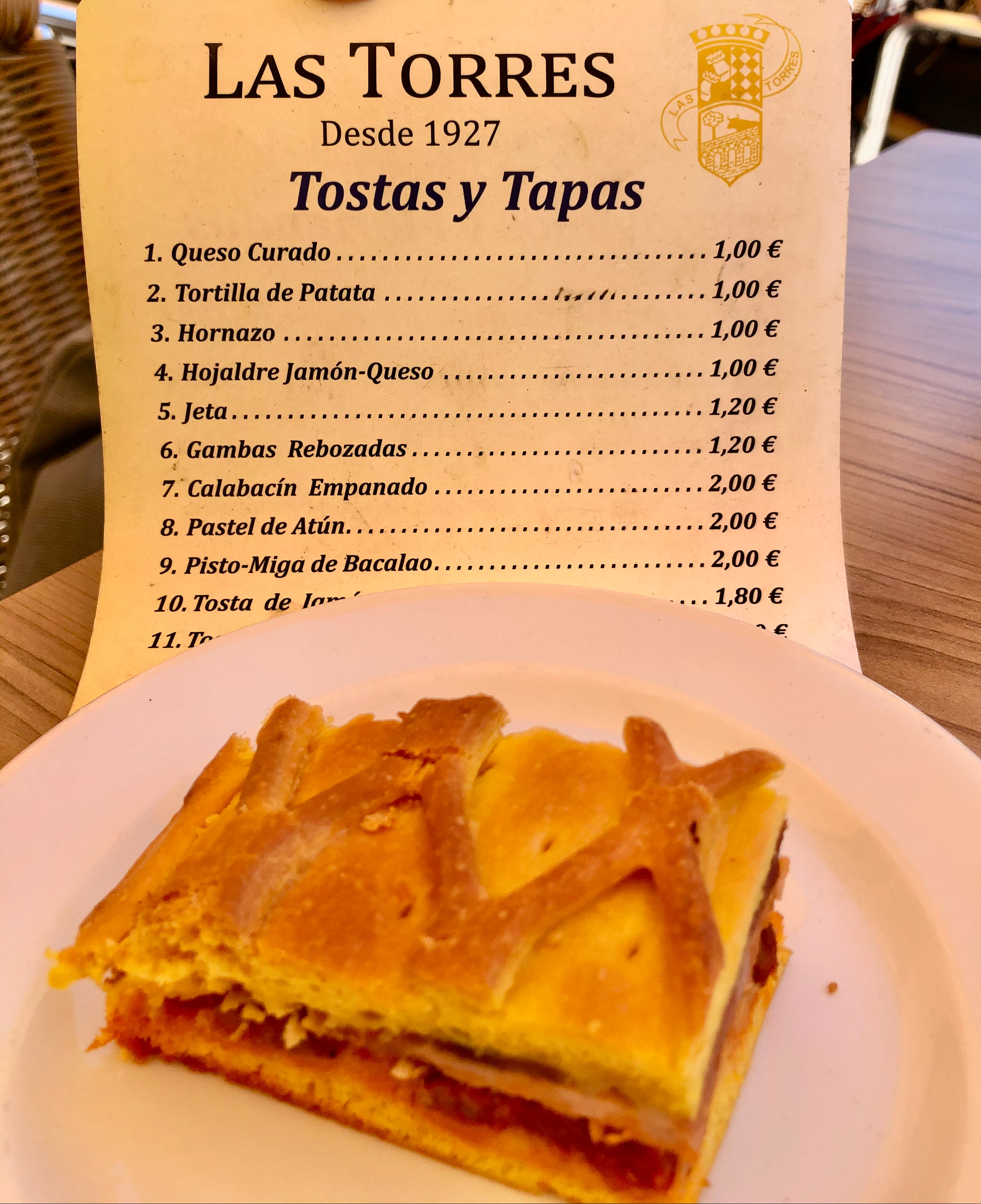
On a bright spring day, I surveyed the splendor from my perch at Las Torres, nibbling on items from the tapas menu at the venerable cafe/bar, a Plaza Mayor fixture since 1927. My favorite was hornazo, a meat lover’s dream. This Salamanca province specialty consists of layers of pork chorizo, pork loin and ham wrapped in lattice-crusted yellow dough, and sometimes includes bits of hard-boiled egg. I also indulged in fried eggplant slices drizzled with honey (crujiente de berenjena-miel in Spanish), more of an Andalusia specialty (from that region’s historical North African influences).
“Hornazo,” a specialty of Salamanca province, consists of layers of pork chorizo, pork loin and ham wrapped in lattice-crusted yellow dough. It is served as a tapa at cafes and restaurants, and sold at bakeries and food shops in larger quantities.
During my two days in Salamanca, I had other memorable tapas:
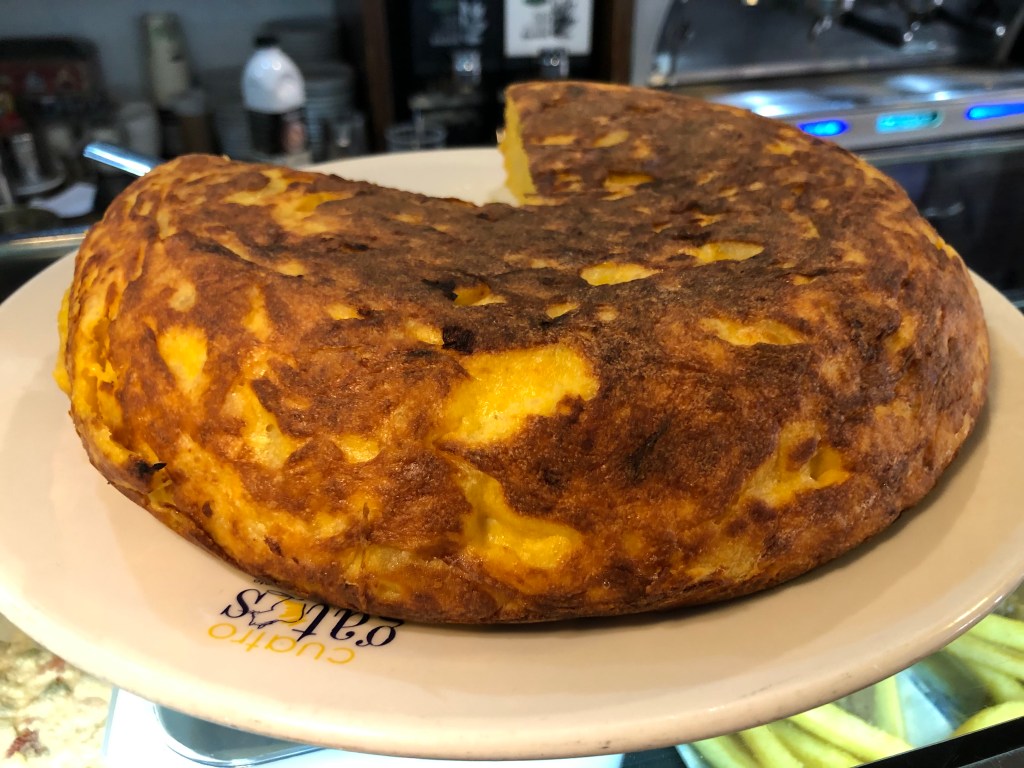
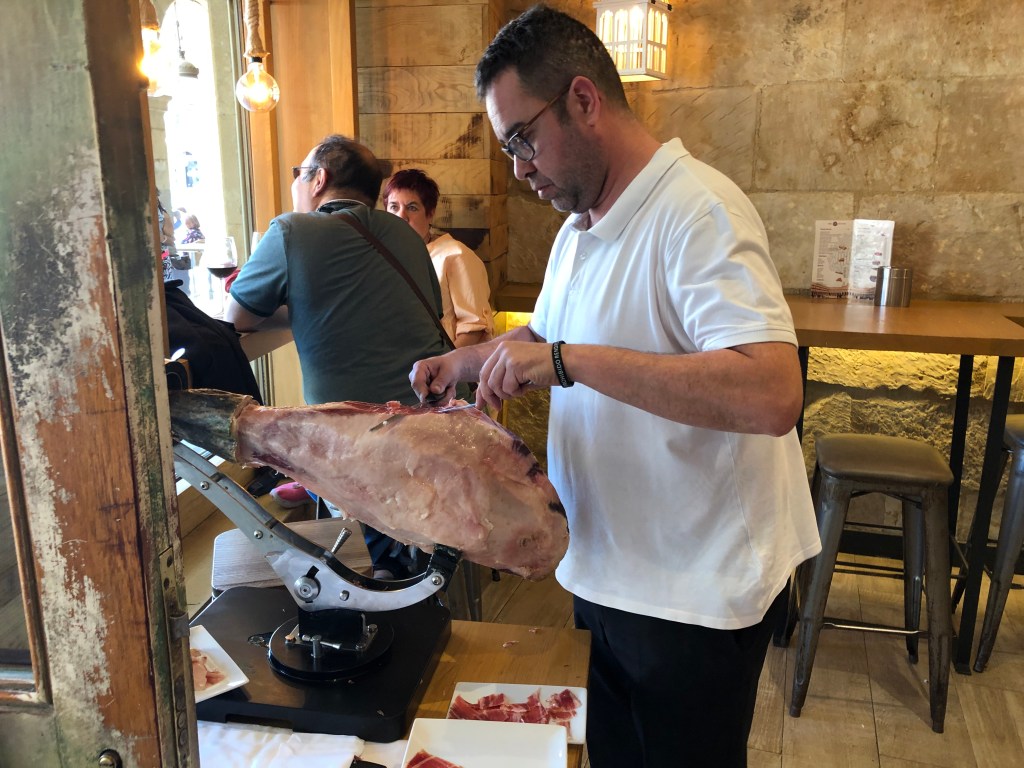
At the Plaza’s Cafeteria Los Escudos, I chose two classics—Iberian cured ham (jamon iberico), thinly sliced on the spot, and a wedge of Spanish omelette (tortilla de patatas), a simple egg-and-potato dish.
On a visit to Los Escudos the next day, I tried ensaladilla rusa—called paloma in Salamanca—a mayonnaise-y tapa with potato, peas and tiny bits of tuna, carrot, olive and hard-boiled egg, served with a wavy, shell-like crisp.
On Calle Rua Mayor, another prime spot for people-watching, I stopped at Cuatro Gatos for revuelto de farinato, a pretty orange-yellow concoction made of farinato (pork fat mixed with bread crumbs and paprika) and fried egg. Flavored with onion, salt, anise seed and other seasonings, farinato is called the “poor man’s chorizo.”
At several places, I ordered ham, chicken or Roquefort cheese croquettes. A favorite of mine, the croquette (croqueta) is a diminutive, deep-fried log of mush filled with the hot, creamy goodness of bechamel sauce (olive oil, butter, flour, milk). Yum.
For dinner at Lilicook Gastropub, I started with a plate of patatas bravas from the menu’s tapas section. The hefty portion of fried potatoes in spicy tomato/mayonnaise sauce could have been my whole meal.
(left) Among the many tapa choices in Salamanca, Spain is “revuelto de farinato,” a mixture of farinato (pork fat with bread crumbs and paprika) and fried egg. (center) Wedges of Spanish omelette, or “tortilla de patatas,” are popular with tapa lovers throughout Spain. This beauty is a creation of Cafeteria Los Escudos, a cafe on Salamanca’s Plaza Mayor. (right) Iberian cured ham (“jamon iberico”), a favorite tapa in Spain, is thinly sliced on the spot at Cafeteria Los Escudos, a cafe on Salamanca’s Plaza Mayor.
Seeing Salamanca From on High
In Europe, whenever the chance arises, I climb to the top of a major landmark—for bird’s-eye views and just the challenge and bragging rights of making it to the summit. Salamanca’s Old Town presented me opportunities at two buildings a short walk from the Plaza Mayor.
At La Clerecia Church, I ascended the wooden Scala Coeli, or “Stairway of Heaven,” on a 200-step trek to the passageway connecting its two bell towers. Setting my sights even higher, I then took the spiral, bell ringer’s stairwell for a look at the big iron bells. Besides enjoying panoramas of the city’s ancient churches, convents and palaces, I spied migratory storks nesting on the dome of the colossal Baroque church, which began life in 1617 as a training school for Jesuit missionaries and now is home to Pontificia University, a private Roman Catholic school.
I also tackled the 328-foot-tall bell tower—and tried my hand at bell ringing—at Salamanca’s somewhat quirky double-cathedral complex. Built centuries apart, the Old Cathedral and New Cathedral are actually attached—they share buttresses. In fact, you can’t visit the 13th century Romanesque church (Cathedral of Santa Maria) without going through the Cathedral of La Asuncion de la Virgen, or New Cathedral, which isn’t new at all—it was built hundreds of years ago in the Gothic, Renaissance and Baroque styles. The bell tower is the highest historic tower in Spain after La Giralda in Seville.
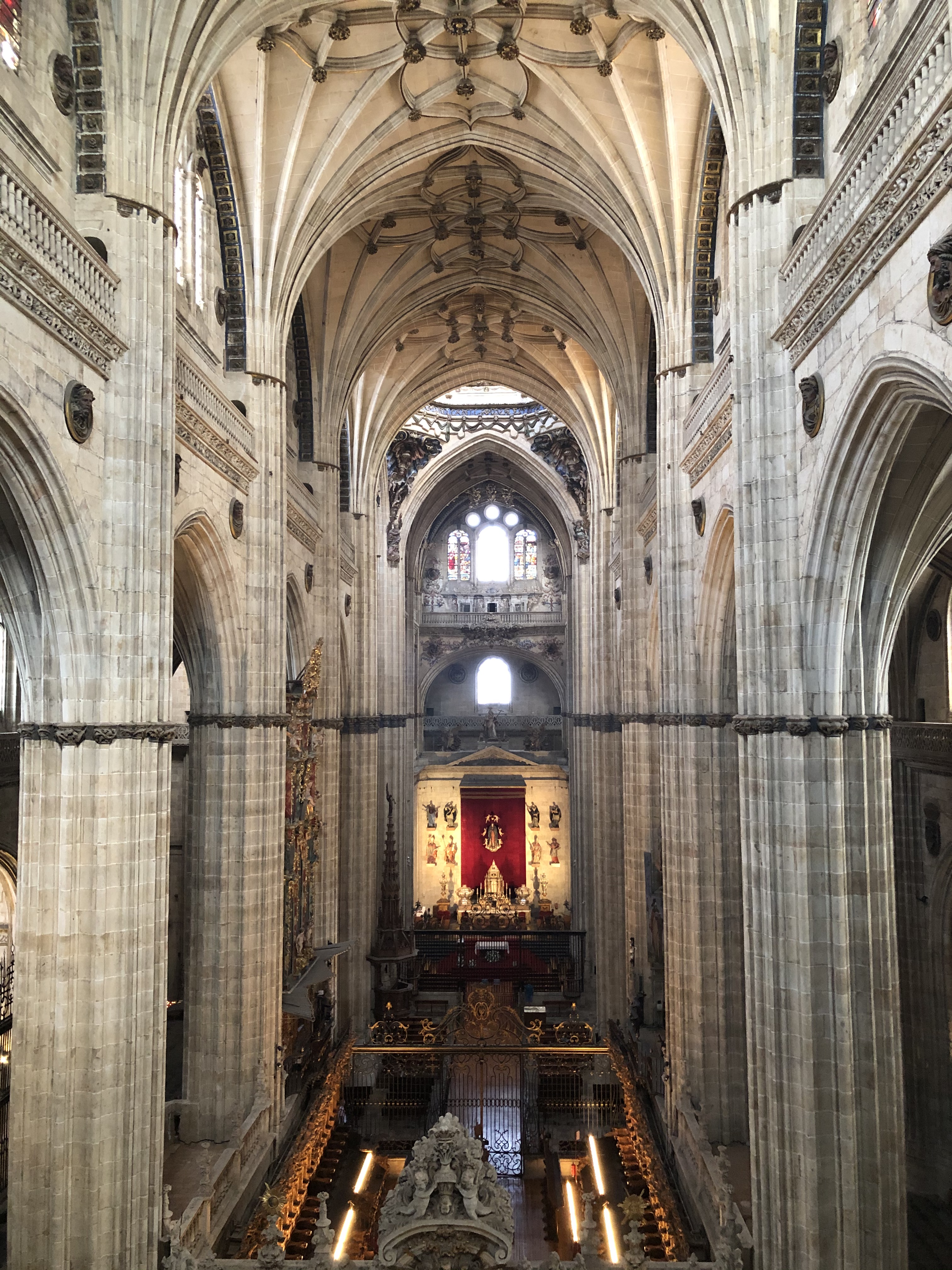
From a viewing platform, visitors can admire the Gothic-style nave of Salamanca’s New Cathedral.
For those who don’t make it to the bell room at the top, lower-level terraces offer fine views of the town and the cathedrals’ exteriors. A cell phone tour of the interiors, a cool activity on a hot day, highlights sumptuous wood carvings, murals and a massive organ.
The University Plays a Big Role in Salamanca
For its first 200 years, the University of Salamanca was in the Old Cathedral. Founded in 1218 by King Alfonso IX of Leon, it ranks as one of the oldest universities in Europe, and, though its prestige peaked in the 16th century, clearly enhances the city’s image.
On a walk through the Old Town’s student quarter, it’s not uncommon to hear English spoken, as many American study-abroad programs take place at the university, which includes both historic buildings—some from the 15th century—and modern ones. Besides Spanish language courses, foreigners take classes in Spanish culture and literature.
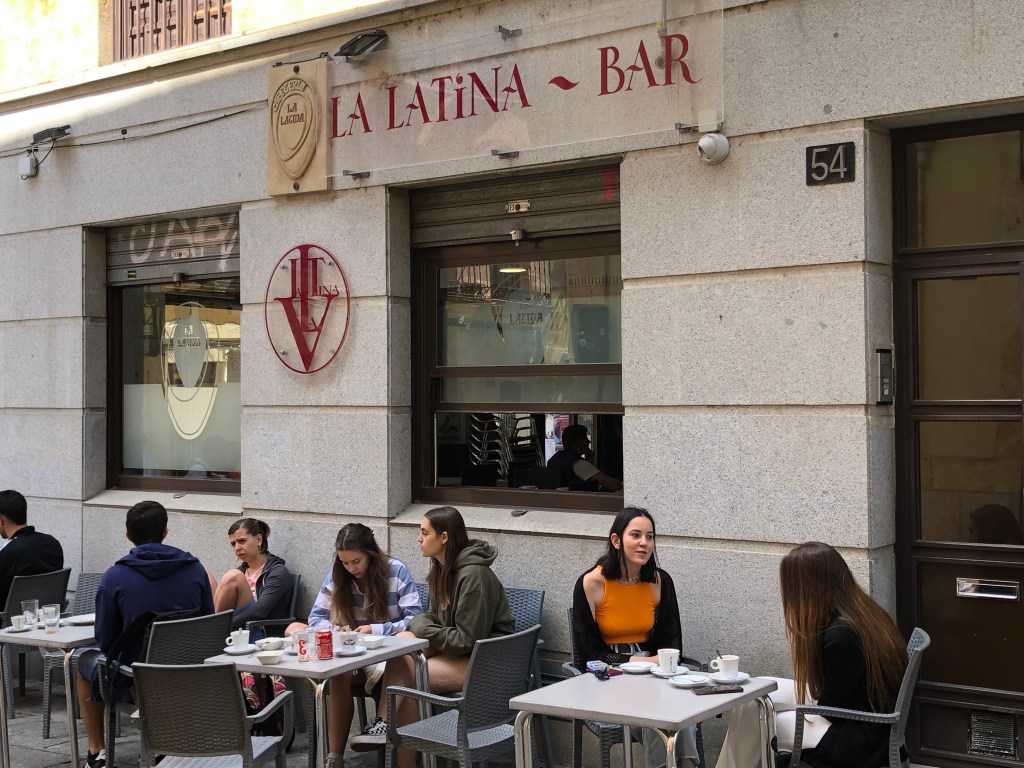
(left and center) Cafes in the student quarter give Old Town Salamanca a youthful vibe. The University of Salamanca, Spain’s oldest, dates back to 1218. (right) The University of Salamanca, the oldest university in Spain, is among the many points of interest in Old Town, a warren of pedestrianized streets filled with examples of architectural splendor.
Intricate stone carvings on the facade of the main university building (Escuelas Mayores, or Upper Schools) provide the focal point for tourists exploring the hallowed streets of academia. The decorative style of ornamentation, popular during the late Spanish Renaissance, is called Plateresque because the filigree-like carvings resemble fine silver jewelry, plata being the Spanish word for “silver.” At any time of day, you’ll see people craning their necks trying to spot the “hidden” frog sitting on a human skull. (Vendors sell croaking toy frogs, and souvenir stores are full of frog trinkets.)
Frescoes and intricate stone carvings impress visitors touring Salamanca’s 13th-century Old Cathedral, a lovingly preserved survivor of the Middle Ages.
Also gracing the splendid facade are carvings of King Ferdinand and Queen Isabella, who financed the university; their grandson, Hapsburg Emperor Charles V; and the pope at the time, plus mythical heroes, religious scenes and coats of arms. (This type of tapestry in sandstone, an Arabic influence, also is found adorning the New Cathedral, St. Stephen’s Monastery and other Old Town buildings from the period.) For an admission fee, tourists can go inside the academic shrine and see the original classrooms and lecture halls, now museum exhibits.
Savoring Salamanca’s Old World Splendor and its Golden Glow
The sandstone used in Old Town’s buildings, quarried in nearby Villamayor, takes on a golden cast as it ages, giving Salamanca a special patina and the nickname Golden City. New buildings constructed with the same stone exhibit a lighter shade.
The best place for photographing the Old World splendor from a distance is the Roman Bridge, a pedestrian span over the River Tormes. Located just outside the city walls, this 1st century relic comprises 26 arches, 15 of them originals. Standing by the bridge is the oldest monument in Salamanca—a weathered stone bull created by pre-Roman settlers about 2,300 years ago. From the bridge you see that the New Cathedral is much bigger than the Old Cathedral. A riverfront park has benches, bike paths and boats for rent.
The Roman Bridge, a walkway spanning the River Tormes, affords fine views dominated by the church towers and domes of Salamanca’s Old Town.
Salamanca Invites Strolling Day and Night
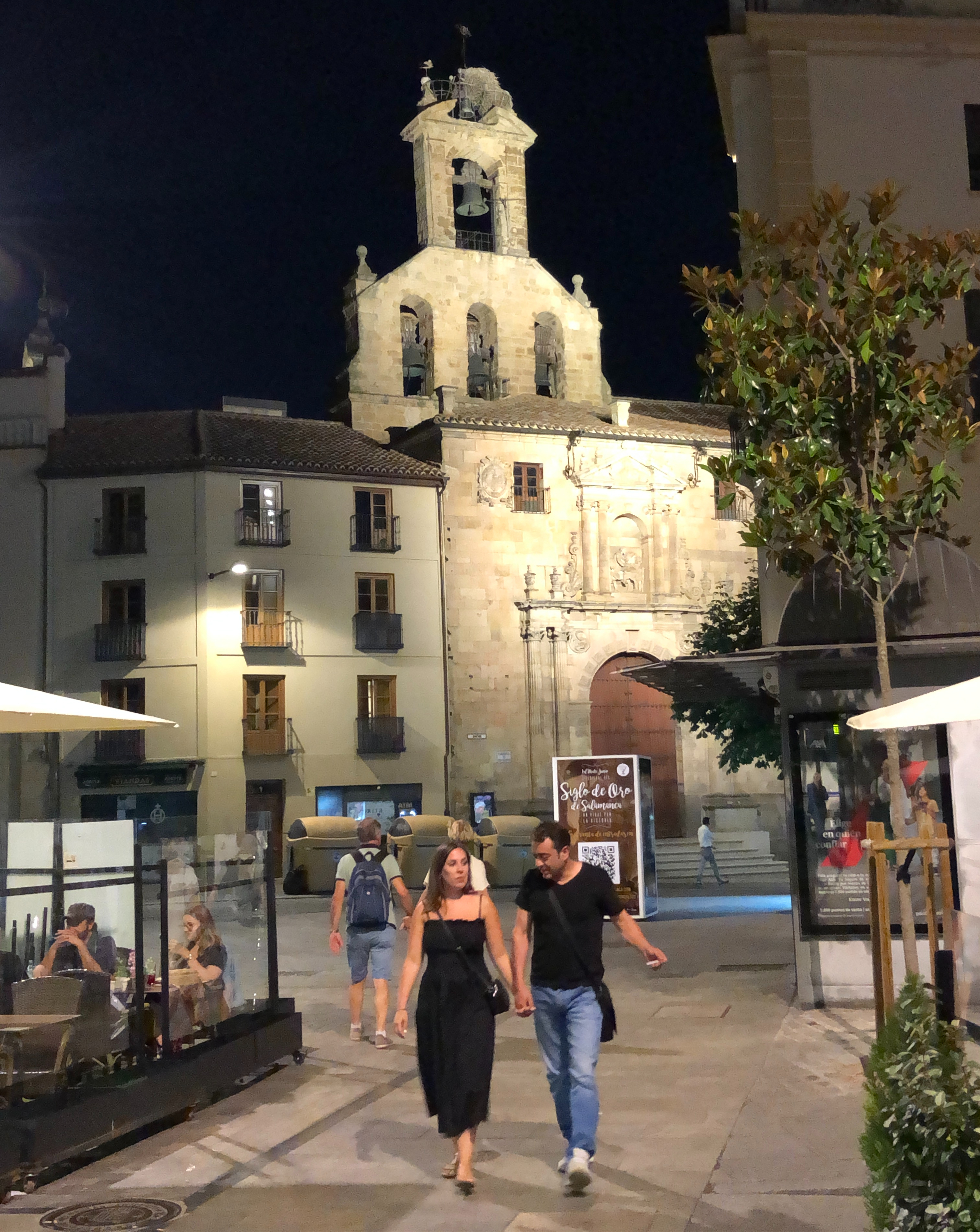
Salamanca’s Old Town doesn’t roll up the sidewalks after dark. Floodlit church towers, domes and facades cast a romantic spell, and ornate iron lampposts illuminate the stone streets. Strolling around this enchanting labyrinth one night around 11:30, I witnessed people thronging restaurants and cafes, lining up at ice cream stands, and sitting on park benches and church steps as they watched the crowds parade by. (I’ll never get used to the Spanish penchant for late-night dinners.) There were even families out with young kids, and a few souvenir stores were open as midnight approached. I loved the ambience—lively but relaxed.
Why was I pounding the pavement well past my bedtime? Having been seduced by the Golden City, I just wanted to soak up every last drop of magic before I had to leave by train the next morning for Madrid and my flight home to Chicago. Salamanca is truly a treasure to savor.
Floodlit buildings cast a romantic spell on Salamanca’s Old Town, a lively district that stays open late.
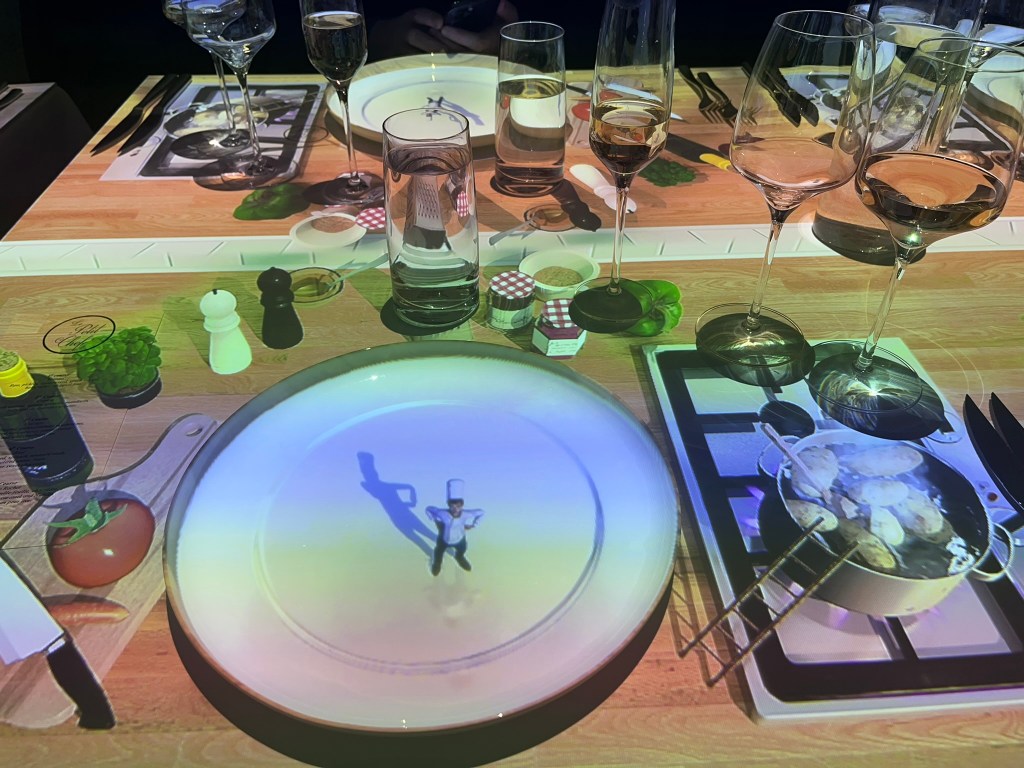
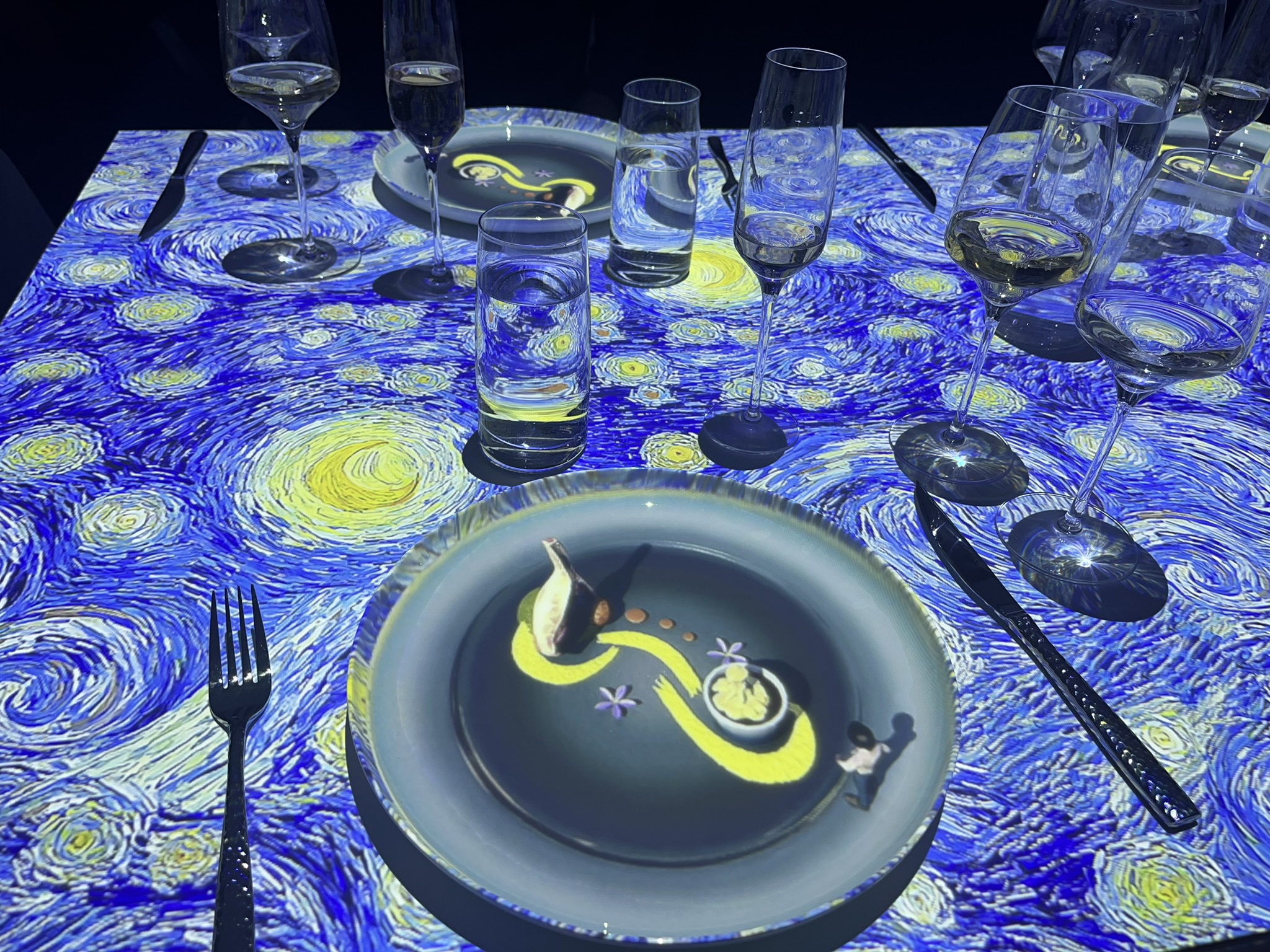
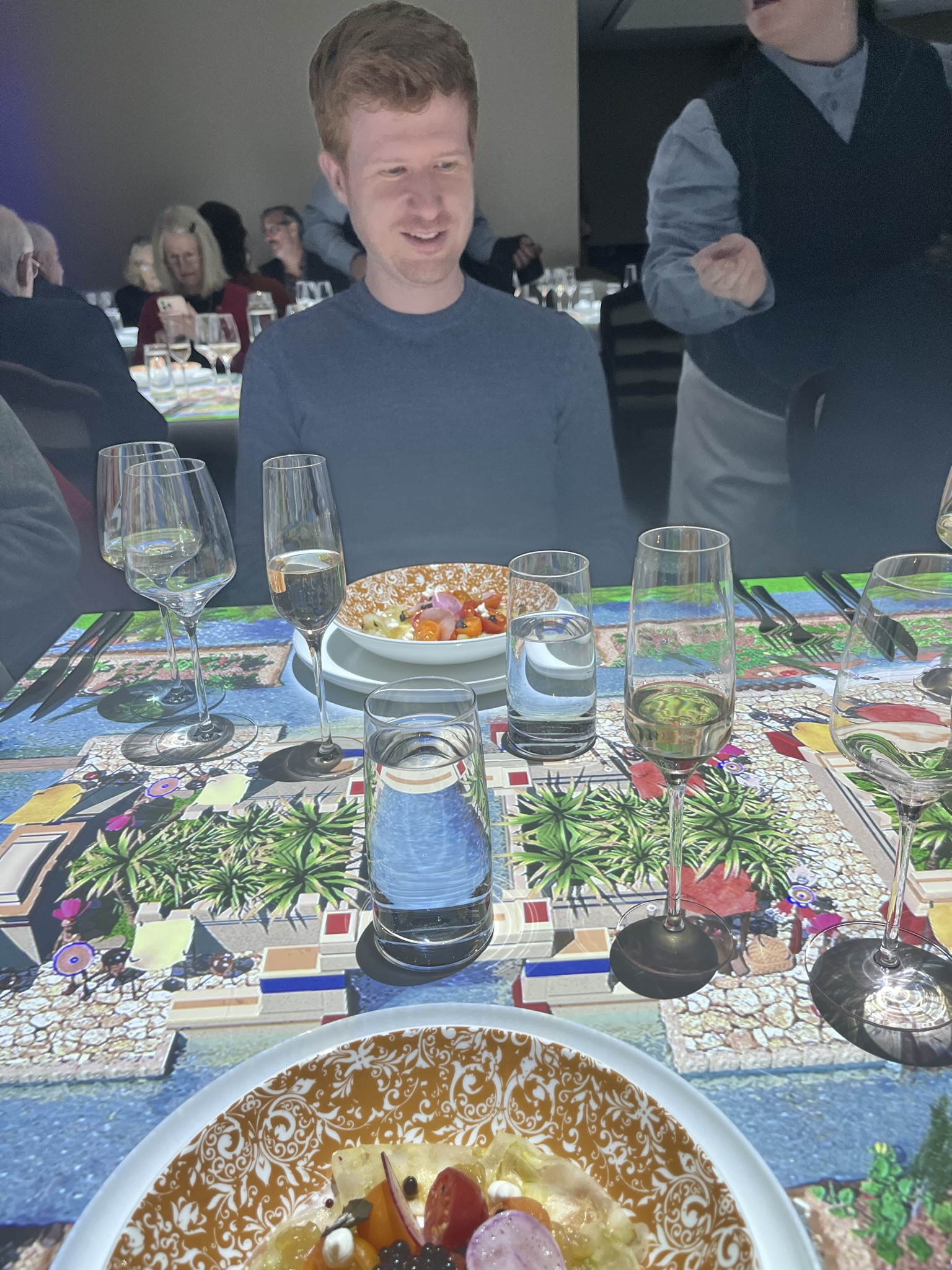
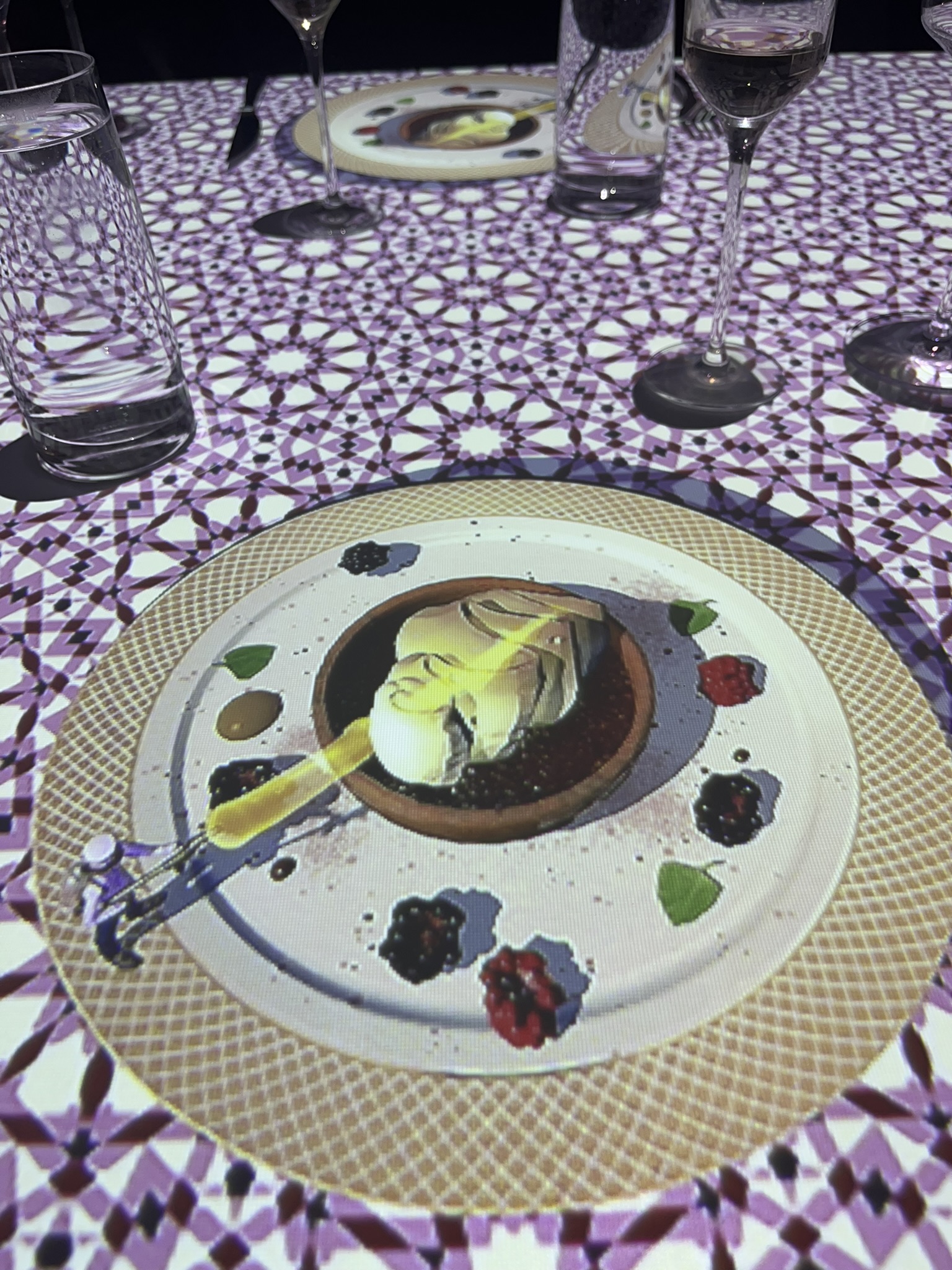
A simple white charger plate and smooth white table turn into a texture-rich artistic musical experience, culinary history lesson, and elaborate feast right before your eyes! Fairmont Chicago’s Le Petit Chef: An Immersive Dining Experience features a 2.5-inch animated French character created by artists at Skullmapping. Rising from the center of your plate via groundbreaking 3D projection mapping that requires no special eyeglasses or visors, Le Petit Chef illustrates through colorful storytelling the history of ingredients used in the meal, the joy of being a chef, and the art of creative plating inspired by famous painters. It’s a dining experience like no other, and Fairmont Chicago, in partnership with TableMation™, opened this exclusive gastronomical adventure to the public on January 19, 2023. The lobby level Cuvée Room at Fairmont Chicago houses this 90-minute themed dinner with curated wine pairings.
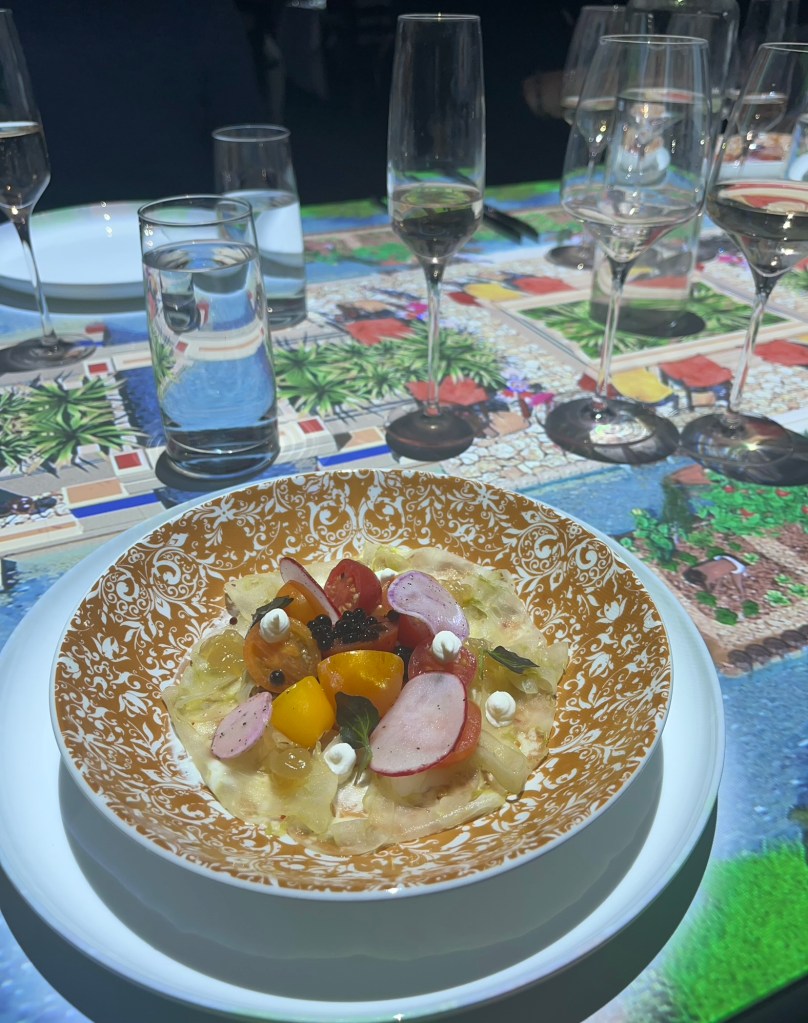
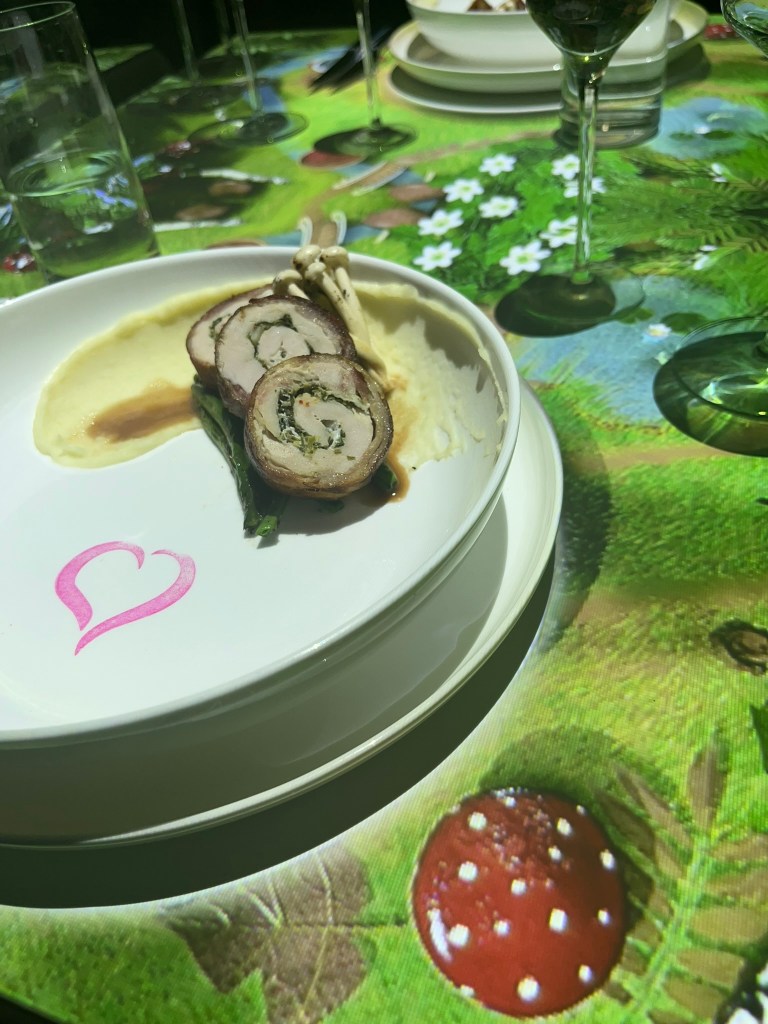
Projected from the ceiling down to the tables and plates, 3D scenes and designs bring the dining area to life, illustrating gardens, sculpted fountains, raging battles, as well as busy cooktops boiling potatoes and searing meat. Between humorous anecdotes, musical numbers featuring dancing vegetables, lessons about ingredient composition, and tips on flavor combinations, guests are served a beautifully prepared, delectable 5-course meal featuring the elements showcased.
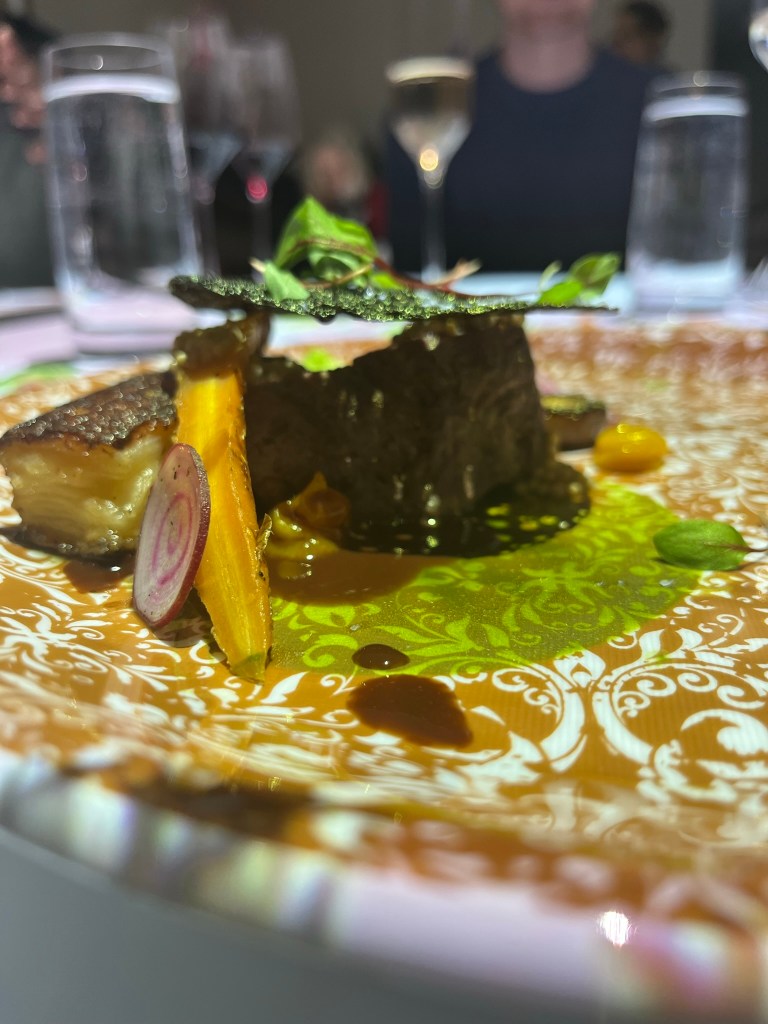
Each dish is rich with taste, texture, and color, but not heavy or saturated with creams and dressings. The delicious natural flavors of fresh produce and meat are perfectly seasoned to surprise and satisfy. Those with allergies or special dietary needs and preferences are graciously accommodated, making the menu safe for all who want to partake.
“I think all kinds of eaters will find something to enjoy in this experience,” said diner Marc Berry after his meal with Le Petit Chef. “Even non-foodies can enjoy each interesting yet accessible course, and the joy of the 3D segments accompanying them.”
Fairmont Chicago General Manager, Clay Spencer, said, “We are thrilled to bring this unique dining experience to our guests, the city of Chicago, and the larger Midwest region. … We’re delighted for diners to experience this culinary adventure through animation. It is a dinner like no other.”
Pricing per person begins at $155 (exclusive of tax and gratuities), with an optional French wine pairing of $42. The first seating starts at 6:00 p.m. and the second at 8:00 p.m. every Thursday through Saturday, through the end of 2023. For more information about Fairmont Chicago and to book your special dining experience at Le Petit Chef, please visitfairmontchicago.com.
For Valentine’s Day, treat your sweetheart to Le Petit Chef’s fun and fancy French meal, or consider these other Chicago area specials:
Love is in the air! Skydeck Chicago’s “Pie in the Sky” VIP Valentine’s Day Dinner offers a three-course meal that includes a delicious Giordano’s heart-shaped deep-dish pizza, salad, and dessert, served with a stunning view of the city. This 10 p.m. after-hours experience is intimate, with only seven tables per evening, maximum, and it takes place after Skydeck Chicago is closed to the public. Before ascending to the 103rd floor to step out on the glass-bottomed The Ledge, explore the ground-level museum and exhibits featuring Chicago’s diverse neighborhoods and architecture. A small-scale Bean (Cloud Gate), Second City stage setup, giant hot dog and deep-dish pizza, full-scale “L” train car, replica Chicago Picasso – there are photo opportunities galore! Book your Pie in the Sky tablehere for Valentine’s Day, February 14, 2023, or celebrate early by booking for Thursday, February 10, or Friday, February 11.
Photo courtesy of Skydeck Chicago
The “Love, Alma” package at stylish Hotel Zachary at Gallagher Way is a tribute to architect Zachary Taylor Davis’ true love and muse, Alma Davis. This romantic overnight includes a $50 food and beverage credit at The Bar, upgraded Wrigley Field ballpark view accommodations, and an extended 1 p.m. late checkout. Book your reservationhere.
Photo courtesy of Hotel Zachary
Spread the love on Friday, February 10, from 6:00 p.m. to 10:00 p.m. at Hotel Zachary’s The Bar “Galentine’s Day Social Hour,” where you can craft a custom flower bouquet, enjoy live R&B DJ entertainment, snack on light bites and desserts, savor wine or a build-your-own-spritz concoction, and observe the on-site creation of an original painting by an artist. This event is hosted by Chicago influencer @FoodiexFancy in partnership with Bombay. Guests in attendance are encouraged to sign cards to be donated to a local Chicago children’s hospital. Purchase your Galentine’s Day Social Hour passeshere.
Photo courtesy of Hotel Zachary
Museum of Illusions (MOI), in the heart of downtown Chicago, is a unique and interactive date spot to explore with your special someone. MOI offers a 2-for-1 Valentine’s Day ticket special for those wanting a mind-bending experience at a fraction of the cost. Reserve your February 14 ticketshere, and the discount will automatically apply at checkout on Adult tickets.
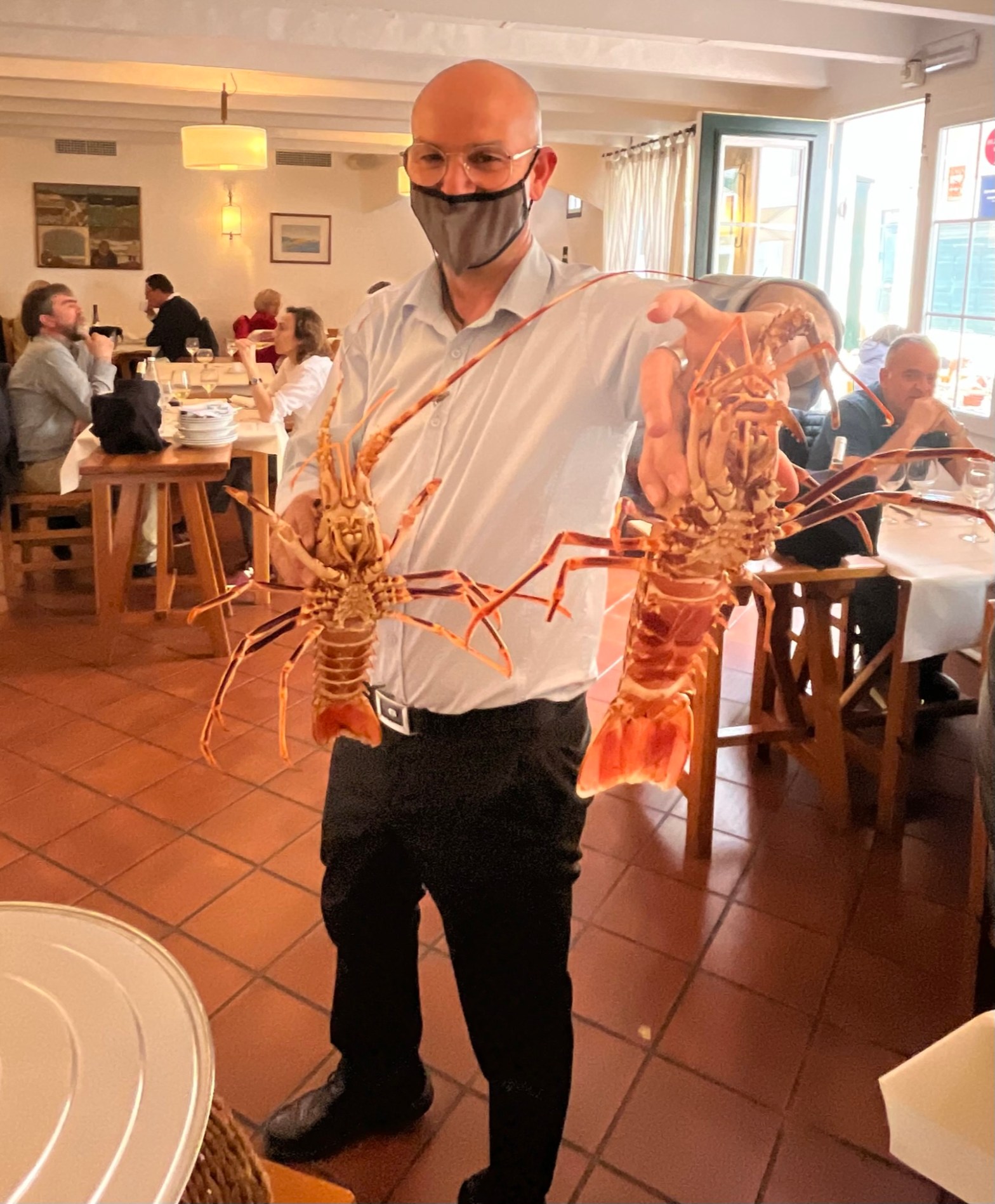
There is a first time for everything. First time visiting Menorca in the Balearic Islands of Spain; first time eating traditional lobster stew; first time holding a live lobster! The first two “firsts” were by choice, and the third was a complete surprise, as waiter Carlos at Es Cranc in Fornells Harbor gestured for me to hold out my hand and suddenly I was gripping a ridged pair of long antennae in my fist, with a huge lobster hanging at the bottom of them.
A lively, rambunctious lobster indicates that it is fresh.
This particular lobster did not end up in our soup bowls at lunch, but a similar one did, and it was key to the flavor of this traditional Menorcan dish. Invented by fishermen and later tweaked by chefs across the island, caldereta is the most renowned dish of Menorca’s seafood cuisine and can be made with lobster, eels, and varieties of fish. Surprisingly, the lobster that visitors relish in Menorca was once considered by islanders to be food for the poor due to its overabundance. Now it is a highly coveted gastronomical treat that restaurateurs take pride in preparing, especially during peak tourist season.
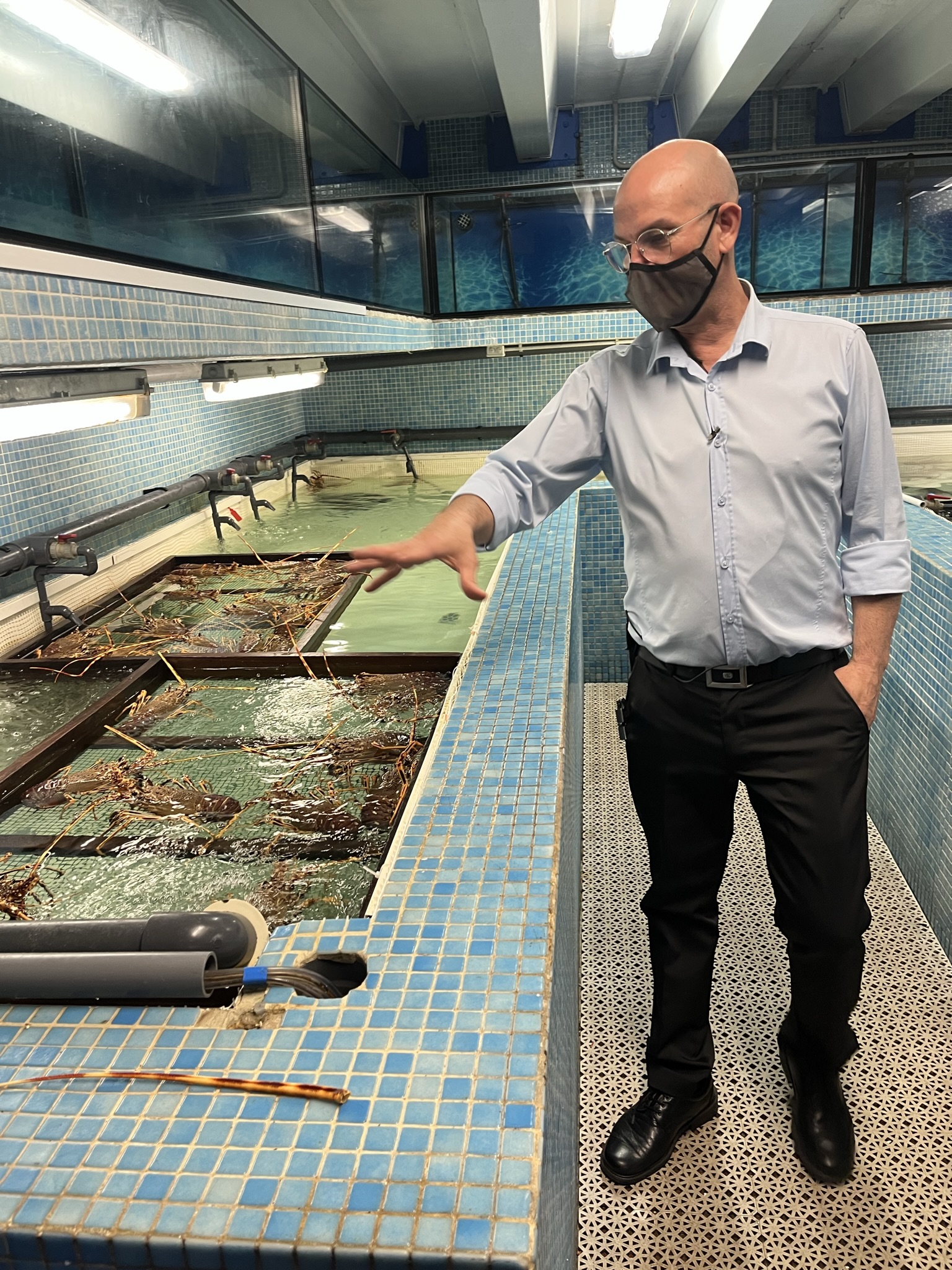
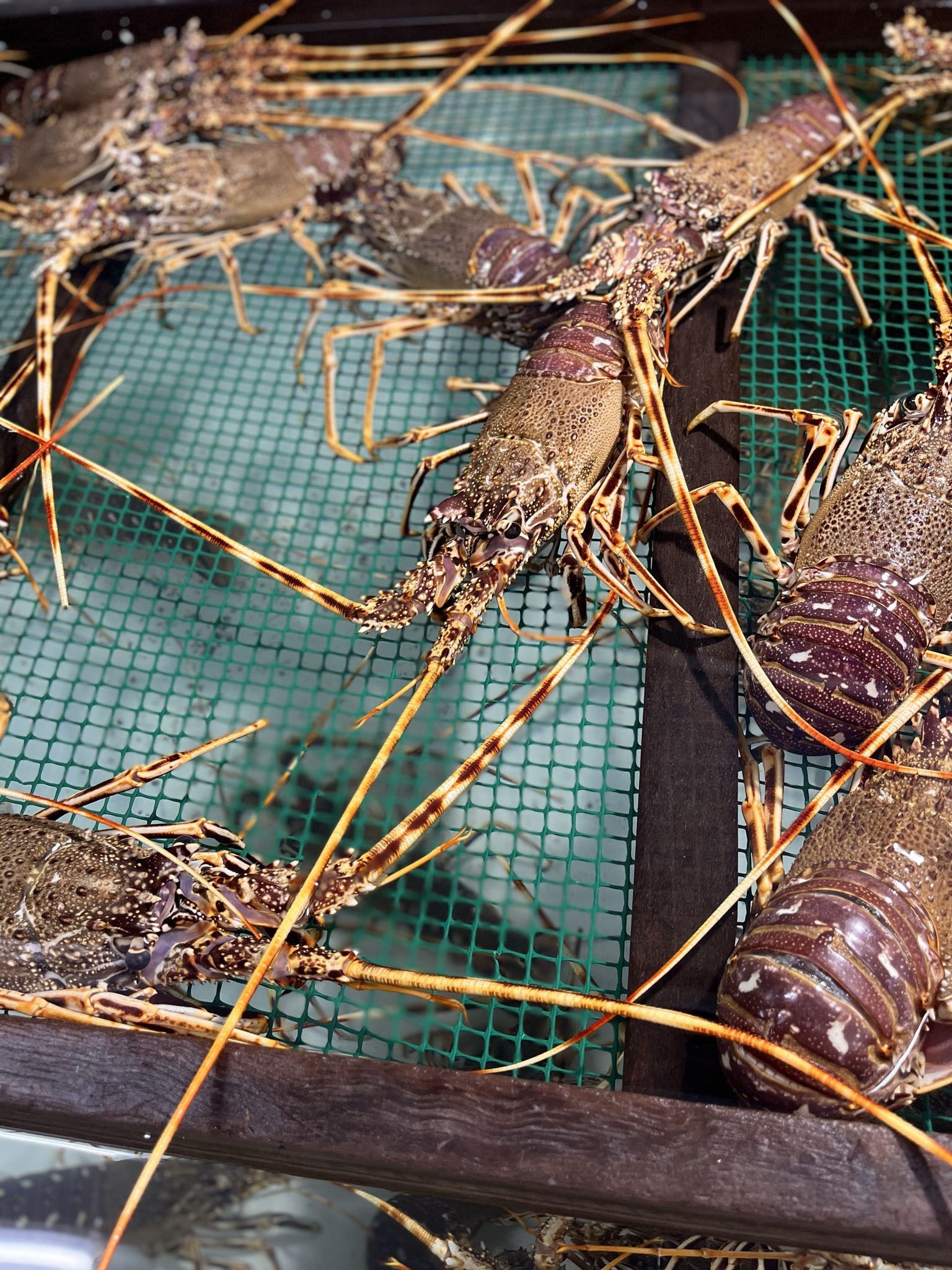
The tanks at Es Cranc can hold 3,600 lobsters—all from Menorca only. Elevated trays hold the lobsters that arrive that day, whereas lobsters from previous catches crawl along the bottoms of the tanks.
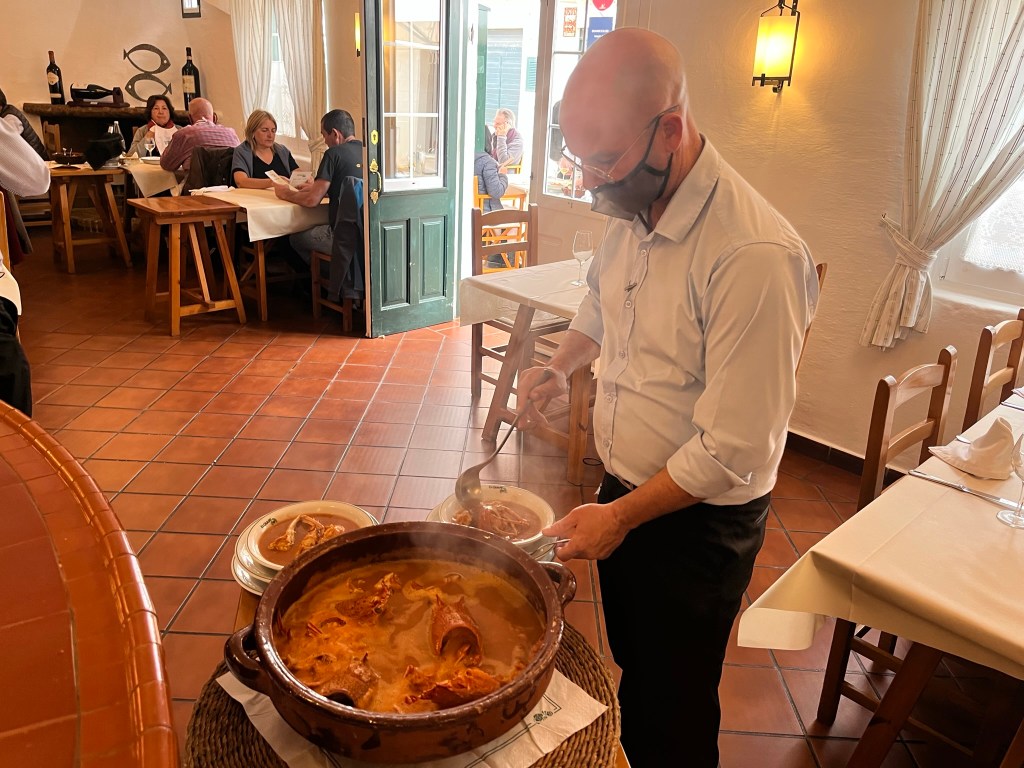
Caldereta de langosta (spiny lobster stew) is a simple recipe traditionally made by braising the locally caught spiny lobster over high heat with a savory sauce containing peppers, onions, tomatoes, garlic, and parsley. Typically served with homemade bread, you can soak the sauce into the slices, or you can simply spoon it up. The lobster stew served at Es Cranc contains several large, meaty portions of tender lobster in a hot, flavorful broth. Dainty eaters, don’t despair—Es Cranc provides bibs, lobster picks, and small bowls of cleansing water for messy hands.
The word “caldereta” refers to the earthenware cauldron in which the stew is prepared.
Whether it’s your first trip to Menorca or you’re a repeat visitor, plan for a meal at Es Cranc. You, too, might get to hold a wiggling crustacean!
A digestif of chilled “herbes” (herbal liqueur) brought the meal to a close. This sweet liqueur can be made with a variety of plants, the most popular being chamomile, as it is found in abundance across the island.
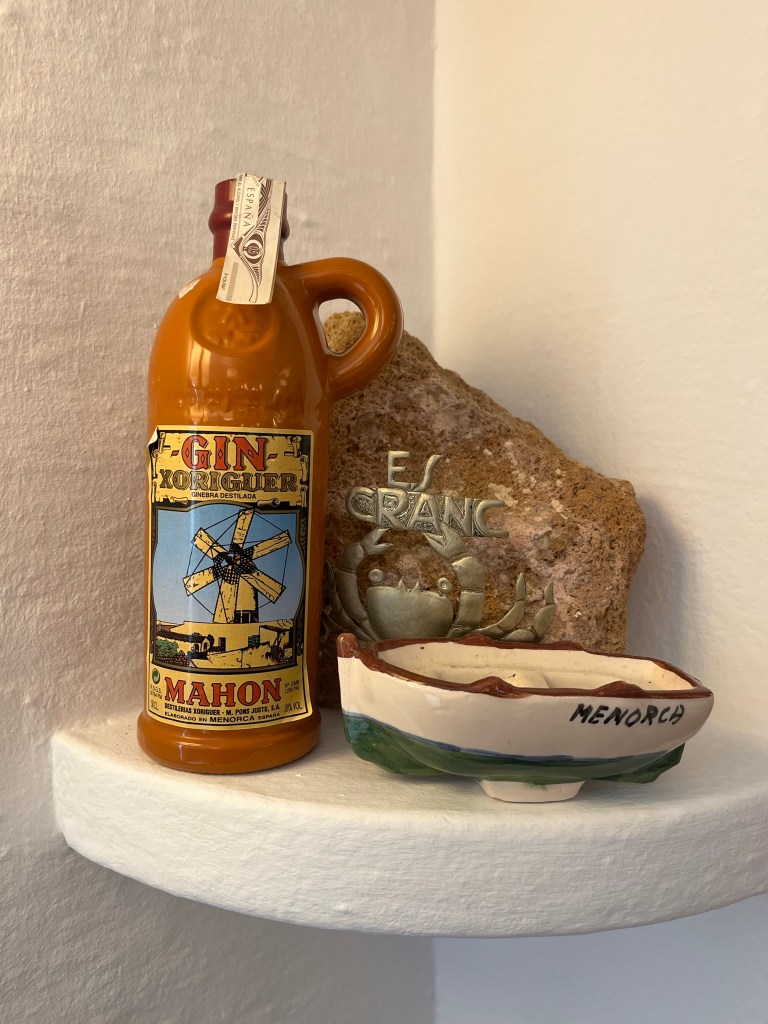
Gin Xoriguer is the most popular Menorcan gin, made from grapes and juniper berries. The distillery has used traditional methods to make this drink for almost a century, and the creator’s family windmill featured on the unique bottle has become a recognizable symbol of the island. Mixed with lemonade, this gin makes a delightfully refreshing drink called a pomada.
Ingredients 2 kg lobster 2 onions 2 cloves of garlic 1/2 green pepper 250 g tomatoes 1 bunch of parsley 7 tbsp. of olive oil 1.5 litres of water slices of bread for soup or toasted bread salt
Preparation Cut the live lobsters into two on a wooden chopping board, separating the head from the tails; reserve the juices in a separate bowl. Split open the body and remove the black intestines using your hands or one of its feelers or antennae. Remove the legs and other feelers. For female lobsters, place the eggs in the bowl, and do the same with the stomachs and livers. Finally, cut the heads in half down the middle, and cut the bodies into slices, making sure to save all the juices.
Finely chop the onion, garlic and green pepper. Place the oil in an earthenware pot and gently fry the vegetables over a low heat. When the onion is translucent, add the very finely diced tomatoes (or they can be grated or blended). Cook over a very low heat for around 10 minutes.
Place the lobsters in the pot and leave to cook a little. Then add the juices, water and chopped parsley, season with salt and cook over a high heat for 15 minutes. When it starts to boil, reduce the heat and cook for a further half an hour.
Meanwhile, grind the lobster eggs, stomachs and livers in a pestle and mortar with a little garlic and parsley, adding the rest of the liquids and a little water to moisten the mixture. When there are just a few minutes’ cooking time left, add the mixture to the pot.
Turn the stove off and leave the stew to rest for at least two hours. In fact, it will be much tastier if made the day before eating. To serve, pour the broth with the lobster pieces into soup bowls, with slices of toast.
By Marilyn Heimburger Photos by Don and Marilyn Heimburger
As spring approaches, thoughts of chocolate come to mind, just because we’re always looking for an excuse to eat chocolate! As the saying goes, “Chocolate–it’s not just for breakfast anymore!”
After a recent trip to Cologne, Germany, and after visiting the Cathedral and Roman ruins, I added a trip to the Chocolate Museum to my itinerary. You’ll learn all there is to know about this treat and have the opportunity to taste and see why the ancients called chocolate the “food of the gods.”
Opened on Halloween Day in 1993, the museum was the idea of Dr. Hans Imhoff, an entrepreneur who was the head of the Stollwerck Chocolate Company of Cologne. The three-story museum is located on the banks of the Rhine, within sight of the Cologne Cathedral.
Designed to look like a ship in the harbor, its modern glass and metal architecture surrounds the historic central customs office, which was built in the 1890’s. The museum welcomes an average of 1,700 visitors a day and about 650,000 per year.
3,000-YEAR-OLD HISTORY
Visitors can see chocolate being made at the museum.
As you walk through the three-story museum, you’ll see exhibits covering the 3,000-year history of chocolate. Growing and harvesting raw cocoa is shown with photographs, harvesting tools and a full size log boat from Ghana. Next is a 100-square-meter tropical greenhouse containing real cocoa plants and more than 60 other rainforest species. You’ll learn that the flowers of the cocoa plant grow directly on the trunk of the tree, so that pollinating insects can find them more easily in the thick jungle!
Chocolate’s popularity began as a luxury drink. An extensive exhibit brings you through the pre-Columbian Olmec, Aztec and Mayan culture, where cocoa was the drink of the gods, and was sometimes used as currency, or “brown gold.”
Next you’ll see the beautiful porcelain and silver cups and pitchers that were crafted to serve this luxury item in 17th and 18th century Europe. The chocolate culture of the 19th and 20th centuries is depicted in a full-sized shop, with chocolate tins and boxes on display, as if you had stepped back in time.
Front and back of a Santa mold
Beautifully preserved chocolate vending machines and advertising posters give insight into the popularity of chocolate. A film room continuously shows old television ads for chocolate. Chocolate packaging from apparently any brand of chocolate that ever existed is on display. Even American brands of chocolate are represented, although Astrid Hage, press representative of the museum, admitted that it was difficult to find someone willing to eat the American-made chocolate in order to empty the packaging. She explained that the Europeans follow a different standard in their chocolate production, and that their formula produces a superior taste.
DECIDE FOR YOURSELF
You’ll have the chance to decide that for yourself in another part of the museum, where, thanks to the Lindt and Spruengli Company, a two-floor exhibit demonstrates the production of chocolate today. From the processing, roasting, grinding of the bean to the pouring of hollow molded chocolate figures and a truffle production line, this small-scale system makes about 400 kg of chocolate every day for visitors to see, smell and finally, to taste.
A nearly 10-foot tall chocolate fountain stands on the production floor, and a museum staff member stands ready to offer a waffle cookie dipped in the warm melted chocolate that pours from the spouts.
THERE’S MORE, TOO
Do you want more of the “food of the gods?” A gift shop offering chocolate, souvenirs and gifts is ready to serve you. The museum also has a restaurant with a view of the Rhine.
Admission fees are 6.50 EUR for adults. Children under six or visiting on their birthdays are free. All exhibit texts are in both German and English.
The museum is closed on Mondays. Check their web page for information on hours, tours and special events: www.schokoladenmuseum.de























 European Traveler