Gingerbread Galore!

By Sharon Hudgins
Photos by the author

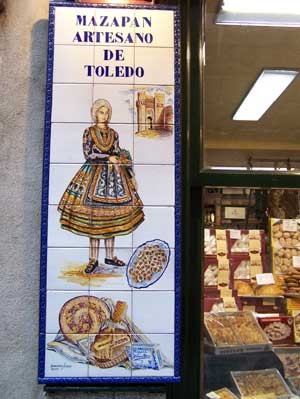
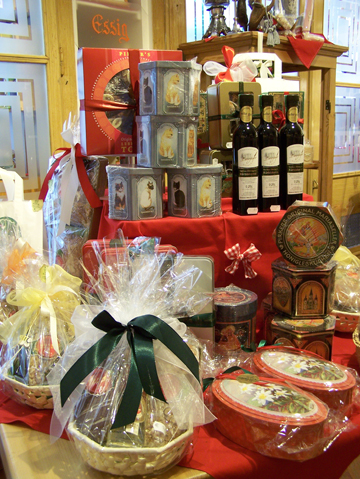
‘Tis the season when a young elf’s fancy turns to thoughts of gingerbread. Although these sweet-spicy cakes and cookies are popular year-round in many countries of Europe, they’re particularly associated with the winter holidays. Bakeries from Sweden to Slovakia to Switzerland turn out tons of commercial gingerbread products, often packaged in brightly colored wrappings and tin boxes. And home bakers dig through kitchen drawers and recipe files to find favorite cookie cutters and family recipes for their own Christmas gingerbreads.

Although flatcakes made with honey and spices were baked by the ancient Egyptians, Greeks, and Romans, the gingerbreads of northern Europe probably date only from the Middle Ages, when honey was still the main type of sweetener available locally, and exotic, expensive spices such as cinnamon, black pepper and ginger were increasingly being imported from faraway lands in the East. A taste for gingerbread eventually spread throughout Europe, with certain cities becoming known for their own particular types: Strasbourg and Dijon in France, Torun in Poland, Tula in Russia, Aachen and Nürnberg in Germany, Basel and St. Gallen in Switzerland.

MANY VARIETIES
Gingerbread recipes evolved over time and in diverse places. Various kinds of gingerbread were, and still are, made with different combinations of honey, sugar, flour, eggs, almonds, hazelnuts, walnuts, raisins, lemons, candied orange peel, candied citron, rosewater, rum, brandy, black pepper, ginger, cinnamon, nutmeg, cloves, allspice, cardamom, coriander, aniseed and saffron. Although these baked goods are often referred to as “gingerbread” in English, some of them don’t contain any ginger at all.

The variety of possible ingredients and textures causes some confusion about what “gingerbread” actually is. A cake, a cookie, or a loaf? Hard or soft? Thick or thin? Glazed or unglazed? Decorated with fancy frostings, or with fruits and nuts, or even with expensive gold leaf? At various times in its history, gingerbread has been all of these.

GERMAN GINGERBREAD
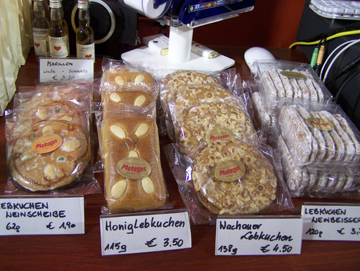
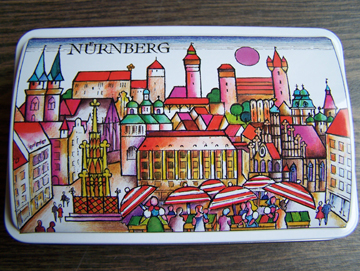
In the Middle Ages, the city of Nürnberg became one of the most famous places for making gingerbreads in Germany, where these seductive sweets have long been known as Lebkuchen (or sometimes Pfefferkuchen, when their spiciness comes from black pepper instead of ginger). Records show that Lebkuchen was being baked in Nürnberg as early as the 14th century. Traditionally, the stiff dough was pressed into highly detailed molds made of wood, metal, or terra cotta, which imprinted intricate designs on the Lebkuchen before it was removed from the molds and baked in a hot oven. Nürnberg Lebkuchen contained such costly ingredients, and was of such high quality, that it was accepted as payment for city taxes and given as gifts to nobles, princes, and heads of state.

Over time, as the prices of ingredients fell and the demand for Lebkuchen increased, faster production methods became necessary. The elaborate handmade molds were replaced by less detailed, often mass-produced, molds. Simpler decorations―such as nuts, candied fruit, and sugar frostings―were applied to the tops of many cookies. And the shapes were simplified, too, evolving into the basic human, animal, and geometric forms common today.

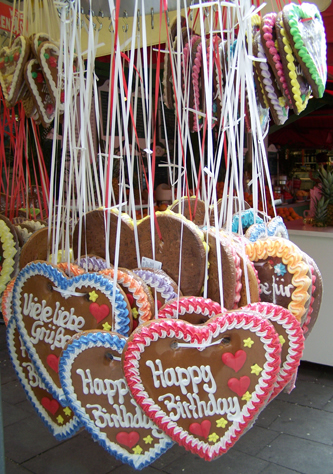
In the early 1800s, gingerbread houses became popular in Germany after the publication of the Grimm brothers’ fairy tale, Hansel and Gretel. And during the 19th century, ornately decorated Lebkuchen hearts also became the rage. Covered with fancy designs and romantic sayings made from colored icing, these large heart-shaped cookies were often exchanged between sweethearts. You can still buy them at almost every German festival and special market, including the Christmas markets held in many German cities throughout December.

The Lebkuchen produced in Germany today comes in all sorts of sizes, shapes, flavors, colors and textures: rounds, rectangles, squares, hearts, stars, pretzel forms, St. Nicholas (for Christmas), lucky pigs (for New Year) and rabbits (for Easter). The Lebkuchen dough can be “white” (light colored) or different shades of brown. Some Lebkuchen are also covered with white or chocolate icing, and some are filled with marzipan or jam. Honey Lebkuchen is sweetened only (or primarily) with honey. Oblaten Lebkuchen are cookies with the dough mounded on top of a thin wafer before baking. And delicate, elegant Elisen Lebkuchen are made with at least 25% ground almonds, hazelnuts, or walnuts, and no more than 10% flour.

GINGERBREADS ACROSS EUROPE
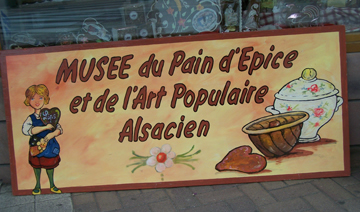
You’ll also find similar spicy cookies of different shapes, colors and textures called Printen (in Aachen, Germany), Pfefferkuchen (in Pulsnitz, Germany), Spekulatius (in the German Rhineland), Leckerli (in Basel, Switzerland), Biberli (in the Appenzell region of Switzerland), speculaas Holland, speculoos in Belgium, pepperkaker in Norway, pepparkakor in Sweden, piperkakut in Finland, pebernǿdder in Denmark, pain d’épices in France, licitar in Croatia, mézeskalács in Hungary, perníky in the Czech Republic and Slovakia, pierniki in Poland and prianiki in Russia. Other towns and regions have their own specific names for the many varieties of gingerbreads produced there.

Europeans also use gingerbread cookies as ingredients in other dishes. You’ll find crumbled gingerbread used as a stuffing for pork and for pasta, as a thickener for sauces, a flavoring for soups, a crunchy texture in salad dressings, and a base for many puddings and desserts. There’s even a German-Italian “fusion” dessert called ” Nürnberger Tiramisu”! And for people who just can’t get enough of that sweet, spicy, Christmasy taste of gingerbread, the Belgians have recently invented a gingery, caramely speculoos spread, similar in texture to Nutella, made from crushed gingerbread cookies.

If I’ve whetted your appetite for these European gingerbreads, my best suggestion is to travel there and taste them for yourself. You can also mail order many of them from the websites listed below. Costard, the clown in Shakespeare’s play, “Love’s Labour’s Lost,” had the right idea when he said, “An’ I had but one penny in the world, thou shouldst have it to buy gingerbread.”

Nürnberg Lebkuchen information www.lebkuchen.nuernberg.de/englische_version/index.html

Lebkuchen-Schmidt, Nürnberg
ww2.lebkuchen-schmidt.com/eng_index.php

Metzger Lebkuchen, Vienna
www.lebkuchenmetzger.at/

Lebkuchen-Pirker, Mariazell, Austria
www.lebkuchen-pirker.at/home/index.php?&lang+eng

Kerner Lebkuchen, Mariazell, Austria
www.lebzelterei-kerner.at/index.htm

Lebkuchen-Gandl, St. Wolfgang, Austria
www.lebkuchen-gandl.com/

Appenzeller Biberli, Switzerland
www.baerli-biber.ch/

Basel Läckerli, Switzerland
www.laeckerli-huus.ch/

French-Alsatian Pain d’Épices
www.paindepices-lips.com
www.fortwenger.fr/

Alte Pfefferkuechlerei (small gingerbread museum in Weissenberg,Germany) www.museum.stadt-weissenberg.de/

Speculoos Spread
www.thenibble.com/zine/archives/speculoos-spread.asp

YouTube video about how to make decorated European gingerbread
www.youtube.com/watch?v=OVX5wiv_oMk

American online sources for ordering European gingerbreads
www.germandeli.com
www.germangrocery.com

Lamb Stew Hits the Spot in Ireland

Photos courtesy of Tourism Ireland

County Wicklow is famous for its sheep and wool, and the Wicklow Mountains have been renowned from the earliest times for the native breeds, which are of a distinct type, and have been on the mountains for centuries. The date of origin of the Wicklow Mountain sheep can only be approximated, but one thing is for sure, the Irish have many seasonal, regional and tasty recipes to take care of nature’s providence, including plenty for the less popular cuts.

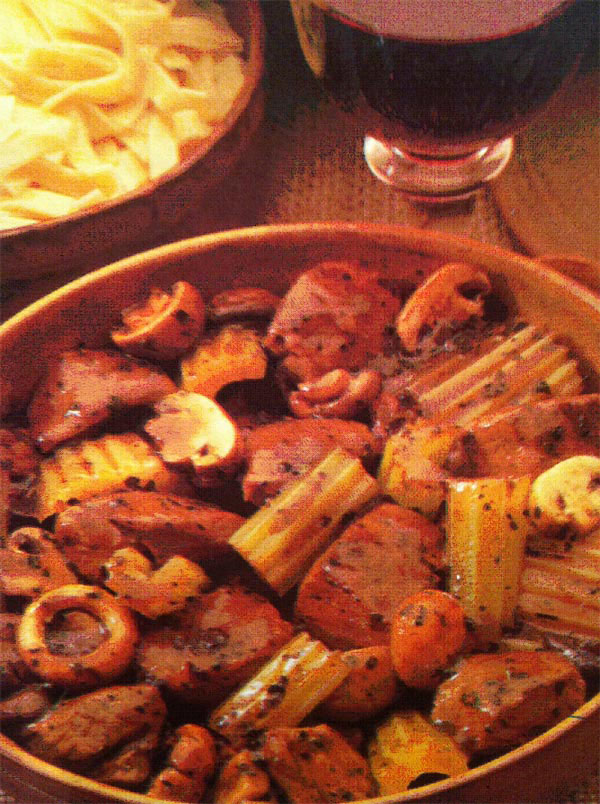
This recipe is a twist on the typical Irish lamb stew with a few additional flavors thrown in such as basil, oregano, celery, mushrooms and red wine. It comes from Wicklow Lady Fiona Teehan, whose mother is handed a gift of a whole sheep every year in return for some sheep-minding duties by her father. Fiona is manager of Pembroke Townhouse, a superb example of classic Georgian elegance in the heart of Dublin’s Ballsbridge area, just a 10-minute walk from the city center.

WICKLOW STEW
Serves 4
Ingredients:
3 tablesp sunflower oil
1 shoulder of Wicklow lamb, boned, trimmed of excess fat and cut into small cubes
3-4 sticks of celery, chopped into 1 inch lengths
1 onion, finely chopped
4 oz mushrooms, halved
1/2 c. red wine
1 c. vegetable stock
1 tablesp cornstarch
1 tablesp fresh basil, finely chopped (or 1 teasp dried basil)
1 tablesp fresh oregano, finely chopped (or 1 teasp dried oregano)
1 teasp grated lemon rind
Sea salt and freshly ground black pepper to taste
To garnish: freshly chopped herbs (some or all of basil / oregano / parsley)
To serve: mashed potato (or buttered noodles or boiled long grain rice to your preference)

Method
1. Heat half of the oil in a frying pan. When the oil is hot, add the lamb cubes and fry them, stirring frequently for about 10 minutes until they are well browned. Transfer the meat to a plate.
2. Heat the remaining oil in a casserole. Add the celery, onion and mushrooms and continue cooking over the heat until the onion is just soft.
3. Add the wine to the pan and boil well for two minutes.
4. Blend the stock together with the cornstarch and pour the mixture into the pan.
5. Add the basil, oregano, lemon rind. Season with the salt and pepper. Then, add back the cubed lamb. Mix well with the rest of the ingredients.
6. Cover with a lid or tinfoil, reduce the heat and simmer gently for 40-45 minutes or until the lamb is tender.
7. Sprinkle with a garnish of freshly chopped herbs (as above). Serve piping hot with mashed potato, (or buttered noodles or boiled long grain rice to your preference)

Optional: If you like garlic, add four cloves of minced Garlic with the onions.

To freeze: This dish freezes well. Cool quickly and pour into a freezer-proof container or bag. Label and freeze. Do not store in freezer for longer than two months.

For more info, go to Discover Ireland.

The ‘Champs-Elysees’ of Burgundy Wines

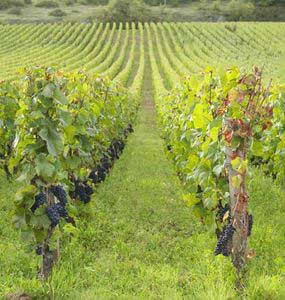
The wines of Burgundy are rich and varied, and are divided into regional appellations, village appellations, Premiers crus and Grands crus. The Appellation d’Origine Contrôlée (AOC) is your guarantee of the characteristics of the regional wines. Fall is a beautiful time to drive or bike through the wine routes.

The Côte de Nuits extends from the south of Dijon to Corgoloin and forms the northern section of the Grands Crus route. It is a prestigious hillside that is home to villages bearing the names of the greatest red wines in the world. Here you will find 24 of the 33 grands crus in Burgundy: Chambertin, Clos de Vougeot, Romanée-Conti and many more.

The Côte de Beaune follows on from the Côte de Nuits towards the south, from Ladoix-Serrigny to the hillside of the Maranges. This soil, blessed with the Chardonnay grape, is where the greatest dry white wines in the world are produced (Corton-Charlemagne and Montrachet, among others). Outside of the city of Beaune, which is the capital of Burgundy’s wine regions, the countryside becomes gentler as you approach Santenay and the département of Saône-et-Loire.

Burgundy hiker

ROUTE OF THE GRANDS VINS DE BOURGOGNE – THE ROUTE THROUGH NATURE
The route of the Grands Vins runs from Santenay to Saint-Gengoux-le-National, and is the extension of the route of the Grands Crus towards the south: more than 100 signposts connect around 40 towns via the vineyards of Maranges, the Couchois and the Côte Chalonnaise. This varied route combines villages with nature, and vineyards with wooded countryside, and is dotted with Romanesque churches and castles. You can discover it by car, but also along the water of the Canal du Centre, or by bike along the the many cycling routes.

ROUTE OF THE MÂCONNAIS-BEAUJOLAIS, THE SOUTHERN WINE-GROWING AREA
This route in the south of Saône-et-Loire is the extension of all the wine routes from Dijon. The eight circuits enable you to break away from the main route and explore the most southerly vineyards in Burgundy in greater depth. The main route itself crosses the Mâcon wine-growing region in a straight line and finishes at Romanèche-Thorins (Saône-et-Loire) on the hillsides of the Beaujolais region.

ROUTE OF THE VINEYARDS OF THE YONNE ALONGSIDE THE RIVERS
In the département of the Yonne, the vineyards have developed alongside rivers: the Jovinien and the Auxerrois in the Yonne Valley, the Chablisien in the Serein Valley, the Tonnerrois in the Armançon Valley, and the Vézelien in the Cure Valley. The wines of the Yonne are undergoing a renaissance and deserve to be discovered in all their diversity just as much as the highly famous Chablis.

ALONG THE LOIRE AROUND THE NIÈVRE
The vineyards of the Nièvre, which extend along the right bank of the Loire, belong not to Burgundy but to the Centre-Loire, and have long suffered from a certain lack of recognition. Now another wine route enables visitors to discover all their charms, from the hillsides of Pouilly-sur-Loire, where the famous Pouilly-Fumé is produced, to the Coteaux du Giennois overlooking Cosne-Cours-sur-Loire. This route also takes in Sancerre on the other side of the river in the Cher.

For more information on Burgundy, go to www.burgundy-tourism.com.

Christmas Markets in Luther Country

Erfurt Christmas Market

In Germany’s Luther Country, Advent means Christmas markets. The crisp winter air is filled with the smell of ginger and nutmeg, signaling the arrival of Stollen, a special Christmas cake, and Glühwein, mulled wine. Cobbled streets and squares, lined with half-timbered medieval houses, provide the backdrop for dozens of wooden stalls, selling wooden toys and Christmas decorations, handcrafted gifts and seasonal foods, such as Zimtsterne (cinnamon stars) and Lebkuchen (soft, spiced cookies).

Brass bands play and choirs sing carols, often written by Martin Luther himself. In fact, many Christmas traditions were supposedly instigated by the Protestant reformer 500 years ago. Legend insists one dark and starry night, Luther was touched by the beauty of the pine trees. On returning home, he cut down a tree, took it into his house and decorated it with candles. As well as the Christmas tree, Luther is credited with the idea of Christkind, the Christ child bringing presents. (Kris Kringle is still familiar in many U.S. homes). Concerned that Saint Nicholas, who delvered his gifts on December 6, was too popular, Luther came up with an alternative to “Santa Claus”: a golden angel, with wings and a crown.

Here are just some of Luther Country’s most authentic Christmas markets.

(clockwise) Christmas Stollen; Lebkuchen; Zimtsterne

ERFURT
November 27 – December 22
Although Erfurt’s 162nd Christmas Market spreads throughout the old town, the focus is on the Domplatz, the vast Cathedral Square. The 200 market booths sell everything from Thuringian bratwurst (Germany’s favorite grilled sausage) and Christmas cookies to handmade toys or traditional, handmade Christmas decorations. Children love the giant Ferris wheel,

the 90-foot-tall Christmas tree covered in candles, and the 40-foot-high wooden pyramid. Most of all, they love the nativity scene, set in a fairytale forest, complete with near life-sized, hand-carved figures. Gardeners should not miss the floral Christmas exhibition in the underground vaults of the cathedral.

Lutherstadt Wittenburg Christmas Market

LUTHERSTADT WITTENBERG
November 28 – December 23
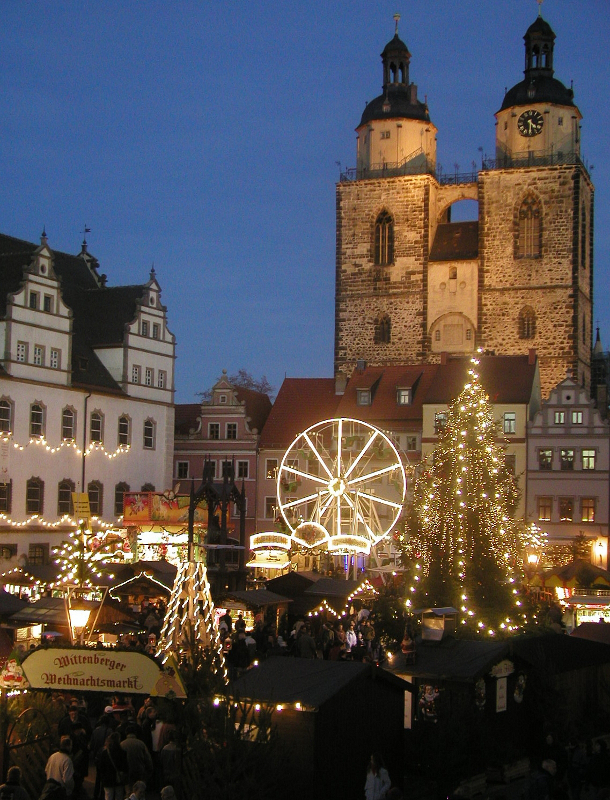
In the market square, a statue of Luther looks out across the Christmas market, with its stalls decorated with pine boughs, lights and Christmas ornaments. In the air is the scent of mulled wine and roasted almonds. Across the square is the Marienskirche (St. Mary’s Church), where Luther preached. Special are the town’s Adventshöfe, medieval courtyards, where local artists and craftsmen sell their wares. In the Cranach Courtyard, named for Luther’s great friend and painter Lucas Cranach, the weekend of December 8 and 9 features weavers and knitters, wood carvers and basket makers.

QUEDLINBURG
November 30 – December 23
With more than 1,300 half-timbered houses, Quedlinburg is one of Europe’s most romantic cities. And during the Christmas Market, strolling along the cobbled streets is like walking through history. One unique event is the “Advent in den Höfen” (December 1-2, 8-9, 15-16), when some 20 private courtyards open to sell special Christmas gifts, often handmade. Another highlight is the world’s largest Advent calendar! At 4:30 p.m. every afternoon for 24 days, children look out for the star that marks the house where the next scene in the Advent calendar will appear. When the door opens, fairytale characters appear and dance, sing or play for spectators.

WERNIGERODE
November 30 – December 22
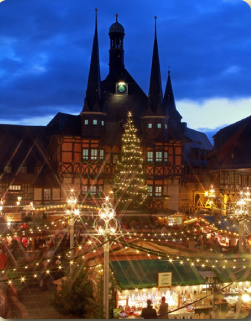
Dominated by its 12th-century castle, Wernigerode’s annual Christmas market has a fairy story backdrop: a 15th-century town hall, half-timbered houses and a 35-foot-tall Christmas tree. The stalls serve traditional food and drink, hand-made toys and ornaments for the home; evenings are filled with concerts of seasonal music. From December 15 to January 8, 2013, the Castle hosts its own special Winter Market. Children meet a fairy at 3 p.m. and receive presents from St. Nikolaus (Santa Claus) at 4 p.m. They also love to ride the Christmas train in a historic carriage, pulled by a steam engine through the snow-covered countryside.

Wernigerode Christmas Market

LAUSCHA
December 1-2 and 8-9
Each Christmas, this small town in a steep, wooded valley in the Thuringian Forest, plays a vital role in every American home. This is where the first glass Christmas tree ornaments were created in 1847. In 1880, F. W. Woolworth, the five-and-dime store pioneer, brought a batch of these glass balls to his store in Pennsylvania, and the rest is history. The tradition continues in Germany’s glassblowing capital, where you can watch artisans creating works of art at Lauscha’s Museum of Glass Art. At Lauscha’s annual Christmas “Kugelmarkt,” or glass bauble market, you can buy these handmade decorations in all shapes and colors.

Mead honey wine

WARTBURG CASTLE, EISENACH
December 1-2, 8-9, 15-16
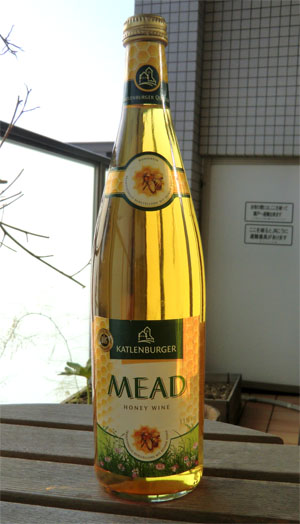
Wartburg Castle is where Martin Luther, the Protestant reformer, changed history when he translated the New Testament into German. And this UNESCO World Heritage Site just outside Eisenach is still a massively impressive fortress. At Christmas, however, a historic Christmas Market transforms the castle, with artists and street performers, craftsmen and knights. Meet candle makers and barrel makers, rope makers and lantern makers, minstrels and puppeteers. With cheerful booths and medieval decorations, this is a like a trip back in time. And the medieval food is delicious, from roast apples and honey to mead.

Raise a Glass to Ireland’s New Whiskey Trail

Photos courtesy Ireland Tourist Office

History, heritage and “a drop in your hand” of the finest whiskey in the world combine in one of the Emerald Isle’s newest visitor attractions, the Ireland Whiskey Trail.

IRISH WHISKEY TOURING GUIDE
Heidi Donelon has created a touring guide for whiskey lovers to Irish pubs, hotels, whiskey shops and distilleries throughout Ireland. The trail features nearly 40 different places, ranging from the famous old Jameson Distillery in Dublin, to less well known whiskey emporiums such as Fairhill House Hotel in Connemara, which boasts a stock of more than 170 different whiskies.

Donelon says: “The trail is a great way for people to experience the story and magic of Irish whiskey, while discovering the heart of Ireland through the Irish characters they will inevitably meet in the pubs and bars across the island. It is a great touring guide for whiskey lovers, but also for anyone who wants to find that perfect Irish pub during their trip, whether they are whiskey drinkers or not. Some of these pubs are the last links to old and forgotten distilleries. These are not just great whiskey pubs, but also some of the very best traditional Irish pubs in the country.”

IN addition to the in-depth tour guide, the Ireland Whiskey Trail gives information about the history of Irish whiskey, insight into the difference between brands, Irish Coffee and whiskey recipes and details of whiskey tasting events. The Irish are credited with inventing whiskey, called uisce beatha in Gaelic, which translates as “water of life.” For 1,500 years whiskey has warmed the hearts of the Irish and their guests, and today it is a worldwide success with sales of brands such as Jameson, Bushmills, Tullamore Dew and Kilbeggan increasing at an unparalleled rate.

For more info, go to www.discoverireland.com or www.irelandwhiskeytrail.com