The humble onion is the star of the show at the Onion Market held in Weimar, Germany every October. These are no ordinary onions lumped together in crates or sacks; these are onions arranged together in the traditional way and decorated with dried flowers of yellow, white or lilac. They come in all sizes, too—from tiny ones to whopping big ones.
MARKET FOR BEASTS AND ONIONS The market was first recorded in 1653 as a “market for beasts and onions” on what is today the Frauenplan, at a time when Weimar barely had a population of 5,000. There are many instances of the links between the German writer Goethe and the Market; he is said to have secured onion hearts to his desk, to have decorated his house with them, and to have praised the role of the onion in promoting good health.
In the 19th century, the market moved to today’s Schillerstrasse and developed into the major onion purchasing center for the whole of central Germany. Dealers came mainly from Heldrungen, 29 miles away, and that is still the case today.
In 1861 the market was extended to three days. In 1872 the city of Weimar passed an Onion Market Ordinance. Onions are offered as well as celery, radishes, garlic, leeks and marjoram, as well as other types of spices and vegetables. During the 20th century, world wars and inflation led to the decline of the market, and it was reduced to one day due to the limited produce available and high prices. It was not until the 1950s that the market began to pick up again, and by 1971 a record was set when 200,000 visitors attended.
ONION GARLAND The sale of the famous market souvenir, the onion garland, has grown to 70,000 pieces, and onions and other vegetables, fruits, spices and handicrafts began to make their mark. In 1990 the Onion Market again became a three-day event. The market has also grown in size in the interim and now occupies the whole of the historic inner city. The number of visitors is now 350,000 annually.
Photos courtesy Lake Geneva Office of Tourism, Switzerland
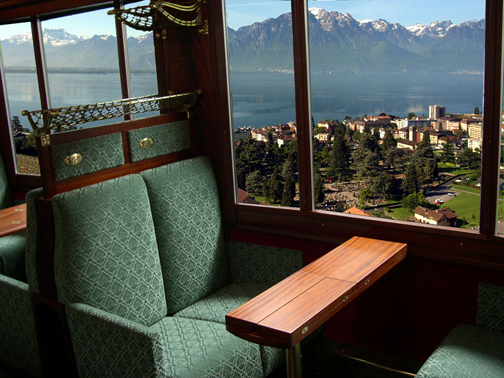
The GoldenPass Cheese Train in Switzerland will take you from Montreux to Château-d’Oex every Friday, Saturday and Sunday at 10:30 a.m. through April 27, where you can discover the specialities of the Pays-d’Enhaut region.
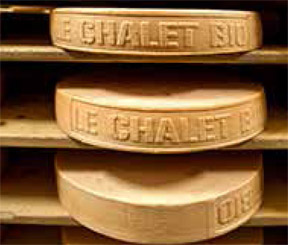
CHEESEMAKING DEMONSTRATION
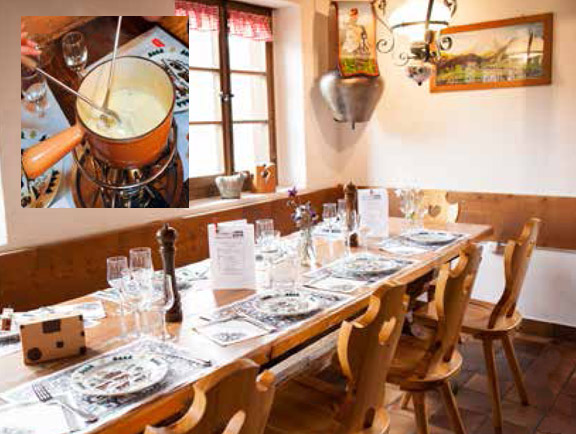
Le Chalet is a typical mountain chalet, serving fondue and dessert.
MUSÉE DU VIEUX PAYS-D’ENHAUT (SILHOUETTE MUSUEM) This museum of folk art was established in 1922 and gives an insight into the lives of the Swiss forefathers. The museum is well-known in particular for its collection of over 60 well-preserved scissor-cut silhouettes.
The art of paper cutting produces images that look like lace. They are carefully cut with scissors or cutters and are traditionally produced in one piece, in black and white. A paper cutting may also have different shades of color or formats, and sometimes it looks like a collage of colored papers.
Also in the Folk Art Museum there is painted wooden furniture, sculptures, statues, military paraphernalia, cow bells and skis, all from the XIV century. These objects are displayed throughout 15 individual rooms. The museum has also recreated rooms which depict the life of blacksmiths, alpine cheese-makers, country kitchens and a bread oven which dates back to 1665.
Photos Courtesy Frankfurt Tourist & Congress Board
Locals and tourists alike enjoy this beverage in rustic apple wine pubs all over the city. The “core” apple wine scene is in Old Sachsenhausen; numerous apple wine pubs line its streets where they serve customers their infamous “liquid gold.”
In the Middle Ages, beer and wine were the beverages of choice. As with many products today, apple wine came into being because of an unavoidable circumstance rather than an idea for a new product. In the middle of the 16th century, the Rhine-Main area went through a climatic change that negatively influenced wine production. Because of this, many vineyards transformed into fruit orchards, thus beginning apple wine production. During the Goethe era, taverns made the switch and became apple wine pubs. Today, apple wine remains a staple in Frankfurt and is growing in popularity.
It’s easy to spot a local apple wine pub: just look for the wreath hanging above the door. There’s even an old saying, “A wreath on the door means apple wine and more.” Traditionally, apple wine is served in a blue-gray stoneware jug called a Bembel. Other necessary glassware for apple wine drinking includes a ribbed glass called a Gerippte.
For an unforgettable Frankfurt experience, take a tour of old town in the “Apple Wine Express.” The Apple Wine Express is the city’s most popular streetcar and takes guests on a sightseeing tour around the city. For one hour, visitors can munch on pretzels, listen to music and sip apple wine while experiencing the city in a new way.
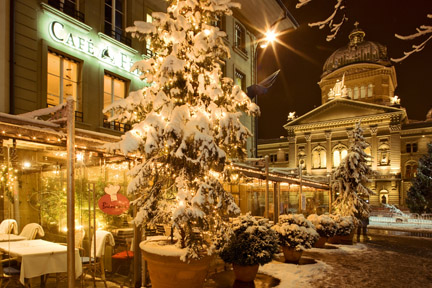
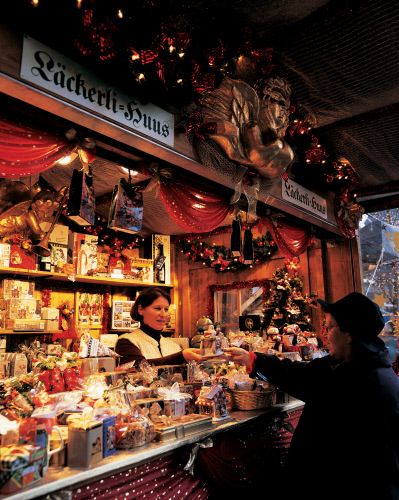
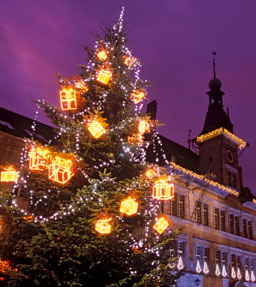
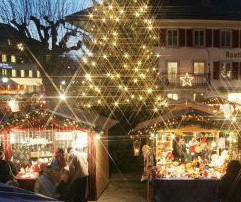
Christmas is around the corner. In Switzerland, Christmas markets and events are as much a part of the holiday tradition as chocolates, cookie baking and family gatherings. Here is a sampling of festivities that vary in scope from the month-long markets in St. Gallen to weekend events in villages like Bad Ragaz, yet all share the basics: Christmas ornaments, gifts, local specialties, plenty of traditional Swiss atmosphere and snow.
Handmade products of Switzerland and local treats bring visitors from around the globe.Swiss Christmas Markets combine holiday festivities and historic locations.Switzerland sparkles at Christmas.
By Marilyn Heimburger Photos by Don Heimburger and courtesy Munich Tourist Office
I have always liked Munich. Actually, it’s more than just liking the city. I feel moved by its vibrant life, its stimulating nature and its friendly people. Apparently many more feel the way I do, since it is Germany’s most-visited city.
Last year, during Munich’s 850th birthday, the city of 1.3 million hosted the following:
City Foundation Festival in June in the heart of the city, featuring traditional Bavarian culture and international folk culture. A highlight of the fest was a Gaufest, or regional festival, of the many associations for folk culture where dancing and costumes from the Isargau region were prominent. As many as 10,000 participants were involved in this. A group of 100 rafters from the Oberland region showed how to build a raft. Dance masters showed how to learn the “Munich-Francaise” dance.
In July, the Old Town Ring, which was free from automobile traffic, served as the center for a celebration of theater, music, dance, games and sports on many stages. Scenes from peasant life in Munich with markets, street theater and beer gardens were staged. There also was music from international bands and more.
In August, the three-day Isar Bridges Festival, centered around the Cornelius, Ludwig and Maximilian bridges, highlighted the Isar River (which flows through the city) as the city’s life-giving artery. There was music under the bridge, dancing along its banks, glittering lights on the water, and with this came Munich’s famous culinary delights. An action theater group, which encouraged audience participation, also presented skits. There were also night-time water and laser shows
Additional highlights included the world premier of a work commissioned from composer Victoria Borisova-Ollas especially for the 850th anniversary. In June the Cuvillies Theater, one of German’s most elegant Rococo theaters, reopened after a spectacular renovation. In the newly re-designed St. Jakobs-Platz, many of the local museums and community organizations held programs of music ranging from classical to klezmer (a musical genre), dancing and creative street theater, exhibitions, tours and more.
Many of Munich museums featured exhibits of famous Munich artists, writers and Munich’s cultural heritage.
As Munich’s Lord Mayor Christian Ude said, “(Munich’s) celebrating its 850th foundation day…is nothing exceptional. What is remarkable is the city’s rapid growth from a monastery on a hill to a European metropolis with over a million inhabitants and a high-tech hub.”
As Ude says, the city is special because of its enduring and much-praised flair as a place with a zest for life.
The settlement of Munichen was originally granted the right to market goods and mint coins in June of 1158. In 1214 it was granted status as a town, and in 1255 it became the seat of the Wittelsbach dynasty. Under Kind Ludwig I, many famous buildings were erected, making Munich a major cultural center, and in 1918 the Free State of Bavaria was formed.
For travelers, the city offers 355 hotels and pensions with 45,500 hotel beds available. In 2006, 4.4. million tourists booked nearly nine million overnight stays, with 47% of them from overseas, with the USA bringing in the most, followed by Italy, Great Britain, Austria and Switzerland.
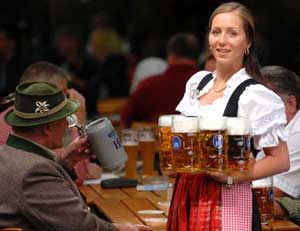
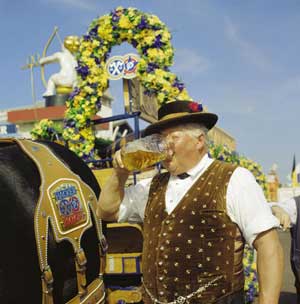
The city boasts three universities and eight colleges, 60 theaters and an opera house, 45 major museums, three symphony orchestras—and it hosts the famous 16-day Octoberfest beginning on the Saturday two weeks before October.
Favorites for visitors to see in Munich include:
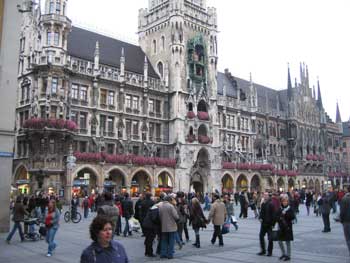
The city’s twin onion-domed towers of the Frauenkirche, Church of our Lady, Frauenplatz 1, is the city’s best-known landmark.
Marienplatz and the glockenspiel on the Marienplatz in the city center displays the mechanical dancers in the tower of the Rathaus (Town Hall) at 11 a.m. and noon (and 5 p.m. in the summer).
Schloss Nymphenburg is the impressive Baroque palace built as the summer residence for the Bavarian Electors. Today the main building houses a museum.
The Viktualienmarkt is Munich’s oldest market, originally begun as a farmer’s market and now a favorite place for a wide range of produce, Bavarian specialties and more.
The Hofbrauhaus deserves a visit, as its one of Munich’s best-known restaurant-breweries at Am Platz 9. Great dining is available, or just casual drinking and listening to oom-pah music. For information on the Hofbrauhaus, visit www.hofbraeuhaus.de.
There are many churches to visit, including the Asamkirche built by the Asam brothers in the 18th century with its spectacular interior at Sendlinger Strasse 62; Church of the Sacred Heart, a cubed-shaped structure with an innovative facade at Romanstrasse 6; and Saint Peter’s, Munich’s oldest parish at Rindermarkt 1.
The Deutsches Museum at Museumsinsel 1 houses sailboats, windmills, space probes, robots, ships, trains, planes and much more. Allot a whole day for this attraction.
Octoberfest Museum, at Sterneckerstrasse 2, will tell you all about the history of beer including how it started as a drink at monasteries, and all about the city’s famous Octoberfest celebration.
The expanded BMW Museum is a must-see if you are fascinated with automobiles and engineering. Tours are available.
Munich is waiting to wow you.
IF YOU GO… You can arrive at Munich’s Airport, which is like a city within itself. Flights from numerous major hubs arrive and depart from here daily. Train is another good option if you are coming from another European city.
If you’ll be in town for at least a day, pick up the City Tour Card (one- and three-day tickets are available), which is good not only for all public transportation, but also includes discounts of up to 50% on more than 30 attractions such as sights, bike rentals, museums, theaters and restaurants. www.citytourcard.com.
A close-in, convenient four-star hotel is the Platzl Hotel at Sparkassenstrasse 10. It is located near the Hofbrauhaus and is within a a couple of minutes walk of the Marienplatz. Visit www.platzl.de.
Guided tours of Munich are available. Visit www.muenchen.de for more information. The tourism office is located in the Rathaus, first floor, at Marienplatz.