From the first red wine produced along the Mosel River during Roman rule to the sweet Riesling for which the country is renowned, German wine is woven into the country’s culture and history.
Many member cities of the Historic Highlights of Germany are inviting travelers to experience this firsthand this fall with a series of wine-themed events, activities and offers.
In Mainz, more than 50 wine growers from throughout the region assemble during the first weekend in September for the annual Mainz Wine Market (photo at left). The event has craft stalls, rides, music and fireworks and, of course, dozens of wine stands. Wine-making goes back nearly 2,000 years in Trier, where several two-night packages feature special themes such as wine cultivation during Roman rule and a combination of World Heritage site visits and wine culture.
In Heidelberg, packages include the Heidelberg Wine and Chocolate Tasting with five wines from regional vineyards and five fine chocolates. Wine has long been central to life in Koblenz, located at the confluence of the Rhine and Mosel Rivers, where the “Wine Village” welcomes visitors to enjoy a glass of wine in the quiet setting of half-timbered houses.
Würzburg, situated on the Main River, is home to several wine estates, where visitors can enjoy tours and wine-tastings—including the Juliusspital, whose 400-year old, 800-foot long wine cellar makes it one of the oldest and largest German wineries.
Historic Highlights of Germany suggests two “Dream Routes” that focus on wine. Click on “Dream Routes” on our site at: www.historicgermany.com
Travelers who like continental lake districts should set their sights on Mecklenburg-Lower Pomerania, Germany’s least densely populated federal state.
More than 1,000 lakes and ponds speckle the countryside terrain. Seven of those are right inside Schwerin’s municipal confines—plenty enough to give this Landeshaupstadt state capital (population 97,100) the appeal of curving shoreline pathways, footbridges, causeways, pleasure-boat docks and south-side Zippendorf’s sandy beach. To reach the city, take an InterCity Deutsche Bahn train from Hamburg, a 57-minute trip (check www.raileurope.com).
Get acquainted with the Schweriner See (biggest of the inner-city lakes) by way of a short Weisse Flotte cruise to Kaninchenwerder and Ziegelwerder, a pair of woodsy nature sanctuaries frequented by 100 species of birds. Even more central, crisscrossed by ferryboats, the oval-shaped Pfaffenteich features spouting fountains and a terrace café.
If this local water world doesn’t satisfy outdoor enthusiasts, you can hike-bike-paddle through the beechwood-forested Warnotal valley, 43 miles northbound toward coastal Rostock-Warnemünde via hidden-away riverside villages.
First though, one of Europe’s most flamboyantly spectacular castles, inspired by Grand Duke Friedrich Franz II, fairly shouts for attention. Its pentagonal bulk stands on a lake (the Burgsee), consciously imitating Château de Chambord in France’s Loire Valley. Rising from medieval fortress foundations on a mini-island accessed by ornamental bridges, ongoing construction and impulsive add-ons produced the neo-Renaissance, gilded-domed Schweriner Schloss, finally completed in 1857. End result, amidst terra-cotta trimmings: a splurge of pinnacles, belfries and 15 turrets. For dramatic impact, floodlights illuminate the ensemble during nighttime hours. Surely an extravagant setup for the state’s Landtag parliamentary offices.
PORTRAITS, PORCELAINS AND OLD MASTERS PAINTINGS For visitors touring the premises, however, bureaucratic doings play second fiddle to the castle’s cultural finery. Not to be missed: galleries devoted to portraits covering 600 years of ancestral dukedom, plus important Mecklenburg landscape paintings. Also here: a lavish oak-paneled banquet hall, chapel and big-windowed orangerie. Inlaid-wood floor patterns and silk brocade wall hangings embellish the ducal throne room.
Watch for the Schloss museum’s displays of furniture, jewelry and weaponry, but especially its sizeable porcelain collection (Meissen, Sèvres, Fürstenberg). Relax in the rococo tea salon or stroll through the flowery Schlossgarten, accentuated by allegorical statues (www.schloss-schwerin.de).
Thanks to past acquisitions made by Mecklenburg Duke Christian Ludwig II and his son Friedrich, the state’s Staatliches Museum Kunstsammlung ranks high as an outstanding fine arts repository. Surrounded by linden groves on Werderstrasse’s northern edge of lakeside Alter Garten greenery, this cultural gem (built 1877-82) resembles a Grecian temple. Gallery-goers ponder Dutch-Flemish “Golden Age” materpieces (Rubens-Rembrandt-Hals-Breugel), but influential German works (Cranach the Elder-Caspar David Friedrich-Max Liebermann-Lovis Corinth) shouldn’t be ignored. Also prominent: Thomas Gainsborough’s full-length, 18th-century Queen Charlotte rendition and (surprise!) a comprehensive French array of dadaist-surrealist Marcel Duchamp canvases.
The Beaux-Arts Mecklenburgisches Staatstheater, another Alter Garten edifice, stages operatic-ballet-theatrical performances—and is “home hall” of the Mecklenburg Court Orchestra, established 448 years ago for eminence as Germany’s third-oldest symphony orchestra, after Dresden’s Staatskapelle and Leipzig’s Gewandhaus.
PANORAMIC VIEWS FROM THE CATHEDRAL TOWER Schwerin’s cityscape emerged in remakably good shape from the economically skimpy GDR decades. So take in the architectural mix. Dom St. Maria und St. Johannes (on Bischofstrasse) exemplifies soaring early-Gothic north-German brick cathedrals. Climbing 219 spiral stairs to the tower rewards sightseers with terrific panoramics from a 320 foot altitude. Evocative tidbit: the 15th century golden cross crowning the steeple was salvaged from Wismar’s war-damaged (and, in 1990, GDR-dynamited) Marienkirche.
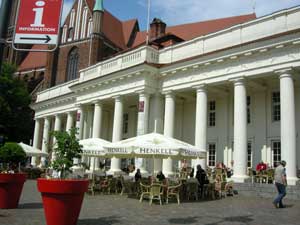
On the Marktplatz, you’ll see an unusual kind of Rathaus—basically Gothic but scrunched behind an English mock-Tudor façade. It stands near Schwerin’s 18th century Säulengebäude market hall, fronted by a dozen white Doric columns.
(right) Monument commemorating Henry the Lion, Duke of Saxony, founding father of Schwerin.
In 1707, a planned Schwerin Neustadt community named Schelfstadt came into existence. Narrow streets, clustered half-timbered Fachwerk houses, Baroque Nikolai Church and tidy kitchen gardens comprise a worthwhile visitor attraction. Same for this lakeside setting’s Freilichtmuseum Schwerin-Muess, recalling 18th-19th century rural folkways.
WHERE TO EAT, WHERE TO SLEEP The Sorat organization converted a 1936 wheat warehouse into Speicher am Ziegelsee, where spacious guest rooms complement a 55-seat restaurant (www.speicher-hotel.de). Another Ziegelsee choice, Best Western’s Seehotel Frankenhorst, has boat dock, swimming pool and whirlpool-sauna amenities (www.seehotel.bestwestern.de).
Tops in town for deluxe ambience and Pffanteich vistas, Niederländischer Hof includes a wood-paneled library and mirrored restaurant (www.niederlaendischer-hof.de). Centrally situated Alt Schweriner Schankstuben is a budget category 16-room Gasthaus (www.alt-schweriner-schankstuben.de).
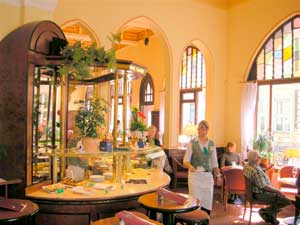
Among recommendable in-town dining options are upscale Weinhaus Uhle (www.weinhaus-uhle.de), beer-pouring Zum Stadtkrug Alstadt Brauhaus (www.altstadtbrauhaus.de), sophisticated Friedrichs, occupying a circa-1801 neoclassical mansion (www.restaurant-friedrichs.com) and ever popular Wallenstein, on a Schweriner See embankment, where patrons seated on the open-air pavilion are treated to views of the castle (www.restaurant-wallenstein.de). For a coffeehouse break, find elegant Café Prag, with sidewalk tables overlooking Schusterstrasse, and Röntgen on the Markplatz.
PLANNING YOUR TRIP Tourist Information Schwerin (www.schwerin.com) is located longside the Rathaus. Or, go to the German National Tourist Office for answers (www.cometogermany.com).
By Marilyn Heimburger Photos by the author and Don Heimburger
The UNESCO World Heritage city of Regensburg, Germany, 90 minutes north of Munich, is more than 2,000 years old, and many of its buildings serve as a testament to its long history.
There’s plenty of reminders of this town’s heritage: located on the Danube, many tour ships dock here and unload visitors for a peek into this German treasure.
Even Mozart liked the city: Regensburg’s hospitality was commended as early as 1790 by Mozart who enjoyed “a sumptuous meal along with divine music” and praised the good wine.
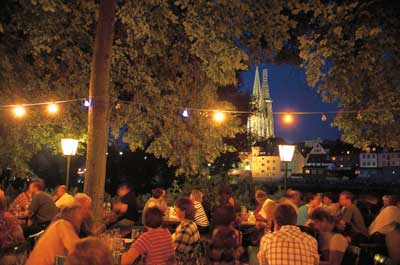
Numerous Roman buildings, such as the Porto Praetorius–an old Roman town gate–can still be seen today. It was preserved because the Bishop’s beer garden was located on the site. An underground museum at Neupfarrplatz displays the history of the Romans and the Jewish community there until 1519.
NEUPFARRPLATZ IN JEWISH QUARTER At the Neupfarrplatz, houses were built in the Jewish quarter over the old Roman fortress in the 8th century. These were destroyed in 1519 when the Jews were blamed for a downturn in the economy and were driven out.
In 1995 an excavation of the area was begun, and the ruins of the Jewish quarter were found, in addition to the Roman ruins.
Found in the excavation and on display in the underground museum were a second or third century statue of the Roman god Mercury; from the 15th century a statue of Aaron (Mose’s brother); and from 1520 an icon of the Virgin Mary. The museum is called Document Neupfarrplatz; if you walk down a flight of stairs, you can view a video showing the excavation finds. www.regensburg.de.
The city began as a Roman fortification (Castra Regina) in 179 AD by Roman Emperor Marcus Aurelius because it was the northernmost point on the Danube. When the Roman Empire fell, the Romans retreated. The fortress built there was not destroyed, and Bavarians then occupied it. It was the first capital of Bavaria; believe it or not, Munich is 1000 years younger!
Not much was damaged in the town during World War II as there wasn’t much industry in Regensburg, so there was nothing to bomb. Thus, the old buildings were preserved.
‘ITALY’S NORTHERNMOST CITY’ Rich merchants gained wealth from importing goods from far away lands. They built large homes with tall towers (a show of strength and wealth) after the style in Italy. Many of these are still standing in Regensburg; nearly 20 are still well preserved. The town is often called “Italy’s northernmost city” because of this.
One of the big Regensburg attractions is The Old Stone Bridge, built on 16 huge arches, which has been in continuous use for more than 800 years. Built between 1135 and 1146, the Stone Bridge enjoys the status of being a unique masterpiece of medieval engineering. It was for many centuries the only stone bridge spanning the Danube between Ulm and Vienna. It was not only a technological masterpiece of engineering, but of strategic importance in terms of transport and, as a result, of great commercial value.
Another town attraction is the Old Town Hall, where Roman Emperors used to summon princes, bishops and ambassadors to discuss the affairs of state. The Imperial Diet Chamber still contains the same furniture, including the benches that gave rise to the German expression “to put something on the long bench” (meaning to postpone it indefinitely).
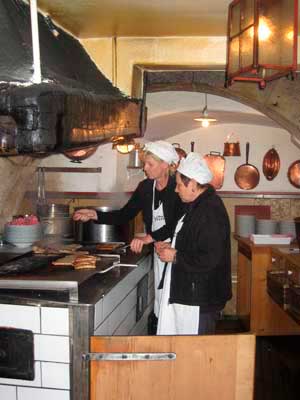
‘HISTORIC LUNCH’ For a quick and tasty lunch, sit down near the Danube and enjoy hot, juicy sausages with kraut and bread in the “Historische Wurstkuchl,” the world’s oldest sausage kitchen. You can actually see them frying the sausages on the grill through a door that leads into the small kitchen. http://www.wurstkuchl.de
Regensburg is a city of churches. Focal points of early Christianity, its ecclesiastical buildings are majestic and typify early Christian architecture. Most famous is St. Peter’s Cathedral, inspired by the French Gothic style and built in the 13th century.
At waterside, Schifffahrt Klinger offers boat trips to many different sights such as the Walhalla, the German Hall of Fame containing busts of famous German personalities.
Regensburg`s remarkable buildings and towers offer an unspoiled look into the past; the wars of the 19th and 20th centuries left this Danubian community virtually unscathed.
The Regensburg Tourism Office is located at the old Rathaus, Rathausplatz 3, D-93047 in Regensburg. Fax is +49 941-507-1919 or e-mail to tourismus@regensburg.de.
ET: How many times have you taken your kids along with you on a foreign trip, and where?
The kids have been traveling with us since before they could walk (they are 10 and eight now), so on many, many trips to places like the British Isles, France, Italy, Greece, Peru, Costa Rica, Alaska, Florida, Mexico and the Caribbean.
ET: At what age do you feel it’s worthwhile for children to be taken on an overseas trip to Europe? Please explain your reasoning.
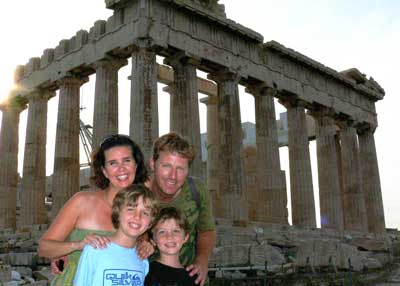
I think each age has its own benefits and drawbacks. When they are babies they are easy to travel with (before they can walk) and babies seem to open up a whole new door with the locals…you will meet other parents and talk about universal issues and be introduced to a whole different world than a typical traveler…people love babies! The drawback is babies come with a lot of gear and long overseas flights can be tough with a crier. Toddlers are fun to travel with because you see things entirely differently. They are fascinated by everything and leave nothing unexplored. What we might see as a famous monument a toddler might see as a cool worm inching its way across a stone surface. It gives perspective to things and adds a playfulness you might not get with older kids. However, toddlers can be unpredictable, and you still have to deal with added gear and schedules. My favorite is school-age kids. They still see things differently: our boys spent a good 20 minutes watching an ant carrying a toothpick across the Parthenon last summer, but they are more able to comprehend the historical and cultural significance of destinations. They are learning about the places in school and they bring that with them as well. Plus, they don’t have as much stuff, and are able to carry their own bags and they actually want to spend time with their parents still. The drawback is that they are in school, so homework has to become a part of their trip as well. Pre-teens and teens, depending on what stage they are in, can still be excited by exotic destinations, especially if you put an adventurous spin on it (i.e., zip lining through the Amazon, hiking the Inca Trail), but they are harder to impress and a mopey teenager can put a damper on the vacation for everyone. But, don’t let this stop you, as they will appreciate it later, and it gives them a global view on life that many kids their age don’t have.
ET: Language differences may or may not be a big barrier to children on a trip to Europe when accompanied by their parents, especially when the children are younger. At what age do you recommend children study the language before they travel overseas, and how might they best learn a language, say, when they’re going over for only a week or two? I always encourage travelers of every age to learn at least a few words in the country they are visiting. Saying “s’il vous plaît” in Paris will get you a much warmer reception than instantly assuming everyone knows English. And its fun for kids to practice the language with local kids. It is by no means necessary. There are very few places on earth that you can’t find at least one person who speaks English. However, if you plan on getting far off the beaten path, I would suggest a phrase book. There are lots of smart phone applications available as well now. We usually download one of those and practice a few key phrases in the weeks before the trip and while we are on long plane or train rides.
ET: Are there some things that are vitally important to take with you when you take younger kids along, that you may not find in Europe?
For the most part, you can find anything in Europe that you will need supply-wise. If there is a specialty item that is unique to your child, you may want to bring that…for example, a certain diaper rash cream for kids with sensitive skin, or a formula that your child needs. Also, any prescription medications. But don’t be afraid to try local things as well. Europe has lots of independent companies producing natural kids’ items that you can’t find in the States.
ET: What about the added expense by taking kids with you to Europe? Does it cost a lot extra to travel around, lodge and feed them?
Airline tickets are the main extra expense. Big hotels will be able to accommodate most small families in a regular room without additional expense. Booking a condo/apartment helps save on lodging costs and gives extra room for the while family to spread out. Plus, the kitchen can help save money on eating out. We usually do breakfast and sometimes lunch or dinner in the condo, but we like to eat out as well to get a feel for the local cuisine.
ET: Food. What do you suggest about finding “kid foods”– good, nutritious food at reasonable prices when overseas?
Go where the locals go. You don’t need to spend a lot to taste the local cuisine. The kids love street stalls. too. Just make sure to ask for guidance from locals to avoid getting sick. Crepe stands in Paris, panini cafes in Italy, pasty shops in England…all these foods let you get a taste of real local foods at a fraction of the cost of a sit-down restaurant.
ET: Can you recommend some special “kid-friendly” hotels in Europe, or cities or attractions that seem to especially cater to kids?
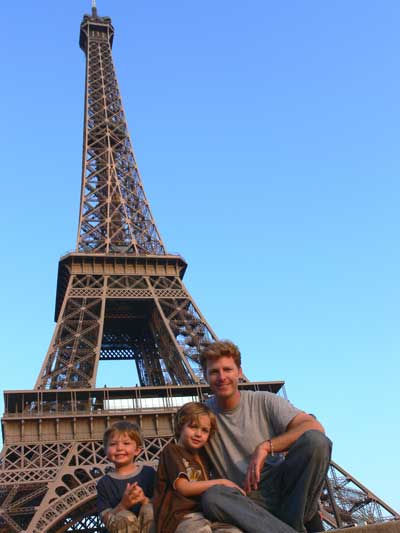
It’s not always the cities you would think that are exciting for kids. There doesn’t have to be an amusement park to interest kids. Our kids were fascinated by Venice, a city many people would not think of taking kids to. They loved taking the boats up and down the canals and wandering the tiny streets. Big cities are fun for kids, too. Paris and London are on the top of our kids’ destinations list. They love riding the tube and double decker buses and visiting big time attractions like the Eiffel Tower. Really anything can be interesting to kids if you prep them for it. Learn about a destination before you go. The kids learned about gladiators and Rome before we went to Italy, and it really came to life in Roman ruins all over Europe. They had a blast pretending to be gladiators in colosseums from Wales to Rome. Walks Inside Rome had a great tour with history on a kid’s level and a visit to Gladiator School…the kids learned from “real gladiators” how to fight with swords and defend against wild animals. Very fun! Many attractions have kid versions of audio tours, scavenger hunts, or something to engage kids. Just ask. If they don’t, you can always make your own. When the kids were younger (ages 5 and 7) we visited the Louvre. I was worried about keeping them interested, so I printed out pictures of some of the more famous exhibits and sent them on an art treasure hunt. They had a blast, and even enlisted the security guards to help them, and we enjoyed extra time at the museum.
As far as hotels go, apartment rentals are always great with kids. The apartments are often in local neighborhoods, so you get a better feel for local life. We rented apartments from Frenchy Rentals in Paris, a villa in Tuscany from Italy Perfect and apartments in Rome from Parker Villas. When we are staying in a hotel, we try to stay in family-owned, smaller hotels. These are usually located in the more culturally rich or historically significant parts of town. A lot of it is also about location. We don’t want to have to take a 20 minute taxi everytime we want to go into the old part of town. We like to be where the action is.
ET: Teenage tensions can be a problem. How do you handle this on a long European trip?
Lots of luck. Just kidding. Teenagers are a different breed, and since I don’t have any yet, I can’t give too much advice here. What I have noticed with my niece and nephews is that when they are out of their element (like you are in a foreign culture), some of that attitude fades away. I went on a trip to New York with my 15-year-old niece last year, and we had a blast. I asked for her input on everything we did, and I think that helped a lot. Let the kids (of all ages) help plan what you are doing. That helps them feel invested in the trip ahead of time and keeps them engaged while you are on the road.
ET: What foreign trips/areas might you not want to take your kids on and why?
I don’t think there are any areas I would say don’t take kids accept for areas I would not go myself because of dangers or violence. I guess there are some third world countries for which I would want to edit the itinerary. It would be very hard for the kids to comprehend such abject poverty. I might also stay away from long trips in which passengers are contained and there are no breaks. Kids who are cooped up and bored for long periods of time can get irritating fast.
Many people ask if I am scared to travel because of coverage they see on television. Fortunately, I have never felt any hostility from locals stemming from my being an American. In fact, quite the opposite. I have always been welcomed with open arms. When we traveled through the Middle East I was not sure what to expect, but everyone was very warm and welcoming. What you see in the news is not always how it is in real life. I would be cautious, of course, as things can happen when you travel, just as they could at home. Be aware of what is going on around you, ask the locals for perspective and trust your instincts.
ET: What do you suggest on a European trip if the parents want to occasionally go out alone in the evening and the kids need to go to bed. Who watches the kids?
Many hotels offer babysitting service. I have never used them as I would not feel comfortable leaving my kids with a stranger. However, I hear stories from other people who did this, and it turned out just fine. I would say that for me, the point of a family vacation is to spend time with your kids. At some point, they won’t want to hang around with us anymore, so I try to cash in on all the time I can with them now. Schedules are a bit more flexible when we travel. So, the kids stay up later which is just fine as the town squares in the evening are packed with families strolling and kids playing. It’s a time where we really get to know the locals, and the kids love it!
ET: What do you think is the most important thing to remember when going to Europe with your kids?
Take time to absorb it all. Often times when we travel (and I am just as guilty of it as anyone else), we pack in as much as we can. There’s so many wonderful things to see and do in Europe. And we end up moving so fast that we don’t take time to just sit and soak it all in. Sitting in the town square, watching life go by, is a great tradition in southern European countries, and it’s a great time to reflect and just spend time with your kids…time bonding and re-connecting with one another, which is really what it’s all about anyway.
Travel With Kids takes viewers on an educational journey through each destination visited, presenting history and culture in an innovative way, as well as showing the kid-friendly things to do and see. Whether planning a trip, or just wanting to learn more about a destination, Travel With Kids will entertain the whole family. For more information on Travel With Kids, or to purchase a DVD visit www.TravelWithKids.tv
Photos courtesy Paris Convention and Visitors Bureau
Designer hotels: everything started in Paris a few years ago with the trend toward boutique hotels.
The term is used for small capacity hotels with three or four stars, which offer clients a personalized and attentive welcome and a particularly refined and cozy decor.
Following the success of this type of hotel, certain hotels decided to take the concept further by entrusting their decor to interior designers and architects and providing their guests with a contemporary atmosphere: designer furniture, use of new materials, the latest technologies and contemporary works of art.
Some hotel groups have made this design orientation their speciality. This is the case for the Murano Hotels and Resorts, which owns the Murano Urban Resort Hotel and the Kube Rooms and Bars Hotel in Paris. The first, located between République and Bastille on the edge of the Marais, drew attention with its immaculate white design aesthetic, its bar lounge with colored seats, its lobby with a huge contemporary fireplace and its guest rooms which mix high-tech and state-of-the-art design. The second, located in the north of the capital, applies the same formula to the design of its guestrooms and offers an out-of-the-ordinary experience with its bar completely made of ice.
The Astotel group also offers 15 Parisian hotels where the designer touch captivates guests in search of a contemporary atmosphere. This is the case at Le 1223 Elysees, a hotel where beautiful materials (Swarovski crystal, marble, etc.) provide a contemporary feel, or at the Hotel Joyce, which combines the latest technology gadgets (iPod stations) with products answering to the needs of today’s travelers (a range of organic products), all in a contemporary decor that play on the codes of traditional hotel charm and character (outlines of bed heads and features of interior decor drawn on the bedroom walls).
The Relais de Paris group reinvents the classic Relais style with a contemporary, designer version. The BLC Design Hotel offers an immaculate white setting in the Charonne district. The 29 guest rooms all have a monochrome look, combining refined furniture with black and white photographs.
At the Standard Design Hotel, not far from the lively Bastille District, black and white begins in the reception areas. The young designers invited to decorate the hotel have created a contemporary, trendy place. The Color Design Hotel, between Bastille and the Gare de Lyon, lives up to its name and offers guests lively colors with special touches in the guest rooms and bathrooms. The vaulted breakfast room follows the same concept with a contrast provided by exposed stonework. Located in the picturesque Montmartre district, the Chat Noir Design Hotel plays the designer card while respecting the traditional Parisian style of this area. The decoration amusingly evokes the shadow plays that gave the Théâtre du Chat Noir its reputation, while offering refined white furniture complemented by warm orange and brick tones.
The wave of designer hotels can be found in all districts of Paris, each revealing a leading concept and specific style of decoration. Another example in the Latin Quarter is the Five Hotel. This hotel’s concept is the awakening of the five senses: smell with fragrances created just for the Five, touch with the use of sensual materials in the guestrooms and particularly the ultra-contemporary reinterpretation of Chinese lacquer, taste with a breakfast of the best Viennese pastries from the Monge bakery, sight with the fibre-optic lighting effects and luminous atmosphere of the bedrooms, and hearing appeased by the hotel’s silence.
In the same neighborhood, the Hotel Design de la Sorbonne has had a makeover and offers an upscale and elegant designer stay. Dark wallpaper, luxury fabrics and a contemporary photography exhibition on every level set the tone of the establishment.
The Hotel Le A, in the heart of the fashion district between the Champs-Élysées and the rue Saint Honore, mixes an ultra-designer look of the interior decor with a cozy feel in the reception areas designed to look like those of a private apartment, with a contemporary-style fireplace, comfortable couches, lounge with a library filled with art books, a bar under a 19th century glass roof and 25 sumptuous guestrooms where a refined sober style contrasts with bold contemporary drawings decorating the walls.
In a more understated style, design is also honored at the Hotel Arvor Saint-Georges, in the peaceful 9th arrondissement. The 30 guestrooms offer the tranquility of a contemporary and convivial private residence. In the 14th arrondissement, LeFabe Hotel stands out from the rest with its 17 guestrooms, each offering an original atmosphere. The names of the rooms (Mona Lisa, Orchidées, Together, etc.) are an indication of the designer decoration offered to guests. In the 16th arrondissement, Mon Hotel, a small establishment of 37 guestrooms a few steps from the Champs-Élysées, boasts luxury designer decor with the use of materials like leather, Alcantara fabric, and wood.










 European Traveler