Gingerbread Galore!

By Sharon Hudgins
Photos by the author

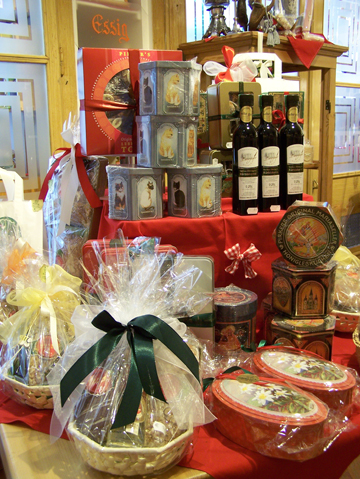
‘Tis the season when a young elf’s fancy turns to thoughts of gingerbread. Although these sweet-spicy cakes and cookies are popular year-round in many countries of Europe, they’re particularly associated with the winter holidays. Bakeries from Sweden to Slovakia to Switzerland turn out tons of commercial gingerbread products, often packaged in brightly colored wrappings and tin boxes. And home bakers dig through kitchen drawers and recipe files to find favorite cookie cutters and family recipes for their own Christmas gingerbreads.

Although flatcakes made with honey and spices were baked by the ancient Egyptians, Greeks, and Romans, the gingerbreads of northern Europe probably date only from the Middle Ages, when honey was still the main type of sweetener available locally, and exotic, expensive spices such as cinnamon, black pepper and ginger were increasingly being imported from faraway lands in the East. A taste for gingerbread eventually spread throughout Europe, with certain cities becoming known for their own particular types: Strasbourg and Dijon in France, Torun in Poland, Tula in Russia, Aachen and Nürnberg in Germany, Basel and St. Gallen in Switzerland.

MANY VARIETIES
Gingerbread recipes evolved over time and in diverse places. Various kinds of gingerbread were, and still are, made with different combinations of honey, sugar, flour, eggs, almonds, hazelnuts, walnuts, raisins, lemons, candied orange peel, candied citron, rosewater, rum, brandy, black pepper, ginger, cinnamon, nutmeg, cloves, allspice, cardamom, coriander, aniseed and saffron. Although these baked goods are often referred to as “gingerbread” in English, some of them don’t contain any ginger at all.

The variety of possible ingredients and textures causes some confusion about what “gingerbread” actually is. A cake, a cookie, or a loaf? Hard or soft? Thick or thin? Glazed or unglazed? Decorated with fancy frostings, or with fruits and nuts, or even with expensive gold leaf? At various times in its history, gingerbread has been all of these.

GERMAN GINGERBREAD
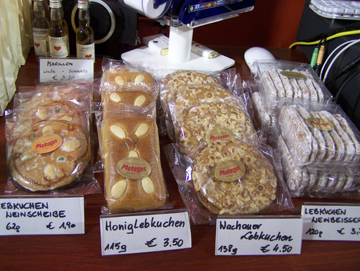
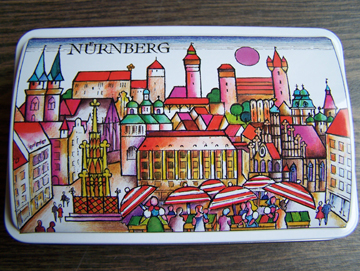
In the Middle Ages, the city of Nürnberg became one of the most famous places for making gingerbreads in Germany, where these seductive sweets have long been known as Lebkuchen (or sometimes Pfefferkuchen, when their spiciness comes from black pepper instead of ginger). Records show that Lebkuchen was being baked in Nürnberg as early as the 14th century. Traditionally, the stiff dough was pressed into highly detailed molds made of wood, metal, or terra cotta, which imprinted intricate designs on the Lebkuchen before it was removed from the molds and baked in a hot oven. Nürnberg Lebkuchen contained such costly ingredients, and was of such high quality, that it was accepted as payment for city taxes and given as gifts to nobles, princes, and heads of state.

Over time, as the prices of ingredients fell and the demand for Lebkuchen increased, faster production methods became necessary. The elaborate handmade molds were replaced by less detailed, often mass-produced, molds. Simpler decorations―such as nuts, candied fruit, and sugar frostings―were applied to the tops of many cookies. And the shapes were simplified, too, evolving into the basic human, animal, and geometric forms common today.

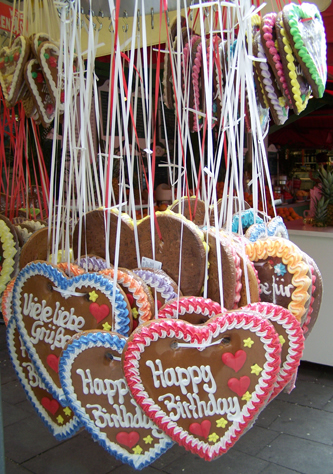
In the early 1800s, gingerbread houses became popular in Germany after the publication of the Grimm brothers’ fairy tale, Hansel and Gretel. And during the 19th century, ornately decorated Lebkuchen hearts also became the rage. Covered with fancy designs and romantic sayings made from colored icing, these large heart-shaped cookies were often exchanged between sweethearts. You can still buy them at almost every German festival and special market, including the Christmas markets held in many German cities throughout December.

The Lebkuchen produced in Germany today comes in all sorts of sizes, shapes, flavors, colors and textures: rounds, rectangles, squares, hearts, stars, pretzel forms, St. Nicholas (for Christmas), lucky pigs (for New Year) and rabbits (for Easter). The Lebkuchen dough can be “white” (light colored) or different shades of brown. Some Lebkuchen are also covered with white or chocolate icing, and some are filled with marzipan or jam. Honey Lebkuchen is sweetened only (or primarily) with honey. Oblaten Lebkuchen are cookies with the dough mounded on top of a thin wafer before baking. And delicate, elegant Elisen Lebkuchen are made with at least 25% ground almonds, hazelnuts, or walnuts, and no more than 10% flour.

GINGERBREADS ACROSS EUROPE
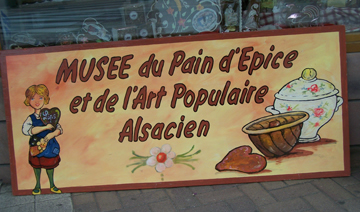
You’ll also find similar spicy cookies of different shapes, colors and textures called Printen (in Aachen, Germany), Pfefferkuchen (in Pulsnitz, Germany), Spekulatius (in the German Rhineland), Leckerli (in Basel, Switzerland), Biberli (in the Appenzell region of Switzerland), speculaas Holland, speculoos in Belgium, pepperkaker in Norway, pepparkakor in Sweden, piperkakut in Finland, pebernǿdder in Denmark, pain d’épices in France, licitar in Croatia, mézeskalács in Hungary, perníky in the Czech Republic and Slovakia, pierniki in Poland and prianiki in Russia. Other towns and regions have their own specific names for the many varieties of gingerbreads produced there.

Europeans also use gingerbread cookies as ingredients in other dishes. You’ll find crumbled gingerbread used as a stuffing for pork and for pasta, as a thickener for sauces, a flavoring for soups, a crunchy texture in salad dressings, and a base for many puddings and desserts. There’s even a German-Italian “fusion” dessert called ” Nürnberger Tiramisu”! And for people who just can’t get enough of that sweet, spicy, Christmasy taste of gingerbread, the Belgians have recently invented a gingery, caramely speculoos spread, similar in texture to Nutella, made from crushed gingerbread cookies.

If I’ve whetted your appetite for these European gingerbreads, my best suggestion is to travel there and taste them for yourself. You can also mail order many of them from the websites listed below. Costard, the clown in Shakespeare’s play, “Love’s Labour’s Lost,” had the right idea when he said, “An’ I had but one penny in the world, thou shouldst have it to buy gingerbread.”
Nürnberg Lebkuchen information www.lebkuchen.nuernberg.de/englische_version/index.html

Lebkuchen-Schmidt, Nürnberg
ww2.lebkuchen-schmidt.com/eng_index.php

Metzger Lebkuchen, Vienna
www.lebkuchenmetzger.at/

Lebkuchen-Pirker, Mariazell, Austria
www.lebkuchen-pirker.at/home/index.php?&lang+eng

Kerner Lebkuchen, Mariazell, Austria
www.lebzelterei-kerner.at/index.htm

Lebkuchen-Gandl, St. Wolfgang, Austria
www.lebkuchen-gandl.com/

Appenzeller Biberli, Switzerland
www.baerli-biber.ch/

Basel Läckerli, Switzerland
www.laeckerli-huus.ch/

French-Alsatian Pain d’Épices
www.paindepices-lips.com
www.fortwenger.fr/

Alte Pfefferkuechlerei (small gingerbread museum in Weissenberg,Germany) www.museum.stadt-weissenberg.de/

Speculoos Spread
www.thenibble.com/zine/archives/speculoos-spread.asp

YouTube video about how to make decorated European gingerbread
www.youtube.com/watch?v=OVX5wiv_oMk

American online sources for ordering European gingerbreads
www.germandeli.com
www.germangrocery.com
Hiking + Swiss Alps = Fun

By Barbara Gibbs Ostmann
All photos courtesy Switzerland Tourist Board

Switzerland is celebrating 150 years of Alpinism this year, and there’s no better way to celebrate than by going for a long mountain hike.

Aristocratic English adventurers were on to a good thing back in 1857 when they reached the summit of the Finsteraarhorn and later, upon their return to London, founded The Alpine Club, the first mountaineering association in the world.

By 1863, English climbers had ascended more than 50 Swiss peaks, firmly launching Switzerland as the playground of Europe and the center of mountain tourism. Today’s hikers can choose from more than 40,000 miles of well-marked paths throughout the country.

NEED COMFORTABLE BOOTS
Touring Switzerland by foot is a lot different than touring it by train or car, and worth all the sweat and effort. The key to a successful hiking trip is a pair of well-broken-in hiking boots — it is not the time to try out a new pair.

Having lived in Switzerland for two years as a graduate student, and visiting it many times, I had my doubts about going on an organized hiking tour. But hiking in a group proved to be a great way to visit Switzerland, providing moral support and camaraderie. Although we had prepared for the trip by hiking at home, we all benefited from the well-planned itinerary that began with easy walks and built up to the steeper climbs, preparing us physically for the more difficult parts of the hike.

My group of hiking companions, ranging in age from 13 to 67, set off in high spirits from Les Avants, above Montreux on Lake Geneva in the French-speaking part of Switzerland, and arrived 10 days later, foot weary but fulfilled, in M̹rren in the heart of the Bernese Oberland in German-speaking Switzerland.

STARTED EASY
The adventure began with an easy hike through the forest up to the Col de Jaman (Jaman Pass), above Lac Leman (Lake Geneva). We spent the first night on the trail in a matratzenlager or dormitory — a large room filled with side-by-side mattresses. It was a good introduction to what to expect in the final stages of our hike when we would be in the mountains for three days, carrying all our food and clothing. For most of the trip, we carried a day pack and a sack lunch each day, while our suitcases were transported by bus to the next village and hotel where we would spent the night.

It was early to bed because it was early to rise. At a little more than 11 miles, the next day’s walk was the longest of the trip, and much of it was on paved roads— hard on the feet and legs. However, the scenery along the Lac de L’Hongrin was beautiful and the weather was sunny and warm. The day’s hike ended in L’Etivaz, a small village in the French part of Switzerland.

DAY THREE
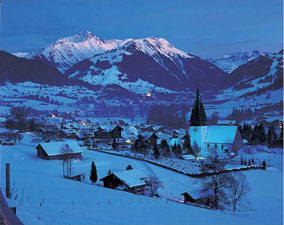
The third day’s walk was more typical of those to come. We started with a steep climb out of the valley and up to the windy Col de Jable (Jable Pass), where we huddled behind a rock fence to eat lunch. Upon crossing the Col de Jable, we left the French Canton of Vaud and entered the German Canton of Bern. Descending, we arrived in the glitzy resort town of Gstaad. There was time to shop, but in our hiking gear, we didn’t look the part of fashionable Gstaad jet-setters.

In the morning, we hiked through drizzling rain to the bus stop and took the postal bus from Gstaad to the village of Lauenen, where we set out on the day’s hike. As we trudged over the Tr̹tlisberg Pass, the rain grew heavier and the temperature dropped. At the top of the pass, it was sleeting, and we were wet, cold and miserable. No stop for a picnic lunch at the top of this pass! In fact, no stop for lunch at all. All we wanted was to get to the next town, Lenk, and get warm and dry.

We did hole up briefly on the porch of an unoccupied chalet where we nibbled chocolate bars, changed from wet to dry clothes (if you were lucky enough to have any dry ones in your pack) and generally fortified ourselves for the remaining descent. We finally arrived at our small hotel in Lenk, where we rushed to get into hot baths midpoint of hike the hotel quickly ran out of hot water.

The next day, the midpoint of the hike and a free day, dawned sunny and bright. Many of us took the ski lift up to Leiterli from where we could see across the valley to the pass we had crossed the day before in the rain. We could pick out the chalet where we stopped, the place where we got lost and had to climb on our hands and knees on the slippery scree to get back up to the path, and where we had turned off to take a shortcut to town. It looked better in the sunshine than it had in the rain the day before!

Sunday, it was back to the trail. We started with a short bus ride to the hamlet of B̹elberg, from which we hiked to the Hahnenmoos Pass. It was drizzling, but nothing like the rainy day we’d had before. As we descended, the rain stopped, and we arrived in the lovely town of Adelboden with time to visit the shops.

The journey from Les Avants to Adelboden had been an introduction to the days to come. From Adelboden on, the mountains were higher and more rugged, and much of the trail was above the timberline.

The next day’s 9-mile hike began with a long, hard climb up to the Bunderchrinde Pass — more than 3,500 feet over slippery shale rock — then on to Kandersteg. As I sweated, puffed and panted, I wondered if I could actually make it. But when I reached the pass at 7,500 feet, it was more than worth the effort.

In my notebook I wrote, with words inadequate to describe the satisfaction of being there: What a thrill. The view is worth the whole hike. We are above the clouds, and in the clouds, as they move and change position. The north face of the Eiger just popped out of the clouds — thrilling! Eiger and Munch

Later, both the Eiger and the M̦nch were stunning as they poked through the clouds. Sighting the Eiger that day was the first of many such glimpses as we continued toward it and ended up directly across from it at our final destination of M̹rren. We were now at the heart of the hike — three days in the mountains with everything on our backs, hiking from Kandersteg to M̹rren, across the Bernese Oberland into the shadow of the Jungfrau, the magnificent mountain and glacier above Interlaken.

Luck was with us, and we had great weather for the three days, and even the next day in M̹rren, when we visited the Jungfraujoch in bright sunlight.

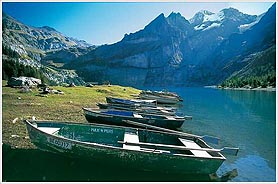
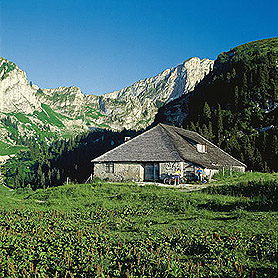
Leaving Kandersteg and its comforts, we started with a chairlift up to the Oeschinnensee, a spectacular Alpine lake with blue waters in an incredibly beautiful setting. From the lake, it’s a climb of more than 3,600 feet to the Hoht̹rli Pass, where we spent the night in an Alpine hut on the Bl̹misalp, next to a glacier. The hut, perched precariously on the top of the pass, is a popular spot for summer hikers and mountain climbers. In the winter, it is covered completely by snow. The accommodations at the hut consisted of a large room filled with mattresses, where we all piled in and slept like logs.

COLORFUL, AWESOME SUNSET
One of the thrills that day was watching the colorful sunset, as the sun sank into the clouds, framed by the mountain peaks. From the pass, we could pick out the Eiger, now bigger and closer than its first sighting yesterday, as well as the Schilthorn with its restaurant perched on top, the scene of the James Bond movie, “In Her Majesty’s Secret Service.”

We began the morning’s descent by clinging to a steel cable pegged into the mountain wall as we slipped and slid on loose scree. The descent of 4,000 feet before reaching Alpine pastures seemed interminable. We just kept walking-and walking-and walking and going down and down and down.

We finally reached the valley floor where a glacial river flowed, icy cold and steel gray in color. We peeled off as much clothing as we could and still be decent and cooled off in the stream. Then it was on to a nearby chalet for cold beer and our sack lunches.

In the afternoon, we hiked along a wide path with wildflowers and bright sun. It was a delightful walk, leading us to our accommodations for the night: a cow and goat barn at Unter D̹rrenberg.

A ‘LOFTY’ SLEEP
We climbed a ladder from the stables to the loft. (You quickly learn to hold the sides of the ladder, not the rungs, unless you want a handful of cow manure!) In the loft, there were side-by-side mattresses, as in the dormitories. Only here, the air was scented with ammonia from the goats and cows below. It was primitive, but one of the trip’s highlights for me, but not for some of my fellow hikers. It was probably a good thing that the next night we would find ourselves in a comfortable hotel once again.

The next day was the last day of the hike, and we hated to see it end. The morning’s climb was the most difficult of the entire trip — or maybe I was just getting tired. I thought I’d never make it across all that slippery scree and obtain the summit. But once again, upon arriving at the pass, the Sefinenfurke, the views were so spectacular and the feeling of accomplishment so great that I immediately forgot the ordeal of arriving there.

MAKE IT LAST
We dawdled over lunch at the pass; everyone wanted to make the day last as long as possible. A snooze in the sun, a scramble to a nearby peak for photos, and soon it was time to descend. We crossed from the shale into Alpine pastures into forest and down into M̹rren, a picturesque village perched on the side of the mountain, facing the Jungfrau, M̦nch and Eiger across the valley.

The snow-covered mountains radiated sunlight as we descended, alpenstocks (walking sticks) in hand. After watching the Eiger grow larger and larger for several days, suddenly there it was, bigger than life and bathed in bright sunlight.

The feelings of the group could be summed up in the words we saw carved in German on an ancient chalet in the village of Kandersteg:

“He who drinks of the high mountain light, shall know no unhappiness on earth.”

I’ll drink to that.

ET EXTRA
The company I traveled with is no longer offering the Swiss hiking itinerary, but several other companies offer similar guided or self-guided trips. Start with these links and do some research to find the trip that suits you.
* Ryder Walker Alpine Adventures, www.ryderwalker.com.
* Wanderweg Holidays, www.wanderwegholidays.com.
* Active Journeys, www.activejourneys.com.
* Ibex Treks, www.ibextreks.com.
* European Walking Tours, www.walkingtours.com.
* The Wayfarers, www.thewayfarers.com.
* Alpinehikers, www.alpinehikers.com.

For hiking tips and itineraries specific to Switzerland, visit www.myswitzerland.com and click on “hiking.”

The most important item for a hiking trip is a good pair of boots that fit you well and are thoroughly broken in. Other things to include in your pack are: moleskin, Band-Aids, Swiss Army knife, water bottle, sunscreen, Ace bandages, medicated powder, poncho, wool or fleece sweater or jacket, flashlight, binoculars, compass, hat, sunglasses, resealable plastic bags for keeping articles dry. Be sure to dress in layers — the weather in the mountains can change swiftly.

ABOUT THE WRITER
Barbara Gibbs Ostmann is an award-winning journalist with 30 years of writing and editing experience in newspapers, magazines, cookbooks and newsletters. She was food writer for the New York Times Regional Newspaper Group from 1993-2005 and food editor of the St. Louis Post-Dispatch from 1975-1990. She joined the faculty of the University of Missouri-Columbia as an assistant professor and the coordinator of the Agricultural Journalism program from 1991-1993.

Barbara has co-edited 12 cookbooks and is co-author of “The Recipe Writer’s Handbook,” a style manual, and was copyedited or contributed to 17 other books. She writes about travel, food and wine for regional and national magazines, and copyedits manuscripts for several publishing houses.

Barbara is treasurer of The Culinary Trust, the philanthropic arm of the International Association of Culinary Professionals (IACP). She is also on the Board of Directors of the Midwest Travel Writers Association and the Missouri Association of Publications. She has traveled extensively in Europe, Asia, Australia, Africa, North America and South America.

Yodeling on the Shores of Lake Lucerne

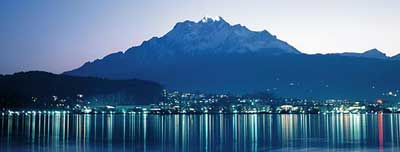
Approximately 200,000 spectators are expected to visit Lucerne, Switzerland for the 27th Swiss Yodeling Festival from June 26 to 29. More than 11,000 yodelers, flag throwers and alphorn players will participate in a number of contests along the shore of Lake Lucerne.
A festival parade winds through the Haldenstrasse and across Lucerne’s “Seebrücke.”

PROGRAM EVENTS

Thursday, 26 June 2008

  • Two national finals: 13th Swiss Young Talents’ Yodeling Competition and the 15th Swiss
    Young Musicians’ Competition

Friday, 27 June 2008

  • Competitive events for yodeling, alphorn blowing and flag throwing
  • Festival happenings in the yodelers’ pubs and at yodelers’ stands

Saturday, 28 June 2008

  • Competitive events for yodeling, alphorn blowing and flag throwing
  • Festival happenings in the yodelers’ pubs and at yodellers’ stands

Sunday, 29 June 2008

  • Ceremonial presentation of the flag
  • Reception of festival veterans, ceremonial church service and official festival ceremony
  • Festival parade
  • Festival happenings in the yodelers’ pubs and at yodelers’ stands

European Christmas Markets Celebrate the Season

Advent is the season in Europe when thousands of communities–large and small–set up Christmas trees, colorful lights and craft stalls in their central market square. For decades, Europeans have been getting together at these unique Christmas markets to share conversation, to enjoy a glass of hot mulled wine, or to find just the right specialty gift for a family member or friend.

European Traveler offers a quick glance at some of these fascinating markets, which normally last until Christmas Eve.

Belgium

Every town in French-speaking Wallonia hosts its own Christmas Market. The central square of Liège and the neighbouring Place du Marché stage one of Belgium’s largest Christmas Markets, attracting more than 1 million visitors with 190 wooden chalets full of tempting goodies, sweets and original hand crafted products and presents. If you’re in Brussels between November 27 and January 3, enjoy the Brussels Winter Wonderland featuring a Christmas Market with many stalls, a giant illuminated ferris wheel, street activities and a large skating rink. 


Switzerland

In Lucerne, a number of Christmas events take place, including the Christ Child Market at Railcity, the train station, between November 28 – December 21. Around 50 festively-decorated market stalls bring a  Christmas atmosphere feel to the station.

Every year between December 3-20 Lucerne’s Christmas Market takes place at the Franziskanerplatz. There are a large variety of stands with Christmas decorations, sweets, food and beverages.  The Christmas Tree Market usually starts one week before Christmas along the Schweizerhofquai. Then between December 17-20, 20 stands from 20 countries  present typical Christmas items from their homelands. There is always a stage featuring Christmas productions from all over the world. For more information, go to www.luzern.com/en/welcome.cfm?

Germany

Thuringia is primarily famous for its festive Christmas markets and especially the large selection of glass Christmas tree decorations. The Lauscha Ball Market (always held during two weekends in Advent) has the largest selection, but these traditional decorations are also available at other Thuringian Christmas markets.

In Frankfurt you are invited to the large, time-honored Christmas market where you can become acquainted with the market’s many culinary specialities and its traditions. You can join tour guides in ascending to the rooftop gallery of St. Nicholas Church, from where you’ll be able to enjoy a wonderful panoramic view of the entire market and the Frankfurt skyline. Next, join young and old for a nostalgic ride on a vintage carousel. Warm yourself with a hot cup of mulled wine at the end of the tour and take in the wonderful view of the market’s beautifully illuminated Christmas tree. The 1 1/2 hour tours include a carousel ride, hot mulled wine and special marzipan candy. Tours are available in English and German from the first day in Advent until Christmas.

Thanks to the Tourist Boards of Germany, Belgium, Austria and Switzerland for the photos in the report.

Park Hotel Weggis

135 Years of Welcoming Guests

By Don Heimburger
Photos by the author and the Park Hotel Weggis
 
On the shores of beautiful, serene Lake Lucerne stands a tall, stately structure amid a lush garden of flowers and trees. I have passed it several times on a Lake Lucerne Navigation Company steam-powered paddlewheel boat, each time saying I would like to visit.
 
It is an intriguing complex of buildings, some hidden by the finely-appointed, trimmed mature greenery. At night, lights in the castle-like buildings, and outside on the grounds, twinkle a welcoming “hello.” The hotel is slightly elevated on the grounds, and thus it takes on an even more eloquent appearance.
 

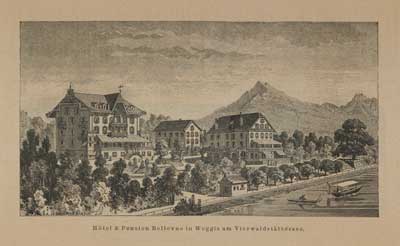
The Park Hotel Weggis has been welcoming guests to Lake Lucerne since 1875.

This year, my time had come to finally “meet” this jewel on the lake. I made an appointment to visit the Park Hotel Weggis, located a 15-minute walk from downtown Weggis, Switzerland. A total of 50% of the clientele is from Switzerland, but I came all the way from the USA to visit, the hotel being that intriguing.
 
Weggis, home of the popular Rosenfest, a lavish July event in this town of 4,000, sits quietly and calmly on the shores of what author Mark Twain once said was the most beautiful spot on earth. While it may be bested by a few other spectacular sights around the globe, I have no doubt that most people would call Weggis a shining star when it comes to serenity and aesthetics.

The hotel looks out onto the lake and the Alps of central Switzerland, and thus this wish from Twain: “This is the charmingest place we have ever lived in for repose and restfulness, superb scenery whose beauty undergoes a perpetual change from one miracle to another, yet never runs short of fresh surprises and new inventions. We shall always come here for the summers if we can.”  Twain lived for several summers in Weggis, traveling up to the nearby Rigi-Kulm, which is 6,000 feet above and to one side of the village. Three of the hotel’s rooms are called the Mark Twain suites.
 
With a warm breeze blowing across the lake, this area creates its own weather patterns which usually means warmer weather in the winter, and softer, gentler breezes during the summer. As a testament to this climate, palm trees and cactus grow alongside the beautiful roses the city is noted for.
 
BEACON ACROSS THE LAKE
It’s in this peaceful setting that the 5 1/2-acre, five-star Park Hotel Weggis shines a beacon across the lake to everyone, that this is a place to rest and relax, to have some fun, to dine or just get away from it all for a while.

In fact, the hotel has been doing this for 135 years, as in 2010 it celebrates more than a century and a third of being hospitable in this unique place. 

The annex portion of the hotel was built in 1899. The hotel, with just 53 rooms and suites in the main building and two adjacent structures, pampers its guests, offers several dining choices and is big on wellness. The hotel has seven categories of rooms, and underground tunnels allow guests to reach various parts of the complex without going outside. The hotel is 30 minutes by car from Lucerne, and  35 miles from Zurich.
 
The list of awards the hotel has garnered through the years includes its selection as one of the 10 best vacation hotels in Switzerland for the past eight years, and the Hotel of the Year Award by GaultMillau in 2001. Its spa and wine selections have also won awards. 
 
A total of 43 rooms in the main building were renovated between 2007 and 2010, and 10 more new “Adara” suites with generously-sized rooms were also added with large balconies, electric curtains, large Treca de Paris beds, Christian Fischbacher satin bed linens and bathrobes, Bose sounds systems and Panasonic flat televisions.

The rooms also incorporate B&B Italia and Promemoria Italian furniture, accessories from the Thony Collection, and fabrics from JAB and Carlucci di Chivasso. Each suite features its own wine cabinet with rarities such as Premier Grand Cru Classe from Bordeaux and Chateau d’Yquem.
 
The showers, in Foster, KOS Italia and Form-Laufen designs, match the green-clad marble walls with marble from the Greek island of Tinos in the Aegean Sea.
 
In the last 13 years, the Park Hotel has poured $100 million (Swiss francs) into refurbishing the property.The Denz family of Switzerland are the owners.
 

WELLNESS AREA OF HOTEL
 The hotel prides itself with its extensive Wellness area for those who like to be especially pampered. With many upscale hotels and resorts paying more attention to this part of a guest’s visit, this is becoming a more prominent feature of hotel services. Under the leadership of Brigitte Bunder, body, soul and spirit are soothed as her team immerses guests in a peaceful, stress-free world for a few hours. The Park Hotel offers a 49 foot x 20 foot open-air heated pool which overlooks Lake Lucerne, and also traditional Tibetan massages (four employees of the hotel are from Tibet). A wide range of other treatments are available, such as body scrubs, hair and beauty sessions, and hot herb applications.

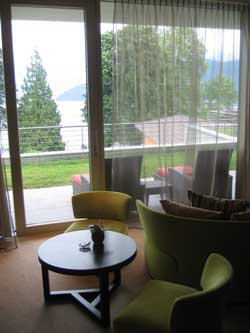
In addition, there are six Spa cottages which offer guests seclusion and privacy. These cottages are available for beauty treatments, fitness exercises, massages and a range of different therapies. The cottages, equipped with whirlpools, sauna or steam baths, solariums, showers and waterbeds, can be rented individually. Designer furniture from Colombostile and Moroso are featured in these rooms. In the Wellness area there is also a library with a matchless view of the surrounding mountains.
 
One aspect of the hotel is its welcoming Japanese gardens located at the entrance of the grounds, which was the first public-opened Bonsai garden in Europe. Large Burgenstock limestone pieces, some weighing seven tons, make up the garden, along with a 100-year-old juniper tree and other plants. The trees in the garden were imported from Japan, and some have been shaped and cared for four generations.

A HIGH POINT: FOOD
 Food is always an attention-getter at a luxury hotel, and the Park offers three inviting venues for dining, including the Annex with Chef Renee Rischmeyer. Being ushered into the Annex sets the mood for the evening, with windows that look out onto the lake and the Alps, or you can also sit outside on the terrace. In this restaurant, traditional French culinary delights with Mediterranean and Asian influences are prepared using fresh local market seasonal products. The wine steward is Christian Bock, who was awarded the Best Swiss Sommelier in 2005/2006 and Master Sommelier in 2009. His job is to offer selections from 2,600 in-house wines, a daunting task. (The hotel’s vinothek offers wine for purchase for guests.)  The Annex has been awarded 16 GaultMillau points and one Michelin star.

I found dining in the Annex was “an experience” as much as having a meal. The lake, the low lights, the glow from the room, and the wait staff service, made the evening memorable. Later did I realize there was soft music playing in the background, loud enough just for me to recognize it was there. It set just the right mood. My “parting shot” for the evening were the three delicious Swiss chocolates that were set before me; they did not last long. 

Restaurant Sparks, with a capacity for 60 guests, is unique for its venue as much as its food. This high-ceiling room with a large chandelier, large windows and comfortable chairs, lifts your mood just walking in. Large scale Luciano Castelli paintings depicting the four seasons adorn the walls. In the Sparks, Chef Florian Gilges presents modern and light cuisine, combining art and design in his natural dishes, which has been awarded 14 GaultMillau-points. The Sparks is where breakfast is served every morning for hotel guests; there are 25 seats also available on the fresh-air veranda.
 
One evening in the Sparks I started off with baked goat cheese with Mediterranean vegetables, beef paillard with Carnaroli risotto and glazed Trevisano, a skewer of fillet of beef on potato salad with clear gazpacho, apple strudel and vanilla custard, and nectarine and honey cream mille feuille on tonka bean ice cream. With the meal I enjoyed a Valais, Switzerland white wine from 2008 and a Figuero tinto (2004) from Spain, both delicious.
 
For even more hotel food delights, guests can stroll over to The Grape a short distance away, where the speciality is California cuisine. There guests–many of them locals–are offered a wide selection of California wines from the Napa Valley, and food selections from California include juicy grilled steaks. For kids, a space has been set aside in the restaurant to play Nintendo games. 
 
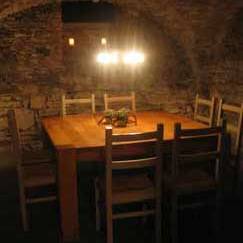
For a nightcap, the Lalique Caviar Bar is perfectly located in the hotel for a great view of the lake. Caviar–of course–malt whiskies and cigars are on the menu, along with the great view. If you want a drink outdoors, you can go down to the water’s edge where the cozy Beach Bar Lounge stays open until late hours. Last, for special dining occasions where you want to make an impression, you can book dinner in the smart vaulted wine cellar. For large gatherings such as weddings, receptions or banquets, the hotel features the Aquarius Hall with frosted glass panels, dark parquet floors and special lighting effects.


 OTHER FEATURES 
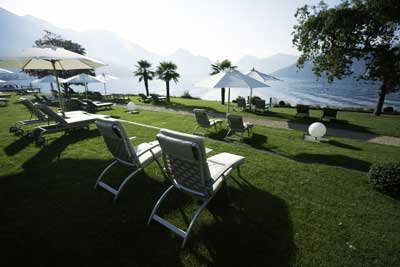
 At this hotel you can arrive by boat, as the hotel has its own boat moorings, as well as a private lakefront area, bathing beach and sunbathing lawn. Sitting outside next to the lake with a good book and a cool drink could very well be the thing to top off an afternoon.
 
For kids, there’s a billiard room, and the suites have their own kid’s rooms, as well as a play station area with television and Nintendo games. The hotel also hosts occasional entertainment for kids. 

With its own boat moorings (the hotel owns three boats itself), a number of cruise scenarios come to mind including renting a boat for yourself and guests and have it pick you up from from the hotel dock, or you can bring your own boat and dock it at the hotel. Canoes, mountain bikes, fitness and exercise equipment is available, as is a 1959 Chevrolet Impala convertible, sometimes parked out in front of the entrance. Nearby is the Rigi Railway (access is via a cable car in Weggis), and the Mt. Pilatus Railway is also close by. Lucerne is just a short car ride or boat ride away.
 
According to deputy director Marc Eichenberger, who is new at the property, guests often arrive stressed from their daily routine, but leave relaxed. Eichenberger knows a bit about getting away from it all himself. He has taken professional classes at Cornell University in the States, and likes to vacation in Asia. Sometimes you’ll find him trekking (and sleeping in a tent) in the desert. 
 
He holds meetings with his staff on a daily basis, discussing the “arrivals,” and weekly and monthly “theme” meetings and even twice a year “broad goal” meetings with the staff. A personable man, he has a sharp eye for detail, and walks from one part of the large property to the other with purpose. 
 
He calls the hotel “a hideaway” for guests who can wander from their room, to a hotel restaurant, to the spa area or to the beach within minutes.  
 
With upwards of 65% of the hotel’s business repeat customers, you know the property is doing something right. My trip complete, I hope to return to this jewel on the lake soon, but perhaps I’ll stay longer next time. One visit just isn’t enough. 
 
IF YOU GO…
The Park Hotel Weggis is rated five stars superior. It is located 225 miles from Munich. The hotel’s address is Hertensteinstrasse 34, CH-6353, Weggis.  Telephone is +41 (0)41 392 05 05; e-mail is info@phw.ch. To see the hotel’s rates, rooms and facilities from their internet site, go to www.phw.ch. The latest award issued the hotel was 1st place in 2010 by the Blilanz news magazine for the best hotel day spa.
 
The hotel is part of the Swiss Deluxe Hotels and the Relais & Chateaux collections.